236 résultats
1947Pages 649- 676. Features: Cover photo of huge black plume of smoke rising from a Jerusalem cinema, mistakenly thought to be Arab owned and burned by Jews in retaliation for Arab looting; Six dramatic photos of Arab riots in Jerusalem where Britain represents the sole stable factor; Photo of the huge Consolidated Vultee military transport, the XC-99, during its first test flight; Photo inside the belly of the XC-99; Two photos of the air raid shelter, or bunker, where Hitler and Eva Braun died; Two photos of the deep water salvage submarine designed by Italian Pietro Vessena for use in Lake Como; Five photos of Russia's mighty military on parade in Moscow; Five photos of hunger and destitution in postwar Berlin; Article discusses the great communist counter-offensive in France; Photos from Manchuria where China's Civil War continues; Two pages of scenes of sabotage and civil disorder in Paris, Arras and Lille, where the French assertion of the right to work has brought the Communists into the open; One-page reproduction of the famous photo of St. Paul's Cathedral during the 1940 blitz - contrasted with the opposing page which shows St. Paul's today, war-scarred but majestic amid devastation; Five photos show repairs being made to St. Paul's; Two pages of photos illustrate the ancient art of Benin; Photos of personalities of the week include Sir Eustace Pulbrook, King Michael of Rumania and Princess Anne of Bourbon-Parme, Samuel Courtauld, Mr. Molotov, Mr. Vishinsky, Chiang Kai-shek, Harold Wilson, and Mme. Chiang Kai-shek; Photo of a detachment of the York and Lancaster Regiment at Dolni Bousov, Czechoslovakia, receiving back the regimental drum, lost to the Germans in Crete in 1941; Photo of huge crowd in Tel Aviv celebrating news that the UN had voted in favour of the partition of Palestine. Somewhat above average wear. Unmarked. Few tape repairs. A worthy vintage copy. Magazine
1931Pages 881-921 plus advertising covers. Features: Cover illustration of new American idea using mirror to protect bank tellers from gun-toting robbers; Six captioned photos of the Nonni Front / Tsitsihar and the relics of the original cause of trouble between the Japanese and Chinese in Manchuria; Review of "The Coinage of England" by Charles Oman; Photos of horse racing; Photo of burning passenger steamer the L.M.S. "Duke of Lancaster"; Photos of sinking of the "Nautilus", the first submarine to attempt reaching the North Pole; Photo of Bert Hinkler, the first airman to fly solo from South America to West Africa; Photo of J.A. Mollison's Gipsy moth upside-down in an Egyptian maize field; Photos of Jammu - occupied by British troops after riots; Bronze-age discover in Cyprus - prehistoric snake-worship; Two excellent photos show New York City's skyline (overlooking Central Park) twenty-five years ago and now (dramatic difference); Two pages of photos (and captions) of New York skyscrapers; Five photos of Captain C.W.R. Knight and white-headed sea-eagle "Miss America" - trained to falconry; Two photos of the first anniversary of the Coronation of Haile Salassie; Photo of Miss Peggy Salaman feeding one of her lion cubs; Photos of the Indian Conference ending and the Burman Conference beginning; Photos of personalities of the week include E.G. Pretyman, Maj.-General Sir P. Hambro, Mr. S.R.C. Bosanquet, Lady Bruce, Maj.-Gen. Sir David Bruce, Dr. Sze of China, Yotaro Sugimura, Mr. Yoshizawa, Yehudi Menuhin performing at the Albert Hall, Mr. C.J. Longmore - the first man to loop-the-loop in a glider in England; Preparing the New Gorilla Group for the Natural History Museum; Four photos of mural discovered in Little Missenden's 12th century church; Five photos of scenes in new film "Tsar Lenin"; Photos of Christmas gift suggestions; plus many nostalgic ads. Unmarked with moderate wear. A quality vintage copy. Book
1938réf. 2091502135409279South Manzhou Railway 1938. Soft Cover. Fine. Number of books: 1 South Manzhou Railway paperback
1926réf. 2091502135501301South Manzhou Railway Beijing Office Laboratory 1926. Soft Cover. Fine. Number of pages: 169p Standard size: 15x22cm South Manzhou Railway Beijing Office Laboratory paperback
réf. 2111902154800499Kawade Shobo Shinsha N.A. Soft Cover. Fine. The book is in fine condition. Kawade Shobo Shinsha paperback
1932réf. JA9-319Dairen [Dalian], The South Manchuria Railway, 1932 / 1934. 2 B?nde original flexible Leinenb?nde, 4?, mit zahlreichen Abb. und Karten; Zustand: gut Vorsatz gestempelt
réf. 2091502135500715Not Available N.A. Soft Cover. Fine. The book is in fine condition. Not Available paperback
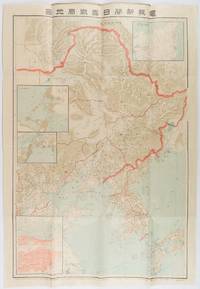
1904réf. 216818東京. Tokyo.: 電報新聞社. Denpō Tsūshinsha. Fifth Edition. Meiji 37 1904. Colour folding map with four inset maps 78.2 x 54.5cm folds into light card covers measuring 21 x 14cm. Very good copy. This the fifth edition of this map was published on 7th June 1904 reflecting the high level of public interest in receiving up-to-date information on the war particularly while the siege of Port Arthur continued without a decisive Japanese victory. The map includes four inset maps among them detailed views of Port Arthur and Vladivostok. It also records distances between key ports in Japan Korea and China. . 電報新聞社. [Denpō Tsūshinsha]. unknown
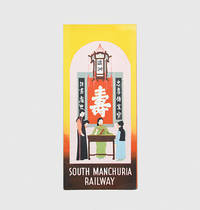
1933réf. 1964131933. An attractive piece of ephemera with photographs of cities in Manchuria a regional map incorporating the railway network and infographics recording the growth of imports exports and the population. The South Manchuria Railway occupied a prominent place in the exposition's Japanese pavilion. The leaflet's text portrays Manchuria as an independent state whose residents had seceded from China in a manner akin to the American Revolution of 1776 and positions Japan as a neutral conduit between the West and the region's rich resources. Colour lithographed sheet 460 x 300 mm folding to 230 x 103 mm printed both sides. Colours vivid and bright small closed tear at foot of one fold: a fine example. unknown
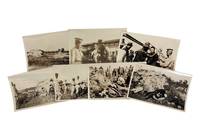
1940réf. 234221940. Chinese prisoner execution photo archive from Japanese-occupied Manchuria circa 1940s recording the custody restraint killing and aftermath of Chinese prisoners under Japanese military control. Japan's occupation of Manchuria followed the Mukden Incident of September 18 1931 when Japanese forces used an explosion along the South Manchurian Railway as the pretext for military conquest; in 1932 Japan established Manchukuo a puppet state that drew international condemnation through the League of Nations' Lytton Commission. By the 1940s Manchuria remained a central zone of Japanese military power in northeast China where occupation authority puppet-state policing and anti-guerrilla campaigns produced summary punishments prisoner shootings and public terror against local Chinese populations. Photo archive of 7 silver gelatin photographs each 4" x 6.5" Manchuria circa 1940s. Japanese soldiers in field uniforms and peaked caps surround blindfolded Chinese captives seated in open ground near an earthen bank; in one scene soldiers level rifles toward bound or blindfolded prisoners at close range. Several men lie face down or on their sides at the base of the embankment with soldiers and civilian onlookers standing above them; plain wooden boxes or planks sit nearby suggesting prepared burial or removal. Another scene records a prisoner being physically restrained in a courtyard or village setting with tiled rooflines uniformed soldiers and civilian men crowded around him. The sequence moves between armed custody execution ground bodies on the earth and prisoner handling under guard giving the group a direct evidentiary relationship to Japanese military violence in occupied Manchuria. Manchuria was not a peripheral theater in Japan's war in China; it was the region where the Kwantung Army transformed a railway-security pretext into territorial occupation state building under Manchukuo and a long-running military presence that helped bring international crisis in the 1930s and full-scale war in Asia. The scenes preserved here are not battlefront combat views but close-range records of prisoners controlled by armed soldiers making the archive especially significant for the study of occupation violence Japanese military practice wartime China and the fate of Chinese civilians or irregular fighters labeled enemies under Japanese authority. Light edge wear and minor fading to some areas; images remain primarily clean; overall very good condition. The archive preserves a compact but stark record of military force in Japanese-occupied Manchuria grounded in the physical proximity between guards prisoners rifles and bodies. unknown
1940réf. 234221940. Chinese prisoner execution photo archive from Japanese-occupied Manchuria circa 1940s recording the custody restraint killing and aftermath of Chinese prisoners under Japanese military control. Japan's occupation of Manchuria followed the Mukden Incident of September 18 1931 when Japanese forces used an explosion along the South Manchurian Railway as the pretext for military conquest; in 1932 Japan established Manchukuo a puppet state that drew international condemnation through the League of Nations' Lytton Commission. By the 1940s Manchuria remained a central zone of Japanese military power in northeast China where occupation authority puppet-state policing and anti-guerrilla campaigns produced summary punishments prisoner shootings and public terror against local Chinese populations. Photo archive of 7 silver gelatin photographs each 4" x 6.5" Manchuria circa 1940s. Japanese soldiers in field uniforms and peaked caps surround blindfolded Chinese captives seated in open ground near an earthen bank; in one scene soldiers level rifles toward bound or blindfolded prisoners at close range. Several men lie face down or on their sides at the base of the embankment with soldiers and civilian onlookers standing above them; plain wooden boxes or planks sit nearby suggesting prepared burial or removal. Another scene records a prisoner being physically restrained in a courtyard or village setting with tiled rooflines uniformed soldiers and civilian men crowded around him. The sequence moves between armed custody execution ground bodies on the earth and prisoner handling under guard giving the group a direct evidentiary relationship to Japanese military violence in occupied Manchuria. Manchuria was not a peripheral theater in Japan's war in China; it was the region where the Kwantung Army transformed a railway-security pretext into territorial occupation state building under Manchukuo and a long-running military presence that helped bring international crisis in the 1930s and full-scale war in Asia. The scenes preserved here are not battlefront combat views but close-range records of prisoners controlled by armed soldiers making the archive especially significant for the study of occupation violence Japanese military practice wartime China and the fate of Chinese civilians or irregular fighters labeled enemies under Japanese authority. Light edge wear and minor fading to some areas; images remain primarily clean; overall very good condition. The archive preserves a compact but stark record of military force in Japanese-occupied Manchuria grounded in the physical proximity between guards prisoners rifles and bodies. unknown books
1930réf. 2091502135501278Osaka Mainichi Shimbun 1930. Soft Cover. Fine. Number of pages: 446p Map size: 16x23cm Osaka Mainichi Shimbun paperback
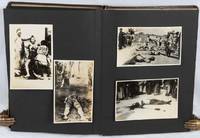
1940réf. 220264Circa1940s. Photographic album with eighty mounted black and white photographic illustrations of varying sizes a further four photographs loosely inserted. Unpaginated. Some with captions some with handwritten descriptions on the verso. 25 x 17cm. Faux leather blind stamped decorative binding a little worn on the edges the rear gutter has been neatly strengthened. Good condition. A strange and very disturbing but historically significant album of photos taken by a Japanese man before and during the Asia-Pacific War. Some photos have been removed from the album but those remaining include family images and school photos taken at the 80th anniversary of Takefumi Higashi Junior School in Echizen City Fukui Prefecture Japan in 1951. A set of five photos stamped with the mark of "E. Tsukio" and the place name Takefumi Higashi show the aftermath of an exceptionally heavy snowfall. The photographs in this album seems to be associated with a family surnamed Hiroba as a number have handwritten notations on the back bearing the names of various individuals with that surname. The album includes a set of commercially produced photographs of the aftermath of the 1923 Great Kanto Earthquake including grim images of piles of bodies of earthquake victims. These are annotated as having been a present from a man named Hiroba Shigenobu. A photo at the rear of the album shows a photo of a Japanese army officer with sword and medals and is annotated "Hiroba Shigeharu 6 October 1940 on the eve of the third expedition to Manchuria given by Takeda Fumio". Next to this is a set of commercially produced photographs of Port Arthur focusing on the monuments to the 1905 Japanese victory there in the Russo-Japanese War. These monuments were a popular tourist attraction for Japanese people visiting Manchuria before or during the Asia-Pacific War. There are also numerous original photos taken in Harbin and the surrounding area mostly in March and April 1941. These include pictures of the streetscape of Harbin and local people participating in an ice festival on the river but also of Japanese military actions in the area - setting up an observation post transporting goods by horse-cart etc. One photo shows the range of cigarette brands available for sale in wartime Harbin. Four photos show a ceremony celebrating the establishment of the "Shimizu Unit no. 24" in Northeast China. The celebrations included a sumo wrestling competition and a party where Japanese troops were entertained by Chinese "beautiful geisha" raising the disturbing spectre of the recruitment of "comfort women" by the wartime Japanese military. More shocking still are nine photos of beheadings and other acts of extreme violence being perpetrated on people during the war in China. The precise locations of these scenes are unclear. Some of the photos appear to have been commercially produced as they contain title inscriptions in within the print but others may be original. One titled photo shows "the heads of bandits being transported by train". A haunting reminder both the horrors of war and of the way in which these can be interwoven into apparently normal family lives. . hardcover
réf. 8663HongKong, Imprimerie de la Société des Missions Etrangères, 1934. 1 fort volume in-8, XX - 1040 pp., enrichi de nombreuses gravures et de plusieurs cartes (dont la grande carte dépliante en couleurs du Man-Tcheou-Kouo). Reliure demi-velin à coins, plats cartonnés marbrés, couvertures illustrées conservées, très bon état.
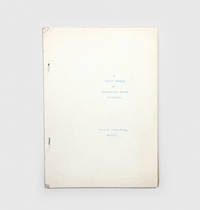
1934réf. 193780Likely Mukden: South Manchuria Railway 1934. First edition significantly scarcer than the second edition of 1936 of this memorandum on the railway's revenue and growth threats from bandits and infrastructure and bus and shipping lines run by its ancillary organizations. Sections are also devoted to agricultural development town planning and medical work. WorldCat records a single holding Claremont Colleges. This work is not to be confused with a more common book of the same title published in the same year. Quarto 252 x 174 mm. With 3 folding tables tables in text. Contents in dittoed typescript occasional corrections in black ink likely as issued. Original white card covers wire-stitched as issued front cover lettered in blue dittoed typescript. Creasing and a little marking to covers rear cover and final leaf detached from wire stitching: very good. unknown
1938Fair French Modern full brown leather, gilt lettering of title on front board. Heavily water stained, and some chippings on extremities of some pages. A fair copy. 4to. (27 x 20 cm). In French. 63 p. The very rare autographed copy of this lecture given in Lebanon on January 20, 1937, at the Youth Center, by Ostrorog after his serving in China as Assistant High Commissioner, a French diplomat from a noble Polish family, who had served as Assistant High Commissioner in China and Syria in the 1930s. Signed and inscribed by Ostrorog as "Par Mahid, Avec autre au mille amitié, Damas, 1938". On the eve of the Second Sino-Japanese War (1937-1945) between the Chinese and the Empire of Japan which is often regarded as the beginning of World War II in Asia, French ex-Assistant High Commissioner in China Ostrorog gave a lecture about Chinese power and policy. Some titles from book: "La Chine.; Le monde au temps de Confucius.; Humanisme Confuceen.; Opposition de l'humanisme Chinois a la morale idealiste de l'occident.; Facteur grammatical.; Universalite des caracteres.; Facteur geographique.; Facteur moral.; La republique des philosophes.; Reaction de Huang Ti au 3me siecle avant notre ere.; Evolution historique dans le cadre de l'unite.; Isolement.; Arrivee des Europeens au XVIme siecle les marchands et les missionnaires.; La querelle des rites condamnation des Jesuites.; Eclat du couchant Kien Lung.; Lettre de Kien Lung a Georges III.; Guerre de l'Opium.; Qeuvre des missions en Chine.; Tseu-hi et Abdul-Hamid.; Le Japon.; Propagande de Moscou.; Succes du mouvement nationaliste.; Intervention Japonaise en Mandchourie.; L'Unite Chinoise menacee.; La Grande pitie.; L'avenir de la Chine.". From the last chapter: "In our contract, the Chinese until now have taken only the faults and vices of Western civilizations. There is, however, something else to choose from and perhaps the time is near when the Chinese will understand it. Whether they are few in number, fifty, forty, ten, or five only, that will suffice. And on that day, with the power of assimilation which has always characterized it, China will integrate, in a way, all the foreign contributions of a moral or cultural order, to rebuild its unity, to resume the continuity of his story, and rediscover his genius." Only two copies in OCLC: 42804470. Signed and inscribed by Stanislas Ostrorog.
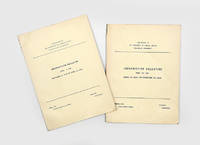
1933réf. 193848Hsinking Changchun: Department of Foreign Affairs Manchoukuo Government 1933 & 1934. First collection editions gathering informational notices previously circulated only to a limited audience in mimeographed form. Issued between September 1932 and February the documents concern the puppet state's legal economic and political affairs including flood relief taxation imports and exports and opium regulation. 2 works quarto. Section titles printed in colour paper. Original light yellow textured card wrappers front covers printed in black. Spines repaired with adhesive creasing and light cockling: very good. unknown
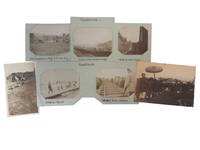
1903réf. 236401903. Chinese Eastern Railway and rural Manchuria photo archive depicting railway travel across Manchuria in 1903 documenting the rapid transformation of northeastern China into one of the most contested transportation corridors of the early twentieth century. Created only months before the outbreak of the Russo-Japanese War the photographs record a landscape where imperial railway construction traditional village life and foreign travel briefly occupied the same space. The French captions identify the photographer as part of the growing community of European travelers who crossed northern China by rail during the final years of the Qing dynasty when newly completed railway lines made regions previously reached only by caravan or river increasingly accessible. Photo archive of 7 silver gelatin photographs ranging from approximately 3 x 4 to 4 x 6.25 inches Manchuria and northern China 1903. Most prints bear contemporary handwritten French captions identifying locations and events including "Montée des monts Kingan" "Passage du Liao-Ho" "Attendant le train de secours" and "Scène champêtre au village de Che-San-Ling." The photographs show passenger trains winding through the forested slopes of the Khingan Mountains travelers gathered beside railway tracks awaiting a rescue train pedestrians crossing the Liao River by ferry expansive mountain vistas viewed from the railway a rural farming scene with villagers pack animal and harvested fields near Che-San-Ling and a ceremonial procession led by musicians carrying traditional instruments and parasols while foreign uniformed soldiers in white tropical helmets march behind. The photographs were made as Manchuria became the focal point of international competition following construction of the Chinese Eastern Railway between 1897 and 1903 a Russian-financed line that connected the Trans-Siberian Railway with Port Arthur and opened the interior of Manchuria to unprecedented commercial and military movement. By 1903 Russia's expanding railway presence and continued military occupation had become an international diplomatic crisis with negotiations over withdrawal collapsing only months before war erupted with Japan in February 1904. These photographs preserve the region immediately before that transformation showing railway travel functioning alongside agricultural villages river crossings and ceremonial life that had defined Manchuria long before foreign concessions arrived. The French captions also reflect the wave of French-speaking diplomats missionaries engineers businessmen and independent travelers who moved through China after the Boxer Rebellion using the expanding railway network to record landscapes and communities that had only recently become accessible to European visitors. Light surface wear minor edge wear and expected age toning; several photographs mounted with original manuscript captions. Overall in very good condition. A visual record of railway expansion cross-cultural travel and everyday life in Manchuria at the moment the region stood on the threshold of the Russo-Japanese War. unknown
1903réf. 236401903. Chinese Eastern Railway and rural Manchuria photo archive depicting railway travel across Manchuria in 1903 documenting the rapid transformation of northeastern China into one of the most contested transportation corridors of the early twentieth century. Created only months before the outbreak of the Russo-Japanese War the photographs record a landscape where imperial railway construction traditional village life and foreign travel briefly occupied the same space. The French captions identify the photographer as part of the growing community of European travelers who crossed northern China by rail during the final years of the Qing dynasty when newly completed railway lines made regions previously reached only by caravan or river increasingly accessible. Photo archive of 7 silver gelatin photographs ranging from approximately 3 x 4 to 4 x 6.25 inches Manchuria and northern China 1903. Most prints bear contemporary handwritten French captions identifying locations and events including "Montée des monts Kingan" "Passage du Liao-Ho" "Attendant le train de secours" and "Scène champêtre au village de Che-San-Ling." The photographs show passenger trains winding through the forested slopes of the Khingan Mountains travelers gathered beside railway tracks awaiting a rescue train pedestrians crossing the Liao River by ferry expansive mountain vistas viewed from the railway a rural farming scene with villagers pack animal and harvested fields near Che-San-Ling and a ceremonial procession led by musicians carrying traditional instruments and parasols while foreign uniformed soldiers in white tropical helmets march behind. The photographs were made as Manchuria became the focal point of international competition following construction of the Chinese Eastern Railway between 1897 and 1903 a Russian-financed line that connected the Trans-Siberian Railway with Port Arthur and opened the interior of Manchuria to unprecedented commercial and military movement. By 1903 Russia's expanding railway presence and continued military occupation had become an international diplomatic crisis with negotiations over withdrawal collapsing only months before war erupted with Japan in February 1904. These photographs preserve the region immediately before that transformation showing railway travel functioning alongside agricultural villages river crossings and ceremonial life that had defined Manchuria long before foreign concessions arrived. The French captions also reflect the wave of French-speaking diplomats missionaries engineers businessmen and independent travelers who moved through China after the Boxer Rebellion using the expanding railway network to record landscapes and communities that had only recently become accessible to European visitors. Light surface wear minor edge wear and expected age toning; several photographs mounted with original manuscript captions. Overall in very good condition. A visual record of railway expansion cross-cultural travel and everyday life in Manchuria at the moment the region stood on the threshold of the Russo-Japanese War. unknown books
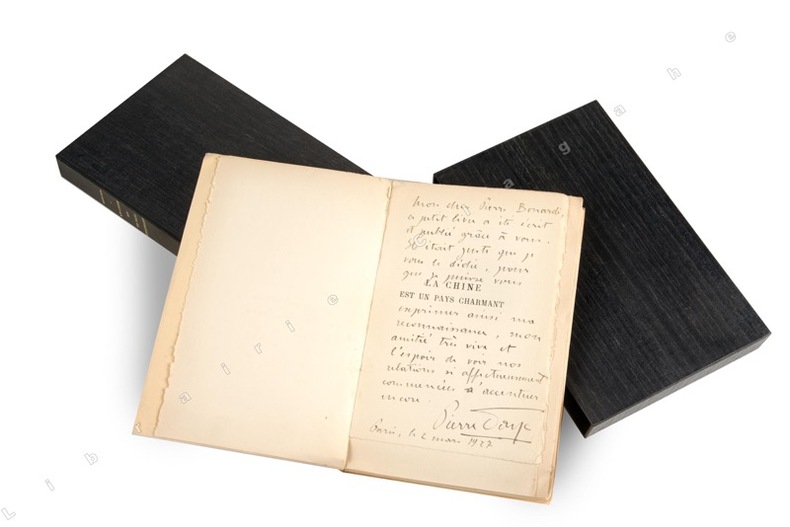
1927réf. 20808Paris, les Editions de France, collection “Notre Temps” publiée sous la direction de Pierre Bonardi, 1927 ; in-16 (210 mm), broché ; [8], 211, [5] pp., couverture jaune imprimée en rouge et noir, chemise-étui simili ébène, dos chagrin noir, titre doré (P.Goy & C.Vilaine).
1939réf. 2110502150410819South Manzhou Railway 1939. Soft Cover. Fine. Volume: 1 South Manzhou Railway paperback
1969réf. 65213Milano: Grafica Uno 1969. Molto buono Very Good. Litografia originale a colori. cm 535x72. . Molto buono Very Good. . Grafica Uno, unknown
1969réf. 89904Milano: Grafica Uno 1969. Molto buono Very Good. Acquaforte acquatinta originale a colori. Cm 22x21 Foglio 53x40. . Molto buono Very Good. . Grafica Uno, unknown
1969réf. 65212Milano: Grafica Uno 1969. Molto buono Very Good. Litografia a 5 colori. cm 76x545. . Molto buono Very Good. Bruniture leggere ai margini del foglio Some light browning and spotting. Tiratura 42. Grafica Uno, unknown
1938réf. 2080502106906007Not Available 1938. Soft Cover. Fine. The book is in fine condition. Not Available paperback