887 results
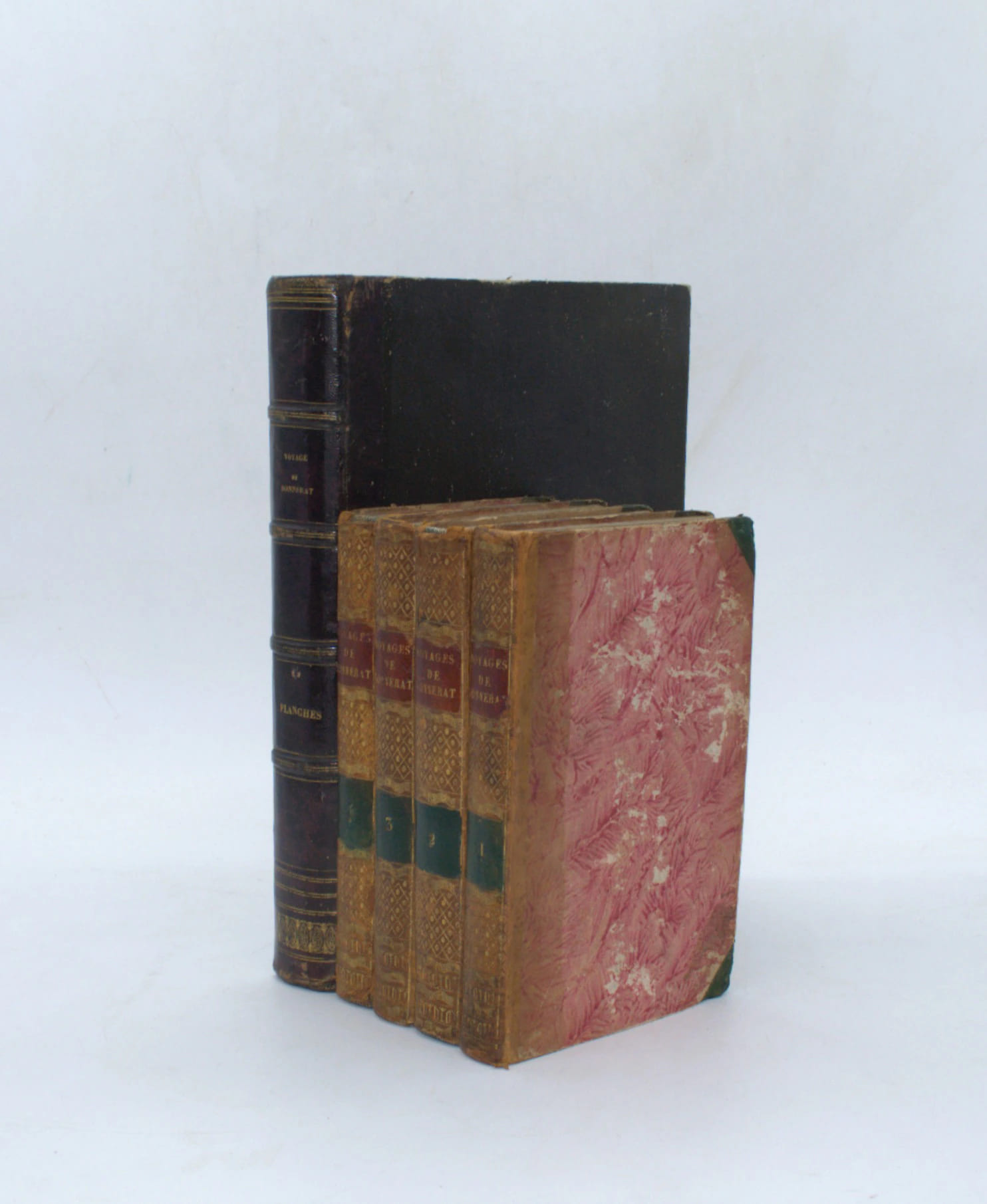
1962ref. 2383All volumes near fine in blue cloth. First editions thus. Consisting of the following: Volume 1: GIRONIERE PAUL DE LA. Twenty Years in the Philippines. Frontispiece is "Una Mestiza de Manila" with tissue guard intact. 1962. Volume 2: CARERI GIOVANNI FRANCESCO GEMELLI. A Voyage to the Philippines. Frontispiece is a water color by Alfredo Carmelo b.1896 depicting Manila galleons moored at the mouth of the Pasig River. 1963. Volume 3: BOWRING SIR JOHN. A Visit To The Philippine Islands. Frontispiece is a black and white portrait of Bowring. 1963. Volume 4: SALEEBY NAJEEB M. The History of Sulu. Frontispiece is black and white photo of Saleeby. 1963. The Filipiniana Book Guild publications expanded to 24 volumes in the first series. These first four volumes are extremely rare. The Princeton library has all volumes except these four. Only digital copies are located in the National Archives of the Philippines. Manila, Philippines, Filipiniana Book Guild, 1962-1963. hardcover
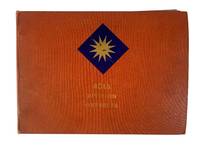
1945ref. 64628Los Angeles CA: 40th Infantry Division ca. 1945. Oblong 4to. 120 pp unpaginated. with 200 silver gelatin photographs all mounted and numbered in lower corner w/in negative keyed to indices inserted after the title page occasional creasing to corners. Brick-red publisher’s cloth post-binder two hidden nickel-plated screwposts at gutter margin 40th Infantry Division sunburst emblem patch on front cover in gilt on blue field minor thumbing edgewear slightly shaken occasional fraying to a couple leaves at fore-edge still a VG copy. First edition thus of this 40th Infantry Division regimental souvenir album visually recording the Western National Guard “Sunshine Division’s” participation in the grueling and bloody island hopping campaign during World War II from Guadalcanal to The Philippines often involved in heavy fighting and credited with capturing or killing over 11000 Japanese troops while suffering 715 casualties. These photographs follow the 40th Division’s arrival and activities in Hawaii followed by their movement to Guadalcanal and arrival at Kukum Dock. Photos depict wrecked Japanese ships beached nearby the typical bare-breasted shots of New Britain Indigenous Peoples arrival of nurse units and training on New Britain. As depicted in these images the bloody Philippine Islands campaign opened with multiple regiments from the 40th Division landing at the Lingayen Gulf on Luzon in order to retake the main Philippine Island in January 1945 including views of Tarlac Bamban battle damage artillery pieces war dogs used by segregated African-American patrols on Luzon well-prepared Japanese positions built to repel the American forces machine gunners Japanese casualties and the results of Japanese troops using grenades to commit Hari Kari.The next phase of the campaign involved the 40th Division participating in the Panay & Guimaras Invasion landing at Tigbauan on Panay Island securing Iloilo City and nearby airfields coordinating with Philippine guerrilla forces with photos of the guerrillas views of the landing craft Philippine peoples and guerrillas wounded by Japanese snipers being treated by American forces and the Division artillery. The 40th Division later came together with other forces and moved onto Negros Island from the end of March through August 1945 pushing deep into Negros Island capturing Bacolod and its airfield before continuing on in the heavy surrounding jungle dislodging Japanese troops in the surrounding area. Their artillery and tank battalions proved particularly effective and many of these photographs depict not only the movements and equipment but the aftermath as well. This album does not include the National Guard Division’s participation in the enforcement of the orders to round up and illegally incarcerate Japanese-Americans throughout the West into War Relocation Centers and Internment Camps for the duration of the War. No copies in Worldcat -- this volume should not be confused with the regimental history published in Baton Rouge LA by the Army & Navy Publishing Company -- “40th Infantry Division: the years of World War II 7 December 1941-7 April 1946. 40th Infantry Division, hardcover
1905ref. 5045Manila: Sugar News Press 1905. Very good. 22pp. Illustrated. Oblong quarto. Original pictorial wrappers stapled. Moderate dust-soiling and edge wear. Light even toning to text. An early and seemingly-unrecorded promotional touting the people and scenery in Mindanao and Sulu in the southern Philippines in the first decade of the 20th century. The work opens with a Foreword detailing the positive aspects of Mindanao particularly its principal city described here as the "Metropolis of Mindanao and Sulu" with "a population of more than thirty thousand a mixture of Moros or Mohammedan Filipinos Christian Filipinos Chinese Japanese and Europeans." Following the Foreword the remainder of the work is mostly comprised of thirty-four duotone photographic prints printed mostly two per page but occasionally with from one to five per page. The photographs feature numerous scenic and street views in and around Zamboanga including various "Moro houses" and about fifteen portraits of indigenous Filipinos such as a "Moro woman weaving materials for head-turbans and sarongs" a view inside a "weaving school" "Yakan Moros on the island of Basilan" "Muhammad Jamallul Sultan of Sulu" "Joloano Warriors" "Moro Kulintang" and their musical instruments Bogobo and Cotabato warriors "Bajaos - the sea gypsies of Sulu" and "Bogobo musicians." The final two pages of the work are taken up with two poems -- the first is a traditional Filipino poem entitled "No Te Vayas" noted as "Zamboanga's 'Auld Lang Syne" and one titled simply "Zamboanga" by Susan Hart Dyer. The front cover is decorated with a central photograph of an indigenous sailing vessel surrounded by an illustrated beach scene signed at bottom left "Jh. Mendoza." The inside front cover contains an illustration of the Philippine Islands from Batanes down to Sulu. We could locate no other copies of the work by title and imprint information in OCLC. Sugar News Press unknown
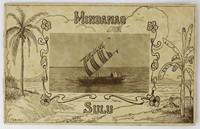
1905ref. 5045Manila: Sugar News Press 1905. Very good. 22pp. Illustrated. Oblong quarto. Original pictorial wrappers stapled. Moderate dust-soiling and edge wear. Light even toning to text. An early and seemingly-unrecorded promotional touting the people and scenery in Mindanao and Sulu in the southern Philippines in the first decade of the 20th century. The work opens with a Foreword detailing the positive aspects of Mindanao particularly its principal city described here as the "Metropolis of Mindanao and Sulu" with "a population of more than thirty thousand a mixture of Moros or Mohammedan Filipinos Christian Filipinos Chinese Japanese and Europeans." Following the Foreword the remainder of the work is mostly comprised of thirty-four duotone photographic prints printed mostly two per page but occasionally with from one to five per page. The photographs feature numerous scenic and street views in and around Zamboanga including various "Moro houses" and about fifteen portraits of indigenous Filipinos such as a "Moro woman weaving materials for head-turbans and sarongs" a view inside a "weaving school" "Yakan Moros on the island of Basilan" "Muhammad Jamallul Sultan of Sulu" "Joloano Warriors" "Moro Kulintang" and their musical instruments Bogobo and Cotabato warriors "Bajaos - the sea gypsies of Sulu" and "Bogobo musicians." The final two pages of the work are taken up with two poems -- the first is a traditional Filipino poem entitled "No Te Vayas" noted as "Zamboanga's 'Auld Lang Syne" and one titled simply "Zamboanga" by Susan Hart Dyer. The front cover is decorated with a central photograph of an indigenous sailing vessel surrounded by an illustrated beach scene signed at bottom left "Jh. Mendoza." The inside front cover contains an illustration of the Philippine Islands from Batanes down to Sulu. We could locate no other copies of the work by title and imprint information in OCLC. Sugar News Press unknown books
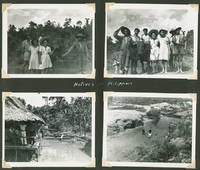
1945ref. 54321Philippines; Okinawa; San Diego. 1945. Photo Album of a Seabee in the Philippines in 1945 A fascinating photographic account of military service in the Philippines compiled by a member of the 142nd U.S. Naval Construction Battalion the Seabees in 1945. Most of the images approximately three-quarters of the album were taken in Guiuan on Samar Island in the central Philippines where the photographer was stationed: Guiuan city square the Seabees' camp numerous portraits of local girls who sometimes pose with American soldiers local families and their activities indigenous architecture and other local scenes. They also show the Immaculate Conception Church with shots of the exterior and detailed views of the silver altar - built in 1595 to 1844 but completely destroyed by Typhoon Haiyan in 2013. Several other photos evidently portray the album's compiler posing next to an American fighter plane while boiling sea shells in front of his tent etc. The final portion of the album contains photos taken during the operations aboard the U.S.S. "Monrovia" and "President Harris" in October-November 1945 including views of Okinawa on the way to China and snapshots of soldiers unloading cargo in China before returning to Manila. There are also eight clear views of Manila showing destroyed Japanese cranes and boats in the harbor American army headquarters and a warehouse. The album concludes with a few photos of the homeward voyage and shows soldiers discharged in San Pedro California. Overall a very good album depicting local life and the activities of the 142nd U.S. Naval Construction Battalion in the Philippines and Yellow Sea in the last months of the World War II. 133 silver gelatin photographs most 2½ x 4 inches but ranging from 2½ x 2½ to several 10 x 7 inches. Oblong folio. Black leatherette album strong tied. Light wear. Photos in corner mounts with many captions. Very good. hardcover
1945ref. 54321Philippines; Okinawa; San Diego. 1945. Photo Album of a Seabee in the Philippines in 1945 A fascinating photographic account of military service in the Philippines compiled by a member of the 142nd U.S. Naval Construction Battalion the Seabees in 1945. Most of the images approximately three-quarters of the album were taken in Guiuan on Samar Island in the central Philippines where the photographer was stationed: Guiuan city square the Seabees' camp numerous portraits of local girls who sometimes pose with American soldiers local families and their activities indigenous architecture and other local scenes. They also show the Immaculate Conception Church with shots of the exterior and detailed views of the silver altar - built in 1595 to 1844 but completely destroyed by Typhoon Haiyan in 2013. Several other photos evidently portray the album's compiler posing next to an American fighter plane while boiling sea shells in front of his tent etc. The final portion of the album contains photos taken during the operations aboard the U.S.S. "Monrovia" and "President Harris" in October-November 1945 including views of Okinawa on the way to China and snapshots of soldiers unloading cargo in China before returning to Manila. There are also eight clear views of Manila showing destroyed Japanese cranes and boats in the harbor American army headquarters and a warehouse. The album concludes with a few photos of the homeward voyage and shows soldiers discharged in San Pedro California. Overall a very good album depicting local life and the activities of the 142nd U.S. Naval Construction Battalion in the Philippines and Yellow Sea in the last months of the World War II. 133 silver gelatin photographs most 2½ x 4 inches but ranging from 2½ x 2½ to several 10 x 7 inches. Oblong folio. Black leatherette album strong tied. Light wear. Photos in corner mounts with many captions. Very good. hardcover books
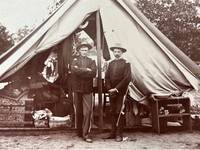
1898ref. 236541898. Spanish American and Philippine American war US military photographs circa 1898 to 1901 documenting the Spanish American War mobilization and the subsequent American occupation of the Philippines. A caption identifying "Co. B Pa. Vol. Mt. Gretna" places one image within Pennsylvania's 1898 volunteer encampment where state militia companies entered federal service during the Spanish American War. A separate inscription "Vigan Philippine Islands Christmas 1901" establishes an American military presence in northern Luzon during the Philippine American War. The photographs record how soldiers were assembled housed transported armed and sustained across stateside and overseas settings. Photo archive of 11 photographs seven silver gelatin and two sepia toned photographs most mounted to cardstock ranging from approximately 5 x 4 to 8 x 10 inches Pennsylvania the Philippine Islands and unidentified locations circa 1898 to 1901. A large company portrait before a conical tent is captioned "Co. B Pa. Vol. Mt. Gretna" among the assembled officers and enlisted men. Other photographs show soldiers standing in opposing ranks along a wooded camp street; five armed men before numbered canvas tents; a mounted officer amid trees and tentage; a long formation carrying an American flag beside railroad tracks telegraph poles freight cars and industrial buildings; and uniformed men posed near a railroad water tower. Two soldiers stand before an open tent crowded with trunks bedding shelving cookware and personal effects while another view records enlisted men seated on the steps of a raised tent furnished with cots. An interior scene shows three soldiers eating smoking pipes and preparing food around a carved table with rifles resting across their laps and beside their chairs. One mount is inscribed "Chas. W. Grammes 925 Maple St. Allentown Pa." while another bears the dated inscription "Vigan Philippine Islands Christmas 1901." Mount Gretna served as Pennsylvania's principal volunteer encampment during the 1898 mobilization but Pennsylvania regiments received different assignments after mustering into federal service. Some units remained stateside or served in Puerto Rico while the 10th Pennsylvania Volunteer Infantry deployed to the Philippines and later fought Filipino forces after the war with Spain had formally ended. Because the Mount Gretna caption omits a regiment number the company shown cannot be securely identified with Philippine service yet the image preserves the state level mobilization from which such overseas assignments were made. By late 1901 Vigan functioned as an American controlled provincial center in Ilocos Sur where military authority and the new colonial administration operated amid continuing resistance elsewhere in the archipelago. Light surface wear and silvering to several images; tonal variation edge wear and staining to some cardstock mounts. Overall good condition. A concentrated visual record of American military organization from Pennsylvania's 1898 volunteer camps to the daily realities of occupation service in the Philippines. unknown
1898ref. 236541898. Spanish American and Philippine American war US military photographs circa 1898 to 1901 documenting the Spanish American War mobilization and the subsequent American occupation of the Philippines. A caption identifying "Co. B Pa. Vol. Mt. Gretna" places one image within Pennsylvania's 1898 volunteer encampment where state militia companies entered federal service during the Spanish American War. A separate inscription "Vigan Philippine Islands Christmas 1901" establishes an American military presence in northern Luzon during the Philippine American War. The photographs record how soldiers were assembled housed transported armed and sustained across stateside and overseas settings. Photo archive of 11 photographs seven silver gelatin and two sepia toned photographs most mounted to cardstock ranging from approximately 5 x 4 to 8 x 10 inches Pennsylvania the Philippine Islands and unidentified locations circa 1898 to 1901. A large company portrait before a conical tent is captioned "Co. B Pa. Vol. Mt. Gretna" among the assembled officers and enlisted men. Other photographs show soldiers standing in opposing ranks along a wooded camp street; five armed men before numbered canvas tents; a mounted officer amid trees and tentage; a long formation carrying an American flag beside railroad tracks telegraph poles freight cars and industrial buildings; and uniformed men posed near a railroad water tower. Two soldiers stand before an open tent crowded with trunks bedding shelving cookware and personal effects while another view records enlisted men seated on the steps of a raised tent furnished with cots. An interior scene shows three soldiers eating smoking pipes and preparing food around a carved table with rifles resting across their laps and beside their chairs. One mount is inscribed "Chas. W. Grammes 925 Maple St. Allentown Pa." while another bears the dated inscription "Vigan Philippine Islands Christmas 1901." Mount Gretna served as Pennsylvania's principal volunteer encampment during the 1898 mobilization but Pennsylvania regiments received different assignments after mustering into federal service. Some units remained stateside or served in Puerto Rico while the 10th Pennsylvania Volunteer Infantry deployed to the Philippines and later fought Filipino forces after the war with Spain had formally ended. Because the Mount Gretna caption omits a regiment number the company shown cannot be securely identified with Philippine service yet the image preserves the state level mobilization from which such overseas assignments were made. By late 1901 Vigan functioned as an American controlled provincial center in Ilocos Sur where military authority and the new colonial administration operated amid continuing resistance elsewhere in the archipelago. Light surface wear and silvering to several images; tonal variation edge wear and staining to some cardstock mounts. Overall good condition. A concentrated visual record of American military organization from Pennsylvania's 1898 volunteer camps to the daily realities of occupation service in the Philippines. unknown books
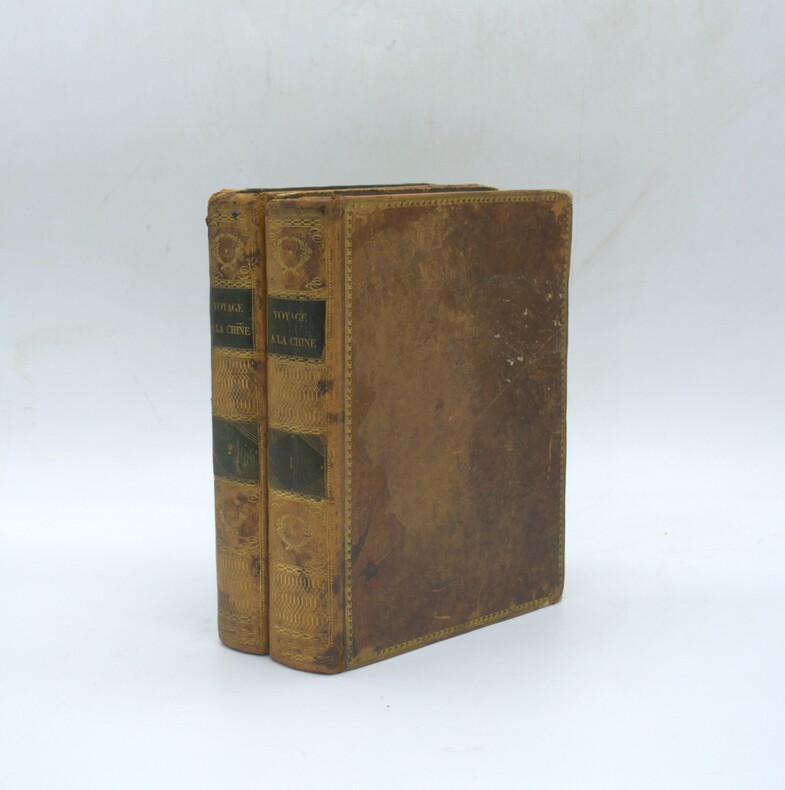
1798ref. PHO-1110Paris, F. Buisson, An 6 de la République (1798). Cinq volumes in-8 (21x13,5cm) , relié plein cuir époque , dos lisse orné avec pièces de titre et de tomaison , filet en torsade sur les plats, coins et coiffes usés , charnières frottées (fente sur le tome 1) , (4) viij, 515pp. et (4) 412pp. et (4) 399pp. et (4) 326pp. et (4) ij, 402pp. ; (2) , illustré de 29 gravures (32) , 4 frontispices et 3 grandes cartes dépliantes gravés par Tardieu l’Ainé , pages de titre brunis . Édition originale du voyage de Macartney avec le 5eme volume ,en seconde édition, contenant le précis de l’histoire de Chine par Huttner (1-184) et la relation de son voyage (187-358) dans une reliure uniforme .
1818ref. 33498Paris Gide fils 1818 in-8 cartonnage d'attente de l'époque de papier noisette, pièce de titre cerise
1725ref. PHO-1468Rouen & Amsterdam, Jean Baptiste Machuel le jeune , (T1, Étienne Roger,T2&8 Pierre le Boucher, Rouen) 1725 . 10 volumes in-12, ,relié plein veau époque , dos orné, pièces de titre et de tomaison rouges, tranches rouges , reliures tome 1 et 2 légèrement différentes, défauts d’usures, illustré de 5 frontispices et 42 gravures , la plupart dépliantes ,quelques défauts d’usages.
Manila, La Oceanía Española, 1878, 20 x 14,5 cm., holandesa piel moderna, IX + 430 págs. (sello en portada de José Paredes Rodríguez, médico de sanidad militar. Rara obra de la que solo hemos localizado 3 ejemplares en en Catálogo Colectivo. "Advierte el editor en el Prólogo que quedándole 400 ejemplares de la edición de 1877, le añadió nuevos pliegos, con notas, para hacer un paralelo entre 1809 y 1878" Retana).
1782ref. PHO-2291A Paris, chez l'Auteur, Froulé, Nyon, Barrois, 1782.- 2 volumes in-4 (26x20,5cm) de XV, (8), 317, (1) pp., 80 pl. h.t. pour le tome 1 ; VIII, 298 pp., 60 pl. h.t. pour le tome 2 ; basane époque, dos lisse orné avec pièces de titre et tomaison vertes, frises aux plats. Frottements et épidermures, début de fentes (3cm) tome 2, coins et coupes usés, vieille mouillure claire, rousseurs et brunissures, 2 feuillets détachés, page 145 déchirée sans manque.
ref. PE54Oblong Folio album ca. 25x33 cm or 10 x 13 ¼ in. 30 card stock leaves. With ca. 330 mounted original gelatin silver photos including five large images from ca. 195x26 cm 7 ¾ x 10 in to ca. 175x24 cm 7 x 9 ½ in; the rest of the photos are from ca. 125x205 cm 4 ¾ x 8 in to ca. 45x65 cm 1 ¾ x 2 ½ in. Nine photos are captioned in negative; at least eighteen with ink manuscript captions on recto or verso. With seven mounted period newspaper clippings or ephemera. Period brown faux leather album fastened with a string; gilt-lettered title “Photographs” on the front cover. Binding rubbed with chipping and losses on extremities over a dozen photos with creases losses of corners or scratches two or three photos possibly previously removed A few photos mildly faded or with mild silvering but overall a very good album of interesting photos. Interesting extensive collection of original gelatin silver snapshot and studio photos taken and collected by an American sailor during his service on U.S.S. “Huron” and “U.S.S. “Black Hawk” in the Southwest Pacific in the 1920s. Former U.S.S. South Dakota 1908-1920 U.S.S. “Huron” served as flagship of the U.S. Asiatic Fleet in 1919-1926 “operating in Philippine waters during the winter and out of Shanghai and Yantai during the summer” Wikipedia. In 1923 the ship participated in the relief operation in Yokohama and Tokyo after the Great Kanto earthquake. U.S.S. “Black Hawk” served in the Asiatic Fleet for twenty years 1922-1942 cruising between various locations in the Philippines Manila Olongapo and China Hong Kong Shanghai Amoy/Xiamen Tsingtao/Qingdao and Chefoo/Yantai. During WW2 it served in Hawaii and Kodiak Alaska. Most images in the album show the U.S. naval ships where the compiler served and their crew members including a large group portrait of sailors wearing the U.S.S. “Huron’s” sports uniform and a large view of U.S.S. “Huron” in Hong Kong harbour. The smaller photos include numerous scenes taken on board mostly of U.S.S. “Black Hawk” with the sailors working or resting some are captioned i.e. “scrubbing gangway in Yellow Sea en Chefoo to Shanghai me with pipe in mouth B.H.” “just like convicts” “B.H. looking forward; x - is our movie screen and o - is the movie house” “main mast” &c. images of an official ceremony on board naval exercises at sea “firing a torpedo” “standing by to fire 4 inch” portraits of the crew members several identified by the compiler i.e. “… Seaner he is at the hospital in Peking now” “F.J. Tancey from Fort Wayne apt gun deck Chefoo” “Lewis R. Hand he died the night we left Chefoo from desentery sic!” “Wirth and Mardis” &c. There are also views of the interior of U.S.S. “Huron’s” launch boat the ship’s radio tower “comforts of a man-of-war” a view “taken from inside of Hawk looking thru an air port tin cans ships and the beach” a launch boat “waiting for the Captain Chefoo” &c. A series of photos show the U.S. naval ships in Chefoo Yantai: “a small part of the Asiatic Fleet anchored in Chefoo;” “x – is were the cans go for shelter when it gets bad also the subs. They might slip there sic! anchor and get washed up on the shore. O. Chinese fort Chefoo;” “tin cans coming in from fireing sic! Chefoo;” “cans and sampans taken at apt gun deck B.H. Chefoo;” “English gun boat in river” “repairing cans Chefoo B.H.” “more of the navy Chefoo” &. Several views of Chefoo show “God in Heaven temple” “Door & lions at Yu Hwan Ding Chefoo” “Chefoo Wall’ taken from above “Arch at American Mission School Temple Hill – Chefoo” “Y.M.C.A. Court Chefoo” “Row of old guns Chefoo Fort” “Chinese memorial Tablets – Chefoo” local boys swimming in the sea &c. There are also several views of Hong Kong port and wharves waterfront residences on Victoria Peak Statue Square with the monument to Queen Victoria Shanghai “entering Shanghai we are in the Yangtze river” “view from B.H. outskirts of Shanghai” a view of the General Post Office building with the Suzhou Creek Qingdao “Tsingtau” &c. Several photos portray American sailors in rickshaw carts “Jew Wirth and me Oriental Hotel Chefoo” posing with Chinese girls “Sing Tat and Job” “6 Chinaman sic! Chefoo” on board the ship &c. The large photos include two reproductions of drawings depicting the service of American sailors in China and the Philippines a map with “Distances from Guam to principal points in the Pacific. Over a dozen photos taken in the Philippines show “Hotel Abella Pagsanjan P.I.” local villages native workers dancers women boys playing a ball game and a group portrait of American sailors “in the Philippine jungles Olongpo sic! while we were in dry dock Feb. 25…” The newspaper clippings and ephemera include articles about the USS S-4 submarine disaster 1927 the appointment of U.S.S. “Pittsburg” the flagship of the Asiatic Fleet in the end of 1926 the movement of San Diego warships a receipt from “Hanson photo studio” in Tsingtau/Qingdao and a ticket to the Peak tramway in Hong Kong. Overall an interesting content-rich visual source on the history of the U.S. Asiatic Fleet and its service near the coast of China and the Philippines in the 1920s. hardcover
ref. PF35Oblong Quarto album ca.18x29 cm. 38 paper album leaves 19 blank . With ca. 90 mounted original gelatin silver photographs and 2 postcards from ca. 14x85 cm 5 ½x3¼ in to ca. 109x65 cm 4 ¼ x 2½ in. Some photos with period caption in negative citing ‘Banzon photos’ likely a local studio the others without captions. Two Real Photo Color Postcards in The Collection Show the Subano Women and Nagasaki View. Both are mounted with a strong glue the previous owner tried to un-glue one to reveal the signature ‘P.J.’ possible date ‘1919’ and readdress ‘To U.S.N.Radio Station’. Other images might be captioned at the back this is subject to further research. The Tatoosh group of photos are loose one of them captioned ‘This is the most lonesome place in the world’. Binding worn several photos missing few images loose one of the postcards with tears but otherwise a very good album of strong interesting photos. Historically important collection of original photographs illustrating the life of American Navy Officer Serving at Navy Radio Station in Washington and Philippines. He likely received his training at Tatoosh before being sent to Philippines. Tatoosh station existed since late 1900s being one of the first Island Naval Radio Stations on West Coast following the first station on Mare Island that has been established in 1904. The album is divided into three group of photos the first one being from WA the second - from Philippines one of them dated in negative as of 1913 which suggests the arrival of the officer to Philippines around that time or in late 1910s. The same group of photos are taken in variety of places in the Philippines but already include a number of photos of Las Baños including the panorama of Los Baños Laguna with U.S. Ambulance & Signal Corp Camp Eldridge on it. The image of thecamp is a good verification for the dating of the photos of the first group: it has been photographed in a very early stage of its establishment while later photos from before Japanese invasion show more buildings and more developed territory. This group of photos which are larger include 17 images. The third group of photos is dedicated entirely to Las Baños its radio facilities and the life of the officer: his home his wife his friends the locals he has photographed. In this series the photographer is likely climbed one of the radio towers and took aerial shots in the process of his climb as well as from the top. As a result a series of photographed has survived showing the laguna and the operation in Los Baños in the early stage. US Naval Radio Control Station was built in 1917 including three 600' towers by 1930 it was operating at a significant capacity as the photos published by navy-radio website demonstrate. It is likely our group of photos is taken earlier as the territory shown on the photos from 1930 is developed more significantly and the pathway to operation building and the gate is not constructed yet. were built in 1917 - one destroyed in 1941 attack two demolished in 1945. 1920s was the early days for US Navy Communication Stations abroad the US: in 1924 there was a shore-based site at Shanghai as early as 1924 but its operations had been shifted to the USS General Alva in 1927; Guam in 1929 had one-person intercept site. Oahu had two stations established in 1924 and 1925. The precent station in Los Baños probably was playing a significant role in the region. Civilian radio in the Philippines started in June 1922 with the establishment of KZKZ AM in Manila Philippines by Henry Herman Sr. owner of the Electrical Supply Company in Manila. One radio tower destroyed in 1941 attack two demolished in 1945. During Japanese occupation Los Baños became known for an agricultural school campus turned Japanese internment camp. In famous ‘Raid on Los Baños’ United States Army Airborne and Filipino guerrilla task force have liberated 2147 Allied civilian and military internees from the camp. Likely the operation affected the Radio Control Station that was not re-started after 1945. Overall an important photographic evidence of the US Navy Radio operations in the Pacific. unknown
1788ref. PHO-1658Paris, Le Jay & Maradan, 1788, in-4, relié plein veau moucheté époque, dos à nerfs avec pièce de titre, XIV-(1)-384 pp., illustré d’un frontispice ,1 gde carte h.-t. et 14 pl. h.-t., petit travail de ver en marge sur 3 feuillets.
1785ref. 1979Madrid:: Printed by D. Joachín Ibara for the Spanish Crown. 1785. First Printing folio very fine in modern half calf and marbled boards; pp. ii57 uncut and unpressed; with 10 blank leaves bound-in at end. The Company was founded in 1785 to establish a monopoly on all trade between the Philippines Spain the Americans Asia and adjacent island states. The port of Manila was closed to foreign trading ships for both imports and exports. Private companies could no longer operate. The Company ceased to hold the monopoly or to operate in 1829 after the losses to Spain's colonial territories in the Americas. Printed by D. Joachín Ibara for the Spanish Crown. hardcover
1727ref. PHO-2344Paris, chez E. Ganeau, 1727. 6 vol. in-12 (17x9,5cm), 3ff.-xvii-592pp.-3ff. (table), 4ff.-512pp., 4ff.-426pp.-3ff., 4ff.-537pp.- 4ff., 4ff.-444pp.-3ff., veau havane tacheté, dos à nerfs orné avec tomaison et pièce de titre grenat, tranches rouges, quelques coiffes accrochées, quelques coins usés, déchirure à 1 planche au pli. Nouvelle édition de cette première traduction en français qui parut initialement en 1719. L'illustration entièrement gravée sur cuivre h.-t. se compose d'un frontispice, un portrait, et 62 planches (63 ?), dont 9 dépliantes. Sabin signale 60 planches sans mentionner le frontispice et le portrait. I ; De la Turquie : Frontispice, portrait, 4 pl. dont 1 dépliante ; II. De la Perse : 5 pl. dont 2 dépliantes ; III. L'Indostan, 25 pl. dont 1 dépliante ; IV. De la Chine 8 pl. dont 2 dépliantes ; V. Des Isles Philippines 2 pl. ; VI. De la Nouvelle Espagne, 18 pl. dont 3 dépliantes.
1806ref. PHO-2636Paris, Dentu, 1806. 5 Volumes, 4 volumes de texte in-8 et 1 atlas in-4. Texte : 4 vol. in-8 (20x13cm), demi reliure et coins époque, dos lisse orné avec pièces de titre rouges et de tomaison vertes, frottements, coiffes usées ou arasées. Atlas : 1 vol. in-4 (29,5x22cm), titre, liste des planches et 140 gravures, demi reliure aubergine, dos à nerfs avec titre et tomaison, quelques frottements, coins usés.
1902ref. 311327np 1902. 5-67 manuscript pages on the rectos of unbound sheets. 8 x 5 inches. Lacking the first 4 leaves and an indeterminate number at end several leaves quite worn each crudely taped or pasted to modern paper and then crudely cropped at the top edge without loss of text. 5-67 manuscript pages on the rectos of unbound sheets. 8 x 5 inches. This account consists of pages five to sixty-seven of what appears to be a diary or copied letters of an unnamed soldier in the 21st United States Infantry. The author who may have been a corporal remains unidentified by name. The account begins in August 1898 at Camp Hobson Lithia Springs GA; in September he is transferred to Plattsburgh NY rejoining the bulk of his regiment which had suffered heavy losses in Cuba. The Philippine-American war ran from February 1899 to July 1902 and was regarded as a continuation of a war for independence by the Philippines and as an insurrection by the United States of America. This account spans the duration of it providing rich detail on topics ranging from food to the war-ravaged environment and American-Philippino interactions both on and off the battlefield. An epic train ride across the country and then a boat from San Francisco brought the 21st US Infantry to Manila on 11 May 1899 in the fourth month of the conflict. The author mentions shipboard conditions an engine breaking down and comments "We caught 4 sharks in our trip. The largest was 12 feet long and took the whole crowd to land him aboard. the men used the bones for rings and pen holders and in fact every thing you could think." Their first combat was the capture of an insurgent outpost at Guadaloupa Ridge on 9 June 1899 where they "joined General Lauter's Flying Column . with eight chinamen to carry our rations." The description of this combat and its aftermath pages 33-41 is the most dramatic passage in the memoir. The writer was sent with another soldier to gather up some supplies that had been left behind but they were separated from the regiment with no food or water. They made a makeshift fort from some old haversacks and brush when they were unable to return to the trenches that night. The author describes scavenging after battle as follows: "About 10:00 oclock there was several chinamen came looking around and picking up what-ever they seen. They came to close to us to suit me and we shot 4 and the rest ran away." Going out in search of water at about four in the morning despite ongoing fire the author found several dead and mortally wounded soldiers from a black regiment including a graphic description of one man who had been shot at close range and had a hole the size of a fist in his belly and was covered in blood. Of the only survivor the author says: "Found one poor cuss shot through the hip. He could not move. I gave him some hard tack and he gave me water then I went back to our haversacks." Another disoriented soldier whom the author names as H. McBain was found wandering without most of his clothing brandishing a bottle of wine and an axe. After waiting until the 11th for a reclamation detail the author and his companion crawled through the brush for a mile to San Peter McCarty and eventually rejoined their regiment at Los Penes where their captain threatened to have them court-martialed for losing their haversacks. Later while hospitalized the author was befriended by Señora Edna Luna cousin of an insurgent general who took him out riding daily: "She was stuck on me and that is no lie. I think I ought to go back and hook up with her as she has all that is required. She is hansome & plenty of money" page 45. The author -- first too ill to be moved then put in a wheel chair and with trouble with his vision -- was transferred back to the States on 15 May 1900 page 48 by way of Nagasaki May 21 1900 and Yokohama arrived in San Francisco on June 9 1900 then was sent to recover at Hot Springs Arkansas concluding in Vancouver Barracks Washington circa July 1901. Some of the pages are torn and some text is lost at the bottom edges due to wear but the handwriting is clear and the voice of the author shines through. This narrative though it took place before World War One reads more akin to a Vietnam War narrative than a Civil War diary in tone and disregard for authority and the morality of war. unknown
1902ref. 311327np 1902. 5-67 manuscript pages on the rectos of unbound sheets. 8 x 5 inches. Lacking the first 4 leaves and an indeterminate number at end several leaves quite worn each crudely taped or pasted to modern paper and then crudely cropped at the top edge without loss of text. 5-67 manuscript pages on the rectos of unbound sheets. 8 x 5 inches. This account consists of pages five to sixty-seven of what appears to be a diary or copied letters of an unnamed soldier in the 21st United States Infantry. The author who may have been a corporal remains unidentified by name. The account begins in August 1898 at Camp Hobson Lithia Springs GA; in September he is transferred to Plattsburgh NY rejoining the bulk of his regiment which had suffered heavy losses in Cuba. The Philippine-American war ran from February 1899 to July 1902 and was regarded as a continuation of a war for independence by the Philippines and as an insurrection by the United States of America. This account spans the duration of it providing rich detail on topics ranging from food to the war-ravaged environment and American-Philippino interactions both on and off the battlefield. An epic train ride across the country and then a boat from San Francisco brought the 21st US Infantry to Manila on 11 May 1899 in the fourth month of the conflict. The author mentions shipboard conditions an engine breaking down and comments "We caught 4 sharks in our trip. The largest was 12 feet long and took the whole crowd to land him aboard. the men used the bones for rings and pen holders and in fact every thing you could think." Their first combat was the capture of an insurgent outpost at Guadaloupa Ridge on 9 June 1899 where they "joined General Lauter's Flying Column . with eight chinamen to carry our rations." The description of this combat and its aftermath pages 33-41 is the most dramatic passage in the memoir. The writer was sent with another soldier to gather up some supplies that had been left behind but they were separated from the regiment with no food or water. They made a makeshift fort from some old haversacks and brush when they were unable to return to the trenches that night. The author describes scavenging after battle as follows: "About 10:00 oclock there was several chinamen came looking around and picking up what-ever they seen. They came to close to us to suit me and we shot 4 and the rest ran away." Going out in search of water at about four in the morning despite ongoing fire the author found several dead and mortally wounded soldiers from a black regiment including a graphic description of one man who had been shot at close range and had a hole the size of a fist in his belly and was covered in blood. Of the only survivor the author says: "Found one poor cuss shot through the hip. He could not move. I gave him some hard tack and he gave me water then I went back to our haversacks." Another disoriented soldier whom the author names as H. McBain was found wandering without most of his clothing brandishing a bottle of wine and an axe. After waiting until the 11th for a reclamation detail the author and his companion crawled through the brush for a mile to San Peter McCarty and eventually rejoined their regiment at Los Penes where their captain threatened to have them court-martialed for losing their haversacks. Later while hospitalized the author was befriended by Señora Edna Luna cousin of an insurgent general who took him out riding daily: "She was stuck on me and that is no lie. I think I ought to go back and hook up with her as she has all that is required. She is hansome & plenty of money" page 45. The author -- first too ill to be moved then put in a wheel chair and with trouble with his vision -- was transferred back to the States on 15 May 1900 page 48 by way of Nagasaki May 21 1900 and Yokohama arrived in San Francisco on June 9 1900 then was sent to recover at Hot Springs Arkansas concluding in Vancouver Barracks Washington circa July 1901. Some of the pages are torn and some text is lost at the bottom edges due to wear but the handwriting is clear and the voice of the author shines through. This narrative though it took place before World War One reads more akin to a Vietnam War narrative than a Civil War diary in tone and disregard for authority and the morality of war. unknown books
1944ref. 220931944. 40th Infantry Division Pacific campaign photograph album documenting combat operations and daily military life of U.S. Army forces during World War II. The 40th Infantry Division served extensively in the Southwest Pacific Theater participating in campaigns across New Guinea New Britain and the Philippines as Allied forces advanced against Japanese defensive positions. The photographs record amphibious landings artillery operations destroyed towns and the collaboration between American troops and Filipino guerrilla forces during the campaign to liberate the Philippines. The album therefore documents the operational environment of Pacific warfare including jungle terrain fortified Japanese defensive networks and the logistical systems required to sustain prolonged combat across island battlefields. Photograph album containing approximately 200 original black and white photographs documenting operations of the 40th Infantry Division during the Pacific campaigns of World War II. Each photograph is sequentially numbered in white ink at the lower corner and corresponds to descriptive entries in a photographic index within the album. Early images depict American Red Cross workers disembarking from landing craft and greeted by U.S. soldiers illustrating the presence of female support personnel assigned to medical and relief operations. Additional photographs record amphibious landing scenes aerial views of destroyed towns in Luzon artillery and tank operations and soldiers operating mounted machine guns overlooking jungle valleys. Several images depict Japanese military casualties reflecting the intense close combat that characterized fighting across the Pacific islands. A printed military map within the album shows Japanese tunnel and cave fortifications in the Zambales Mountains illustrating defensive positions encountered during operations in the Philippines. The album also documents logistical and civilian dimensions of the campaign. Photographs show ships unloading cargo Filipino guerrilla units marching through urban streets and groups of local porters assisting Allied forces in moving supplies through mountainous terrain. Weapons and equipment visible in the images include field artillery pieces mortars and armored vehicles such as the M4 Sherman. One photograph depicts African American soldiers accompanied by scout dogs operating in jungle terrain illustrating the presence of Black servicemen serving within the segregated structure of the wartime U.S. Army. Other photographs show tent encampments mess areas interactions with local populations and the recovery of prisoners of war following combat operations. The photographs collectively present a visual record of combat logistics and daily military life during the Pacific campaigns. Album contains approximately 200 photographs with indexed numbering. Light handling wear visible to album and photographs consistent with wartime field compilation. Overall condition very good. unknown
1944ref. 220931944. 40th Infantry Division Pacific campaign photograph album documenting combat operations and daily military life of U.S. Army forces during World War II. The 40th Infantry Division served extensively in the Southwest Pacific Theater participating in campaigns across New Guinea New Britain and the Philippines as Allied forces advanced against Japanese defensive positions. The photographs record amphibious landings artillery operations destroyed towns and the collaboration between American troops and Filipino guerrilla forces during the campaign to liberate the Philippines. The album therefore documents the operational environment of Pacific warfare including jungle terrain fortified Japanese defensive networks and the logistical systems required to sustain prolonged combat across island battlefields. Photograph album containing approximately 200 original black and white photographs documenting operations of the 40th Infantry Division during the Pacific campaigns of World War II. Each photograph is sequentially numbered in white ink at the lower corner and corresponds to descriptive entries in a photographic index within the album. Early images depict American Red Cross workers disembarking from landing craft and greeted by U.S. soldiers illustrating the presence of female support personnel assigned to medical and relief operations. Additional photographs record amphibious landing scenes aerial views of destroyed towns in Luzon artillery and tank operations and soldiers operating mounted machine guns overlooking jungle valleys. Several images depict Japanese military casualties reflecting the intense close combat that characterized fighting across the Pacific islands. A printed military map within the album shows Japanese tunnel and cave fortifications in the Zambales Mountains illustrating defensive positions encountered during operations in the Philippines. The album also documents logistical and civilian dimensions of the campaign. Photographs show ships unloading cargo Filipino guerrilla units marching through urban streets and groups of local porters assisting Allied forces in moving supplies through mountainous terrain. Weapons and equipment visible in the images include field artillery pieces mortars and armored vehicles such as the M4 Sherman. One photograph depicts African American soldiers accompanied by scout dogs operating in jungle terrain illustrating the presence of Black servicemen serving within the segregated structure of the wartime U.S. Army. Other photographs show tent encampments mess areas interactions with local populations and the recovery of prisoners of war following combat operations. The photographs collectively present a visual record of combat logistics and daily military life during the Pacific campaigns. Album contains approximately 200 photographs with indexed numbering. Light handling wear visible to album and photographs consistent with wartime field compilation. Overall condition very good. unknown books
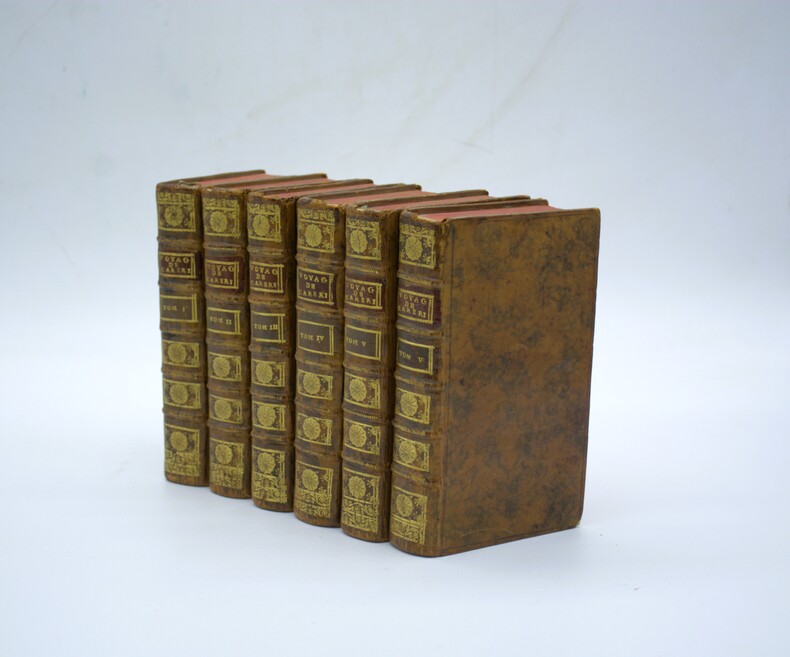
1719ref. PHO-2391Paris, chez Étienne Ganeau, 1719. 6 vol. in-12 (17x9,5cm), 4ff.-xxvii-2ff.-454pp.-5ff. (table), 4ff.-354pp.-3ff., 4ff.-402pp., 4ff.-532pp., 4ff.-374pp., 4ff.-512pp., veau moucheté, dos à nerfs orné avec tomaison et pièce de titre, tranches jaspées, exlibris verso 1er plat, écritures aux titre, dos et charnières frottés, coins usés, petit manque plat tome 1 Édition originale L'illustration entièrement gravée sur cuivre h.-t. se compose d'un frontispice, un portrait, et 60 planches, dont dépliantes. Sabin signale 60 planches sans mentionner le frontispice et le portrait. I ; De la Turquie : Frontispice, portrait, mappemonde, 4 pl. dont 1 dépliante ; II. De la Perse : 3 pl. ; III. L'Indostan, 24 pl. ; IV. De la Chine 8 pl. dont 2 dépliantes ; V. Des Isles Philippines 2 pl. ; VI. De la Nouvelle Espagne, 18 pl. dont 3 dépliantes.
ref. PC42Oblong Folio album ca. 275x365 cm. 75 card stock leaves with tissue guards over 30 blank. With ca. 269 mounted gelatin silver photographs including two large photos ca. 21x27 cm 8 ¼ x 10 ½ in and ca. 20x25 cm 7 ¾ x 10 in and two panoramas ca. 12x29 cm 4 ¾ x 11 ¼ in; the rest of the photos are from ca. 7x11 cm 2 ¾ x 4 ½ in to ca. 6x85 cm 2 ¼ x 3 ¼ in. Ca. 70 photos with period white ink captions on the mounts one photo is captioned in negative. With twenty-seven loosely inserted gelatin silver photos including two large ones ca. 205x25 cm 8x10 in and 17x25 cm 6 ½ x 10 in; the rest of the photos are from ca 8x105 cm 3 ¼ x 4 in to ca. 55x8 cm 2 ¼ x 3 ¼ in. Period dark brown sheep boards fastened with metal bolts; the front board with an elaborate blind-stamped ornament with two Chinese dragons and a gilt-lettered title. The first leaf with a period printed introduction titled “My Oriental Album.” Boards rubbed on extremities several leaves with minor tears on the margins not affecting the photos four images previously removed from the album but possibly laid in as loose photos but overall a very good album of strong interesting photos. Interesting album with over original gelatin silver snapshot photos of China and the Philippines taken and collected by an American sailor during his service in the U.S. Naval Battle Force in the 1930s. The album opens with two large partly-coloured photos of the U.S. naval ships where the compiler apparently served a portrait of Admiral Harris Laning 1873-1941 commander of the U.S. Naval Battle Force in 1935-1936 and images of the ships of the Battle Force “torpedo bomber” plane “night battle practice” and “ground swells.” Two large loosely inserted photos show U.S.S. “Guadalupe” launched in 1940 a fleet replenishment oiler where the compiler apparently served in the 1940s. The photos of Tsingtao Qingdao include views of the entrance to the “Enlisted Men’s Club” and the interior of a dining room apparently in the same club city racecourse beach and waterfront harbour with Chinese boats and U.S. naval ships Zhanqiao pier with the octagonal Hunian pavilion Memorial Monument to the fallen in the “Japanese War” former German Governor’s House city streets and shops a shop with flags and sign “Sze Fang Road” on the side pagodas and temples portraits of a local policeman Japanese girls Chinese kids and families people “making blankets” beggars U.S. sailors posing with young local women “Nina & I” “Shera & Spindle” “Sally” “Korean girls” &c. A series of over thirty images illustrate the “Lao Shan Valley Trip” Mount Lao southern Shandong Peninsula showing the compiler and his fellow servicemen posing on the grounds of the local temples possibly the Temple of Supreme Purity next to a “Chinese farmhouse” playing with children being carried in sedan chairs drinking beer &c. The album also contains two large panoramas of Hong Kong city waterfront and Victoria Peak taken from the sea; Victoria Harbour. Smaller photos of Hong Kong show the city waterfront with the third building of the Hong Kong and Shanghai Bank under construction completed in 1935 harbour mansions on the slopes of Victoria Peak the Peak Tram Chinese houseboats Repulse Bay Hotel a review of American marines a ferry of the “Hongkong and Yaumati Ferry Ltd.” sign “HYF” on the top &c. There are also several views of Beijing White Stupa on the Jade Flower Island interior of the Forbidden City sailors posing on the bronze astronomical instruments of the Ancient Observatory the Great Wall of China photos of “Pao Hsing Restaurant All kinds of Liquors and Grocery Regular Meals and Money Exchange Chin Hang Tao North China” a new building of the “Chinese Telegraph Administration Tangyi Road Branch” Chinese pagodas colourful street procession numerous portraits of American sailors posing in rickshaw carts at Chinese arch gates riding donkeys drinking at several bars “Morgan’s Bar” “U.S. Bar” &c. The photos of the Philippines show the facilities and vessels at the Olongapo Naval Station modern-day U.S. Naval Base Subic Bay: a floating drydock the compiler’s ship missing the entrance to the dock U.S.S. Pigeon U.S.S. John D. Ford U.S.S. Augusta H.I. J.M.S. Koma naval exercise in the Manila Bay Corregidor Island &c. Among the identified images of Manila are the views of the Central Post Office Old Legislative Building Legaspi Landing scenes of public celebrations during the day and at night in the Luneta Rizal Park with the visible Rizal Monument &c. The other images show U.S. naval ships at sea and in port a submarine lighthouses group portraits of the compiler and other enlisted sailors &c. Twenty-one photos at the rear portray the compiler and his family in the United States. hardcover