3 240 résultats
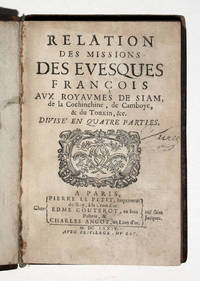
1674réf. 2448 ff. 367 1 pp. Bound in contemporary calf gilt heraldic stamp on covers gilt spine with raised bands worn with joints cracked but sound head foot and corners bumped. Lacking endleaves; illegible ownership inscription on lightly soiled title; very good overall. Rare first edition of this account of the state of Christianity in Thailand Cambodia Vietnam by rivals of the Jesuits. The Société des Missions Etrangères a new apostolic missionary group established in Paris in 1660 was as a society of secular priests who devoted their lives to foreign missions but refrained from taking vows. Under the aegis of the Propaganda Fide the Société des Missions soon became embroiled in conflicts over territory with the Jesuits. As a result of the patriotism of its priests the organization's impact extended beyond evangelicalism into the political realm: in addition to facilitating a series of embassies and treaties it also successfully established a more active trade between Indo-China the Indies and France. This Relation brought fresh information about the condition of the mission in different parts of southeastern Asia between 1666 and 1671. It consists of four parts the first dealing with the mission in Siam and containing descriptions of amongst others Bourbon Island Madagascar and Mozambique the second treating the situation in Cochin-China the third the mission in Cambodia and the fourth being devoted to Tonkin including an account of the work of bishop Lambert de la Motte. Lambert was a member of the Society's first expedition to the Far East which had left Europe in 1660. Fermanel de Favery c. 1632-88 superior and director of the "S'naire pour les Missions Etrangères" signs the dedicatory epistle to Cardinal de Bo' and consequently Streit Lach and Van der Kley ascribe authorship to him. The work was reprinted in 1680 and 1684 and an Italian translation Relatione delle missioni de vescovi vicarii apostolici' alli regni di Siam Cocincina Camboia e Tunkino was published in Rome in 1677 and 1697. Cordier I.826 s.v. Evêques Français; Chadenat 1706 1684 ed.; Satow 46; Streit V.1797; Lach III.i.222ff. Pierre Le Petit, Edme Couterot & Charles Angot hardcover books
1674réf. 2448 ff. 367 1 pp. Bound in contemporary calf gilt heraldic stamp on covers gilt spine with raised bands worn with joints cracked but sound head foot and corners bumped. Lacking endleaves; illegible ownership inscription on lightly soiled title; very good overall. Rare first edition of this account of the state of Christianity in Thailand Cambodia Vietnam by rivals of the Jesuits. The Société des Missions Etrangères a new apostolic missionary group established in Paris in 1660 was as a society of secular priests who devoted their lives to foreign missions but refrained from taking vows. Under the aegis of the Propaganda Fide the Société des Missions soon became embroiled in conflicts over territory with the Jesuits. As a result of the patriotism of its priests the organization's impact extended beyond evangelicalism into the political realm: in addition to facilitating a series of embassies and treaties it also successfully established a more active trade between Indo-China the Indies and France. This Relation brought fresh information about the condition of the mission in different parts of southeastern Asia between 1666 and 1671. It consists of four parts the first dealing with the mission in Siam and containing descriptions of amongst others Bourbon Island Madagascar and Mozambique the second treating the situation in Cochin-China the third the mission in Cambodia and the fourth being devoted to Tonkin including an account of the work of bishop Lambert de la Motte. Lambert was a member of the Society's first expedition to the Far East which had left Europe in 1660. Fermanel de Favery c. 1632-88 superior and director of the "S'naire pour les Missions Etrangères" signs the dedicatory epistle to Cardinal de Bo' and consequently Streit Lach and Van der Kley ascribe authorship to him. The work was reprinted in 1680 and 1684 and an Italian translation Relatione delle missioni de vescovi vicarii apostolici' alli regni di Siam Cocincina Camboia e Tunkino was published in Rome in 1677 and 1697. Cordier I.826 s.v. Evêques Français; Chadenat 1706 1684 ed.; Satow 46; Streit V.1797; Lach III.i.222ff. Pierre Le Petit, Edme Couterot & Charles Angot hardcover
1933réf. 134089Sn. 1933 In-4 oblong 27 x 41,5, demi-basane verte à coins, 206 tirages argentiques de formats 23 x 17 cm 14 ; 16 x 11,5 cm 104 ; 11 x 7,5 cm 44 ; 8 x 6.5 cm 2. Superbe album réalisé par les services de communication du Gouvernement de l'Indochine et l'Aéronautique militaire d'Indochine à l'attention d'un haut-fonctionnaire. Les 104 pages grises intérieures sont toutes légendées à la gouache blanche par un calligraphe vietnamien. Majoritairement des vues d’Hanoï : les monuments, l’habitat, les rues, des portraits types et des scènes de la vie quotidienne, petits métiers, paysannerie... Une dizaine de vue aériennes 24 x 17 cm réalisées par des photographes embarqués à bord des biplans Potez de l'aéronautique militaire d'Indochine. Elles sont assez exceptionnelles par leur qualité. Vues d’Haïphong, de Moncay, Chapa, Vientiane, Hué, Dakto, Louang Praband, la baie d'Along, les femmes moïs, etc. Deux vues de têtes de pirates décapités.
1954réf. 135183Sn 1954 Deux albums in-folio oblong, 411 & 607 photographies contrecollées en 40 & 50 planches, format divers : ca 6 x 6 à 17 x 24 cm., majorirtairement 8,5 x 11 cm., tirages argentique et mat, près d’une trentaine de retirages. Nombreuses légendes, en pastilles ou en marge de la photographie. Témoignage photographique d’un officier du 1er escadron du 8ème GSAP 8ème RSA en janvier 1953 au long de deux séjours 4 années et des multiples engagements de cette unité d’intervention : opérations Bissextile, Sablé, Porto, Lorraine, Artois-Bretagne, Corse, Mouette, etc. Le “récit” débute à Alger en 1942 sur quelques photographies familiales puis Saumur en 1949, les étapes du voyage : près de 145 vues prédédent son arrivée. Quelques portaits et scènes de groupe, prises d’arme, etc. précèdent le coeur du reportage : les engagements de son peloton sur half-tracks à l’appui de nombreuses vues de combat, ce qui est rare. Des coupures de presses enrichissent le récit, avec quelques correctifs manuscrits. En point d’orgue : l’opération Mouette. Le second album est agrémenté de près de 300 photographies de correspondants de guerre Camus, Corcuff, Ferrai, Varoqui, etc. de format divers et de très belle facture, débordant le cadre du 8ème spahis : opérations du 3ème BPVN, du 8ème BPC opérations Bambou et Hirondlelle, vue célèbre du 2ème classe Lardillier, le 2ème BEP au Laos, etc. Un document emblématique au coeur du conflit, de toute rareté.
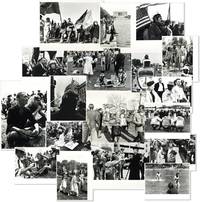
1970réf. 81746Silver Spring MD: James B. Johnson 1970. Archive consisting of 70 original double-weight silver gelatin photographs. Forty-seven 47 measuring 8" x 10" and twenty-three 23 measuring 14" x 11". Many though not all bear the photographer's rubber-stamp on verso James B. Johnson 2200 Dennis Ave. Silver Spring MD. a few bearing brief holograph captions or codes in red and black ink. Light wear to extremities subtle curling to the edges and a few photos with tiny creases to the corners; overall Very Good. A substantial group of images documenting the April 4 1970 "March For Victory" in Washington DC. This march and the victory marches that followed were organized by the Rev. Carl McIntire 1906-2002 and his wife Fairy who were fundamentalist ministers radio evangelists and founders of the International Council of Christian Churches ICCC and American Council of Christian Churches ACCC. The April 4th march drew close to 50000 protestors - the era's largest pro-war demonstration - and was stridently against the "Vietnamization" of the war which McIntire viewed as a sign of retreat and running away from America's duty to fight communism. The march was to take place from Capitol Hill down Pennsylvania Avenue and conclude at the base of the Washington Monument. "Rather than the usual college-age protesters known for demonstrating against the war the Victory March's attendees were largely middle aged and elderly featuring contingents of World War I World War II and Korean War veterans as well as Cuban exiles and members of the National Socialist White People's Party.The demonstrators carried signs and banners saying "Nixon is a No-Win Swine" "In God We Trust" and "Marxism is Jewish" as well as Confederate and American flags and many wore "Wallace for President" hats.While the war was the main point of contention the masses demonstrated for and against a plethora of other issues including support for prayer in school to stop bussing programs designed to desegregate schools and just generally against "secular universities and hippies and yippies everywhere" Mednick Avi. Blog post: "The Silent Majority Storm The National Mall." Boundary Stones: WETA's Local History Website 03/02/2017. Georgia governor Lester Maddox was present and spoke at the rally at the Washington Monument; by the time he spoke the counter-protesters who had been showing up all day outnumbered the Victory Marchers. The images in this archive capture both sides of the march. Carl and Fairy McIntire appear holding a Bible and an American flag with their followers and their children shown marching carrying flags and signs seated on the Washington Mall and stomping on North Vietnamese flags. Numerous images of the counter-protesters are present carrying signs American and North Vietnamese flags passing out flowers dancing a few covered in decorative paint and seated with instruments with a number of photos showing hippies disrobing or fully naked bathing in the reflecting pool in front of the Lincoln Memorial. We have been able to ascertain little about the photographer aside from his name and that he was a member of the Silver Spring Camera Club. A striking group of images documenting the intersection of the "Silent Majority" and the anti-war movement. 81746. James B. Johnson unknown books
1970réf. 81746Silver Spring MD: James B. Johnson 1970. Archive consisting of 70 original double-weight silver gelatin photographs. Forty-seven 47 measuring 8" x 10" and twenty-three 23 measuring 14" x 11". Many though not all bear the photographer's rubber-stamp on verso James B. Johnson 2200 Dennis Ave. Silver Spring MD. a few bearing brief holograph captions or codes in red and black ink. Light wear to extremities subtle curling to the edges and a few photos with tiny creases to the corners; overall Very Good. A substantial group of images documenting the April 4 1970 "March For Victory" in Washington DC. This march and the victory marches that followed were organized by the Rev. Carl McIntire 1906-2002 and his wife Fairy who were fundamentalist ministers radio evangelists and founders of the International Council of Christian Churches ICCC and American Council of Christian Churches ACCC. The April 4th march drew close to 50000 protestors - the era's largest pro-war demonstration - and was stridently against the "Vietnamization" of the war which McIntire viewed as a sign of retreat and running away from America's duty to fight communism. The march was to take place from Capitol Hill down Pennsylvania Avenue and conclude at the base of the Washington Monument. "Rather than the usual college-age protesters known for demonstrating against the war the Victory March's attendees were largely middle aged and elderly featuring contingents of World War I World War II and Korean War veterans as well as Cuban exiles and members of the National Socialist White People's Party.The demonstrators carried signs and banners saying "Nixon is a No-Win Swine" "In God We Trust" and "Marxism is Jewish" as well as Confederate and American flags and many wore "Wallace for President" hats.While the war was the main point of contention the masses demonstrated for and against a plethora of other issues including support for prayer in school to stop bussing programs designed to desegregate schools and just generally against "secular universities and hippies and yippies everywhere" Mednick Avi. Blog post: "The Silent Majority Storm The National Mall." Boundary Stones: WETA's Local History Website 03/02/2017. Georgia governor Lester Maddox was present and spoke at the rally at the Washington Monument; by the time he spoke the counter-protesters who had been showing up all day outnumbered the Victory Marchers. The images in this archive capture both sides of the march. Carl and Fairy McIntire appear holding a Bible and an American flag with their followers and their children shown marching carrying flags and signs seated on the Washington Mall and stomping on North Vietnamese flags. Numerous images of the counter-protesters are present carrying signs American and North Vietnamese flags passing out flowers dancing a few covered in decorative paint and seated with instruments with a number of photos showing hippies disrobing or fully naked bathing in the reflecting pool in front of the Lincoln Memorial. We have been able to ascertain little about the photographer aside from his name and that he was a member of the Silver Spring Camera Club. A striking group of images documenting the intersection of the "Silent Majority" and the anti-war movement. 81746. James B. Johnson unknown
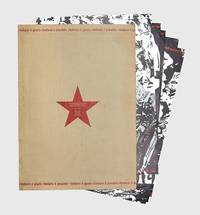
1969réf. 148329Milan: c. 1969. Striking pop art-influenced suite of anti-imperialist propaganda posters published in Milan by the Comitato Vietnam - self-described in their literature as the "sezione italiana del tribunale Russell". The work of a collective comprised of six prominent Italian artists the images carry the theme 'Rebellion is right rebellion is possible' into various theatres of anti-imperialist struggle. Baratella b. 1935 Mariani b. 1936 and Spadari 1938-97 were long-term collaborators and members of the Nuova Figurazione art movement. Amadori 1945- 2015 won the Joan Miró prize in 1972. Spadari's contribution draws on the "solarised" image of Castro in the Cuban Revolution from his work "26 de julio" while in an anti-Vietnam War themed poster similarly treated repeated images of a Vietnamese women are overlain by a Lichtensteinian US fighter jet wheeling away from an explosion from which emerges a Coca-Cola bottle cap with the slogan 'Nixon boia' - Nixon executioner also the title of a song by popular singer-story teller Franco Trincale - and the partially obscured text 'Coca-Cola merda'. Nixon also features on a poster featuring his cartoonish portrait wearing a star-spangled neck-tie while being choked out by several nooses above him a ferociously snarling Black Panther head; while "Africa Rossa/Africa Nera" centres on a photographic image of the clenched first Black Power salute. Baratella based his poster around his painting "Benito Mussolini Storia del fascismo" where "Il Duce's" face morphs into a skull here with the lower part is superimposed with six small portraits of current political leaders including de Gaulle Pompidou Khrushchev and LBJ. The last in the group dramatises the Arab-Israeli conflict with a repeated image of a woman PFLP fighter - Leila Khaled - in keffiyeh and camo fatigues carrying a AK-47 above her a map of Jerusalem. No other set of these traced a couple of examples of individual posters noted institutionally; an excellent evocation of the artistic-political synergies of the period. Six large black and white photomontage posters 700 x 500 mm printed on coated paper each with the repeated slogan 'ribellarsi è giusto ribellarsi è possibile' in red; in the original tan slub-weave linen textured light card portfolio printed in red title to the front panel superimposed on a red five-pointed star. The portfolio a little rubbed and soiled pale damp spots at the spine-fold where there are a few short splits posters show light handling but overall very good. unknown
réf. FRE67Oblong Folio album ca. 315x43 cm 12 ¼ x 17 in. 14 card stock leaves. With 74 mounted albumen and gelatin silver photos including over 35 large images from 21x335 cm 8 ¼ x 13 in to ca. 17x22 cm 6 ½ x 8 ½ in; the rest of the photos are from ca. 13x17 cm 5 x 6 ¾ in to ca. 75x10 cm 3x4 in. Ca. 30 photos are captioned and/or numbered in French in negative; two photos are also signed “P. Dieulefils Hanoi” in negative. Ca. 27 photos are with period pencil captions in French on the mounts. Period brown quarter sheep with cloth boards fastened with metal bolts. Binding rubbed on extremities spine with cracks on hinges and minor tears on top and bottom; mounts slightly age-toned a few photos mildly faded one photo with a loss of the right lower corner but overall a very good album of interesting photos. Historically significant collection of early original photos of Vietnam during French colonial rule with about half of the images attributed to the first professional photographer in Hanoi Pierre-Marie Dieulefils. Two photos from the album bear his signature in negative images with the same style of captions were attributed to Dieulefils by the librarians of Côte d'Azur University. Ca. 34 studio photographs of the French Protectorate of Tonkin northern Vietnam – attributed to Dieulefils - include a series of views of Hanoi showing “Grand Lac”/West Lake fishermen and houseboats with the entrance pillars and gate of the Pagode du Grand Buddha/Quan Thanh Taoist Temple “Petit Lac” Hoan Kiem Lake ancient gate at rue Jean Dupuis “Rue des Brodeurs” and “Boulevard Gia Long.” Other views of Tonkin show “Pagode au village du Kinh Luoc” Son Tay a covered bridge Bao Ha village Ba Vi Mountains Nam Dinh a street river port Lang Son the citadel Lao Cai French officers posing in front of the confluence of the Red and Nam Ti Rivers barrage on the Black River near Cho Bo Red River at Trai Hut &c. There are also individual and group portraits of Vietnamese musicians singers attendants of a Buddhist ceremony a “grand mandarin en costume de céremonie” most likely Le Kinh Luoc vice-king of Tonkin women and children in traditional costumes barbers water carriers carpenters and sculptors market sellers &c. About twenty photos of the French Protectorate of Annam Central Vietnam show the “citadelle de Binh Dinh” French officer with native soldiers posing at the entrance gate a view of the gate taken from the side the capital of the Binh Dinh province Quinhon/Quy Nhon waterfront and bay “maison de commersant chinois” “l’ancienne ambulance” fishermen at a local beach Song Cau French residence Cu Mong village and valley &c. The portraits taken in Annam depict “Nguyen Van Thanh <…> du Binh Dinh <…> ministre de la guerre” a French official photographed upon his arrival to the colony and then six months later Vietnamese prisoners wearing wooden cangue yokes soldiers from the civil guard boys posing with a hunted tiger inhabitants of the Binh Dinh province French officials during a visit to “Truong Soc” two little French girls &c. The album also contains several views of Saigon – the capital of French Cochinchina now Ho Chi Minh City showing the Governor’s Palace Norodom Palace built in 1868-1973 destroyed by bombing in 1962 Palace of Justice built in 1881-85 now People’s Law Court Central Post Office Château d’Eau Waterworks Tower and Notre-Dame Cathedral Basilica. There are also four early interesting views of Angkor Wat in Cambodia enclosures towers and central structure a steep staircase and a large photo of the steep incline of the Peak Tram line in Hong Kong operated since 1888. Overall a historically interesting extensive collection of original photos of Vietnam and its people in the late 19th century. hardcover
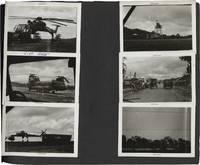
réf. 162967N.p.: N.p. 1971. Archive of 236 vernacular photographs documenting an African-American serviceman's deployment as a cavalryman with the 228th Aviation Battalion likely at An Khe Vietnam as well as his life back home in the US circa 1969-1971. Includes 180 black-and-white and 56 color photographs housed in two photograph albums. The serviceman in question appears to be Isaac Johnson whose name is written in a caption on one photograph and whose image appears throughout both photograph albums reconfirmed by a page near the end of the first album with the endearing heading "Some of the Woman sic in Johnson's Life . Before Me." The first album contains 153 photographs showing Vietnam and 83 photographs showing friends and family back home in the US most with captions in manuscript ink on the margins. The album's first half documents friends family and events back home including the serviceman's wedding. The second half beginning on the ninth leaf captures what appears to be the soldier's initial deployment in Vietnam showing images of Chinook and Sikorsky helicopters various military vehicles village and base scenes Vietnamese locals and fellow soldiers. Following the Vietnam photographs are two pages containing Johnson's military insignias Vietnamese currency and military payment certificates. The following leaf presents photographs-one of a stereo and two of a young boy likely the soldier's son-alongside two ticket stubs dated August 28 1970 from Baltimore Baseball Club captioned "Darryl's first Baseball Game." The tickets on that date were apparently for the Baltimore Orioles versus the Milwaukee Brewers at Memorial Stadium in Baltimore. The final leaf contains a computer printout of an "A Co 228th ASH Wildcats" insignia and two maps of Vietnam both with An Khe circled. The second photograph album containing the majority of photographs taken in Vietnam presents 128 photographs largely black-and-white images of fellow soldiers at work and leisure as well as barracks structures and equipment Vietnamese locals and girlfriends Chinook helicopters and the Vietnamese countryside. The final two leaves of the album contain 16 photographs of family friends children and a pet cat all in the US. Photographs: 2.5 x 3.5 inches to 5 x 3.5 inches. Very Good plus to Near Fine overall with a few photographs starting to detach from leaves. Green album: 14 x 11 inches. Very Good plus with some light edgewear and rubbing to the corners. Black album: 13.25 x 9.75 inches. Very Good plus with some chipping near the hinge on the front board. N.p. unknown books
réf. 162967N.p.: N.p. 1971. Archive of 236 vernacular photographs documenting an African-American serviceman's deployment as a cavalryman with the 228th Aviation Battalion likely at An Khe Vietnam as well as his life back home in the US circa 1969-1971. Includes 180 black-and-white and 56 color photographs housed in two photograph albums. The serviceman in question appears to be Isaac Johnson whose name is written in a caption on one photograph and whose image appears throughout both photograph albums reconfirmed by a page near the end of the first album with the endearing heading "Some of the Woman sic in Johnson's Life . Before Me." The first album contains 153 photographs showing Vietnam and 83 photographs showing friends and family back home in the US most with captions in manuscript ink on the margins. The album's first half documents friends family and events back home including the serviceman's wedding. The second half beginning on the ninth leaf captures what appears to be the soldier's initial deployment in Vietnam showing images of Chinook and Sikorsky helicopters various military vehicles village and base scenes Vietnamese locals and fellow soldiers. Following the Vietnam photographs are two pages containing Johnson's military insignias Vietnamese currency and military payment certificates. The following leaf presents photographs-one of a stereo and two of a young boy likely the soldier's son-alongside two ticket stubs dated August 28 1970 from Baltimore Baseball Club captioned "Darryl's first Baseball Game." The tickets on that date were apparently for the Baltimore Orioles versus the Milwaukee Brewers at Memorial Stadium in Baltimore. The final leaf contains a computer printout of an "A Co 228th ASH Wildcats" insignia and two maps of Vietnam both with An Khe circled. The second photograph album containing the majority of photographs taken in Vietnam presents 128 photographs largely black-and-white images of fellow soldiers at work and leisure as well as barracks structures and equipment Vietnamese locals and girlfriends Chinook helicopters and the Vietnamese countryside. The final two leaves of the album contain 16 photographs of family friends children and a pet cat all in the US. Photographs: 2.5 x 3.5 inches to 5 x 3.5 inches. Very Good plus to Near Fine overall with a few photographs starting to detach from leaves. Green album: 14 x 11 inches. Very Good plus with some light edgewear and rubbing to the corners. Black album: 13.25 x 9.75 inches. Very Good plus with some chipping near the hinge on the front board. N.p. unknown
1875réf. 64770Yokohama & Tokyo Japan Hong Kong Canton China Saigon Vietnam: No Compiler ca. 1875-1893. Thick Oblong folio. 14.5 x 10.75 x 2.25 in. 50 pp unpaginated on thick cream-coloured boards each mounted with white silk hinge at gutter margin w/ 41 tipped-in albumen photos sixed from 6 x 8 in. up to 8.5 x 11 in. 5 of which are hand-coloured many w/ photographer’s annotated caption w/in the negative at lower fore-edge frequently with image inventory number many w/ manuscript in pencil captions. Beautiful beveled lacquer boards Mother-of-Pearl & bone inset panel on black laccquer on front cover depicting Rickshaw drive pulling Japanese Geisha w/ Mount Fuji in background a.e.g. rebacked w/ black calf minor edgewear minor curving to textblock a couple images w/ minor creasing from mounting 1 w/ very minor tear still an excellent exemplar with the nearly all the photographs retaining bright strong contrast. This superb Asian Souvenir Export photo album filled with large albumen prints offers a vivid representation of people life and the architectural landscape of Victorian-Era Hong Kong Saigon in French Indochina Vietnam Canton Guangzhou China and Meiji-era Japan. Fifteen of the photographs depict scenes and life in and around Hong Kong with several of the photos by famed Chinese photographer Lai Afong 1839-1890 including a view of Happy Valley the Public Gardens the Peak Hill District with 55 houses at the Peak Cemetery and another view of the public gardens with harbour in the background by William Pryor Floyd 1834-c.1900 a prolific British Commercial Photographer. One of the Hong Kong photographs depicts the Mount Austin Hotel which was built above the Victoria Gap opened in 1891 and was named after Colonial Secretary John Gardiner Austin and operated for just a short time converted by 1897 into the Mount Austin Barracks. Another Hong Kong photo depicts the six-story expansion completed in 1893 to the Hong Kong Hotel facing Victoria Harbor on Queen’s Road which included a private ferry launch for guests. The last Hong Kong photo is a striking street scene by Lai Afong. Of particular interest are the several original albumen photos capturing Saigon French Indochina or Cochin China and surrounding areas with images shot by Emile Gsell 1838-1879 noted French military photographer and his successor Otto Wegener 1849-1922 noted Swedish photographer who continued to sell Gsell’s prints as well as Vidal/Salin-Vidal. These images include views of a “Native House Saigon” “Native Street Saigon” French “Military Hospital Ship” docked in Saigon “Monkey Palms Saigon” “French Settlement Saigon” along some railroad tracks and traditional sampans boats along a canal in Cholon Saigon. In our experience this many French Indochina Vietnam photographs included for travel in and around Saigon are quite uncommon. Nine of the original albumen photographs capture such scenes in and around Canton Guangzhou China such as the 500 Mages or interior shot of the 500 Lohan disciples of the Buddha inside the Hualin Temple in the western suburb of Canton the “Execution Yard” in Canton Pagoda near Cantonas well as two very nice images of the “Flower Boats” in Canton possibly by Lai Afong or Emil Rumsfield visually capturing these multi-tiered wooden houseboats or pleasure boats operating as exclusive floating brothels featuring music dining and socializing and essential to the Pearl River’s social economy into the 20th Century. A couple others include prisoners in wooden stocks in Canton China taken from a cracked glass negative and well-dressed Mandarin Chinese official.The remainder of the albumen photographs sprinkled through the album encompass a hand-coloured albumen of Japanese rickshaw pulling kimono-clad Japanese women; the Yokohama Hataba or English/French treaty pier; Yokohama Park with cherry blossoms viewing & rickshaws; the famed view of the staged seppuku scene with nearby kaishakunin Samurai assistant standing with drawn sword for beheading and beautiful Kamakura Temple shot by Felice Beato. Other Beato photos include a fine Palanquin photo of young geisha and porters; and a very nice “Setting Silk-Worm-Eggs to the Paper” with young silkworm women workers carefully extracting the threads. Adolfo Farsari 1841-1898 photos include one of the No. 9 House in Yokohama Japan as well as two shots of the Grand Hotel in Yokohama. See: Terry Bennett History of Photography in China Chinese Photographers 1844-1879; Metadata Database of Japanese Old Photographs in Bakumatsu-Meiji Period Nagasaki University Library Collection 2006; Early Photography of Japan Harvard College Library; Bennett Photography in Japan 1853-1912 2006; Old Photos of Japan. A Photo Blog of Japan in the Meiji Laisho and Showa Periods. [No Compiler], hardcover
1631réf. 5335Rome: Francesco Corbelletti 1631. FIRST EDITION. Hardcover. Fine. Bound in early 20th c. stiff parchment ruled in red with elegant pen-work in red and black on the spine. A nice copy perhaps lightly washed. With woodcut arms of the dedicatee Pope Urban VIII with the Barberini arms on p. 3. FIRST EDITION of this important account of Vietnam the first report on Vietnam written by a European. Written from the author's own experiences during his residence in the Nguyễn domains in what is now central and southern Vietnam between 1618 and 1621 the work presents the author's direct observations of the land's geography climate and natural resources; its political administration commerce and social customs including descriptions of indigenous religions; as well as a narrative of the progress of the nascent Jesuit mission. The Italian Jesuit scientist a heliocentrist and supporter of Galileo arrived in Cochinchina in late 1617 or early 1618 when the missionary presence was still in its infancy and marked by uncertainty. Expecting hostility or even martyrdom Borri instead found a courteous reception and went on to spend four productive years in the country. During that time he strengthened the mission established lasting relations with local communities and conducted scientific research. In Chapter 5 he records his predictions and observations of two lunar eclipses and the solar eclipse of 22 May 1621. Although Borri's Relatione contains no sustained Vietnamese text it is among the earliest European works to record Vietnamese Cochinchinese words phonetically in the Latin alphabet-chiefly titles such as Onsaij ông sãi "monk" Omgne ông nghè "court official" and place names like Faifò Hội An and Turon Äà Nẵng. These spellings document early European attempts to capture Vietnamese sounds before the creation of the systematic Romanized script quốc ngữ by later Jesuits such as Alexandre de Rhodes. The book is structured in two parts the first dealing with the geography and culture of Vietnam. BOOK I - The Temporal State of Cochinchina Borri introduces Cocincina Cochinchina the area corresponding roughly to central and southern Vietnam ruled by the Nguyễn lords. He explains the etymology of the name from "Coci" a Japanese term for Annam and "China" and locates the country between Tunchim Tonkin northern Vietnam and Chiampà Champa south-central Vietnam. He praises its fertility mild climate and dense population portraying it as a prosperous and well-governed realm suited for missionary enterprise. He describes a region of temperate weather divided between rainy and dry seasons. The atmosphere he notes is wholesome and pure free from epidemic disease. He admires the regularity of the monsoon winds which bring both agricultural abundance and maritime prosperity. In Chapter 3 Borri offers a lush catalogue of agricultural wealth-rice sugar fruits and aromatic woods like aloes and calambac. Borri likens the fertility of Cocincina to that of Italy itself and emphasizes divine providence in the country's abundance. He observes that the people are skilled in irrigation and land management. In Chapter 4 "Of Elephants and the Abadas" Rhinoceroses Borri turns to fauna describing elephants used in labor and war and the abada rhinoceros found in the forests. He recounts local stories and adds European natural-philosophical reflections presenting the animals as symbols of strength and divine order. An ethnographic portrait follows; Borri comments on the politeness and intelligence of the Cocincinesi Vietnamese their industry and sense of honor. He also notes "superstitious" elements in religion and medicine describing their use of herbal cures and astrological diagnosis. The men wear loose garments; women are modest and industrious. The society he writes prizes civility and filial duty. Chapter 6 - Of the Political and Civil Government The government is structured hierarchically: the Nguyễn lord rules from Sinvuà Huế through governors of provinces such as Quamguya Quảng Ngãi Cacciam Qui Nhơn and Pulucambì Phú Yên. Laws are administered with Confucian-like decorum; justice is swift and often exemplary. The administration balances severity and generosity maintaining peace and prosperity. Chapter 7 describes the Nguyễn ruler's military might and his conflicts with Tunchim Tonkin. The king commands numerous elephants and disciplined troops and Borri marvels at the discipline and courage of the soldiers. He describes the long rivalry between the Nguyễn and Trịnh dynasties as both political and moral warfare. Borri ends Book I with a vivid description of Faifò Hội An and Turon Äà Nẵng flourishing harbors open to Japanese Portuguese and Chinese traders. The openness of the ports makes Cocincina a meeting point of East and West its commercial wealth feeding the royal treasury and preparing the ground for Christian missions. Book II is Borri's account of the Jesuit Mission and the progress -and setbacks- of bringing Christianity to Vietnam. Borri recounts the first entrance of Jesuit missionaries into Turon Äà Nẵng and Cacciam Qui Nhơn. Welcomed by local officials they erect two churches and begin preaching through interpreters. The early success marked by curiosity and goodwill from the people seems to promise a great harvest of conversions. Soon misfortune strikes. Drought and famine are blamed on the Jesuits and persecution erupts. Borri himself is sent from Macao Macau to aid the mission traveling in disguise. Miraculously torrential rains begin at his arrival which locals interpret as proof of divine favor and hostility ceases. The Governor of Pulucambì Phú Yên or Quy Nhơn befriends the missionaries grants them land and builds a church and residence. His protection allows the Fathers to preach publicly and win respect at court. The chapter emphasizes how local authority could shelter fragile missions. Tragedy follows. The Governor dies suddenly of fever while hunting before baptism. Borri mourns him as a noble pagan whose sympathy for Christianity nearly transformed the province. With his death the missionaries lose all support and return to poverty and danger. After three years of hardship in Pulucambì divine providence renews the mission. The wife of an ambassador from Nuoecman Nước Mặn moved by Borri's preaching requests baptism followed by twenty-five of her ladies. She receives the Christian name Orsola Ursula. Later her husband the Ambasciadore Ignatio Ignatius and many courtiers convert marking the first flowering of Christianity among the elite. Borri narrates conversions among scholars and astrologers. One notable case involves a royal astrologer who mispredicted an eclipse that Borri accurately forecast using European astronomy. The accuracy of Jesuit science impresses the court leading several literati to study Christian doctrine and some to convert. There are descriptions of priests and Onsaij Buddhist Clergy being converted to Christianity. A Buddhist monk named Onsaij Ly for instance becomes an exemplary Christian living a pious life preaching publicly and converting others-including learned monks and nobles. Borri interprets this as proof that divine grace can penetrate the highest orders of gentile religion. Borri next surveys native religious systems tracing them to Xaca ÅšÄkyamuni Buddha and noting similarities with pagan errors known to Europe. He divides the sects into philosophers idolaters and astrologers arguing that their doctrines contain echoes of the Gospel distorted by ignorance. Borri describes healings answered prayers and deliverance from storms as proofs of divine favor confirming the truth of the new faith among simple folk. By the time Borri writes Faifò Hội An Turon Äà Nẵng and Cacciam Qui Nhơn all possess flourishing Christian congregations with churches catechists and sacraments. The Jesuits administer baptisms and establish schools creating a stable Christian presence in the kingdom. Chapter 11 - On the Kingdom of Tonkin Borri turns north to Tunchim Tonkin ruled by the Trịnh lords. He sketches its wealth learning and openness to European contact predicting that Tonkin too will embrace Christianity complementing the progress in Cochinchina. In his final chapter Borri concludes with an exalted description of Cochinchina-its beauty healthful climate wealth in gold silk and aromatic woods and the sweetness and liberality of its people. He insists that the land lacks only 'many of God's angels' meaning apostolic missionaries to become a piece of heaven on earth. He contrasts the openness of Cochinchina where foreigners may live freely with the restrictions of China affirming that here the Gospel may flourish without disguise. Further reading: Olga Dror "Phantasmatic Conchinchina" in "Views of Seventeenth-century Vietnam" pp. 23-59. Francesco Corbelletti hardcover books
1631réf. 5335Rome: Francesco Corbelletti 1631. FIRST EDITION. Hardcover. Fine. Bound in early 20th c. stiff parchment ruled in red with elegant pen-work in red and black on the spine. A nice copy perhaps lightly washed. With woodcut arms of the dedicatee Pope Urban VIII with the Barberini arms on p. 3. FIRST EDITION of this important account of Vietnam the first report on Vietnam written by a European. Written from the author's own experiences during his residence in the Nguyễn domains in what is now central and southern Vietnam between 1618 and 1621 the work presents the author's direct observations of the land's geography climate and natural resources; its political administration commerce and social customs including descriptions of indigenous religions; as well as a narrative of the progress of the nascent Jesuit mission. The Italian Jesuit scientist a heliocentrist and supporter of Galileo arrived in Cochinchina in late 1617 or early 1618 when the missionary presence was still in its infancy and marked by uncertainty. Expecting hostility or even martyrdom Borri instead found a courteous reception and went on to spend four productive years in the country. During that time he strengthened the mission established lasting relations with local communities and conducted scientific research. In Chapter 5 he records his predictions and observations of two lunar eclipses and the solar eclipse of 22 May 1621. Although Borri's Relatione contains no sustained Vietnamese text it is among the earliest European works to record Vietnamese Cochinchinese words phonetically in the Latin alphabet-chiefly titles such as Onsaij ông sãi "monk" Omgne ông nghè "court official" and place names like Faifò Hội An and Turon Äà Nẵng. These spellings document early European attempts to capture Vietnamese sounds before the creation of the systematic Romanized script quốc ngữ by later Jesuits such as Alexandre de Rhodes. The book is structured in two parts the first dealing with the geography and culture of Vietnam. BOOK I - The Temporal State of Cochinchina Borri introduces Cocincina Cochinchina the area corresponding roughly to central and southern Vietnam ruled by the Nguyễn lords. He explains the etymology of the name from "Coci" a Japanese term for Annam and "China" and locates the country between Tunchim Tonkin northern Vietnam and Chiampà Champa south-central Vietnam. He praises its fertility mild climate and dense population portraying it as a prosperous and well-governed realm suited for missionary enterprise. He describes a region of temperate weather divided between rainy and dry seasons. The atmosphere he notes is wholesome and pure free from epidemic disease. He admires the regularity of the monsoon winds which bring both agricultural abundance and maritime prosperity. In Chapter 3 Borri offers a lush catalogue of agricultural wealth-rice sugar fruits and aromatic woods like aloes and calambac. Borri likens the fertility of Cocincina to that of Italy itself and emphasizes divine providence in the country's abundance. He observes that the people are skilled in irrigation and land management. In Chapter 4 "Of Elephants and the Abadas" Rhinoceroses Borri turns to fauna describing elephants used in labor and war and the abada rhinoceros found in the forests. He recounts local stories and adds European natural-philosophical reflections presenting the animals as symbols of strength and divine order. An ethnographic portrait follows; Borri comments on the politeness and intelligence of the Cocincinesi Vietnamese their industry and sense of honor. He also notes "superstitious" elements in religion and medicine describing their use of herbal cures and astrological diagnosis. The men wear loose garments; women are modest and industrious. The society he writes prizes civility and filial duty. Chapter 6 - Of the Political and Civil Government The government is structured hierarchically: the Nguyễn lord rules from Sinvuà Huế through governors of provinces such as Quamguya Quảng Ngãi Cacciam Qui Nhơn and Pulucambì Phú Yên. Laws are administered with Confucian-like decorum; justice is swift and often exemplary. The administration balances severity and generosity maintaining peace and prosperity. Chapter 7 describes the Nguyễn ruler's military might and his conflicts with Tunchim Tonkin. The king commands numerous elephants and disciplined troops and Borri marvels at the discipline and courage of the soldiers. He describes the long rivalry between the Nguyễn and Trịnh dynasties as both political and moral warfare. Borri ends Book I with a vivid description of Faifò Hội An and Turon Äà Nẵng flourishing harbors open to Japanese Portuguese and Chinese traders. The openness of the ports makes Cocincina a meeting point of East and West its commercial wealth feeding the royal treasury and preparing the ground for Christian missions. Book II is Borri's account of the Jesuit Mission and the progress -and setbacks- of bringing Christianity to Vietnam. Borri recounts the first entrance of Jesuit missionaries into Turon Äà Nẵng and Cacciam Qui Nhơn. Welcomed by local officials they erect two churches and begin preaching through interpreters. The early success marked by curiosity and goodwill from the people seems to promise a great harvest of conversions. Soon misfortune strikes. Drought and famine are blamed on the Jesuits and persecution erupts. Borri himself is sent from Macao Macau to aid the mission traveling in disguise. Miraculously torrential rains begin at his arrival which locals interpret as proof of divine favor and hostility ceases. The Governor of Pulucambì Phú Yên or Quy Nhơn befriends the missionaries grants them land and builds a church and residence. His protection allows the Fathers to preach publicly and win respect at court. The chapter emphasizes how local authority could shelter fragile missions. Tragedy follows. The Governor dies suddenly of fever while hunting before baptism. Borri mourns him as a noble pagan whose sympathy for Christianity nearly transformed the province. With his death the missionaries lose all support and return to poverty and danger. After three years of hardship in Pulucambì divine providence renews the mission. The wife of an ambassador from Nuoecman Nước Mặn moved by Borri's preaching requests baptism followed by twenty-five of her ladies. She receives the Christian name Orsola Ursula. Later her husband the Ambasciadore Ignatio Ignatius and many courtiers convert marking the first flowering of Christianity among the elite. Borri narrates conversions among scholars and astrologers. One notable case involves a royal astrologer who mispredicted an eclipse that Borri accurately forecast using European astronomy. The accuracy of Jesuit science impresses the court leading several literati to study Christian doctrine and some to convert. There are descriptions of priests and Onsaij Buddhist Clergy being converted to Christianity. A Buddhist monk named Onsaij Ly for instance becomes an exemplary Christian living a pious life preaching publicly and converting others-including learned monks and nobles. Borri interprets this as proof that divine grace can penetrate the highest orders of gentile religion. Borri next surveys native religious systems tracing them to Xaca ÅšÄkyamuni Buddha and noting similarities with pagan errors known to Europe. He divides the sects into philosophers idolaters and astrologers arguing that their doctrines contain echoes of the Gospel distorted by ignorance. Borri describes healings answered prayers and deliverance from storms as proofs of divine favor confirming the truth of the new faith among simple folk. By the time Borri writes Faifò Hội An Turon Äà Nẵng and Cacciam Qui Nhơn all possess flourishing Christian congregations with churches catechists and sacraments. The Jesuits administer baptisms and establish schools creating a stable Christian presence in the kingdom. Chapter 11 - On the Kingdom of Tonkin Borri turns north to Tunchim Tonkin ruled by the Trịnh lords. He sketches its wealth learning and openness to European contact predicting that Tonkin too will embrace Christianity complementing the progress in Cochinchina. In his final chapter Borri concludes with an exalted description of Cochinchina-its beauty healthful climate wealth in gold silk and aromatic woods and the sweetness and liberality of its people. He insists that the land lacks only 'many of God's angels' meaning apostolic missionaries to become a piece of heaven on earth. He contrasts the openness of Cochinchina where foreigners may live freely with the restrictions of China affirming that here the Gospel may flourish without disguise. Further reading: Olga Dror "Phantasmatic Conchinchina" in "Views of Seventeenth-century Vietnam" pp. 23-59. Francesco Corbelletti hardcover
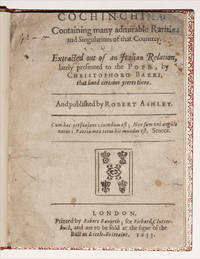
1633réf. 4531London: Robert Raworth for Richard Clutterbuck 1633. Hardcover. Very Good. 4to - over 9¾ - 12" tall. Tastefully bound in ruled red morocco interior gilt dentelles; title-page dusty and trimmed at upper & outer margins; repaired corner of prelims. Otherwise very good. Rare first edition of the first book on Vietnam in English an eyewitness account of the commerce government and cultural life of Cochin-China central Vietnam written by the Jesuit missionary Cristoforo Borri and first published in Italian in 1631.Borri begins by marking the kingdom's boundaries identifying it as a narrow strip of land between Laos and the South China Sea bordered to the north by Tongking and to the south by Champa. A discussion of the kingdom's fertile land and rich natural resources follows emphasizing the abundance of fruits nuts rice fish textiles domestic stock and "all other things requisite for the entertainement of a man's life." Silk is produced in such quantities that "the baser sort of people wear it dayly." Gold and silver mines abound and "the Wood and Timber of this countrey is the best of all the world." Having piqued his readers' curiosity the author goes on to describe Cochin-China's vibrant commercial climate declaring it free of the red tape and bureaucratic hostility that so often greeted European traders in East Asia.Borri's 1631 Relazione a Jesuit missions letter directed at his Catholic superiors and lay readers was already unusual among works in its genre for devoting a substantial part exclusively to non-religious content. Ashley the translator executed further changes of his own in order to render the present work more attractive to Protestant business interests-most notably by omitting the part where Borri testified to the struggle and success of his Jesuit missions particularly the conversion of Pulucambi province. The translation also cheerfully elides two disastrous episodes in recent European trade with Cochin-China: the 1601 massacre of 23 members of an envoy from the VOC and a similar massacre in 1613 of the crew of an English trading vessel. This attempt to coax England's notoriously skittish merchants into commerce with Cochin-China is also borne out by Ashley's choice of dedicatee: Maurice Abbot the newly-elected governor of the British East India Company. According to Pollard and Redgrave the work's last signature is in 3 rather than 4 because the unsigned title-page was printed as the 4th and final leaf.Cristoforo Borri 1583-1632 a Milanese astronomer lived in Cochin-China from 1617-1622 where he learned enough of the language to hear confession. By 1633 two years after its first appearance his Relatione had been translated into French German Dutch and English. This is the first copy to appear on the market since 1988 Christie's sale of John Fleming 11.08.88.STC 1504; Lach.III v. 3 p. 1250-1266; Dror & Taylor Views of 17th C Vietnam pp. 66. Not in Löwendahl who nonetheless records translations in French German and Dutch. Robert Raworth for Richard Clutterbuck hardcover books
1633réf. 4531London: Robert Raworth for Richard Clutterbuck 1633. Hardcover. Very Good. 4to - over 9¾ - 12" tall. Tastefully bound in ruled red morocco interior gilt dentelles; title-page dusty and trimmed at upper & outer margins; repaired corner of prelims. Otherwise very good. Rare first edition of the first book on Vietnam in English an eyewitness account of the commerce government and cultural life of Cochin-China central Vietnam written by the Jesuit missionary Cristoforo Borri and first published in Italian in 1631.Borri begins by marking the kingdom's boundaries identifying it as a narrow strip of land between Laos and the South China Sea bordered to the north by Tongking and to the south by Champa. A discussion of the kingdom's fertile land and rich natural resources follows emphasizing the abundance of fruits nuts rice fish textiles domestic stock and "all other things requisite for the entertainement of a man's life." Silk is produced in such quantities that "the baser sort of people wear it dayly." Gold and silver mines abound and "the Wood and Timber of this countrey is the best of all the world." Having piqued his readers' curiosity the author goes on to describe Cochin-China's vibrant commercial climate declaring it free of the red tape and bureaucratic hostility that so often greeted European traders in East Asia.Borri's 1631 Relazione a Jesuit missions letter directed at his Catholic superiors and lay readers was already unusual among works in its genre for devoting a substantial part exclusively to non-religious content. Ashley the translator executed further changes of his own in order to render the present work more attractive to Protestant business interests-most notably by omitting the part where Borri testified to the struggle and success of his Jesuit missions particularly the conversion of Pulucambi province. The translation also cheerfully elides two disastrous episodes in recent European trade with Cochin-China: the 1601 massacre of 23 members of an envoy from the VOC and a similar massacre in 1613 of the crew of an English trading vessel. This attempt to coax England's notoriously skittish merchants into commerce with Cochin-China is also borne out by Ashley's choice of dedicatee: Maurice Abbot the newly-elected governor of the British East India Company. According to Pollard and Redgrave the work's last signature is in 3 rather than 4 because the unsigned title-page was printed as the 4th and final leaf.Cristoforo Borri 1583-1632 a Milanese astronomer lived in Cochin-China from 1617-1622 where he learned enough of the language to hear confession. By 1633 two years after its first appearance his Relatione had been translated into French German Dutch and English. This is the first copy to appear on the market since 1988 Christie's sale of John Fleming 11.08.88.STC 1504; Lach.III v. 3 p. 1250-1266; Dror & Taylor Views of 17th C Vietnam pp. 66. Not in Löwendahl who nonetheless records translations in French German and Dutch. Robert Raworth for Richard Clutterbuck hardcover