Joao de Sousa; Arabia; PortugalBiblio.com
1.495 resultados
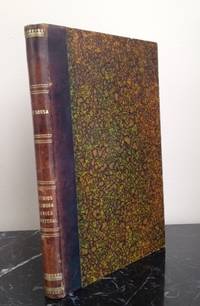
1789ref. 145041789. Sousa João de. Vestigios da lingoa arabica em Portugal ou lexicon etymologico das palavras e nomes portuguezes que tem origem Arabica 1789 a foundational linguistic study documenting the influence of Arabic language and culture on Portuguese vocabulary. João de Sousa an eighteenth century scholar of Arabic born in Damascus and later active in Portugal served as the first professor of Arabic at the University of Lisbon and was an associated member of the Academia Real das Sciencias. His work emerged from the scholarly environment of late Enlightenment Portugal when the study of language history and cultural transmission became central concerns of learned academies. The book records the long historical impact of Arabic speaking societies in the Iberian Peninsula where centuries of Islamic presence from the early Middle Ages through the late fifteenth century left lasting linguistic and cultural traces in Portuguese. Sousa João de. Vestigios da lingoa arabica em Portugal ou lexicon etymologico das palavras e nomes portuguezes que tem origem Arabica. Lisbon: Na Officina da Academia Real das Sciencias 1789. First edition. The work was produced under the authority of the Academia Real das Sciencias of Lisbon and represents the first etymological dictionary devoted specifically to Portuguese words of Arabic origin. Entries are arranged alphabetically in Portuguese and followed by the corresponding Arabic word or source a transliteration and an explanatory discussion. The lexicon also identifies Portuguese terms that entered the language through Arabic but ultimately derived from other linguistic traditions including Hebrew Greek Persian and Turkish. Among the loanwords catalogued are terms relating to plants spices agricultural products architecture and place names illustrating the wide range of everyday vocabulary shaped by centuries of cultural exchange between Islamic and Iberian societies. The book appeared during a period when European scholars increasingly examined the linguistic consequences of medieval cultural contact between Islamic and Christian societies in the Mediterranean world. The Iberian Peninsula in particular preserved a large body of Arabic derived vocabulary that entered both Portuguese and Spanish through trade agriculture science and administrative life during the centuries of Muslim rule and cultural interaction. Sousa's lexicon became an important early contribution to the study of these linguistic exchanges and preceded later nineteenth century scholarship on the subject. A second edition was published in 1830 and further studies such as the work of Francisco de S. Luiz did not appear until several decades later. Quarto volume with twenty preliminary pages and 160 pages of text woodcut device of the Academia Real das Sciencias on the title page bound in mid nineteenth century quarter sheep over marbled boards with pictorial lithograph bookplate of José Bernardo Pereira Martins. Small binder's ticket of Santos & Alves of Lisbon on the front pastedown occasional marginal annotations in ink and pencil minor repair to the upper margin of the title page and two other leaves without loss and slight wear to spine ends and corners. Overall very good condition. unknown
1789ref. 145041789. Sousa João de. Vestigios da lingoa arabica em Portugal ou lexicon etymologico das palavras e nomes portuguezes que tem origem Arabica 1789 a foundational linguistic study documenting the influence of Arabic language and culture on Portuguese vocabulary. João de Sousa an eighteenth century scholar of Arabic born in Damascus and later active in Portugal served as the first professor of Arabic at the University of Lisbon and was an associated member of the Academia Real das Sciencias. His work emerged from the scholarly environment of late Enlightenment Portugal when the study of language history and cultural transmission became central concerns of learned academies. The book records the long historical impact of Arabic speaking societies in the Iberian Peninsula where centuries of Islamic presence from the early Middle Ages through the late fifteenth century left lasting linguistic and cultural traces in Portuguese. Sousa João de. Vestigios da lingoa arabica em Portugal ou lexicon etymologico das palavras e nomes portuguezes que tem origem Arabica. Lisbon: Na Officina da Academia Real das Sciencias 1789. First edition. The work was produced under the authority of the Academia Real das Sciencias of Lisbon and represents the first etymological dictionary devoted specifically to Portuguese words of Arabic origin. Entries are arranged alphabetically in Portuguese and followed by the corresponding Arabic word or source a transliteration and an explanatory discussion. The lexicon also identifies Portuguese terms that entered the language through Arabic but ultimately derived from other linguistic traditions including Hebrew Greek Persian and Turkish. Among the loanwords catalogued are terms relating to plants spices agricultural products architecture and place names illustrating the wide range of everyday vocabulary shaped by centuries of cultural exchange between Islamic and Iberian societies. The book appeared during a period when European scholars increasingly examined the linguistic consequences of medieval cultural contact between Islamic and Christian societies in the Mediterranean world. The Iberian Peninsula in particular preserved a large body of Arabic derived vocabulary that entered both Portuguese and Spanish through trade agriculture science and administrative life during the centuries of Muslim rule and cultural interaction. Sousa's lexicon became an important early contribution to the study of these linguistic exchanges and preceded later nineteenth century scholarship on the subject. A second edition was published in 1830 and further studies such as the work of Francisco de S. Luiz did not appear until several decades later. Quarto volume with twenty preliminary pages and 160 pages of text woodcut device of the Academia Real das Sciencias on the title page bound in mid nineteenth century quarter sheep over marbled boards with pictorial lithograph bookplate of José Bernardo Pereira Martins. Small binder's ticket of Santos & Alves of Lisbon on the front pastedown occasional marginal annotations in ink and pencil minor repair to the upper margin of the title page and two other leaves without loss and slight wear to spine ends and corners. Overall very good condition. unknown books
18274 tiré-à-part reliés ensemble en 1 vol. in-8 reliure demie-percaline verte, Lettre à M. Abel-Rémusat sur la nature des formes grammaticales en général, et sur le génie de la langue chinoise en particulier, par M. G. de Humboldt ; Extrait du Journal des Savans, Février et mars 1828, A Paris de l'Imprimerie Royale, Mars 1828, 40 pp. - Nouveaux aperçus sur l'Histoire de l'Ecriture chez les Arabes du Hedjaz, Librairie Orientale de Dondey-Dupré Père et Fils, Paris, 1827, 27 pp. - Lettre à M. J. L. Burnouf sur l'Impératif latin, Imprimerie Panckoucke, Paris, Mars 1841, 31 pp. - Deuxième Lettre sur l'Impératif latin, Imprimerie de Paul Dupont et comp., Extrait du Journal Général de l'Instruction Publique, 1841, 4 pp. Bel exemplaire des ces quatres rares tirés à part, tous en édition originale. On y trouve la rare notice de Silvestre de Sacy consacrée à la controverse menées entre Abel-Rémusat et G. de Humboldt sur l'influence des formes grammaticales sur le développement des idées, et surtout l'introuvable notice du même auteur consacrée à l'histoire de l'Ecriture chez les arabes du Hedjaz : la découverte de papyrus en langue arabe permet à Silvestre de Sacy de confirmer son intuition, et l'autorise à affirmer que "le caractère neshki, dont on fixait l'invention à la fin du IIIe siècle de l'Hégire, existait, à peu près sous la forme actuelle, avant que les Arabes du Hedjaz reçussent d'Anbar ou de Hira celui qui a donné naissance au caractère coufique". Les deux tirés à part de Quicherat sont également en édition originale. Fine copy of the two very scarce original offprints by Silvestre de Sacy (OCLC records only two copies of the first one in the USA - Cornell and Standford according to OCLC, two copies in Cambridge and Manchester on COPAC -, no copy of the second one located in the USA, only one copy at Manchester University according to COPAC ). Français
18798vo, viii, 488 pages, frontispiece and 12 plates, 2 color maps, 1 foldout, Original Publisher's blue cloth, solid hinges, original yellow endpapers, all edges gilt. In very good condition. THE RAREST OF ISABEL BURTON'S BOOKS. Very good condition. This book was in essence an account of Isabel and Richard's Tour of India in the late 1870's. It includes political observations written by Richard but purporting to be Isablel's views on the partition of Turkey. The original source documents for this book, now with the Isabel Burton papers at the Wiltshire Records Office are entirely in Richard Burton's handwriting.
1899Very Good Turkish, Ottoman (1500-1928) Paperback. Foolscap 8vo. (18 x 13 cm). In Ottoman script (Turkish with Arabic letters). 80 p., [10] unnumbered b/w plts. Yenisehirlizâde Halit Eyüp was the son-in-law of Ahmet Midhat Efendi, one of the shaded names of Turkish literature. This rare book has 10 unnumbered b/w plates shows firstly Abd Al-Rahman Khan, (1845-1901), who was Emîr of Afghanistan and played a prominent role in the fierce and long-drawn struggle for power waged by his father and his uncle, A'?am Khân, against his cousin Shîr 'Alî, the successor of Dost Mo?ammad Khân. And then, Khaybar Fortress, Peshaver city in India, Tajik chief of Afghanistan: Maaz Khan (two-paged print), a view of Kabul city (two-paged print), Ghaznawid Fortress, North Gate of Kandahar, Herat Fortress (two-pages print), Cohat Fortress, a portrait of Afghan Sufi. An extremely rare and richly illustrated book of the history of Afghanistan. Hegira: 1316 = Gregorian: 1899. First and Only Edition. TBTK 12178.; Özege 19966.; Three copies located in OCLC: 944246927 (One copy in Library of Congress - Karl Süssheim Collection, No. 7.).; 163633157 (Orient-Institut Istanbul and Bayerische Staatsbibliothek).
1935Roy. 8vo., First Edition thus, with portrait frontispiece, 47 plates by Kennington, Rothenstein, Roberts and others, 6 illustrations in the text and 4 folding maps, endpapers faintly spotted; original decorative brown buckram gilt, gilt back, uncut, brown top, backstrip very lightly sunned else a near fine copy. The first publicly available edition of this literary classic, following private publication in 1926 and the limited edition of 1935. Winston Churchill believed that it 'ranks with the greatest books ever written in the English language'. The work also formed the basis of David Lean's multiple Oscar-winning feature film 'Lawrence of Arabia' starring Peter O'Toole and Omar Sharif. Enser, p.191; O'Brien A042.
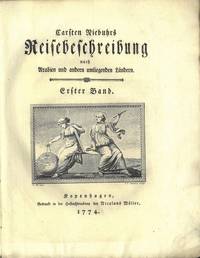
1774ref. 71463Kopenhagen 1774. Stor 4to. Samtidig stivt blankt omslag. Ubeskåret. XVI 4 505 1 s. LXXII kobberstukne plansjer hvorav flere foldet. Med et stort foldet kart over Jemen. Gedruckt in der Hofbuchdruckerey bey Nicolaus Möller Tysk. KUND BIND I. Plansjene delvis trykt på blålig papir. unknown
ref. ORD-8001Ouvrage traduit de l'anglais avec l'autorisation de l'auteur par Émile JONVEAUX. Et accompagné d'une carte et 4 plans. Paris. Hachette. 1866. Edition originale de la traduction française, parue un an après l'originale anglaise. 2 tomes en 2 volumes grand in-8 (164 x 242mm) dos chagrin bleu nuit à 4 nerfs, caissons, titre et filets or, plats toile chagrinée de même couleur orné de filets à froids (reliure de Vigneau & Pasquier), gardes moirées, tranches dorées, 2ff., portrait de l'auteur en frontispice, XVI pages (introduction par VIVIEN de SAINT-MARTIN), 346 pages et 1 d'erratum pour le tome 1; 2ff., 429, (1) pages pour le tome 2. Bien complet des plans et de la carte. Exemplaire en excellent état, je n'ai trouvé de rousseurs que sur la page 1 du tome 2, encore sont-elles très pâles, papier généralement très blanc.
1798ref. LBW-7952[Paris, P.G. Chanlaire et E. Mentelle, An six de la République - 1798]. 323 x 427 mm, sur papier bleuté.
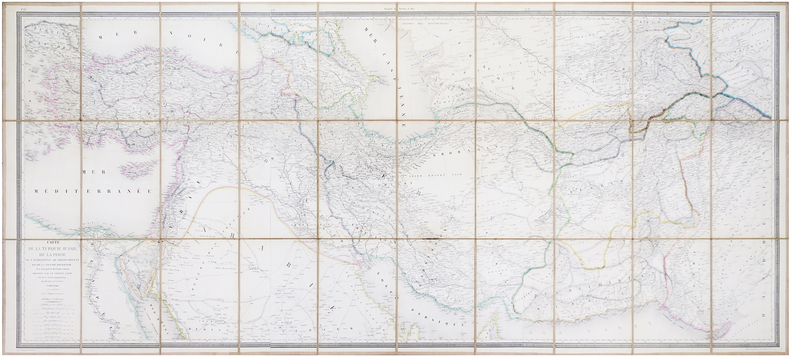
1848ref. LBW-6680Paris, C. Picquet, 1848. En 30 sections montées sur toile et pliées, formant une carte de 0,64 x 1,43 m ; étiquette au dos de l'éditeur E. Andriveau-Goujon.
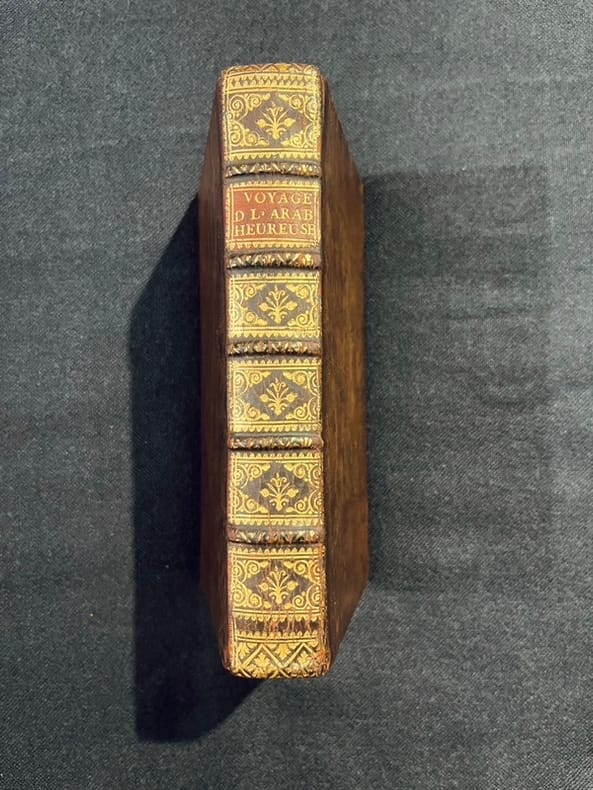
ref. 3864Paris, chez J.B. Costard, 1773-79, reliure aux armes (non identifiées) plein cuir d'époque, dos à cinq nerfs, caissons dorés, pièce de titre et tomaison rouge, tranches rouges, 10x17,5 cm, 440+477+427 pages. (traces d'encre noire ? au bas du dos des trois volumes).
1907Large format nautical charts of Aden Harbour and approaches surveyed from january to march 1906 by Lieutenants W. C. Taylor, A. G. Bingham, A. P. Robinson, E. D. Danson and J. E. Vibart under the direction of Capt. T. H. Heming in charge of the Marine Survey of India. The map was published at the Admiralty 26 november 1907 under the Superintendence of Rear Admiral A. Mostyn, large correstions 1932.
18203 voll. in-8, pp. XXIV, 635; 487; XX, 268, leg. mod. carta color. con tass. ai d. Con 5 tavv. in rame. La storia degli Arabi in Spagna dall’anno 572 fino all’anno 1493. Belliss. esempl. in barbe e intonso. [137]
1840Very Good Turkish, Ottoman (1500-1928) Original quarter leather bdg. Slight wear on spine. Otherwise a very good copy. Cr. 8vo. (20 x 15 cm). In Ottoman script (Old Turkish with Arabic letters). 143 p. Extremely rare first Turkish edition of the legend of Hatem of Tai tribe, or "the tale of Hatemtai, or qissa-e Hatem-Tai" which was very popular in the Indian subcontinent, as well as the earliest printed separate form from the Arabian nights [Alf laila wa laila] in the Middle East. In Turkish literature, this story was printed nine times separately from the Arabian nights (1840, 1856, 1867, 1871, 1874, 1879, 1885, 1891, 1925). This is the very first edition of this book. Hatim al-Tai (?âtim bin Abd Allâh bin Sa'ad a't-Tâ'iyy; Hatim of the Tayy tribe; deceased 578), was the ruling prince and poet of the Tayy tribe of Arabia. Stories about his extreme generosity have made him an icon among Arabs up until today, as evident in the proverbial phrase "more generous than Hatim". His son was Adi ibn Hatim, who was a companion of the Islamic prophet Muhammad. Al-Tai lived in Ha'il in present-day Saudi Arabia and was mentioned in some Hadiths by Muhammad. He died in 578 AD and was buried in Tuwarin, Ha'il. His tomb is described in the Arabian Nights. He lived in the sixth century CE and was also mentioned in the Arabian Nights stories. The celebrated Persian poet Saadi, in his work Gulistan (1259 CE) wrote: "Hatim Tai no longer exists but his exalted name will remain famous for virtue to eternity. Distribute the tithe of your wealth in alms; for when the husbandman lops off the exuberant branches from the vine, it produces an increase of grapes". He is also mentioned in Saadi's Bostan (1257). According to legends in various books and stories, he was a famous personality in the region of Ta'i (present-day Ha'il) and is also a well-known figure in the rest of the Middle East as well as the Indian subcontinent, featuring in many books, films, and TV series in Arabic, Persian, Urdu, Turkish, Hindi and various other languages. The books on the story usually consist of a short introduction describing his ancestry and character and tell the seven episodes based on seven riddles, asked by a beautiful and rich woman named Husn Banu, who will marry only the person who is able to obtain answers to all seven of them. A king, who falls in love with her but is unable to find answers, tells the generous Hatemtai, whom he meets by chance, all about it. Hatim undertakes the quest to find the answers and help the king marry her. Özege 3639.; TBTK 8155.; Only one copy in the Library of Congress according to OCLC 951465696.
1840Very Good Turkish, Ottoman (1500-1928) Original full leather bdg. in Islamic style with a flap. Demy 8vo. (22 15 cm). In Ottoman script (Old Turkish with Arabic letters). 285 p. Rebacked to spine, slight wear on binding. Overall a good copy. Early Turkish edition of the book of parrot (or the book of Humayun), which is a 14th-century series of 52 stories, originally written in Persian, translated by Sari Abdullah Efendi (1584-1660), who was an Ottoman mystic poet and scholar. The adventure stories narrated by a parrot, night after night, for 52 successive nights, are moralistic stories to persuade his female owner Khojasta not to commit any adulterous act with any lover, in the absence of her husband. She is always on the point of leaving the house to meet her lover until the loyal parrot detains her with a fascinating story. The authorship of the text of the Tutinama is credited to Ziya'al-Din Nakhshabi or just Nakhshabi, an ethnic Persian physician and a Sufi saint who had migrated to Badayun, Uttar Pradesh in India in the 14th century, and wrote in the Persian language. He had translated and/or edited a classical Sanskrit version of the stories similar to Tutinama into Persian, around 1335 AD. It is conjectured that this small book of short stories, moralistic in theme, influenced Akbar during his formative years. It is also inferred that since Akbar had a harem (of women siblings, wives, and women servants), the moralistic stories had a specific orientation towards the control of women. The main narrator of the 52 stories of Tutinama is a parrot, who tells stories to his owner, a woman called Khojasta, in order to prevent her from committing any illicit affair while her husband (a merchant by the name Maimunis) is away on business. The merchant had gone on his business trip leaving behind his wife in the company of a mynah and a parrot. The wife strangles the mynah for advising her not to indulge in illicit affairs. The parrot, realizing the gravity of the situation, adopts a more indirect approach of narrating fascinating stories over the next fifty-two nights. The stories are narrated every successive night as an entertaining episode to keep Khojasta's attention and distract her from going out. The Persian text used was redacted in the 14th century AD from an earlier anthology 'Seventy Tales of the Parrot'in Sanskrit compiled under the title Sukasaptati (a part of katha literature) dated to the 12th century AD. In India, parrots (in light of their purported conversational abilities) are popular as storytellers in works of fiction. (Source: Wikipedia). Özege 21353., OCLC 165609299.
1982ref. 56847Saudi Arabia: Ministry/Defense & Aviation 1982. good. Quarto approx. 150 3-ring plastic binder with customized front and spine text 3-hole punched color illus. color figures. Slight wear and soiling to binder. In early 1981 the Saudi government requested American assistance in providing meteorological support to the Kingdom's military forces. This request was accepted. This document constitutes a visionary organizational arrangement for the Kingdom. Weather morale and logistics are three imponderables of warfare with morale and logistics significantly affected by weather. This plan considers the unique position of the Kingdom the sophisticated armaments in the region command and control requirements economy of force and responsiveness to external contingencies among other factors. The plan represents the then state of the art technology and equipment and required a military-civil mix of personnel to execute and to understand and respond to military needs. This plan was prepared by a joint Saudi and U.S. team comprised of highly-skilled professionals including a number from the U.S. Department of Defense and the military services. This plan was deemed to meet military requirements standardize the service emphasize safety and operations response and to aid in decisions affecting the rules of engagement. Ministry/Defense & Aviation unknown
1680ref. LBW-7558Paris, chez l'auteur, [circa 1680]. 381 x 537 mm.
1758In.-8°; 2 voll. rilegati in piena pelle con tasselli e titolo in oro al dorso, tagli in rosso. 1- pp. (4), xxiv, 464, (2). 2 - pp. (4), 518, (2) con 3 tavole f.t. ripiegate incise su rame, tra cui una che raffigura la pianta della città di Gerusalemme. Nel testo testate e finalini incisi su legno. Brunet 28372
1869The light vessels being the predecessors of the two permanent lighthouses of Ceylon fame, situated some fourteen kilometers apart off the coast of Yala National Park. Two folio documents: April 1869 double leaf true copy of a memorandum on winds and currents at Little Basses; April 1870 single leaf notice to sea captains announcing the temporary lighthouse near the Great Basses, issued by Colonial Secretary Henry Turner Irving (later Governor) and penned in a secretarial hand; both on blindstamped stationery of the United States Commercial Agency of Ceylon measuring approximately 20 x 32 cm. Slight age-toning, otherwise in very good condition, rare documents connected to two offshore lighthouses which are among the most famous in Asia. This fascinating and detailed manuscript lighthouse report, was made prior to the actual lighthouses having been constructed, by a sea captain who lived on the light ship anchored off the Ceylon southern shore for at least seven years, making important observations and providing light for navigators. The first document is an annual report by John Buchanan, master of the light vessel at Little Basses, describing seasonal wind and weather conditions, sea currents, tides, monsoons and storms, over the period of one year. The captain also describes steamships having difficulties making the passage to shore. This document being a true copy of the original made in April 1869 by Thomas Steele, Assistant Government Agent at Hambantota, who took a noteworthy interest in local antiquities and Sinhalese literature. [An admiralty notice based on Buchanan's memorandum, though slightly edited, was published in the London and China Telegraph, Vol. 12, May 16, 1870, and also in The Nautical Magazine and Naval Chronicle for 1870]. Excerpts from Buchanan's lightship memorandum: ".... at Little Basses Rocks, Ceylon, during 13 months as observed from the Light Ship." "January [1869]... It would not be inaccurate to say that a strong current continues throughout January coming from the NNE from the Bay of Bengal setting S.S.W. Sea crossing very rough all the month.... both wind and tide against them...difficult for ships to get to the Northeast. It would be well not to attempt to do so." "February... towards the end of the month the wind becomes much lighter. The northerly current also slacken. Occasionally in the month the Light Vessel swings. In 1868, however, she did not swing until April, while in the current year (1869) she swings in February. During the seven years I have been here, the SW monsoon has not hitherto set in regularly until from the 4th to the 10th of May. This year it has been steady at SW since April 6th. The present year is accordingly an exception to the rule..." "I consider March one of our finest months at the Little Basses... 87º in the shade... Shipmasters going to any part of Burmah need have no cause for hesitation... " "May... the monsoon sets in strong and steady... much rain falls, and thunder and lightning... until about the 20th October..." "June, July, August and September... the S.W. monsoon blows strong and steady... Notwithstanding the extreme difficulty I have been enabled (occasionally at much risk of life and property) to keep up a monthly communication with Pottana Bay [Pothana Bay], and thence by land with Galle." "November... much thunder and lightning... Floating bodies invariably I have observed, set right out to sea, S.S.W. ..." "Summary... There are no regular tides... the N.E. monsoon... during five months without variation. Thus a steamer steering N.N.E., has not only to oppose a three-knot tide opposed to her, but the wind dead against her... some steamers barely make two miles an hour going to the north... When the sun goes to the northward of the Light Ship, there is no more N.E. monsoon... in the event of a vessel making Dondra Head when bound to Galle, which is not uncommon the Master should never attempt to beat to Galle, but recross the line." End Excerpts. "Notice to Mariners, Bay of Bengal. Temporary Lighthouse near the Great Basses" heads the second document, which was issued by Colonial Secretary Henry T. Irving at Colombo in April 1870. Irving became a colonial governor not long after. Here too, prior to construction of a permanent structure, the admiralty anchored a temporary light-vessel upon which was mounted a revolving signal. This announcement came approximately one year before placement of the first stone for the lighthouse, and four years before it would begin operation. Excerpt from Irving's notice to mariners: "... it is hereby notified... that a light-vessel, exhibiting at an elevation of 38 feet above the sea, a red revolving light at intervals of 45 seconds, has been placed... at a distance of 3/4 of a mile from the N.E. rock of the Great Basses Reef... The vessel carries two balls vertical at the Mast Head." End Excerpt. Sir Henry Turner Irving, GCMG (1833-1923) was a British Civil Servant and Colonial Administrator. He first served as acting Governor of British Ceylon. In 1873-1874, he served as Governor of the Leeward Islands. In 1874-1880, he served as Governor of Trinidad and Tobago. In 1882-1887, he served as Governor of British Guiana. He was the first Governor of Trinidad to occupy the Government House, now known as the President's House. Notes on the lighthouses that subsequently replaced the "light-ships" described above: Great Basses Reef Lighthouse is an offshore lighthouse in the south of Sri Lanka. Accessible only by boat, it is located on a reef 13 km off the coast of Yala National Park, near Little Basses Reef Lighthouse. The necessity of a lighthouse at this location was acknowledged in 1856, a design of an iron tower on a granite base was suggested and costs began to be incurred without fruition. A new design by Alexander Gordon and Sir James Nicholas Douglass was approved in 1867. The executive engineer in charge was James' brother William Douglass. Two steam vessels were used, each capable of carrying 120 tonnes of stone, and each equipped with the appropriate lifting gear. Each support block weighed 2 to 3 tons. The first stone was laid in December 1870, the last in late 1872 and the light was lit in March 1873. The cost had been £63,000, of which £40,000 had been expended to no effect before Trinity House and William Douglass were involved. Little Basses Reef Lighthouse is an active offshore lighthouse at the southern end of Sri Lanka. It is located on a reef called Kuda Ravana Kotuwa (Fort of Little Ravana), formerly called Little Basses by the British when they invaded Ceylon. It is fourteen km off the coast of Yala National Park and north east of the Great Basses Reef Lighthouse. It was completed in 1878, built by William Douglass using the same steam ships, crew and workers as the Great Basses Reef Lighthouse. Designed by Sir James Nicholas Douglass, Little Basses lighthouse was one of a limited number of lighthouses that were designed to house the large Hyperradiant Fresnel lenses that became available at the end of the 19th century. Four of these lenses were used in Sri Lankan lights, all made by Chance Brothers in England. The lighthouse is close to Daedalus Rock, site of the sinking of HMS Daedalus (1811). The two Basses lighthouses are among the most famous offshore lighthouses of Asia. Manuscript
1952Small octavo, original pale green cloth. Very good condition in the rare dustjacket. First and only edition of this scarce guidebook to the Persian Gulf, illustrated with 16 half-tone plates from photographs by the author and three maps. This scarce guidebook was written shortly after the beginning of full-scale oil drilling in the region, and includes chapters on Bahrain, Kuwait, Qatar, the Trucial Coast (modern-day United Arab Emirates), and Muscat Oman, covering local history, society and culture, with a chapter on the pearl industry. Tweedy writes that Doha is "practically untouched by the progressive hands of the West and the camels and donkeys outnumber the motor-cars how long this simplicity will last is hard to say, for the enormous increase in oil revenues must inevitably affect the lives of all" (39-40).
1733in-4, pp. (6), 374, bella leg. m. pelle coeva con tass. al d., tagli spruzzati. Front. a due colori. Testo latino e arabo. [136]
1716ref. 21801A Amsterdam, chez Steenhouwer et Uytwerp, 1716. In-12 de [16]-343-[13] pages (dernier feuillet blanc) :*8;A-N12; P4;Q6. Pleine basane brune, dos à nerfs orné de filets et fleurons dorés, pièce de titre beige, tranches rouges.
1866ref. 26274Paris Challamel aîné 1866 in-8 cartonnage moderne papier vert, titre en long sur pièce de maroquin vert [Honnelaître]
2025ref. __3031090470Springer 2025. Hardcover. New. 10.00x7.01 inches. Springer hardcover
1743ref. PHO-1218La HAYE ,Jean Neaulme, 1743, deux volumes in 4° (260x210mm) reliés plein veau marbré, dos orné à 5 nerfs, pièce de titre, tranches rouges ,(2 plats détachés),coiffes arasées, coins usés, papier bruni ,Épître à Frédéric roi de Prusse imprimé en rouge et noir, XLIV-414pp./IV-192 pp., à la suite extraits de plusieurs auteurs anciens et autres pièces ,178 pp. ,orné de 12 cartes dont 9 dépliantes et 21 planches dont 5 dépliantes, une planche de musique et un fragment de la célèbre carte de Peutinger , ex-libris de Charles Kettaneh Première édition en français,