1.401 Ergebnisse
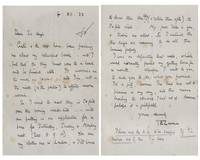
1923Best.-Nr. 0088591923. Letter. This 4 December 1923 autograph letter signed by T. E. Lawrence is noteworthy in multiple respects including: for referencing an important meeting about what would become the Subscribers issue of Seven Pillars of Wisdom; for being written to Lawrences great friend and patron Hugh Trenchard the head and father of the Royal Air Force; for highlighting the contradictions inherent to Lawrences supposedly anonymous enlistment in the R.A.F.; for being signed with Lawrences true name which he had already effectively abandoned. The letter is also replete with Lawrences characteristic liberties with punctuation and grammar which so amusingly belied his remarkable erudition. Curtis & the rest have been pressing me about my reluctant book: and I feel that the thing must come to a head and be finished with. The letter is written entirely in Lawrences hand on the first and third panels of a single folded sheet of 9 x 7 inches 22.86 x 17.78 cm watermarked Waverley Pen Vellum stationery folded once to make four 4.5 x 7 inches 11.43 x 17.78 cm panels. The letter is dated 4 . XII . 23 with the salutation Dear Sir Hugh. The body of the letter reads in full: Curtis & the rest have been pressing me about my reluctant book: and I feel that the thing must come to a head and be finished with. It worries me too much as it is: and Im not in the mood or the position to afford more worries. So I want to meet them in Oxford over the coming week-end . And am putting in an application for a pass for Saturday Sunday & Monday next. Dec. 8.9.10. You see my clothes are in London & Ill have to draw them there before & return them after the Oxford visit. My poor bike is gone & trains are slow. So I estimate the three days as necessary to do all the business properly. I was on defaulters last week which would normally prevent my getting leave for a month. Wherefore I write to you to ask you to do what you promised. Its a pity because Ive tried here not to presume in any way and this means breaking the standard I had set up. However perhaps it is justifiable. Lawrence signed TELawrence below his valediction yours sincerely. A two-line post script underlined follows: Please ask the A. G. to be careful. If Im kicked out of this Im done. Condition Condition is good plus Lawrences ink clear and distinct. The stationery is complete though spotted and with a horizontal and vertical fold bisecting each panel ostensibly from original mailing. Initials at the head of the first panel just below the date are plausibly those of Trenchard. The letter is protected in a clear removable archival sleeve housed within a rigid full blue Morocco goatskin folder with a gilt-printed front cover gilt-ruled turn-ins framing gray paper pastedowns within and an integral printed cardstock insert. Lawrence of Arabia During the First World War Thomas Edward T. E. Lawrence 1888-1935 experienced a transformative odyssey as instigator organizer hero and tragic figure of the Arab Revolt against the Ottoman Empire which he began as an eccentric junior intelligence officer and ended as "Lawrence of Arabia. He spent the rest of his famously short life struggling to variously reconcile reject share and repress this indelible experience which was eventually recounted in his magnum opus Seven Pillars of Wisdom. The Father of the Royal Air Force Father of the Royal Air Force Hugh Montague Trenchard First Viscount Trenchard 1873-1956 began his military career as a dashing cavalry officer full of high Victorian bravado who attracted the notice of his superiors for blunt words boundless energy and stern discipline of men under his command. At forty Trenchard asked for leave to learn to fly at his own expense and then joined the Royal Flying Corps which had been formed only months before. There his age and military experience saw him appointed to the staff and he recognized more quickly than most officers of his age the aeroplane's unlimited military potential. He would be indelibly associated with Britains air service for the rest of his life. Before the end of the First World War Trenchard was both appointed the first head of the new Royal Air Force and knighted. By 1919 Trenchard was created a baronet and was working to secure the foundations of an enduring independent RAF. Trenchard and T. E . Shaw Trenchard and T. E. Lawrence both worked with and for Winston S. Churchill who was respectively Secretary of State for War and Air appointed January 1919 and Colonial Secretary appointed February 1921. Perhaps Trenchards own impetuous inclinations and the experience of being both of and other in British society and institutions facilitated Trenchards friendship with T. E. Lawrence. That friendship proved critical for Lawrence and emblematic of the inherent contradictions between his inescapable fame and his fitful attempts to evade and ignore it. At the beginning of January 1922 Lawrence wrote to Trenchard expressing a wish to join the R.A.F.: Its an odd request this hardly proper perhaps asking you to use your influence to get me past the Recruiting Officer! By July Churchill had released Lawrence from service and in August Lawrence enlisted first under the name John Hume Ross and later Thomas Edward Shaw a name he used until his death. Hence from that time forward he seldom signed with his original surname. Ive tried here not to presume in any way and this means breaking the standard I had set up. However perhaps it is justifiable. As evident in this letter despite his pretensions to anonymity and protestations of humility as an enlisted Aircraftman Lawrence was not above calling in favors from the exalted Trenchard. Lawrences friendship with Trenchard was known to his superiors and often resented. In the case of this letter Lawrence was going over the head of his local superiors to secure a pass in order to attend a meeting about publishing Seven Pillars of Wisdom. In this effort Lawrence was successful; Lawrence did meet in Oxford with Lionel Curtis referenced in this letter D. G. Hogarth and Alan Dawnay on 9 December 1923 where in Lawrences words the four decided to produce 100 copies of the Seven Pillars at thirty guineas a copy if so many subscribers can be found. Curtis was one of Lawrences most trusted friends and it was mainly Curtis and D. G. Hogarth who had persuaded Lawrence to rewrite Seven Pillars after the original manuscript was lost in 1919. Specially bound in R.A.F. blue When Lawrence finally published the famous Subscribers Edition of Seven Pillars of Wisdom in 1926 Trenchard was among the select few gifted a presentation copy Trenchards specially bound in R.A.F. blue. The edition would also be known as the Cranwell Edition because Lawrence was stationed at the Cranwell Cadet College founded by Trenchard when he completed it. References: Wilson Lawrence of Arabia; ODNB; T. E. Lawrence: Correspondence with the Political Elite unknown