ROBERTS (David).Livre Rare Book
1482 risultati
1842rif. LBW-8857London, F.G. Moon, 1842. 513 x 335 mm.
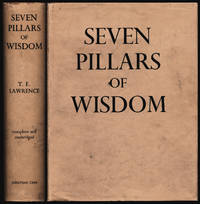
1936Roy. 8vo., First US Trade Edition, with a portrait frontispiece, 47 plates by Kennington, Rothenstein, Roberts and others, 6 illustrations in the text and 4 folding maps coloured in outline; handsomely bound in red full morocco, back gilt with five raised bands, second and fourth compartments lettered and ruled in gilt, all other compartments tooled and ruled in gilt, uncut, pictorial gilt from original board preserved and mounted on new leaf at front, a most attractive copy ideal as a gift or for presentation. The first publicly available US edition of this literary classic, following private publication in 1926 and the limited edition of 1935. Winston Churchill believed that it 'ranks with the greatest books ever written in the English language'. The work forms the basis of David Lean's multiple Oscar-winning feature film 'Lawrence of Arabia' (1962) starring Peter O'Toole and Omar Sharif. Enser, p.191; O'Brien A42.
1878Original letter penned and signed by Layard after the Bulgarian uprising in the Balkans. The letter measures 7 x 9 inches dated February 23, 1878 while he was HBM Ambassador in Constantinople. The letter provides a reference for a James Long, MA who was a humanitarian. Long was about to go to Bazandjik on the Danube in Bulgaria which had recently been occupied by the Russians during the Russo-Turkish War. Together with the letter is an original portrait photograph of Layard measuring 8 x 10 inches as well as a contemporary bigraphical sketch from the 1880's. Letters from Layard while abroad are rare. Manuscript
1921rif. 512921 brochure in-8, Imprimerie d'Etudes Sociales et Politiques, s.d. [ 1921 ], 34 pp.
1845rif. 5842Paris, Imprimerie Royale, 1845. 2 vol. in-12 (135 x 84 mm), (3) ff., CLXXX pp. : Discours préliminaire, 154 pp. : Chaîne des Chroniques + 105-(1) pp., env. (100) ff. : Texte arabe. Reliure demi-veau, dos à faux-nerfs orné d'une pièce de titre et de tomaison, orné de roulettes dorés, dernier feuillet du vol. 2 : impression bicolore, vol. 1 : 4 ff. ont un trou de vers dans la marge inf., vol. 2 : 12 ff. présentent une trace de pliure dans le coin sup., bel état. Très bel exemplaire.
1935rif. SevenPillarsTELawrenceSeven Pillars of Wisdom T.E. Lawrence aka Lawrence of Arabia Hardcover First Trade Edition - First Printing London: Jonathan Cape 1935. 30s aka 30 shillings cover price present no indication of later printings on copyright page indicating a first printing with the exception of a private edition issued in 1926 mostly to friends associates and family. Contains numerous portraits some city and desert scenes a few caricatures and humorous images and three maps. Near Fine in Very Good Dust Jacket. A splendid copy notoriously difficult to find in nearly intact dust jacket. The book itself has typical again and a little hint of discoloration to the boards. The text-block edges are uneven which is common with this edition. Sometimes the pages/leaves were cut after the printing causing the text-block to be uneven on the right-hand side. The pages themselves are quite clean. The jacket is nearly all there with just a bit of fraying to the top spine common edge-wear and slits here and there but no major tears or chips. Quite nice. NOTE: All modern books with dust jackets come with dust jacket covers. ALSO: The pictures are of the actual item for sale. The pictures are NOT stock photos. Jonathan Cape hardcover
1946rif. 192581London: Naval Intelligence Division 1946. First edition of this comprehensive and extensively illustrated regional handbook prepared under the direction of the academic geographer Lieutenant-Colonel Kenneth Mason a recipient of the Founder's Medal of the Royal Geographical Society. Chapters cover geology geography coastal areas climate vegetation demographics public health and economics. Specific sections explore the history and governance of the Arabian Peninsula in the 20th century addressing Saudi Arabia Yemen and Aden. Western Arabia and the Red Sea was part of a new series of handbooks intended to replace those produced by the Admiralty in the First World War. The series one of the largest geographical compilation efforts ever attempted was spearheaded by Rear-Admiral John Godfrey 1888-1970 Director of Naval Intelligence and his personal assistant Ian Fleming. This copy has a label mounted over the classification statement on the title page verso confirming that it was sold after the series was declassified and made available to the public. Octavo. Halftone frontispiece after photograph of Mecca 169 halftone photographic plates 1 folding 18 maps 12 folding of which 5 with highlights in blue or brown large colour folding map of Arabia in end pocket folding pedigree; plans sketches tables and maps in text; printer's credit overpasted as issued. Original green cloth spine and front board lettered in gilt. Spine sunned and lightly mottled rear board lightly scratched contents bright: a very good copy. hardcover
1776rif. 94389Amsterdam, Baalde, Utrecht, Van Schoonhoven 1776 In-4 25,5 x 20,5 cm. Reliure plein veau porphyre, dos à nerfs, caissons ornés, triple filet sur les plats, titre gravé, 10-407 pp., 72 planches, 23 repliés dont 6 cartes. Reliure usée, premier plat partiellement délié fragile, coiffes arrachées, manque en tête, mors fendillés et coins émoussés. Quelques rousseurs marginales éparses, sinon int. assez frais. En l’état.
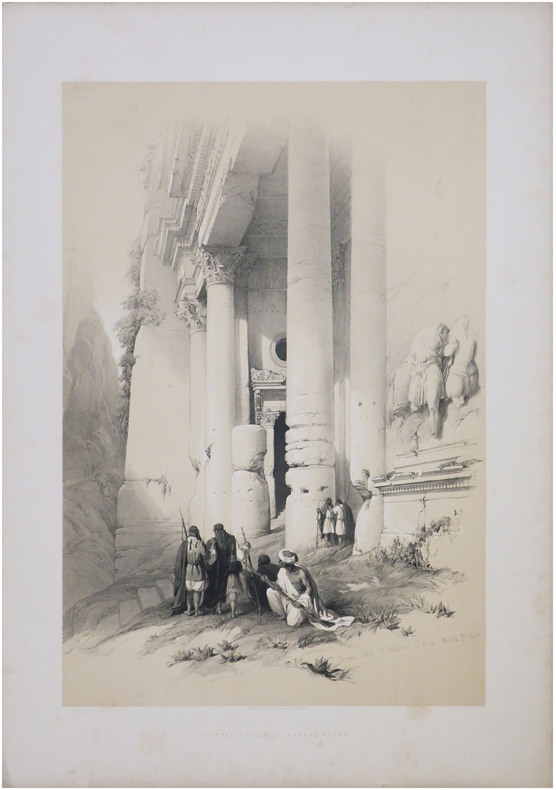
1836Boards faded and professionally repaired. Very light occasional foxing. Front free endpaper dog eared ; Scarce. SIGNED on front endpaper by the Earl of Ellenborough with his bookplate. Frontispiece of "Interior View of the Khasne". One fold-out map and Numerous tissue guarded b&w illustrations; 8vo; xxviii, map, 331, 4 pages
1894In-8 gr. (mm. 260x208), tela editoriale con titolo oro al piatto (in lingua orientale) e al dorso, pp. (4),6,(4), 42 cc.num., 1 c.nn., stampate solo al recto. Seconda edizione (la prima è del 1880, stampata privatamente da Quaritch). Dalla prefazione, scritta da Isabel Burton (moglie dell’A.): “On the return journey from Meccah, when Richard Burton could secure any privacy, he composed the following exquisite gem of Oriental poetry, and called it “The Kasidah”. by Haji Abdu al-Yazdi, which was one of his Eastern noms-de-plume.. “The Kasidah” was written in 1853. It is a poem of extraordinary power, on the Nature and Destiny of Man, anti-Christian and Pantheistic. So much wealth of Oriental learning has rarely been compressed into so small a compass..”. “Sir Richard Francis Burton (1821-1890), viaggiatore e scrittore inglese. Per alcuni anni in India, compì (1853) un viaggio alla Mecca travestito da pellegrino; e quindi in Somalia riuscendo a raggiungere Harrar, non ancora visitata da Europei (1854). Parti’ quindi con Speke alla ricerca delle sorgenti del Nilo e scoprì il lago Tanganica (1858). Fu poi in California e nuovamente in Africa, dove salì per primo il M. Camerun. Lasciò importanti relazioni delle sue esplorazioni”, così Diz. Treccani,II, p. 561-62. Bella edizione in tiratura limitata di sole 100 copie numerate. La ns., 46, è in ottimo stato, con barbe.
1772rif. 36574Paris Vincent 1772 fort vol. in-8 veau fauve marbré, dos à nerfs cloisonné et fleuronné, pièce de titre cerise, encadrement de triple filet doré sur les plats, tranches marbrées [Rel. de l'époque], un mors supérieur fendu
1789rif. 145041789. Sousa João de. Vestigios da lingoa arabica em Portugal ou lexicon etymologico das palavras e nomes portuguezes que tem origem Arabica 1789 a foundational linguistic study documenting the influence of Arabic language and culture on Portuguese vocabulary. João de Sousa an eighteenth century scholar of Arabic born in Damascus and later active in Portugal served as the first professor of Arabic at the University of Lisbon and was an associated member of the Academia Real das Sciencias. His work emerged from the scholarly environment of late Enlightenment Portugal when the study of language history and cultural transmission became central concerns of learned academies. The book records the long historical impact of Arabic speaking societies in the Iberian Peninsula where centuries of Islamic presence from the early Middle Ages through the late fifteenth century left lasting linguistic and cultural traces in Portuguese. Sousa João de. Vestigios da lingoa arabica em Portugal ou lexicon etymologico das palavras e nomes portuguezes que tem origem Arabica. Lisbon: Na Officina da Academia Real das Sciencias 1789. First edition. The work was produced under the authority of the Academia Real das Sciencias of Lisbon and represents the first etymological dictionary devoted specifically to Portuguese words of Arabic origin. Entries are arranged alphabetically in Portuguese and followed by the corresponding Arabic word or source a transliteration and an explanatory discussion. The lexicon also identifies Portuguese terms that entered the language through Arabic but ultimately derived from other linguistic traditions including Hebrew Greek Persian and Turkish. Among the loanwords catalogued are terms relating to plants spices agricultural products architecture and place names illustrating the wide range of everyday vocabulary shaped by centuries of cultural exchange between Islamic and Iberian societies. The book appeared during a period when European scholars increasingly examined the linguistic consequences of medieval cultural contact between Islamic and Christian societies in the Mediterranean world. The Iberian Peninsula in particular preserved a large body of Arabic derived vocabulary that entered both Portuguese and Spanish through trade agriculture science and administrative life during the centuries of Muslim rule and cultural interaction. Sousa's lexicon became an important early contribution to the study of these linguistic exchanges and preceded later nineteenth century scholarship on the subject. A second edition was published in 1830 and further studies such as the work of Francisco de S. Luiz did not appear until several decades later. Quarto volume with twenty preliminary pages and 160 pages of text woodcut device of the Academia Real das Sciencias on the title page bound in mid nineteenth century quarter sheep over marbled boards with pictorial lithograph bookplate of José Bernardo Pereira Martins. Small binder's ticket of Santos & Alves of Lisbon on the front pastedown occasional marginal annotations in ink and pencil minor repair to the upper margin of the title page and two other leaves without loss and slight wear to spine ends and corners. Overall very good condition. unknown books
1789rif. 145041789. Sousa João de. Vestigios da lingoa arabica em Portugal ou lexicon etymologico das palavras e nomes portuguezes que tem origem Arabica 1789 a foundational linguistic study documenting the influence of Arabic language and culture on Portuguese vocabulary. João de Sousa an eighteenth century scholar of Arabic born in Damascus and later active in Portugal served as the first professor of Arabic at the University of Lisbon and was an associated member of the Academia Real das Sciencias. His work emerged from the scholarly environment of late Enlightenment Portugal when the study of language history and cultural transmission became central concerns of learned academies. The book records the long historical impact of Arabic speaking societies in the Iberian Peninsula where centuries of Islamic presence from the early Middle Ages through the late fifteenth century left lasting linguistic and cultural traces in Portuguese. Sousa João de. Vestigios da lingoa arabica em Portugal ou lexicon etymologico das palavras e nomes portuguezes que tem origem Arabica. Lisbon: Na Officina da Academia Real das Sciencias 1789. First edition. The work was produced under the authority of the Academia Real das Sciencias of Lisbon and represents the first etymological dictionary devoted specifically to Portuguese words of Arabic origin. Entries are arranged alphabetically in Portuguese and followed by the corresponding Arabic word or source a transliteration and an explanatory discussion. The lexicon also identifies Portuguese terms that entered the language through Arabic but ultimately derived from other linguistic traditions including Hebrew Greek Persian and Turkish. Among the loanwords catalogued are terms relating to plants spices agricultural products architecture and place names illustrating the wide range of everyday vocabulary shaped by centuries of cultural exchange between Islamic and Iberian societies. The book appeared during a period when European scholars increasingly examined the linguistic consequences of medieval cultural contact between Islamic and Christian societies in the Mediterranean world. The Iberian Peninsula in particular preserved a large body of Arabic derived vocabulary that entered both Portuguese and Spanish through trade agriculture science and administrative life during the centuries of Muslim rule and cultural interaction. Sousa's lexicon became an important early contribution to the study of these linguistic exchanges and preceded later nineteenth century scholarship on the subject. A second edition was published in 1830 and further studies such as the work of Francisco de S. Luiz did not appear until several decades later. Quarto volume with twenty preliminary pages and 160 pages of text woodcut device of the Academia Real das Sciencias on the title page bound in mid nineteenth century quarter sheep over marbled boards with pictorial lithograph bookplate of José Bernardo Pereira Martins. Small binder's ticket of Santos & Alves of Lisbon on the front pastedown occasional marginal annotations in ink and pencil minor repair to the upper margin of the title page and two other leaves without loss and slight wear to spine ends and corners. Overall very good condition. unknown
18274 tiré-à-part reliés ensemble en 1 vol. in-8 reliure demie-percaline verte, Lettre à M. Abel-Rémusat sur la nature des formes grammaticales en général, et sur le génie de la langue chinoise en particulier, par M. G. de Humboldt ; Extrait du Journal des Savans, Février et mars 1828, A Paris de l'Imprimerie Royale, Mars 1828, 40 pp. - Nouveaux aperçus sur l'Histoire de l'Ecriture chez les Arabes du Hedjaz, Librairie Orientale de Dondey-Dupré Père et Fils, Paris, 1827, 27 pp. - Lettre à M. J. L. Burnouf sur l'Impératif latin, Imprimerie Panckoucke, Paris, Mars 1841, 31 pp. - Deuxième Lettre sur l'Impératif latin, Imprimerie de Paul Dupont et comp., Extrait du Journal Général de l'Instruction Publique, 1841, 4 pp. Bel exemplaire des ces quatres rares tirés à part, tous en édition originale. On y trouve la rare notice de Silvestre de Sacy consacrée à la controverse menées entre Abel-Rémusat et G. de Humboldt sur l'influence des formes grammaticales sur le développement des idées, et surtout l'introuvable notice du même auteur consacrée à l'histoire de l'Ecriture chez les arabes du Hedjaz : la découverte de papyrus en langue arabe permet à Silvestre de Sacy de confirmer son intuition, et l'autorise à affirmer que "le caractère neshki, dont on fixait l'invention à la fin du IIIe siècle de l'Hégire, existait, à peu près sous la forme actuelle, avant que les Arabes du Hedjaz reçussent d'Anbar ou de Hira celui qui a donné naissance au caractère coufique". Les deux tirés à part de Quicherat sont également en édition originale. Fine copy of the two very scarce original offprints by Silvestre de Sacy (OCLC records only two copies of the first one in the USA - Cornell and Standford according to OCLC, two copies in Cambridge and Manchester on COPAC -, no copy of the second one located in the USA, only one copy at Manchester University according to COPAC ). Français
18798vo, viii, 488 pages, frontispiece and 12 plates, 2 color maps, 1 foldout, Original Publisher's blue cloth, solid hinges, original yellow endpapers, all edges gilt. In very good condition. THE RAREST OF ISABEL BURTON'S BOOKS. Very good condition. This book was in essence an account of Isabel and Richard's Tour of India in the late 1870's. It includes political observations written by Richard but purporting to be Isablel's views on the partition of Turkey. The original source documents for this book, now with the Isabel Burton papers at the Wiltshire Records Office are entirely in Richard Burton's handwriting.
1899Very Good Turkish, Ottoman (1500-1928) Paperback. Foolscap 8vo. (18 x 13 cm). In Ottoman script (Turkish with Arabic letters). 80 p., [10] unnumbered b/w plts. Yenisehirlizâde Halit Eyüp was the son-in-law of Ahmet Midhat Efendi, one of the shaded names of Turkish literature. This rare book has 10 unnumbered b/w plates shows firstly Abd Al-Rahman Khan, (1845-1901), who was Emîr of Afghanistan and played a prominent role in the fierce and long-drawn struggle for power waged by his father and his uncle, A'?am Khân, against his cousin Shîr 'Alî, the successor of Dost Mo?ammad Khân. And then, Khaybar Fortress, Peshaver city in India, Tajik chief of Afghanistan: Maaz Khan (two-paged print), a view of Kabul city (two-paged print), Ghaznawid Fortress, North Gate of Kandahar, Herat Fortress (two-pages print), Cohat Fortress, a portrait of Afghan Sufi. An extremely rare and richly illustrated book of the history of Afghanistan. Hegira: 1316 = Gregorian: 1899. First and Only Edition. TBTK 12178.; Özege 19966.; Three copies located in OCLC: 944246927 (One copy in Library of Congress - Karl Süssheim Collection, No. 7.).; 163633157 (Orient-Institut Istanbul and Bayerische Staatsbibliothek).
1935Roy. 8vo., First Edition thus, with portrait frontispiece, 47 plates by Kennington, Rothenstein, Roberts and others, 6 illustrations in the text and 4 folding maps, endpapers faintly spotted; original decorative brown buckram gilt, gilt back, uncut, brown top, backstrip very lightly sunned else a near fine copy. The first publicly available edition of this literary classic, following private publication in 1926 and the limited edition of 1935. Winston Churchill believed that it 'ranks with the greatest books ever written in the English language'. The work also formed the basis of David Lean's multiple Oscar-winning feature film 'Lawrence of Arabia' starring Peter O'Toole and Omar Sharif. Enser, p.191; O'Brien A042.
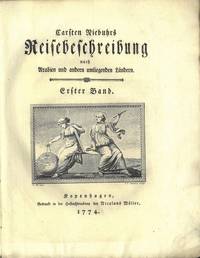
1774rif. 71463Kopenhagen 1774. Stor 4to. Samtidig stivt blankt omslag. Ubeskåret. XVI 4 505 1 s. LXXII kobberstukne plansjer hvorav flere foldet. Med et stort foldet kart over Jemen. Gedruckt in der Hofbuchdruckerey bey Nicolaus Möller Tysk. KUND BIND I. Plansjene delvis trykt på blålig papir. unknown
rif. ORD-8001Ouvrage traduit de l'anglais avec l'autorisation de l'auteur par Émile JONVEAUX. Et accompagné d'une carte et 4 plans. Paris. Hachette. 1866. Edition originale de la traduction française, parue un an après l'originale anglaise. 2 tomes en 2 volumes grand in-8 (164 x 242mm) dos chagrin bleu nuit à 4 nerfs, caissons, titre et filets or, plats toile chagrinée de même couleur orné de filets à froids (reliure de Vigneau & Pasquier), gardes moirées, tranches dorées, 2ff., portrait de l'auteur en frontispice, XVI pages (introduction par VIVIEN de SAINT-MARTIN), 346 pages et 1 d'erratum pour le tome 1; 2ff., 429, (1) pages pour le tome 2. Bien complet des plans et de la carte. Exemplaire en excellent état, je n'ai trouvé de rousseurs que sur la page 1 du tome 2, encore sont-elles très pâles, papier généralement très blanc.
1798rif. LBW-7952[Paris, P.G. Chanlaire et E. Mentelle, An six de la République - 1798]. 323 x 427 mm, sur papier bleuté.
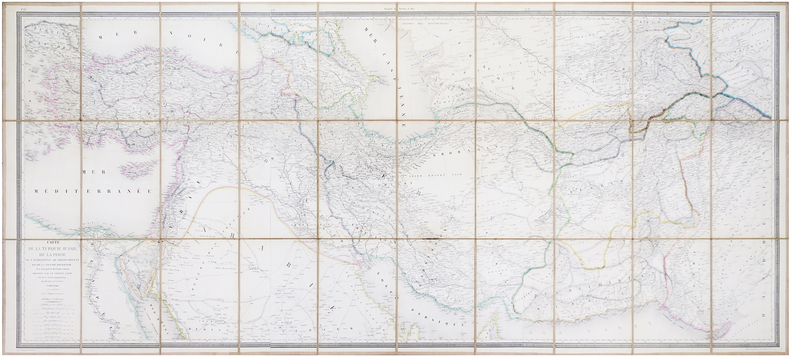
1848rif. LBW-6680Paris, C. Picquet, 1848. En 30 sections montées sur toile et pliées, formant une carte de 0,64 x 1,43 m ; étiquette au dos de l'éditeur E. Andriveau-Goujon.
rif. 3864Paris, chez J.B. Costard, 1773-79, reliure aux armes (non identifiées) plein cuir d'époque, dos à cinq nerfs, caissons dorés, pièce de titre et tomaison rouge, tranches rouges, 10x17,5 cm, 440+477+427 pages. (traces d'encre noire ? au bas du dos des trois volumes).
1907Large format nautical charts of Aden Harbour and approaches surveyed from january to march 1906 by Lieutenants W. C. Taylor, A. G. Bingham, A. P. Robinson, E. D. Danson and J. E. Vibart under the direction of Capt. T. H. Heming in charge of the Marine Survey of India. The map was published at the Admiralty 26 november 1907 under the Superintendence of Rear Admiral A. Mostyn, large correstions 1932.
18203 voll. in-8, pp. XXIV, 635; 487; XX, 268, leg. mod. carta color. con tass. ai d. Con 5 tavv. in rame. La storia degli Arabi in Spagna dall’anno 572 fino all’anno 1493. Belliss. esempl. in barbe e intonso. [137]
1840Very Good Turkish, Ottoman (1500-1928) Original quarter leather bdg. Slight wear on spine. Otherwise a very good copy. Cr. 8vo. (20 x 15 cm). In Ottoman script (Old Turkish with Arabic letters). 143 p. Extremely rare first Turkish edition of the legend of Hatem of Tai tribe, or "the tale of Hatemtai, or qissa-e Hatem-Tai" which was very popular in the Indian subcontinent, as well as the earliest printed separate form from the Arabian nights [Alf laila wa laila] in the Middle East. In Turkish literature, this story was printed nine times separately from the Arabian nights (1840, 1856, 1867, 1871, 1874, 1879, 1885, 1891, 1925). This is the very first edition of this book. Hatim al-Tai (?âtim bin Abd Allâh bin Sa'ad a't-Tâ'iyy; Hatim of the Tayy tribe; deceased 578), was the ruling prince and poet of the Tayy tribe of Arabia. Stories about his extreme generosity have made him an icon among Arabs up until today, as evident in the proverbial phrase "more generous than Hatim". His son was Adi ibn Hatim, who was a companion of the Islamic prophet Muhammad. Al-Tai lived in Ha'il in present-day Saudi Arabia and was mentioned in some Hadiths by Muhammad. He died in 578 AD and was buried in Tuwarin, Ha'il. His tomb is described in the Arabian Nights. He lived in the sixth century CE and was also mentioned in the Arabian Nights stories. The celebrated Persian poet Saadi, in his work Gulistan (1259 CE) wrote: "Hatim Tai no longer exists but his exalted name will remain famous for virtue to eternity. Distribute the tithe of your wealth in alms; for when the husbandman lops off the exuberant branches from the vine, it produces an increase of grapes". He is also mentioned in Saadi's Bostan (1257). According to legends in various books and stories, he was a famous personality in the region of Ta'i (present-day Ha'il) and is also a well-known figure in the rest of the Middle East as well as the Indian subcontinent, featuring in many books, films, and TV series in Arabic, Persian, Urdu, Turkish, Hindi and various other languages. The books on the story usually consist of a short introduction describing his ancestry and character and tell the seven episodes based on seven riddles, asked by a beautiful and rich woman named Husn Banu, who will marry only the person who is able to obtain answers to all seven of them. A king, who falls in love with her but is unable to find answers, tells the generous Hatemtai, whom he meets by chance, all about it. Hatim undertakes the quest to find the answers and help the king marry her. Özege 3639.; TBTK 8155.; Only one copy in the Library of Congress according to OCLC 951465696.