1 492 résultats
2012New English Original bdg. HC. 4to. (31 x 23 cm). In English. 152 p., color ills. "This book focuses on the banknotes of Kazakhstan with respect to their cultural, historical and technical content. It also tells the little known history of how Kazakhstan became one of the best producers of banknotes in the world in less than 20 years time." "Kazakhstan has been an eager adopter of innovative anti-counterfeiting technologies, including many firsts in world banknotes. Collectors everywhere will appreciate adding this book to their numismatic libraries as the first specialized reference to the nation's beautiful and groundbreaking new notes." (Owen W. Linzmayer, Publisher of the Banknote Book). Contents: Introduction.; Acknowledgements.; H. E. Nursultan Nazarbayev the First President of the Republic of KAzakhstan, his bright vision on the news technologies and innoivation.; Mr. Grigoriy Marchenko, the governor...; Historical characters depicted on the banknotes of Kazakhstan.; Technical definitions of the Security Features used on the banknotes of Kazakhstan.; Regular issues: 1993 - Tenge, 1993 Tiyn, 1994, 1996, 1998, 1999, 2000, 2001, 2003, 2006, 2011-2012 issue: Commemorative banknotes of Kazakhstan...".
réf. 204775Edimbourg-Londres, Oliphant, Anderson & Ferrier, s.d. (1910) in-8, [3] ff. n. ch., 436 pp., avec des figures dans le texte, 18 planches hors-texte, et deux cartes dépliantes, dont une aux contours rehaussés de couleurs "in fine", toile orange, dos et plats illustrés (reliure de l'éditeur). Dos insolé.
1958réf. 70022Wuppertal-Barmen, Fr. Staats, (1958). 173 S. Mit einigen farb. Randillustr. 20 cm. OLn.
Hardcover in-8, 446 pages, illustrations en noir, cartonnage sous jaquette illustrée. Très bon état. [BL-5]
réf. 67111aafParis, Larousse /Vuef/Prisma Presse/Geo, 2003, gr. in-4to, 190 p., rich. ill. de superbes prises photogr. en couleurs, cartonnage original ill. en couleur, jaquette couleur. Ex. Neuf.
réf. ORD-17376Le Roman Français d'Aujourd'hui.. Paris. Cité des Livres. 1927. In-8 (143 x 195mm) broché, couverture verte à rabats, 4ff., 358, (1) pages. Ouvrage tiré à 1095 exemplaires, celui-ci n°1016, un des 1000 sur vergé d'Arches. Pâles piqûres sur le 1er feuillet blanc et sur le fx-titre, sinon bel exemplaire.
1849Very Good Turkish, Ottoman (1500-1928) In contemporary fine black 1/3 leather bdg. Decorated gilt to spine. Roy. 8vo. (23 x 16 cm). In Ottoman script (Old Turkish with Arabic letters). 112 p. Extremely rare first edition of this Nabi's first-hand account of Mecca, Medina and the Hejaz during his pilgrimage in the late 17th century. This is the most celebrated literary pilgrimage narrative written in Ottoman Turkish. Nabi (1642-1712) was one of the prominent Ottoman poets and is considered a foremost exponent of the didactic trend (hikem-i tarz) in Ottoman Turkish literature. Nabi, whose given name was Yusuf, was born in Urfa (then known as Ruha) in 1052/1642. In 1082/1671 he took part in the Ottoman military campaign in Poland, in the retinue of Müsahib Pasha, (1640-1686). Having spent thirteen years in Istanbul, Nabi desired to go on a pilgrimage to Mecca. He was personally ready to undertake a journey to the Hijaz and to set down an eloquent account of his journey, the experience of his lifetime. Accordingly, having achieved a position of good standing with his patrons, Müsahib Mustafa Pasha and Mehmed IV, Nabi revived his longstanding desire to perform the hajj. In 1089/1678, at around 37 years of age, he set out in a small private caravan from Istanbul, passing through Konya, Urfa, Damascus, Jerusalem and Cairo, where he joined the main Egyptian pilgrimage caravan. The work, which is one of the most successful examples of Ottoman insa (artistic prose), includes historical, sociological, geographical and autobiographical information. In his preliminary remarks, Nabi indicates that he had received governmental help for his journey. He relates that he first obtained leave for the hajj from his patron Musahib Mustafa Pasha, and then submitted a qasida to Mehmed IV, describing the sacred places. The sultan provided Nabi a letter of recommendation addressed to Abdurrahman Pasha (d. 1691), governor of Egypt, ordering him to enable Nabi to make a comfortable journey. Nabi traveled in a small private caravan, since the caravan extended its route to Nabi's homeland, Urfa, and spent about fifty days there. It appears that he generally followed the usual route of the pilgrimage caravan from Istanbul to Damascus, passing through Scutari, Kartal, Gebze, Hersek, Iznik, Eskisehir, Seyitgazi, Aksehir, Ilgin, Ladik, Konia, Eregli, Adana, Misis bridge, Payas, Antioche, Aleppo (with a long detour to Urfa (Edessa) and back to Aleppo via Aintab), Hama, Hims and the Kuteyfe strait. He was fascinated with the splendid architecture of the buildings, the bazaars and the mosques built side by side by Kurdish and Circassian rulers and the Nile when he arrived in Cairo. Nabi gives a general description of the city of Cairo, the Nile, the two reservoirs of the city, parklands, the Ahram hills and the immediate neighborhood of the city. In Mecca, Nabi visited the sacred sites enthusiastically and performed the hajj on 77 January 1679. He gives a moving account of his experience as a pious emotional pilgrim. It appears that Nabi stayed in Mecca for more than twenty days. Immediately after 1 Muharrem 1090/12 February 1679, he set out for Medina, presumably in the Damascus caravan. While in Medina, Nabi served at the tomb of the Prophet by lighting the candles since his name was on the honorary list of attendants who were determined by the central government to serve the sanctuaries in Mecca and Medina. Nabi regards these services as a testimony to the legitimacy of Ottoman rule. He summarizes his journey of return from Medina to Damascus and to Istanbul in a few general words. Özege 21267.; Not in OCLC.

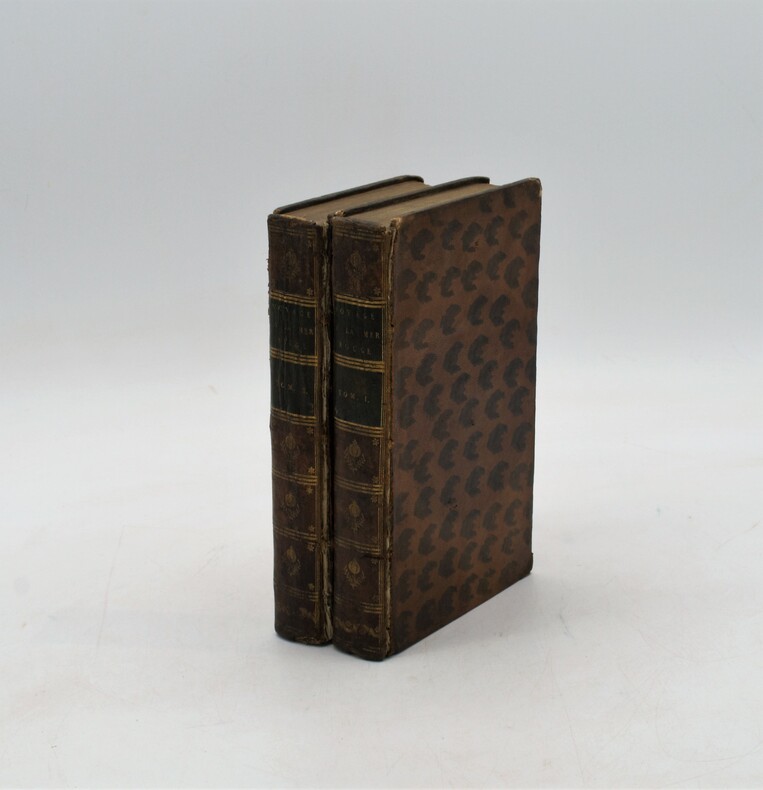
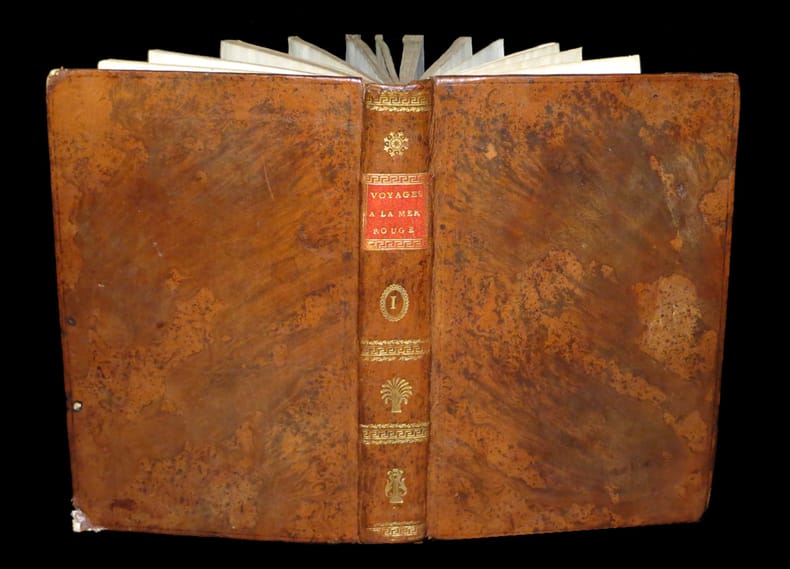
1792réf. PHO-1241Chez Briand, à Paris 1792, 2 tomes en 2 Vol. in-8 (13,5x21,8cm), (2) vj, 440pp. et (2) 483pp., relié plein basane tacheté , dos lisse orné avec pièces de titre et tomaison vertes , ex-libris manuscrit , coiffes et coins usés , charnières fendues , vieilles mouillures avec quelques traces .
1792réf. 21421A Paris, chez Briand, 1792. Un fort vol. au format in-8 (201 x 132 mm) de 2 ff. n.fol., vi - 440 pp. Reliure de l'époque de pleine basane racinée brune, filet à froid encadrant les plats, dos lisse orné de filets dorés, roulettes dorés, larges fleurons stylisés dorés, pièce de titre de maroquin cerise, titre doré, tranches mouchetées.
1899Very Good Turkish, Ottoman (1500-1928) Paperback. Foolscap 8vo. (18 x 13 cm). In Ottoman script (Turkish with Arabic letters). 80 p., [10] unnumbered b/w plts. Yenisehirlizâde Halit Eyüp was the son-in-law of Ahmet Midhat Efendi, one of the shaded names of Turkish literature. This rare book has 10 unnumbered b/w plates shows firstly Abd Al-Rahman Khan, (1845-1901), who was Emîr of Afghanistan and played a prominent role in the fierce and long-drawn struggle for power waged by his father and his uncle, A'?am Khân, against his cousin Shîr 'Alî, the successor of Dost Mo?ammad Khân. And then, Khaybar Fortress, Peshaver city in India, Tajik chief of Afghanistan: Maaz Khan (two-paged print), a view of Kabul city (two-paged print), Ghaznawid Fortress, North Gate of Kandahar, Herat Fortress (two-pages print), Cohat Fortress, a portrait of Afghan Sufi. An extremely rare and richly illustrated book of the history of Afghanistan. Hegira: 1316 = Gregorian: 1899. First and Only Edition. TBTK 12178.; Özege 19966.; Three copies located in OCLC: 944246927 (One copy in Library of Congress - Karl Süssheim Collection, No. 7.).; 163633157 (Orient-Institut Istanbul and Bayerische Staatsbibliothek).
1986réf. V33853London (Harrap) 1986 (= Erste Auflage). 8°, illustrierte Originalbroschur (Paperback) 267 s., Bildtafeln, ISBN 0-245-54473-9 1
réf. 17870Lausanne, Impr. Vaudoise 1977, 230x160mm, 519pages, broché. Bel exemplaire.
1970Fine English Paperback. Demy 8vo (21 x 14 cm). Edition in English. [xi], [2], 142 p. The world of Islam [= Le monde Islamique: Essai de geographie religieuse]. Third Edition.
réf. 322Relations Internationales & Culture . Paris 1994
1852réf. X114460Göttingen, Dieterichschen Buchhandlung 1852 Complete in 2 parts in one physical volume, [4] + [82] + [106] pp. (containing resp. 24 and 27 genealogical tables), in oblong (23x32cm.), solid modern amateur hardcover (marbled boards, spine in cloth), pages are clean and bright, good condition, [N.B. The "Register" to this work, published in 1853, is not included], weight: 1kg., X114460
1842In 8, pp. 56. Br. ed. Estr. da: Revue de legislation et de Jurisprudence tom XV.
réf. PHO-687Paris, Payot, 1937, in-8, plein chagrin rouge, dos à nerfs, insolé, couv. conserv. ,208pp , illustrations , bel exemplaire.
réf. DADAX0333654811New unknown
réf. DADAX0231084218New unknown
réf. 1333484194.Gpaperback. Good. Access codes and supplements are not guaranteed with used items. May be an ex-library book. paperback
192725 pages, including a full-page sketch map. Plus black and white plates. Original condition with blue wrappers, titles to front, and containing all the ads. This is a complete issue, seldom found in such good and original condition. This is a fascinating and comprehensive historical report on the Persian Gulf, illustrated with black and white plates and a sketch map and dealing with the early records of commerce dating back to 2000 BC, the important sheltered port of Sur, Albuquerque's control over the Portuguese, and much more. This report being a preface to his book published the following year, Wilson gives us a compelling geographical and historical overview of civilian life, Bahrain and the pearling industry, the Islam religion, and Christain missions, in a time of British presence and much change in Iraq. The author spent almost 18 years in the Persian Gulf and was one of the most important British civil servants in the Middle East. He served in consulates at Ahwaz and Khorramshahr from 1907-1914 and also worked for the Anglo Persian Oil Company. He has been described as a versatile, fearless and exceptionally gifted man who was at home in all walks of life, and in all circumstances. In January 1919, the British set up a military administration under Sir Arnold Wilson, and in April 1920 the League of Nations confirmed the British Mandate over the region. Wilson's rule, however, helped set the stage for Great Arab Revolt in 1920. Because of the major economic investments, British war-time policy in Iraq was very different from western Arabia where they overtly encouraged and aided the Arab Revolt. The British managed to suppress the revolt at great expense. Wilson was later replaced by Sir Percy Cox who was sympathetic to Arab aspirations. On the outbreak of the Second World War Sir Arnold Wilson (who had served in parliament as MP for Hitchin since 1933) joined the Royal Air Force Volunteer Reserve. An air gunner in Bomber Command, he was killed in action over northern France in 1940 shortly before publication of his second book, S. W Persia: Letters and Diary of a Young Political Officer 1907-1914 (1941). This report pre-dates Wilson's book published in 1928, entitled The Persian Gulf: An Historical Sketch from the earliest Times to the Beginning of the Twentieth Century. A most incredible report on the ancient commerce of Persia, that shaped to a large extent the state of affairs in the turmultuous regions of the Middle East.
188420 pages. Plus a fold-out colour map, measuring approximately 10.5 x 8 inches (27 x 20cm). Original condition with blue wrappers, titles to front, and containing all the ads. This is a complete issue, seldom found in such good and original condition. This is a most compelling report on an English political mission determined to establish military consulates in Asia Minor to watch the introduction of reforms under the Anglo - Turkish Convention. This mission was primarily installed in order to glean information. A fascinating read accompanied by a map of Asia Minor (Anatolia) and showing the Gulf of Scanderun. A fascinating geographical report on the picturesque valleys, mountain districts, large rivers, ruins and new discoveries in Asia Minor.
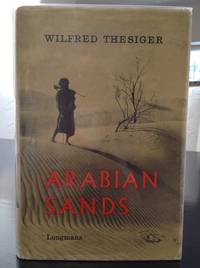
1960réf. 144741960. Thesiger Wilfred. Arabian Sands 1960. First edition second impression of the British explorer's account of his journeys through southern Arabia between 1945 and 1950 including two crossings of the Rub' al Khali or Empty Quarter in 1946-1947 and 1947-1948. Thesiger 1910-2003 known among his Arab companions as Mubarak bin London traveled with Bedouin guides across Oman the deserts of southern Arabia Abu Dhabi and the Trucial Coast recording tribal customs camel journeys desert navigation territorial disputes and the practical demands of survival in an arid environment. His account includes detailed descriptions of the Bedouin communities with whom he traveled particularly their hospitality tribal loyalties conflicts and knowledge of desert routes and water sources. Written before extensive oil development transformed much of southeastern Arabia the narrative records social and geographical conditions during the final years preceding the region's rapid economic and infrastructural changes. Thesiger Wilfred. Arabian Sands. London: Longmans 1960. First edition second impression first published 1959. One volume 326 pp. measuring approximately 9" x 6". Original cloth hardcover in illustrated dust wrapper. Illustrated with 68 photographic illustrations seven maps and a large folding map housed in the rear pocket. The narrative includes chapters devoted to Abu Dhabi the Trucial Coast and the Empty Quarter describing Thesiger's journeys through the territories of present-day Oman Saudi Arabia the United Arab Emirates and Yemen. His photographs record Bedouin companions desert encampments camel caravans regional landscapes and settlements encountered during his travels. The maps trace the principal routes and geographical features of the Arabian interior. Before undertaking his Arabian journeys Thesiger served in the Sudan Political Service and participated in military campaigns in Abyssinia and the Western Desert during the Second World War. His subsequent travels in Arabia were conducted largely on foot and by camel accompanied by Bedouin guides whose knowledge of tribal territories wells and desert conditions made the crossings possible. His descriptions of Abu Dhabi and the Trucial Coast predate the formation of the United Arab Emirates in 1971 and the extensive urban development financed by petroleum revenues. Arabian Sands preserves both Thesiger's observations and the experiences of his Arab traveling companions including Salim bin Kabina and Salim bin Ghabaisha who accompanied him on major portions of his journeys. The dust wrapper shows edge wear and a small 1 cm tear along the upper edge of the verso. Otherwise the book is in very good condition retaining its original dust wrapper photographic illustrations maps and folding map in the rear pocket. unknown books
1960réf. 144741960. Thesiger Wilfred. Arabian Sands 1960. First edition second impression of the British explorer's account of his journeys through southern Arabia between 1945 and 1950 including two crossings of the Rub' al Khali or Empty Quarter in 1946-1947 and 1947-1948. Thesiger 1910-2003 known among his Arab companions as Mubarak bin London traveled with Bedouin guides across Oman the deserts of southern Arabia Abu Dhabi and the Trucial Coast recording tribal customs camel journeys desert navigation territorial disputes and the practical demands of survival in an arid environment. His account includes detailed descriptions of the Bedouin communities with whom he traveled particularly their hospitality tribal loyalties conflicts and knowledge of desert routes and water sources. Written before extensive oil development transformed much of southeastern Arabia the narrative records social and geographical conditions during the final years preceding the region's rapid economic and infrastructural changes. Thesiger Wilfred. Arabian Sands. London: Longmans 1960. First edition second impression first published 1959. One volume 326 pp. measuring approximately 9" x 6". Original cloth hardcover in illustrated dust wrapper. Illustrated with 68 photographic illustrations seven maps and a large folding map housed in the rear pocket. The narrative includes chapters devoted to Abu Dhabi the Trucial Coast and the Empty Quarter describing Thesiger's journeys through the territories of present-day Oman Saudi Arabia the United Arab Emirates and Yemen. His photographs record Bedouin companions desert encampments camel caravans regional landscapes and settlements encountered during his travels. The maps trace the principal routes and geographical features of the Arabian interior. Before undertaking his Arabian journeys Thesiger served in the Sudan Political Service and participated in military campaigns in Abyssinia and the Western Desert during the Second World War. His subsequent travels in Arabia were conducted largely on foot and by camel accompanied by Bedouin guides whose knowledge of tribal territories wells and desert conditions made the crossings possible. His descriptions of Abu Dhabi and the Trucial Coast predate the formation of the United Arab Emirates in 1971 and the extensive urban development financed by petroleum revenues. Arabian Sands preserves both Thesiger's observations and the experiences of his Arab traveling companions including Salim bin Kabina and Salim bin Ghabaisha who accompanied him on major portions of his journeys. The dust wrapper shows edge wear and a small 1 cm tear along the upper edge of the verso. Otherwise the book is in very good condition retaining its original dust wrapper photographic illustrations maps and folding map in the rear pocket. unknown
1994réf. 95916Denoël, 1994, fort gr. in-8°, 1288 pp, traduit de l'anglais, 32 pl. de gravures et photos, 7 cartes, annexes, index, broché, couv. illustrée, sous étui cartonné illustré en couleurs, bon état