THESIGER WilfredMareMagnum

1.140 resultados
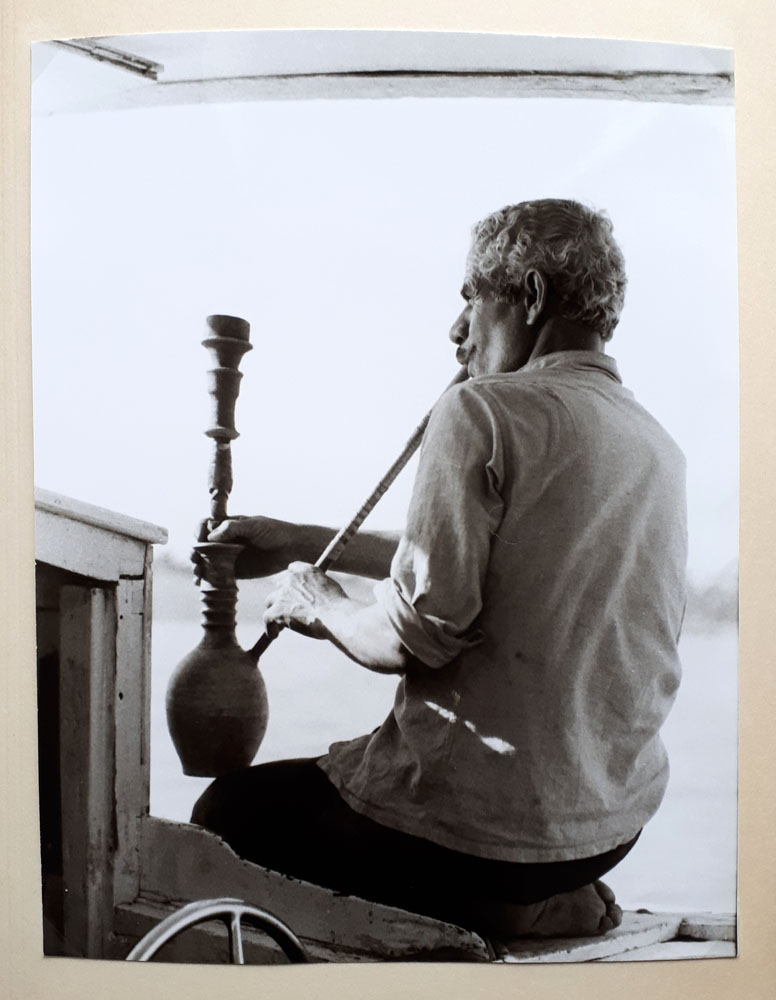
19648vo., First Edition, with frontispiece, 103 plates on 60 and 3 maps (one double-page) in the text; handsomely bound in dark red full morocco, sides with gilt frame border, back with raised bands, second and fourth compartments ruled and lettered in gilt, all other compartments tooled in gilt, gilt top, a most attractive copy ideal as a gift or for presentation. The Marsh Arabs occupy the region around the junction of the Tigris and Euphrates in southern Iraq. This classic account, recording eight years spent living among them, is a worthy sequel to his masterpiece 'Arabian Sands'.
2004Boldy signed and generically inscribed by Piper upon title page. 128 pages. Index. Footnotes. Black and white reproductions of photos. "The secret history of how America's 'Neo-Conservative' (neo-con) Trotskyites came to power and orchestrated the war against Iraq as the first step in their drive for global empire." - subtitle. "Writing about these subjects is 'radical' and 'controversial,' but it's a dirty job and someone has to do it. I make no apologies for telling the truth." - page 128. A well-studied copy with considerable pencil underlining and marginalia throughout and spine rolled. Piper (1960-2015) was a prominent talk show host and prodigious author whose works include such titles as "Confessions of an Anti-Semite". Book
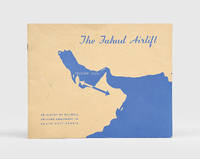
1955ref. 195609Hull: Newcom Press for Blackburn and General Aircraft Ltd after 1955. First edition recording the transport of over 129 tons of equipment from Umm Said in Qatar to Fahud in Oman the operational centre of Petroleum Development Oman. We have traced only two other copies: one at the Solway Aviation Museum and another we sold last year. The 365-mile journey "unique in the history of aviation" p. 3 was undertaken by a Blackburn "Universal" XB260 freighter the civilian equivalent of the RAF's "Beverley" model and was a collaboration between Blackburn and General Aircraft and Hunting-Clan Air Transport. The photographs illustrate the various phases of the operation as well as the drilling machinery and aircraft. Oblong octavo pp. 20. Illustrations throughout. Original pictorial wrappers wire-stitched as issued wrappers lettered in blue. Light creasing and marking: very good. unknown
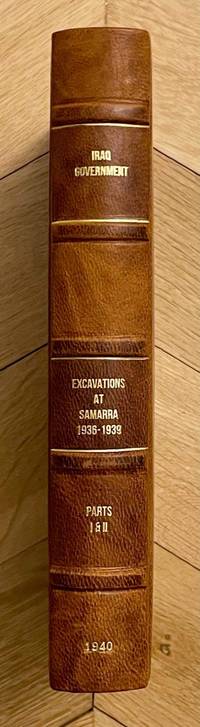
ref. M8814Very rare complete set of two volumes bound in one. Government Press Baghdad 1940. First edition. In-8. Vol. I: 25 pages 120 plates. Vol. II: xiii & 24 pages 144 plates. Bound in an elegant modern half-leather with cloth boards a fine copy. Language: English. This book ships from Europe shipping costs will be updated accordingly BCI. Relevant subjects: Mesopotamia. unknown
1951ref. 182329London: Ordnance Survey 1951. Later editions marked "restricted" revised from those produced by the War Office in 1941-42 and with isogonals correct to 1953. They show the international borders between Iran and Iraq but warn that they are still under negotiation. These maps are in a variety of later editions all printed in 1951 Baghdad fifth; Basra eighth; Tehran third; Bushehr fourth. This was a critical year in Iranian politics as the country underwent the Abadan Crisis saw the assassination of Razmara and the election of Mosaddeq. In the same period Iraq saw a number of anti-government protests including the 1952 Iraqi Intifada against the Anglo-Iraqi Treaty. Over these years British and American forces kept close watch on the region's development and likely printed these maps printed on rayon as escape items to issue to forces in case fighting broke out. Escape maps were first introduced by MI9 during the Second World War designed to be easily smuggled into POW camps. They were printed on silk and for "good reasons: silk is flexible and durable in a way that paper is not and it is noiseless when hidden about one's person" Bond. They continued to be issued throughout the 20th century and into the modern day especially during the 1960s and the Vietnam War. 2 sheets of rayon 596 x 715 mm; 610 x 676 mm colour map on each side key on map of Tehran; text in English and French. Sometime folded edges fraying more so to sheet of Baghdad and Basra: a very good copy. Barbara A. Bond "Escape and evasion maps of World War II" The British Library 2016. unknown
ref. 20819Paris, Eugène Fasquelle, sans date (1908-1911). Demi chagrin à coins, dos ornés de décors floraux peints et estampés à froid, pièces de titres maroquinées, têtes dorées, signets. 8 volumes in-4 de (8)-395, 348, 339, 315, 355, 371, 371, 347-(8) pages, texte illustré et encadré par le fac-similé des miniatures qui ornent les manuscrits originaux persans et hindous, tiré en pastel, 156 planches en couleurs (miniatures persanes du musée Guimet, BNF, musée des Arts Décoratifs et de la collection du docteur Mardrus), bandeaux, culs de lampe.
1901Royal octavo. Pp. xiv, 230. Plus 2 plates with maps of Baghdad in 17th and 18th centuries respectively. Hardcover, bound in contemporary quarter cloth and marbled boards, gilt lettering to spine, bit marked, with the original printed wrappers bound in, signature on title-page. In fine condition. Excellent copy. ~ First edition. Scarce.
1958ref. PHO-1454Paris, , Maisonneuve ; Besson & Chantemerle, 1958 , 4 volumes in-8 , relié pleine toile rouge , supra libro aux plats, cachets ,2ff.-viii-599pp., 2ff.-ii-552pp. ,2ff.752pp.,2ff.iii-665pp.
1948Very Good Arabic Original chromo-lithograph map in brown tones. On a special paper with an ongoing blindstamped "Regestre Robur" during the borders. Folded. 70x100 cm. In Arabic. Scale: 1 /1.000.000. Chipped on margins, split on folded traces. Slight discoloration and one stain on lower margin. Otherwise a good copy. An attractive and detailed map of Syria shows the capital (as Aleppo n that map), other cities like Damascus, Raqqa, Homs, Latakia, Ayn al-Arab, Idlib, Hama, Deir Ez-Zor, Jarabulus, et alli. And it shows Turkey on the north (as Turkey containing Hatay and Alexandrette), The Mediterranean shores of the land as well as Lebanon and Palestine (and Jerusalem) on the west, Sharq al-Urdun (Jordan) and Iraq on the south and east. It's very detailed on showing the roads spread throughout the land like railways and ancient roads from the Roman period. Additionally this roads can be followed to the other Arabic countries and regions on the map. This map was calligraphed by Kamel Al-Baba, (1905-1991), who was a Lebanese contemporary / modern calligrapher. He is the son of famous calligrapher Mokhtar Al-Baba. Cannot be found in WorldCat.; Not in Library of Congress Map Collection. Very scarce.
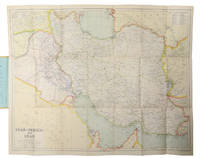
1930ref. L6CC0NQYKB25London: George Philip & sons 1930. Colour printed map 54 x 68 cm with yellow covers 19.5 x 11 cm. Map of Iran Iraq and parts of the surrounding countries including modern Kuwait Bahrain Qatar and the UAE in the 1930s published in the series "Philips' authentic imperial maps for tourists & travellers". Published in the early years of the discovery of oil in the Middle East the map shows roads and railways but also caravan routes submarine cables and oil pipelines.Slightly soiled in very good condition. George Philip & sons, unknown
1991429 pages. Numerous colour photographic plates and black and white reproductions of photos. Text in English. "Describes the stages of militant, intellectual and political life of one of the most distinguished existing leaders of the Arabian world and of the Third World. Tends to find and tell the truth to those who look for it far from fanaticism, resentments and prejudices." - from back cover. Unmarked with average wear. Binding intact. A sound copy. Book
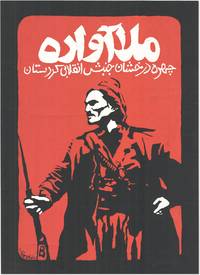
1990ref. 83129Kurdistan: New Organization 1990's. Original silkscreened poster 63.5cm x 46cm printed in red and white on heavy black paper. Slight wear to edges almost neglible and some minor surface cracking to the very heavily applied paint are the only things that could be considered defects. A very good example. An exceptionally striking image printed in dramatic red and white onto black card depicting a heavily armed figure in traditional Kurdish dress beneath the legend in Kurdish: "The Displaced Mullah; The Shining Face of Revolutionary Kurdistan" The figure depicted is in all likelihood a stylized portrait of Mahmoud Barzanji a national Kurdish hero from the unrest of the early 20th century who became the first King of Kurdistan and was appointed Governor of the region by the British after the formation of the Kurdistan Protectorate after WW1. Barzanji not universally popular in Southern Kurdistan was a leader of considerable energy and ambition which far outstripped British plans for his 'control' of the region. The British and Barzanji came into direct conflict when he began arresting and imprisoning British officials who put up any opposition to his plans and embarking upon a localised uprising. The British predictably enough put a stop to his ambitions by ambushing him on the Sulamaniah road wounding him and then graciously commuting his death sentence to one of imprisonment in the British stronghold of Lahore in India where Barzanji was kept prisoner until 1922. The other possibility and with a stronger resemblance is that the poster depicts Simko Shakik early 20th century warlord and revolutionary who aside from massacring Armenians and Assyrians for the greater good of Kurdistan also led a rebellion against Iran. Although not conspicuously working from a Kurdish nationalist perspective modern critical thought suggests that Shikak should be placed "within the confines of Kurdish ethno-nationalism" Kamal Soleimani; "The Kurdish image in statist historiography: the case of Simko" 2017. Shikak himself was mainly interested in plunder and what he no doubt considered 'punitive justice against' basically anyone who sought to extert power over him or as a secondary consideration other Kurds; the results of his aggressive energy and willingness to fight anybody however are historically considered evidence of his benefit to Kurdish freedoms. No other examples of this poster can currently be traced in trade or institutional database. New Organization unknown
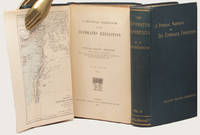
1888ref. 33602London: Kegan Paul Trench & Co. 1888. 2 volumes. First Edition. With pleasing provenance. With a fine map showing the Tigris and Euphrates rivers and the surrounding geography of the Middle East. Thick 8vo publisher's original dark green cloth the upper covers and spines lettered in gilt original green endleaves. xv 447 32 publisher's catalogue; vii 492 pp. A very bright and pleasing set as fine as can be expected. FIRST EDITION OF THIS ELUSIVE AND SIGNIFICANT WORK. Ainsworth's excellent account of the Euphrates expedition to which he was appointed surgeon and geologist. The expedition was intended to "examine the feasibility of opening up the Mesopotamian rivers to steam navigation as a new route to India as well as asserting British political presence in the area promoting British commercial ties and gathering scientific and archaeological data" ODNB. This is arguably the fullest contemporary account of the expedition as the fraught publication history of Chesney's account meant that his 'NARRATIVE.London 1868 was ultimately less detailed than intended. This copy was owned by John Brinton who was elected member of parliament for Kidderminster in 1880 but accepted the Chiltern Hundreds next month because he was holding a government contract at the time. He was reelected without opposition and held the seat until 1886. In 1887 he presented Brinton Park to Borough of Kidderminster. He became High Sheriff of Worcestershire in 1889 and was an Alderman of the County Council from 1890. His attractive engraved plate is at each pastedown. Kegan Paul, Trench & Co. hardcover
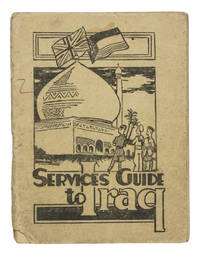
1942ref. ABC_47444Baghdad: PAI force G. H. Q. Welfare Committee 1942. Original publisher's beige printed paper wrappers. 14.5 x 11 cm. With two full-page maps of Iraq and Baghdad on page 24 and 25 and a full-page map of the "Baghdad Amenities area" on the back wrapper. Further with 6 pages of advertisements serving as endleaves. A very rare guide intended for British armed forces stationed in Iraq during the Second World War. It was probably handed to the soldiers soon after arrival. Works like these were often discarded when they were no longer needed. As such there are usually few of them left. This particular military guide is likewise extremely rare. We have only been able to find 3 other copies 2 of which are located at the Imperial War Museum in London.The Services guide to Iraq was probably published by the welfare committee of the British PAI force which is short for "Persia and Iraq Force". The British were stationed here to prevent Nazi Germany from invading the region for oil among other reasons. The guide was meant to teach the soldiers the basics of finding their way in this new country. It explains where to go for sports music religion legal aid education the costs of sending letters home and how to recognize and prevent various tropical diseases. It also aims to instill some cultural awareness in the reader: included is an excerpt of a work about the history of Iraq by Seton Lloyd 1902-1996 archaeologist and then curator at the Baghdad museum.The paper wrappers are torn at the bottom of the spine with some loss of material barely affecting the integrity of the binding a small stain and two small pen marks in red and green on the front wrapper. Somewhat browned throughout. Otherwise in good condition.l Not in WorldCat. PAI force G. H. Q. Welfare Committee, unknown
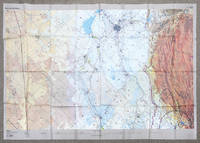
2002ref. 162482London: DGIA Ministry of Defence 2002. First edition stretching from Baghdad to Basrah and showing all of Kuwait. The sheet was likely issued to RAF pilots in the run up to the Iraq War and is printed on rayon for ease of use and durability. These charts produced by the Defence Geographic and Imagery Intelligence Agency feature many warnings about flying within controlled airspace in Iraq and Saudi Arabia. The RAF flew many missions over this region in the lead-up to the Second Gulf War and in Operation Telic. "The first documented intimations of UK involvement in the operation that became Telic can be traced to March 2002. In May the Chief of the Defence Staff CDS was advised of a potential RAF contribution to a future operation in Iraq comprising 88 fast jets and 38 support platforms - more aircraft than the RAF had deployed on a single operation since the First Gulf War and more in all probability than it will ever deploy again" Ritchie p. 5. A formal plan was drafted in August to overwhelm Hussein's government through multiple co-ordinated fronts of which the RAF's role was to eradicate the enemy air force destroy equipment support ground forces and strike important targets to shock the Iraqi people. According to the key there was another sheet issued charting northern Iraq. Single sheet of rayon 912 x 1300 mm colour map with key on recto and verso. Sometime folded and thinning along lines: a near-fine copy. Sebastian Ritchie "The Royal Air Force in Operation Telic: Offensive Air Power March-April 2003" 2021. unknown
ref. 208099S.l., s.d. (1929) 2 vol. in-4, [52] et 35 ff. de papier fort, regroupant 194 tirages photographiques généralement de format 12,5 x 17 cm, et 61 reproductions de dessins, demi-percaline (cerise / verte) à coins, traces de rubans (reliure de l'époque). Manque le dos du volume I.
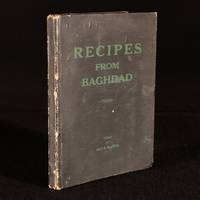
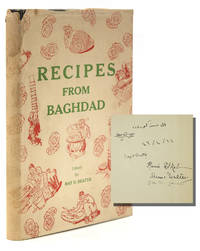
1946ref. 966F11Baghdad: The Indian Red Cross 1946 . First edition. Cloth. Good. 9" by 7". Suad Salim. The first edition of this very scarce mid 20th century cookery work presenting recipes hailing from Baghdad and Iraq. A vanishingly scarce first edition.With a folding table of weights and measures and a small number of vignette illustrations by Suad Salim.A very scarce cookery work presenting recipes popular in Iraq in the 1940s adapted for English tastes. With instructions for making various liqueurs Kubba Lebania Yuen Tsi Khankar Bakmadi and various other dishes.With an introduction from Her Majesty the Queen Mother of Iraq this work is edited by May H. Beattie with the assistance of Bedia Afnan Renée Al Kabir Helen Gaudin and Ann Walter.With bookplate of Martin and Pamela Finch to front free endpaper. They were antiquarian booksellers with an interest in antiquarian gastronomy.With a former owner's inscription to front free endpaper. In the publisher's original paper covered boards. Handling marks to boards. Rubbing to back strip head and tail and joints. Tail of front joint starting with board firmly held. Inscription and bookplate to front pastedown. Internally firmly bound. Pages lightly age toned due to paper type but generally clean with only the odd spot. Good The Indian Red Cross hardcover
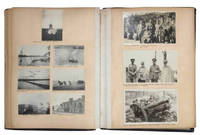
1912ref. JBDEH1HAEOMM1912. 1/4 leather album. 4to. Approximately 120 mounted usually 2-4 to a page snap shots ranging in size from 60 x 40 mm to 120 x 100 mm. Brief captions in black ink under almost all the photos. The first half of the photos show middle class life in Edwardian England. The second and more interesting half of the photos are snap shots that appear to have been taken by a British officer and include military subjects scenes of Baghdad and the Euphrates and views of the Bosporus.An early 19th century photograpic impression of middle class life in England and the military in Iraq Some photos are faded or have minor spots or light streaks. Wretched-looking lacking backstrip with covers worn discolored and detached. hardcover
1918Very Good Turkish, Ottoman (1500-1928) In contemporary black cloth. Roy. 8vo. (24 x 17 cm). In Ottoman script (Old Turkish with Arabic letters). Occasionally minor stains and fading on pages. Otherwise a good copy. 384 p. It is a rare book written after the Constitutional Monarchy at the request of the Unionists to make propaganda about Kurds. It is one of the early detached texts about Kurds written in the Ottoman period. Upon the request of the Ittihad ve Terakki [i.e. Union and Progress] leaders, he began to work in 1912 for the newly established National Security Organization (Teskilât-i Mahsusa). He then continued his intelligence work with the IAMM and AMMU, in the name of which he did his fieldwork on the Anatolian Kurds and Turcoman (Turkmen) tribes. Habil Adem's (his pseudonym means in English 'Abel Adam') writing reflect -even more openly than those of his colleague Baha Said- the unionist ambition to collect the data considered necessary for its politics of social and demographic engineering, such as information on basic demographic realities, as well as social and cultural aspects. The obvious aim of this publication was to create public knowledge favorable to the nationalization project. His book on the Kurds, printed in 1918, immediately after WW 1, under the pseudonym of a fictitious German orientalist (Dr. Friç), allegedly only translated by Habil Adem, elaborated on a thesis that would gain leverage in the early Turkish Republic and become very prominent in the 1930s, namely that the Kurds were actually Turks and the Kurdish as an independent language did not exist. In the book's section on the religion of the Kurds, he makes two distinctions such as Muslim and non-Muslim Kurds and Sunni and Shiite Muslim Kurds. (Source: Writing Religion: The Making of Turkish Alevi Islam; Dressler, Marcus). Pelister worked in the translation office of the General Directorate of Security since 1908 and in the Turkmen Branch of the General Directorate of Tribes and Immigrants from 1913, and he personally assigned him to Talat Pasha, (1874-1921). He was very good at speaking English, German, and French languages, thus, he was involved in researches related to the Kurdish and Turkmen tribes with some delegations in Ottoman Turkey in Asia. The German original of this book never existed, neither did Dr. Fritsch from the Berlin Academy of Science. Years later, Celadet Bedirxan, a Kurdish intellectual, explained the mistakes that Naci Ismail made intentionally or unknowingly on the Kurdish culture, population, history, folklore, and language, with the letters he wrote to Mustafa Kemal and drew Mustafa Kemal's attention. This book was written probably by a commission with corrigenda and footnotes by Pelister. The book generally focuses on the historical geography of the Kurds. There is an effort to Turkify in the part that talks about the origins of the Kurds. In the introduction, detailed information about Iranian and Iraqi Kurds is given and Sharafnâma is criticized. Although detailed information is available on many Kurdish tribes (Leks, Sividis, Arukhs, etc) in Anatolia and Mesopotamia, most of these are dubious. Only three institutional copies in OCLC: 977638243 (University of Toronto Robarts Library), 949451620 (Bogaziçi Library), and 164856325 (Bayerische Staatsbibliothek of Germany).; Özege 11517.; TBTK 11113. First Edition.
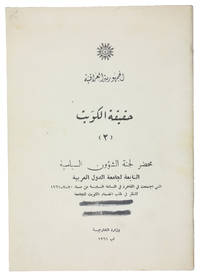
1961ref. ABC_47301Baghdad: Wizarat al-Kharijiyah = Ministry of Foreign Affairs 1961. Original printed wrappers stapled. 8vo. Arabic text. First edition of the second of two rare pamphlets published by the Iraqi government opposing the independence of Kuwait. The first pamphlet published in English and Arabic outlined Kuwait's historical connection to Iraq and analysed its "imperialist relations" with Britain. This second one in Arabic throughout prints the minutes of the Political Affairs Committee of the Arab League which met in Cairo on 20 July 1961 to consider Kuwait's request to join the League.Kuwait emerged as an independent state in June 1961 after sixty-two years as a British protectorate. With a new constitution it held its first parliamentary elections in 1963 thereby becoming the first Arab state in the Gulf to establish a parliament. Such political developments married with growing wealth and modernisations in health culture and finance helped to make Kuwait the most prosperous state in the Arabian Peninsula.The Iraqi government argued that the move toward independence was a continuation of Kuwait's relationship with Britain albeit under a new guise. Furthermore they felt that the historical links between Iraq and Kuwait entitled the former to control over the latter and one suspects a share of its growing wealth. This position partly detailed in the pamphlet led to a point of crisis with Iraq threatening invasion. To the relief of Kuwait the Iraqis were eventually deterred by the Arab League's promise of military opposition.The wrappers are a little dusty two thick black lines on the front wrapper seemingly erasing a stamp another stamp partially visible on the back wrapper most likely a bookseller's name and address "Baghdad" is legible. Internally clean and bright. Overall in very good condition.l Jisc LibraryHub 1 copy BL; WorldCat 219629380 3 copies. Wizarat al-Kharijiyah [= Ministry of Foreign Affairs], unknown
1969ref. q5r1030b81969. Ca. 180 orig. s/w Vintage auf Barytpapier, ca. 17, 6 x 23,2 cm und ca. 80 orig. Farb-Abzüge, ca. 13 x 18 cm . Die Aufnahmen wurden mit einer Leica-Mittelformat-Kamera gemacht und enstanden während einer Studienreise März-April 1969 durch die Gebiete des heutigen Irak und Iran. Der Photograph ist unbekannt. Alle Photos sind mittels Photoecken auf Photo-Karton befestigt. Die Pappen sind in vier Ringbücher abgeheftet. Die Photos sind sauber und unbeschädigt und können getrost als wichtige Dokumente der Kunst- und Kulturgeschichte des Mittleren Ostens bezeichnet werden. Sehr guter Zustand. ca. 1800 gr. Aus dem gleichen Bestand wird separat eine Serie angeboten, die wahrschscheinlich für eine Ausstellung vorbereitet war. Weitere Informationen auf Anfrage. Bildrechte beim Verlag IL. 4° [7 Warenabbildungen] Ringbuchheftung
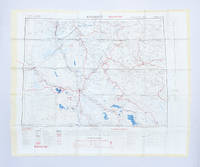
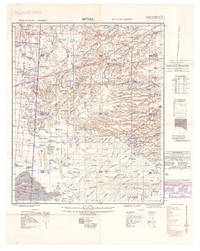
1940ref. L7VDM2ALRS81UK Government: Geographical Section General Staff War Office 1940. 2 topographic maps colour-printed. Scale 1:500000. 820 x 640 mm and 770 x 648 mm. Previously folded. Marked "Iraq Desert Sheet 1" and "Sheet 2". Generally well preserved. Compiled from 1930s surveys and produced by the British 512 Army Field Survey Company Royal Engineers for use in the Persian war theatre. These consecutive maps cover the south-western area of Iraq including Rutba and Fallujah with parts of Saudi Arabia Jordan and Syria approximately the area between 31° and 33°30 N and 39° and 44° E.Previously folded. Marked "Iraq Desert Sheet 1" and "Sheet 2". Generally well preserved. Geographical Section, General Staff, War Office, unknown
1886Very Good Arabic Original cloth bdg. Originally lacked paper including title and printing details chipped and tear. Interior very good. Otherwise a good copy. [14], 378 p. Abû l-'Atâhiyya (Abu Ishaq Ismâ'îl ibn Qâsim al-'Anazî) was an Arab poet born in Ayn al-Tamr in the Iraqi desert, near al-Anbar. His ancestors were of the tribe of 'Anaza. His youth was spent in Kufa, where he was engaged for some time in selling pottery. During the time when he took the occupation of selling pottery, he saw the assembly of poets in a competition and he participated in it. Thus he became famous for his poetry. For uplifting his poetry he reached to Baghdad. Moving to Baghdad, he continued his business there, but became famous for his verses, especially for those addressed to 'Utba, a concubine of the Abbasid Caliph al-Mahdi. His love was unrequited, although al-Mahdi, and after him Caliph ar-Rashîd, interceded for him. Having offended the caliph, he was imprisoned for a short time. He died in 828 in the reign of Caliph al-Ma'mûn. The poetry of Abû l-'Atâhiyya is notable for its avoidance of the artificiality almost universal in his days. The older poetry of the desert had been constantly imitated up to this time, although it was not natural to town life. Abû l-'Atâhiyya was one of the first to drop the old qasîda (elegy) form. He was very fluent and used many metres. He is also regarded as one of the earliest philosophical poets of the Arabs. Much of his poetry is concerned with the observation of common life and morality, and at times is pessimistic. Thus he was strongly suspected of heresy. Compiled and prepared by Louis Cheikho. Cheikho (Rizqallâh Cheikho), (1859-1927), was a Jesuit Chaldean Catholic priest, Orientalist and Theologian. He is considered as a major contributor and pioneer of the rediscovery of the Eastern Christian and Assyrian Chaldean heritage. Louis Cheikho was born in Mardin, Turkey on February 5, 1859. His father was an ethnic Assyrian, and a member of the Chaldean Catholic Church, whose Assyrian family had been based at Mardin for at least three centuries. His mother was an Armenian named Elizabeth Schamsé, who took him on pilgrimage to the Holy Land when he was 9 years old. In 1868, Cheikhô joined his brother at the Maronite Jesuit Seminary in Ghazîr, Lebanon. At this date, the seminary was not merely preparing young men for the priesthood, but also acted as a secondary college for young Christian and especially Assyrian Chaldean men. Both groups followed a similar syllabus. There, he learned both ancient and modern European and Semitic languages. In 1874 he entered the Jesuit Order and started his novitiate training at Lons-le-Saunier, France. He adopted at that time the name of 'Louis' out of devotion for the young Jesuit saint Louis Gonzaga. In 1878, he returned to Lebanon and taught Arabic Literature at the Jesuit Saint Joseph College in Beirut for 10 years. During this period, Cheikho continued his studies of philosophy at Université Saint-Joseph, Beirut. In 1888, Cheikho travelled to Great Britain for theological studies in preparation for the priesthood. He was ordained priest by the Chaldean Church of the East on 8 September 1891. He then spent one year in Austria and another year in Paris. Those extended European stays allowed him to acquire the academic methodologies that helped him in his later works. Finally in 1894, he settled in Beirut, Lebanon, where he continued his academic career at Université Saint-Joseph. Cheikho died in Beirut in 1927. Cheikho is perhaps the founder of modern publications of unpublished Eastern Christian texts, especially Christian Arabic texts. He also founded, in 1898, the journal Al-Machriq, and contributed many articles and publications to its pages. His work was an inspiration for CEDRAC. (Wikipedia). First Edition. Extremely rare. This edition not in OCLC; for late editions see OCLC 404750229.
1946ref. 313857Baghdad 1946. Six pages in ink on three leaves. 1 vols. 8vo. Letter: small loss from old staple at top of first leaf affecting two letters. Near fine. Book: Black cloth title in green illustration of measuring utensils on pastedowns. Pictorial dust jacket. Binding a bit rubbed spine faded with small loss at head Very good minus. Six pages in ink on three leaves. 1 vols. 8vo. Letter from Baghdad 1946. Fascinating letter from editor May H. Beattie 1908-1997 editor of Recipes from Baghad published for the benefit of the Red Cross and later a widely published author on Persian and oriental carpets. Beattie describes its contemporary reception in cosmopolitan Baghdadi circles noting specific criticisms of contents and illustrations how the barbs affected some of the editors with report of discussions with an editor in the U.K and mention of a possible Arabic edition for local "middle class people". Beattie writes "At the moment rather between ourselves I have a most consuming passion to make a record of Baghdad women - I am finding out all sorts of things about their cosmetics tatooing hair dying & customs in general. I should think it will be almost impossible to extract any information from Baghdad "Society" but I am finding other sources in plenty and a card index is filling rapidly." Beattie who trained as a microbiologist had come to Baghdad with her husband in 1937; in 1946 they returned to England and so the book on Baghdad women was never completed. Beattie's career as a scholar of carpets began in the 1950s when she saw the shortcomings of earlier research. "Dr. Beattie transferred her scholarly training in one discipline to another" Mackie and assembled facts and "recorded manufacturing methods equipment patterns and functions of carpets." With: Recipes from Baghdad with an Introduction by Her Majesty the Queen Mother of Iraq. Edited by May H. Beattie B.A. Ph.D. with the assistance of Bedia Afnan Renée Elkab Helen Gaudin and Ann Walter. Caricatures by Suad Salim. Folding table; illustrations in text. 163 2 blank xi pp. 8vo Baghdad: Published by the Indian Red Cross Printed at the Government Press 1946. OCLC: 29816802 7 copies. Inscribed by the Queen Mother of Iraq on flyleaf in Arabic: ila Miz Gaudin 'Aliya 16/4/46; and signed below by May H. Beattie Renée Elkab Ann Walter and Helen Gaudin. 'Aliya bint 'Ali 1911-1950 Queen Mother of Iraq was granddaughter of King Faisal of the Hejaz and widow of King Ghazi. Her son Faisal II was the last king of Iraq and was killed in the 1958 revolution. For May Beattie see biographical notice by Louise W. Mackie in Oriental Carpet and Textile Studies 3:1 1987 pp. 6-10 unknown books
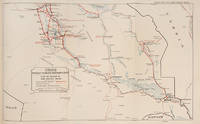
ref. 112648Government of Iraq 1929. . Revised and enlarged edition. Folio 34.5 x 21.5 cm. approx. iv 34pp. photographic frontispiece 8 folding maps coloured in outline scale 1 inch = 15.78 miles 1: 100000 original red cloth lettered in gilt on upper cover a very good copy. Maps include Baghdad and Environs The Environs of Basrah and several road maps to Southern and Northern Iraq. Government of Iraq, 1929. hardcover