SACY (Baron Antoine-Isaac Silvestre De)Livre Rare Book

4 822 résultats
1826réf. PHO-1339Paris, Imprimerie Royale, 1826-1827. 2 volumes grand In-8°(sur 3 , manque tome 1), de VII, 577pp. ; VIII, 596 pp. , demi-chagrin , dos ornés avec auteur ,titre et tomaison , initiale en pied , plat frottés , coins usés , pages de garde brunies , tache au titre (tome 2).
1959réf. 111199Marseille Cahiers du Sud 1959 1 vol. relié in-8, bradel de papier grège, dos lisse avec en pied une bande de même papier déchiré bordé de gris portant le titre imprimé "Chronique", décor de formes abstraites sur papier déchiré bordé de gris sur les plats, avec sous titre imprimé "Homme de Vigie" au premier et nom de l'auteur au second, tête dorée, non rogné, couvertures et dos conservées, rhodoïd (Honnelaître, 1998), 58 pp. Tiré à part de ces textes parus dans la revue des Cahiers du Sud (numéro spécial), constituant l'édition originale du poème Chronique et des textes d'exégèse par P. Guerre, L.-A. Marcel et A. Rousseaux. Tirage limité à 100 exemplaires, plus quelques nominatifs, numérotés sur pur fil Lafuma. Très fine reliure moderne de Claude Honnelaître.
1959réf. 111199Marseille Cahiers du Sud 1959 1 vol. relié in-8, bradel de papier grège, dos lisse avec en pied une bande de même papier déchiré bordé de gris portant le titre imprimé "Chronique", décor de formes abstraites sur papier déchiré bordé de gris sur les plats, avec sous titre imprimé "Homme de Vigie" au premier et nom de l'auteur au second, tête dorée, non rogné, couvertures et dos conservées, rhodoïd (Honnelaître, 1998), 58 pp. Tiré à part de ces textes parus dans la revue des Cahiers du Sud (numéro spécial), constituant l'édition originale du poème Chronique et des textes d'exégèse par P. Guerre, L.-A. Marcel et A. Rousseaux. Tirage limité à 100 exemplaires, plus quelques nominatifs, numérotés sur pur fil Lafuma. Très fine reliure moderne de Claude Honnelaître.
1944réf. 74505Buenos Aires Editions des Lettres Françaises 1944 1 vol. relié in-4, reliure à la bradel de papier recyclé grège, dos orné d'une bande de même papier déchiré bordé de noir, plats également ornés de larges bandes de papier recyclé grège, déchiré et bordé de noir ou rouge, titre inscrit en reprographie sur le premier plat et nom de l'auteur inscrit sur le second, non rogné, couvertures et dos conservés, rhodoïd à rabats (Honnelaître, 1996), non paginé. Edition originale tirée seulement à 392 exemplaires, celui-ci un des 60 exemplaires d'essai sur papier grossier dit "chandelle", non justifié. Cette reliure de grand format qui met parfaitement en valeur la singularité du papier du présent exemplaire a figuré à l'exposition "Claude Honnelaître" de la Bibliothèque Historique de la Ville de Paris en 1996 (n° 124 du catalogue).
1944réf. 74505Buenos Aires Editions des Lettres Françaises 1944 1 vol. relié in-4, reliure à la bradel de papier recyclé grège, dos orné d'une bande de même papier déchiré bordé de noir, plats également ornés de larges bandes de papier recyclé grège, déchiré et bordé de noir ou rouge, titre inscrit en reprographie sur le premier plat et nom de l'auteur inscrit sur le second, non rogné, couvertures et dos conservés, rhodoïd à rabats (Honnelaître, 1996), non paginé. Edition originale tirée seulement à 392 exemplaires, celui-ci un des 60 exemplaires d'essai sur papier grossier dit "chandelle", non justifié. Cette reliure de grand format qui met parfaitement en valeur la singularité du papier du présent exemplaire a figuré à l'exposition "Claude Honnelaître" de la Bibliothèque Historique de la Ville de Paris en 1996 (n° 124 du catalogue).
réf. 927920Imprimerie Nationale Exécutive Du Louvre Paris 1793 In-4 carré ( 270 X 220 mm ) de XVI-431-18 pages, demi-chagrin chocolat à coins, dos à nerfs orné de filets et palettes dorées, et fleurons à froid, tête dorée, non rogné. ( Reliure récente ). 9 planches hors-texte, certaines dépliantes. Très bel exemplaire, grand de marge, parfaitement relié.
1896réf. 13722Stuttgart, Kohlhamer, 1896 (recte 1886 - 1896). 3 Bde. und Prolegomena in 1 Bd. 4°. HLwd. des 20. Jahrhunderts mit Rückenschild (kl. Gebrssprn.).
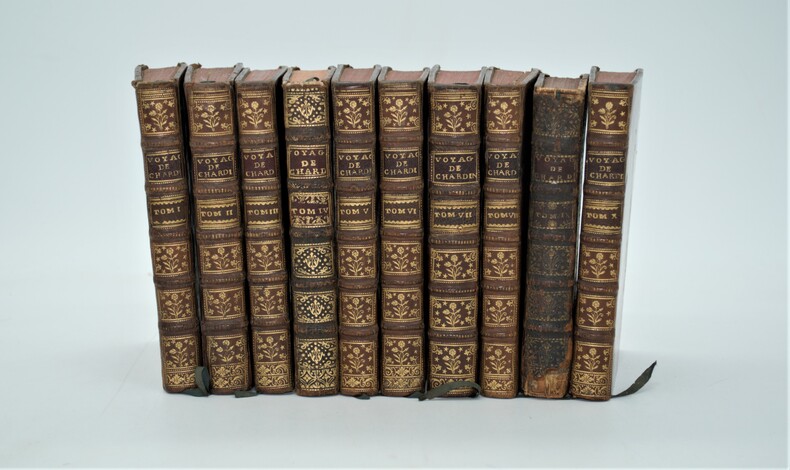
1723réf. PHO-9451723, à Paris chez Denys Horthemels , 10 vol., in-12, veau blond de l'époque , dos à 5 nerfs orné avec pièces de tire et tomaison, caissons fleuronnés dorés, tranches rouge , 32p-254, 334, 285, 280, 312, 328, 10 p.-448, 255, 308, 220-(82) pp. , (T 4 et 9 reliure légèrement différente, T4-plats frottés,page de titre réparée ,T 9- imprimé à Rouen,petites rousseurs , manque la page de garde, manque au dos,charnière fendue , plats frottés , coins usés , cachets répétés)
1922réf. PHO-1362A l'Imprimerie Nationale, Paris, Ernest Leroux et Paul Geuthner Éditeur, 1922-1949. . Édition bilingue: Texte arabe avec traduction française en regard. 5 volumes In-8° de: Tome I (4e tirage,1927) 2ff-XLVI & 443pp. Tome II (4e tirage,1914), XIV & 465 pp. Tome III (4e tirage, 1914), XXVI & 476 pp. Tome IV (4e tirage, 1922), 479 pp. Le Tome V, constitue l'index ,(3e tirage , 1927) 91 pp.. Broché avec couverture éditeur ,tome 1,4 et annexe non coupé , étiquettes au dos et cachets (tome 2 et 3) , manque au dos tome 3.
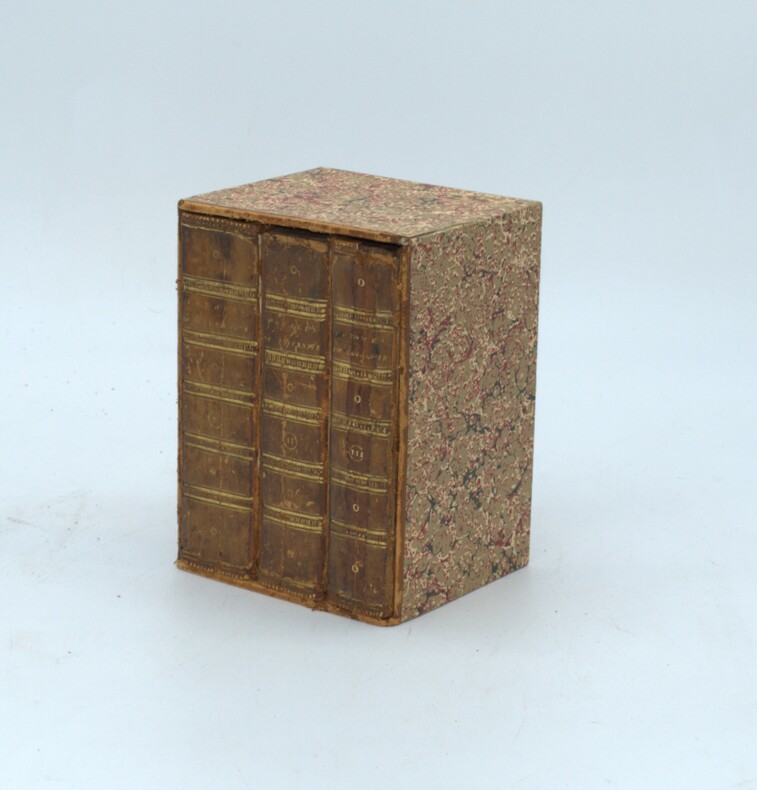
1679réf. PHO-1446Paris , 1679 , 3 vol. in-12, plein veau sous emboîtage, dos orné , filet sur les plats , 19ffn.-780pp.-4ff. , 6ff.-616pp. , 5ff.-564pp.4ff. , charnières faibles , 1 plat détaché , coupes , coins usés, coiffes sup. tome 2 et 3 abimées, réparation au titre tome 2 , manque de papier à l’épître tome 3 , une carte avec manque , déchirure au pli à la carte du Tunquin , trace de réparation avec adhésif sur une planche coupée court .
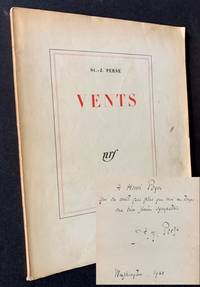
1946réf. 19265Paris: Librairie Gallimard 1946. Original wraps. Very Good . WARMLY INSCRIBED BY ST.-JOHN PERSE TO PRE-EMINENT LITERARY SCHOLAR AND YALE PROFESSOR HENRI PEYRE on the front free endpaper. A solid very presentable copy to boot of the 1946 1st edition. #2236 of 2350 copies "sur papier de chataignier". Bright and VG in its off-white wrappers with very light soiling to the front panel and mild offsetting creasing and soiling at the rear panel. Very small paper cuts along the fore-edges of the preliminaries otherwise clean as could be internally with no writing or markings to speak of. Tall quarto one of the Nobel Prize winner's long poems written during his American "exile Librairie Gallimard unknown
1946réf. 19265Paris: Librairie Gallimard 1946. Original wraps. Very Good . WARMLY INSCRIBED BY ST.-JOHN PERSE TO PRE-EMINENT LITERARY SCHOLAR AND YALE PROFESSOR HENRI PEYRE on the front free endpaper. A solid very presentable copy to boot of the 1946 1st edition. #2236 of 2350 copies "sur papier de chataignier". Bright and VG in its off-white wrappers with very light soiling to the front panel and mild offsetting creasing and soiling at the rear panel. Very small paper cuts along the fore-edges of the preliminaries otherwise clean as could be internally with no writing or markings to speak of. Tall quarto one of the Nobel Prize winner's long poems written during his American "exile Librairie Gallimard unknown books
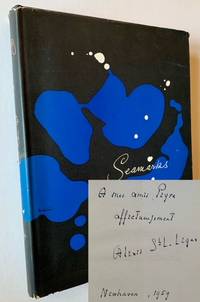
1958réf. 19209New York: Pantheon Books The Bollingen Series 1958. Decorative Cloth. Near Fine/Near Fine. WARMLY INSCRIBED BY SAINT JOHN PERSE USING HIS REAL NAME "ALEXIS SAINT LEGER" TO PRE-EMINENT LITERARY SCHOLAR AND YALE PROFESSOR HENRI PEYRE on the front free endpaper. A very sharp copy to boot of the 1958 1st American edition. Clean and Near Fine just a touch of light offsetting at the front inner hinge in a crisp price-intact Near Fine dustjacket with very mild chipping along the spine ends and the top-edges. Tall quarto wonderful dustjacket design by Paul Rand. Translated from its original French by Wallace Fowlie part of the formidable Bollingen Series in this case LXVII. Pantheon Books (The Bollingen Series) unknown
1958réf. 19209New York: Pantheon Books The Bollingen Series 1958. Decorative Cloth. Near Fine/Near Fine. WARMLY INSCRIBED BY SAINT JOHN PERSE USING HIS REAL NAME "ALEXIS SAINT LEGER" TO PRE-EMINENT LITERARY SCHOLAR AND YALE PROFESSOR HENRI PEYRE on the front free endpaper. A very sharp copy to boot of the 1958 1st American edition. Clean and Near Fine just a touch of light offsetting at the front inner hinge in a crisp price-intact Near Fine dustjacket with very mild chipping along the spine ends and the top-edges. Tall quarto wonderful dustjacket design by Paul Rand. Translated from its original French by Wallace Fowlie part of the formidable Bollingen Series in this case LXVII. Pantheon Books (The Bollingen Series) unknown books
Very Good Turkish Original artwork in watercolor, Indian ink, and dry paint. 11,5x9,5 cm. This rare original artwork of Mary and Jesus comes along an exceptional provenance of Turkish cartoonist Semih Balcioglu (1928-2006), with his handwritten note on verso "Cemal Nadir'in bir kompozisyonudur" [i.e. It's composed by Cemal Nadir]. Signed on right lower as "C. N". Unpublished work. Cemal Nadir was a Turkish cartoonist. He was born in Bursa, Ottoman Empire on 13 July 1902. His father Sevket was a calligrapher (Turkish: Hattat) employed in courts. After finishing high school, he began working as a sign painter in Bursa. He also created cartoons, and his first cartoon appeared in Diken (literally: "The Thorn") periodical. Although he moved to Istanbul and tried to be a full-time cartoonist, he could not make it and he returned to Bursa. The Alphabet reform of 1929 gave Cemal Nadir a second chance to show his talent. When Turkey adopted the Latin alphabet replacing the Ottoman Turkish alphabet in Arabic script, all sign boards were necessarily changed, and he worked hard to meet the demand. The same year, he moved once more to Istanbul to work for the daily Aksam. Later, he also drew for the newspaper Son Posta, as well as for satirical magazines such as Akbaba. He also contributed to Yedigün. During this period, he published the satirical magazine Amcabey. During World War II, he drew anti-Nazism cartoons in the daily Cumhuriyet. In 1946, Republican People's Party (CHP) invited him to run for a seat in the parliament. However, he refused the invitation, he said that with political affiliation he would not be able to create cartoons.
1835Very Good Persian Original decorative dark brown full leather bdg. 44 p. Printed on a special paper with an early 18th century watermark. The Advice by Attâr includes 901 couplet in Persian. Attar Persian poet, Sufi, theoretician of mysticism, and hagiographer, born ca. 540/1145-46 at Nisapur, and died there in 618/1221. His name was Abû ?âmed Mo?ammad b. Abî Bakr Ebrâhîm or, according to Ebn al-Fowatî, b. Sa'd b. Yûsof. ?Attâr and Farîd-al-dîn were his pen-names. It seems that 'Attâr was not well known as a poet in his own lifetime, except at Nisâpûr. 'Awfî, who traveled widely, may have heard about him while staying there , or perhaps from Majd-al-dîn Bagdâdî if this Majd-al-dîn was their common Sufi mentor, though Awfî appears to have only known about Attâr's lyric poetry. Farid al-din 'Attar is one of the most famous spiritual poets of Persia. His works were the inspiration of Rumi and many other mystical poets. 'Attar, along with Sana'i were two of the greatest influences on Rumi in his Sufi views. Rumi has mentioned both of them with the highest esteem several times in his poetry. Rumi praises 'Attar as follows: "Attar roamed the seven cities of love... we are still just in one alley." 'Attar reached an age of well over 80 and died a violent death in the massacre which the Mongols inflicted on Nishapour in April 1221. The world depicted in 'Attar's works reflects the whole evolution of the Sufi movement. The starting point is the idea that the body-bound soul's awaited release and return to its source in the other world can be experienced during the present life in mystic union attainable through inward purification. In explaining his thoughts, 'Attar uses material not only from specifically Sufi sources but also from older ascetic legacies. Apart from his two famous epic masnavi poems 'The Conference of the Birds' and 'The Book of God' he composed a Divan full of powerful, enlightened ghazals and ruba'is. The Pand-nama is a small book of wise, moral advice in short poems in rhyming couplets that is practical and spiritual... (Encyclopedia Iranica & Pand-nama : (Book of Wisdom) Selections Introduction). [EARLY FIRST PERSIAN EDITION of the ADVICE by ATTAR PRINITED in the OTTOMAN EMPIRE] Pend-i Attar. Published by Fâkîr Seyhzâde Es-Seyyid Mehmed Es'ad. Only two printed copies of this edition in OCLC: 819123862.; Türkiye'de basilmis Farsça eserler çeviriler ve Iran'la ilgili yayinlar bibliyografyasi [= Bibliography of the Persian books, their translations and books on Iran published in Turkey] 721.; Mushar -.
1896Very Good Turkish, Ottoman (1500-1928) Original leather bdg. with traditional decorative embossing and gilt lettering of the title on boards. Roy. 8vo. (24 x 15 cm). In Ottoman script (Old Turkish with Arabic letters) and Persian. 480 p. Traditionally framed text. First volume, all published. Early edition of this exceedingly rare Persian-Turkish lexicon, which was one of the earliest Persian dictionaries in the Islamic world, written by Hasan Suuri Efendi from Aleppo, one of the finance officers of the Ottoman Empire. First edition was printed in 1742 and was the last book in two volumes of the first Islamic printing house founded by Ibrahim Müteferrika. This copy is the second edition. All published. Özege 5625.; 780172767, 39832974 (Seven printed copies in American libraries: Concordia Theological Seminary, Virginia Tech, Butler University Libraries, Concordia College Library, Morningside University, Dallas Theological Seminary, and Princeton University Library).
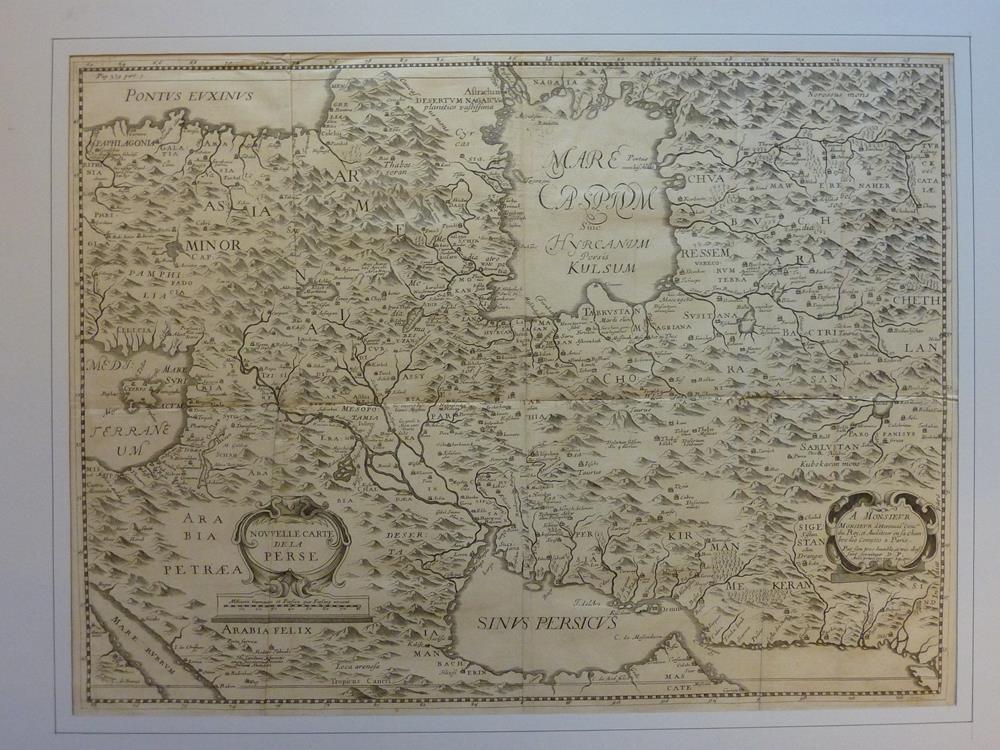
1659réf. 78854( 1659]. 39,5 x 53,5, Blattgröße 41 x 55,5. Unter weißem Passepartout mit schwarzer Linieneinfassung.
réf. 022176[Iran, Perse, Qajar] Aqa Mo?ammad-?Ali Amin-e ?azrat [Mohamed-Ali Amin-e Hazrat] (?-ca.1893?), un des sept fils (l'ainé) de Agha Ebrahim Amin os-Soltan [Amile-el-Sultan] (?-ca.1882), homme d'état important de Perse, proche de Nassereddine Shah. Mohammad-Ali est aussi le frère ainé de Mirza Ali Asghar Khan Amin al-Soltan. L.A.S. [probablement autographe, en français], Téhéran [Thehran], 10 avril 1874, 1p in-8. A un français, Gaston, rencontré lors du voyage du Shah en Europe en 1873 : « Mon cher ! J'ai l'honneur d'avoir reçu votre lettre qui m'a fait renouveller la bonne amitié que j'ai réjouis pendant la voyage et que j'espère être honnorable par la même. Depuis que je vous ai quitté une espèce d'incertitude m'à saisit et il ne me reste que prier Dieu pour me destiner une longue voyage en Europe où sans doute j'aurai la bonne occasion de vous revoir. Je vous offre les photographies que vous avez demandé en attendant de recevoir celle de vous avec des nouvelles de votre santé. Mon père et mon cousin se portent bien et vous présente ses respectes. Faites-moi plaisir en acceptant pour votre ami Mahomed-Ali fils d'Amine-el-Sultan ». Les formulations et l'orthographes sont parfois aléatoire mais révèlent néanmoins un lettré. Aqa Mo?ammad-?Ali Amin-e ?azrat connut par la suite une carrière moins brillante que celle de son demi-frère ?Ali-A??ar Khan. Gouverneur de Zanjan en 1887-1888 puis de ?amsa en 1889-1890, il est décrit par E?temad-al-Sal?ana comme ayant été, dans sa jeunesse, un homme ambitieux avant de sombrer dans une consommation excessive d'alcool après que son demi-frère eut été préféré à lui pour les hautes fonctions. Molkara lui attribue également une tendance à la débauche. Il fut victime d'une crise cardiaque en mars 1889 et mourut environ quatre ans plus tard à Téhéran, après une longue maladie. Sur le même document, un français (un diplomate ?), au même Gaston, mentionnant notamment le voyage de Paris à Vienne où Gaston a côtoyé les fils d'Amile-el-Sultan. Papier faible aux plis d'origine. Rare témoignage épistolaire des relations franco-persanes au sein de l'entourage de Na?er-al-Din Shah, au lendemain du premier voyage européen du souverain en 1873. [538]
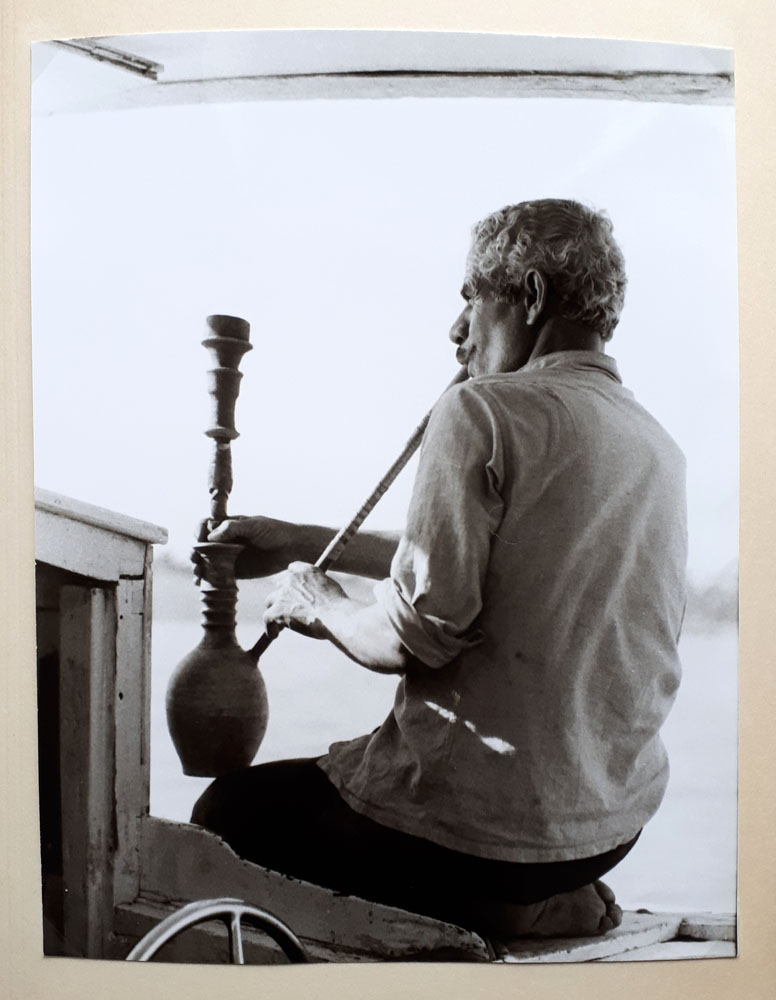
1969réf. q5r1030b81969. Ca. 180 orig. s/w Vintage auf Barytpapier, ca. 17, 6 x 23,2 cm und ca. 80 orig. Farb-Abzüge, ca. 13 x 18 cm . Die Aufnahmen wurden mit einer Leica-Mittelformat-Kamera gemacht und enstanden während einer Studienreise März-April 1969 durch die Gebiete des heutigen Irak und Iran. Der Photograph ist unbekannt. Alle Photos sind mittels Photoecken auf Photo-Karton befestigt. Die Pappen sind in vier Ringbücher abgeheftet. Die Photos sind sauber und unbeschädigt und können getrost als wichtige Dokumente der Kunst- und Kulturgeschichte des Mittleren Ostens bezeichnet werden. Sehr guter Zustand. ca. 1800 gr. Aus dem gleichen Bestand wird separat eine Serie angeboten, die wahrschscheinlich für eine Ausstellung vorbereitet war. Weitere Informationen auf Anfrage. Bildrechte beim Verlag IL. 4° [7 Warenabbildungen] Ringbuchheftung
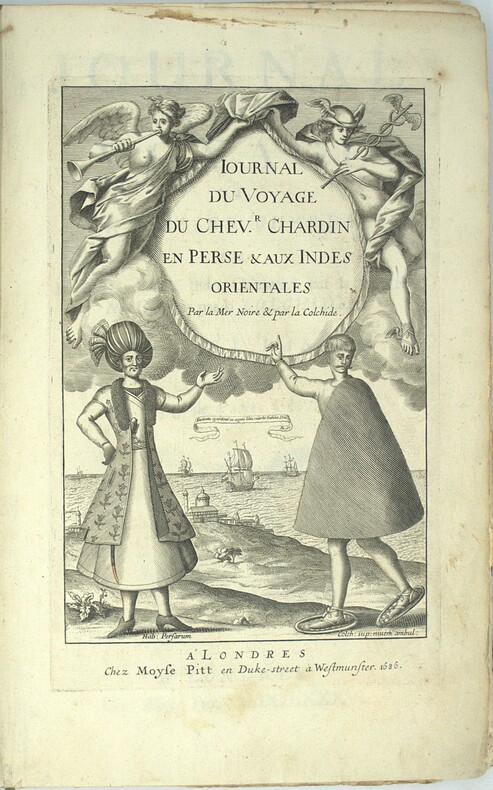
1686réf. PHO-2117Londres, chez PITT, 1686, in-folio (32x21cm), 8ff. - 349pp.-3ff., illustré de 17 gravures, la plupart dépliantes, manque le portrait de l’auteur, relié plein cuir époque, défauts de reliure avec manque de matière mais corps solide, 2 planches détachées, déchirures sans manque, manque en marge à la carte, traces de réparation à quelques planches, traces d’oxydation (adhésif).
1912réf. 45497Jena; Diederichs, 1912. 315 S., 10 Tafeln von F. H. E. Schneidler. Gr.-8°(=22,5-25cm); Blauer Original-Maroquin-Ledereinband mit reicher Goldprägung. Kopfschnitt in Gold.
1922réf. PHO-1091A l'Imprimerie Nationale, Paris, Ernest Leroux et Paul Geuthner Éditeur, 1922-1949. . Édition bilingue: Texte arabe avec traduction française en regard. 5 volumes In-8° de: Tome I (4e tirage,1927) 2ff-XLVI & 443pp. Tome II (5e tirage,1949), XIV & 465 pp. Tome III (5e tirage, 1949), XXVI & 476 pp. Tome IV (4e tirage, 1922), 479 pp. Le Tome V, constitue l'index ,(3e tirage , 1927) 91 pp.. Broché avec couverture éditeur .
1827réf. 18393Paris, Ponthieu et Cie; Leipzig Ponthieu, Michelsen et Cie 1827 in-8 de 2 ff.n.ch. et 187 pp. br., couv. bleue impr., couv. tachée, infimes piqûres
réf. 176637Paris, Ducollet, 1833-1835 7 vol. in-8, carte dépliante, demi-chagrin noir, dos à nerfs, caissons à froid, filets dorés (rel. de l'époque). Rousseurs, qqs taches plus prononcées à la fin du tome 5. Timbre sec.