1 624 résultats
1829Volume in 8° grande, brossura editoriale a stampa, (un po' polverosa ma integra), titolo al piatto entro cornice decorativa, frontespizio, sommario, VII, bianca, 252 pp., colophon, bianca finale. Bell'esemplare marginoso ed in barbe di questa importante e rara grammatica siriaca, compilata da uno specialista delle lingue orientali, che non si limita alla mera traduzione dei vari nomi, ma accompagna con una spiegazione lessicale e con ampi esempi i vari modi grammaticali. Al fondo del volume le ultime otto pagine sono completamente in lingua siriaca. Stampato su carta forte e croccante, piuttosto polverose le barbe e gli angoli esterni del frontespizio (una macchia scura all'angolo inferiore). Efficace, completo e di scarsissima reperibilità.
2019réf. x-3030111520Palgrave Macmillan 2019. Hardcover. New. 211 pages. 8.25x6.00x0.75 inches. Palgrave Macmillan hardcover
1883réf. 320989London: Richard Bentley 1883. First edition. x 2 436 6 adspp. 8vo. Bound in three quarters modern brown morocco and marbled boards. Fine. First edition. x 2 436 6 adspp. 8vo. Richard Bentley unknown
1883réf. 320989London: Richard Bentley 1883. First edition. x 2 436 6 adspp. 8vo. Bound in three quarters modern brown morocco and marbled boards. Fine. First edition. x 2 436 6 adspp. 8vo. Richard Bentley unknown books
1900réf. 144451900. Keystone View Company. Six stereoviews of Middle Eastern cities settlements workers and local inhabitants circa 1900-1910 document landscapes and daily life across the late Ottoman domains during the formative years of mass-market educational photography. The photographs encompass river agriculture in Mesopotamia urban panoramas of Beirut and Damascus an Arab sheikh accompanied by an armed bodyguard and skilled labor in Tarsus. Together they provide visual evidence for the study of Ottoman urban geography rural settlement transportation dress animal labor and American representations of the Middle East before the territorial divisions imposed after the First World War. Keystone founded in Meadville Pennsylvania in 1892 distributed stereographs for domestic and classroom use and established an Educational Department in 1905 placing geographically distant communities within an interpretive framework designed for American viewers. Six original photographic stereoviews published by the Keystone View Company circa 1900-1910 each with an extended printed caption on the verso. 1 "Land of Euphrates" shows two boys looking from flat rooftops toward the riverine Mesopotamian landscape contrasting cultivated ground near the Euphrates with the arid plain beyond; its caption identifies the region through the biblical tradition of the Garden of Eden. 2 An Arab sheikh stands with his horse and an accompanying bodyguard carrying a rifle preserving details of dress equestrian culture and armed personal attendance. 3 A panoramic view of Beirut records a dense concentration of buildings and several vessels offshore documenting the Mediterranean port's built environment and maritime setting. 4 An Arab village beside the Euphrates shows settlement within the Mesopotamian river valley. 5 A Damascus cityscape places a minaret above clustered rooftops emphasizing the vertical relationship between religious architecture and surrounding domestic buildings. 6 A blacksmith shoes a buffalo within the streets of Tarsus recording animal-powered transportation and an urban metalworking trade. Although the printed caption reportedly associates Tarsus with Syria the city was in Ottoman Cilicia and is now in southern Turkey. Produced before the postwar mandates divided much of the former Ottoman Middle East between British and French administration the views should not be described as records of modern European colonization; rather they document places still governed within the Ottoman imperial framework while revealing the biblical ethnographic and educational language through which Keystone presented the region abroad. The caption texts are themselves significant secondary evidence particularly where "Land of Euphrates" interprets Mesopotamian geography through Christian scripture and where broad ethnic labels mediate the identification of pictured subjects. The stereoviews show only minor evidence of age and handling and remain in very good condition. This coherent group combines detailed visual records of six locations and activities with the publisher's original explanatory texts enabling comparative study of both Ottoman-era environments and their circulation within American visual education. unknown
1900réf. 144451900. Keystone View Company. Six stereoviews of Middle Eastern cities settlements workers and local inhabitants circa 1900-1910 document landscapes and daily life across the late Ottoman domains during the formative years of mass-market educational photography. The photographs encompass river agriculture in Mesopotamia urban panoramas of Beirut and Damascus an Arab sheikh accompanied by an armed bodyguard and skilled labor in Tarsus. Together they provide visual evidence for the study of Ottoman urban geography rural settlement transportation dress animal labor and American representations of the Middle East before the territorial divisions imposed after the First World War. Keystone founded in Meadville Pennsylvania in 1892 distributed stereographs for domestic and classroom use and established an Educational Department in 1905 placing geographically distant communities within an interpretive framework designed for American viewers. Six original photographic stereoviews published by the Keystone View Company circa 1900-1910 each with an extended printed caption on the verso. 1 "Land of Euphrates" shows two boys looking from flat rooftops toward the riverine Mesopotamian landscape contrasting cultivated ground near the Euphrates with the arid plain beyond; its caption identifies the region through the biblical tradition of the Garden of Eden. 2 An Arab sheikh stands with his horse and an accompanying bodyguard carrying a rifle preserving details of dress equestrian culture and armed personal attendance. 3 A panoramic view of Beirut records a dense concentration of buildings and several vessels offshore documenting the Mediterranean port's built environment and maritime setting. 4 An Arab village beside the Euphrates shows settlement within the Mesopotamian river valley. 5 A Damascus cityscape places a minaret above clustered rooftops emphasizing the vertical relationship between religious architecture and surrounding domestic buildings. 6 A blacksmith shoes a buffalo within the streets of Tarsus recording animal-powered transportation and an urban metalworking trade. Although the printed caption reportedly associates Tarsus with Syria the city was in Ottoman Cilicia and is now in southern Turkey. Produced before the postwar mandates divided much of the former Ottoman Middle East between British and French administration the views should not be described as records of modern European colonization; rather they document places still governed within the Ottoman imperial framework while revealing the biblical ethnographic and educational language through which Keystone presented the region abroad. The caption texts are themselves significant secondary evidence particularly where "Land of Euphrates" interprets Mesopotamian geography through Christian scripture and where broad ethnic labels mediate the identification of pictured subjects. The stereoviews show only minor evidence of age and handling and remain in very good condition. This coherent group combines detailed visual records of six locations and activities with the publisher's original explanatory texts enabling comparative study of both Ottoman-era environments and their circulation within American visual education. unknown books
réf. 115882Petrus De La Roviere S.L. (Geneva) 1619 Petit in-4 ( 230 X 160 mm ) de [18]-278-[2] pages, vélin ivoire à recouvrement. Page de titre abimée avec mouillures et manques, dos absent, reliure avec manques, exemplaire à restaurer.
1828réf. 12889Florenz, Giuseppe Galletti, 1828. Kupferstich. Blattgröße: 42,5 x 50,5 cm, Druckspiegel: 29 x 43,5 cm. [2 Warenabbildungen]
1964Fine Turkish Original pictorial wrappers. Oblong large 8vo. (13 x 25 cm). In Turkish. [22] p., many b/w plates. Not recorded in any platform and library, extremely rare propaganda pamphlet prepared for 60's Turkey by the UAR, The United Arab Republic. On the frontispiece, the leader of the UAR, Egyptian President Gamal Abdel Nasser's iconic words with his portrait by Moheeb. The pamphlet includes the UAR's vision usually and its social and economic policies, projects, Suez Canal, Al-Wady al-Gadid, industry, navigation, mining, oil and its industry, agriculture and agricultural reforms, livestock, culture and education, medicine, water, tourism, etc. Extremely rare.
1697réf. 8349Leipzig, Martin Theodor Heybey, 1697. Kl.-8°. Mit gest. Frontispiz. Titel in Rot u. Schwarz. 3 Bll., 533 (1) S., Ldr. d. Zt. a. 4 Bünden.
réf. awd-1075In-4 en feuilles à l’italienne, couverture illustrée à rabats (28 pp.).
1892complet en 2 parties: xix,841 + 694pp., 26cm., 2 tomes avec reliures cart. uniformes (dos en cuir avec titre et faux-nerfs dorés, plats décorés en motif "tree-calf", qqs. trous de ver aux dos), feuilles de garde marbrées, imprimé sur papier de luxe (probablement papier Hollande), bon état, texte et intérieur en très bon état, ce ménologe contient ca. 800 biographies de Jésuites desdits régions, [cfr. De Backer-Sommervogel, III-1933-21], R50188
1892réf. R50188Paris, Schneider 1892 complet en 2 parties: xix,841 + 694pp., 26cm., 2 tomes avec reliures cart. uniformes (dos en cuir avec titre et faux-nerfs dorés, plats décorés en motif "tree-calf", qqs. trous de ver aux dos), feuilles de garde marbrées, imprimé sur papier de luxe (probablement papier Hollande), bon état, texte et intérieur en très bon état, ce ménologe contient ca. 800 biographies de Jésuites desdits régions, [cfr. De Backer-Sommervogel, III-1933-21], R50188
18412 volumi in 8, pp. 528 con 8 tavole fuori testo incise all'acquaforte e protette da veline editoriali (rispetto all'indice delle tavole manca la tavola con le giovani greche di Milo ma vi e' una tavola in piu' non menzionata con il busto di Volney); 480 + 2 pp. di indice (numerate come 281-282) + foglietto sciolto con l'indice delle tavole, con 10 tavole fuori testo incise all'acquaforte e protette da veline (completo delle tavole). Intonso. Mezza pelle coeva con fregi al dorso. Si tratta del volume 3 e 4 della raccolta della 'Raccolta di viaggi alla scoperta del nuovo continente' compilata dal Marmocchi. Le descrizioni inserite in questo viaggio comprendono: Gerusalemme e la Terra Santa, L'Egitto, Isole dell'Egeo (Rodi, Candia, Paros, Nassos e Sira), la Grecia, Smirne, la Misia e la Bitinia, Costantinopoli, Romelia e Valacchia, Adrianopoli, Bucarest e poi Scio, Milo, Nicea, Elosponto, Delo, Santorino, la Cilicia, Cipro, Sidone, Tiro, Palestina.
réf. 240857Paris, Guillaumin & Cie, Lyon, Rey et Cie, 1902 in-8, 557 pp., carte dépliante en couleurs, demi-vélin ivoire à la Bradel, premier plat de couverture conservé (reliure de l'époque).
réf. 9042In 8 broché,faux-titre, titre, XII, 347 pages,complet des 9 croquis et cartes dont dépliants, en fin de volume. Paris Librairie Ernest Leroux 1931. Edition originale. Un manque réparé, dan la partie supérieure du dos, petites rousseurs, sans gravité sur les plats, Très bon état intérieur
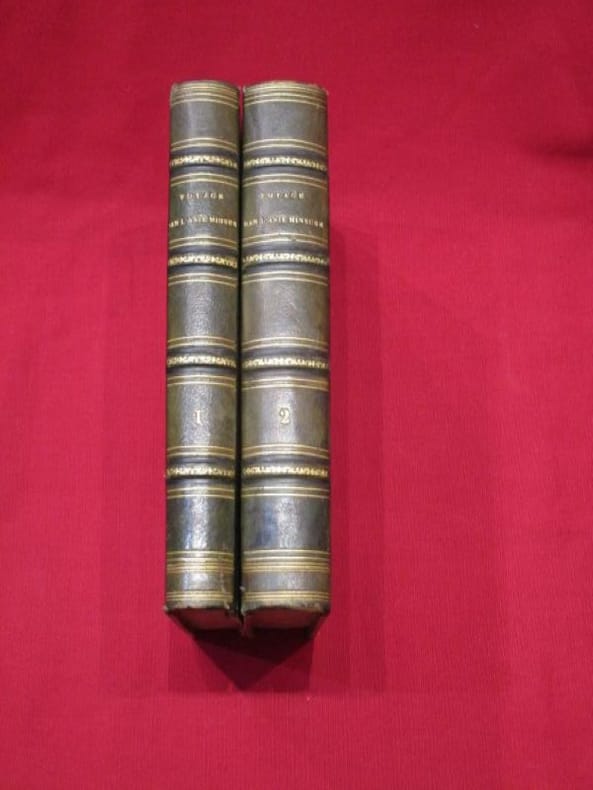
1840réf. PHO-1534Paris, Ducollet, 1840-1841. 2 vol. in-8, XII-456pp.-612pp., brochage éditeur, non coupé, non rogné, petit manque de papier à la couverture du tome 1 et dernière de couv. tome 2.
réf. 118922Paris, Ducollet, 1840, 2 volumes in-8 de XII, 456 pages - 612 pages. Demi-reliure verte, dos à nerfs portant titres et tomaisons dorés, tranches mouchetées, gardes de papier marbré. Dos insolés, quelques épidermures sur le cuir, ex libris papier sur les contreplats, taches d'oxydation par endroits, sinon bon état général.
réf. 13978290Paris: Didier et Cie, 1862 in-16, [6]-viii-448 pages, gravure frontispice "Bibliothèque de la jeunesse", Alphonse Pigoreau libraire spécialité de distribution des prix. Reliure percaline rouge usée et partiellement décolorée, fer du collège d'Arles sur le premier plat, tranches dorées, bon état intérieur.
1939réf. X117619Roma [Rome], Pontificium Institutum Orientalium Studiorum 1939 Volume I (out of 3): li + 418pp., 28cm., nice and solid modern hardcover, with Syriac texts and Latin translation, [Content: Volume I fasc.1: Introductio (by A. Raes), Anaphora Timothei Alexandrini (by A. Rucker), Anaphora Severi Antiocheni (by H.W. Codrington) // Volume I fasc.2: Anaphora Gregorii Nazianzeni (by I. Hausherr), Anaphora Ioannis Chrysostomi (by H.G. Codrington), Anaphora duodecim apostolorum prima & secunda (by A. Raes) // Volume I fasc.3: Anaphora Dioscori Alexandrini Prima & secunda (by G. de Vries), Anaphora Cyrilli Hierosolymitani vel Alexandrini (by A. Raes), Index verborum voluminis primi (by A. Raes)], with ex-libris on blanco endpaper, text is clean and bright, good condition, rare, weight: 2.1 kg., X117619
1792réf. VOY953MVOLNEY - DIVERS 1792. In-8°, 2 voll,248+289 pp. Relié, veau raciné du temps .L'édition sans lieu ni éditeur, après le succès de la première en 1787, n'est probablement pas autorisée.
19678vo., First Edition, with numerous plates; red tweed cloth, gilt back, red endpapers, a very good, bright, clean copy in unclipped dustwrapper, the latter lightly creased at extremities and with one short closed tear. SIGNED BY THE AUTHOR ON FRONT FREE ENDPAPER. Fresh copy of the great travel writer's first book. SIGNED COPIES ARE SCARCE.
1864réf. 85033Couverture rigide. Reliure toile de l'éditeur, défraîchie. 336 pages. Légèrement défraîchi. Papier légèrement bruni. Quelques rousseurs. Très légère mouillure en marge inférieure sur 10 pages.
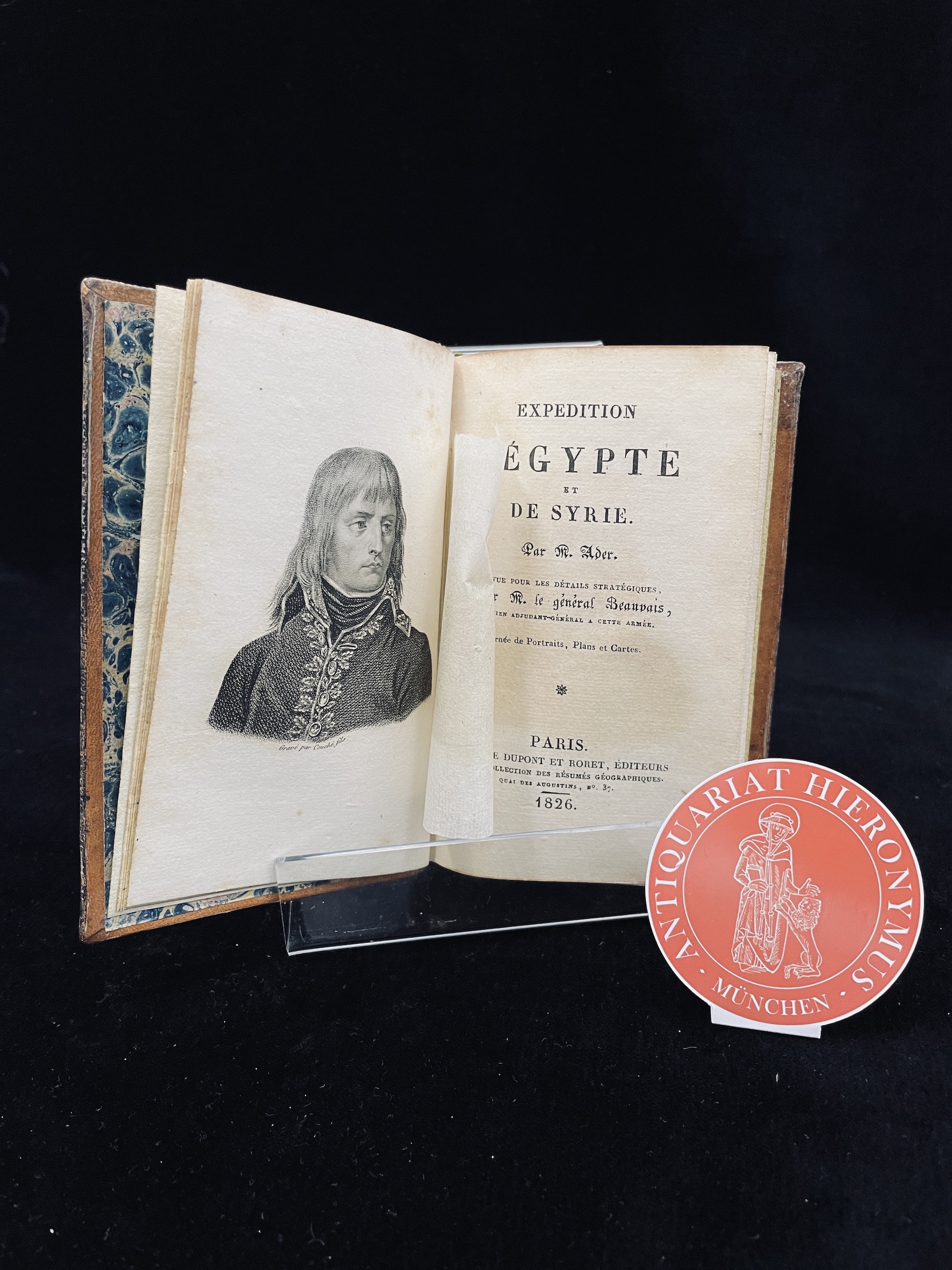
1826réf. 11251Paris, Ambroise Dupont et Roret, 1826. 1. Auflage 16° (10-15 cm). 356 S. Maroquinleder der Zeit mit verziertem und vergoldetem Rücken und zwei montierten Rückenschildern
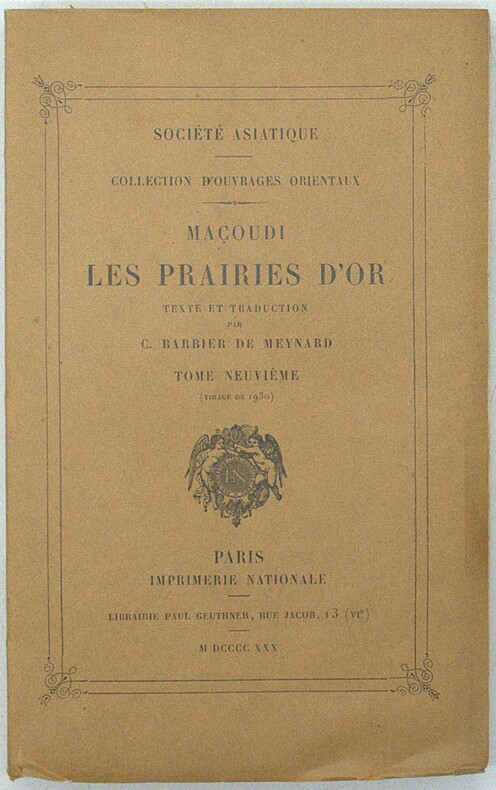
1930réf. PHO-1959Paris, Imprimerie Nationale, 1930, 1 vol. (sur 9) In-8°, brochage éditeur. Édition bilingue : Texte arabe avec traduction française en regard, Tome IX : 3ffnch.-VI-299 pp., suivi des notes et variantes, correction ainsi que la table des matières, en fin d’ouvrage, un index général occupe les pages 96 à 299.