British Colonial IndiaBiblio.com
4.257 Ergebnisse
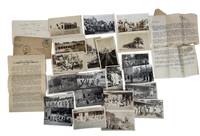
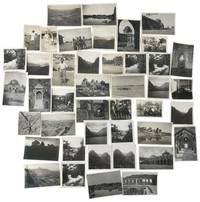
1940Best.-Nr. 232161940. British India photo archive following an unidentified man likely a serviceman in Mhow and Mandu during World War II 1942-1943 preserving a localized record of colonial wartime life through mess scenes sport staff bungalows named companions imposed colonial social frameworks and visits to the major Islamic monuments of Mandu. The captions place the central figure in the company of "Carroll Sahib" Ken Davis and other men in uniform-style dress while repeated references to the "mess" weapon training staff and cantonment-like grounds situate the photographs within a British colonial wartime environment in central India. The group shows one participant moving between military or officer-adjacent daily life and the monumental landscape of Mandu at a moment when India remained a crucial base of Allied wartime activity. Photo archive of 43 silver gelatin photographs ranging from 2 x 3.5 to 2.5 x 2.5 inches Mhow and Mandu India 1942-1943. Most photographs bear substantial contemporary handwritten inscriptions on the versos often dated. Identifiable scenes include two men with tennis rackets outside a bungalow captioned as taken after tennis; a portrait inscribed "Me the Carroll Sahib & Ken Davis outside the Mess 25/12/42"; a group of eight men captioned "two scotsmen our four weapon training instructors the Carroll Sahib me outside the W/T staff bungalow 25/12/42"; men wearing garlands outside the mess; a sports or gymkhana ground with riders or runners in formation; tented grounds beside a large building; and a portrait of a man identified as "Machdo our bearer." The architectural and landscape views are closely tied to Mandu with captions naming the Jami Masjid Jahaz Mahal Rupmati's Pavilion Baz Bahadur's Palace mosque interiors courtyards pools lake views ravines and elevated plateaus. Several photographs show men posed on open parade or sports grounds in light uniform-style dress including group portraits outside the mess and the W/T staff bungalow with tennis rackets bicycles garlands and temporary tent lines indicating a social world organized around exercise communal dining and station routine. Other images turn to Mandu's built landscape in much greater detail with framed views of domed pavilions arcaded courtyards carved entrances long interior corridors water tanks and palace ruins seen from terraces lakesides and elevated lookouts. The landscape scenes broaden that record further including steep ravines river and waterfall views and plateau panoramas that place the serviceman's movements within the wider terrain of central India. During World War II Mhow remained an important cantonment in British India and these photographs place one serviceman within the daily social world of that station where tennis communal dining staff housing local attendants and holiday gatherings existed alongside travel to nearby historic sites. The Mandu views record the same hand moving through one of central India's best-known Sultanate monument complexes with captions naming the Jami Masjid Jahaz Mahal Rupmati's Pavilion Baz Bahadur's Palace and associated interiors courtyards pools and landscape features. Light general wear occasional silvering and minor handling marks; inscriptions strong and legible on most versos. The dense captioning and photographic record show British colonial India during World War II through the the personal lens colonial rank and language staff organization sport and leisure during wartime Indian attendants and movement through one of central India's historic architectural landscapes. unknown
1879Best.-Nr. 0009094London: John Murray 1879. First edition. Hardcover. Fine. 8vo; cxxvii 444 12 pages blue cloth Burton's contributions occupy the first 190 pages. Also Prof. George Rolleston's lecture to the RGS an early ecology talk "The Modifications of the External Aspects of Organic Nature produced by Man's Interference". " I propose . to notice a few of the many alterations produced by disforesting in our own and other countries". John Murray hardcover
1941Best.-Nr. 209861941. Gregson Anita. A.P. Mission City School archive 1941-1942 documenting girls' education missionary activity and community life in Ambala Punjab during World War II. This material records daily instruction social interaction and local conditions within a mission-run school for girls alongside written correspondence and institutional reporting that situate the school within wartime pressures and colonial India's educational landscape. The archive provides direct evidence of classroom practices gendered education and the integration of local families into school environments as well as the impact of global conflict on regional communities. Archive comprises 21 original black and white and sepia photographs one typed letter and one annual report. Photographs measuring approximately 2" x 3" to 3" x 5" frequently bear handwritten or typed captions on the verso likely by Anita Gregson identifying subjects and activities. Images show groups of schoolgirls engaged in classroom exercises and outdoor instruction including one scene of students constructing a ground map of India to illustrate agricultural production. Another photograph depicts a semicircle of young children seated outdoors during a lesson with their teacher identified as Miss Atmaran and a veiled mother observing her burkha partially drawn back. Additional images document craft instruction including girls weaving coconut palm leaves into fans and producing woven ties on frames. Musical activity is also present with students playing instruments. Beyond the school photographs depict village life in Punjab including oxen operating a water-drawing mechanism children gathered around a missionary playing a ukulele and a merchant carrying goods suspended from a yoke. The accompanying letter dated June 14 1942 from Gregson to a correspondent in New York references World War II noting international observances and local enlistment: "The young men in our Indian community are continuing to sign up for the army navy and air force." The annual report for the 1941-1942 school year details wartime financial strain fundraising efforts and instructional programs including an adult literacy course for women teaching reading writing and arithmetic. Created while India functioned as part of the British Empire during World War II these materials document the intersection of missionary education wartime mobilization and local social life. The inclusion of adult literacy instruction for women reflects ongoing efforts to expand female education under colonial conditions while the letter and report connect the school directly to global conflict and its local consequences. Light wear and minor fading to photographs; handling wear present. Letter on thin paper with tears and fragility consistent with wartime materials poor to fair condition; remaining materials overall very good condition. This archive provides a concentrated visual and textual record of girls' education and community experience in wartime Punjab. unknown
Best.-Nr. DADAX0198263775New unknown
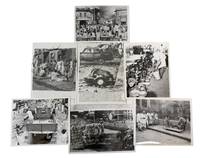
1943Best.-Nr. 234951943. Indian famine crisis press archive depicting hunger relief work and public unrest from Bengal famine conditions through later food riots in independent India. The Bengal Famine of 1943 killed an estimated three million people and food scarcity remained politically volatile in India for decades afterward. Street demonstrations over grain rationing and hunger drew police deployments in multiple cities turning food access into a public order crisis as well as a humanitarian emergency. Photo archive of 7 silver gelatin press photographs mostly measuring 8" x 10" India 1943-1964. Crowds gather outside food distribution points children sit with metal bowls during feeding mounted police face demonstrators and uniformed officers move through dense street scenes. Press captions identify Calcutta famine conditions food rioters dispersed by police in Kerala fighting and fire in Lucknow and relief activity for famine victims. Typed captions identify "food rioters" being dispersed outside the Travancore state government house in Trivandrum Kerala where police and mounted officers filled the street after looting over food. Another caption describes Lucknow fighting in which "rioters set fire to about a six-block square" with crowds massed near burning buildings and shopfront signs. Calcutta scenes show famine victims clustered around relief vessels and feeding bowls with one caption stating that people had been "reduced to skin and bone" after food shortages. A street-side feeding scene shows children and adults crouched in rows with metal dishes receiving food from a man holding a large bucket.Verso stamps include Acme Newspictures NEA reference markings New York Bureau labels editor crop marks typed captions and publication dates. The group connects famine mortality postwar scarcity and street protest in India across a period when food distribution became a central test of colonial and postcolonial government authority. Press handling wear caption remnants crop marks corner creasing and scattered surface marks; overall in very good condition. A strong press group linking famine relief imagery with the public unrest that followed hunger into India's mid-century political life. unknown
1893Best.-Nr. 2305250019Roorkee: Thomason College Press 1893. First Edition. Hardcover. Good. Plate book of Indian Archeology Bound in publisher's blue cloth-backed boards. Scattered foxing. 47 pp. folding lithographic plan of Fatehpur Sikri 6 large albumen print photographs 24 x 17 cm mounted 3 folding lithographic plates of frescoes. Roorkee: Thomason College Press hardcover
1903Best.-Nr. 43874London: Adam and Charles Black 1903. First edition Copy Number 173 of 1000 signed by Mortimer Menpes. 100 Plates. The illustrations have been engraved and printed at the Menpes Press under Mr. Menpes's direction. 210 pp. 1 vols. 4to. Cream cloth some wear at bottom front joint inner hinges started. First edition Copy Number 173 of 1000 signed by Mortimer Menpes. 100 Plates. The illustrations have been engraved and printed at the Menpes Press under Mr. Menpes's direction. 210 pp. 1 vols. 4to. The first Durbar was held in 1877 to proclaim Queen Victoria as Empress of India. This is the second Durbar to proclaim Edward VII as king in 1902 but was not attended by the King either. It was not until the 1911 Durbar when George V and Queen Mary went to India was the Emperor and his Empress proclaimed in person to the people of India. Our authors stayed in Camp Number One called "The Millionaires' Camp." in Delhi. With an ALS from Menpes tipped in at the back. Inman #18 Adam and Charles Black unknown
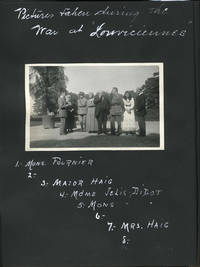
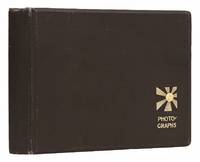
1915Best.-Nr. 231261915. Very good condition. A photograph album memorializing two trips made by an English woman Mrs. K. Haig throughout Europe then to India to visit her son Major W. de W. Haig a British officer and his wife. It concludes with "Pictures taken during the War at 'Louviciennes'" including an image of the Chateau des Voisins now the BNP Paribas campus. The first half of the album begins in 1909 with the departure of the ship "Yale" based in Bath with an American flag to the European continent. Another ship listed is possibly the "Bleucher". Places visited include Berlin Potsdam Sans Souci Dresden the Royal Gardens at Nieder-Siedlitz Munich Lucerne Pilatus Berne Murren Zermatt Geneva Lyons Avignon Arles Nimes Montpelier Tours Chenenceaux Chateau de Lude Aise le Rideau Villandry Fontainebleau St. Cloud Chantilly & Versailles. The second half of the album is entitled " 'India' From Pictures By Major W. de W. Haig". These include Kashmir Naini Tal Muktesar Srinagar Dehra Dun and the Khyber Pass. Major Haig took some lovely and at times atmospheric images of the people of India including a papier mache worker women grinding corn men sewing with a sewing machine on the curbside; candy shop in the bazaar Mrs. K. Haig "travelling in a 'Dandy' on men's heads" on the way to Muktesar wood gatherers a pair of men using a long bowed saw Indians in small boats at the shore of a lake surrounded by mountains. There are also extensive images of their bungalow at Lucknow and "Beaucaire" the home of Major and Mrs. Haig 31 Rajpur Rd Dehra Dun. looking very grand residences!. The sign at the Khyber Pass taken with their automobile states "It is absolutely forbidden to cross this border into Afghan Territory." The last 4 pages are photographs taken at Louviciennes outside of Paris the first a group of 8 with 5 identified as Mons. Fournier Major Haig and his wife Mdme & Mons. Gelis-Didot. Gelis-Didot may be Pierre Gelis-Didot author of "Hotels et Maisons de Paris/ Facadea et Details" published in 1893. He was celebrated for his architectural drawings. There is a picture of the "Chateau des Voisins" now the BNP Paribas campus. and then a series of images of tea at the Fornier's where the visitors pose with a massive bomb shell presumably to emphasize the fire power of the French. They appear content with little recognition of the pain and suffering soon to be rained down on them all. Albumen and silver gelatin prints 112 images of Europe generally 3 3/4" square and 4 1/2 x 3 1/2". 54 images of India varying from 4 5/8 x 3 1/2" to 6 x 8 5/8" with most 4 1/2 x 6". 14 images of Louviciennes 11 quite small 2 x 2 1/2" the 1/4 x 3 1/2". Captioned below and sometimes within the margin of images. Album 8 1/4 x 10 1/4" black original cloth gilt "Photographs" on the front board spine slightly faded. 50 leaves photographs on both sides of the pages. unknown
1945Best.-Nr. 819981945. Varying sizes and formats the majority being 8cm x 5.5cm with some larger format images being no larger than 12cm x 8.5cm. The majority in Very Good condition or better with a couple of images having some abrasions to verso some marginal creasing and in one instance a triangle of loss to the border. A compact and informative group of images the majority with detailed verso captions from an American serviceman a long way from home. One of the most strategically important but now somewhat marginalized initiatives of the later stages of WW2 was the vitally important China-Burma-India resupply route. A phenomenal effort was made to ensure seamless movement of troops and materials in defiance of the ebb and flow of Japanese occupations and blockades throughout the theater of war between 1943 and 1945. Originally allied forces held control of what came to be called "Stilwell Road" running from Ledo through to Kunming in China via Burma this ground route proved subject to a number of issues not least of which was Japanese aggression so an initiative was developed to allow the air transport of vital resources between the rapidly constructed Dinjan airfield in Assam where our G.I. is stationed and the distribution points in China and Burma. This important piece of military and indeed civilian co-ordination was carried out by a number of units; initially the India Air Task Force the majority of which became the U.S. Tenth Air Force with additional allied units ranging from British RAF to the legendary China National Aviation Corporation CNAC. This collection includes an image of Captain Enos Claire Kirkpatrick of the CNAC captioned "One swell fellow" which is notable mainly for his participation in the gradual evolution of the CNAC into the Civil Air Transport and subsequently into the CIA backed Air America for whom Kirkpatrick flew support missions to Dien Bien Phu and a number of other conflict torn South East Asian destinations before his retirement in 1966. Very much a 'cowboy' operation during WW2 with a number of the CNAC pilots being ex- Flying Tigers it later became a more streamlined and well supplied arm of U.S. military intelligence. CNAC was also distinctive for being made up of U.S. and Chinese pilots and crew flying together performing 38000 missions between 1942-1945. A number of other units operated out of Assam during this period including the 443rd Troop Carrier Group the 44th Service group represented in this collection the 3rd Combat Cargo Group and the 1080th QM Quartermaster Company. Which unit our GI belonged to or was seconded to is unclear the situation at Dinjan seems to have been fairly fluid and informal with the risky and rather impetuous nature of running missions "Over The Hump" as the Himalaya crossing was referred to lending itself to some fairly esoteric variations on traditional military roles and conventions. An unofficial grouping of images with many of the photos seeming to have been sent to a sweetheart back home with brief explanations of the content. There are numerous depictions of things that would naturally fascinate a U.S. serviceman positioned in Northern India: the Nimtollah burning ghats temples the Calcutta racetrack street scenes in Assam and Calcutta snake charmers beggars small reminders of home like the Red Cross "Donut Bebe" who ran a truck offering donuts and coffee every other day on base the building of a company bar and rec room the eccentric 1st Lieutenant various Fakirs C-47 transport planes flying low over the river and the day-to-day of base life. Also present in the captions are some observations on Indian culture ranging from the complimentary to the mystified; our PFC clearly and unsurprisingly had no grasp of India's caste system and few reference points for the complex social structures through which he wandered looking for excitement and distraction. An additional point on this largely forgotten wartime effort is that it inadvertently assured U.S. domination of the post-war international airline industry with a large number of the decommissioned transports subsequently being sold off and refitted for civilian air use. unknown
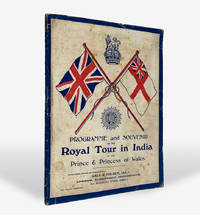
1906Best.-Nr. 21207831906. Gale & Polden Ltd. London Offices and Warehouse Aldershot Stores Bombay. 1906. Royal 8vo. Colour-printed card wrappers; pp. xiv 31 four colour illustrations after paintings on 2 leaves of plates highly illustrated after photographs in the text; spotting to wrappers inside of lower wrapper with small abrasure internally very good.This extremely rare publication by the military printers and publisher Gale and Polden in Aldershot opens with the detailed schedule of the Royal visit from their landing in Chennai on the 24th of January until their departure from Hyderabad on the 10th of February and a visit to Ellora Caves on Friday the 16th. This publication covers only a small part of the Royal tour which in total lasted from November 1905 to March 1906 and we assume this sovenir was published for the members of tf the Army and Navy who where engaged in safeguarding and as entourage. The bulk of this souvenir describes life work and pastimes in Army and Navy.We were not able to trace any copy institutionally or commercially nor is this publication referred to in any text known to the internet. unknown
Best.-Nr. 23438Simla 12 July 1917. One page 8vo small closed tear. fold mark ow good condition. With pencilled notes above the signatures and on verso identifying signatories. See image. Simla 12 July 1917 unknown
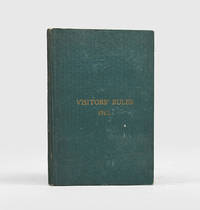
1913Best.-Nr. 185139Lahore: Printed at the "Civil and Military Gazette" Press 1913. The 1913 edition of this handbook with guidance on camping fishing shooting and other matters. Readers are also warned against felling trees for firewood and against gifting or selling guns to any subject of the maharaja not licensed to carry firearms. The Kashmir visitor rules were first issued in 1806. Institutional searches show small holdings of a range of editions but no copies of this 1913 publication. Small octavo. Original green hexagonally grain cloth front cover lettered in gilt. Spine sunned light wear a few pages dog-eared: near-fine. hardcover
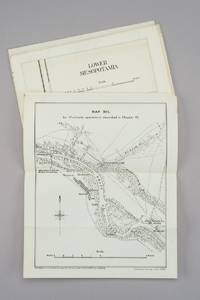
1923Best.-Nr. BRI-1923-152His Majesty’s Stationery Office HMSO London First published: 1923 1923. This is the official history produced by the Historical Section of the Committee of Imperial Defence. Your set is the 1923–27 reprint of the original 1920–27 issue. Reprints are still highly collectible especially when complete with maps. 8vo. SHORT DESCRIPTION Year: 1923-1927 nVolume: Volume I Volume II Volume III Volume IV nPublisher: His Majesty’s Stationery Office DESCRIPTION A definitive four-volume official history of the Mesopotamian campaign combining authoritative military analysis and detailed operational maps into one of the British Empire’s most important First World War records. n nCloth remains bright with some fading and handling marks particularly to spines. Light bumping to extremities. Internally clean with occasional light spotting. Maps appear complete and well-preserved. One volume with small shelf label to spine. Overall a strong working set of this substantial official history. STORY This is not a general history—it is the British Empire’s official account of one of the most complex and underexamined theatres of the First World War. Compiled at the request of the Government of India and based directly on official military records The Campaign in Mesopotamia presents a forensic reconstruction of operations across modern-day Iraq. From the early advances along the Shatt al-Arab to the catastrophic siege of Kut and the eventual capture of Baghdad this work captures both the ambition and the miscalculations of imperial warfare. What distinguishes this set is its authority. Written by Brigadier-General F. J. Moberly under the Historical Section of the Committee of Imperial Defence it is effectively the Empire documenting itself—strategy logistics command decisions and failures laid bare with institutional precision. The inclusion of detailed folding maps—such as the operational plans around Mohammerah and the lower Mesopotamian theatre—transforms the work from narrative into a functional military record. These were tools of understanding not decoration. Complete sets are increasingly difficult to assemble in uniform condition. As a four-volume official history this stands as one of the definitive primary sources for the Mesopotamian campaign and remains essential for collectors of military history imperial studies and Middle Eastern conflict narratives. WHY THIS MATTERS Official war histories occupy a unique position in the rare book market—they are both primary sources and institutional narratives. This set provides direct insight into British imperial military operations in the Middle East a region whose geopolitical significance continues to resonate today. Complete sets particularly with maps intact are increasingly scarce in the trade. Volume I His Majesty’s Stationery Office (HMSO) London First published: 1923 unknown
Best.-Nr. 10626-9371339187Paperback. New. Book Condition is in New Paperback Original Edition. Shipped Same Day. We do not ship APO and FPO. Will be dispatched fast. Please send me an email if you have any questions. 100% Satisfaction. paperback
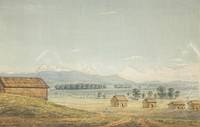
Best.-Nr. MC70Watercolour on board ca. 27 x 42 cm 10.5 x 16.5 in. Recently matted some minor abrasion on the lower right but overall a very good watercolour. Almora is "a cantonment town in the Almora district in the state of Uttarakhand India. Almora was founded in 1568. It is considered the cultural heart of the Kumaon region of Uttarakhand. Almora has an average elevation of 1651 metres 5417 feet. The snow capped Himalayas can be seen in the background "Wikipedia. unknown
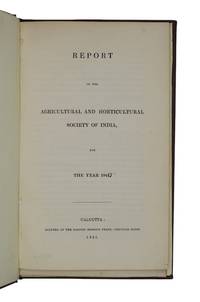
1841Best.-Nr. AQ32634Calcutta: Printed at the Baptist Mission Press 1841. 35pp 1. Bound with: Drop-head title: List of members of the Agricultural & Horticultural Society of India. January 1st 1841. Calcutta. Bishop's College Press 1841. 2 23pp 1. 8vo. Modern brown cloth lettered in gilt to spine. Two early manuscript corrections to first mentioned work title and drop-head title. The second located copy of the annual report of the Agricultural & Horticultural Society of India for the year 1840 together with a contemporary list of members printed at the Baptist Mission Press at Calcutta which operated from 1818 until the 1970s. The Society was founded by orientalist and missionary William Carey 1761-1834 in 1820. The report records the progress of the work done by the society including efforts to promote and improve cotton cultivation in the country the introduction of a new species of mulberry plant the promotion of tea culture in Assam and revision of discriminating duties on rum and tobacco. OCLC and COPAC record copies of each work at a single location BL. . First edition. Printed at the Baptist Mission Press hardcover
1915Best.-Nr. AQ27136Ranikhet: Abdulla Khan photographer 1915. 24 black and white photographs mounted on twelve leaves. Sewn as issued in original publisher's printed red wrappers. Rubbed and creased a trifle bowed. An unrecorded publication comprised of 24 evocative photographs primarily group shots of members of the 1/4th Battalion Duke of Cornwall's Light Infantry whilst stationed at Bareilly Uttar Pradesh during the first year of the Great War. 1/4th Battalion formed in Truro made up part of the Devon and Cornwall Brigade in Wessex Division. They sailed for India late 1914 and landed in Bombay on 10th November 1914 and remained there until 1916 where they moved to Aden 1916-1917 and then finished out the war in Egypt 1917-1918. . Oblong 8vo. [Abdulla Khan, photographer] unknown
Best.-Nr. 66551c.1918-1919. Original photo-album. Oblong 4to. 15.5 x 20 cm. 12 leaves of grey card each with 8 original small format black & white photographs 4.5 x 6.25 cm some with manuscript captions housed in contemporary grey cloth binding. Some variable fading to photographs overall a neat and well-preserved album. An album of 96 small format photographs taken in all likelihood by a colonial administrator in the Dera Ghazi Khan area of the Punjab now Pakistan in 1918-1919. Several of the photographs show Fort Murray scene of an uprising by the Marri and Khetran tribes in 1918. One shows a character marked 'Teague-Jones' likely to be Reginal Teague-Jones 1889-1988 an intelligence office with the British Army stationed in Dera at the time and subsequently in the Caucasus during the Russian civil war. There are also several photographs of Lahore showing Shalimar Gardens. c.1918-1919. hardcover
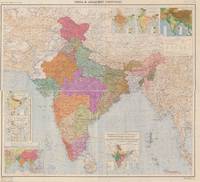
Best.-Nr. 59553Printed at the 101 H.L.O. Printing Group of Survey of India 1969. Extremely large colour-printed folding map of India and the adjacent countries 82 x 173 cm mounted onto linen with seven inset maps showing Density of Population Principal Industries Geology and Principal Minerals Orographical Features Average Rainfall Isothermal Lines and a small version of India and Surrounding Countries. Remnants of original paper wrappers printed in red still present to verso. Light spotting to verso only generally a very good copy of this large-scale map. First published in 1951. Printed at the 101 (H.L.O.) Printing Group of Survey of India, 1969. unknown
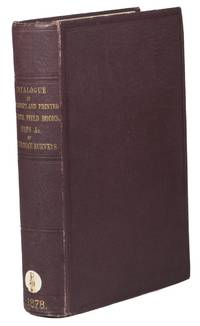
1878Best.-Nr. ABC_45484London: George E. Eyre & William Spottiswoode colophon 1878. Contemporary cloth title in gold on spine. Large 8vo. First and only edition of a catalogue of the material held in the London India Office that was produced by the Indian Surveys for the East India Company. The catalogue was printed by order of her Majesty's Secretary of State for India in council. It is a key reference work for all studies on the East India Company era in Indian and British history.Shelf mark on spine library plate on front paste-down Scheepvaartmuseum Amsterdam. Slight foxing on the first and last couple pages. Otherwise in very good condition.l Kaul Early writings on India: a union catalogue of books on India in the English language published up to 1900 and available in Delhi libraries 1975 92. George E. Eyre & William Spottiswoode (colophon), hardcover
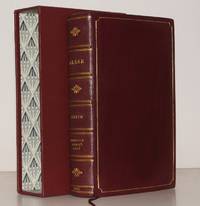
1917Best.-Nr. 20036Clarendon Press Oxford 1917. 8vo. First Edition with coloured frontispiece 14 plates 5 full-page maps in the text and 3 folding maps on japon title lightly dust-soiled; handsomely bound in full burgundy crushed morocco sides with gilt frame border back with raised bands second and fourth compartments lettered and ruled in gilt all other compartments tooled in gilt gilt top hand-made endpapers ribbon marker custom-made-slip-case an elegant copy ideal as a gift or for presentation. THIS COPY WAS FORMERLY IN THE LIBRARY OF SIR REGINALD SPENCE AND BEARS HIS FINE ENGRAVED ARMORIAL BOOKPLATE ON FRONT PASTE- DOWN. IT WAS SUBSEQUENTLY PRESENTED BY SPENCE TO THE LIBRARY OF CHRIST'S HOSPITAL SCHOOL HORSHAM AND BEARS THAT INSTITUTION'S PRESENTATION BOOKPLATE ON FRONT FREE ENDPAPER. Sir Reginald Spence prominent merchant philanthropist and educationalist spent much of his career in India. He was a prominent wine merchant Master of the Worshipful Company of Distillers 1949-1950 and an eminent freemason District Grand Master of Bombay and Northern India; the Lodge Reginald Spence was founded in his memory. A fervent educationalist he co-founded Barnes School in Devlavi one of the finest institutions of its type in Western India where a school house now bears his name. A NOTABLE ASSOCIATION COPY OF A WORK SELDOM FOUND IN THE ORIGINAL EDITION. Clarendon Press, Oxford, hardcover
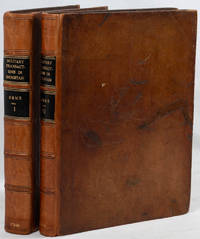
1778Best.-Nr. 223135London.: Printed for John Nourse. 1778-1880. Third Edition"revised by the author" of Volume I; first edition of Volume II Part I only lacking Part II. Two volumes 23 maps plans or views of 36 most folding: iv 436pp xcvii Index iii Errata Errata in the Index Directions for the Binder to Place the Maps; ii 365pp contemporary calf boards re-backed boards scored and scuffed 28.3 x 22 cm several of the maps with small fold splits no loss some offsetting the folding views of Calcutta and Bengal particularly fine the large folding "General Map of Indostan" in the first volume heavily spotted affecting the facing leaf several old paper repairs and inked corrections in an early hand with the armorial bookplates of Joseph Cator a prominent merchant and administrator with the East India Company and of Peter Cator his son founder of the Cator Prize and of Bertie Peter Cator and of Kelham Hall a handsome example lacking the second part of Volume II in good condition. Foundational work written by Robert Orme an official and historiographer for the British East India Company EIC with a noteworthy family provenance. The text chronicles the geopolitical struggles and military conflicts that paved the way for British dominance over the Indian subcontinent. The Cator family built a legacy of immense wealth regional development and colonial influence spanning three generations. Joseph Cator 1733–1818 laid the financial foundations as a wealthy "nabob" and high-ranking East India Company official in Calcutta. His 1780 marriage to Diana Bertie daughter of Sir Albemarle Bertie successfully elevated the family into the British aristocracy allowing him to return to England and manage expanding Kent estates like Beckenham Place Park. His son Peter Cator 1796–1873 leveraged this land inheritance during the mid-19th-century railway boom. Alongside his brother Peter transformed these holdings into the upmarket Cator Estate across Blackheath and Beckenham while also working as a lawyer and establishing educational scripture prizes in Madras. This colonial and legal influence continued with his descendant Sir Ralph Bertie Peter Cator 1861–1945 who served the British Empire as a prominent colonial judge holding key judicial appointments as the First Judge of British East Africa and later in the High Court of Constantinople. . Printed for John Nourse. hardcover
Best.-Nr. DADAX0198217889New unknown
Best.-Nr. DADAX019820809XNew unknown
Best.-Nr. 10626-8182052149Paperback. New. Book Condition is in New Paperback Original Edition. Shipped Same Day. We do not ship APO and FPO. Will be dispatched fast. Please send me an email if you have any questions. 100% Satisfaction. paperback