[INDIA].Biblio.com
4.257 Ergebnisse
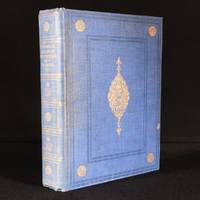
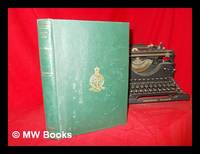
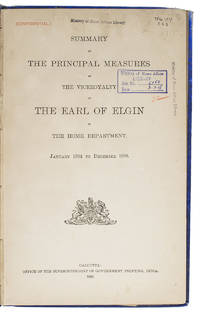
1898Best.-Nr. ABC_45361Calcutta: Office of the Superintendent of Government printing India 1898. Blind-stamped blue cloth title in gold on spine blue decorated endpapers. Folio. With armorial vignette on the title page. The official Summary always published at the end of a Viceroy-ship by the Office of the Superintendent of Government printing in Calcutta containing the narrative of proceedings of the Home Department in this case from January 1894 to December 1898 the time the 9th Earl of Elgin served in that function. The extensive contents pp. i-iv refers always to the pages in the appendices pp. 1-6156 ! not present.During his time as Viceroy famine broke out in India in which Elgin reportedly admitted that up to 4.5 million people died. Other estimates have put the death toll at 11 million people. His administration in India was otherwise notable for the Afridi frontier uprisings of 1897-1898.With the label of the Home Department Juridical Branche on the front board and a second label with the shelfmark and stamps of the Ministry of Home Affairs on the title page and elsewhere including a Confidential stamp. Head of both boards damaged and damp-stained front hinge worn front endpapers loose slightly browned throughout.l Bence-Jones Mark. The Viceroys of India London 1982. Office of the Superintendent of Government printing, India, hardcover
1914Best.-Nr. 951F7London: The Government of India by John Murray 1914 . First edition. Cloth. Very Good. 11.5" by 9.5". Not Stated. The very scarce first edition of this richly illustrated account of George V's 1911 visit to entia to take part in the Imperial Durbar in Delhi. A very scarce first edition.Illustrated with a colour frontispiece eight colour plates two photogravures forty-four collotypes and numerous monochrome plates alongside four plans one of which is folding.Collated complete.With the bookplate of Christopher J. E. Jarchow to the front pastedown.The Delhi Durbar or Imperial Durbar was a mass assembly organized by the British at Coronation Park Delhi India to mark the succession of an Emperor or Empress of India. Also known as the Imperial Durbar it was held three times in 1877 1903 and 1911 at the height of the British Empire. The 1911 Durbar was the only one that a sovereign George V attended. It took pace in December 1911 to honour King George V and Queen Mary's coronation in Britain a few months prior and to proclaim their titles of Emperor and Empress of India. All Indian princely state kings and governors were called to pay respect.This work in great detail depicts this display of imperial power during the British Raj and includes detailed itineraries speeches and illustrations of this defining event of Colonial India. In the publisher's original cloth binding. Bumping to back strip head and tail. Light spotting to perimeters of front board with a touch of fading to centre of rear board. Light spotting to text block fore edge. Bookplate to front pastedown. Internally firmly bound. Pages clean and bright. Very Good The Government of India by John Murray hardcover
1907Best.-Nr. 011405Calcutta: Superintendent of Government Printing India 1907. Book measures 33.5x21.cm. iiivi 40pp. Bound in original publishers printed boards. Boards rubbed sellotaped spine library labels and withdrawal stamp. Binding in good condition. Internally occasional library stamp or mark. Pages in good clean condition. A good clean copy. . Hard Cover. Good Plus. Quarto. Superintendent of Government Printing India Hardcover
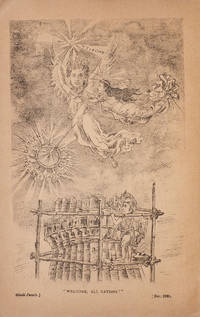
1903Best.-Nr. 8569First edition of this rather extraordinary survey of Curzon's many appearances in caricature in Hindi Punch and other Indian comic papers where he often appears in Indian dress and frequently as various Hindu deities notably Ganesh. 'This unpretentious little book is offered as a humble souvenir of the Delhi Durbar: in its pages our popular Viceroy as representative in the great Coronation Durbar of the greatest monarch of modern times is the central figure. In a land of her-worship it is not to be marvelled that the energy versatility and strong personality of Lord Curzon added to his many loveable traits should lend themselves easily to the genius of the Indian artist for caricaturing' author's Preface. Despite this warm introduction Curzon was subject to both approval and dissent through these images. The satire of British comic publications like Punch was enthusiastically appropriated by Indian artists - and India itself was frequently represented through the figure of Mr Punch - though their caricatures were also influenced by Indian artists such as Raja Ravi Varma. It is a fascinating fusion. 4to 248 × 158 mm pp. 2 2 48 4 adverts for Hindi Punch etc plus lithograph forntispiece numerous caricatures to text. Original lithographic boards. Slightly rubbed and soiled hinge cracked and backstrip rather crudely but effectively repaired with tape. [Tatva-Vivechaka Press and lithographed at Ajinkya Art P. Works for] Babajee Sakharam & Co,
1900Best.-Nr. 100865c. 1900. 54 diapositive glass lantern slides 3-1/4 x 4 and 3-1/4 x 3-1/4 inches six hand-colored bound at edges with gummed paper or metal frame some with manufacturer's printed label and manuscript caption; a few with hairline cracks. Housed in contemporary wooden box with lid. A varied collection of ethnographic and architectural scenes largely from Northern India with a few of Ceylon Sri Lanka tea production. Some of the locations include Darjeeling Mumbai Bombay Kakinada Elephanta Caves Mumbai Calcutta including many of the Hooghly River Dehli Sinla Ceylon Kashmir as well as one scene of European tourists scaling pyramids in Egypt. The collection appears to have been gathered from various sources with plates manufactured by T.H. McAllister New York William Garrison Reed Boston J. Moore Birmingham and William H. Rau Philadelphia. unknown
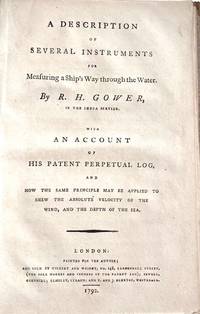
1792Best.-Nr. 1325NAUTICAL INSTRUMENTS GOWER Richard Hall in the India Service. A Description of several instruments for Measuring a Ship's Way through the Water By.With an Account of his Patent Perpetual Log and how the same principle may be applied to shew the absolute velocity of the Wind and the depths of the Sea. 8vo modern cloth backed marbled boards half-title title 5-32 2 copper engraved plates. London: Printed for the Author 1792. First Edition of author's rare first nautical work with the half-title. ESTC locates two copies in England BL & NMM and two copies in this country BA & NYPL. Gower fl. 1767-1833 a sea captain and naval architect "had been shocked by the low standard of navigation which he found in the convoy which took him to the East Indies.He devised a patent log part of the workmanship being entrusted to Alexander Grant and the sole rights of sale vested in Messrs Gilbert & Wright of 148 Leadenhall Street. He refers to "the indefatigable Mr. Stancliff' as cutting the scale on his optical instrument with his dividing machine. He then tried the instrument out with John Adams a mathematical teacher of Edmonton who has been identified as a reviser of textbooks for Mount and Page the chart-sellers."-Taylor The Mathematical Practitioners of Hanoverian England 1714-1840 #840. "In 1787 he devised an instrument which measured a vessel's way through the water with greater accuracy than had previously been possible."-ODNB. The followng year he wrote A Treatise on the Theory and Practice of Seamanship which long remained a standard work. We trace no copies at auction. 84574 The Author
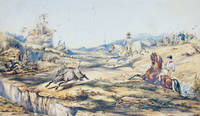
Best.-Nr. MC22Watercolour ca. 24.5 x 41.5cm 9.5 x 16.5 inches. Recently matted with a couple of minor scratches but overall a very good watercolour. The well executed watercolour show a wild boar being chased by two British hunters with spears on horseback in the foreground and native Indians and an Indian castle in the background. "In India pigsticking was popular among the Jatts Gujjars Rajputs Sikhs Maharajas and with British officers during Victorian and Edwardian times. According to the 1911 edition of the Encyclopædia Britannica it was encouraged by military authorities as good training because "a startled or angry wild boar is . A desperate fighter and therefore the pig-sticker must possess a good eye a steady hand a firm seat a cool head and a courageous heart "Wikipedia. unknown
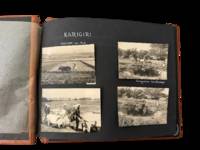
1961Best.-Nr. 232281961. Southern India photo album documenting an international Christian missionary medical group around Vellore Karigiri Katpadi and Kanchipuram in 1961 many photographs captioned and identify individuals. The album showcases how missionary labor operated after the end of British rule through hospitals training schools religious ceremony and organized visits into village and temple spaces. Compiled by a French speaking participant within an international Christian medical network the album centers on institutions linked to Christian Medical College and Hospital Vellore where foreign and Indian personnel worked inside a system first developed under colonial era Protestant missions and then carried forward in postcolonial India through education nursing public health and evangelical presence. Photo archive of 110 Silver gelatin photographs mounted in a leather bound album most photos measure 3" x 4" album measures 9" x 12" Vellore Karigiri Katpadi Polambakkam and Kanchipuram Tamil Nadu dated by captions to 1961. Many identified individuals. Captioned pages identify "Vellore CMCH" "Christian Medical College and Hospital Vellore" and a "Soirée de remise du voile aux infirmières étudiantes de dernière année Sept. 61" showing large indoor assemblies of Indian nursing students in uniform at a veil ceremony for final year nurses. Other pages name hospital streets a guest house pavilion postman colleagues and an international group including participants identified by nationality including Argentina Belgium Venezuela Australia Thailand the United States England and South India. The album also moves beyond the hospital into the surrounding countryside and sacred landscape with rice cultivation and field irrigation at Karigiri village huts pastoral scenes cattle and goats potters fuel collection pigs and ducks a cyclist returning from Sunday mass the cathedral at Katpadi and multiple views of temples and priests at Kanchipuram. Handwritten French captions guide the viewer through these scenes including "inner courtyard of a temple" "Hindu priest explaining a point of his religion" "signing the temple guest book and giving the offering" and observations of sculpture yogis village labor and local children. The 19th to early 20th century saw an increase in Protestant missionary organizations in India with schools hospitals and women's medical training programs as response both to evangelical ambition and to colonial inequalities in health care access. By 1961 India was politically independent yet this album shows how missionary medicine still organized relations between Western visitors Indian Christian institutions and local Tamil communities. Overall very good condition. A strong record of postcolonial missionary medicine in southern India showing how colonial religious systems survived through healthcare education and cross cultural authority rather than formal imperial rule alone. unknown
Best.-Nr. 10626-103657945XPaperback. New. Book Condition is in New Paperback Original Edition. Shipped Same Day. We do not ship APO and FPO. Will be dispatched fast. Please send me an email if you have any questions. 100% Satisfaction. paperback
1911Best.-Nr. 196420Lahore: Printed at the Punjab Government Press 1911. First edition of this informative collection of papers covering the period from the arrival of the British at Ludhiana in 1808 to the conclusion of the first Gurkha Campaign in June 1815. This work formed Volume II in an eight-volume series of Punjab Government records that was compiled by Arthur Raynor formerly the registrar of the Punjab Civil Secretariat. As here some copies were issued in 1915 with a revised price affixed to the title page and a tipped-in additional "Introductory Note" leaf dated December 1915. Octavo 241 x 159 mm. Photogravure frontispiece portrait of Major-General Sir David Ochterlony after an engraving by Henry Meyer. Near-contemporary green buckram spine lettered in gilt. Publisher's price sticker on title page. Ex-Financial Commissioners Office Library Lahore with shadow from removed label on spine 21 September 1938 ink stamp on half-title and a few numerical markings on front pastedown and first few leaves. Rubbed and bumped text block toned and brittle in margins in places: very good. hardcover
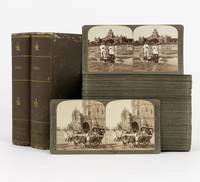
1902Best.-Nr. 142564New York: Underwood & Underwood Publishers 1902. First Edition. Hardcover. Fine. New York Underwood & Underwood Publishers 'Copyright 1902' to 'Copyright 1907' a date within this range is printed on the recto of each item with the majority 1902 and 1903. Each pair of sepia-toned gelatin silver photographs is mounted on the publisher's dark grey card with an English-language caption underneath the photograph; an abridged version is repeated in six languages on the verso of all but 16 cards which are blank. The size of the arch-topped prints is approximately 80 × 78 mm; the card size is 88 × 178 mm. The condition of all photographs is uniformly fine; four cards have a crease down the centre but the rest are in fine condition. The set comes with the publisher's cloth-covered double bookform box lettered 'India Underwood and Underwood' on both spines cloth a little rubbed and lightly worn at the extremities. The cards are numbered 1-100 on the recto; many also have a four-digit number as well. In addition to the brief captions in six languages on the verso 81 cards also have lengthy captions in English on the verso 79 are printed down the length of the card when it is in portrait format; the other two are printed across the card when it is in landscape format. 100 items. Underwood & Underwood, Publishers hardcover
Best.-Nr. SONG0295970642Used: Good unknown
1954Best.-Nr. 293238Dehra Dun : Survey of India 1954. First Edition. Hardcover. Near fine copy in the original publisher's gilt-blocked cloth edges very slightly toned. Corners sharp with an overall tight bright and clean impression. Complimentary copy from the Surveyor General of India. Physical description; xii 534 p. : ill. maps ; 30 cm. Notes; Complimentary copy from the Surveyor General of India sent to Arthur Jaffe with the receipts. Includes bibliographical references and index. Subjects; Survey of India. Surveying India History. Genres; Bibliography. Illustrated. Dehra Dun : Survey of India hardcover
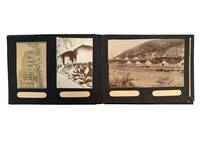
1917Best.-Nr. 235951917. British frontier military photo archive documenting the garrison system of the North West Frontier during the final years of the First World War 1917 to 1918 showing how the British Indian Army organized training logistics aviation medical services and daily military life across what is now Pakistan. Centered on Risalpur with additional views of Nowshera Sibi and other frontier stations the archive records the infrastructure that sustained Britain's defensive frontier against Afghanistan while thousands of Indian Army troops remained committed to imperial service overseas. Contemporary manuscript captions on many versos identify locations dates military units and events preserving an unusually well-documented record of the frontier during one of the British Empire's most militarized periods. Photo archive of 52 silver gelatin photographs most measuring approximately 3 x 5 inches British India principally Risalpur and the North West Frontier 1917 to 1918. The photographs depict cantonments parade grounds barracks military camps mounted troops cavalry exercises soldiers in formation and group portraits of officers and enlisted men. Other photographs show military hospitals and Red Cross personnel aviation facilities transport columns aerial views of cantonments engineering works fortified compounds rail infrastructure and frontier outposts. Civilian scenes appear as part of the military landscape rather than separate subjects including bazaars camel caravans village streets fruit vendors brick makers ox drawn carts river crossings market stalls and local residents interacting with soldiers. Several photographs record strategic infrastructure including the Attock Bridge mosques military compounds and river transport essential to frontier communications. Numerous versos carry contemporary inscriptions identifying subjects with captions such as "Camp of the 22nd Squadron M.G. Corps at Risalpur Dec. 1917-May 1918" "Risalpur 1918" "Mosque at Nowshera 1917" "Aeroplane accident" and "Filling ammunition belts 22nd M.G. Squadron Risalpur" substantially increasing the documentary precision of the archive. By 1917 the North West Frontier had become one of the British Empire's principal military districts supplying cavalry machine gun units aviation personnel transport and logistical support while simultaneously guarding the Afghan frontier. Risalpur developed into one of the subcontinent's major military centers housing cavalry regiments the Machine Gun Corps flying facilities and training establishments that would remain central to frontier defense through the Third Anglo Afghan War of 1919 and beyond. Photos emphasize the construction and occupation of cantonments preparation of ammunition medical organization transportation networks reconnaissance engineering and the constant interaction between British military institutions and the civilian communities surrounding them. Light surface wear with occasional corner bumps and scattered silvering; manuscript captions remain clear and legible. Overall in very good condition. A concentrated record of the British Indian Army's military infrastructure and frontier administration on the North West Frontier during the closing years of the First World War. unknown
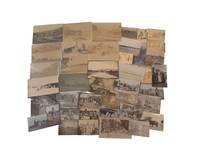
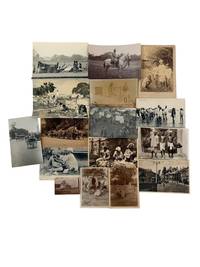
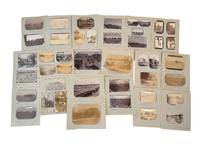
1890Best.-Nr. 234981890. Colonial Indian labor photo archive depicting street work informal commerce transport labor and social hierarchy under British rule circa 1890s-1920s. British India depended on low-paid manual labor to move people goods food and raw materials through cities ports hill stations and military cantonments. The group contrasts workers seated on the ground with baskets tools tents carts and roadside goods against riders on horseback and passengers carried by rickshaw carriage and bullock cart. Photo archive of 16 silver gelatin photographs and black-and-white real photo postcards various sizes India circa 1890s-1920s. Marketplace sellers sit among baskets cloth tents and on the ground goods; families and workers gather beside tents and rough encampments; men pull or guide rickshaws carriages and ox-drawn carts through colonial streets. A mounted man sits formally on a white horse while views of Simla show pedestrians commercial buildings and hill-station streets associated with British administration and seasonal elite life. Additional scenes show an outdoor "Hindu barber" "Indian coolies" carrying large baskets men seated by stonework near a Gothic-style building children posed in white garments some hand written captions en verso identify locations or tasks. The archive records the everyday labor that supported colonial India before independence when caste landlessness debt and imperial wage economies shaped who carried cleaned hauled shaved sold and served. Ligh toning handling and edge wear; overall in very good condition. A late colonial documentation of Indian labor and social separation grounded in street work transport marketplace survival and the visible privileges of those being carried or served. unknown
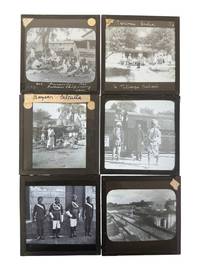
1900Best.-Nr. 232871900. India glass lantern slide archive documenting class hierarchy dichotomy in British India with scenes of village labor bazaar exchange railway movement industrialization Sikhs and colonial cavalry circa 1900-20. Images clearly depict the class divide and caste system; villagers and laborers are shown seated on bare ground in carpentry work men and goats occupy an unpaved settlement space Sikh men stand beside a railway carriage tied to imperial transport networks a factory scene introduces mechanized industry and a formal portrait of turbaned cavalry soldiers. Photo archive of 8 glass lantern slides 3.25" x 3.25" India circa 1900 to 1920. Several slides retain manuscript captions on the mounts including "Central India" "Village School" "Bazaar Calcutta" and "MV. parannis an Indian carpentry clas." "Parannis" is probably a misspelling or misreading of "Pariahs" a historical caste/community term used in colonial-era descriptions of South Indi The British largely preserved formalized and exploited the Indian caste system rather than dismantling it. Their relationship with caste was pragmatic: caste became a tool for administration taxation labor control military recruitment and social organization across British India. The "Village School" slide shows a line of children and adults posed before a low building under dense tree cover with one figure standing forward in the open yard. The carpentry slide shows a large group of Indian boys outdoors beneath a tree seated or crouched on the ground around planks and hand tools with timber laid across the foreground and simple structures behind. The Calcutta bazaar scene places vendors baskets and goods in an open market setting under palms while the village scene presents men in loose garments in what seems to be a cattle farm setting. One slide shows Sikh men beside a railway carriage one barefoot in the foreground and others gathered near the rail car doors linking Indian bodies to the movement of goods troops and passengers through the colonial rail system. Another slide presents four uniformed soldiers in turbans possibly the Madras cavalry posed formally with boots sashes and weapons before a masonry wall. The factory view shows smoking industrial works with long roofs tracks and an extended production yard further cementing colonial industrialization within the archive. British rule in India relied on linked systems of extraction transport discipline and military force and these slides place those systems beside the people who bore their unequal social effects. Railways expanded under colonial finance and administration to move troops raw materials and commercial goods; industrial sites grew beside older economies of hand labor and bazaar trade; Indian soldiers and cavalry units served within an army organized to secure imperial control; and rural schools workshops and village scenes expose the local social world that existed under those pressures rather than outside them. Light edge wear some mount loss to several slides; no cracks or chips. Overall very good condition. British colonialism widened India's class divide by concentrating wealth transport and military power in imperial systems while leaving many Indians in village labor and low paid market work. unknown
1673Best.-Nr. 33344London: Printed by the Author at his House in White-Friers 1673. First Edition. Illustrated throughout with 30 finely engraved copperplates generally a third of a folio page in size title page printed in red and black. Large Folio bound in contemporary calf. xii 253 15 A Table 1 pp. A well worn copy lacking the 5 map and the double-page or folding plates the text block and textual engravings all well preserved the paper crisp and unpressed some of the usual mellowing and evidence of age or use and old worm track to the bottom blank area of the leaves again not obtrusive the "Directions to the Binder" leaf not present at the end of the volume otherwise collated complete. FIRST EDITION. John Ogilby was a Scottish translator impresario publisher and cartographer. Ogilby established Ireland's first theatre in Werburgh Street Dublin and following the Restoration that country's first Theatre Royal. Ogilby played a significant part in arrangements for the coronation of King Charles II. Following the Great Fire of 1666 Ogilby's large-scale map of the City of London was founded on precise survey work and his Britannia is the first road atlas of England and Wales to be based on surveys and measurements and drawn to scale. During the Great Fire of London in 1666 Ogilby's house in Shoe Lane together with its printing works and most of his stock was destroyed; he estimated he had lost Å3000. After the Great Fire the Corporation of London appointed Ogilby and his wife's grandson William Morgan as "sworn viewers" members of a group of four trustworthy gentlemen directed by Robert Hooke to plot disputed property in the city. Ogilby later made what he called "the most accurate Survey of the City of London and Libertyes therof that has ever been done". By 1668 he had a new house in Whitefriars and was ready to resume his printing and publishing work. Ogilby's next major venture was a series of atlases of China Japan Africa Asia and America. The first of these was An Embassy from the East India Company of the United Provinces to the Grand Tartar Cham Emperor of China which was published in 1689. This book was substantially a translation of Johan Nieuhof's Dutch publication of the same name with English copies of the Dutch engravings. Ogilby's Africa appeared in 1670 and was followed in rapid succession by Atlas Japanennsis 1670 America 1671 Atlas Chinensis 1671 and Asia 1673. In 1671 in response to his proposal to make a detailed survey and atlas of Great Britain the King appointed Ogilby Royal Cosmographer. Thus at about the age of 70 and with the scientific advice of Robert Hooke58 Ogilby began work on Britannia the project for which he is best known among cartographers. Printed by the Author at his House in White-Friers unknown
Best.-Nr. #[33300]'s Gravenhage Jacobus Scheltus 1743. 4to. Misbound with dog's ears. With woodcut coat of arms on title-page. 47 pp. Compilation of all charters of the Dutch East India Company VOC starting with the original charter of 1602 followed by all prolongations up until 1754. The charter granted by the States General meant that the VOC was the only organization from the Dutch Republic allowed to trade in this region. - Age-browned. Landwehr VOC 19. unknown
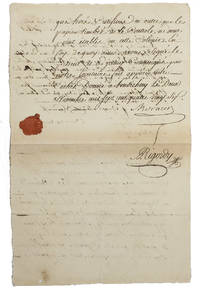
1786Best.-Nr. ABC_45537Puducherry Pondichéry 1786. Folio. Manuscript death certificate including a red wax seal of a former employee of the French East India Company who is buried in the cemetery of the Église Notre-Dame-des-Anges in Puducherry which was the capital of the Indian district and later also the larger union territory of the same name which was ruled by the French from 1673 to 1954. The certificate is signed by the reverend father Damas who was superior of Puducherry and was authenticated by the authorizing officer of the French East India Company Jean-François de Moracin who was also commissioner general of the ports and naval arsenals in the colonies.In good condition. unknown
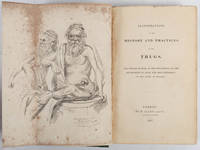
1837Best.-Nr. 224787London.: Wm. H. Allen and Co. First Edition. 1837. Black and white folding engraved frontispiece and one other folding plate ii blanks iv 475pp 22 x 13.5 cms original green cloth-covered boards re-backed mounting the original paper title label chipped endpapers renewed the plates spotted and darkened concentrated at the margins and folds early inked ownership inscription "John C. Clare/Calcutta Decr. 1851" to the initial blank and one other recent to the front pastedown a little dusty the original boards a trifle scuffed frontispiece starting but firm in the renewed binding a good copy of a scarce work. Scarce. The author Edward Thornton 1799-1875 was on the staff of East India House 1814-57 and his account was a sensational exposé that detailed the secret hereditary network of highway assassins who terrorised travellers across India for centuries. Relying heavily on official court records and testimonies from captured informants Thornton meticulously documented how these gangs disguised themselves as friendly travellers used a sacred cloth scarf rumāl to strangle their victims without shedding blood and buried them in hidden graves to avoid detection. The account deeply fascinated and horrified Western readers by illustrating the religious rituals underpinning the crimes—including devotion to the goddess Kali and the tracking of omens—while ultimately highlighting the aggressive intelligence-led colonial campaign spearheaded by William Sleeman and was hugely popular. With the early ownership inscription of "John C. Clare Calcutta Decr. 1851" possibly the prominent 19th-century British ship master and captain who regularly commanded merchant voyages along trade routes between the UK Australia and Calcutta India. In October 1851 the British Indian Association had been formed in Calcutta marking the exact birth of organised Indian nationalist politics and a shift in how both native elites and Europeans challenged the British East India Company's monopoly. . Wm. H. Allen and Co. hardcover
1870Best.-Nr. 302484London: The London Printing and Publishing Company Limited 1870. 37 plates with 3 prints laid in and a portrait of Dr. Colin Rogers with notation on verso " Superintending Surgeon Madras Med. Dept. who married my Aunt Mary Anne. J.T.C. Ross.". 1 vols. Oblong 8vo. Contemporary green morocco 2 minor tears to the tail of the first leaf not affecting illustration 1-1/2 inch tear to the tail of the second leaf affecting bottom center of image some staining and soiling but overall very good. Various artists including S. Austin Clarkson Stan. 37 plates with 3 prints laid in and a portrait of Dr. Colin Rogers with notation on verso " Superintending Surgeon Madras Med. Dept. who married my Aunt Mary Anne. J.T.C. Ross.". 1 vols. Oblong 8vo. A wonderful album containing images of India drawn during the first two decades of the British Raj signed by "J.T.C. Ross as belonging to Aunt Jini ." J.T.C. Ross 1823-1897 recieved his medical education at St. George's Hospital and was admitted as a member of the Royal College of Surgeons in 1845. He served as Surgeon Major with the British Bengal Army Medical Service and was eventually promoted to Deputy Surgeon General and Surgeon-General. He was also the first editor of the Indian Medical Gazzette. The London Printing and Publishing Company, Limited unknown
1912Best.-Nr. 235531912. Missionary education and colonial album depicting India circa 1912 recording Western presence in a British ruled colony through girls' schooling domestic compounds rural labor and major sites of imperial tourism. One of the first images show a group of Indian girls posed with three Western women standing behind them likely a mission school or mission supported classroom during the period when Protestant and Catholic missions made female education one of their central claims to social reform in India. The album also records the wider colonial setting around that work with Western men and women appearing in bungalows on a tennis court and among Indian workers and residents placing missionary possibility inside the everyday social and racial ordering of colonial life. Photo album of 20 silver gelatin photographs each approximately 4 x 3 inches in a 6.5 x 5 inch album India circa 1910s with one image captioned "Holgate 1912." The photos show Indian girls grouped outside a building with three Western women at the rear; children or young laborers crouched in a field; men carrying harvested material along a road; an Indian woman seated at a weaving apparatus; another photo of young Indian girls in seated position in front of grass housing units potentially implying another educational setting; other images show Western figures in colonial settings including a woman holding a tennis racket players on a tennis court with the caption "Holgate 1912" a Western man and children on the veranda of a bungalow a Western woman standing in a brick doorway a Western man with a horse before a house and a large residence set behind a lawn. Architectural and travel views include the Taj Mahal another domed Mughal or Indo Islamic building a street scene with horse drawn vehicles outside commercial buildings a rural village at the base of hills and a settlement or station in a dry mountainous landscape. At the turn of the twentieth century Western women in India came as missionaries teachers medical workers wives of colonial officials tourists and members of expatriate religious and commercial communities. Mission boards used girls' schools orphanages zenana visiting Bible instruction and medical missions to enter spaces that male missionaries could not easily reach while British colonial rule supplied the legal linguistic transport and racial framework that made such work possible and unequal. Light surface wear fading silvering and album wear with some prints unevenly toned. Overall good condition. A compact visual record of Western missionary possibility colonial domestic life Indian labor and tourist seeing in India under the British Raj. unknown
1917Best.-Nr. 235941917. British frontier military photo archive documenting the administration of Britain's North West Frontier during the final years of the First World War and its immediate aftermath 1917 to 1919 showing how the Indian Army sustained imperial communications cavalry training transport and everyday life across what is now Pakistan. Made at stations including Nowshera Risalpur Sibi Quetta and surrounding cantonments the archive records the military infrastructure supporting British control over one of the Empire's most strategically important frontier regions bordering Afghanistan. Compiled during the years surrounding the Third Anglo Afghan crisis and the closing campaigns of the First World War the photographs preserve both the operational machinery of the frontier and the civilian landscapes through which imperial authority was exercised. Photo archive of approximately 96 sepia and black and white photographs ranging from 2 x 3 to 4 x 5 inches North West Frontier Province and Baluchistan British India 1917 to 1919. Nearly every photograph is mounted on album leaves with careful contemporary manuscript captions identifying places dates and subjects. The photographs depict cavalry exercises mounted reviews riding school instruction the 21st Lancers horse lines transport trains railway stations ferries crossing the Kabul River at Nowshera the boat bridge at Nowshera cantonment buildings military camps and barracks. Other photographs record the "Victory Sports" at Risalpur in December 1918 an aeroplane accident at Risalpur in December 1917 with multiple views of the wreckage and assembled soldiers soldiers posing with local residents officers on horseback rail travel between Nowshera and Sibi and military groups assembled before stores and equipment. Civilian life appears throughout in photographs captioned "Making bricks" "Melons" "Cooks" "Native carts Baluchistan" "The Kabul River Nowshera" "Ferry boat on Kabul River Risalpur" and market scenes at Bagaran. Additional views document Quetta Sibi Baluchistan landscapes bridges forts irrigation works mosques camel caravans washermen working along the Kabul River ox drawn transport and portraits of Punjabi Pashtun and Baluchi residents encountered throughout the frontier. The North West Frontier formed the principal buffer between British India and Afghanistan after the Durand Line agreement of 1893 and by 1917 the region had become one of the Empire's largest concentrations of cavalry transport and logistical forces. Cantonments at Nowshera and Risalpur served as major cavalry and aviation centers while Sibi and Quetta anchored the railway linking the Punjab to Baluchistan and the Bolan Pass a route essential for imperial communications and frontier defense. Rather than concentrating on combat alone this archive records the systems that sustained British rule: transport networks mounted units engineering works indigenous labor military recreation and the daily interactions between colonial personnel and local communities across the frontier. Contemporary manuscript captions throughout provide unusually precise geographical and chronological documentation. Album leaves show edge wear creasing and occasional corner losses; photographs generally remain clean. Overall in very good condition. A concentrated visual record of the military and civilian infrastructure that maintained British authority across the North West Frontier during the closing years of the First World War and the transition to the postwar imperial frontier. unknown
2017Best.-Nr. Raj-97881820504642017. New. English unknown
2017Best.-Nr. Raj-97881820504642017. New. English unknown