4.257 Ergebnisse
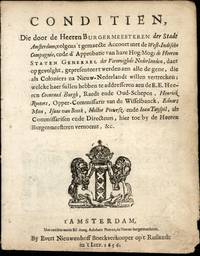
1656Best.-Nr. 2582Amsterdam: Evert Nieuwenhoff 1656. Unbound as published. Final leaf soiled and dust stained; trifle worn along outer lower corner throughout. Unbound as published. 8 p. Scarce prospectus by the City of Amsterdam on behalf of the Dutch West Indies Company designed to find new settlers for New Netherlands during the colony's final phase under the governorship of Peter Stuyvesant. Published as an appendix to A. Van Der Donck Beschryvinge van Nieuw-Nederlant in 1656 the same year as its first appearance. The ordinance stating the conditions for those who wish to settle in New Netherland the American Dutch colony. It was published at a time when the colony experienced a period of economic prosperity and was in need of new settlers to strengthen the Dutch positions in the area. . Evert Nieuwenhoff unknown
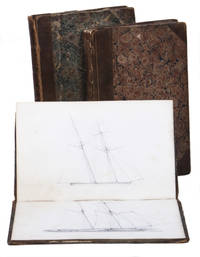
1822Best.-Nr. ABC_49460Aboard the Winchelsea written and drawn at sea 1822. Contemporary half gold-tooled brown calf marbled paper sides each volume with a different marbled paper the journal volume with marbled endpapers. 8vo. The two sketchbooks contain a total of ca. 100 pages of sketches of ships done in pencil including 1 page containing signal flags in colour. 3 volumes. With: Two sketchbooks with pencil drawings of ships. A neatly-written and illustrated sea journal kept by James Dudman the second mate on board the East India Company's ship Winchelsea during a 1822-23 voyage to India. Launched in 1803 the Winchelsea was already a veteran East Indiaman this being her ninth voyage - she made a total of eleven voyages for the EIC before she was broken up in 1834. On the present voyage commanded by Captain William Adamson she carried 592 people including the 17th and 44th Regiments of Foot and detachments of the King's and EIC's soldiers and a number of women and children. The sea journal volume is accompanied by two additional volumes by Dudman containing pencil sketches of unidentified masted sailing vessels.The Winchelsea's journey from its departure at Blackwall Dock on April 24 1822 to its arrival in Bengal and eventual return to England via St. Helena and The Downs on May 24 1823 reflects the extensive maritime routes integral to British imperial dominance. The ship's role in transporting personnel and cargo exemplifies the strength of the EIC's logistical network sustaining Britain's colonial and economic interests in India. The journal with its careful record-keeping offers an intimate glimpse into the daily operations experiences and extraordinary events encountered by the second mate aboard an East Indiaman during Britain's height of imperial expansion.The journal written in Dudman's beautiful scribe-like handwriting opens with an entry dated 24 April 1822 at Blackwall Dock where the voyage started "bound for Bengal." The next few pages contain a detailed listing of the people on board beginning with the ship's company of 122 men with names followed by the troops on board: "List of a detachment of His Majesty's Troops belonging to the 44th Regt. of Foot on board the Honable. Company's Ship Wincelsea for Bengal" comprising name and rank of 367 men followed by the names of 42 women on board as well as the name and age of 57 children on board including 3 who died at sea plus 4 additional passengers.At Saugur meaning Sagar Island they took on board further passengers duly noted in an additional "List of H.M. 17th Regiment of Foot with the Women and Children accompanying them. Embarked on board the Honble. Company's ship Winchelsea at Saugur New Anchorage for England."Beyond the usual records of position winds weather and other ships Dudman includes interesting notes on unusual occurrences. Perhaps the most fascinating event was recorded on February 10 1823: a major earthquake off the coast of India experienced by the Winchelsea: "At 10 minutes past 1 PM every one on board was greatly alarmed at the singular feel of the ship which was in a violent trembling motion as if the ship was grazing over a rocky shoal and a loud rumbling noise similar to the roll.g! of a Bull quickly along the deck this very singular seuration lasted certainly not less than a minute those below ran on deck to enquire the cause and those below the poop below to ask the same question. I was in the round house at the time when it comen'd. The noise appeared to me as coming along the quarter deck and instantly over the poop the sea was smooth and the day clear. I looked out at the stern windows but saw no appearance of any shoal which I certainly would have done had such existed. The water being very clear and the ship not going more than 2 knots I cannot account for this very singular phenomenon in any other way than its being the shock of an Earthquake".The voyage journal of the Winchelsea during its 1822-23 journey to Bengal provides valuable insight into the maritime operations of the EIC its commercial and colonial reach and the strategic importance of British trade with India in the early 19th century. As a veteran East Indiaman the Winchelsea was part of the vast trading network that connected Britain with the Indian subcontinent transporting soldiers goods and passengers under the auspices of the EIC which functioned as both a commercial enterprise and a colonial governing force.The journal volume contains the typographic book plate of Mr. Jas. Dudman on the front pastedown and a manuscript inscription in ink on the first flyleaf by Lumsden Dudman who was married to Mary Anne Shirreff "Joseph H. Shirreff from L.S. Dudman Xmas 1892" one of the sketchbooks contains a manuscript inventory list in Greek of goods for sale on the first flyleaf and one of the sketchbooks with ownership signature "L: Dudman / Sept. 27 1836" likely Rev. Lumsden S. Dudman perhaps a brother of James Dudman. Some general wear to the leather spines and corners of the boards of the volumes occasionally foxed but overall internally clean. Overall in good condition. unknown
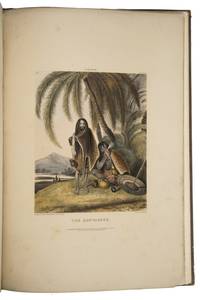
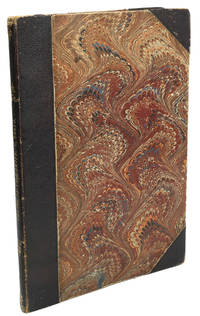
1842Best.-Nr. M2ACVI942UQXLondon: Thomas McLean 1842. Contemporary half calf with cloth sides gold tooled title on front cover. Large folio 545 x 375 cm. With 6 hand coloured lithograph plates and a lithographed title. First and only edition of an ethnographic study of native Indian people by William Tayler 1808-1892 who was at that time Acting Salt Agent of the Central Division of Cuttack for the East India Company. He dedicated his work to "Lady William Bentinck" born Lady Mary Acheson 1809-1850 who was the wife of the Governor-General of India. The illustrations were drawn by Tayler himself who was an amateur artist and drew much of the Indian daily life that he encountered. He selected the present 6 drawings to be published and had them lithographed by J. Bouvier. The first 3 plates not only show the ways of Indian people but even more so the luxurious life of the English in India. The first plate The Young Civilian's Toilet shows a young man relaxing while being treated by several servants who are named Anglo-Indians. The room is strewn with objects of leisure. The next 2 plates The Young Ladies Toilet & The Breakfast show equal scenes. The other 3 plates are more ethnographic in nature showing native Indians in their everyday life: Women grinding at the mill; the Sunyasees Sannyasis & The village barber. Tayler later became a controversial figure for his excessively harsh oppression of Indian people when he was the commissioner of Patna.Spine and covers slightly worn pages a little frayed some foxing on the text pages. Dedication page broened. Plate 2 detached and inserted loosely. Plates in good condition.l Abbey Travel 465; Bobins I 272; H.K. Kaul Early Writings on India 454; Prasannajit De Silva Colonial Self-Fashioning in British India c. 1785-1845 2018 pp. 116-119. Thomas McLean, hardcover
1865Best.-Nr. 311412Madras: Lawrence Asylum Press 1865. Illustrated with 12 mounted albumen photographs captioned in ink. Text within braided rule borders. ii 65 pp. 1 vols. 8vo. Full black morocco spine with gilt rules boards with gilt roll borders ornamental cornerpieces titled in gilt on upper cover yellow endsheets with orange ticket Bound at the Lawrence Asylum Press within border. Some minor rubbing occasional foxing. Fine. Gift inscription on first blank "J. Michael with the kindest regards of J.C.H. July 17th 1875. Illustrated with 12 mounted albumen photographs captioned in ink. Text within braided rule borders. ii 65 pp. 1 vols. 8vo. Spectacular unrecorded privately printed diary recounting a hunting expedition in Kerala southern India from 27 July to 22 September 1865 "the best shikar trip I have ever had". The narrator and his companion A.M.D. bagged 43 heads of eleven different types of big game including tiger bear elephant bison chettul and others with original albumen photographs mounted and captioned in a neat hand. The unnamed narrator mentions passing hunting parties one such Brown Jones and Robinson suggests that he read Trollope when the novel appeared as a serial in the Cornhill; the terrain around Hassanoor Ghaut was familiar to him for he had planted fruit trees and roses near a camp building; mention is made also of Hamilton Brooke and Faulkener hunting the area the previous year. This may be Douglas Hamilton who in 1892 published a long retrospective 'Records of Sport in Southern India'. The narrator buys prepared photographic plates from a departing hunter who had ordered them from the Patent dry Collodion Co. of Birmingham. The two hunters were accompanied by the dog Scamp chief among a pack that included Tinker and a plucky three-legged dog Pinko both killed by a panther and bearers of cowardly deportment save for the plucky Rajii who stood by when the narrator faced bear and elephant. At times the grass was too high for a man to get through easily. Notably the hunter describes many photographic incidents including how the frontispiece "The Tiger's Siesta" came to be made. One day D. encountered a a tigress atop the head of a young elephant and shot her despite the commotion. The young elephant ran off. The next day going to photograph the tigress the narrator was charged by a herd of elephants. He shot an elephant cow and they moved on to photograph the elephant "taking the tigress with us. The men who carried her threw her body into the elephants arms and it looked so strange the tigers mouth being curiously drawn up as if she were laughing that I thought I would try a picture in that position.". UNRECORDED in all the usual references and catalogues Lawrence Asylum Press unknown
1796Best.-Nr. ABC_49403Various places including Saudi Arabia and Yemen 1796. Contemporary or slightly later half black morocco marbled boards. Small folio ca. 19 x 30.5 cm. English manuscript on watermarked paper. With a loosely inserted manuscript map titled A Chart shewing the Track of HMS Ship Myrtle of the Bay of Biscay and Portugal and a hand-coloured manuscript signal chart. A detailed description of the voyage of the East India company vessel the Swift from 1794-1795 featuring visits to both Saudi Arabia and Yemen. Twelve pages of observations are dedicated to Jeddah alone witnessed at the height of the influx of pilgrims during the Hajj followed by a description of Mocha also Mokha in Yemen. Other ports visited include those of Brazil South Africa India the Nicobar Islands Malaysia and Sri Lanka.Jeddah the author says "has a very pleasant appearance as you approach it from the sea . The houses are all of stone of the coral kind." However as the Swift had arrived in the midst of the Hajj and its crew found provisions difficult to acquire as thousands of pilgrims poured into Jeddah: "It is astonishing the number of Mahometans arriving from all parts of the world to attend the yearly ceremony at Mecca called Hadgi from thence to Medina." Several accounts are given of particular Muslim practices through occasionally somewhat confused British eyes: "When near Geddah all the Pilgrims going their first journey altered their dress assuming what is called the Ihhram a piece of linnen ! which is wrapped round the loins leaving the rest of the body naked in this state they proceed through the rest of the pilgrimage till they have visited the Kaaba at Mecca; the other garment they are then suffered to wear is a cloth of linen over their shoulders. . Some of them carry a trade of muslins and some other little articles which if they are not robbed by the Bedouins wild Arabs they make out tolerably well . The landing of the pilgrims with their wives and household utensils would have been an excellent view for the inimitable Hogarth."The Swift appears to be one of the ships which accompanied the Suffolk a 64-gun ship to escort a convoy to India under the command of Captain Peter Rainier 1741-1808 later Admiral of the Blue and namesake of Mount Rainier. This particular voyage was in itself notable as a trial for the implementation of a citrus diet for sailors to ward off scurvy which was ultimately successful and became Admiralty policy the following year. On the first page of the account we find the following: "The beer being expended ordered the Company to be served wine mixed with 1oz of sugar and oz of lemon juice to every pint it was very nice tipple."The boards show mild traces of use. With a few small smudges on some of the leaves. Otherwise in excellent condition. hardcover
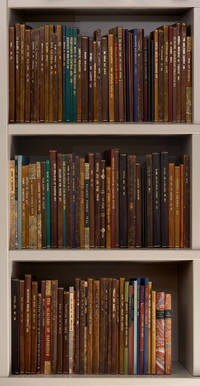
1837Best.-Nr. ABC_46027London Calcutta etc.: various publishers 1837. Half calf with marbled sides and lettering in gold on spine or cloth with marbled sides and a spine label. 8vo. Some illustrated with plates and maps. 107 volumes many containing multiple articles. Handsomely bound extraordinary collection of important scientific journal articles by 19th and 20th century Western explorers of Afghanistan Central Asia China the Himalayas India including Assam Bengal Kashmir and Punjab Karakoram Pakistan including Sindh and Tibet with content covering anthropology archaeology exploration geography geology glaciology history language and grammar mountaineering and politics. At the time these were the far outskirts of the world for Western science where a lot was yet to be learned. Often the maps in these journals are the first modern maps of such regions and findings were the first to be scientifically published.Generally in very good condition.Please inquire for a full list of contents. various publishers, hardcover
1893Best.-Nr. 3075751893. 193 original albumen prints ranging in size from 180mm x 260mm to 239mm x 290mm mounted on card most captioned in ink in English in a fin-de-siècle Vienna hand; approx. 60 with small printed captions mounted to boards; 8 photographs untitled. 2 vols. Oblong 4to. Housed in two contemporary morocco backed cases stamped in gilt "Indien" on spine and upper covers with third box to match. Some occasional bowing of boards photographs fine and well preserved with exception of a stock image of the Taj Mahal lightly faded and some soiling to the mount. 193 original albumen prints ranging in size from 180mm x 260mm to 239mm x 290mm mounted on card most captioned in ink in English in a fin-de-siècle Vienna hand; approx. 60 with small printed captions mounted to boards; 8 photographs untitled. 2 vols. Oblong 4to. Group of 193 original albumen print photographs documenting the Indian portion of the world tour of Archduke Franz-Ferdinand of Austria 1863-1914. This official voyage of the Archduke lasting from December 1892 to October 1893 had explicit diplomatic ethnographic and scientific aims as well as an unspoken goal of permitting the Archduke to recover his health after a diagnosis of tuberculosis. The royal party traveled aboard the imperial cruiser Kaiserin Elisabeth the most modern vessel of the Austrian fleet. They spent two weeks in Ceylon now Sri Lanka before arriving in India in mid-January 1893. The party spent two-and-a-half months in India before touring Nepal returning briefly to Calcutta to embark for Singapore at the end of March. The world tour continued with visits in Australia the Pacific Islands Japan Canada and the American West before the Archduke sailed from New York to Le Havre. The Archduke's stay in India included diplomatic engagements military reviews and a formal visit to the sixth Nizam of Hyderabad who was in late Victorian times the richest man in the world. The Archduke was put up in the Nizam's Bashir Bagh palace. The Archduke also spent considerable time hunting hawking pigsticking bagging some 20 tigers and leopard antelope sambhur black buck and just about every other beast of the chase in Ceylon he had hunted elephant. Franz-Ferdinand was a devoted hunter whose lifetime game bag exceeded 200000 animals; on the world tour his entourage included a huntsman and his taxidemist Eduard Hodek 1858-1929 who was also the Archduke's photographer and boon companion. The itinerary of the Archduke's travels permits the close dating of many of the photographs and events of the trip. A detailed list of the photographs is available. An exhibition in Vienna in 1894 publicized the collections made by the Archduke during his world travels and his diary was published as Tagebuch meiner Reise um die Erde in two volumes 1895-6. Upon the death of his father in 1896 Franz-Ferdinand became the heir to the Austrian throne. His assassination at Sarajevo in 1914 proved the spark that sent Europe and the world into war. The photographs document a wide range of subjects both formal and informal including views of the Archduke's activities grand receptions by the Nizam of Hyderabad military reviews sporting and equestrian events topographical vistas palace scenes as well as ethnographic and hunting images including substantial game bags. Many of the formal photographs of events in Hyderabad were taken by Lala Deen Dayal 1844-1905 noted court photographer to the Nizam and the first Indian photographer to gain international recognition for his work as a pioneer of photography in India only a few bear his studio stamp; but the images are identified in Höfer. Some of the views of and around Calcutta are from Samuel Bourne or Bourne and Shepherd. A spectacular visual record of 1890s India the opulence of the court of Hyderabad and sporting episodes in the life of Franz-Ferdinand. Regina Höfer Imperial Sightseeing: Die Indienreise von Erzherzog Franz-Ferdinand von Österreich-Este Vienna Museum für Völkerkunde Wien 2010 unknown