INDIA - THE PUNJABBiblio.com
4.257 Ergebnisse
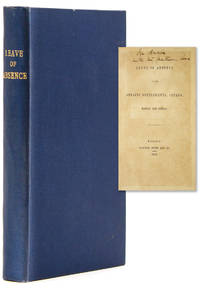
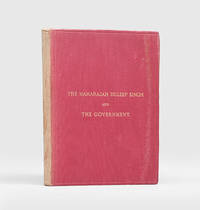
1884Best.-Nr. 189408London: Printed by the Ballatyne Press "For Private Circulation" 1884. Duleep Singh reclaims his throne First and only edition privately issued of this controversial presentation of the maharajah's grievances against the British Government's claims to the Punjab. Decidedly uncommon around 14 copies traced institutionally just a couple at auction. An excellent copy of a fragile fugitive and highly desirable work here in a variant binding to the black skiver usually encountered. The child king Duleep Singh 1838-1893 Maharajah of Lahorewas carried into exile following defeat in the Second Anglo-Sikh War 1848-9 converting to Christianity in 1854 obtaining a royal audience and becoming "an immediate success" with the Queen and eventually settling in Elveden Suffolk with Bamba Müller his "part-Ethiopian part-German" ODNB wife who he had met in Cairo when returning from his mother's funeral in India; "Duleep Singh loved Elveden and rebuilt the church cottages and the school. His fame as a shooter of game was revived in the grounds of the great estate". However "amid European glamour the spirit that had tasted sovereignty was hibernating somewhere in the mind of Duleep Singh. Prompted initially by his mother then by his cousin Thakur Singh Sandhanwalia and finally by the supposed prophecies of the tenth Sikh guru Duleep Singh began a battle with the British government asserting the illegality of the annexation of the Punjab and demanded to be reinstated as maharajah. In 1886 he tried to return to India to place himself as the prophesied head of the Sikh people but was arrested at Aden. Here he was received back into the Sikh faith". From Paris he made himself the centre of various plots to overthrow British rule in the Punjab scheming with Russian and Irish revolutionaries to force the Khyber Pass but all of these conspiracies came to nothing. Increasingly dogged by ill health he sought a reconciliation with Victoria who "responded with a full pardon through the secretary of state on 1 August 1890". He died in Paris in 1893 and was carried back to his beloved Elveden and buried in the graveyard of St Andrew's and St Patrick's Church. The present work represents the historical groundwork to his campaign for reinstatement to the throne and was distributed solely to those who he felt could be of influence to that end. It was "compiled partly from historical sources and partly from private information and documents furnished" Preface by Duleep Singh himself and encompasses a sketch of the early history of the Punjab; a biographical narrative of the Maharajah; and an explanation "of the peculiar Relations in which the Maharajah stands towards the Government and the causes of the differences between them". Octavo. pp. viii 183. Original moderate red cloth over flexible boards title gilt to the front cover single fillet blind panel to both covers grey-blue decorative endpapers. Slightly rubbed the spine sunned; endpapers a little browned pale toning to the text-block else a very good copy. hardcover
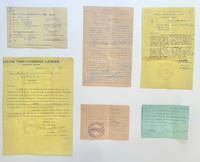
1943Best.-Nr. 010675Kyaiklat Burma British India 1943. Handwritten. Very Good. Loose Leaf. 4to - over 9¾ - 12" tall. Correspondence from Chettiar in Tamil from IIL in English. 9 letters from Chettiar and IIL in manuscript and typescript; 10 pieces of correspondence from IIL on note cards with IIL letterhead; 1 IIL membership card for Chettiar. CONDITION: Overall Very Good old folds some splitting and tape repairs along folds of documents by IIL but Chettiar's letters largely free of wear or tear text legible throughout. All documents now housed in sleeves that are mounted onto backing but it remains easy to remove documents from enclosures. This collection contains English translations of Chettiar's letters presumably made by the previous owner who also wrote captions describing each piece of correspondence on their respective mounts. An evocative collection of correspondence document- ing an Indian nationalist organization's coercion of funds from a member of a prominent money-lending Burmese-Tamil family. These letters show the Indian Independence League's attempt to extort money from a wealthy man whom they had identified as being in a position to help "free India from bondage and for the maintenance of the Indian National Army." This was M.S.M. Somasundarum Chettiar a 63-year-old merchant who operated his business on Strand Road in Kyaiklat a town in the Pyapon District of Burma. A recent historical study by Suppiah and Raja on the Chettiar families of Burma suggests that Somasundaram was part of a "distinguished ethnic group comprising the business class among Malaysian Indian-Tamils" who made their fortunes by lending money to the Indian working class in Burma. The Chettiar ethnic group boasted "a centuries long tradition as an indigenous banking caste in South India" and thus due to a combination of "stringent business regulations during British colonialism in the Madras Presidency and economic opportunities in the newly opened British colonies in Southeast Asia" both the Indian working class in Burma and members of the Straits Settlement Chinese utilized "Chettiar agents in order to conduct bank transactions.in the middle of the nineteenth century." This reliance upon the Chettiar's services only increased by the turn of the twen- tieth century as the demand rose for rubber and tin made in Southeast Asia. As "local Chinese and Malays with only small and medium capital sources relied on loans from Chettiar agents to develop land plant rubber and open mines.Chettiar agents" became "known as the leading moneylenders" in late-colonial Burma. Somasundaram would thus have been part of a known community of capitalists "who accumulated capital for further expansion of their activities at the expense of the Indian working class." The Indian Independence League and the Indian National Army were closely intertwined movements during WWII both led by Subhas Chandra Bose and governed by the Azad Hind Provisional Government in Exile.They worked to unite the Indian diaspora in Southeast Asia to support the cause of independence and sought military support from Japan to facilitate an armed wing for their movement. Primary source documentation of the Azad Hind government's activities is scant institutionally. We locate a scrapbook created by a member of the Indian National Army held at the Institute of Social Research in the Netherlands and a letter from Subhas Chandra Bose asking for a loan from the Hikari Kikan of Syonan held by the National Library Board of Singapore. This would be the only comparable collection held in North America.A rich collection of correspondence highlighting the conflicting poles between Indian diasporic wealth and Indian nationalists' aspirations for the nation's self-rule listing credit Pico Banerjee Peek A Boo Rare Books & Ephemera . unknown
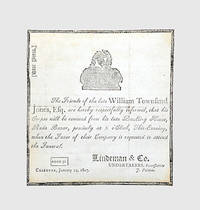
1807Best.-Nr. 122432Calcutta: Star Press 24 January 1807. Haunting piece of Company-rule ephemera announcing the funeral of William Townsend Jones c.1757-1807 attorney on the council of the Supreme Court of Judicature at Fort William the highest court of British India from its foundation in 1774 until 1862. Jones's name is now usually connected with his indictment in December 1789 for flogging to death one Sheriut Allah the brother of his durwan gate-porter whom he suspected of stealing one of his dogs which was "an unlikely crime for a Muslim" Franklin. He was acquitted by the Supreme Court who concluded that Sheriut Allah had died by suicide by eating opium. The affair arose only two years after the impeachment of Warren Hastings in 1787 whose fall from grace had begun with a similar miscarriage of justice involving the execution of a native East India Company administrator Nandakumar. Jones is also a recurring character in the recently published diaries of Calcutta surveyor and builder Richard Blechynden 1759-1822 which reveal that he was also rumoured to have killed another of his servants his mater sweeper. The undertaker Peter Lindeman 1771-1856 of Scottish descent worked from premises at 144 Durrumtollah; from 1803 the Calcutta Missionaries held services in his house on Cossitollah Street until the completion of a new chapel at Lall Bazar in 1809 of which he became a trustee. Single sheet of laid paper 130 x 139 mm printed on one side. Mourning border motif of urn on an altar. Contemporary signature "T. R. R" on verso shaved; the leaf sometime removed from an album or mount adhesive markings and 3 strips of adhesive paper verso 3 faint creases from folding minute hole to one intersection of folds. In excellent condition. Franklin "Orientalist Jones": Sir William Jones Poet Lawyer and Linguist 1746-1794 pp. 300-1; Robb "Memory Place and British Memoirals in Early Calcutta" in Rashkow et al. eds Memory Identity and the Colonial Encounter in India online accessed 4/11/2017; see further Robb ed. Sex and Sensibility: Richard Blechynden's Calcutta Diaries 1791-1822 online. unknown
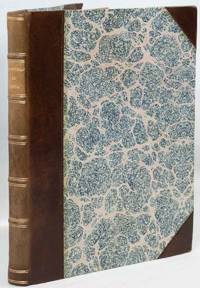
1813Best.-Nr. 222915London.: Edward Orme. 1813. 20 hand coloured aquatint plates 149pp x Index including the Half Title and List of Plates; contemporary half calf over marbled boards spine gilt-lettered in compartments marbled edges 28.2 x 22 cm the first plate a trifle spotted with a small chip from the bottom margin slight age-toning and minor spotting in very good condition. Scarce suite of finely hand coloured aquatints depicting domestic colonial life in British India: the Europeans at their leisure attended by Indian servants. Doyley's compositions are often quietly satirical: Plate IV "A Gentleman Dressing Attended by His Head-Bearer and Other Servants" shows a young man in his gown relaxed seated and reading while an Indian servant washes his feet another in the background pours his drink and yet another makes his bed all overseen by the "Head-Bearer". The artist Charles Doyley was illustrating and observing a world in which was an intimate participant he had been born in India into a family that had long served in India himself serving as a member of the Bengal Civil Service from 1797 to 1838. Abbey Travel 435; Tooley 185 . Edward Orme. hardcover
Best.-Nr. TK0040India: 19th century. Collection from various sources meaning clearly this group includes work from several different artists. Please view added illustrations online under this description. [19th century]. unknown
Best.-Nr. elala6164London: 1804. The second Anglo-Maratha War 1803-05 saw the British gain significant territories and influence including regions around Delhi and in present-day Gujarat falling into direct Company rule. The two rulers who fought the EIC were Daulat Rao Sindhia 1779-1827 and Raghuji Bhonsle II d. 1816. General Gerard Lake and General Arthur Wellesley commanded the EIC army. Included here are the texts of government dispatches government correspondence with the secret committee of the EIC agents ministers and military officers commanding in the field and correspondence and proceedings with the Maratha Princes of States. The plates include two maps of India by A.Arrowsmith and six plans showing General Lake’s encampment at Secundra Aug. 26 1803 the battle of Assye Sept. 23 1803 the attack on Perron's Camp before Allyghur Aug. 29 1803 the entrance into the fort on Sept. 4 the Battle of Delhi Sept. 11 1803 and the Battle of Laswaree November 1 1803. “At the Battle of Assaye on 23 September 1803 General Sir Arthur Wellesley 1769-1852 the future Duke of Wellington masterminded victory for the EIC over the Maratha army of Daulat Rao Sindhia head of the Gwalior state. The cause was greatly helped by Wellesley first steadily building up supplies and then bribing British and Anglo-Indian mercenary officers in the Marathas' employ not to fight. When the Marathas heard of this subterfuge they promptly dismissed all their European officers believing them all of suspect loyalty. The unfortunate consequence for the Marathas was that their army now had no command structure and was routed but not before their artillery had caused tremendous damage to the British. The costs for the EIC victory in this bloody battle were high with around one-third of its army killed or wounded. 6000 Maratha soldiers were killed at Assaye. The experienced British officers were all in agreement that the Maratha artillery was as well organized and deadly as that of any European army they had ever faced. There was some consolation for the human losses in the capture of 98 Maratha cannons. Wellesley then won another battle at Argaum aka Argaon in November 1803 but at the end of his career and even after defeating Napoleon Bonaparte at Waterloo in June 1815 Wellesley declared that his greatest ever military challenge had been at Assaye. On 1 November 1803 the EIC won another decisive victory at the Battle of Laswari this time with a force of 10000 men under the able command of General Gerard Lake 1744-1808 a veteran of the American War of Independence. Again the costs of victory were high with around 838 EIC troops killed or wounded. The EIC then took over Delhi and its surrounding territory. There were a few minor Maratha successes such as the defence of Bhurtpore aka Bharatpur against multiple British attacks in early 1805 but with the large losses in central India to Wellesley and in northern India to Lake the Maratha Confederacy was now but a shadow of its former self. The Hindu princes were largely obliged to follow EIC policies and put up with a permanent resident backed by sepoys EIC Indian troops. However there would be one more conflict to come in a doomed effort to regain the Marathas' lost independence.” Mark Cartwright The World History Encyc. folio. pp. xix 1 587. 2 folding hand-coloured maps & 6 folding partly hand-coloured plans. modern half calf a few minor marks on spine. elala6164 [London]: 1804 unknown
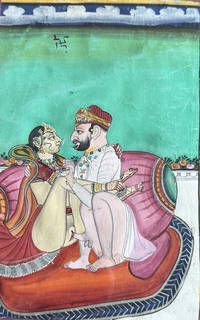
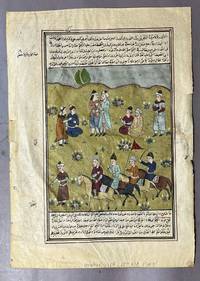
1580Best.-Nr. 007146India 1580. No Binding. Good. Single leaf on paper approx. 345 x 245 mm recto with a finely executed polychrome miniature painting framed within ruled borders and surmounted by Arabic manuscript text in a clear Naskh hand. The painting depicts a narrative scene of figures in animated conversation within a pastoral landscape including standing and seated courtiers and mounted riders arriving from the right. The figures wear Mughal court dress- long jamas sashes and wrapped turbans- and are rendered with individualized facial features and subtle gesture hallmarks of early Mughal painting. The verso is densely written in Arabic in black ink with rubrication in red and extensive marginal annotations indicating scholarly use. The presence of commentary and corrections suggests the leaf once formed part of a learned or historical manuscript rather than a purely literary work. Executed in opaque watercolor and ink the miniature displays a restrained palette of olive green pale blue soft pink cream and lapis tones with stylized floral motifs scattered across the ground. The composition and painterly handling point to an Akbari-early Jahangiri period workshop. Moderate overall wear consistent with age and use. Paper toned with surface wear. Edges worn with small closed tears; remnants of old tape at corners of verso. Minor pigment abrasion and flaking. Text remains largely legible; image stable and visually appealing. Ships unmounted and unframed unknown
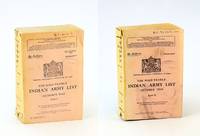
1943Best.-Nr. 223j2732New Delhi India: The Manager of Publications India. Fair with No dust jacket as issued. 1943. First Edition. Paperback. An encyclopedic reference "detailing British and Indian officers including names ranks commissions promotions unit assignments and war services during WWII. Served as an official reference for appointments awards and casualties within the Indian Army." - Google AI. 2790 pages in two volumes. Interesting vintage advertisements. Few markings to covers. Above-average wear. Bindings intact. A rare example of this extraordinarily informative WWII reference. ; Sm 4to . The Manager of Publications, India paperback
Best.-Nr. 103335India Uttar Pradesh circa 1840. . 4 loose leaves watercolours on paper with contemporary French and Sanskrit captions under each image each 405 by 300 mm.; some faint spotting and darkening of outer edges light finger soiling overall bright and attractive condition A vibrant group of large company school illustrations with contemporary ink inscriptions in French describing the four scenes. Illustrations included are of a matrimonial celebrations in a pandal a procession of the Gondi tribe a matrimonial procession with newlyweds and also one depicting the cow-drawn carriage of a governor. India, Uttar Pradesh, circa 1840. unknown
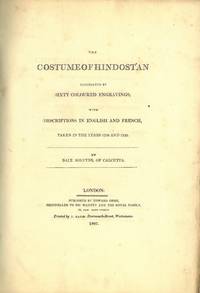
1807Best.-Nr. 78470London 1807. Folio. Nyere burgunder skinnryggbind med ryggforgylling og opphøyde ryggbånd marmorerte dekler. Ubeskåret. Upaginert. 12 60 håndkolorerte farveplansjer. Med to s. tekst til hver plansje - med tekst på engelsk og fransk. Folio. Recent burgundy red half calf spine gilt raised bands marbled covers. Uncut. 12 pp. 60 handcloured copper engravings. With 2pp. text to each plate - in English and French. Printed by Edward Orme. Engelsk. Abbey 429. Colas 2766. Lipperheide 1479. Rent og fint eksemplar.Very nice copy. hardcover
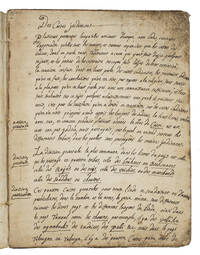
1743Best.-Nr. ABC_45492Karaikal 1743. Blue mottled stiff paper wrappers. 4to ca. 24 x 18.5 cm. Manuscript written in dark brown ink on beige laid paper. French manuscript written in Karaikal French India since 1739 which gives a detailed explanation of the Indian caste system: the author explains in the beginning of the text that the French people are ill-informed about it. To illustrate the Indian caste system the anonymous author tells lively anecdotes and makes comparisons with French social classes and parallels to biblical stories. The author not only describes the details of the four castes Brahmin Raj Vaisya and Sudra including their hierarchy and advantages the purpose of this social structure and the experience of those who lose their caste. He goes further speculates about the way different cultures criticize each others morals. He argues that all nations criticize each other in some way simply because the habits of cultures differ each with its own good reasons. He also wrote about the extent of superstition in the customs of Indian people for example the beliefs surrounding cows. He concludes that not all their customs are superstitious. The author clearly views Indian cultural practices with a certain gentleness.Somewhat worn at the extremities and spine slightly foxed on the front paste-down and a little dust soiled on the first page. Otherwise in good condition. unknown
1859Best.-Nr. 320421Calcutta: Thacker Spink & Co. printed by P.M. Craneburgh at the Bengal Military Orphan Press 1859. First edition. iv 244 viii pp. 8vo. Original blue ribbed cloth spine gilt bookplate to front pastedown of Sir Charles P. Hobhouse Bart. Bradford-on-Avon presentation inscription to title page. A fine copy. First edition. iv 244 viii pp. 8vo. Inscribed on the title page: "For Annie with the Author's love." This copy also formerly belonged to Sir Charles Parry Hobhouse 3rd Baronet of Westbury. A crisp copy recording the anonymous author's seven month's of exploring through South East Asia in 1851 and 1853. Departing 8 September 1851 the author who remains anonymous to this day spent four months travelling to Ceylon and Singapore before returning to Calcutta. In 1853 he set off again this time for a three month excursion to the Madras and Bombay Presidencies. There are vivid descriptions of Singapore Penang Malacca Madras Calcutta Bombay Bangalore and Candy as well as coffee plantations and Buddhist temples. The author spends quite some time travelling overland and describes an ascent of Pedro Tallagalla and Kilkamany and camping at Makoortie Peak. Despite the scarcity of this little book it did attract critical attention. A favourable notice appeared in the Calcutta Review which states that the author had "seen and noted down . as much as any one who had preceded or who has since followed him in the same track." The work concludes with an appendix in two parts the first being a table showing the route modes of transport ship rail bandy pony and the amount of time spent at each location. The second is titled "Hints for travellers" which concludes: "Travellers will find it wiser never to have coolies to their palanquins when they can procure bearers; never to go in palanquins when they can with safety from the sun ride; never ride down passes when they can walk and never to be discouraged by indifference or dissuaded by alarms from prosecuting any enterprise." There is nothing in the preface to explain the six year delay between the conclusion of his travel and the publication of the account. Exceedingly rare. No copies on OCLC or COPAC. The only other copy we know of is the Brooke-Hitching copy identically bound; the present copy is in superior condition. The Calcutta Review vol. 33. July-December 1859. Serampore: "Friend of India" Press 1859 pp. lxviii-lxxi Thacker, Spink & Co. (printed by P.M. Craneburgh at the [Bengal] Military Orphan Press) unknown
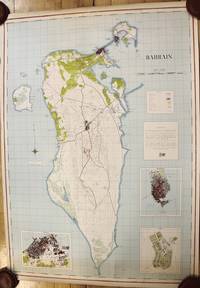
1951Best.-Nr. M9730London c.1951-1953. Very Good mounted on contemporary linen. Notes: A very scarce wall map of Bahrain published jointly by the Royal Geographical Society and the Bahrain Petroleum Company. The map depicts roads tracks buildings cultivated areas marshland and the Bahrain Refinery. Major cities as Awali Manama Town and Muharraq Town are shown in detail. The map has three large insets of Muharraq Awali and Manama. Bahrain small Arab state situated in a bay on the southwestern coast of the Persian Gulf. It is an archipelago consisting of Bahrain Island and some 30 smaller islands. Its name is from the Arabic term al-baḥrayn meaning “two seas.” The economy has long relied on processing crude oil from neighbouring countries and more recently the financial commercial services and communications sectors have grown markedly as has tourism. Britain’s decision to withdraw all of its forces from the gulf in 1968 led Bahrain’s independence in August 1971. A treaty of friendship was signed with the United Kingdom terminating Bahrain’s status as a British protectorate. Size : 925x655 mm 36.42x25.79 Inches Coloring: Hand Colored Category: Maps Asia Middle East Persian Gulf; unknown
1796Best.-Nr. 398421796. The archive comprises: 1. Autograph letter signed "John Canning." Bifolium 13 x 8 1/4 inches 21 lines in fine Malay Jawi with Arabic opening formula docketed "Calcutta 10 Dec 1796"; octagonal red-wax armorial seal of the Canning family. Letter requests that local rulers receive Capt. Hogan "as our agent. to conclude a treaty advantageous to both sides" dated 22 Jumada II 1211 / 10 Dec 1796. 2. to 5. 4 Paper wrappers. English addresses in a copperplate hand & parallel Jawi headings each with intact Canning seal. Addressed to the Sultan of Magindanao King of Mempawah Borneo King of Bali Sultan of Borneo. 6. to 8. 3 Yellow-silk diplomatic covers. Golden satin sleeves with paper address bands in two languages; two remain unopened and sealed. Addressed to the Sultan of Johor unopened King of Sumbawa unopened Sultan of Sulu wrapper only. An exceptional archive uniting British Malay and Islamic manuscript traditions that captures the East India Company’s first concerted overtures to the island-states of Southeast Asia. Drafted in the wake of the Dutch East India Company's collapse and the French Revolutionary Wars this archive documents the East India Company's first concerted diplomatic overtures to the maritime courts of the Malay world. With Dutch control unraveling after the 1795 Batavian Revolution Britain saw a strategic opportunity to enter the lucrative Spice Island trade. Lacking on-the-ground alliances the Company turned to private initiative: Captain Michael Hogan an Irish-American merchant and former convict transport captain was enlisted as unofficial envoy aboard his ship Marquis Cornwallis. The diplomatic texts were composed by Captain John Goodall Canning then Harbour-Master of the port in refined court Malay using Jawi script the Islamic-inflected lingua franca of diplomacy from Aceh to Sulu. In keeping with regional tradition the letters open with Islamic invocation and florid honorifics followed by carefully phrased expressions of friendship and commercial intent. The surviving autograph letter fixes the date of the mission and declares its purpose: "to plant affection and concord and if Your Highness deem it good to enter with us into a compact benefiting both realms." After disembarking convicts in Port Jackson Sydney in February 1796 the Marquis Cornwallis passed northward through Torres Strait calling at New Guinea the Moluccas and ports across the Java Sea almost certainly delivering these and parallel documents en route. The silk wrappers signal the elevated diplomatic status of the messages which were meant to be presented in person by Hogan and opened only in the presence of the addressee. The present archive offers a rare and vivid glimpse into the hybrid ceremonial linguistic and political world of early modern Southeast Asia and into the improvisational diplomacy of the Company at the edge of empire. unknown
Best.-Nr. 48671presented to the Lords States Generall of the united Provinces in defence of the said Company touching the bloudy proceedings against the English Merchants executed at Amboyna. Together with the Acts of the Processe against the sayd English and the Reply of the English East India Company to the said Remonstrance and Defence. Published by Authority. London : printed by John Dawson for the East India Company 1632. Three parts in one volume small quarto modern panelled calf in period style spine in compartments with gilt decoration and lettering; pp. 8 29 1 blank; 2 separate title-leaf 38; 47; 1; with a full-page woodcut depicting the torture of one of the English merchants at Ambon bound in at the end of the preliminaries in effect as a frontispiece to the first part; main title with woodcut armorial device woodcut initials head- and tailpieces; some mild browning a fine copy. Together the three parts of this work provide a summarised account of the so-called Amboyna or Ambon massacre a watershed event that occurred at a time of growing rivalry between the English and Dutch East India Companies over control of the lucrative spice trade. In early 1623 at the Dutch garrison of Fort Victoria on the island of Amboyna in the Moluccas the local Dutch governor ordered the arrest of ten English merchants suspected of plotting to take over the garrison; they confessed under torture and were executed in February 1623. The English reacted by branding the event a massacre. This volume is sometimes found bound with another that was published in London the same year which also presents the controversy from an English perspective A True Relation of the Unjust Cruell and Barbarous Proceedings against the English at Amboyna in the East-Indies by the Netherlandish Governor and Councell there. Both publications helped fuel a rising tide of anti-Dutch sentiment; it would not be long before animosity would give way to open hostility with the outbreak of the First Anglo-Dutch War in 1652. Rare especially in such fine condition. STC 7450a unknown
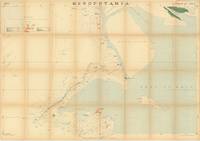
Best.-Nr. 66204Dehradun India: Published under the direction of Colonel Sir S.G. Burrard K.C.S.I. R.E. F.R.S. Surveyor General of India 1917. Original heliozincographed map 73 x 105 cm printed at the Survey of India Offices in partial colour folding between publisher's original buff paper covers printed in black and with key map to back cover. The map compiled from ground and air reconnaissance is centred on Kuwait Bay and extends to the northern portion of the Persian Gulf and the mouth of the Shatt al-Arab with its date groves printed in green in the north and Kuwait city in the south. The map shows roads suitable for automobiles camel roads mule paths foot paths unsurveyed or doubtful routes telegraph lines water wells and oils mosques imamzadehs a shrine-tomb of a holy person in Shi'a Islam forts watch-towers deserted villages springs pipelines graves trigonometrical stations post offices and telegraph offices and camping grounds. Map overprinted with numeric reference grid. Some light even toning slightly more so along folds a few trivial splits along folds generally in very good condition. Produced for official military use during the Mesopotamian Campaign of World War I this large-scale Survey of India sheet presents a detailed tactical map of Kuwait and the surrounding coast. Issued from Dehra Dun in 1917 under Surveyor General Sir Sidney Gerald Burrard the classified map was marked "For Official use only" to supply British and Indian Army staff officers with vital intelligence along the head of the Persian Gulf. The survey encompasses Kuwait Bay Failaka Island Bubiyan Island Khor Abdullah and the mouth of the Shatt-al-Arab near Fao. Topographic contours delineate the Jal-al-Zor ridge while cultural features record Kuwait town highlighting the British Political Agency and Shaikh's Palace alongside wells telegraph lines camel routes tracks and coastal anchorages. Hydrographic depth soundings and palm grove notations around the Shatt-al-Arab estuary provided crucial tactical information for naval supply lines supporting British operations in Iraq. Serving as Sheet No. 2 of the Survey of India's multi-sheet "Mesopotamia" mapping series this sheet exemplifies the rapid expansion of military cartography in the Middle East during World War I. Prepared using heliozincography a process favored for fast field reproduction of complex multi-color tactical plans copies were printed in limited numbers for official command personnel and are rare today. Historical maps focusing specifically on Kuwait especially those as early as this are extremely rare. OCLC traces just one copy at the Staatsbibliothek zu Berlin. OCLC: 1235957231 Dehradun, India: Published under the direction of Colonel Sir S.G. Burrard, K.C.S.I., R.E., F.R.S., Surveyor General of India, 1 unknown
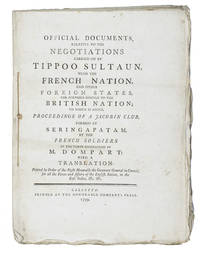
1799Best.-Nr. ABC_45147Calcutta: Honorable Companys Press 1799. Never bound but side stitched through 3 holes. Super Royal 4to 33.5 x 25 cm. A British propaganda publication printed in Calcutta transcribing secret documents that the British supposedly found in the palace of Seringapatam: primarily Tipu Sultans correspondence with the French considered a betrayal of the British. Tipu Sultan 1750-1799 ruler of the Kingdom of Mysore in southern India took part in a long-standing military feud with the British but made peace with them in 1792. When the French under Napoleon made a push for India in 1798 the British attacked Tipus forces once again starting the Fourth Anglo-Mysore War and eventually killing Tipu Sultan in the attack on Seringapatam. He had a fearsome reputation as the Tiger of Mysore and the present publication attempts to discredit him as a traitor. His supposed affiliation with the French Jacobin Club would have especially concerned British readers. Most of the correspondence between Tipu Sultan the French and their allies including Zaman Shah Durrani ruler of what was to become Afghanistan is printed in parallel columns in English and French. Also included is the text of a letter from Tipu Sultan printed letterpress in Persian in the nastaliq script: 9 lines of type apparently set in the nastaliq type cut under the direction of Charles Wilkins 1749-1836 who served the East India Company in India and became their leading orientalist. It was first used at Calcutta in 1781. The only earlier type for the script that has been clearly documented is thought to have been cut in the 1590s for the Propaganda Fide in Rome who used it around 1633. Neil Benjamin Edmonstone translated the Persian and G.G. Keble the French. Although the book is a true very large quarto point holes along the fold at the head and deckles at the foot and fore-edge the chainlines are vertical though one would not expect sheets this large to be made in double moulds the usual reason for chainlines parallel to the long axis of the sheet.In good condition. Wholly untrimmed and with most bolts unopened and the point holes present.l Shaw Printing in Calcutta 359; Shaw SABREB sab00086; not in Cat. East-India Comp. Honorable Companys Press, unknown
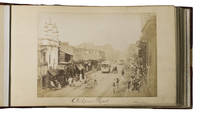
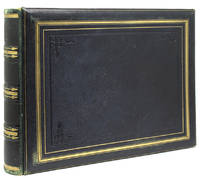
1874Best.-Nr. ABC_46925Calcutta 1874. Contemporary gold-tooled half red morocco brown cloth sides. Oblong 8vo. With 33 mounted sepia albumen prints ca. 15/15.5 x 10.5/11 cm all captioned. Manuscript title and captions of the pictures in English written in brown ink in a neat 19th-century cursive hand. Photograph album containing 33 albumen prints of buildings important places views and people in Calcutta in the 1870s. The album opens with some architectural photographs including the governor's house the new market the post office St. Paul's cathedral and the high court. Also included are views of roads and streets that are still important today such as Benting Street Chilpore Road Russell Street and Strand Road and 5 albumen prints of the B.Y. Docks. The album also contains views near Kalighat and Barnatore especially of the landscape but also of a Hindu temple. The album concludes with some photographs of people living in Calcutta showing beggars carpenters palki bearers a barber ending the album with a group of Rohillas.The album includes a photograph of the statue of Sir James Outram unveiled in Calcutta on 22 May 1874 an all photographs seem likely to have been made soon after that.Binding a little worn and scuffed endpapers a little dust-soiled some leaves marginally slightly dust-soiled some leaves slightly browned some occasional foxing paper of the last photograph slightly damaged not affecting the image some images a little faded but overall in good condition. A highly interesting album showing life in Calcutta in the 1870s.l For dating the statue of Sir James Outram: Catalogue of the sculpture of J.H. Foley in: Dublin Historical Record 32 3 1979 pp. 108-116. hardcover
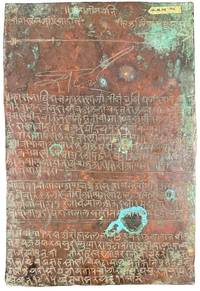
1819Best.-Nr. 42798Eastern India possibly Bengal or Assam circa 18th-19th century. Copper plate 13 7/8 x 9 1/8 inches engraved on both sides. The principal face with several lines of incised text at the head followed by a large engraved validating or emblematic mark and below this three dense sections of text divided by ruled horizontal lines. The reverse largely uninscribed with three small engraved seals or validating marks near the edge. An inscribed copper plate of Indian origin possibly Bengal or Assam engraved in a Bengali or Bengali-Assamese script and preserving a formal documentary text in metal. This copper plate belongs to the South Asian tradition of preserving legal devotional and administrative records on durable metal supports. Copper plate documents often described as tamrapatra or copper charters were used for grants endowments title rights decrees and other formal acts their material permanence giving them authority beyond that of ordinary manuscript documents. The present example appears to preserve a substantial text arranged in ruled sections and accompanied by validating marks. The script appears close to Bengali or Bengali-Assamese. The letterforms show rounded and looped shapes consistent with scripts used in eastern India. If confirmed this would suggest an origin in Bengal Assam or a neighbouring region where related scripts were used for administrative and religious writing. From their earliest centuries of development copper plate inscriptions have occupied a central place in South Asian documentary culture particularly in the recording of land grants royal edicts temple endowments and other formal transactions. Their durability made them suitable for preserving records intended to endure and they were often deposited in temples or held by families or institutions as proof of rights and privileges. While earlier examples are frequently associated with royal chancelleries the practice continued into the early modern and colonial periods with regional administrations and local authorities maintaining related forms of documentation. The present plate appears to belong to this later phase of the tradition when such documents were still being produced for administrative legal or commemorative purposes. Its relatively large format and the density of inscription suggest a formal text of some substance while the additional engraved devices indicate an effort to authenticate or formalise the record. The copper plate offers a direct example of a documentary practice that bridges manuscript culture and more durable forms preserving both the text itself and the physical conventions of its transmission. unknown
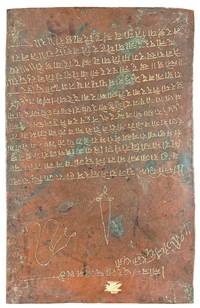
1819Best.-Nr. 42797Western or Northern India circa 18th or 19th century. Copper plate 15 1/2 x 9 3/4 inches engraved on both sides one face densely filled with horizontal lines of incised text and with additional marks including a dagger or torch device and other validating or ownership marks. The reverse more sparsely inscribed with two lines of text. An inscribed copper plate of Indian origin engraved on both sides and belonging to the South Asian tradition of preserving legal devotional and commemorative texts. A striking survival from the documentary culture of South Asia where copper served as a durable support for records intended to outlast paper and palm leaf. Such copper records often described as tamrapatra or copper charters were valued because they were portable difficult to alter and capable of serving as enduring witnesses to grants decrees endowments title rights and other formal acts. The script appears to belong to the Nagari family possibly Devanagari or a related cursive administrative hand such as Modi the script long used for Marathi official and business writing. From their earliest centuries of development copper plate inscriptions have occupied a central place in South Asian documentary culture particularly in the recording of land grants royal edicts temple endowments and other formal transactions. Their durability made them suitable for preserving records intended to endure and they were often deposited in temples or held by families or institutions as proof of rights and privileges. While earlier examples are frequently associated with royal chancelleries the practice continued into the early modern and colonial periods with regional administrations and local authorities maintaining related forms of documentation. The present plate appears to belong to this later phase of the tradition when such documents were still being produced for administrative legal or commemorative purposes. Its relatively large format and the density of inscription suggest a formal text of some substance while the additional engraved devices indicate an effort to authenticate or formalise the record. The copper plate offers a direct example of a documentary practice that bridges manuscript culture and more durable forms preserving both the text itself and the physical conventions of its transmission. unknown
1940Best.-Nr. ZB394384Linguistic Society of India. 1940-1973. Price HAS BEEN REDUCED by 10% until Monday Oct. 26 weekend SALE item volumes 1-34; lacks volume 27. 1940-1973. partly bound library markings textually clean & tight PRICE IS FOR THE LOT. - If you are reading this this item is actually physically in our stock and ready for shipment once ordered. We are not bookjackers. Buyer is responsible for any additional duties taxes or fees required by recipient's country. Photos available upon request. Linguistic Society of India. unknown
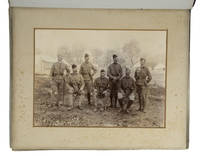
1898Best.-Nr. ABC_457021898. 2 PARK Superintendent. 1898. Catalogue of photographs by Sergeant A.J. Clarke R.E. taken during Tirah Expedition 1897-1898. Kirkee Pune India Sappers and Miners' Press 1898. Small folio 22 x 14.5 cm 4 pp. With a lithographed title-page. Loosely inserted in the album. Collection of photographs taken by a British Indian Army officer who served in the Peshawar Column during the Tirah Expedition in the Northwest Frontier of India from June 1897 to April 1898 including a manuscript Key that identifies seven British officers that are in the first photo of the album and a list of captions to 10 photos in the album.The Tirah Expedition was aimed against the Afridi and Orakzai tribes in British Indias Northwest Frontier modern-day Khyber Pashtunkhwa province of Pakistan. One of many Northwest Frontier campaigns of British India the Tirah campaign concentrated on the area west and south of Peshawar in the mountainous region between the valleys of the Bara and Kohat Rivers. The album primarily documents the actions of the Tirah field forces Peshawar Column under command of Brigadier-General Arthur George Hammond 1843-1919 which followed the route of the Bara Valley.The present photo album contains 8 large albumen photos documenting the movement of the Peshawar Column. The large photos were taken by W. Rahn according to the memoirs of Peshawar Column officer Richard Thomsett we had a photographer named Rahn with the column and he accompanied us until we arrived at Ali Masjid in December 1897 when an accident necessitated his returning to India. Rahn was a German who had come out to the East some twenty years before and seemed to be ubiquitous for wherever we were there he was with his camera ready and I must say he took some very excellent pictures.The present album also includes 43 smaller gelatin photos with manuscript captions for 10 of them on a small piece of paper perfectly describing the photos on leaves 5 and 9 of the album. The album is supplemented with a rare 4-page brochure no doubt produced in a small print-run that lists 99 photos. About 20 have been marked by hand in pencil probably by the albums compiler. The brochure indicates that the present photos could be purchased from the Bombay Sappers and Miners.8 of the large photos have contemporary manuscript captions in ink on the mounts. 2 marks on the front paste-down reading "photographs by British Royal Engineers. Tirah Expedition 1897-1898 North India. Binding slightly rubbed on extremities the original 5 cords replaced with 3 new black cords hinged to stubs . A few images mildly faded. The additional manuscript leaves foxed and worn. Otherwise in good condition.l The navy and army illustrated V no. 53 24 December 1897 pp. 150-152 4 of the 8 large photographs & no. 57 18 February 1898 p. 275; R.G. Thomsett With the Peshawar olumn. Tirah expeditionary force London 1899 pp. 103-104. unknown
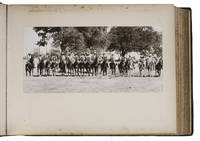
1933Best.-Nr. ABC_45905Cambridge Mumbai New Delhi: Scott & Wilkinson Clifton & Co Hamilton Studios and Kinsey Bros. 1933. Oblong half morocco photograph album by W. Johnson & sons London. With 105 photographs mounted in the album ranging from 16 x 28 cm to 4 x 6 cm 2 photographs loosely inserted and a watercolour mounted at the back 11.5 x 21 cm. Unique photograph album showcasing the vigorous "fox" hunting scene in British India in the early 1930s particularly around Delhi. Most of the photographs show members of the British upper class in India often mounted on horses or posing for a group photograph and accompanied by hounds. The album contains no titles captions or inscriptions and the photographs do not seem to figure recurring individuals which suggests that it was probably compiled to commemorate the hunting and or riding club and its activities in the early 1930s. Numerous photographs show groups of mostly men posing with hounds at lunches and possibly a hunt ball or mounted on horses at jumping events and even a few cup trophies. The very first photograph is by Scott & Wilkinson in Cambridge active before 1933 and was therefore probably taken in England. The other inscribed photographs are by Clifton & Co. and Hamilton Studios from Bombay and Kinsey Bros. which started in New Delhi in 1935.British life in India mirrored life in native Britain and included popular equestrian activities such as hunting. Starting in the second half of the 19th century foxhounds were imported from Britain and subsequently bred in India. Regiments and brigades kept their own packs but at the beginning of the 20th century these had morphed into local hunts. Hounds were kept at over 12 hunting clubs which included Delhi Meerut Narbuda Vale Jaora Poona Bombay Bangalore Ooty Madras Lahore Quetta Peshawar and Karachi. Although the Indian silver fox was sometimes hunted the most common prey was the golden jackal.A different type of hunting popular in India was pig sticking: the chase of a wild boar on horseback with the spear. Several photographs in the album show pig sticking parties either posing or in action and sometimes accompanied by spectators on elephants. In contrast to the jackal-hunt parties the pigstick groups are composed of more military looking men and also include Indian men as opposed to the British-only hound groups.Most photographs show the area around Delhi and include a hunt near Shah Alam's Tomb. A photograph of this event is loosely inserted in the album and dated 1933/34 on the back. Other photographs show the Rashtrapati Bhavan one group shows the Earl later Marquess of Willingdon India's Governor-General from 1931 to 1936. Two images show the monumental Gateway of India completed in 1924 in Bombay Mumbai which can also be seen in an aerial photograph. Several photographs show what is probably the airfield at Karachi as it shows two airplanes loading mail on apparently the first voyage of the Indian Transcontinental Airways. Imperial Airways liner "Hanno" departing from Croydon had left for Karachi on 1 July 1933 via Bahrain and Sharjah. In Karachi the cargo was transferred to the Transcontinental airliner "Arethusa" as can be seen on the photographs.It is unclear why only half of the album was used. It is possible the compiler transferred to Kut in British Mesopotamia Kut al-Imara in modern Iraq. A watercolour on the final page of the album is captioned "A river bank north of Kut".Binding slightly rubbed and worn at the edges. Album leaves foxed throughout but most of the photographs in very good condition. The paper of the large photograph of the group near Shah Alam's Tomb is heavily damaged at the top and left side but the image itself is undamaged. A unique collection of British-Indian hunting photographs in very good condition.l Cf. Hamid "Riding with the Peshawar Vale hunt" thefridaytimes.com; Hunt "Delhi" in: Ten cities that made an empire; "1933 Eastwards: Karachi to Calcutta" indianairmails.com; Lucas Hunt and working terriers pp. 116-120; Mitter et al. The artful pose. Scott & Wilkinson, Clifton & Co, Hamilton Studios and Kinsey Bros., unknown
1880Best.-Nr. 3050981880. Albumen prints approximately 9 x 11-1/2 in. mounted on card with manuscript captions 61 signed and numbered in the negative by Bourne the rest unattributed. 1 vols. Oblong folio. Contemporary full pebbled morocco. Light traces of rubbing occasional light foxing to mounts. Albumen prints approximately 9 x 11-1/2 in. mounted on card with manuscript captions 61 signed and numbered in the negative by Bourne the rest unattributed. 1 vols. Oblong folio. An excellent and varied view of British India in the 1860s with large-format photographs supplied by one of the longest running photography firms in the world. The images grouped by location generally show architectural views as well as some Himalayan and rural views. Images include scenes from Goverdhan Deig Cawnpore Lucknow Benares Calcutta Darjeeling Udaipur Palace in the Lake and Ahmedabad. unknown
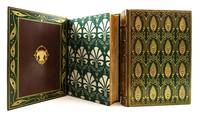
1906Best.-Nr. ST20132London: Printed by the Edinboro Press for the Grolier Society 1906-07. Edition magnifique letter J of 26 lettered sets. 260 x 180 mm. 10 1/4 x 7". Nine volumes volume II bound without two-page Appendix IV Jackson A. V. Williams. SPLENDID CONTEMPORARY EMERALD GREEN MOROCCO lavishly gilt and with delicate scarlet morocco inlays forming a repeating peacock feather motif surrounded by Art Nouveau twining vines all within a gilt French fillet spine similarly decorated raised bands BROWN MOROCCO DOUBLURES with a central inlaid and gilt triple elephant motif within a wide green morocco frame adorned by gilt peacock feathers with indigo morocco inlays unusually elaborate floral silk flyleaves top edge gilt other edges untrimmed. WITH 153 PLATES including 72 photographic reproductions on shiny paper and 81 plates in three states with printed tissue guards: one hand colored; one tipped on in black & white; and one sepia; plus numerous black & white illustrations 68 of these being full-page; and one double-page map. Spines uniformly sunned to a light tan but bindings otherwise lustrous and virtually unworn; one tissue guard stuck to the plate facing p. 150 in volume IV a few corner creases other trivial imperfections but very clean and fresh with some leaves still unopened. This nine-volume history of India features a luxurious binding with sparkling gilt and vibrant morocco inlays forming motifs that perfectly suit its contents. Intended to present the history of India from the "earliest times" through the British Raj this profusely illustrated work was written by some of the most prominent Victorian scholars on the subject and edited by an esteemed professor of Indo-Iranian languages at Columbia University. Volume I "From the earliest times to the sixth century B.C." is the work of native Calcutta historian Romesh Chunder Dutt 1848-1909 author of major works on the cultural and economic history of the country. Volume II "From the sixth century B.C. to the Mohammedan conquest" is the contribution of Irish antiquarian Vincent Arthur Smith 1848-1920 who wrote the "Oxford History of India" which DNB says "was to exert a vast influence over generations of students." Volumes III and IV "Medieval India from the Mohammedan conquest to the reign of Akbar the Great" and "From the reign of Akbar the Great to the fall of the Moghul empire" come from British orientalist and numismatics expert Stanley Lane-Poole 1854-1931 praised by DNB as "a versatile writer able to produce both academic reference works . . . and popular versions of his biographies and introductions to historical subjects." Volumes V-VIII were written by former administrators of the Raj who had taken up Indian history as an avocation. Volume V "The Mohammedan period as described by its own historians" was prepared by editors from earlier works by Sir Henry Miers Elliot 1808-53. Volumes VI and VII "From the first European settlements to the founding of the English East India Company" and "The European struggle for Indian supremacy in the seventeenth century" were penned by Sir William Wilson Hunter 1840-1900 who spent 25 years in the Indian Civil Service before retiring to write about the history of colonialism in India. The penultimate volume "From the close of the seventeenth century to the present time" was written by someone who actually lived key parts of that history Sir Alfred Comyn Lyall 1835-1911 survivor and hero of the Indian Mutiny lieutenant-governor of the North-Western Provinces and longtime member of the Council on India. In the final volume editor Abraham Valentine Williams Jackson 1862-1937 compiles "Historic accounts of India by foreign travellers classic oriental and occidental." All volumes are copiously illustrated with photo plates of life in Victorian India many taken from Jackson’s own photographs and with examples of Indian art architecture and crafts. Though unsigned the spectacular bindings were clearly the work of a master possibly Sangorski & Sutcliffe. The quality of materials skill of finishing and elaborate motifs are consistent with those produced by that outstanding bindery or another of equal skill and taste. While the work occurs with some regularity on the market it is extremely rare in such a beautiful decorative dress as seen here. Printed by the Edinboro Press for the Grolier Society unknown