1,022 results
1910ref. 238911910. Pineapple plantation photo archive circa 1910s documenting cultivation harvest and transport on an unidentified tropical plantation during the expansion of commercial pineapple production for export markets and black sharecropping labor. The photographs concentrate on the agricultural cycle rather than plantation buildings or domestic life moving from densely planted acreage and individual ripening fruit to large accumulations of harvested pineapples and a mule drawn wagon loaded for transport. Pineapple cultivation expanded substantially in the Caribbean and Hawaii during the early twentieth century making the crop increasingly visible within American commercial agriculture and food consumption. Photo archive of 10 silver gelatin photographs each approximately 3 x 4 inches Caribbean location circa 1910s. Several photographs survey extensive fields planted almost entirely in pineapple including broad views in which rows of spiked plants extend toward distant hills and close studies showing mature fruit rising from individual plants. Other images record the harvest after removal from the field: pineapples are arranged in substantial piles beside cultivated acreage while two white men pose before one accumulation holding individual fruit. Another photograph shows a mule drawn wooden wagon filled above its sideboards with harvested pineapples with one white man standing beside the wagon another seated atop the load and a black man positioned with the mule team further highlights post emancipation plantation labor. The men's differing positions within the harvest scenes preserve visible evidence of diverse groups participating in the plantation's agricultural economy alongside the animal powered transportation used to move a bulky commercial crop from the field. Commercial pineapple production was developing rapidly across several regions connected to the United States Hawaii and the Carbons during this period. The photographs belong to that broader transformation of pineapple from a geographically restricted tropical fruit into an increasingly standardized export commodity but neither crop morphology nor the visible terrain distinguishes securely among these producing regions. More specifically the images record the material stages behind that trade: dense monocrop planting maturation in the field manual harvesting accumulation of fruit and transportation by mule drawn wagon. Light handling wear occasional edge and corner losses minor curling and scattered toning; image surfaces remain generally clear with strong detail. Overall in good condition. A concentrated photographic record of early twentieth century pineapple agriculture showing the field harvest labor and transport required to move a tropical crop toward commercial distribution. unknown books
1910ref. 238911910. Pineapple plantation photo archive circa 1910s documenting cultivation harvest and transport on an unidentified tropical plantation during the expansion of commercial pineapple production for export markets and black sharecropping labor. The photographs concentrate on the agricultural cycle rather than plantation buildings or domestic life moving from densely planted acreage and individual ripening fruit to large accumulations of harvested pineapples and a mule drawn wagon loaded for transport. Pineapple cultivation expanded substantially in the Caribbean and Hawaii during the early twentieth century making the crop increasingly visible within American commercial agriculture and food consumption. Photo archive of 10 silver gelatin photographs each approximately 3 x 4 inches Caribbean location circa 1910s. Several photographs survey extensive fields planted almost entirely in pineapple including broad views in which rows of spiked plants extend toward distant hills and close studies showing mature fruit rising from individual plants. Other images record the harvest after removal from the field: pineapples are arranged in substantial piles beside cultivated acreage while two white men pose before one accumulation holding individual fruit. Another photograph shows a mule drawn wooden wagon filled above its sideboards with harvested pineapples with one white man standing beside the wagon another seated atop the load and a black man positioned with the mule team further highlights post emancipation plantation labor. The men's differing positions within the harvest scenes preserve visible evidence of diverse groups participating in the plantation's agricultural economy alongside the animal powered transportation used to move a bulky commercial crop from the field. Commercial pineapple production was developing rapidly across several regions connected to the United States Hawaii and the Carbons during this period. The photographs belong to that broader transformation of pineapple from a geographically restricted tropical fruit into an increasingly standardized export commodity but neither crop morphology nor the visible terrain distinguishes securely among these producing regions. More specifically the images record the material stages behind that trade: dense monocrop planting maturation in the field manual harvesting accumulation of fruit and transportation by mule drawn wagon. Light handling wear occasional edge and corner losses minor curling and scattered toning; image surfaces remain generally clear with strong detail. Overall in good condition. A concentrated photographic record of early twentieth century pineapple agriculture showing the field harvest labor and transport required to move a tropical crop toward commercial distribution. unknown
ref. DADAX0415630339New unknown
ref. DADAX0415660068New unknown
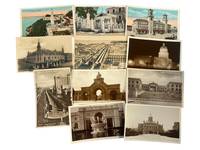
1920ref. 224751920. Cuba Havana landmarks and urban development real photo post card archive ca. 1920s-1940s. 11 color and sepia real photo postcards of iconic civic and cultural architecture in Havana Cuba. Each measure 4" x 6". Many with captions identifying the locations in the negative or en verso with some printed in English and others in Spanish signaling their intended audience of both locals and foreign tourists. A compelling photo archive documenting early 20th-century Havana's architectural and political aspirations this collection showcases prominent landmarks that symbolized Cuba's nationalist identity international cosmopolitanism and American-influenced modernization in the decades between independence from Spain and the Cuban Revolution. The archive includes silver gelatin and printed color views of the National Theatre Cuba's Capitol Building Central Railway Station Gran Casino Nacional National University and the grand gateway of Havana's Colón Cemetery. Other views depict Paseo de Martí one of Havana's most iconic boulevards lined with vintage American cars and flanked by ornate colonial facades and new Art Deco-style hotels evidence of the influx of U.S. capital and tourism during the Batista era. Havana in this period was rapidly transforming into a showcase city of the Caribbean its urban core reflecting both Spanish colonial heritage and American urban planning models. The presence of monumental buildings like El Capitolio constructed between 1926 and 1929 and modeled after the U.S. Capitol in Washington D.C. points to Cuba's alignment with American political aesthetics and aspirations toward modern statehood. Similarly the University and Gran Casino Nacional represent both the intellectual elite and leisure-class investment that typified pre-revolutionary Cuban society. The mixture of European and U.S. architectural influences ranging from Beaux-Arts to Art Deco speaks to the layered colonial legacy and new economic dependency forged during the Platt Amendment era. Some mild edge wear. One card with a small corner crease others clean. Overall very good condition. This archive captures Havana in the midst of dramatic urban renewal and internationalization before the massive ruptures brought on by the 1959 revolution. unknown books
ref. DADAX0195369149New unknown
1920ref. 224751920. Cuba Havana landmarks and urban development real photo post card archive ca. 1920s-1940s. 11 color and sepia real photo postcards of iconic civic and cultural architecture in Havana Cuba. Each measure 4" x 6". Many with captions identifying the locations in the negative or en verso with some printed in English and others in Spanish signaling their intended audience of both locals and foreign tourists. A compelling photo archive documenting early 20th-century Havana's architectural and political aspirations this collection showcases prominent landmarks that symbolized Cuba's nationalist identity international cosmopolitanism and American-influenced modernization in the decades between independence from Spain and the Cuban Revolution. The archive includes silver gelatin and printed color views of the National Theatre Cuba's Capitol Building Central Railway Station Gran Casino Nacional National University and the grand gateway of Havana's Colón Cemetery. Other views depict Paseo de Martí one of Havana's most iconic boulevards lined with vintage American cars and flanked by ornate colonial facades and new Art Deco-style hotels evidence of the influx of U.S. capital and tourism during the Batista era. Havana in this period was rapidly transforming into a showcase city of the Caribbean its urban core reflecting both Spanish colonial heritage and American urban planning models. The presence of monumental buildings like El Capitolio constructed between 1926 and 1929 and modeled after the U.S. Capitol in Washington D.C. points to Cuba's alignment with American political aesthetics and aspirations toward modern statehood. Similarly the University and Gran Casino Nacional represent both the intellectual elite and leisure-class investment that typified pre-revolutionary Cuban society. The mixture of European and U.S. architectural influences ranging from Beaux-Arts to Art Deco speaks to the layered colonial legacy and new economic dependency forged during the Platt Amendment era. Some mild edge wear. One card with a small corner crease others clean. Overall very good condition. This archive captures Havana in the midst of dramatic urban renewal and internationalization before the massive ruptures brought on by the 1959 revolution. unknown
900Jamaica Surveyed by Staff Com.r G. Stanley 1873-5 and Lieut.t T. F. Pullen 1876-9. Morant Cays by Lieut A. Carpenter and the Officers of H. M. S. Sparrowhawk 1890.London Published at the Admiralty 27 October 1880 under the Superintendence of Captain F.J. Evan. Small corrections: 1931. Folded
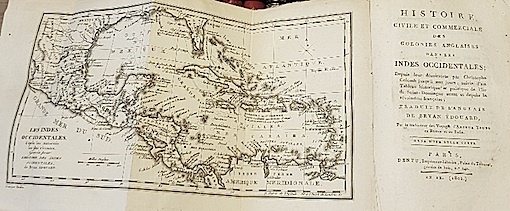
1801ref. 10389Dentu Paris An IX (1801) 1 vol. Fort in-8 broché de VIII 490 pp., couverture muette de l'époque, pièce de titre papier.
Madrid, por Don Joachín Ibarra, 1783. 8vo.; 2 hs., 240 pp. Encuadernación de época, en piel marbreada, ligeramente fatigada.
ref. DADAX0367210487New unknown
1942ref. ZB382805Cascade: Trinidad and Tobago Medical Associations 1942-70. Price HAS BEEN REDUCED by 10% until Monday Oct. 26 weekend SALE item volumes 4#2; 6#2; 11#1-2; 12#1/2; 13#1/2; 17#1/2; 21#1/4; 21#1/4; 23#1/4; 26#1/4; 30#1/4; 31/32#1/4 original paper wrappers minor library markings & with some bibliographic data corrected in pen; good; Price is for the lot. - If you are reading this this item is actually physically in our stock and ready for shipment once ordered. We are not bookjackers. Buyer is responsible for any additional duties taxes or fees required by recipient's country. Photos available upon request. Cascade: Trinidad and Tobago Medical Associations unknown
ref. DADAX1570362858New unknown
1855(Original) boards with light rubbing to extremities and faded. Spine sunned and with light fraying. Bookplate. Former owner's name on front free endpaper. Very light foxing to first and last few pages ; 60 b&w illustrations. ; 12mo 7" - 7½" tall; 366 pages
900Port Antonio (556x644 mm) Surveyed by Captain R.W. Glennie assisted by Lieut.t Com.dr C.S. Lockhart A.E. Harbord D.L. Cowan R.M. Southern & A.H. Stanley H.M. Surveying Ship "Mutine" Jan.y - March 1921. Intesting "Objects on this chart conspicuous to the Navigator" Titchfield Hotel, Richmond House, Isolation Hospital...London Published at the Admiralty 7 May 1923 under the Superintendence of Rear Admiral Fred.k C. Learmonth. Folded
ref. 42793Paris Chez Pillet Ainé, Imprimeur Libraire 1819 in 8 (21x13,5) 1 volume broché, couverture imprimée, XII et 135 pages [1], renfort ancien sur le dos de la couverture, rousseurs éparses, non rogné. Rare. Bon exemplaire
1844ref. PHO-1491Paris, Arthus Bertrand, 1844, in-8, 2 volumes, LXXI-771-[2] pp. en numérotation continue, 20 diagrammes hors texte, demi-chagrin rouge, dos à faux nerfs, monogramme "J.M.C." doré en pied des dos, Rousseurs, quelques auréoles, l'une assez large en tête du second tome.
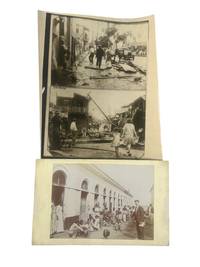
1928ref. 219181928. Puerto Rico photo archive circa 1910s and 1928 documents colonial-era social conditions and hurricane destruction in the decades after the United States took control of the island. The archive centers on two related subjects: a large group portrait of Puerto Rican adults and children gathered outside a long arched building and press images of San Juan after the September 13 1928 San Felipe Segundo hurricane. The photographs provide visual evidence of everyday poverty built environment disaster damage and public movement through wreckage during a period shaped by U.S. civil government under the Foraker Act of 1900 and U.S. citizenship without voting representation in Congress under the Jones-Shafroth Act of 1917. Puerto Rico photo archive. Puerto Rico circa late 1910s and 1928. Three silver gelatin photographs with two images printed on one press sheet. Sizes range from 5 x 9 inches to 8.5 x 11 inches. The 1928 press photograph contains two stacked photojournalistic views of San Juan after the hurricane showing torn corrugated roofing broken utility poles damaged structures debris-filled streets and residents including children and laborers moving through the wreckage. The larger earlier image shows a white man standing before a long arched tenement-style or institutional building surrounded by Puerto Rican women men and numerous children many barefoot and wearing worn or minimal clothing; the image appears posed or observational but the man's role is not identified. The San Felipe Segundo hurricane struck Puerto Rico on September 13 1928 as a Category 5 storm and caused 312 reported deaths widespread housing destruction and several hundred thousand people left homeless giving the press images strong value as disaster documentation within a colonial setting. The earlier group photograph broadens the archive beyond catastrophe recording visible poverty dress housing and racialized colonial social relations without requiring unsupported identification of the white figure. Some edge wear tape on margins of smaller image and original editor's markings en verso to press photograph; very good. A compact Puerto Rico photo archive linking colonial-era social conditions with one of the island's most destructive twentieth-century hurricanes. unknown books
1853ref. 604771853. London: Printed by W. Clowes and Sons 1853. London: Printed by W. Clowes and Sons 1853. The First Compilation of the Laws of St. Lucia Saint Lucia. Laws at Present in Force in the Island of St. Lucia. London: Printed by W. Clowes and Sons 1853. vi 388 pp. Octavo 9-1/2" x 6". Contemporary calf with early rebacking red and black lettering pieces and small paper location label to spine upper lettering piece and endpapers renewed. Moderate rubbing to extremities some scuffing and edgewear to boards gilt red and black lettering pieces light toning to text internally clean. Ex-library. Old shelf label at head of spine small embossed stamps to boards inkstamp Bibliothek des Reichsgerichts to title page. A solid copy of a scarce title. $450. With index and side-notes. Saint Lucia was discovered by Columbus in 1502. The first group of colonists from England were massacred by the Caribs but the French succeeded in colonizing the island in 1642. It passed between France and Great Britain a number of times and became a British possession in 1803. It became independent and joined the Commonwealth in 1979. As one would suspect traces of French law remain in the island's legal system. The Reichsgerichtsbibliothek Imperial Court of Justice Library was at its peak Germany's largest and most important law library with 170000 works in its collection before the outbreak of the First World War. OCLC locates 9 copies in North America. Sweet & Maxwell A Legal Bibliography of the British Commonwealth 7:341. unknown books
1928ref. 219181928. Puerto Rico photo archive circa 1910s and 1928 documents colonial-era social conditions and hurricane destruction in the decades after the United States took control of the island. The archive centers on two related subjects: a large group portrait of Puerto Rican adults and children gathered outside a long arched building and press images of San Juan after the September 13 1928 San Felipe Segundo hurricane. The photographs provide visual evidence of everyday poverty built environment disaster damage and public movement through wreckage during a period shaped by U.S. civil government under the Foraker Act of 1900 and U.S. citizenship without voting representation in Congress under the Jones-Shafroth Act of 1917. Puerto Rico photo archive. Puerto Rico circa late 1910s and 1928. Three silver gelatin photographs with two images printed on one press sheet. Sizes range from 5 x 9 inches to 8.5 x 11 inches. The 1928 press photograph contains two stacked photojournalistic views of San Juan after the hurricane showing torn corrugated roofing broken utility poles damaged structures debris-filled streets and residents including children and laborers moving through the wreckage. The larger earlier image shows a white man standing before a long arched tenement-style or institutional building surrounded by Puerto Rican women men and numerous children many barefoot and wearing worn or minimal clothing; the image appears posed or observational but the man's role is not identified. The San Felipe Segundo hurricane struck Puerto Rico on September 13 1928 as a Category 5 storm and caused 312 reported deaths widespread housing destruction and several hundred thousand people left homeless giving the press images strong value as disaster documentation within a colonial setting. The earlier group photograph broadens the archive beyond catastrophe recording visible poverty dress housing and racialized colonial social relations without requiring unsupported identification of the white figure. Some edge wear tape on margins of smaller image and original editor's markings en verso to press photograph; very good. A compact Puerto Rico photo archive linking colonial-era social conditions with one of the island's most destructive twentieth-century hurricanes. unknown
1853ref. 604771853. London: Printed by W. Clowes and Sons 1853. London: Printed by W. Clowes and Sons 1853. The First Compilation of the Laws of St. Lucia Saint Lucia. Laws at Present in Force in the Island of St. Lucia. London: Printed by W. Clowes and Sons 1853. vi 388 pp. Octavo 9-1/2" x 6". Contemporary calf with early rebacking red and black lettering pieces and small paper location label to spine upper lettering piece and endpapers renewed. Moderate rubbing to extremities some scuffing and edgewear to boards gilt red and black lettering pieces light toning to text internally clean. Ex-library. Old shelf label at head of spine small embossed stamps to boards inkstamp Bibliothek des Reichsgerichts to title page. A solid copy of a scarce title. $450. With index and side-notes. Saint Lucia was discovered by Columbus in 1502. The first group of colonists from England were massacred by the Caribs but the French succeeded in colonizing the island in 1642. It passed between France and Great Britain a number of times and became a British possession in 1803. It became independent and joined the Commonwealth in 1979. As one would suspect traces of French law remain in the island's legal system. The Reichsgerichtsbibliothek Imperial Court of Justice Library was at its peak Germany's largest and most important law library with 170000 works in its collection before the outbreak of the First World War. OCLC locates 9 copies in North America. Sweet & Maxwell A Legal Bibliography of the British Commonwealth 7:341. unknown
ref. DADAX0198206283New unknown
ref. DADAX0415306868New unknown
ref. DADAX1890515043New unknown
ref. DADAX0415640474New unknown