2642 risultati
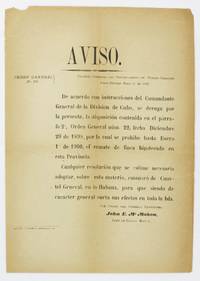
1899rif. 5378Puerto-Principe Cuba: Imp. el Progreso-Soledad January 11 1899. Good. Broadside 11.75 x 8.25 inches. Old folds minor chip at top left corner uniformly tanned and somewhat tender. An unrecorded general order issued in Spanish by the American "Jefe de Estado Mayor" Chief of Staff John E. McMahon during the military occupation of Cuba in the Spanish-American War. The order stipulates that a paragraph in a previous order prohibiting the auction of mortgaged property in the province of Puerto-Principe until January 1 1900 is hereby repealed and any further instructions on this matter will come from the Army's General Headquarters in Havana. McMahon issued several general orders during the American Army's occupation of Cuba and all appear to be rare. An interesting artifact from America's expansionist period with no other copies in OCLC auction history or the trade. Imp. el Progreso-Soledad, January 11 unknown books
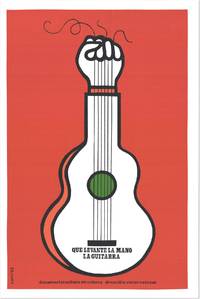
1983rif. 83069Havana: S.i. 1983. Original illustrated poster with text and pictorial elements silkscreened in four colors on white stock measuring 51cm x 76.25cm 20 1/8" x 30". Mild handling to extremities ele a bright Fine copy unbacked. Striking poster designed by Concepción Robinson Mendoza aka. "Coni" for Victor Cassaus's 1983 documentary Que Levante la Mano la Guitarra centered around Cuban musician and folk singer Silvio Rodríguez Domínguez. 83069. S.i. unknown
1983rif. 83069Havana: S.i. 1983. Original illustrated poster with text and pictorial elements silkscreened in four colors on white stock measuring 51cm x 76.25cm 20 1/8" x 30". Mild handling to extremities ele a bright Fine copy unbacked. Striking poster designed by Concepción Robinson Mendoza aka. "Coni" for Victor Cassaus's 1983 documentary Que Levante la Mano la Guitarra centered around Cuban musician and folk singer Silvio Rodríguez Domínguez. 83069. S.i. unknown books
1887rif. 64748Barcelona Spain: Campania Trasatlantica Espanola S.A. C.T.E. 1887. 8vo. 72 pp. With 2 large double-page colour maps 5 large folding engraved colour deck plans for CTE ocean liners. Red cloth-backed colour chromolithograph boards cover art of CTE liner in port at Gibraltar CTE Barcelona insignia on back cover minor scuffing edgewear minor soiling front cover slightly shaken 2 deckplans w/ very minor closed tears still a VG- copy. First edition of this very rare transatlantic guidebook timetable and deck plans for the Campania Trasatlantica Espanola S.A. Barcelona CTE ocean liner service between Spain Cuba Mexico New York & Colombia. Ports of call after New York included Boston Philadelphia Baltimore Georgetown Charleston Savannah and New Orleans with stops in various ports in Cuba Puerto Rico Jamaica Veracruz Mexico as well as several in Colombia and the Guiana’s. Deck plans engraved by Hermenagilda Miralles Bailan in Barceolna include those for the 8600 ton Reina Ma Cristina 9850 ton Buenos Aires 5450 ton Veracruz 6720 ton Ciudad de Santander and finally the 9700 ton Alfonso XII. Founded originally in 1850 by Spanish businessman and slave trader Don Antonio L. Lopez in 1850 to feed African-American slaves into both Havana as well as Mobile AL & New Orleans LA prior to the Civil War and headquarters was established in Barcelona after the marriage of Lopez to Luisa Bru Lassus. After 1883 Don Claudio B. Lopez took charge of the company and by 1887 had reached over 30 steamships and ocean liners many of which were used by the Spanish Navy following the outbreak of the Spanish-American War. Campania Trasatlantica [Espanola S.A.] (C.T.E.), hardcover
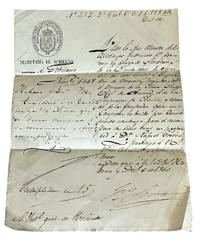
1860rif. 234291860. Spanish colonial administration in Havana used port health regulation as a mechanism of commercial and maritime control with the Captaincy General directing military customs and sanitary officials through centralized orders. This December 6 1860 manuscript concerns the "Junta local de Sanidad" "víveres averiados" and Dr. Rafael Cortés placing damaged provisions public health authority and port enforcement within the same bureaucratic chain. The phrase "usando de las facultades que me competen" invokes the vested powers of the colonial government confirming that the matter was handled through Spanish imperial authority rather than local civic discretion. Gobierno y Capitanía General de la Isla de Cuba. Secretaría de Gobierno sección de Gobierno. Manuscript order. Havana Cuba: December 6 1860. Single folded manuscript document with printed colonial seal and heading docketed "Habana y Dic. 6 de 1860" and addressed to maritime or port authorities. The text instructs compliance with a petition or order involving the local Board of Health damaged provisions or foodstuffs and Dr. Rafael Cortés with official endorsements and large administrative signatures below. The verso bears docketing and filing marks consistent with bureaucratic circulation. The document belongs directly to Spanish colonial governance in Cuba where the Governor and Captain General exercised civil military and administrative power over the island until the end of Spanish rule in 1898. Its contents connect colonial rule to the management of ports food safety and public health all crucial areas in Havana's nineteenth-century Atlantic economy. Folded as issued with toning scattered foxing edge wear and original folds; seal heading date and principal manuscript text remain legible. Overall good condition. unknown
1860rif. 234291860. Spanish colonial administration in Havana used port health regulation as a mechanism of commercial and maritime control with the Captaincy General directing military customs and sanitary officials through centralized orders. This December 6 1860 manuscript concerns the "Junta local de Sanidad" "víveres averiados" and Dr. Rafael Cortés placing damaged provisions public health authority and port enforcement within the same bureaucratic chain. The phrase "usando de las facultades que me competen" invokes the vested powers of the colonial government confirming that the matter was handled through Spanish imperial authority rather than local civic discretion. Gobierno y Capitanía General de la Isla de Cuba. Secretaría de Gobierno sección de Gobierno. Manuscript order. Havana Cuba: December 6 1860. Single folded manuscript document with printed colonial seal and heading docketed "Habana y Dic. 6 de 1860" and addressed to maritime or port authorities. The text instructs compliance with a petition or order involving the local Board of Health damaged provisions or foodstuffs and Dr. Rafael Cortés with official endorsements and large administrative signatures below. The verso bears docketing and filing marks consistent with bureaucratic circulation. The document belongs directly to Spanish colonial governance in Cuba where the Governor and Captain General exercised civil military and administrative power over the island until the end of Spanish rule in 1898. Its contents connect colonial rule to the management of ports food safety and public health all crucial areas in Havana's nineteenth-century Atlantic economy. Folded as issued with toning scattered foxing edge wear and original folds; seal heading date and principal manuscript text remain legible. Overall good condition. unknown books
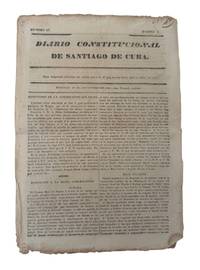
1836rif. 231491836. Diario Constitucional de Santiago de Cuba No. 57 November 1836 just months after the restoration of Spain's liberal Constitution of 1812. This newspaper records the transmission of Spanish constitutional government into eastern Cuba in late 1836 through decrees ministerial correspondence and public political dispute printed for circulation in Santiago de Cuba. Issued weeks after the political upheavals that restored constitutional rule in Spain this number shows how the language of the regency government the suppression and reorganization of state bodies and local declarations of loyalty to Isabel II reached colonial readers through the newspaper press. In a Cuban setting where metropolitan policy was filtered through governors ministries and municipal elites an issue such as this preserves the working connection between imperial administration and provincial print. Diario Constitucional de Santiago de Cuba. No. 57. Santiago de Cuba 27 November 1836. 4 pages. Folio newspaper issue. The masthead reads "DIARIO CONSTITUCIONAL / DE SANTIAGO DE CUBA" with the date line "DOMINGO 27 DE NOVIEMBRE DE 1836." Page 1 opens with "MINISTERIO DE LA GOBERNACION DEL REINO" followed by a circular and a substantial "EXPOSICION A LA REINA GOBERNADORA" leading into a "REAL DECRETO" concerning the suppression of the Consejo Real de España e Indias. Interior pages continue the decree and carry translatedly legible sections including "MISCELANEA" notices on "Las islas turcas libres" and "Noticias sobre Tejas" and a long exchange under "REMITIDOS" dated "Cuba 25 de Noviembre de 1836" addressing militia service volunteers of Isabel II and the political insult attributed to an earlier subscriber. The issue survives as a complete four page folio with dense double column text throughout and no wrappers as issued. Printed in Santiago the issue shows constitutional and monarchist language being adapted for a colonial audience that was expected to follow ministry decrees military loyalty and debates over public honor in the same sheet. Folded as issued with minor edge chipping small losses at corners and margins some toning and closed tears and pinholes; complete and legible. Overall good condition. The juxtaposition of metropolitan government text Caribbean and Atlantic news and the local controversy printed in "Remitidos" gives the number a documentary range broader than a routine official gazette placing state policy beside the contested language of provincial political life. unknown
1836rif. 231491836. Diario Constitucional de Santiago de Cuba No. 57 November 1836 just months after the restoration of Spain's liberal Constitution of 1812. This newspaper records the transmission of Spanish constitutional government into eastern Cuba in late 1836 through decrees ministerial correspondence and public political dispute printed for circulation in Santiago de Cuba. Issued weeks after the political upheavals that restored constitutional rule in Spain this number shows how the language of the regency government the suppression and reorganization of state bodies and local declarations of loyalty to Isabel II reached colonial readers through the newspaper press. In a Cuban setting where metropolitan policy was filtered through governors ministries and municipal elites an issue such as this preserves the working connection between imperial administration and provincial print. Diario Constitucional de Santiago de Cuba. No. 57. Santiago de Cuba 27 November 1836. 4 pages. Folio newspaper issue. The masthead reads "DIARIO CONSTITUCIONAL / DE SANTIAGO DE CUBA" with the date line "DOMINGO 27 DE NOVIEMBRE DE 1836." Page 1 opens with "MINISTERIO DE LA GOBERNACION DEL REINO" followed by a circular and a substantial "EXPOSICION A LA REINA GOBERNADORA" leading into a "REAL DECRETO" concerning the suppression of the Consejo Real de España e Indias. Interior pages continue the decree and carry translatedly legible sections including "MISCELANEA" notices on "Las islas turcas libres" and "Noticias sobre Tejas" and a long exchange under "REMITIDOS" dated "Cuba 25 de Noviembre de 1836" addressing militia service volunteers of Isabel II and the political insult attributed to an earlier subscriber. The issue survives as a complete four page folio with dense double column text throughout and no wrappers as issued. Printed in Santiago the issue shows constitutional and monarchist language being adapted for a colonial audience that was expected to follow ministry decrees military loyalty and debates over public honor in the same sheet. Folded as issued with minor edge chipping small losses at corners and margins some toning and closed tears and pinholes; complete and legible. Overall good condition. The juxtaposition of metropolitan government text Caribbean and Atlantic news and the local controversy printed in "Remitidos" gives the number a documentary range broader than a routine official gazette placing state policy beside the contested language of provincial political life. unknown books
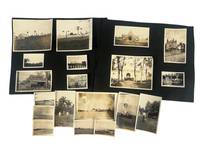
1915rif. 224781915. Polk George Washington Jr. Havana and rural Cuba photo archive 1915 documents Cuba through the viewpoint of an American military traveler during the Platt Amendment era when U.S. power shaped Cuban sovereignty port security naval access and commercial movement. The photographs record ships in Havana Harbor coastal fortifications rural dwellings Cuban farmers agricultural landscapes and colonial plazas providing insight into how U.S. military personnel visually encountered Cuba just before American entry into World War I. The Platt Amendment gave the United States broad authority to intervene in Cuban affairs and required Cuba to lease land for naval stations remaining central to U.S.-Cuba relations until its repeal in 1934; this archive therefore places vernacular travel photography within a larger framework of military oversight and commercial access. Polk George Washington Jr. Havana Cuba vernacular photo collection. Havana Cuba: unpublished December 1915. Twenty-eight silver gelatin photographs pasted to album pages with some loose or partially detached ranging from approximately 2 x 2½ inches to 4½ x 3½ inches many with handwritten ink annotations dated December 22 to 29 1915. The images include vessels anchored in Havana Harbor harbor views from on board ship Morro Castle and other coastal fortification views colonial civic plazas local laborers and civilians thatched rural huts or bohíos sugarcane fields and agricultural scenes captioned "Orange Trees & Coconut Palms Near Havana." One photograph is captioned "Cuban Farmer & Son Near Havana Dec 22 1915" giving the archive direct documentary value for rural family life and American observation of Cuban agricultural communities. Other captions identify boats as "U.S.C. 5th Protectors off Havana" and refer to the United Fruit Company steamer Abangarez on the Havana-Colon route; the Abangarez was a United Fruit Company passenger and cargo vessel completed in 1909 and later brought under United States registry during World War I. The photographs combine military commercial and rural subjects in a compact record of U.S.-Cuban contact. Polk's annotations and the repeated Potchernick-Birdsong Co. Kodak Place San Antonio Texas stamps on versos indicate that the images were developed in the United States after the trip or sent home for processing preserving the path by which overseas military travel became a personal photographic record. Polk's later military service is supported by burial and veterans' records identifying George Washington Polk Jr. as born May 13 1889 died July 27 1976 and buried at Fort Rosecrans National Cemetery; the supplied description identifies him as later a Colonel in the U.S. Army Air Corps and instructor in the early U.S. Air Force. Most photographs lightly pasted along one edge to scrapbook leaves with some detached or partially affixed; a few corner creases otherwise sharp images with strong contrast good to very good overall. Focused 1915 Cuba archive linking Havana Harbor rural Cuban labor vernacular architecture United Fruit maritime movement and American military observation during the U.S. protectorate period. unknown
1915rif. 224781915. Polk George Washington Jr. Havana and rural Cuba photo archive 1915 documents Cuba through the viewpoint of an American military traveler during the Platt Amendment era when U.S. power shaped Cuban sovereignty port security naval access and commercial movement. The photographs record ships in Havana Harbor coastal fortifications rural dwellings Cuban farmers agricultural landscapes and colonial plazas providing insight into how U.S. military personnel visually encountered Cuba just before American entry into World War I. The Platt Amendment gave the United States broad authority to intervene in Cuban affairs and required Cuba to lease land for naval stations remaining central to U.S.-Cuba relations until its repeal in 1934; this archive therefore places vernacular travel photography within a larger framework of military oversight and commercial access. Polk George Washington Jr. Havana Cuba vernacular photo collection. Havana Cuba: unpublished December 1915. Twenty-eight silver gelatin photographs pasted to album pages with some loose or partially detached ranging from approximately 2 x 2½ inches to 4½ x 3½ inches many with handwritten ink annotations dated December 22 to 29 1915. The images include vessels anchored in Havana Harbor harbor views from on board ship Morro Castle and other coastal fortification views colonial civic plazas local laborers and civilians thatched rural huts or bohíos sugarcane fields and agricultural scenes captioned "Orange Trees & Coconut Palms Near Havana." One photograph is captioned "Cuban Farmer & Son Near Havana Dec 22 1915" giving the archive direct documentary value for rural family life and American observation of Cuban agricultural communities. Other captions identify boats as "U.S.C. 5th Protectors off Havana" and refer to the United Fruit Company steamer Abangarez on the Havana-Colon route; the Abangarez was a United Fruit Company passenger and cargo vessel completed in 1909 and later brought under United States registry during World War I. The photographs combine military commercial and rural subjects in a compact record of U.S.-Cuban contact. Polk's annotations and the repeated Potchernick-Birdsong Co. Kodak Place San Antonio Texas stamps on versos indicate that the images were developed in the United States after the trip or sent home for processing preserving the path by which overseas military travel became a personal photographic record. Polk's later military service is supported by burial and veterans' records identifying George Washington Polk Jr. as born May 13 1889 died July 27 1976 and buried at Fort Rosecrans National Cemetery; the supplied description identifies him as later a Colonel in the U.S. Army Air Corps and instructor in the early U.S. Air Force. Most photographs lightly pasted along one edge to scrapbook leaves with some detached or partially affixed; a few corner creases otherwise sharp images with strong contrast good to very good overall. Focused 1915 Cuba archive linking Havana Harbor rural Cuban labor vernacular architecture United Fruit maritime movement and American military observation during the U.S. protectorate period. unknown books
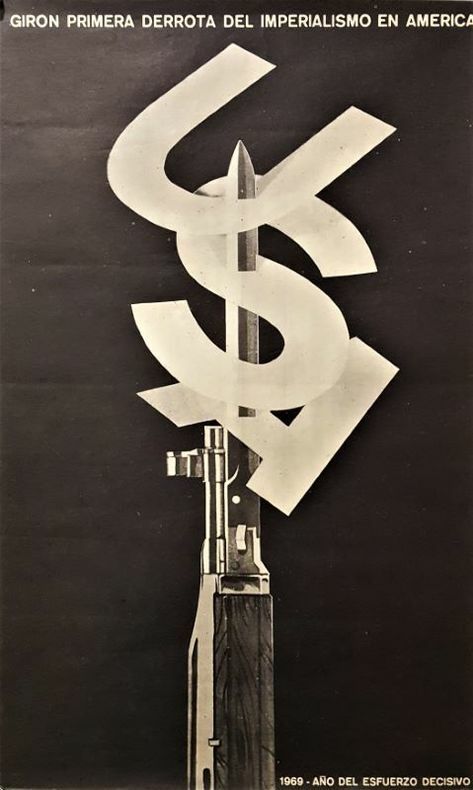
rif. 2092Sans mention d'éditeur. 1969. Impression offset.Dim : 52,5 x 32,5 cm
rif. 2092Sans mention d'éditeur. 1969. Impression offset.Dim : 52,5 x 32,5 cm
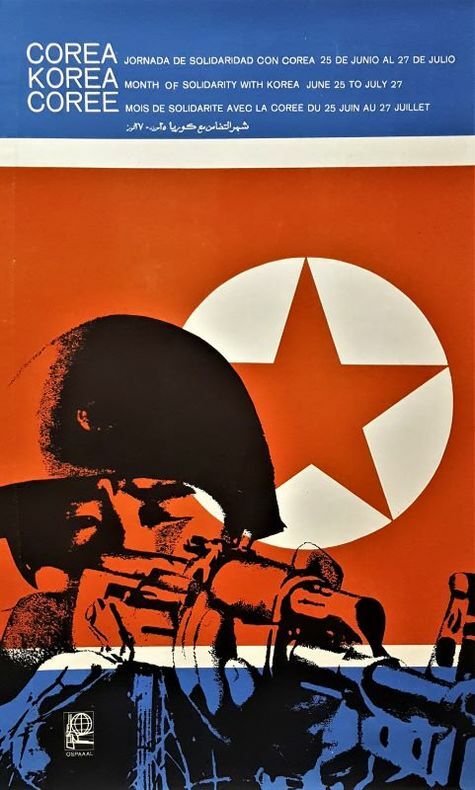
rif. 2090Edit. OSPAAAL. 1968. Impression offset. Dim : 53 x 33 cm.
rif. 2090Edit. OSPAAAL. 1968. Impression offset. Dim : 53 x 33 cm.
1963rif. boz_003353Fidel Castro Lot de 13 Photos d'époque officielles - VIIème Congrès de l'Union Internationale des Architectes à La Havane, 1963, avec comme problématique "L'architecture dans les pays en voie de développement", Tampon du "Ministère des relations extérieures" et du Ministère de la construction Dimensions : Grandes photos : 20,2 x 25,5 cm Petites photos : 12,4 x 19,8 cm État : bon état, certaines ont des traces de frottements.
1844rif. PHO-1491Paris, Arthus Bertrand, 1844, in-8, 2 volumes, LXXI-771-[2] pp. en numérotation continue, 20 diagrammes hors texte, demi-chagrin rouge, dos à faux nerfs, monogramme "J.M.C." doré en pied des dos, Rousseurs, quelques auréoles, l'une assez large en tête du second tome.
1860rif. 12907Paris Librairie Hachette [Imp. de Ch. Lahure et Cie] 1860 in-12 br., couv. jaune impr., non rogné, couv. lég. us. avec petits manques, qq. pâles rouss
1854rif. AMA-124Librairie de l’Association pour la propagation et la Publication des Bons livres, s.d. [1854-1855]. 3 volumes in 12, demi-chagrin noir, dos à nerfs orné de petits fleurons et de filets dorés, têtes dorées. (2)ff.-VIII-408 pp., (2)ff.-444 pp., (2)ff.-433 pp.
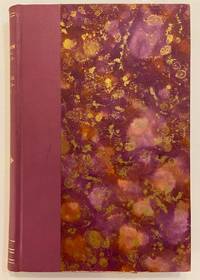
1895rif. 87496Havana: Castro Fernandez 1895. First. hardcover. near fine. Folding table. 414pp. 1/2 modern lavender buckram marbled boards original wrappers bound in. Habana: Castro Fernandez 1895. First Edition. Near Fine. Laws regulating the telephone and telegraph industries. Castro, Fernandez unknown
1895rif. 87496Havana: Castro Fernandez 1895. First. hardcover. near fine. Folding table. 414pp. 1/2 modern lavender buckram marbled boards original wrappers bound in. Habana: Castro Fernandez 1895. First Edition. Near Fine. Laws regulating the telephone and telegraph industries. Castro, Fernandez unknown books
1932rif. 50120Santiago de Cuba 1932. A unique album of 19 leaves of heavy black stock 7 x 5 1/2 inches with 67 mounted b&w silver photographs of varying sizes 1 3/4 x 2 1/2 inches - 3 1/2 x 5 7/8 inches all captioned in white ink. The album is titled and decorated in gilt on the upper cover "PHOTOGRAPHS: SOUVENIR OF SANTIAGO CUBA and tied with a cloth lace. Very good. An earthquake of 6.7 magnitude struck the city of Santiago de Cuba at dawn on 3 February 1932. Over half the buildings were destroyed or damaged and reports of the deaths range to 1500. These photographs show the destruction to the commercial and residential buildings and the Cathedral and the tents set up as temporary shelters. A few of the photographs were made by local commercial photographers just after the quake and the remainder within days. All captions in Spanish. unknown
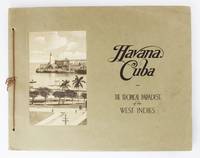
1925rif. 6379Havana: American Photo Studios 1925. Very good plus. 48pp. each with 6x8-inch photographic prints directly mounted. Original card wrappers photo-illustrated and string-tied. Minor wear and dust soiling. Images strong and clear. An attractive and uncommon 1920s travel brochure distributed by ocean liners sailing to and from Havana. This album of photographic prints opens with shots of Ward Line and P & O steamships entering and leaving the city harbor. The images by American Photo Studios images encompass views of Havana's Carnival Hotel Plaza Colon Park the old city walls the Santa Clara Convent and the monument to the USS Maine on Malecon Drive. Also included are views of freshly built suburbs stately homes on "Fifth Avenue" the Havana Country Club Jockey Club and even a view of the Hershey Company's sugar mill. An engaging album that shows Havana at the beginning of its run as a Caribbean destination for American high society in the first half of the 20th century. American Photo Studios unknown
1925rif. 6379Havana: American Photo Studios 1925. Very good plus. 48pp. each with 6x8-inch photographic prints directly mounted. Original card wrappers photo-illustrated and string-tied. Minor wear and dust soiling. Images strong and clear. An attractive and uncommon 1920s travel brochure distributed by ocean liners sailing to and from Havana. This album of photographic prints opens with shots of Ward Line and P & O steamships entering and leaving the city harbor. The images by American Photo Studios images encompass views of Havana's Carnival Hotel Plaza Colon Park the old city walls the Santa Clara Convent and the monument to the USS Maine on Malecon Drive. Also included are views of freshly built suburbs stately homes on "Fifth Avenue" the Havana Country Club Jockey Club and even a view of the Hershey Company's sugar mill. An engaging album that shows Havana at the beginning of its run as a Caribbean destination for American high society in the first half of the 20th century. American Photo Studios unknown books
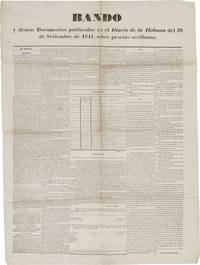
1841rif. 15527Havana. Sept. 29 1841. A proclamation by the Spanish military government in Cuba concerning legal tender and its circulation and providing a series of regulations for commerce and exchange. Broadside 23 x 16 1/2 inches. Splitting on middle fold else very good. unknown
1841rif. 15527Havana. Sept. 29 1841. A proclamation by the Spanish military government in Cuba concerning legal tender and its circulation and providing a series of regulations for commerce and exchange. Broadside 23 x 16 1/2 inches. Splitting on middle fold else very good. unknown books