CubaABAA
2.538 Ergebnisse
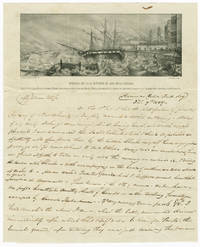
1847Best.-Nr. WRCAM56260Havana Cuba and onboard ship to New Orleans 1847. 11pp. in black or blue ink on two different Cuban pictorial letter sheets plus a folded sheet of plain paper the latter also used as the enclosure for the entire letter addressed on verso of last page of enclosure. Minor soiling old folds with a few short fold separations and a longer separation in last folded sheet. Last sheet with small abrasion from removed wax seal most of which remains. Overall good plus condition. A lengthy and interesting letter from a Pennsylvania businessman named M.L. Dawson to his "dear wife" back in Philadelphia written over the course of a few weeks during his time in Havana and onboard a ship traveling from Cuba to New Orleans in the spring of 1847. Being written over the course of several entries the letter also acts as a kind of brief diary of Dawson's time in Cuba and the Gulf of Mexico and contains much information on the people and places he saw in and around Havana and much on the ship's activities on the way to Louisiana. Two- thirds of the letter is written on two separate Cuban letter sheets that are themselves rare and desirable printed ephemeral items from mid-19th century Cuba. The eleven-page letter covers Dawson's stay in Havana and his voyage to New Orleans. He writes that he had previously arrived in Havana from Philadelphia. His letter begins on March 7 and Dawson details trips on horseback to the Cuban countryside which he finds beautiful. He comments on odd Cuban funerary practices Cuban agricultural products seeing the home where Santa Anna spent his exile and gives firsthand observations on the effects of slavery. He witnesses a scene in Havana where slaves are chained and forced to make repairs while being overseen by men with whips and muskets. Dawson comments that despite the beauty of the countryside "the evidence of Slavery is every where apparent." Also apparent are "the ravages of the awful storm of the 10th month last" a reference to the devastating October 11 1846 hurricane the effect of which is depicted in each of the letter sheets here. Dawson also reports on being invited to breakfast by a Cuban nobleman but was so taken aback by the food and the experience that he vows never to repeat the experience. After departing Havana for New Orleans on May 9 on the Brig P. Soule Dawson reports on various shipboard activities a disagreeable cursing captain slow progress boredom and seasickness. He comments on claret as the typical drink for breakfast. The letter ends on April 1 when Dawson's ship anchors in New Orleans Road. He closes with a promise to write again soon after he lands in New Orleans and sends kisses and love to his children and relatives. The Cuban letter sheets Dawson employs for more than two-thirds of his letter are interesting and attractive printed items in their own right. The first titled HURACAN DEL 11 DE OCTUBRE DE 1846 EN LA HABANA shows a lithographed scene of various ships in an angry sea being tossed against a breakwater in Havana harbor during the October 11 1846 hurricane. One passenger is being rescued with a breeches buoy while other ships flounder in the distance. The second letter sheet is titled TEATRO PRINCIPAL DE LA HABANA. The scene at the head of this sheet shows further destruction of the October 11 hurricane centered on the damaged ruins of the Teatro Principal Main Theater near the harbor. Two men in top hats survey the damage while an African-American man stands at left center holding long boards. Havana harbor is visible in the background showing two paddlewheel steamers and other ships damaged or sunken in the harbor. Mordecai L. Dawson was the proprietor of M.L. Dawson & Co. a brewery in Philadelphia. Here Dawson addresses the letter to his company noting the letter is specifically intended "for E Dawson" his wife. The Dawson brewery opened in 1820 at 79 Chestnut Street then moved to the corner of 10th and Filbert Streets in 1830 after the company purchased the old Farmers' Brewery in 1829. Dawson apparently closed his brewery in 1849 not long after penning this letter home. Though he does not state it explicitly in his letter Dawson may have been traveling to Cuba to establish an import business. Philadelphia was a pipeline for numerous imports into Cuba in the mid-19th century including beer. An interesting record of one man's sojourn to Cuba in the 1840s with notable observations on slavery and the Cuban situation in the wake of the October 11 1846 hurricane written mostly on two attractive and rare Cuban letter sheets that also memorialize the hurricane. hardcover books
1875Best.-Nr. WRCAM56107Cuba 1875. Twenty-two partially-printed forms on folio sheets completed in manuscript in a variety of hands. Most printed and accomplished on the recto only though a few with print or manuscript on the verso as well. Some with old folds chipping and small tears to edges of most documents one document with the upper right corner cut away. Occasional foxing tanning and ink offsetting and bleedthrough. Several documents with additional manuscript annotations. About very good overall. An important collection of contracts documenting Chinese indentured servitude in Cuba two signed in Chinese. All but one are from various municipalities in the Matanzas Province usually attested to with an ink or blind stamp from a local official one with paper tax stamps affixed. Each contract stipulates the term of service for the "colono" - one or two years along with wages to be paid food and clothing issued duties and hours to be worked and so forth. The laborers are identified in the contracts by their assigned Spanish names with no surnames though some forms have a section for their "nombre nacional" and place of origin as well. There are provisions for what happens if the servant cannot complete their term of service due to illness pending agreement with the "patrono" and a section on options for contract renewal. The latest of these contracts dated May 24 1875 bears the laborer's signature in Chinese. He is described as "al asiatico José" aged 30 of Macao and is contracted to work for Ignacio de Cardenas for six years. Another contract from Bejucal in the Mayabeque Province is also signed in Chinese this one by "Antonio" "natural del pueblo de Leo Chao en China." This is also the only document in the collection with a signature area labeled: "Firma del interpréte ó de dos personas de confianza del colono ó dos testigos." Formal slavery continued in Cuba until it was abolished by Spanish royal decree in 1886; it was accompanied however by a significant population working in indentured servitude. As sugar exports rose in the mid to late 18th century there was a dramatic increase in the need for enslaved workers. "One of the explicit goals of Spanish reformist policy in the last third of the eighteenth century became the need to emulate other European nations' success with slave plantation development in the Caribbean. Partly because of this slave-based coffee and sugar estates sprang up in increasing numbers in portions of Cuba especially around Havana Santo Domingo and Puerto Rico. An expanded slave trade was a necessary condition of such growth. In Cuba alone approximately seventy thousand slaves were imported between 1763 and 1792 and another three hundred twenty-five thousand were brought in between 1790 and 1820.For the entire nineteenth century imports to Cuba amounted to about seven hundred thousand persons." - Drescher. The abolition of slavery in the British West Indies however meant that from the 1830s onward a new source of labor was necessary. It is this gap that indentured servitude filled. Unlike the earlier waves of European immigrants who travelled to the New World as indentured servants Asia was now the primary source. Between 1848 and 1874 125000 Chinese indentured servants arrived in Cuba alone - a figure outstripped only by the number who indentured themselves in California. "Some contemporaries and later historians.have condemned the servitude of the Asians as a thinly disguised revival of slavery. These critics have pointed to a variety of abuses to which the Asians were subjected both legally - with severe laws governing absenteeism vagrancy and insufficient work - and illegally in the form of harassment by vicious masters. Yet other observers have defended the system as a boon to the Asian workers. Voluntary reindenture at the end of their terms was common among the migrants suggesting that many Asians judged the system to be beneficial to them" - Drescher. Voluntary or not a large number of Chinese migrants were laboring in Cuba in the 19th century; for most of them these contracts are the only existing records of their work if not of their lives. Seymour Drescher & Stanley L. Engerman editors A HISTORICAL GUIDE TO WORLD SLAVERY New York 1998 pp.140-42 239-42. hardcover books
1910Best.-Nr. WRCAM55308Havana: American Photo Co. 1910. Panoramic photograph image 7 1/4 x 47 1/4 inches on sheet 10 x 49 inches. Printed caption title below image. Publisher and date written in negative at lower right corner; in the lower left corner is written: "#5 2d Regiment U.S. Atlantic Fleet Deer Point Camp Guantanamo Bay Feb. 13 1910. 'Minnesota' 'New Hampshire' 'Mississippi' 'Idaho.'" "Printed in Germany" printed below image at lower left. Some light soiling minor fading to right side of photo some rumpling from previous rolling. Very good. An impressive view of sailors and marines from the United States' Atlantic Fleet assembled on the parade grounds of Deer Point Camp Guantanamo Bay. Well over five hundred officers seamen and marines are in formation with encampments on both sides of the grounds. In the background looking out into the harbor nineteen ships are visible in the water including the four listed on the photo: MINNESOTA NEW HAMPSHIRE MISSISSIPPI and IDAHO. One camp building with a wide veranda is behind and to the left of the sailors. U.S. forces with their Cuban allies first occupied Guantanamo Bay in 1898 during the Spanish American War creating a forward- operating base in their effort to wrest Spanish control of the island. In 1903 the U.S. leased forty-five square miles of land and water at Guantanamo Bay from the newly- independent Cuban government and built the Deer Point Camp to support naval operations in the Caribbean. The American facilities at Guantanamo Bay are in use to this day. The American Photo Company advertised itself as "the best equipped commercial photographers in Cuba." It established a commercial network in Havana that distributed images of Cuba on a worldwide scale. This photo is rare. We found no records of it at auction and no copies in OCLC however the Naval History and Heritage Command lists a copy in their collections. "US Naval Station Guantanamo Bay Cuba" UA 571.45 copy of this image Washington Navy Yard D.C.: Naval History and Heritage Command Naval Heritage Foundation accessed online. American Photo Co. unknown books
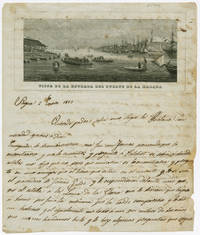
1853Best.-Nr. WRCAM54601Havana 1853. 4pp. on a bifolium. Previously folded. Some chipping at fore- edge slightly affecting text. Light dampstaining and tanning. About very good. An attractive Cuban pictorial letter sheet with a neatly executed third-page lithograph illustration of the port of Havana. The image depicts several small boats rowing barrels to and from a loading dock. In another small boat a plantation owner or some form of dignitary is being rowed to shore by a crew of men. On the right side of the image several larger ships lie at anchor and in the background on the shore is the fort guarding the mouth of the harbor the Morro Castle. The sheet is filled out by a man named Juan Fabre writing to his parents on Jan. 2 1853 advising them of his safe arrival in Havana. He talks about meeting up with a relative that he had not seen in two years and working at a shoe shop with another relative who adds a brief post script on the verso of the second leaf. Pictorial letter sheets of Cuba are quite rare on the market. unknown books
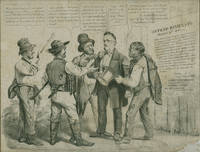
1856Best.-Nr. WRCAM53452New York: Nathaniel Currier 1856. Broadside 10 x 13 inches. Foxed bottom right corner chipped. Lower margin trimmed costing the title. Good only. Framed under glass. A scarce political cartoon regarding the controversial Ostend Manifesto the initially- secret attempt by the United States to purchase Spanish-controlled Cuba. Earlier President Franklin Pierce had instructed Pierre Soulé upon his appointment as minister to Spain in April 1853 to negotiate to buy Cuba. Three American foreign ministers serving in Europe - James Buchanan John Y. Mason and Soulé - met secretly at Ostend Belgium in late 1854 to draft a plan to either buy Cuba from Spain or force Spain to give up Cuba by inciting a Cuban revolution. The plan met with overwhelming opposition once it was made public in America. In the present political cartoon Buchanan is attacked for his role in the Ostend controversy. He is surrounded by four armed ruffians seeking to rob him of his coat hat watch and money a particularly sharp turn- about on the American minister to Great Britain. The muggers' demands include quotations from the manifesto which is pasted to the fence at right. Buchanan calls out: "Why! Why! This is rank robbery! Help! Help! All honest men!" The fallout from the Ostend controversy was widespread. President Pierce's Democratic Party split asunder after he refused to continue any discussions of the plan or any other expansionist ideas; Soulé understandably resigned; and the international community saw it as a threat to Spanish sovereignty in the region. Oddly enough James Buchanan was not too hurt by the controversy; he was easily elected president in 1856 and still harbored hope for Cuban annexation. He was smart enough however to table the Cuba question for the foreseeable future after meeting with both popular opposition and increasingly bitter sectional conflict the latter only spurred on by incidents such as the Ostend controversy. CURRIER & IVES: CATALOGUE RAISONNÉ 5021. NEVINS & WEITENKAMPF p.72-73. Nathaniel Currier unknown books
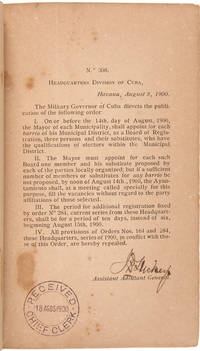
1900Best.-Nr. WRCAM51843Havana 1900. Approximately 520; 600pp. including several folding charts. Over 200 separate imprints. Original half leather and brown cloth boards spine gilt. Corners and edges worn spine rubbed boards scuffed. Initial leaves of first volume torn away but present. Several other leaves chipped and torn throughout. With many official signatures and docketing stamps. Good. Two volumes of orders promulgated in 1889 and 1900 by the American military government of Cuba after the cessation of hostilities in the Spanish-American War. Under the terms of the Teller Amendment to the Congressional Joint Resolution for war with Spain in 1898 the United States denied the intention of using the conflict as a pretext for the annexation of Cuba and promised to leave the island following the termination of the war. The American military therefore oversaw the creation of the new independent Cuban government before departing in 1902. The documents contained in this collection consist of over two hundred orders in both English and Spanish from the Headquarters Division of Cuba that helped to shape the emerging civilian government. They include instructions for the running of elections the organization of the courts and school system the appointments for various government offices provisions for tax regulations and many other critical issues facing Cuba at its independence. The directives cover two periods from January to July in 1899 and from July to September in 1901. Many of the orders are signed in manuscript by the assistants to the military governor for the island Gen. Leonard Wood including assistant adjutant generals J.B. Hickey and L.W.V. Kennon and Brig. Gen. Chief of Staff Adna R. Chaffee. An interesting documentation of the first American occupation of Cuba. hardcover books
1832Best.-Nr. WRCAM51901Havana 1832. 18pp. Folio. Loose leaves. Heavy worming mostly marginal but somewhat affecting text in places. Light dampstaining and foxing. Good. An extensive list of fugitives from Cuban courts that covers the period from 1822 to 1832. Each section comprises a catalogue of men tried before a specific court and individual entries provide names brief descriptions mostly of skin color birthplaces likely places of residence and crimes committed together with the sentences handed down. Many men are condemned to the gallows or are facing long sentences in African or other overseas prison camps. This list was also printed as a part of the Oct. 9 1832 issue of DIARIO DE LA HABANA but a separate printing as in the present example is not found in OCLC or the relevant bibliographies. unknown books
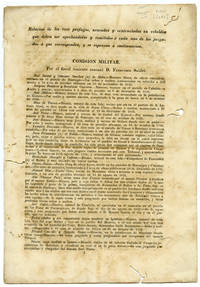
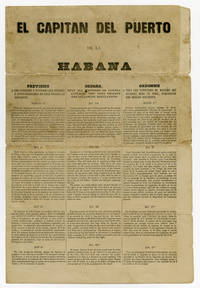
1850Best.-Nr. WRCAM51706Havana 1850. 4pp. on a bifolium 15 3/4 x 10 1/2 inches. Printed in three columns. Previously folded with some short separations along fold lines and a closed tear to top edge. Somewhat tanned with some dust soiling in upper portion of first leaf recto. Good plus. Bifolium printing of twenty-four directives intended to govern the operation of vessels in the port of Havana. They include provisions for the arrival and departure of ships their docking and mooring the storage of gunpowder while in port fire prevention and penalties for carrying firearms or other deadly weapons ashore. The document is printed in three columns which provide versions of the regulations in Spanish English and French. Daniel Warren mentioned here as the port officer in charge of preventing desertions and illegal transfers of men from ship to ship is also named as Havana shipping master in an 1858 letter from the American Consul Thomas Savage to the Governor of Havana included in a contemporary United States Senate report on foreign trade. "As early as 1828 Irish migrant Daniel Warren established 'a deposit for foreign sailors and artisans' in Havana providing an initial place for them to stay while looking for work"- Curry-Machado. A very rare piece of Cuban maritime ephemera with OCLC noting only one copy at the Harvard Law Library. OCLC 81408661. Curry-Machado CUBAN SUGAR INDUSTRY p.74. unknown books
1834Best.-Nr. WRCAM51022Havana 1834. 2pp. plus blank integral leaf. Bifolium. Minor edgewear and toning. Offsetting. Good. Manuscript document written by John Morland acting consul in Cuba relaying the details of the voyage of the ship "Hunter" travelling from New York to New Orleans. The ship ran into trouble partway through the voyage with seven passengers saved from the "disastrous" situation. The letter does not detail how many if any perished. The seven passengers continued their journey on two other ships one being a Spanish vessel. unknown books
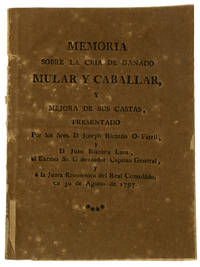
1799Best.-Nr. WRCAM51487Havana: Imprenta de la Capitanía 1799. 212pp. Dbd. Loose sheets. Heavily tanned outer leaves slightly chipped. Good. A short tract on equine husbandry with its own titlepage but published as a part of a royal decree entitled "Gracia concedida por S.M. à los habitantes de esta isla para la introduccion de caballos frisones de ambos sexôs desde las provincias del Norte de América" which approved the importation of horses to Cuba. Initially presented to government officials in 1797 the report by Joseph Ricardo O'Farril and Juan Bautista Lanz laments poor breeding practices in Cuba that have led to weaknesses in the horse stock and recommends the introduction of North American horses and different breeding methods. Until the suggestions of this work were implemented by the decree in 1798 horses were not allowed to be imported from other sources in greater numbers than they were from Spain. According to Trelles this is the first Cuban imprint to address issues related to livestock and animal husbandry. Very rare with OCLC recording only five copies. SABIN 56747. MEDINA HABANA 162. TRELLES pp.177-78. OCLC 19860506. Imprenta de la Capitanía unknown books
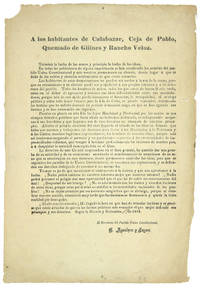
1878Best.-Nr. WRCAM38237Cuba 1878. Broadside 12 1/2 x 8 3/4 inches. Chip at upper left corner not affecting text. Small tears in all edges several repaired by tape on verso. Good. A rare and fascinating Cuban political broadside calling for an end to armed struggle but a beginning to a "struggle for ideas" at the conclusion of Cuba's "Ten Years' War" the battle for independence from Spain in 1868 to 1878. The broadside is addressed to the residents of the region around the north-central coast of Cuba some 150 miles east of Havana. The text of the broadside is signed in print by Gabriel Aguilera y Zayas Secretary of the Partido Union Constitucional PUC one of the two main political parties that developed out of the Ten Years' War. The PUC which was a conservative pro-Spanish party led by prominent Creoles sought a measure of local political autonomy while favoring continued Spanish control over Cuba. The text exhorts Cubans to partake in the ideological struggle that would succeed the armed rebellion and urges them not to fall into lethargy but to continue the battle of ideas against radicals seeking independence from Spanish colonial rule. Due to their ephemeral nature as well as the climate of the Caribbean any such Cuban broadsides are scarce. No copies of this broadside are located in OCLC. Important evidence of the political factionalism and the strength of pro-Spanish sentiment in Cuba in the late 19th century. Rare and possibly unique. unknown books
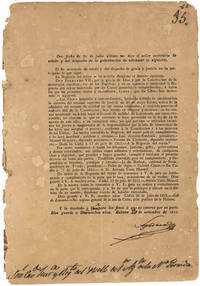
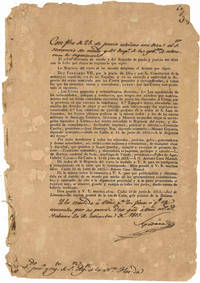
1813Best.-Nr. WRCAM46891Havana 1813. 1p. plus integral blank. Folio. Old fold lines. Moderately chipped and worn at edges. Evenly tonned. Contemporary manuscript notations. Good. A rare Havana imprint. As Spanish power in the New World was waning its grip on Cuba was threatened by domestic and foreign intruders. This decree issued by Fernando VII on June 17 1813 and printed on September 20 orders the annulment of all criminal cases. This amnesty policy extended to other areas of New Spain as well sought to placate opposition forces. It calls on all levels of government to announce and enforce the decree. It is endorsed in manuscript. unknown books
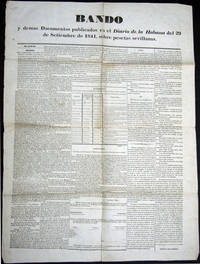
1841Best.-Nr. WRCAM15527Havana 1841. Broadside 23 x 16 1/2 inches. Splitting on middle fold else very good. A proclamation by the Spanish military government in Cuba concerning legal tender and its circulation and providing a series of regulations for commerce and exchange. unknown books
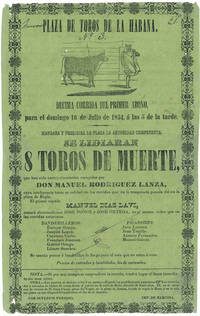
1854Best.-Nr. WRCAM46994Havana 1854. Broadside 12 1/2 x 8 inches. Printed on green paper. Old fold lines. Light wear and soiling minor separation at some folds. A few contemporary notations. Very good. Cuban broadside advertising a bullfight featuring matador Don Manuel Rodriguez Lanza and the "8 toros de muerte." The top of the sheet features a woodcut of a matador holding his cape out to a bull. The first swordsman for the fight is Manuel Diaz Lavi with two alternates listed. The names of the Banderilleros and Picadores for the fight are also noted. Bullfighting was a popular entertainment in Cuba during the Spanish colonial period though it was done away with after Cuban independence at the beginning of the 20th century. unknown books
1813Best.-Nr. WRCAM46892Havana 1813. 1p. plus integral blank. Folio. Old fold lines. Moderately chipped and worn at edges. Lightly and evenly toned. Contemporary manuscript notations. Good. A rare printed decree from Cuba at the beginning of the 19th century as Spanish power in the world was waning but Spain's grip on Cuba was still quite firm. This decree issued by the King on June 14 1813 and printed on September 20 announces new laws regarding the rights to vote and to be elected to hold government positions for professors and scholars from certain universities collegiums and seminars. The decree forbade these rights to the Knights of Justice of the Order of St. John of Jerusalem as well as members of the four military orders of Santiago Calatrava Alcantara and Montesa. It is endorsed in manuscript with the imprint and header also written in by hand. Early Caribbean imprints are rare. unknown books
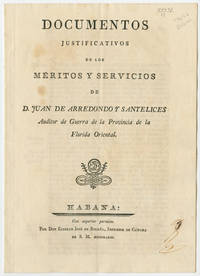
1815Best.-Nr. WRCAM49642Havana: Esteban José de Boloña 1815. 19pp. Gathered signatures stitched. Stitching mostly perished. Light fold lines minimal foxing ink marginal notations contemporary ink inscription after the text. Very good. An early Cuban imprint printed by Esteban José de Boloña the first printer in Cuba after the 1776 ban on printing. Juan de Arrondo y Santilices was an official in Spanish Florida the Auditor of War of East Florida during the early 19th century. This is a work detailing the deeds of Arrondo y Santilices likely an attempt to secure a pension. Rare with one copy located by OCLC at the John Carter Brown Library. Esteban José de Boloña unknown books
1877Best.-Nr. 2027Havana 1877. Very good. 1p. on a bifolium. Removed from a a bound volume with unobtrusive stabholes at gutter margin. Light wear at edges; light dust soiling and damp staining. Remarkable bidsheet submitted by a Cuban business in response to a newspaper advertisement for an auction of slaves for hire held in Havana during November 1877. The firm Jado Sarasúa y Compañia writes that "Enterada del anuncio publicado en la Gaceta fecha 9 del corriente para el arrendamineto en publica subasta de los esclavos existentes en el Asilo de San Jose pertenecientesa Bienes Embargados y sujentadose en un todo al pliego de Condiciones inserto en la misma Gaceta hace la siguente proposicion." Below is a list of fourteen slaves mostly women and the prices that the company is willing to offer for the slaves being rented ranging from ten to seventeen pesos per month. Signed and dated at the bottom "Habana Noviembre 14 de 1877. unknown books
1977Best.-Nr. 24673Cuba: Instituto Cubano del Arte y la Industria Cinematográficos ICAIC 1977. Poster in colors for La Ultima Cena The Last Supper 1976 Tomas Gutierrez Alea film. A77 printed in bottom left corner;. Approx. 20" x 30" size; strongly-printed screened image of candelabra color bleed-through on reverse; some edge-creasing and edge-wear; in very good condition. Poster. Not Bound. Very Good. Instituto Cubano del Arte y la Industria Cinematográficos (ICAIC) Paperback books
2018Best.-Nr. 9560San Francisco CA: Cuba 2018. Unique. Hardcover. Fine. Minor edge wear else tight bright and unmarred. Loosely bound sheets. 8vo. np. Illus. colored plates. Unique copy. Signed by the artist. Acrylic paint marker drawings on paper. Artist' shop-book used to test/design work and color schemes. A unique books of acrylic paint marker drawings of graffiti murals most of which have been executed on walls throughout the San Francisco Bay area from 2009 2012. This is an amazingly beautiful example of urban art and valuable primary research materials for African American studies calligraphy type design urban studies art history and visual art. This an unusual work as he seldom does 'women' focused typically on more political issues. Here he blends women and politics with style and flare. Also unusually he includes a small self portrait. Cuba is one of the grandfathers of the San Francisco Mission School supplying both the aesthetic styles and the radical leftist politics that formed what may be the only coherent new school of American art since the Punk/graf rock art scene of the 1980s. It was a lot of punk rock shows and stuff like that. There was always graffiti in these places and I was just like "Who is this guy I keep on seeing this guy." There was this one guy Cuba he wrote "Cuba" and it was at all the same hardcore shows in the bathroom on the door and on the street. And then I was like "What who's doing this" It was different than my idea of what graffiti was before that. - Barry McGee in PBSs Art of this Century 2005 "We want to flex our skills and make the community look better" says the 41-year-old painter known as Cuba who has been working on walls with and without permission for more than 25 years. "It's our own form of urban renewal." -San Francisco Chronicle Monday March 7 2005 Cuba hardcover books
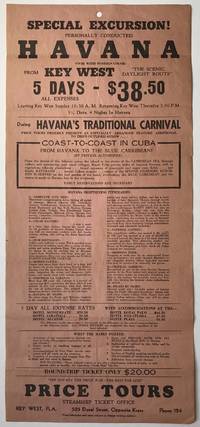
1935Best.-Nr. 848Key West 1935. Very good. Broadside 18 x 8 inches. Printed on pink paper slightly faded. Old folds minor wear. Broadside advertising a steamship cruise offered by Price Tours from Key West to Havana during Carnival with additional sightseeing itineraries available once on the island. The cruise is a five-day all expenses included trip for the reasonable price of $38.50 with four nights in Havana and the option to add a driving tour across the island seeing Cuba from coast to coast. Other potential tours include a cigar factory a rum distillery Morro Castle a shopping tour and more. No copies recorded in OCLC. unknown books
1967Best.-Nr. 23401n.p.: n.p. 1967. Very good. Four photographs ranging in size from 5'' x 7'' to 7'' x 10'' approx. Various press agency stamps to versos. Paper captions mounted to versos of three photos. Slight curling and minor edgewear to photos with creasing and chipping to captions. Very good overall. Press photographs with agency stamps from Keystone AGIP and United Press Photos taken around the time of the trial and imprisonment of Regis Debray in Muyupampa Bolivia. Debray a Paris-trained philosopher and former professor at the University of Havana was arrested as an associate of Che Guevara in August 1967 and sentenced to 30 years in prison; he was released in 1970 after sustained protests. Photos show Debray in prison uniform on August 8th; in civilian clothes in front of a bank of microphones at an August 14 press conference following a hunger strike; walking in the prison yard escorted by an armed guard; and with his wife Elizabeth Burgos after his release. Captions all but one in French give descriptions and expanatory context. n.p. hardcover books
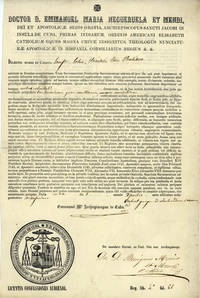
1860Best.-Nr. 42951Santiago de Cuba 1860. A very good copy with small tape repair on verso at fold. 2 pp. 1 sheet. 7 3/4" x 11 3/4" A license to hear confessions issued by Emmanuel Maria Negueruela et Mendi 1811-1861 Archbishop of Santiago de Cuba exactly one month after he arrived in Santiago de Cuba. A partially printed document completed in manuscript and signed 8th April 1860 and recorded. On the verso is a list of cases that are to be reserved for the Archbishop. Published one month before his first and only recorded work his first pastoral letter Carta pastoral que el Excmo. e Ilmo. Señor D. D. Manuel Ma Negueruela y Mendi. OCLC locates only copies of this letter and we could locate no other items by him. unknown books
1977Best.-Nr. 24690Cuba: Union de Escritores y Artistas de Cuba UNEAC 1977. Poster in colors text in Spanish; Approx. 20" x 29" size horizontal format; some edge-crinkling; in very good condition. Poster. Not Bound. Very Good. Union de Escritores y Artistas de Cuba UNEAC Paperback books
1991Best.-Nr. 67620Coral Gables Florida: Elite Fine Art José Martínez-Cañas 6 Dec - 21 Dec 1991. 23x23cm. 24 pages color plates catalogue biography/chronology bibliograpic references pages 23-24 color pictorial wrappers PRESENTATION COPY SIGNED BY THE ARTIST. Essay "Nature at the Sensual Extreme: Mario Bencomo's Paintings" by Donald Kuspit Elite Fine Art José Martínez-Cañas unknown books
2000Best.-Nr. 56789La Habana: Centro de Arte Contemporáneo Wifredo Lam; Consejo Nacional de las Artes Plasticas Noviembre 2000. 24cm. 463 pages b/w and color plates portraits facsimiles biographies/chronologies catalogue indices folding color wrappers Excellent guide to new art in Cuban and Latin America with artists such as Ciro Abath Ricardo Benaím Alessandro Balteo Osvaldo Cibils León Ferrari Rubén Gutiérrez and Juan Carlos Ribero. N.B. Includes a section dedicated to architecture for the second time in the history of the Havana biennial. The architectural exhibitions are entitled: The Recovery of the Old City; From the Havana Tomorrow to the Havana Everyday; The City of the Future; Back to the Sixties; and The National Prizes for Architecture. ENGLISH AND SPANISH TEXT Centro de Arte Contemporáneo Wifredo Lam; Consejo Nacional de las Artes Plasticas unknown books