2.545 Ergebnisse
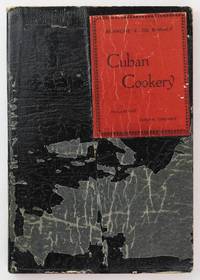
1931Best.-Nr. 6190Havana 1931. Very good. 150pp. Stiff black cloth covers printed paper label on front board. Front cover vertically creased light wear to boards; remnants of glassine stuck to covers. Contemporary inscription on front flyleaf. Internally clean. In a custom clamshell box. First edition of the first Cuban cook book published in English. Blanche Zacharie de Baralt 1865-1950 was born in New York; she married Luis Alejandro Baralt y Peoli in 1886 and the couple moved to his native Cuba in 1900. She earned a PhD in philosophy from the University of Havana in 1902 and went on to translate the poetry of Tagore and to write a book on Jose Marti. She also published this volume which was clearly geared toward the tourist market with the introduction emphasizing the idea of taking home the tastes of one's holiday abroad. Each chapter heading has an illustration and these were drawn by Federico Edelmann and Conrad W. Massaguer the one above the section for beans appears to show a cowboy riding along in a cloud of gas. Notably this work contains several important Cuban cocktails including the first appearance of the mojito referred to here as a Rum Cocktail or Cuban Mojo. Rare in the true first edition. unknown books
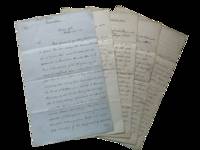
1852Best.-Nr. List2521London 1852. Five groups of documents measuring 13 x 8 inches various paginations see full description below. Fine condition. A scarce set of primary source documents relating to the protection of British territory in the Caribbean in particular along the Mosquito Coast during the period of varied interests in the area in the period following the Anglo-Spanish agreement on the slave trade. Consisting of a series of secretarial copies of reports delivered to Peter McQuhae Commodore of H.M.S. Imauam stationed in Jamaica these dispatches offer an overview of the issues confronting the British Navy in Jamaica during the period and in the Caribbean more broadly. Most of the documents refer to issues with Cuba the most interesting perhaps being a letter warning of an impending filibustering expedition against Cuba by a pro-slavery faction in the American South. The group consists of five groups of bound documents some bound out of order and likely bound later. Contents are as follows: 1. Addington A.M. Four Page Report Concerning Placing a Ship of War at Grey Town to Discourage Invasions on the Mosquito Coast March 13 1851. Henry Addington writes McQuhae to recommend stationing a warship at Grey Town: ".it would be sufficient that a Ship of War should from time to time look in grey Town without remaining there at any time long enough to endanger the health of the crew. to provide for the case which is possiblee tho' not at all likely that during the interval between the visits of a Ship of War some expedition of Nicaraguan or some of the North Americans returning from California might take advantage of the comparatively unprotected state of the lace to take possession of it and that the cruiser on its return to Grey Town might find the place so occupied Lord Palmerston concieves taht in such an event it would seem to be inconsistent with the Honor of this Country that a British Ship of War should acquiesce in such an aggression and it would be right that the intruder should be expelled if the Commander of the Ship of War should find as he probably would that he had the means of doing so without much difficulty and that in case he should repel the intruders and re-establish the authorities of the Mosquito Government demanding the liberation of any British or Mosquito subjects who might have been made Prisoners and holding hostages for their relief if they should have been removed up into the interior of the Country. It It is to be hoped however that all questions of dispute in regard to Grey Town will beoon be settled because Her Majesty's government has through Her Majesty's Minister at Washington proposed to the Government of the United States that an arrangement should be made by which the Sovereignty of Grey Town. should be transferred to the State of Costa Rica. Lord Palmerston desires me to add that there are at present at Washington a plenipotentiaries both from Nicaragua and Costa Rica for the purpose of conducting this negotiation." 2. Addington G.M. Single Page Letter in Secretarial Hand Warning of Incoming Ships to Cuba Carrying Enslaved Individuals January 24 1852. Addington writes to McQuhae about two incoming vessels carrying enslaved Africans passing on information received at Rio De janeiro by another British vessel: "I am directed by Earl GraH.M. Minister at Rio reporting that he had recieved information that two Slavers had sailed from Havana to. the coast of Africa. with the intention of returning with Cargoes of slaves which are to be landed at the Entrade de Cuchillo in Cuba." 3. Seymour G.F. et al. Four Reports Bound Together on Varied Subjects including the Case of the Creole British Fishing Rights in Spanish Waters off of Cuba and Porto Rico and the Case of a Detained British Vessel in Cuba 1852. A series of four reports addressed to McQuhae on various subject as follows: A. Report dated May 17 1852 from Seymour discussing the case of the Creole detained in 1851: ".enclosing copies of a letter from the Under Secretary of State for Foreign Affairs approving of the course I had pursued with regard to the Creole and of a despatch from the Earl of Malmesbury to Her Majesty's Minister at Madrid relative to the rights of British Subjects to fish on the coast of Cuba." B. Letter from Augustus Stafford Apriul 23 1852 discussing the Creole mostly discussing the enclosure of varied reports on the subjects but with little specific information. C. Addington A.M. April 21 1852 letter discussing the Creole case and the enclosure of documents. D. Earl of Malmesbury April 14 1852 letter discussing the Creole case in more detail: " The Right thus claimed rests on this universally admitted precept of international Law "dominium finitur ubi finitur armorum vis" which in modern practice has been construed to mean "about one marine league from the mainland" and H.M.'s Govt are clearly justified in demanding that the Spanish authorities shall be ordered not to meddle or interfere with British fishermen outside that three mile boundary." 4. Earl of Malmesbury et al. Series of Three Secretarial Copies of Reports Concerning Impending Filibuster Raids on Cuba Giving Instructions for Assisting Spanish Forces. A very interesting series of reports detailing the planned response to pending "Piratical Attacks" showing the extent to which British forces were prepared for an American filibuster attack on the island and the degree to which they intended on assisting the Spanish forces. As follows: A. Seymour G.F. Secretarial Copy of Letter Written on May 5 1852 from Cumberland at Bermuda relaying the transmission of a full report of instructions to the British forces regarding an impending filibuster raid: " I hereby enclose for your guidance. orders. relative to the assistance which is to be afforded by Her Majesty's Ships on the application of the Captain General of Cuba in the Transport of Troops in the event of a Piratical attack being again made on that island by which you will govern your conduct." B. Earl of Malmesbury. Secretarial Copy of a Letter Dated April 10 1862 discussing piratical attacks: ".that in the event of a Piratical Attach being made upon that island. HM's ships might assist in conveying troops to any poiunt of the Coast of Cuba at which the invading Party might effect a landing." C. Honley P. Secretarial Copy of an Undated Letter c. 1852 regarding piratical attacks: "Her Majesty's ships might assist in coveying Troops to any point off the Coast of Cubat at which the invading Party might effect a landing. you should be instructed until further ORders that if the Captain General of Cuba should require your assistance for the transport of troops in the manner pointed out in your abovementioned dispatch you should comply with that demand." 5. Crampton Sir John. Copy of a Letter in Secretarial Hand Relaying the Impending Danger of a Pro-Slavery Filibuster Mission from Florida May 17 1852. A fascinating letter relaying information received from M. Calderon de la Barca concerning an impending filibuster mission against Cuba led by a Dr. Wren part of an organization called "The Lone Star Association:" ".it would appear that the government of the United States has also received an intimation that something of the sort is on foot for the President informed M. Calderon that orders had already been sent to the U.S. Authorities at the different Ports of the Union to be prepared to take vigorous measures for the repression of any such attempts. an expedition is in fact meditated by certain parties in the South and that it is intended that it should leave some Port of Florida. The real object of this expedition however as as I am told not Cuba. but San Domingo for the purpose of acting as auxiliaries to the Dominicans against the Haytians. it is by no means impossible that its ultimate aim would be Cuba. the persons I am given to understand engaged in the expedition are a Dr. Wren who is president of a society called "The Lone Star State Association." The letter is worthy of further study - we find references to a Dr. Wren in newspaper articles from the period but were unable to pinpoint his identity or the history of his organization. An article from a Loudon Tennessee newspaper describes Dr. Wren as a "representative of New Orleans societies" and described a meeting in Loudon in 1852 trying to recruit for the overthrow of the Spanish colonial government of Cuba through an invasion. unknown books
1950Best.-Nr. 93352Auckland New Zealand: The Atlas Press 1950. Hardcover. Very Good/Good. plates mostly color 37p. Original boards. dj. 25 cm. Modest splitting along bottom portion of front joint. Jacket somewhat soiled and edge-worn including three jagged chips on front panel. Laid in is an undated autograph letter signed by Cuba to M. B. Bradshaw of the Art Exhibition Bureau in London. Cuba reports that he is busy ". trying to paint London in the smog. The Atlas Press hardcover books
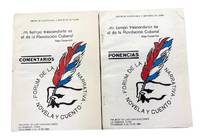
1985Best.-Nr. 60167Havana: Union de Escritores y Artistas de Cuba 1985. Paperback. Very Good. 2 separate volumes. 206 186p. Softcovers in original wrapper. 21 cm. Author's name and title inked on each backstrip. Spanish text. Union de Escritores y Artistas de Cuba paperback books
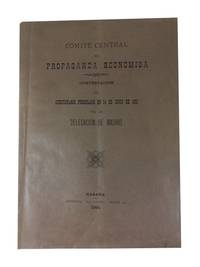
1891Best.-Nr. 44433Habana: Imprenta "La Razon 1891. Paperback. Very Good. table 35p. Softcover in original wrapper. 22 cm. Slight vertical crease and slight wrinkling throughout. Cuban institutional stamp on title-page. Spanish text. Tariffs and taxes on Cuban export commodities mainly sugar and tobacco. Imprenta "La Razon paperback books
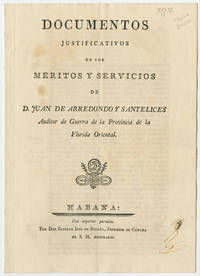
1815Best.-Nr. 49642Havana: Esteban José de Boloña 1815. An early Cuban imprint printed by Esteban José de Boloña the first printer in Cuba after the 1776 ban on printing. Juan de Arrondo y Santilices was an official in Spanish Florida the Auditor of War of East Florida during the early 19th century. This is a work detailing the deeds of Arrondo y Santilices likely an attempt to secure a pension. Rare with one copy located by OCLC at the John Carter Brown Library. Gathered signatures stitched. Stitching mostly perished. Light fold lines minimal foxing ink marginal notations contemporary ink inscription after the text. Very good. unknown books
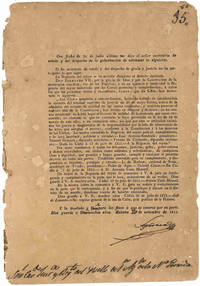
1813Best.-Nr. 46892Havana. Sept. 20 1813. Early Havana Imprint A rare printed decree from Cuba at the beginning of the 19th century as Spanish power in the world was waning but Spain's grip on Cuba was still quite firm. This decree issued by the King on June 14 1813 and printed on September 20 announces new laws regarding the rights to vote and to be elected to hold government positions for professors and scholars from certain universities collegiums and seminars. The decree forbade these rights to the Knights of Justice of the Order of St. John of Jerusalem as well as members of the four military orders of Santiago Calatrava Alcantara and Montesa. It is endorsed in manuscript with the imprint and header also written in by hand. Early Caribbean imprints are rare. Folio. Old fold lines. Moderately chipped and worn at edges. Lightly and evenly toned. Contemporary manuscript notations. Good. unknown books
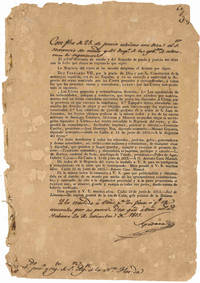
1813Best.-Nr. 46891Havana. Sept. 20 1813. Amnesty to Curry Favor A rare Havana imprint. As Spanish power in the New World was waning its grip on Cuba was threatened by domestic and foreign intruders. This decree issued by the Council of Regents "Cortes" standing in for Fernando VII on June 17 1813 and printed on September 20 orders the annulment of all criminal cases. This amnesty policy extended to other areas of New Spain as well sought to placate opposition forces. It calls on all levels of government to announce and enforce the decree. It is endorsed in manuscript. Folio. Old fold lines. Moderately chipped and worn at edges. Evenly toned. Contemporary manuscript notations. Good. unknown books
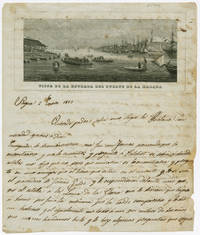
1853Best.-Nr. 54601Havana. 1853. Writing Home from Havana An attractive Cuban pictorial lettersheet with a neatly executed third-page lithograph illustration of the port of Havana. The image depicts several small boats rowing barrels to and from a loading dock. In another small boat a plantation owner or some form of dignitary is being rowed to shore by a crew of men. On the right side of the image several larger ships lie at anchor and in the background on the shore is the fort guarding the mouth of the harbor the Morro Castle. The sheet is filled out by a man named Juan Fabre writing to his parents on Jan. 2 1853 advising them of his safe arrival in Havana. He talks about meeting up with a relative that he had not seen in two years and working at a shoe shop with another relative who adds a brief post script on the verso of the second leaf. Pictorial lettersheets of Cuba are quite rare on the market. Previously folded. Some chipping at fore-edge slightly affecting text. Light dampstaining and tanning. About very good. unknown books
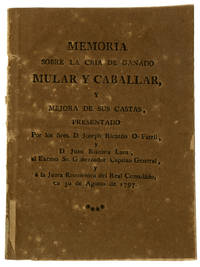
1799Best.-Nr. 51487Havana: Imprenta de la Capitanía 1799. 18th-Century Cuban Imprint A short tract on equine husbandry with its own titlepage but published as a part of a royal decree entitled "Gracia concedida por S.M. à los habitantes de esta isla para la introduccion de caballos frisones de ambos sexôs desde las provincias del Norte de América" which approved the importation of horses to Cuba. Initially presented to government officials in 1797 the report by Joseph Ricardo O'Farril and Juan Bautista Lanz laments poor breeding practices in Cuba that have led to weaknesses in the horse stock and recommends the introduction of North American horses and different breeding methods. Until the suggestions of this work were implemented by the decree in 1798 horses were not allowed to be imported from other sources in greater numbers than they were from Spain. According to Trelles this is the first Cuban imprint to address issues related to livestock and animal husbandry. Dbd. Loose sheets. Heavily tanned outer leaves slightly chipped. Good. SABIN 56747. MEDINA HABANA 162. TRELLES pp.177-78. unknown books
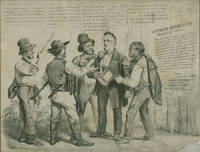
1856Best.-Nr. 53452New York: Nathaniel Currier 1856. Trying to Grab Cuba A scarce political cartoon regarding the controversial Ostend Manifesto the initially-secret attempt by the United States to purchase Spanish-controlled Cuba. Earlier President Franklin Pierce had instructed Pierre Soulé upon his appointment as minister to Spain in April 1853 to negotiate to buy Cuba. Three American foreign ministers serving in Europe - James Buchanan John Y. Mason and Soulé - met secretly at Ostend Belgium in late 1854 to draft a plan to either buy Cuba from Spain or force Spain to give up Cuba by inciting a Cuban revolution. The plan met with overwhelming opposition once it was made public in America. In the present political cartoon Buchanan is attacked for his role in the Ostend controversy. He is surrounded by four armed ruffians seeking to rob him of his coat hat watch and money a particularly sharp turn-about on the American minister to Great Britain. The muggers' demands include quotations from the manifesto which is pasted to the fence at right. Buchanan calls out: "Why! Why! This is rank robbery! Help! Help! All honest men!" The fallout from the Ostend controversy was widespread. President Pierce's Democratic Party split asunder after he refused to continue any discussions of the plan or any other expansionist ideas; Soulé understandably resigned; and the international community saw it as a threat to Spanish sovereignty in the region. Oddly enough James Buchanan was not too hurt by the controversy; he was easily elected president in 1856 and still harbored hope for Cuban annexation. He was smart enough however to table the Cuba question for the foreseeable future after meeting with both popular opposition and increasingly bitter sectional conflict the latter only spurred on by incidents such as the Ostend controversy. Broadside 10 x 13 inches. Foxed bottom right corner chipped. Lower margin trimmed costing the title. Good only. Framed under glass. CURRIER & IVES: CATALOGUE RAISONNÉ 5021. NEVINS & WEITENKAMPF p.72-73. unknown books
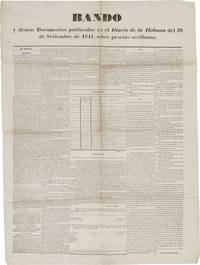
1841Best.-Nr. 15527Havana. Sept. 29 1841. A proclamation by the Spanish military government in Cuba concerning legal tender and its circulation and providing a series of regulations for commerce and exchange. Broadside 23 x 16 1/2 inches. Splitting on middle fold else very good. unknown books
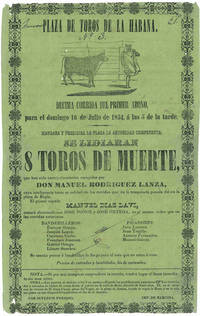
1854Best.-Nr. 46994Havana. 1854. A Bullfighting Broadside from Cuba in 1854 Cuban broadside advertising a bullfight featuring matador Don Manuel Rodriguez Lanza and the "8 toros de muerte." The top of the sheet features a woodcut of a matador holding his cape out to a bull. The first swordsman for the fight is Manuel Diaz Lavi with two alternates listed. The names of the Banderilleros and Picadores for the fight are also noted. Bullfighting was a popular entertainment in Cuba during the Spanish colonial period though it was done away with after Cuban independence at the beginning of the 20th century. Broadside 12½ × 8 inches. Printed on green paper. Old fold lines. Light wear and soiling minor separation at some folds. A few contemporary notations. Very good. unknown books
1910Best.-Nr. 55308Havana: American Photo Co. 1910. The Early American Presence at Guantanamo Bay An impressive view of sailors and marines from the United States' Atlantic Fleet assembled on the parade grounds of Deer Point Camp Guantanamo Bay. Well over five hundred officers seamen and marines are in formation with encampments on both sides of the grounds. In the background looking out into the harbor nineteen ships are visible in the water including the four listed on the photo: Minnesota New Hampshire Mississippi and Idaho. One camp building with a wide veranda is behind and to the left of the sailors. U.S. forces with their Cuban allies first occupied Guantanamo Bay in 1898 during the Spanish American War creating a forward-operating base in their effort to wrest Spanish control of the island. In 1903 the U.S. leased forty-five square miles of land and water at Guantanamo Bay from the newly-independent Cuban government and built the Deer Point Camp to support naval operations in the Caribbean. The American facilities at Guantanamo Bay are in use to this day. The American Photo Company advertised itself as "the best equipped commercial photographers in Cuba." It established a commercial network in Havana that distributed images of Cuba on a worldwide scale. This photo is rare. We found no records of it at auction and no copies in OCLC; however the Naval History and Heritage Command lists a copy in their collections. Panoramic photograph image 7¼ x 47¼ inches on sheet 10 x 49 inches. Printed caption title below image. Publisher and date written in negative at lower right corner; in the lower left corner is written: "#5 2d Regiment U.S. Atlantic Fleet Deer Point Camp Guantanamo Bay Feb. 13 1910. 'Minnesota' 'New Hampshire' 'Mississippi' 'Idaho.'" "Printed in Germany" printed below image at lower left. Some light soiling minor fading to right side of photo some rumpling from previous rolling. Very good. "US Naval Station Guantanamo Bay Cuba" UA 571.45 copy of this image Washington Navy Yard D.C.: Naval History and Heritage Command Naval Heritage Foundation online. unknown books
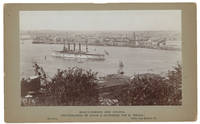
1890Best.-Nr. LIST110Havana: R. Testar 1890. Albumen photograph on cardstock mount image measuring 7 1/4 x 4 1/2 inches on 8 3/4 x 5 1/2 inch mount. A view of an American warship in Havana harbor likely taken prior to the outbreak of hostilities between the United States and Spain in early 1898. The photographers Leach and Patterson of Calle San Rafael published several views of Cuba at this time mostly of bucolic scenes around Havana and its environs. The American cruiser is similar in design to the U.S.S. Maine with slight differences - two smokestacks instead of three. An excellent example with minor wear to mount and fine image. R. Testar unknown books
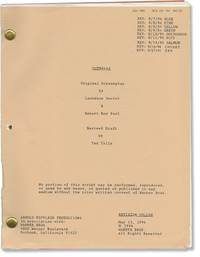
1994Best.-Nr. 170268Burbank CA: Warner Brothers 1994. Revised Draft script for the 1995 film. Bound in at the rear of the script are nine pages relating to revisions to the script. US Army doctors race to find the cure to a deadly virus quickly spreading from Africa to North America by way of a smuggled capuchin monkey. Shot on location in California and Hawaii. Self wrappers. Title page present dated May 13 1994 noted as REVISION POLISH with credits for screenwriters Laurence Dworet and Robert Roy Pool and revision credits for uncredited screenwriter Ted Tally. 174 leaves with last page of text numbered 136. Xerographic duplication rectos only with rainbow revision pages throughout dated variously between August 7 and 17 1994. Pages Near Fine bound with two gold brads. Warner Brothers unknown books
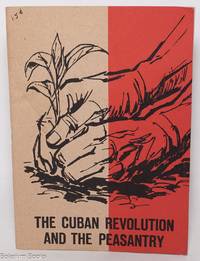
1965Best.-Nr. 346950Havana: Cuba Ministry of Foreign Affairs 1965. Pamphlet. 35p. wraps old price on front wrap otherwise very good condition 6x8.5 inches black & white illustrations. Cuba Ministry of Foreign Affairs unknown books
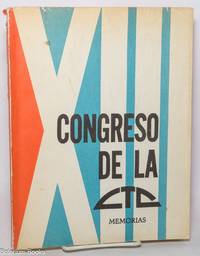
1973Best.-Nr. 346129Havana: Departamento de Divulgación de la CTC Nacional 1973. Paperback. 274p. 17p. unnumbered b&w photographic plates 10.75x8 inches; head of spine heavily damaged and chipped top right corner of back cover separating from text block paper toned otherwise in good condition with no markings to text. Text in Spanish. Report from the Cuban trade union congress including a speech from Fidel various resolutions and presentations from an array of foreign delegates. Departamento de Divulgación de la CTC Nacional paperback books
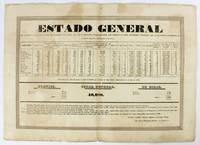
1838Best.-Nr. 5957Sancti Spiritus 1838. Good plus. Broadside measuring 12.5 x 17.5 inches. Previously folded. Light wear to edges and along old fold lines with a few small chips at edges. Moderate toning and soiling. An unrecorded broadside that prints statistics relating to agricultural production for the region of Sancti Spiritus in central Cuba during the late 1830s. For each municipality the broadside prints the number of property owners; ranches; land-grant farms; slaves; white employees; animals including mules donkeys cows and sheep; distances to transport and shipping hubs; and several other figures. In the bottom third of the broadside are printed the census figures from 1836 with the population totaling just over 40000 people and split into Black and white groups. Rather pointedly the figures for the white population are divided by gender while the figures for the Black population are divided by status free or slave. A very interesting statistical snapshot of a smaller rural region in colonial Cuba in 1838. Not in OCLC. unknown books
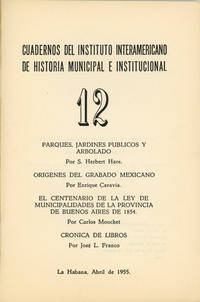
1955Best.-Nr. 35421La Habana: El Instituto 1955. First edition. Paper wrappers. A very good copy wrappers rubbed and soiled. 95 pp. Sm. 8vo. El Instituto unknown books
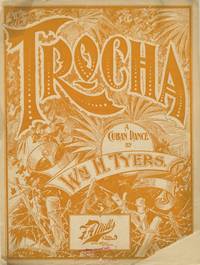
1890Best.-Nr. List3666New York: Jos. W. Stern & Co 1890. Folio sheet music illustrated pictorial cover printed in orange. 5 pp. including cover. Approximately 13 ½ x 10 ½ inches. Covers detached loss to front cover contents complete fair to good. A decorative late nineteenth-century dance publication for “Trocha” described on the cover as “A Cuban Dance” composed by the African American composer and bandleader W. H. Tyers. The elaborate pictorial cover incorporates stylized tropical foliage and island scenery rendered in a bold single-color design typical for the period’s fascination with exoticized musical forms. William H. Tyers 1870–1924 was an African American composer arranger and bandleader active in New York during the ragtime era. Born in Petersburg Virginia to Henry Tyers and Jane “Jennie” Jones both formerly enslaved he spent part of his youth in Richmond before his family relocated to New York City where he began studying piano. His early teachers recognized an aptitude for composition as well as performance and by the mid-1880s he was writing dance pieces including polkas and waltzes. Around the age of twenty Tyers secured employment as a music librarian and arranger with a touring concert company a position that brought him to Europe where he studied orchestration and arranging with Professor Gaspari in Hamburg. Returning to New York Tyers became active in the city’s rapidly expanding popular music trade working as an arranger and composer for publishers including F. A. Mills and Jos. W. Stern & Co. In 1896 he published “Sambo” a syncopated march sometimes considered to be one of the first instrumental rags.1 “Trocha” also released in the 1980s brought Tyers prominence for his ability to write Latin-style rhythms. It was re-issued in 1913 as a tango and its success led Tyers to work as an arranger with Joseph W. Stern in 1897. Tyers’ compositions blended contemporary American dance music with Caribbean and Latin themes a style reflected in pieces such as Trocha and later in his well-known ragtime composition Panama 1911 which remained a staple of early jazz and dance orchestras. OCLC finds two copies with different entries at the Cleveland Public Library and the British Museum Reference Collections. 1 “William Tyers Music Arranger” African American Registry https://aaregistry.org/story/william-tyers-born/ accessed March 10 2026. Jos. W. Stern & Co unknown books
1950Best.-Nr. 198125Auckland New Zealand: Atlas Press 1950. Hardcover. AS IS Ex-Library with all accompanying accoutrements; Boards are terribly worn; spine strip lettering and material is almost entirely worn away; interior has toning and occasionally foxed/smudged. Brown boards with black lettering and illustration; 37 leaves; letter from the copyright office of New Zealand tipped in on ffep; richly illustrated. "This book of 25 concise formuals is the result of ten years' painstaking research and the illustration are proofs from hand engraved Aluminium by him" -- leaf #3. Atlas Press hardcover books
1989Best.-Nr. 8193Colorado Springs Colo: Colorado Springs Fine Arts Center 1989. Softcover. VG fresh and tight clean with seveal small stamps from previous owner. Appears unused. Quarto. Softcover. BW & color illus. glossy wraps. 196 pp. 59 bw 65 color plates. Issued in conjunction with a series of 1989 exhibitions. The first study of this important school and the artists' colony which developed around it. Text by Stanley L. Cuba and Elizabeth Cunningham. Includes biographical sketches of artists including the following: Barrett Biddle Warren Chappell Eduardo Chavez Davey Dehn Laura Gilpin Yasuo Kuniyoshi Ernest Lawson Doris Lee Lockwood Mechau Robinson Sandzen and others. Wonderful illustrations extensive text. Colorado Springs Fine Arts Center paperback books
1987Best.-Nr. 7880Wilkes-Barre Penna: Sordoni Art Gallery 1987. Softbound. VG slight writing on title-page at top. Rust wraps French flaps 108 pp. 18 color 44 bw plates. Issued in conjunction with 1987-1988 exhibitions held in Wilkes-Barre PA: Sordoni Art Gallery Wilkes College May 3 to June 14 1987 three other locations. The exhibition features selected works of American realist painter George Luks 1867-1933. With three essays by Stanley L. Cuba Judith O'Toole and Nina Kasanof with 185 notes and an exhibition checklist of 32 oils and 30 works on paper. A very nice catalogue that takes a look beyond the clown pictures and illustrates some of his landscapes and portraiture. Very well illustrated. Sordoni Art Gallery paperback books
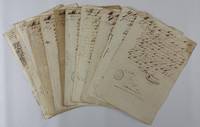
1873Best.-Nr. 12720Cuba 1873. Twelve manuscript documents on folio sheets approximately 8.5 x 12.5 inches all with official rubber-stamped seal. Small pinholes along left margin light wear occasional chipping to edges some ink bleed and light damp staining. Overall very good. A collection of documents recording the liberation or attempted liberation of numerous men women teenagers and a child from enslavement. The child is but seven years old while the remaining slaves range from fifteen to fifty-seven years old. The slave trade ended in Cuba around 1867 but the practice of owning slaves remained legal until 1880 and then was abolished completely by Spanish decree in 1886. Cuba was the penultimate country to outlaw slavery in the western hemisphere beating Brazil to formal abolishment by two years. Even before the official abolition of slavery in Cuba African or criollo slaves were manumitted by a variety of owners and at various costs as evidenced here especially after the practice of importing Chinese indentured servants began. Each of the present documents names the slaveholder and the slave granted "libertad" along with the cost in escudos or pesetas of that liberty. The slaves liberated here are as follows: 1 Luis criollo 7 years old for the sum of 28 pesos 2 Maria Antonia part criolla 20 years old for the sum of 2500 pesetas 3 Catalina morena de Africa 41 years old for c.200 pesetas 4 Lorenzo moreno criollo 21 years old for 2500 pesetas 5 Lucia morena criolla 15 years old for 320 pesos or 1600 pesetas 6 Frigidae "negro.de Africae" 56 years old 7 Augusto criollo 19 years old for 1750 pesetas 8 Marta criolla 16 years old for 1621 pesetas 9 Gil moreno de Africa 57 years old for 1500 pesos 10 Carmita morena criolla 20 years old for 1750 pesetas 11 Augustina Prieto morena criolla 30 years old for 1750 pesetas 12 Edwigio 39 criolla; Lazara 36 criolla; and Maria Leoncia 15 criolla for 2000 pesetas. These Cuban slave manumissions are offered with one 1844 manumission document liberating a slave in Spain totaling two pages and measuring about 8.5 x 13.5 inches. The document also has three rubber-stamped official seals at the head noting Isabella II. This document appears to free slave Nicolas 25 years old for the sum of 400 pesos and is signed November 5 1844. unknown books