Committee On Relations With CubaBiblio.com

2 665 résultats
2008réf. 1561041967Kessinger Publishing USA 2008. Reprint. Softcover. Very Good Condition. Reprint. Book is in very good condition. Text appears to be clean. Cover has some wear scuffsdings and corner bumps. Spine is in very good condition. May have book store sticker. Quantity Available: 1. Shipped Weight: Under 1 kilo. ISBN: 1436816793. ISBN/EAN: 9781436816793. Pictures of this item not already displayed here available upon request. Inventory No: 1561041967. . 9781436816793 Kessinger Publishing paperback
réf. DADAX0415042054New unknown
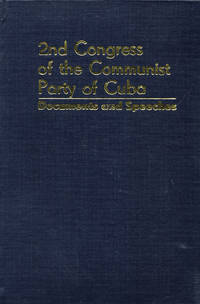
1981réf. 86364Havana Cuba: Political Publishers 1981. Presumed First Edition First printing. Hardcover. Good/Good. 116 4 pages. Index. Among the topics addressed in the Index are Socioeconomic Developments Revolutionary Armed Forces Social Organizations Ministry of the Interior Union of Young Communists Communist Party Ideological Struggle Foreign Policy and Economics. Fidel Alejandro Castro Ruz 13 August 1926 - 25 November 2016 was a Cuban revolutionary and politician who was the leader of Cuba from 1959 to 2008 serving as the prime minister of Cuba from 1959 to 1976 and president from 1976 to 2008. Ideologically a Marxist-Leninist and Cuban nationalist he also served as the first secretary of the Communist Party of Cuba from 1965 until 2011. Under his administration Cuba became a one-party communist state; industry and business were nationalized and socialist reforms were implemented throughout society. On January 20 1981 Fidel Castro gave the closing speech at the Communist Party of Cuba's second Congress held from January 17-20. He addressed almost 150 foreign delegations representing pro-Soviet communist parties liberation movements and even some social democratic parties of the Socialist international as well as more than a million Cubans. This fact alone is a measure of the prestige which the CPC has among many political trends and working people around the world. But the economic situation in Cuba brought to light during the congress and the path which Castro is proposing to the peoples struggling against imperialism give food for thought and should lead us to question the supposedly revolutionary path which Castro claims to be defending. One of the main concerns of the congress was the economic situation in Cuba. Despite an overall situation envied by many of the peoples dominated by U.S. imperialism the main report presented by Castro revealed that the objectives of the 5-year plan adopted at the First Congress in 1975 were not attained. Economic growth reached only 4% despite an objective of 6% and the industrialization plan met with difficulties. These results are of some importance since the objectives set at the last congress were consciously modest. Given this situation the Second Congress underlined the need for increased mobilization in production and stepped up plans to implement the new system to manage the economy which was first adopted at the First Congress. At the time this system was presented as an answer to the idealist errors of the 1965-70 period when it was claimed that all forms of market economy had abruptly been eliminated. The system clearly draws inspiration from the experience of the economic reforms introduced in the U.S.S.R. by Khrushchev in the early sixties which are judged as positive. These reforms underlined the importance of "the law of value the necessity that in all enterprises including State enterprises there are buy and sell relations and that within these relations the market categories function as indispensable instruments for measuring the use we make of our productive resources. in order to decide which investments are the most advisable and to know which enterprises.work the best.". Political Publishers hardcover
réf. Cub7Hbk 421pp no dj as issued fine blue cloth boards with bright gilt titles now in custom acetate jacket an excellent clean tight and unmarked copy as new Havana: Political Publishers, 1981, hardcover
réf. DADAX0415737850New unknown
réf. SONG0415737850Used: Good unknown
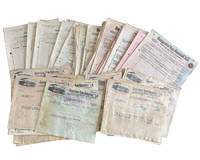
réf. 0012156Havana Cuba Santiago DE Cuba. Very Good with no dust jacket. Non-Book. On offer is a substantial 1937–1959 Bacardi Cuba corporate operations archive comprising approximately 110 documents from Compañía "Ron Bacardí " S. A. And related Cuban rum-industry files. Centered chiefly on Santiago de Cuba and Havana the archive documents Bacardi's pre-nationalization business through export invoices checks purchase requests receiving forms supplier correspondence freight records label orders tax payments advertising records and banking endorsements. What makes the archive particularly strong is that many records are functionally connected. Purchase requests correspond to receiving forms supplier letters explain pricing and material changes export invoices trace named overseas shipments and checks document freight taxes advertising transport and government-related payments. Together they provide a detailed working record of Bacardi as a producer exporter taxpayer advertiser purchaser of printed packaging user of Cuban freight networks and participant in the country's banking and fiscal systems during the final decades of privately operated Bacardi production in Cuba. Many documents identify the company as Compañía "Ron Bacardí " S. A. Santiago de Cuba y Habana Sucesores de Bacardí y Cía. Establecidos en 1862. Others describe it as "Propietarios del Bacardí y la Cerveza Hatuey " directly linking the archive to both Bacardi rum and Hatuey beer. Among the most historically important records are 1959 Bacardi checks showing ordinary private commercial activity continuing after the January Revolution and before the confiscation of Bacardi's Cuban assets in October 1960. A January 26 1959 check to Agrupación de Transporte S. A. Pays for hauling performed during the second half of January. Another check that day to Porteadora Cubana de Carga S. A. References a waybill and carries banking and customs-related endorsements. A June 1959 check pays the Cámara de Comercio de Camagüey for advertising while an August 1959 Trust Company of Cuba check covers freight on packages and boxes containing promotional materials. Two additional January 1959 checks concern relief at Sagua de Tánamo Oriente including one issued "Para socorrer a los habitantes de Sagua de Tánamo" to assist the inhabitants of Sagua de Tánamo. These records capture Bacardi still conducting transport advertising banking freight and civic activities during Cuba's revolutionary transition. A major portion of the archive documents Bacardi's label packaging and lithographic supply chain particularly through Compañía Litográfica de la Habana S. A. 1957 purchase requests include orders for 1000000 Carta Blanca analysis labels 1000000 Ron Palmas labels 100000 Carta de Oro labels 70000 Bacardi Imports Carta Blanca labels 12000 Añejo Brand miniature labels and 6000 aluminum-paper Añejo bottle wrappers. Several have corresponding receiving forms showing delivery through Porteadora Cubana de Carga. The Hatuey beer records reveal even greater scale. One receiving form records 3000000 Hatuey Clara labels another records 1200000 additional oval labels while supplier invoices document runs of 4000000 and 2800000 Cerveza Hatuey Pilsener labels. Supplier correspondence adds unusually detailed operational context. A 1956 letter explains that an order for 33000 aluminum-paper Añejo wrappers could only be partly filled at the old price because existing stock was exhausted forcing the remainder to be produced from more expensive new material. Other records concern paper substitutions cancellation of 50000 lithographed Bacardi envelopes and quotations for 26000 holiday greeting cards and 26000 envelopes. The archive includes 1950s export records documenting shipments to the United States Canada and Newfoundland Holland Honduras El Salvador and Hong Kong. A 1953 invoice to Gande Price & Co. Ltd. Hong Kong records 25 cartons of Bacardí Carta Blanca marked "DOUBLE STEEL STRAPPED. " A related Bacardi letter identifies the shipment as Embarque No. 157 and discusses documentation required for a Cuban public-works charge. A 1953 invoice to The Board of Liquor Control St. John's Newfoundland shipped aboard the Canadian Observer via Halifax records 500 cartons of Bacardí Carta de Oro Rum marked "DOUBLE STEEL STRAPPED " "STRENGTH: 40.0 G. L. " and "NO FODDER USED. " The total including freight was $8145.50. Related Nova Scotia material further documents Bacardi's Canadian-Caribbean trade. Earlier correspondence documents Bacardi's American label and distribution system. A 1939 letter to H. B. Estrada at the Empire State Building concerns "Etiquetas U. S. A. " and records shipment of 1200 Bacardí Carta Blanca labels 400 Bacardí Carta de Oro labels and 2000 analysis foot-labels. A 1940 letter on José M. Bosch Agent for Compañía Ron Bacardi Empire State Building letterhead requests additional Carta Blanca and Carta Oro label sets to be sent by air. The archive also documents Bacardi's interaction with Cuba's fiscal and banking systems. A 1950 check for $26928.00 records the purchase of liquor-tax stamps. Other documents concern income taxes wage-tax matters public-works charges treasury payments and banking clearance. Many retain original endorsements and stamps from institutions including the Tesorería General de la República Cámara Nacional de Compensaciones The Bank of Nova Scotia and other Cuban banking and fiscal bodies. Advertising records include Bacardi-Hatuey newspaper advertising Chamber of Commerce advertising promotional freight and a 1957 Propaganda Department order for 26000 greeting cards and 26000 envelopes for the 1958 holiday season. One unusual letter from F. M. Hitchcock of Wichita Kansas thanks Bacardi for miniature labels and requests sets of its full-size labels and medal label showing that Bacardi packaging was already being collected as brand ephemera during the period. Also included is related Cuban rum-industry material notably a 1959 José Arechabala S. A. Check providing comparative documentation from another major Cuban liquor producer during the same revolutionary year. The archive documents Bacardi's continued private operations in 1959 rum exports across North America Europe Central America and Asia multi-million-unit production of Hatuey beer labels Bacardí Carta Blanca Carta de Oro Ron Palmas and Añejo packaging lithographic suppliers and packaging production freight transport banking taxes and customs-related processing prewar U. S. Distribution through New York advertising and promotional material local civic and relief activity in Oriente and related José Arechabala rum-industry material. Founded in Santiago de Cuba in 1862 Bacardi became one of Cuba's most internationally recognized brands. Its Cuban assets were confiscated by the revolutionary government on October 14 1960. This archive preserves a detailed paper trail of the company before that event including 1959 records showing Bacardi still operating as a private Cuban business during the revolutionary transition. More than a group of isolated invoices and checks the archive shows how Bacardi actually functioned: labels ordered by the million bottles and promotional materials packaged overseas shipments processed suppliers negotiated with taxes paid freight moved and banking transactions cleared. Approximately 110 documents are included consisting of checks export invoices supplier invoices purchase requests receiving forms letters freight records tax and fiscal records advertising records and related commercial correspondence. Condition varies as expected for working corporate records. Documents show folds handling wear filing holes edge wear creases stamps endorsements perforated cancellations annotations and occasional tears or staining. Many retain original fiscal stamps bank and treasury marks routing notes and cancellation perforations. Overall Fair to Good. ; Manuscripts; Oblong Small 4to 9" - 11" tall; 110 pages; Signed by Author .
1941réf. 056819BALTIMORE MD.: LITHO COPY PREP. CLEAN COPY. . Very Good. Hardcover. 1941. LITHO COPY PREP hardcover
réf. 036507960X.Ghardcover. Good. Access codes and supplements are not guaranteed with used items. May be an ex-library book. hardcover
réf. 0364301090.Gpaperback. Good. Access codes and supplements are not guaranteed with used items. May be an ex-library book. paperback
réf. ORD-17445[Toulouse]. La Dépêche. (1898). Grande carte de 780 x 560 mm toutes marges comprises, gravée par Charaire, partie centrale, la carte proprement dite, en couleurs, entourée de divers sujets en noir avec texte en bas de feuille. Intéressante pièce, supplément du journal La Dépêche. La carte décrit les flottes navales de l'Espagne et celle de l'Amérique dans l'Océan Atlantique et représente les 10 longues semaines de cette guerre déclarée à propos de l'indépendance de Cuba. Elle est entourée de vignettes montrant les uniformes de chacune des armées ainsi que des vues de La Havane, Santiago de Cuba, Matanzas et le Fort des Boucaniers. Traces légères de pliage en 8 mais très bon état de ce fragile document malgré qq. menus défauts. Rare. (2). Photo sur demande.
réf. 0332093794.Ghardcover. Good. Access codes and supplements are not guaranteed with used items. May be an ex-library book. hardcover
réf. 0364997273.Ghardcover. Good. Access codes and supplements are not guaranteed with used items. May be an ex-library book. hardcover
1928Milano, 1928, 8vo stralcio con copertina posticcia muta, pp. 130/138 con 9 illustrazioni fotografiche. - !! ATTENZIONE !!: Con il termine estratto (o stralcio) intendiamo riferirci ad un fascicolo contenente un articolo, completo in se, sia che esso sia stato stampato a parte utilizzando la stessa composizione sia che provenga direttamente da una rivista. Le pagine sono indicate come "da/a", ad esempio: 229/231 significa che il testo è composto da tre pagine. Quando la rivista di provenienza non viene indicata é perché ci è sconosciuta. - !! ATTENTION !!: : NOT A BOOK : “extract” or “excerpt” means simply a few pages, original nonetheless, printed in a magazine. Pages are indicated as in "from” “to", for example: 229/231 means the text comprises three pages (229, 230 and 231). If the magazine that contained the pages is not mentioned, it is because it is unknown to us.
réf. DADAX0415780675New unknown
réf. DADAX0786449012New unknown
1978réf. 38645Laffont, 1978, gr. in-8°, 320 pp, broché, couv. illustrée, bon état (Coll. Vécu)
1995Editions du Rocher 1995 In-8 broché de 444 pages illustrées. Cartes. Très bon état
1995réf. 36291Editions du Rocher Editions du Rocher; 1995. In-8 broché de 444 pages illustrées. Cartes. Très bon état
1986réf. 38870ABo.O. (das Original: Habana, Cuba), Franca Imports Editiones Latinas, 1986. quadr.gr.8°, 250 S. mit zahlr. s/w-Abb. und Illustr., Text: spanisch, illustr. original Kartonage (Paperback), Rücken aufgehellt, Einband leicht berieben, sonst - bis auf die übliche papierbedingte Nachdunklung innen - ein gutes, sauberes Exemplar
2007réf. 300-05028Grafika Press 2007-11-01. paperback. New. In shrink wrap! Looks like an interesting title! Grafika Press paperback
1989Milano, Jaca Book, 1989, 4to tutta tela con sovraccopertina illustrata a colori, pp. 220 compl. ill. col.
1984(Codice VS/0424) In 4° (cm 30,5) 152 pp. Introduzione storica di Julio Le Riverend. Molte bellissime fotografie a colori di Gianni Costantino. Cartone editoriale, sovraccoperta, astucco. Come nuovo. ~~~ SPEDIZIONE IN ITALIA SEMPRE TRACCIATA
2002A clean, unmarked book with a tight binding. Small closed tear on spine. 9 1/4"w x 11 1/4"h. 228 pages. Many illustrations.
1998194pp. avec de nombreuses illustrations en couleurs, 30cm., reliure cart., jaquette illustrée, très bon état, V95248