[Cuba]Biblio.com
2 545 résultats
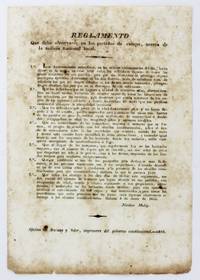
1822réf. 3190Havana: January 5 1822. Good. Broadside 11.5 x 8 inches. Foxed faint signs of folding a few small wormholes not affecting text. An apparently unrecorded broadside order from the captain general of Cuba Nicolas Mahy directing all able-bodied men under the age of fifty to join up with their local militias in order to keep the peace. The local militias are directed to go out on nightly forays "en nùmero capaz de evitar las incursiones de los salteadores por los caminos y la desercion que pueda acontecer de los negros de los ingenios cafetales y demas haciendas." Additionally all men between the ages of fifty and seventy are told to report to “las casas mas fuertes de los pueblos" to form a garrison that can protect women children and the elderly in case of insurrection. By the formation of these militias and the establishment of "el uso de los pasaportes" it was hoped to identify and arrest "los vagos y mal entretenidos." All mayors within ten days of receipt of this regulation were to report the number of men they had enlisted along with their particulars. In the early 1820s much of Spanish colonial America was gripped by revolution and with these orders the Cuban government likely hoped to avoid similar unrest on the island. Several independence groups had been formed in Cuba as of the promulgation of this decree the largest of which was the Soles y Rayos de Bolívar established in 1821. Signed in print by Mahy; not in OCLC. January 5 unknown
1822réf. 3190Havana: January 5 1822. Good. Broadside 11.5 x 8 inches. Foxed faint signs of folding a few small wormholes not affecting text. An apparently unrecorded broadside order from the captain general of Cuba Nicolas Mahy directing all able-bodied men under the age of fifty to join up with their local militias in order to keep the peace. The local militias are directed to go out on nightly forays "en nùmero capaz de evitar las incursiones de los salteadores por los caminos y la desercion que pueda acontecer de los negros de los ingenios cafetales y demas haciendas." Additionally all men between the ages of fifty and seventy are told to report to “las casas mas fuertes de los pueblos" to form a garrison that can protect women children and the elderly in case of insurrection. By the formation of these militias and the establishment of "el uso de los pasaportes" it was hoped to identify and arrest "los vagos y mal entretenidos." All mayors within ten days of receipt of this regulation were to report the number of men they had enlisted along with their particulars. In the early 1820s much of Spanish colonial America was gripped by revolution and with these orders the Cuban government likely hoped to avoid similar unrest on the island. Several independence groups had been formed in Cuba as of the promulgation of this decree the largest of which was the Soles y Rayos de Bolívar established in 1821. Signed in print by Mahy; not in OCLC. January 5 unknown books
1931réf. D1703La Habana 1931. Hardcover. Very Good. Five issues all but the last with their original wraps bound in one volume leather-backed marbled paper over boards -- a bit scuffed and bumped along the edges. Includes: Ano I. No. 1; Febrero 15 1931 / Ano I. No. 2; Febrero 22 1931 / Ano I. No. 3; Marzo 1 1931 / Ano I. No. 4; Marzo 8 1931 / Ano I. No. 5; Marzo 15 1931. The last issue No. 5. does not have the original front cover otherwise all original illustrated wraps are present. All a bit browned as expected and brittle with the occasional small marginal tear but perfectly good reading copies complete and nicely preserving the text illustrations sheet music and ads. Santa Clara bookseller's ticket on front paste-down. A wonderful and uncommon look at Cuba. hardcover
1931réf. D1703La Habana 1931. Hardcover. Very Good. Five issues all but the last with their original wraps bound in one volume leather-backed marbled paper over boards -- a bit scuffed and bumped along the edges. Includes: Ano I. No. 1; Febrero 15 1931 / Ano I. No. 2; Febrero 22 1931 / Ano I. No. 3; Marzo 1 1931 / Ano I. No. 4; Marzo 8 1931 / Ano I. No. 5; Marzo 15 1931. The last issue No. 5. does not have the original front cover otherwise all original illustrated wraps are present. All a bit browned as expected and brittle with the occasional small marginal tear but perfectly good reading copies complete and nicely preserving the text illustrations sheet music and ads. Santa Clara bookseller's ticket on front paste-down. A wonderful and uncommon look at Cuba. hardcover books
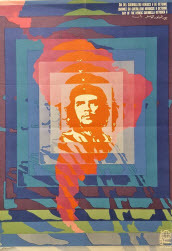
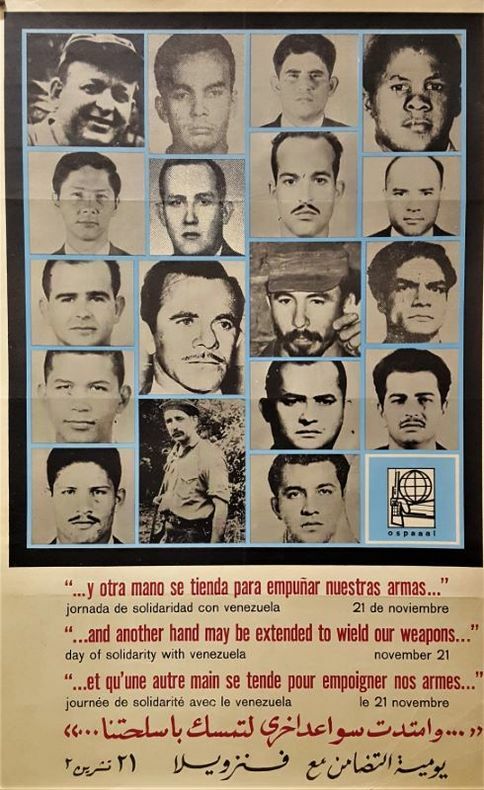
réf. 1827Impression offset. OSPAAAL. 1968. Dim: 49,5 x 34,5 cm. Rare.
réf. 1827Impression offset. OSPAAAL. 1968. Dim: 49,5 x 34,5 cm. Rare.
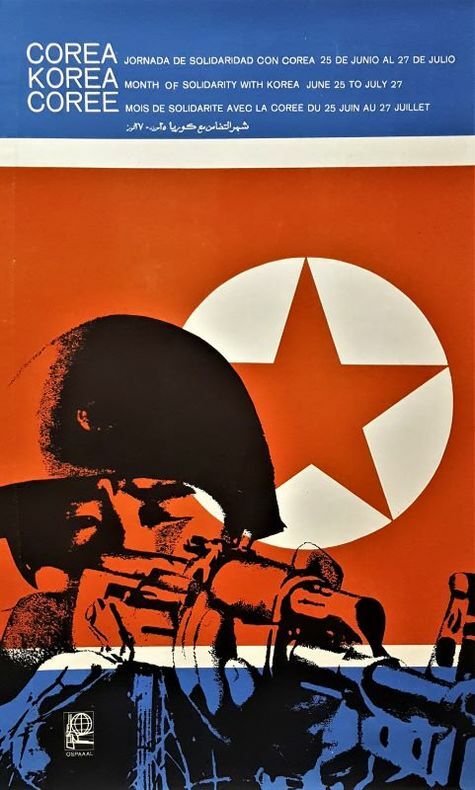
réf. 2090Edit. OSPAAAL. 1968. Impression offset. Dim : 53 x 33 cm.
réf. 2090Edit. OSPAAAL. 1968. Impression offset. Dim : 53 x 33 cm.
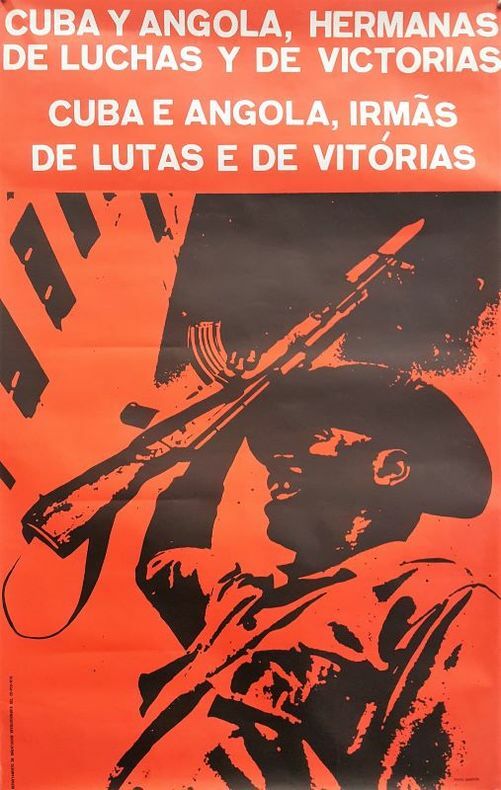
réf. 1105Impression offset. ca.1975. Dim: 72,7 x 46,5 cm. Departamento de Orientación Revolucionaria del Comité Central del Partido Comunista de Cuba. Bon état.
réf. 1105Impression offset. ca.1975. Dim: 72,7 x 46,5 cm. Departamento de Orientación Revolucionaria del Comité Central del Partido Comunista de Cuba. Bon état.
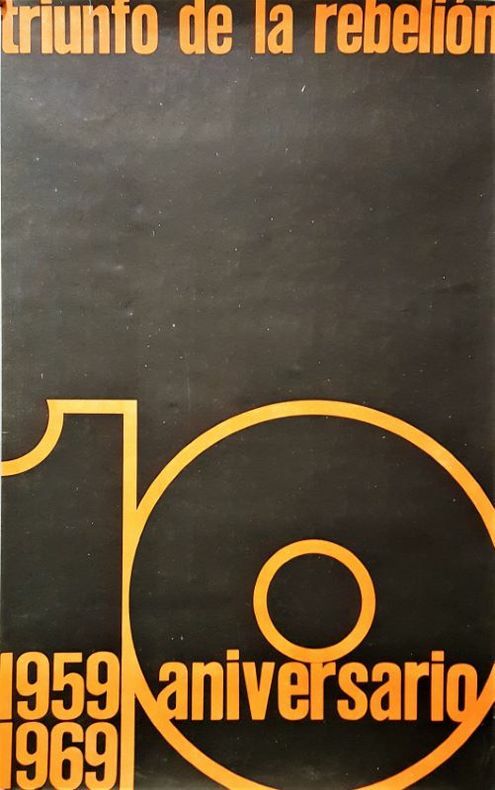
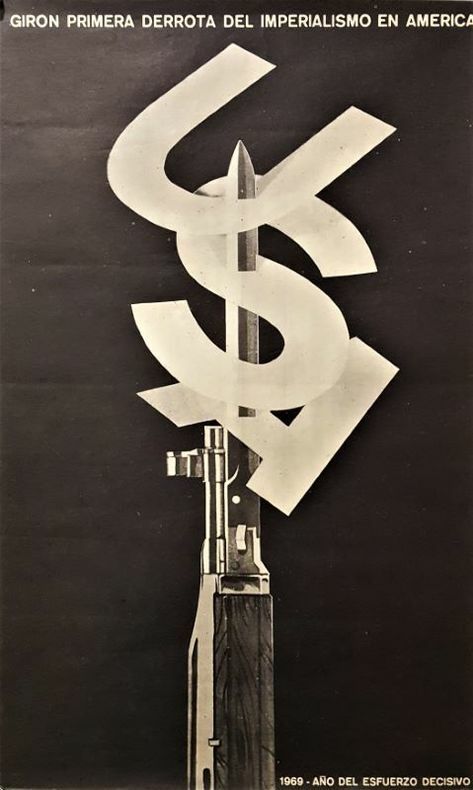
réf. 2096Dans lesprit OLAS.1969. Impression offset.Dim : 52 x 33 cm
réf. 2096Dans lesprit OLAS.1969. Impression offset.Dim : 52 x 33 cm
réf. 2092Sans mention d'éditeur. 1969. Impression offset.Dim : 52,5 x 32,5 cm
réf. 2092Sans mention d'éditeur. 1969. Impression offset.Dim : 52,5 x 32,5 cm
réf. 2094Edit. OSPAAAL . 1970. Impression offset. Dim : 56 x 33 cm
réf. 2094Edit. OSPAAAL . 1970. Impression offset. Dim : 56 x 33 cm
1999réf. 200122Havana: Palcogra/Artes Graficas 1999. Pamphlet. 17p. softbound pamphlet in 7.5x5.5 inch stapled wraps; clean and sound a very good copy. Palcogra/Artes Graficas unknown books
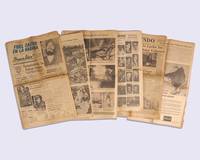
réf. 900066CASTRO'S ARRIVAL IN HAVANA AND THE EARLY DAYS OF THE REVOLUTION CUBA MEXICO AND MIAMI A collection of newspapers spanning the years 1959-1960 Mexico City/Miami Beach: El Mundo Prensa Libre Ultimas Noticias Excelsior 1950-60 A collection of five newspapers each measuring up to 62 x 40cm when fully unfolded; between 8 and 26 pages in length including 'El Mundo' 'Presna Libre' and 'Ultimas Noticias Excelsior' printed mostly in black but with occasional titles in blue; containing numerous black and white photographs of Fidel and Ramon Castro Che Guevara Celia Sanchez Adolfo Lopez Mateos and other members of the Revolution including the execution of Garcia Olayon as well as Richard Nixon J. F. K and other political figures; all newspapers fragile and toned in accordance with age with some splits and chips along folds some loss of text in places; chips to edges and occasional brown spots; one small annotation in blue ink of 'Imogen Browning National Coffee Shop' in Miami; remarkable survivals nonetheless and very good overall. A scarce collection of newspapers which together portray a vivid picture of the turbulent political and social scene towards the end of the 1950s. Articles include 'The Destruction of Santa Clara' and 'With the Rebel Leaders in the Villages' with copious photographs and there are numerous celebratory passages welcoming in Fidel Castro the 'Supreme Leader' and 'Los Gloriosos Heroes de la Revolucion'. There is also a map of the invasion of Cuba and advertisements for children's toys which include automatic pistols army trucks and plastic rockets. All text in Spanish. Please note that these items contain some graphic images unknown
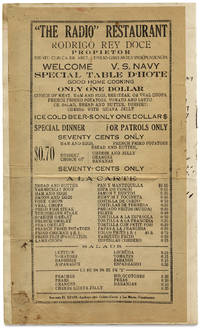
réf. 3726630Guantanamo Cuba: Imprenta El Suaso Aguilerae ntre Calixto Carćia y Los Maceo. ca. 1930s. 13½ x 7½ inches. Broadside simple ornamental border. Single sheet mounted to a larger ledger sheet. Two short tears upon fold lines in margins; tanning; good. A rare unrecorded Cuban restaurant menu directed at American naval servicemen. This bilingual broadside functions as both menu and advertisement for Rodrigo Rey Doce’s restaurant aptly named “The Radio” promising “Good Home Cooking” to the U.S. Navy through a fixed-price offering. For one dollar patrons could order familiar comforts—ham and eggs “beesteak” “french fried potatoes” veal chops or cheese with guava jelly—while ice-cold beer was offered at the same price a detail that hints at the economics of leisure near a U.S. base. An à la carte menu supplemented the set meal listing dishes in both English and Spanish including bacon and eggs fried fish steak fried fish parguitos vermicelli soup and simple fruit desserts. The menu suggests a steady clientele of American sailors likely stationed at Guantánamo and captures a small but telling moment of cultural exchange between Cuban proprietors and the U.S. Navy. A rare survival likely kept as a souvenir by a sailor and brought home to the United States. unknown
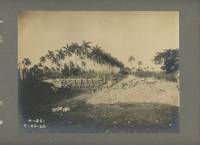
1906réf. List3021La Habana Province Republic of Cuba 1906. Twenty-two photographs measuring 7 ¼ x 9 ½ inches mounted on heavy cardstock measuring 10 x 12 inches. Photos numbered and dated on negative. In album embossed with “Havana Central Railroad Co./ Progress Photographs/ GUANAJAY”. Photos with fine contrast and some wear; mounts with minor damage slightly warped with some detached from binding. Overall excellent. Havana Central Railroad Company was an American company formed in April 1905. It opened two electric tram lines—Havana to Guanajay in 1906 and Havana to Güines in 1907—before it was bought by the English company United Railways following the Panic of 1907. Offered here is a photo album showing the construction of the Guanajay line. The photographs show laborers assisted by horse-drawn carts digging culverts laying tracks and erecting bridges and buildings. This project came on the heels of the successful efforts of the Cuba Company another railroad company to make the emerging Cuban Republic amenable to American business.They did so first by using ‘revocable permits’ which could ostensibly be revoked by the new government when it was formed to circumvent the Foraker Amendment prohibiting concessions to American companies by the US’s military government; and second by using their close relationships to several members of the Cuban Constitutional Convention to include a law allowing irrevocable permits.1 These along with the Platt Amendment and Governor Leonard Wood’s General Railway Law led to what would amount to domination by US interests in Cuba particularly but not exclusively in the railroad industry.2 Of interest to scholars of the early Republic of Cuba especially the history of US businesses in the country. 1 Juan C. Santamarina “The Cuba Company and the Expansion of American Business in Cuba 1898–1915” The Business History Review 74 no. 1 Spring 2000: 41–83. 2 Louis A. Pérez Jr. “Insurrection Intervention and the Transformation of Land Tenure Systems in Cuba 1895–1902” Hispanic American Historical Review 65 no. 2 1985: 229–254. unknown books
1906réf. List3021La Habana Province Republic of Cuba 1906. Twenty-two photographs measuring 7 ¼ x 9 ½ inches mounted on heavy cardstock measuring 10 x 12 inches. Photos numbered and dated on negative. In album embossed with “Havana Central Railroad Co./ Progress Photographs/ GUANAJAY”. Photos with fine contrast and some wear; mounts with minor damage slightly warped with some detached from binding. Overall excellent. Havana Central Railroad Company was an American company formed in April 1905. It opened two electric tram lines—Havana to Guanajay in 1906 and Havana to Güines in 1907—before it was bought by the English company United Railways following the Panic of 1907. Offered here is a photo album showing the construction of the Guanajay line. The photographs show laborers assisted by horse-drawn carts digging culverts laying tracks and erecting bridges and buildings. This project came on the heels of the successful efforts of the Cuba Company another railroad company to make the emerging Cuban Republic amenable to American business.They did so first by using ‘revocable permits’ which could ostensibly be revoked by the new government when it was formed to circumvent the Foraker Amendment prohibiting concessions to American companies by the US’s military government; and second by using their close relationships to several members of the Cuban Constitutional Convention to include a law allowing irrevocable permits.1 These along with the Platt Amendment and Governor Leonard Wood’s General Railway Law led to what would amount to domination by US interests in Cuba particularly but not exclusively in the railroad industry.2 Of interest to scholars of the early Republic of Cuba especially the history of US businesses in the country. 1 Juan C. Santamarina “The Cuba Company and the Expansion of American Business in Cuba 1898–1915” The Business History Review 74 no. 1 Spring 2000: 41–83. 2 Louis A. Pérez Jr. “Insurrection Intervention and the Transformation of Land Tenure Systems in Cuba 1895–1902” Hispanic American Historical Review 65 no. 2 1985: 229–254. unknown
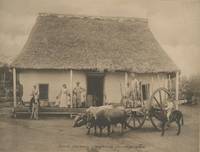
1913réf. List3218Brooklyn New York: The Albertype Co 1913. Photo album of twenty-five 12 ½ x 10 inch pages containing fifty 8 x 6 inch photographs with cardstock cover. Cover and pages worn with marginal damage; pages mostly detached from string binding; photos with captions on negative; Near Fine with Fine contrast. Overall excellent to Near Fine. After the Spanish American War the Isle of Pines now Isla de Juventud in Cuba was contested territory because the 1901 Platt Amendment had specifically left ownership of the island up to a future treaty; the 1904 Hay-Quesada Treaty recognizing Cuban sovereignty over the island failed to be ratified by the US until 1925. American citizens controlled ninety-five per cent or more of the island’s land and were strongly in favor of American annexation. Offered here is a 1913 photo album exhibiting the island’s lush scenery productive farmland and luxurious American residences and resorts. The American property owners are identified by name and include American Residents and Property Owners’ Association President T.J. Keenan who in 1902 described the island under default administration by the Cuban government as “on the verge of anarchy . American interests are absolutely unprotected”1; H.A. Christy Vice President of the Cincinnati Richmond & Muncie Railroad; coal and coke businessman John F. Atcheson and other elites. There are also shots of a number of hotels; grapefruit banana and pineapple farms belonging to the settlers; and recreation by both automobile and boat. Two photographs are not of American ventures: one of the home of José Sarda which housed José Martí before his exile to Spain labeled merely “Nueva Gerona Sarda Homstead”; and one of a house labeled “San Juan Native Homestead” showing a family standing on the porch of their thatched-roof home with an oxcart before them. We find four copies of this photo book on OCLC. Of interest to historians of US imperialism in Cuba following the military withdrawal. 1 “The Isle of Pines President Orders Investigation of Affairs There” The Press-Herald November 15 1902 2. The Albertype Co unknown books
1913réf. List3218Brooklyn New York: The Albertype Co 1913. Photo album of twenty-five 12 ½ x 10 inch pages containing fifty 8 x 6 inch photographs with cardstock cover. Cover and pages worn with marginal damage; pages mostly detached from string binding; photos with captions on negative; Near Fine with Fine contrast. Overall excellent to Near Fine. After the Spanish American War the Isle of Pines now Isla de Juventud in Cuba was contested territory because the 1901 Platt Amendment had specifically left ownership of the island up to a future treaty; the 1904 Hay-Quesada Treaty recognizing Cuban sovereignty over the island failed to be ratified by the US until 1925. American citizens controlled ninety-five per cent or more of the island’s land and were strongly in favor of American annexation. Offered here is a 1913 photo album exhibiting the island’s lush scenery productive farmland and luxurious American residences and resorts. The American property owners are identified by name and include American Residents and Property Owners’ Association President T.J. Keenan who in 1902 described the island under default administration by the Cuban government as “on the verge of anarchy . American interests are absolutely unprotected”1; H.A. Christy Vice President of the Cincinnati Richmond & Muncie Railroad; coal and coke businessman John F. Atcheson and other elites. There are also shots of a number of hotels; grapefruit banana and pineapple farms belonging to the settlers; and recreation by both automobile and boat. Two photographs are not of American ventures: one of the home of José Sarda which housed José Martí before his exile to Spain labeled merely “Nueva Gerona Sarda Homstead”; and one of a house labeled “San Juan Native Homestead” showing a family standing on the porch of their thatched-roof home with an oxcart before them. We find four copies of this photo book on OCLC. Of interest to historians of US imperialism in Cuba following the military withdrawal. 1 “The Isle of Pines President Orders Investigation of Affairs There” The Press-Herald November 15 1902 2. The Albertype Co unknown
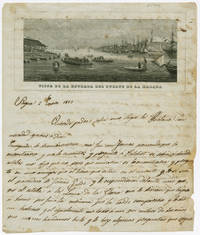
1853réf. 54601Havana. 1853. Writing Home from Havana An attractive Cuban pictorial lettersheet with a neatly executed third-page lithograph illustration of the port of Havana. The image depicts several small boats rowing barrels to and from a loading dock. In another small boat a plantation owner or some form of dignitary is being rowed to shore by a crew of men. On the right side of the image several larger ships lie at anchor and in the background on the shore is the fort guarding the mouth of the harbor the Morro Castle. The sheet is filled out by a man named Juan Fabre writing to his parents on Jan. 2 1853 advising them of his safe arrival in Havana. He talks about meeting up with a relative that he had not seen in two years and working at a shoe shop with another relative who adds a brief post script on the verso of the second leaf. Pictorial lettersheets of Cuba are quite rare on the market. Previously folded. Some chipping at fore-edge slightly affecting text. Light dampstaining and tanning. About very good. unknown books
1853réf. 54601Havana. 1853. Writing Home from Havana An attractive Cuban pictorial lettersheet with a neatly executed third-page lithograph illustration of the port of Havana. The image depicts several small boats rowing barrels to and from a loading dock. In another small boat a plantation owner or some form of dignitary is being rowed to shore by a crew of men. On the right side of the image several larger ships lie at anchor and in the background on the shore is the fort guarding the mouth of the harbor the Morro Castle. The sheet is filled out by a man named Juan Fabre writing to his parents on Jan. 2 1853 advising them of his safe arrival in Havana. He talks about meeting up with a relative that he had not seen in two years and working at a shoe shop with another relative who adds a brief post script on the verso of the second leaf. Pictorial lettersheets of Cuba are quite rare on the market. Previously folded. Some chipping at fore-edge slightly affecting text. Light dampstaining and tanning. About very good. unknown