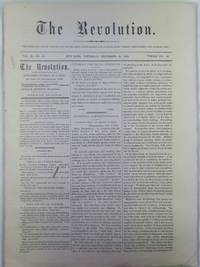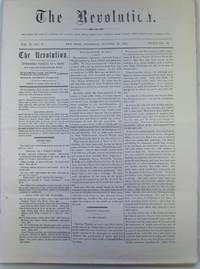
1868ref. 020291New York: Susan B. Anthony Proprietor; R.J. Johnson Publisher 1868. Wraps. Good. Side sewn journal. Approximately 12 ¼ by 9 inches. 16 pp. arly issue of the Revolution a groundbreaking and influential newspaper produced by Elizabeth Cady Stanton Susan B. Anthony and Parker Pillsbury. The paper was established to provide a voice to activists and suffragists such as Stanton and Anthony whose voices were marginalized by the mainstream press as well as many abolitionist publications with whom they had been previously allied. Anthony and Stanton advocated for an amendment giving suffrage to women along with the amendment sponsored by abolitionists that would give Black men the right to vote. Many abolitionists actively discouraged Stanton and Anthony from pursuing their amendment until the amendment enfranchising Black men passed creating a rift in the abolitionist movement as well as the women's suffrage movement. Feeling betrayed by abolitionists and Republicans who initially supported them they established the Revolution with financial help from George Francis Train a Democrat who supported women's rights but was openly racist. As the name indicates The Revolution adopted a combative radical tone with Stanton and others unafraid to take on critics. The paper openly discussed sexual and physical abuse in marriage and advocated better divorce laws that would offer women a way to escape abusive marriages. In 1869 the paper broke with Train who had supplied very little of the funding he initially offered. It published until 1872 struggling to make expenses along the way. This issue with a lengthy profile of Anna Elizabeth Dickinson written by Elizabeth Cady Stanton as well as an essay on marriage and mistresses that questions legal rulings favoring men in marriage over women. Also present is an essay by actor and writer Olive Logan titled "U.S". GOOD condition. Several fold creases present with other general wrinkling. Minor toning and scattered soiling in the interior. Small tear affecting the title at the top of the first page appearing to have happened during the printing. Susan B. Anthony, Proprietor; R.J. Johnson, Publisher unknown
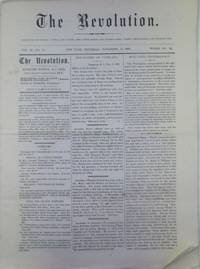
1868ref. 020339New York: Susan B. Anthony Proprietor; R.J. Johnson Publisher 1868. Wraps. Fair. Side sewn journal. Approximately 12 ¼ by 9 inches. 16 pp. Early issue of the Revolution a groundbreaking and influential newspaper produced by Elizabeth Cady Stanton Susan B. Anthony and Parker Pillsbury. The paper was established to provide a voice to activists and suffragists such as Stanton and Anthony whose voices were marginalized by the mainstream press as well as many abolitionist publications with whom they had been previously allied. Anthony and Stanton advocated for an amendment giving suffrage to women along with the amendment sponsored by abolitionists that would give Black men the right to vote. Many abolitionists actively discouraged Stanton and Anthony from pursuing their amendment until the amendment enfranchising Black men passed creating a rift in the abolitionist movement as well as the women's suffrage movement. Feeling betrayed by abolitionists and Republicans who initially supported them they established the Revolution with financial help from George Francis Train a Democrat who supported women's rights but was openly racist. As the name indicates The Revolution adopted a combative radical tone with Stanton and others unafraid to take on critics. The paper openly discussed sexual and physical abuse in marriage and advocated better divorce laws that would offer women a way to escape abusive marriages. In 1869 the paper broke with Train who had supplied very little of the funding he initially offered. It published until 1872 struggling to make expenses along the way. This issue with a lengthy column editorial correspondence written by Elizabeth Cady Stanton wherein she discusses her time in Philadelphia and Pennsylvania as well as the case of Hester Vaughn. There are two other lengthy articles on Hester Vaughn one written by Elizabeth Cady Stanton. Vaughan was tried and convicted of murdering her newborn baby to which she gave birth alone. The circumstances around the birth and death the child were murky and she was sentenced to death by an all male jury. The Revolution took up her case seeking her pardon and inferred she was raped. Stanton and Anthony attracted a lot of publicity to the case. Vaughn was eventually pardoned by the governor of Pennsylvania and sent back to England. The cause proved a bit divisive for Stanton and Anthony and the Revolution with modern historians asserting it helped to set back their work for women's suffrage. FAIR condition. Front leaf DETACHED with the binding a bit fragile. Several fold creases present with other general wrinkling. Minor toning and scattered soiling in the interior. Susan B. Anthony, Proprietor; R.J. Johnson, Publisher unknown
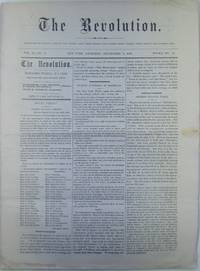
1868ref. 020366New York: Susan B. Anthony Proprietor; R.J. Johnson Publisher 1868. Wraps. Good. Side sewn journal. Approximately 12 ¼ by 9 inches. 16 pp. Early issue of the Revolution a groundbreaking and influential newspaper produced by Elizabeth Cady Stanton Susan B. Anthony and Parker Pillsbury. The paper was established to provide a voice to activists and suffragists such as Stanton and Anthony whose voices were marginalized by the mainstream press as well as many abolitionist publications with whom they had been previously allied. Anthony and Stanton advocated for an amendment giving suffrage to women along with the amendment sponsored by abolitionists that would give Black men the right to vote. Many abolitionists actively discouraged Stanton and Anthony from pursuing their amendment until the amendment enfranchising Black men passed creating a rift in the abolitionist movement as well as the women's suffrage movement. Feeling betrayed by abolitionists and Republicans who initially supported them they established the Revolution with financial help from George Francis Train a Democrat who supported women's rights but was openly racist. As the name indicates The Revolution adopted a combative radical tone with Stanton and others unafraid to take on critics. The paper openly discussed sexual and physical abuse in marriage and advocated better divorce laws that would offer women a way to escape abusive marriages. In 1869 the paper broke with Train who had supplied very little of the funding he initially offered. It published until 1872 struggling to make expenses along the way. This issue with a piece "The Dignity of the Ballot" and an account of the Boston Woman's Suffrage Convention both written by Elizabeth Cady Stanton. GOOD condition. Several fold creases present with other general wrinkling. Minor toning and scattered soiling in the interior. Small crease to the lower front page corner. Susan B. Anthony, Proprietor; R.J. Johnson, Publisher unknown
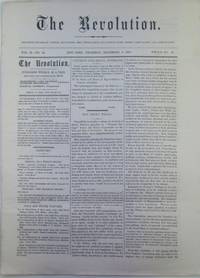
1868ref. 020469New York: Susan B. Anthony Proprietor; R.J. Johnson Publisher 1868. Wraps. Good. Side sewn journal. Approximately 12 ¼ by 9 inches. 16 pp. Early issue of the Revolution a groundbreaking and influential newspaper produced by Elizabeth Cady Stanton Susan B. Anthony and Parker Pillsbury. The paper was established to provide a voice to activists and suffragists such as Stanton and Anthony whose voices were marginalized by the mainstream press as well as many abolitionist publications with whom they had been previously allied. Anthony and Stanton advocated for an amendment giving suffrage to women along with the amendment sponsored by abolitionists that would give Black men the right to vote. Many abolitionists actively discouraged Stanton and Anthony from pursuing their amendment until the amendment enfranchising Black men passed creating a rift in the abolitionist movement as well as the women's suffrage movement. Feeling betrayed by abolitionists and Republicans who initially supported them they established the Revolution with financial help from George Francis Train a Democrat who supported women's rights but was openly racist. As the name indicates The Revolution adopted a combative radical tone with Stanton and others unafraid to take on critics. The paper openly discussed sexual and physical abuse in marriage and advocated better divorce laws that would offer women a way to escape abusive marriages. In 1869 the paper broke with Train who had supplied very little of the funding he initially offered. It published until 1872 struggling to make expenses along the way. This issue with a lengthy article written by Elizabeth Cady Stanton on women's suffrage in Texas as well as a shorter piece asking "What is a Democrat" Two short pieces on the front page look at a new suffrage movement in Boston regarding 18 year old boys and woman suffrage in Michigan. An anonymous piece discusses "Indian Troubles in Kansas" describing attacks on white settlers by various tribes in the region. The author asserts that the Native American image as described by Longfellow peaceful is wrong and asserting that "murder and plunder are their ruling spirit." GOOD condition. Several fold creases present with other general wrinkling. Minor toning and scattered soiling in the interior. Front and rear page tenuously attached along the spine. Susan B. Anthony, Proprietor; R.J. Johnson, Publisher unknown
1868ref. 020532New York: Susan B. Anthony Proprietor; R.J. Johnson Publisher 1868. Wraps. Good. Side sewn journal. Approximately 12 ¼ by 9 inches. 16 pp. Early issue of the Revolution a groundbreaking and influential newspaper produced by Elizabeth Cady Stanton Susan B. Anthony and Parker Pillsbury. The paper was established to provide a voice to activists and suffragists such as Stanton and Anthony whose voices were marginalized by the mainstream press as well as many abolitionist publications with whom they had been previously allied. Anthony and Stanton advocated for an amendment giving suffrage to women along with the amendment sponsored by abolitionists that would give Black men the right to vote. Many abolitionists actively discouraged Stanton and Anthony from pursuing their amendment until the amendment enfranchising Black men passed creating a rift in the abolitionist movement as well as the women's suffrage movement. Feeling betrayed by abolitionists and Republicans who initially supported them they established the Revolution with financial help from George Francis Train a Democrat who supported women's rights but was openly racist. As the name indicates The Revolution adopted a combative radical tone with Stanton and others unafraid to take on critics. The paper openly discussed sexual and physical abuse in marriage and advocated better divorce laws that would offer women a way to escape abusive marriages. In 1869 the paper broke with Train who had supplied very little of the funding he initially offered. It published until 1872 struggling to make expenses along the way. This issue with a lengthy piece on Hon. Henry Wilson being harshly critical and mocking written by Elizabeth Cady Stanton. GOOD condition. Several fold creases present with other general wrinkling. Minor toning and scattered soiling in the interior. Susan B. Anthony, Proprietor; R.J. Johnson, Publisher unknown
ref. 013720New York: Virtue and Yorston. Half-Leather. Good. no date presumed circa 1867 or 1877 based on a date on the half title illustration of volume three and a misbound map in the same volume with a date of 1877. Half leather with brown cloth. Small folios. 664 680 738 pp. All illustrations present as called for although a map from volume 3 is misbound in volume one with a few other portraits misbound or DETACHED and laid in. A reprint of this work originally published under the title "The War with the South" and issued in parts. This edition continued and finished by Benjamin Smith. A general history of the Civil War looking at the various battles campaigns notable figures etc. GOOD condition. A few illustrations detached but present. Heavy scuffing to the leather along the extremities and spine with general fading and otherwise minor scuffing to the covers. Minor soiling and staining to the covers. Interiors with light scattered soiling and uneven heavy toning to some of the pages. Some foxing to some of the plates. See Dornbush Volume 3 #257 for this work with a Worthington imprint. Virtue and Yorston unknown
1887ref. 011564Washington: Government Printing Office 1887. Half Leather. Good. Half leather with marbled boards. Pagination varies throughout. Nine volumes including index volumes plus a report volume containing testimony from railroad officials government officials and others associated with railroads in the United States ascertaining their finances and benefit to the US government and how the financing and relationship between the government and railroads should continue. GOOD condition. Moderate to heavy scuffing to the leather along the extremities and hinges. Owner's name in gilt at the foot of each spine. Minor fading. Some dustiness and light soiling to the covers. Light toning to the paper. Government Printing Office unknown
(Núremberg), 1754, mapa con los contornos coloreados de 21’5 x 33 cm., que contiene las islas de Santo Domingo, Jamaica, Puerto Rico y la parte occidental de Cuba.
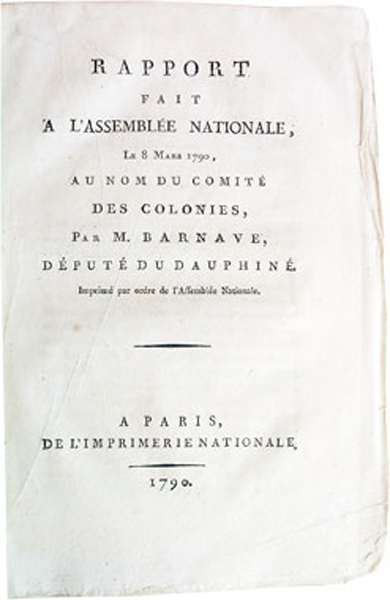
ref. 13233Paris, Imprimerie Nationale, 1790. In-8, broché, couverture papier moderne, 24 p.
In-8, broché, couverture papier fort (rel. moderne), 11 p. (qqs rouss.). Edition originale. Le rapport qui relança le débat sur la citoyenneté des hommes de couleurs et des "Nègres libres". "Le député de la Somme propose qu'aucun règlement sur l'état des personnes ne puisse être pris par le Conseil législatif sans la demande précise et formelle des assemblées coloniales. A la suite des interventions de Pétion, Destutt et de Grégoire cette initiative avorte" (Pluchon, 'Histoire de la colonisation', p. 880). Le rapport est suivi du projet de décret en 16 articles. Bon exemplaire.
1840français In-8 de XII-460 pp.; demi-reliure de l'époque. Deuxième édition revue, corrigée dans toutes ses parties et considérablement augmentée. Contient : I. Typographie de Sainte-Lucie. II. Climat des Antilles. Etc. Deux tampons en marge du titre, Lég. cerne claire dans la partie supérieure des feuillets. Rare.
ref. 201532 pièces réunies en un volume in-8, broché, couverture papier fort (rel. moderne).
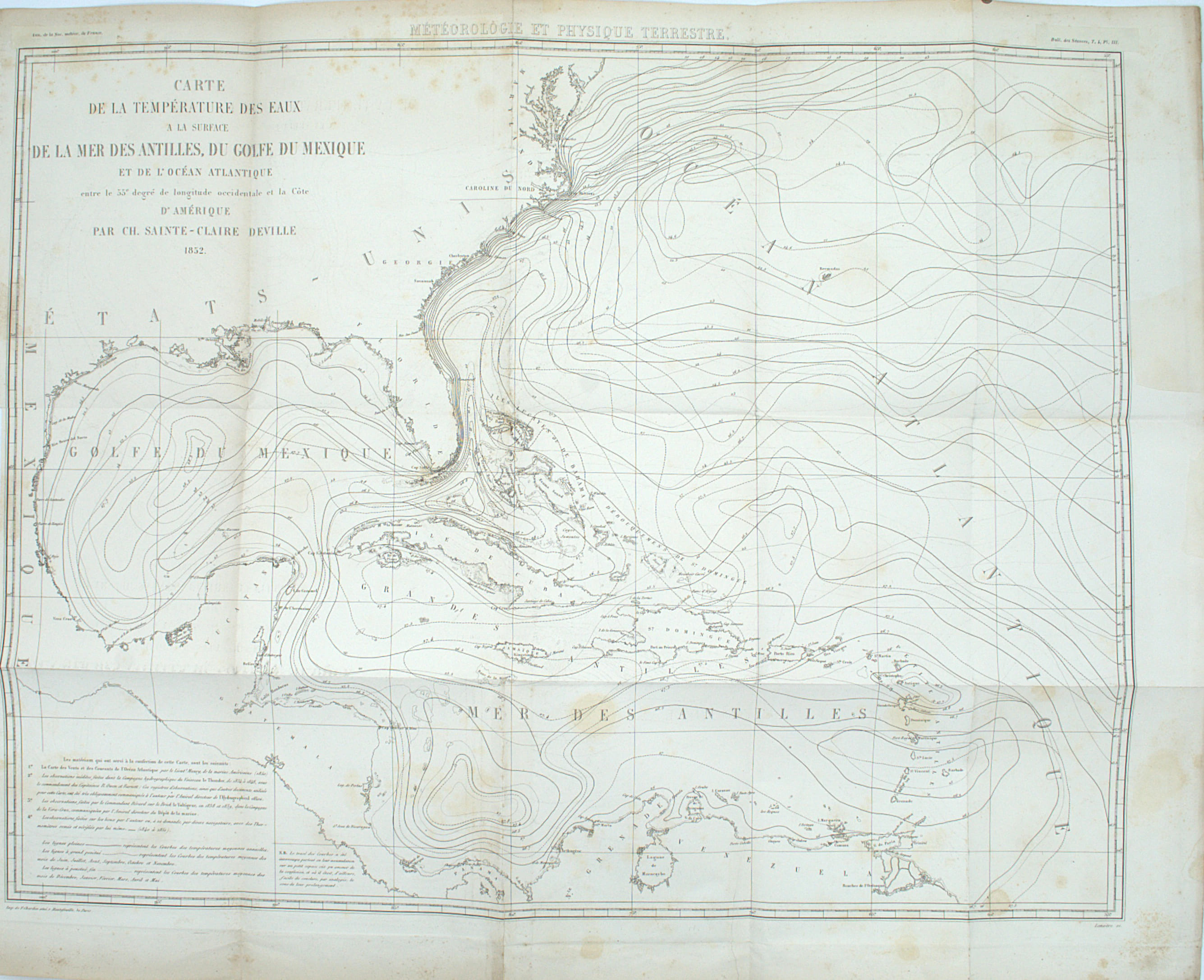
1852ref. PHO-2529Paris, imprimerie de F. Chardon aîné, 1852. Grand in-8 (260x170mm), 6pp., accompagné par une grande carte dépliante (550 × 658 mm), gravée par G. Lemaître. Relié demi toile, auteur et titre au dos. Carte volante.
1740ref. 200020AG1740. Nuremberg Homann Heirs c.1740. Original hand-coloured map. Plate Size: 55.6 cm x 48.7 cm. Sheet Size: 60 cm x 52 cm. Original map. Very good condition. Trace of foxing along sheet edges. Minor open tear with missing material evident to fore edge. Lower margin running out towards left corner. Centre-fold as issued. Sandler S. 136 nach Moll; mit Dat. 1740; Kapp Jamaica 59; Palmer Bermuda 32; Campbell Barbados 26 u. Taf. X; Tooley Antigua 18 u. St. Kitts 23. - Alle Bibliogr. außer Sandler datieren 1737. Very interesting set of five maps on a single sheet showing the highly-prized British possessions in the Caribbean - St. Kitts Antigua Bermuda Barbados and Jamaica - each in excellent detail noting cities rivers roads forts plantations surrounding islands political/administrative subdivisions and a host of other topographical features. The individual maps include separate title and scale bars with most having additional descriptions in German and reference keys. Barbados is orientated with north facing left while the rest are all orientated North. A beautifully decorative title cartouche is presented in the top right and includes the title in Latin as well as German. English/German translations of mapping terms and the text on the maps is in German. Homann Erben/Heirs was a prominent German publishing firm in the European map market throughout the eighteenth century. Founded in 1702 by Johann Baptist Homann the business passed to his son Christoph upon Johanns death in 1724. Christoph died in 1730 aged only 27 and the firm was inherited by subsequent Homann heirs. This changed the name of the company which was known as Homann Erben or Homann heirs. The firm continued in business until 1848. unknown
1743ref. 2914A Amsterdam & à Leizig, Chez Arkstee et Merkus, 1743. 2 volumes in-8 de 8-[4]-382-[26]+ 384-[28] pages. Plein veau marron moucheté, dos lisses ornés de fleurons dorés, pièce de titre de maroquin bordeaux, tranches rouges. Dos frottés, coiffes sup. manquantes, coiffes inf. frottées avec un accroc au vol. 1, plats légèrement épidermés, page de titre raccourcie par le relieur. Ex-libris Marcuard.
ref. 39747London: Printed for J. Roberts 1744. First edition 8vo 4 iv 30pp. with half-title short tear on inner blank margin nineteenth century half calf head of spine chipped. Sometimes attributed to C. A. Heath. The variant with the 'Price six-pence' on the half-title. Sabin 15940; Kress 4708; Goldsmith 8071; Hanson 5819. London: Printed for J. Roberts, 1744 unknown
1790ref. LBW-7775[1790]. In-8 de 3 pp. ; cartonnage de papier marbré marron, pièce de titre marron (reliure moderne).
ref. LBW-7772Paris, Pillet ainé, [début XIX° siècle]. In-8 de 6-(2 bl.) pp.; cartonnage de papier marbré mauve, pièce de titre rouge (reliure moderne).
ref. 236407Basse-Terre, Imprimerie du gouvernement, 1910 in-8, [3] ff. n. ch., 158 pp., demi-toile modeste, dos lisse muet, titre de la première couverture reporté et contrecollé [Grève agricole de 1910] sur le plat supérieur (reliure de l'époque). Traces blanches sur la page de titre couvrant un cachet ou un ex-libris.
ref. 225811Mâcon, Combier, 1935 in-4, [26] ff. n. ch., avec de nombreuses illustrations photographiques dans le texte, broché, dos renforcé. Essais de plume sur la première couverture, dernière couverture très défraîchie.
ref. ORD-13283N°13943 du Bulletin des Lois N°1432. 12 Octobre 1847.. In-8 (ca 145 x 220mm) sans couverture, non rogné, tel que paru. Pages 929 à 935 du bulletin. Papier lgt bruni, bords de feuilles poussiéreux, rares rousseurs, assez bon état.
1764ref. LBW-23601764. 212 x 300 mm.
1788ref. LBW02492[1788]. 236 x 347 mm.
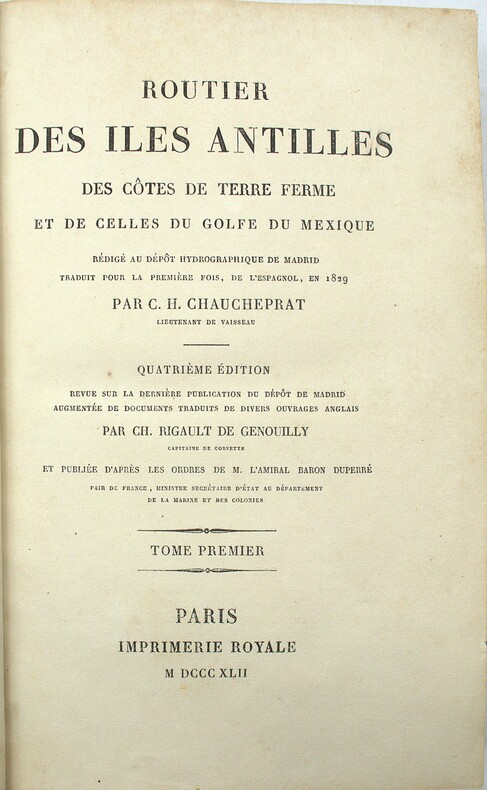
1842ref. PHO-2031Paris, Imprimerie Royale, 1842, 2 volumes in-8 (23x15cm), 1f.-XXII-595pp. & XVI-581pp., demi veau époque, dos lisse avec titre et tomaison, frottements et épidermures, débuts de fentes, accrocs aux coiffes, coins usés, quelques rousseurs.
1789ref. LBW-7793Paris, Baudouin, [1789]. In-8 de 16 pp.; cartonnage de papier marbré vert, pièce de titre verte (reliure moderne).