Various AuthorsBiblio.com

1.980 resultados
1848ref. 020554New York: Greeley and McElrath Publisher 1848. Wraps. Good. no date perhaps late 1847 early 1848. Printed wraps. 64 pp. Two maps present one depicting the region of Texas and present-day Oklahoma; the other depicting the Oregon Territory. An almanac for 1846 issued by the Whig Party in the United States printing a definition of the party and its platform on the front cover. Usual monthly almanac information along with election returns from various states a look at the values of foreign currency and money a declaration of principles of the Whig Party from a convention in Massachusetts etc. Of note are several pieces on the US-Mexican War one discussing the origins of the war and another providing the latest news of the war battles etc. A third is a speech by Tom Corwin on the war. Also present is a printing of a speech by Henry Clay at Lexington Kentucky. GOOD condition. General uneven toning. Minor soiling. Minor spotting. Light wrinkling and edgewear. Text block toned. Small owner's name in ink on the upper front cover. Greeley and McElrath, Publisher unknown
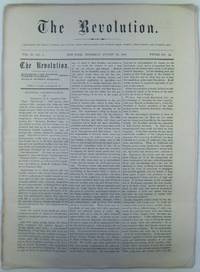
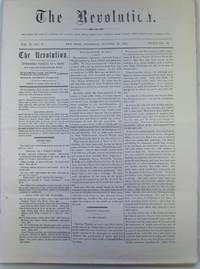
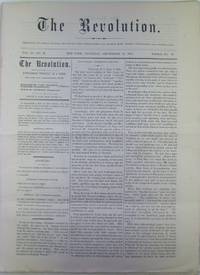
1868ref. 020444New York: Susan B. Anthony Proprietor; R.J. Johnson Publisher 1868. Wraps. Good. Side sewn journal. Approximately 12 ¼ by 9 inches. 16 pp. Early issue of the Revolution a groundbreaking and influential newspaper produced by Elizabeth Cady Stanton Susan B. Anthony and Parker Pillsbury. The paper was established to provide a voice to activists and suffragists such as Stanton and Anthony whose voices were marginalized by the mainstream press as well as many abolitionist publications with whom they had been previously allied. Anthony and Stanton advocated for an amendment giving suffrage to women along with the amendment sponsored by abolitionists that would give Black men the right to vote. Many abolitionists actively discouraged Stanton and Anthony from pursuing their amendment until the amendment enfranchising Black men passed creating a rift in the abolitionist movement as well as the women's suffrage movement. Feeling betrayed by abolitionists and Republicans who initially supported them they established the Revolution with financial help from George Francis Train a Democrat who supported women's rights but was openly racist. As the name indicates The Revolution adopted a combative radical tone with Stanton and others unafraid to take on critics. The paper openly discussed sexual and physical abuse in marriage and advocated better divorce laws that would offer women a way to escape abusive marriages. In 1869 the paper broke with Train who had supplied very little of the funding he initially offered. It published until 1872 struggling to make expenses along the way. This issue with a lengthy article written by Elizabeth Cady Stanton providing "editorial correspondence" on politics Democrats and Republicans etc. Many shorter anonymous articles on suffrage labor and other topics present." GOOD condition. Several fold creases present with other general wrinkling. Minor toning and scattered soiling in the interior. Front and rear leaf separating from the rest of the piece but still intact and tenuously holding on. Susan B. Anthony, Proprietor; R.J. Johnson, Publisher unknown
1889ref. 006146Paris: Librería Española de Garnier Hermanos 1889. Hardcover. Very Good. Nueva Edition Aumentada con un resúmen histórico desde la rendicion de Méjico hasta el fallecimiento de Hernan Cortés é ilustrada con notas." 4 597 p.; 18 cm. Contemporary polished calf spine with marbled paper over boards. Six spine compartments between raised bands. Leather labels in second and third compartments with gilt-tooled author and title "Conquista de Méjico." Gilt-tooled decoration in remaining compartments. All page edges marbled. Marbled endpapers. In Very Good Condition: edges rubbed; spine is sunned; minimal foxing; occasional minor pencilled marginal notations; otherwise clean and tight. Librería Española de Garnier Hermanos hardcover
1977ref. 005254Moscow: Editorial Progreso 1977. Hardcover. Near Fine. 258 6 p.: tables; 21 cm. Light grey cloth with black stamped spine and cover titles; green stamped author's name and publisher's emblem on front cover. No dust jacket. Translation of Latinskaia Amerika by M. Jusainov. This Spanish translation of Boyko's work on imperialism and capitalism in Latin America is very scarce. In Near Fine Condition: cover lightly soiled; pages are clean and tight. Editorial Progreso hardcover
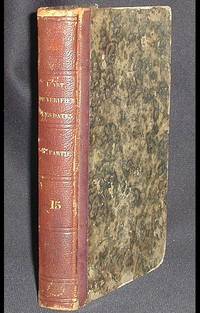
1834ref. 002351Paris: A.J. Dénaina 1834. Hardcover. Very Good. Volume 15 only of 16 volumes: 4 536 p.: tables 1 folded; 21 cm. Contemporary calf spine with gilt-tooled spine title; marbled paper over boards. Marbled endpapers. Running title: Chronologie Historique de l'Amérique. The folded table is not included in pagination. This volume covers the history of Guyana from 1770 to 1834. In Very Good Condition: ends of spine and corners rubbed; faint dampstain on upper corner of pages 273-370 not impacting text; minimal foxing; otherwise pages are clean and tight. A.J. Dénaina hardcover
1868ref. 020422New York: Susan B. Anthony Proprietor; R.J. Johnson Publisher 1868. Wraps. Fair. Side sewn journal. Approximately 12 ¼ by 9 inches. 16 pp. Early issue of the Revolution a groundbreaking and influential newspaper produced by Elizabeth Cady Stanton Susan B. Anthony and Parker Pillsbury. The paper was established to provide a voice to activists and suffragists such as Stanton and Anthony whose voices were marginalized by the mainstream press as well as many abolitionist publications with whom they had been previously allied. Anthony and Stanton advocated for an amendment giving suffrage to women along with the amendment sponsored by abolitionists that would give Black men the right to vote. Many abolitionists actively discouraged Stanton and Anthony from pursuing their amendment until the amendment enfranchising Black men passed creating a rift in the abolitionist movement as well as the women's suffrage movement. Feeling betrayed by abolitionists and Republicans who initially supported them they established the Revolution with financial help from George Francis Train a Democrat who supported women's rights but was openly racist. As the name indicates The Revolution adopted a combative radical tone with Stanton and others unafraid to take on critics. The paper openly discussed sexual and physical abuse in marriage and advocated better divorce laws that would offer women a way to escape abusive marriages. In 1869 the paper broke with Train who had supplied very little of the funding he initially offered. It published until 1872 struggling to make expenses along the way. This with a lengthy editorial by Elizabeth Cady Stanton on a proposed amendment for manhood suffrage harshly criticizing the amendment. FAIR condition. Front and rear leaf very tenuously attached with the binding a bit fragile. Front leaf being held on by a torn small section of margin. Several fold creases present with other general wrinkling. Minor toning and scattered soiling in the interior. Susan B. Anthony, Proprietor; R.J. Johnson, Publisher unknown
1970ref. 020528South Berwick ME: Old Berwick Historical Society 1970. Hard Cover. Good/No Jacket. Hard cover. No jacket. A reprint of the 1903 edition. 822 pages including index. With photos and illustrations. A list of patrons included in the rear. An extensive history of Kittery Maine from its establishment to the important families that settled in Kittery as well a history of skirmishes with Native Americans municipal history genealogical information etc. In GOOD condition. Minor soiling and edgewear to the covers. Foxing present along the page edges. Old Berwick Historical Society unknown
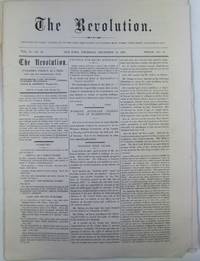
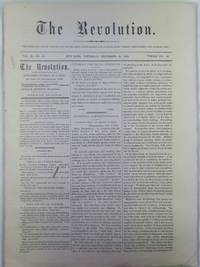
1868ref. 020395New York: Susan B. Anthony Proprietor; R.J. Johnson Publisher 1868. Wraps. Good. Side sewn journal. Approximately 12 ¼ by 9 inches. 16 pp. Early issue of the Revolution a groundbreaking and influential newspaper produced by Elizabeth Cady Stanton Susan B. Anthony and Parker Pillsbury. The paper was established to provide a voice to activists and suffragists such as Stanton and Anthony whose voices were marginalized by the mainstream press as well as many abolitionist publications with whom they had been previously allied. Anthony and Stanton advocated for an amendment giving suffrage to women along with the amendment sponsored by abolitionists that would give Black men the right to vote. Many abolitionists actively discouraged Stanton and Anthony from pursuing their amendment until the amendment enfranchising Black men passed creating a rift in the abolitionist movement as well as the women's suffrage movement. Feeling betrayed by abolitionists and Republicans who initially supported them they established the Revolution with financial help from George Francis Train a Democrat who supported women's rights but was openly racist. As the name indicates The Revolution adopted a combative radical tone with Stanton and others unafraid to take on critics. The paper openly discussed sexual and physical abuse in marriage and advocated better divorce laws that would offer women a way to escape abusive marriages. In 1869 the paper broke with Train who had supplied very little of the funding he initially offered. It published until 1872 struggling to make expenses along the way. This issue with a continuation of a lengthy profile of Anna Elizabeth Dickinson written by Elizabeth Cady Stanton as well as five shorter pieces by her: "The Old Year Gone" "Roll up the Petitions" "Henry Ward Beecher" "Henry James on Woman" and "Hearth and Home." A short column by Susan B. Anthony is present thanking their helpers. Also of note is a report on the Working Women's Association by Sarah Norton in which she reports in detail on the work of rag pickers in New York City. GOOD condition. Rear leaf very tenuously attached with the binding a bit fragile. Rear leaf also rather toned. Several fold creases present with other general wrinkling. Minor toning and scattered soiling in the interior. Susan B. Anthony, Proprietor; R.J. Johnson, Publisher unknown
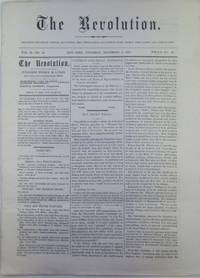
1868ref. 020366New York: Susan B. Anthony Proprietor; R.J. Johnson Publisher 1868. Wraps. Good. Side sewn journal. Approximately 12 ¼ by 9 inches. 16 pp. Early issue of the Revolution a groundbreaking and influential newspaper produced by Elizabeth Cady Stanton Susan B. Anthony and Parker Pillsbury. The paper was established to provide a voice to activists and suffragists such as Stanton and Anthony whose voices were marginalized by the mainstream press as well as many abolitionist publications with whom they had been previously allied. Anthony and Stanton advocated for an amendment giving suffrage to women along with the amendment sponsored by abolitionists that would give Black men the right to vote. Many abolitionists actively discouraged Stanton and Anthony from pursuing their amendment until the amendment enfranchising Black men passed creating a rift in the abolitionist movement as well as the women's suffrage movement. Feeling betrayed by abolitionists and Republicans who initially supported them they established the Revolution with financial help from George Francis Train a Democrat who supported women's rights but was openly racist. As the name indicates The Revolution adopted a combative radical tone with Stanton and others unafraid to take on critics. The paper openly discussed sexual and physical abuse in marriage and advocated better divorce laws that would offer women a way to escape abusive marriages. In 1869 the paper broke with Train who had supplied very little of the funding he initially offered. It published until 1872 struggling to make expenses along the way. This issue with a piece "The Dignity of the Ballot" and an account of the Boston Woman's Suffrage Convention both written by Elizabeth Cady Stanton. GOOD condition. Several fold creases present with other general wrinkling. Minor toning and scattered soiling in the interior. Small crease to the lower front page corner. Susan B. Anthony, Proprietor; R.J. Johnson, Publisher unknown
2011ref. 020458Orono ME: Maine Folklife Center Publisher 2011. Wraps. Near Fine. Glossy blue wraps. CD present in inside rear cover. 327 pp. Short examples of musical notation throughout. A continuation of a work originally published in 1929. It further continues the work of the first providing origins recreations textual patterns and singing styles along with discussion of the importance of the folk songs gathered. NEAR FINE condition. In original shrinkwrap with little visible wear. Maine Folklife Center, Publisher unknown
1926ref. 020463Chicago: Fashion Art League of America Publisher 1926. Wraps. Good. Green wraps with lettering stamped in gilt. 24 pp. including ads. A few ads with illustrations. A program of events for a convention held by the Fashion League of America listing the board of directors members of various committees etc. as well as a list of talks and fashion shows to be held. This includes an opening fashion show and one displaying French fashions. Talks look at the business side of dressmaking and fashion. The Fashion Art League of America was founded by Alla Ripley Bannister in 1913 after she became president of the Chicago Dressmakers Club and reorganized it. Going by her professional name Madame Ripley she was influential in promoting fashion as an art and establishing it as a business for women at a time when women were expected to give up work once married. She took part in a 1913 fashion show in Chicago that featured dresses and clothing inspired by European Cubism and worked throughout her career to promote American fashion as equal or superior to French fashions see The Beverly Review Sept. 17 2019 article for previous information. GOOD condition. Minor toning and soiling to the covers. Light bumping and creasing along the edges. Small doodle on the lower front cover. Two small notes on the last blank page. Fashion Art League of America, Publisher unknown
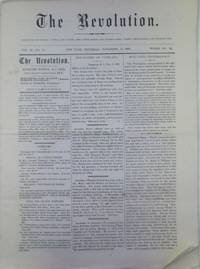
1868ref. 020339New York: Susan B. Anthony Proprietor; R.J. Johnson Publisher 1868. Wraps. Fair. Side sewn journal. Approximately 12 ¼ by 9 inches. 16 pp. Early issue of the Revolution a groundbreaking and influential newspaper produced by Elizabeth Cady Stanton Susan B. Anthony and Parker Pillsbury. The paper was established to provide a voice to activists and suffragists such as Stanton and Anthony whose voices were marginalized by the mainstream press as well as many abolitionist publications with whom they had been previously allied. Anthony and Stanton advocated for an amendment giving suffrage to women along with the amendment sponsored by abolitionists that would give Black men the right to vote. Many abolitionists actively discouraged Stanton and Anthony from pursuing their amendment until the amendment enfranchising Black men passed creating a rift in the abolitionist movement as well as the women's suffrage movement. Feeling betrayed by abolitionists and Republicans who initially supported them they established the Revolution with financial help from George Francis Train a Democrat who supported women's rights but was openly racist. As the name indicates The Revolution adopted a combative radical tone with Stanton and others unafraid to take on critics. The paper openly discussed sexual and physical abuse in marriage and advocated better divorce laws that would offer women a way to escape abusive marriages. In 1869 the paper broke with Train who had supplied very little of the funding he initially offered. It published until 1872 struggling to make expenses along the way. This issue with a lengthy column editorial correspondence written by Elizabeth Cady Stanton wherein she discusses her time in Philadelphia and Pennsylvania as well as the case of Hester Vaughn. There are two other lengthy articles on Hester Vaughn one written by Elizabeth Cady Stanton. Vaughan was tried and convicted of murdering her newborn baby to which she gave birth alone. The circumstances around the birth and death the child were murky and she was sentenced to death by an all male jury. The Revolution took up her case seeking her pardon and inferred she was raped. Stanton and Anthony attracted a lot of publicity to the case. Vaughn was eventually pardoned by the governor of Pennsylvania and sent back to England. The cause proved a bit divisive for Stanton and Anthony and the Revolution with modern historians asserting it helped to set back their work for women's suffrage. FAIR condition. Front leaf DETACHED with the binding a bit fragile. Several fold creases present with other general wrinkling. Minor toning and scattered soiling in the interior. Susan B. Anthony, Proprietor; R.J. Johnson, Publisher unknown
1782ref. CA0094lii315 pages. Octavo 8" x 5 3/4" bound in full leather with gilt lettering to spine. Translated with notes by Pedro Varela y Ulloa. Palau 196692. First Spanish edition. A text that engaged the well-studied debates about the natural history of the Americas and Spain's colonial history. In 1780 in Venice Juan Nuix published Riflessioni imparziali supra l'umanita degli spagnuoli nell' Indie contro i pretersi filosofi e politici. Nuix a Catalan living in Italy since the expulsion of the Jesuits wrote the book to defend Spanish colonialism and historiography against the attacks of Robertson and Raynal. It sailed by the censors in the Council of the Indies and two separate translations appeared in succession one in 1782 edited by a member of the Royal Council Pedro Varela y Ulloa and another in 1783 by Joseph Nuix Juan's brother. The Spanish edition sponsored by the crown opened with an essay by Varela y Ulloa in which he first offered a searing Critique of traditional forms of colonialism not unlike that put forth by Raynal. After describing military campaigns in foreign lands from Alexander the Great to Genghis Kahn as butcheries Varela y Ulloa went on to claim that the Spanish colonialism was unique. The crimes attributed to Spain in the Indies had been committed by private individuals who did not represent the nation as a whole and who had acted as they did while surrounded by hungry cannibals. Moreover compared with the atrocities committed by other European colonial powers the actions of the Spaniards looked like misdemeanors. Varela y Ulloa's effort to portray Spanish colonialism as unique benign captured the essence of Nuix's thesis well. Nuix's defense of the record of Spanish colonialism opened with passages that sought to bolster his credibility by stressing that he was a Catalan and that Catalans had not really participated in the Spanish colonization of the Indies so that he could not be accused of being partisan. He then articulated a five-pronged defense of Castilian colonial behavior in America seeking to demonstrate the unreliability of the sources used by Robertson and Raynal and of their interpretations. Nuix First set out to prove that charges of Spanish cruelty to Amerindians were exaggerations originally put into circulation by writers such as Las Casas whose reports on the destruction of the Indies were at the root of most foreign criticisms of Spain. According to Nuix Las Casas was of Flemish origin which explained why he had sought to undermine Spain. Las Casas also often contradicted himself Nuix argued no impartial jury could trust such "an inept" witness. Foreign historians who had echoed Las Casas's allegations were not credible either not Robertson whose moderation had prompted him to dismiss Las Casas. Robertson had selected and reinterpreted the testimony of Spanish witnesses when recounting various colonial massacres. Instead of quoting them moreover Robertson had manipulated the testimony of witnesses to depict the Amerindians as passive victims of Spanish cruelty. History was not a matter of interpretation however but of faithfully presenting the testimony of witnesses and in that respect Robertson lacked credibility. In order to prove that Spaniards in America had not behaved like greedy barbarians Nuix argued that the alleged depopulation caused by the Conquest was the product of factors outside human control. The infantile susceptibility of the natives to disease for example was why epidemics had wiped them out. The barrenness of the Americas and the idleness of the originally small number of natives had moved the conquerors to create economies based on mining and large estates. Such economies along with the foreign monopoly on colonial trade not Spanish cruelty and greed Nuix contended were responsible for having slowed both markets and population growth. Condition: Provenance: Book plate of Alberto Parreño formerly president of the Cuban Chamber of Commerce in New York to front paste down. Spine head chipped rubbing to edges and corners very crisp internally else about a very good copy. Joachin Ibarra hardcover
ref. 020421Cleveland OH: Social Welfare Department Cleveland Church Federation Publisher. Wraps. Good. no date circa 1958. Wraps. 22 pp. A report based on a survey of churches that were part of the Cleveland Church Federation analyzing the statistics gathered to establish how inclusive Cleveland churches were. While piece concludes that churches were not as segregated as they once were they still had a long way to go. GOOD condition. Uneven fading and toning to the wrappers with some soiling and wrinkling. Old price in red crayon on the front cover. Social Welfare Department, Cleveland Church Federation, Publisher unknown
ref. 020423St. Louis MO: Paramount Progressive Order of Moose Publisher. Unbound. Good. no date perhaps circa 1922. Single sheet 6 by 4 inches. Small piece that looks like it was to have been folded into a 4 page booklet although this is unfolded. A promotional piece issued by the Paramount Progressive Order of Moose an African American fraternal organization very similar to the Loyal Order of Moose. The Loyal Order of Moose did not allow African Americans into their organization so this and other similar organizations were founded to serve the needs of African Americans. The Paramount Progressive Order of Moose appears to have ceased operations by the early 1930s perhaps partly due to lawsuits it faced from the Loyal Order of Moose for its use of their imagery. This piece discusses mentions the building of a tabernacle for parentless children as well as the Moose's goals of feeding and educating the children. With a list of dues. GOOD condition. Minor fading staining and creasing. Paramount Progressive Order of Moose, Publisher unknown
1868ref. 020291New York: Susan B. Anthony Proprietor; R.J. Johnson Publisher 1868. Wraps. Good. Side sewn journal. Approximately 12 ¼ by 9 inches. 16 pp. arly issue of the Revolution a groundbreaking and influential newspaper produced by Elizabeth Cady Stanton Susan B. Anthony and Parker Pillsbury. The paper was established to provide a voice to activists and suffragists such as Stanton and Anthony whose voices were marginalized by the mainstream press as well as many abolitionist publications with whom they had been previously allied. Anthony and Stanton advocated for an amendment giving suffrage to women along with the amendment sponsored by abolitionists that would give Black men the right to vote. Many abolitionists actively discouraged Stanton and Anthony from pursuing their amendment until the amendment enfranchising Black men passed creating a rift in the abolitionist movement as well as the women's suffrage movement. Feeling betrayed by abolitionists and Republicans who initially supported them they established the Revolution with financial help from George Francis Train a Democrat who supported women's rights but was openly racist. As the name indicates The Revolution adopted a combative radical tone with Stanton and others unafraid to take on critics. The paper openly discussed sexual and physical abuse in marriage and advocated better divorce laws that would offer women a way to escape abusive marriages. In 1869 the paper broke with Train who had supplied very little of the funding he initially offered. It published until 1872 struggling to make expenses along the way. This issue with a lengthy profile of Anna Elizabeth Dickinson written by Elizabeth Cady Stanton as well as an essay on marriage and mistresses that questions legal rulings favoring men in marriage over women. Also present is an essay by actor and writer Olive Logan titled "U.S". GOOD condition. Several fold creases present with other general wrinkling. Minor toning and scattered soiling in the interior. Small tear affecting the title at the top of the first page appearing to have happened during the printing. Susan B. Anthony, Proprietor; R.J. Johnson, Publisher unknown
1869ref. 020389Washington: Government Printing Office 1869. Disbound. Good. Disbound government document lacking any wrappers or spine holding it together. 239 pp. all loose but complete. It appears all pages were slightly cropped along the left edge and perhaps the other edges as well. A US government document providing lengthy testimony on the voter suppression disenfranchisement and violence encountered by African Americans in the state of Georgia when trying to vote or serve in office. Governor Rufus Bullock opens the testimony recalling several incidents of violence and intimidation and discusses the expulsion from state congress of 29 African Americans elected to office. Following his testimony Henry McNeal Turner testifies as to his experiences as a leader in the African Methodist Episcopal Church working in Georgia. Bullock worked to establish equal rights for African Americans in Georgia becoming the "most hated man in the state." He left Georgia in 1871 due to threats made by the Ku Klux Klan. GOOD condition. Disbound with wear as noted above. Presumably ex-library with a faint library name stamped on the page edges. Uneven toning to the pages heavy to several. Government Printing Office unknown
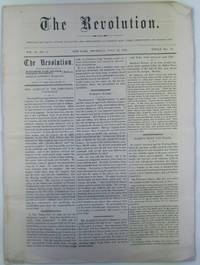
1868ref. 020242New York: Susan B. Anthony Proprietor; R.J. Johnson Publisher 1868. Wraps. Good. Side sewn journal. Approximately 12 ¼ by 9 inches. 16 pp. Early issue of the Revolution a groundbreaking and influential newspaper produced by Elizabeth Cady Stanton Susan B. Anthony and Parker Pillsbury. The paper was established to provide a voice to activists and suffragists such as Stanton and Anthony whose voices were marginalized by the mainstream press as well as many abolitionist publications with whom they had been previously allied. Anthony and Stanton advocated for an amendment giving suffrage to women along with the amendment sponsored by abolitionists that would give Black men the right to vote. Many abolitionists actively discouraged Stanton and Anthony from pursuing their amendment until the amendment enfranchising Black men passed creating a rift in the abolitionist movement as well as the women's suffrage movement. Feeling betrayed by abolitionists and Republicans who initially supported them they established the Revolution with financial help from George Francis Train a Democrat who supported women's rights but was openly racist. As the name indicates The Revolution adopted a combative radical tone with Stanton and others unafraid to take on critics. The paper openly discussed sexual and physical abuse in marriage and advocated better divorce laws that would offer women a way to escape abusive marriages. In 1869 the paper broke with Train who had supplied very little of the funding he initially offered. It published until 1872 struggling to make expenses along the way. This issue with a lengthy article written by Elizabeth Cady Stanton on US prisons and prison reform. Many shorter anonymous articles on suffrage labor and other topics present as well as a brilliant and scathing retort against the Warrick Indiana Herald which while reviewing the Revolution calls "women's suffrage an absurdity and an evil." GOOD condition. Several fold creases present with other general wrinkling. Minor toning and scattered soiling in the interior. Susan B. Anthony, Proprietor; R.J. Johnson, Publisher unknown
ref. 020344Philadelphia: John E. Potter and Company. Cloth. Good. no date perhaps 1870s 1880s. While an 1851 date is given on the copyright page that is from the original printing of this. Based on the address it is prior to 1888. Illustrated cloth. 448 pp. Black and white illustrations throughout. A somewhat fictionalized somewhat historically accurate account of life at the border of what was the United States prior to 1850 recalling anecdotes of Tecumseh Simon Kenton Moses Hewitt Daniel Boone the massacre a Big Bottom the massacre of the Moravian Indians etc. GOOD condition. Minor fading and toning to the covers mostly the spine. Cloth a bit frayed and scuffed along the extremities and hinges. Minor scuffing. Interior hinges cracked but holding. Old tape stains on the endpapers. Gift inscription present. Text block toned. John E. Potter and Company unknown
ref. 020318New York: Dick's Publishing House. Wraps. Good. no date presumed late 1890s. Pink wraps with a center front cover portrait illustration of Neil Burgess dressed in drag. 20 pp. including covers. Primarily an advertising book for works published by Dick's Publishing house with this containing the lyrics to several songs featured in the New County Fair play/musical starring Neil Burgess. Burgess was an American actor from the mid to late 19th century noted for playing female roles specializing in elderly women and playing a variety of women in vaudeville performances. GOOD condition. Uneven fading. Faint vertical fold crease present. Some chipping tearing and minor loss along the extremities with splitting at the head and tail of the spine. Heavy toning to the text block. Owner's name stamped to one page. Dick's Publishing House unknown
1868ref. 020311New York: Harper and Brothers 1868. Wraps. Fair. Folio. Illustrated wraps. Folio. Pagination runs 401-416. Black and white photos and illustrations throughout. Single issue of this journal this featuring a full page front cover political cartoon by Thomas Nast. Titled "The Political Niagara-A Drowning Man Catches at a Straw" the work depicts the Democratic Party just about to go over the falls grasping at a cane that bears the head of an African American man with a sign to the write mentioning the S.P. Chase as their candidate for president. A US flag in the distance reads Grant/Colfax. Nasr and Harper's were politically aligned with Lincoln and his Republican Party with Nast perhaps alluding to African Americans as a way to gain political salvation for the Democratic Party. Interior features a part of "The Moonstone" by Wilkie Collins as well as a large illustration accompanying an article detailing a duel between two African American men near Savannah Georgia but apparently in South Carolina. The duel was between Jackson Brand and Eugene Moorehead as the result of alleged political loyalties. Moorehead apparently was part of a conservative group to which Jackson Brand had recently joined having previously been a Republican. A duel with shotguns was fought with Brand mortally wounded. FAIR/GOOD condition. Horizontal fold crease present. Moderate toning with some soiling and offsetting. Some chipping and tearing mostly along the fore edge. Pages 411-416 with a 2 inch triangular piece torn off from the fore edge affecting some text. Pages 407-416 have a tear at the upper middle right small at first and increasing larger toward the end affecting text and illustrations in that area. Harper and Brothers unknown
ref. 1160759537.Gpaperback. Good. Access codes and supplements are not guaranteed with used items. May be an ex-library book. paperback
1868ref. 020196New York: Susan B. Anthony Proprietor; R.J. Johnson Publisher 1868. Wraps. Good. Side sewn journal. Approximately 12 ¼ by 9 inches. 16 pp. Early issue of the Revolution a groundbreaking and influential newspaper produced by Elizabeth Cady Stanton Susan B. Anthony and Parker Pillsbury. The paper was established to provide a voice to activists and suffragists such as Stanton and Anthony whose voices were marginalized by the mainstream press as well as many abolitionist publications with whom they had been previously allied. Anthony and Stanton advocated for an amendment giving suffrage to women along with the amendment sponsored by abolitionists that would give Black men the right to vote. Many abolitionists actively discouraged Stanton and Anthony from pursuing their amendment until the amendment enfranchising Black men passed creating a rift in the abolitionist movement as well as the women's suffrage movement. Feeling betrayed by abolitionists and Republicans who initially supported them they established the Revolution with financial help from George Francis Train a Democrat who supported women's rights but was openly racist. As the name indicates The Revolution adopted a combative radical tone with Stanton and others unafraid to take on critics. The paper openly discussed sexual and physical abuse in marriage and advocated better divorce laws that would offer women a way to escape abusive marriages. In 1869 the paper broke with Train who had supplied very little of the funding he initially offered. It published until 1872 struggling to make expenses along the way. This issue with a lengthy column written by Elizabeth Cady Stanton on her travels in the US spanning almost two pages. Another piece by Stanton discusses the upcoming presidential election and the potential affiliation of the Revolution with the Democrats. Three small paragraphs by Susan B. Anthony one on the National Unitarian Convention the National Workingmen's Congress and one soliciting more subscribers. A few pieces discuss voting rights for Black men. GOOD condition. Small piece torn from the upper edge of one leaf and another from the bottom corner of the last leaf. Several fold creases present with other general wrinkling. Minor toning and scattered soiling in the interior. Susan B. Anthony, Proprietor; R.J. Johnson, Publisher unknown
1878ref. 016766No Place: No publisher 1878. Pamphlet. Good. No publisher place or date. Presumed US Government Printing Office Washington DC: 1878. Pamphlet disbound from a larger work. No wrappers. 39 pp. A lengthy piece requesting compensation for land purchased by the US government from the Pottawatomie Nation and various Native American tribes affiliated with it. It cites various treaties and actions in seeking money for land in the Michigan and Indiana region. GOOD condition. Minor toning. Some wear chipping and creasing along the spine edge. No publisher unknown
1920ref. 010803No Place: No Publisher 1920. Unbound. Good. No Publisher. Perhaps Tyrone PA: 1920. Black clothbound slipcase containing seven of eight maps called for. MISSING the Johnstown-Somerset Region map. A collection of seven very large fold out maps depicting various bituminous coal producing regions in Pennsylvania with roads and rail lines serving the region also labeled and depicted. Pennsylvania Railroad logo on the map keys so it is presumed these maps may have been issued by the company. No accompanying text. Maps present are: the Pittsburg Region the Indiana-Butler Region the Clearfield Region the Broad Top Mountain Region the Renovo-Cook's Run Region the Snow Shoe-Tangascootac Region and the English Center-Ralston Region. Maps in GOOD to VERY GOOD condition with a few minor tears along the folds minor toning and scattered soiling. Slipcase soiled faded and somewhat worn with heavy fraying to the cloth along the opening edge. No Publisher unknown