Stanton, Elizabeth Cady et alBiblio.com
1.993 resultados
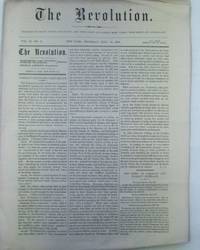
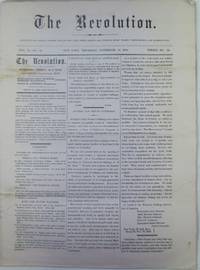
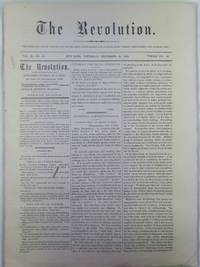
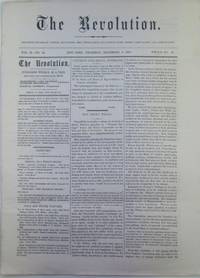
1869ref. 021006New York: Susan B. Anthony Proprietor; R.J. Johnson Publisher 1869. Wraps. Good. Side sewn journal. Approximately 12 ¼ by 9 inches. 16 pp. Early issue of the Revolution a groundbreaking and influential newspaper produced by Elizabeth Cady Stanton Susan B. Anthony and Parker Pillsbury. The paper was established to provide a voice to activists and suffragists such as Stanton and Anthony whose voices were marginalized by the mainstream press as well as many abolitionist publications with whom they had been previously allied. Anthony and Stanton advocated for an amendment giving suffrage to women along with the amendment sponsored by abolitionists that would give Black men the right to vote. Many abolitionists actively discouraged Stanton and Anthony from pursuing their amendment until the amendment enfranchising Black men passed creating a rift in the abolitionist movement as well as the women's suffrage movement. Feeling betrayed by abolitionists and Republicans who initially supported them they established the Revolution with financial help from George Francis Train a Democrat who supported women's rights but was openly racist. As the name indicates The Revolution adopted a combative radical tone with Stanton and others unafraid to take on critics. The paper openly discussed sexual and physical abuse in marriage and advocated better divorce laws that would offer women a way to escape abusive marriages. In 1869 the paper broke with Train who had supplied very little of the funding he initially offered. It published until 1872 struggling to make expenses along the way. This issue with two pieces by Elizabeth Cady Stanton "Too Many People Vote Now" and "Don't Unsex Yourself." Also present is news on the National Woman's Suffrage Association etc. GOOD condition. Several fold creases present with other general wrinkling. Minor toning and scattered soiling in the interior. Pages tearing along the lower hinge. Susan B. Anthony, Proprietor; R.J. Johnson, Publisher unknown
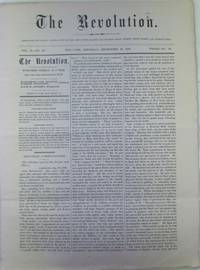
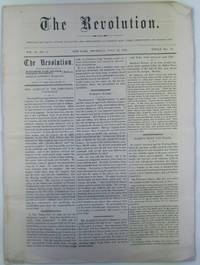
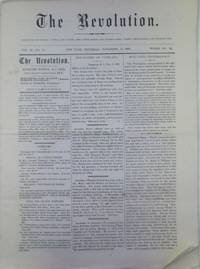
1868ref. 020098New York: Susan B. Anthony Proprietor; R.J. Johnson Publisher 1868. Wraps. Good. Side sewn journal. Approximately 12 ¼ by 9 inches. 16 pp. Early issue of the Revolution a groundbreaking and influential newspaper produced by Elizabeth Cady Stanton Susan B. Anthony and Parker Pillsbury. The paper was established to provide a voice to activists and suffragists such as Stanton and Anthony whose voices were marginalized by the mainstream press as well as many abolitionist publications with whom they had been previously allied. Anthony and Stanton advocated for an amendment giving suffrage to women along with the amendment sponsored by abolitionists that would give Black men the right to vote. Many abolitionists actively discouraged Stanton and Anthony from pursuing their amendment until the amendment enfranchising Black men passed creating a rift in the abolitionist movement as well as the women's suffrage movement. Feeling betrayed by abolitionists and Republicans who initially supported them they established the Revolution with financial help from George Francis Train a Democrat who supported women's rights but was openly racist. As the name indicates The Revolution adopted a combative radical tone with Stanton and others unafraid to take on critics. The paper openly discussed sexual and physical abuse in marriage and advocated better divorce laws that would offer women a way to escape abusive marriages. In 1869 the paper broke with Train who had supplied very little of the funding he initially offered. It published until 1872 struggling to make expenses along the way. This issue with several articles written by Elizabeth Cady Stanton including a lambasting of the Democratic Party with another piece not treating Republicans kindly either. She also discusses the Peoples Party etc. A short piece by Susan B. Anthony present addressing the beginning of volume 2 of the Revolution. GOOD condition. Several fold creases present with other general wrinkling. Minor toning and scattered soiling in the interior. Front and rear leaf separating from the rest of the piece but still intact. Susan B. Anthony, Proprietor; R.J. Johnson, Publisher unknown
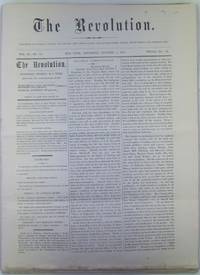
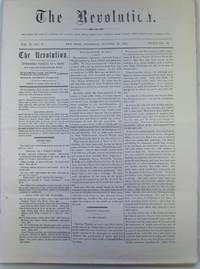
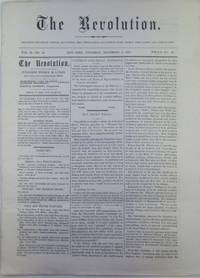
1868ref. 020102New York: Susan B. Anthony Proprietor; R.J. Johnson Publisher 1868. Wraps. Good. Side sewn journal. Approximately 12 ¼ by 9 inches. 16 pp. Single issue of the Revolution a groundbreaking and influential newspaper produced by Elizabeth Cady Stanton Susan B. Anthony and Parker Pillsbury. The paper was established to provide a voice to activists and suffragists such as Stanton and Anthony whose voices were marginalized by the mainstream press as well as many abolitionist publications with whom they had been previously allied. Anthony and Stanton advocated for an amendment giving suffrage to women along with the amendment sponsored by abolitionists that would give Black men the right to vote. Many abolitionists actively discouraged Stanton and Anthony from pursuing their amendment until the amendment enfranchising Black men passed creating a rift in the abolitionist movement as well as the women's suffrage movement. Feeling betrayed by abolitionists and Republicans who initially supported them they established the Revolution with financial help from George Francis Train a Democrat who supported women's rights but was openly racist. As the name indicates The Revolution adopted a combative radical tone with Stanton and others unafraid to take on critics. The paper openly discussed sexual and physical abuse in marriage and advocated better divorce laws that would offer women a way to escape abusive marriages. In 1869 the paper broke with Train who had supplied very little of the funding he initially offered. It published until 1872 struggling to make expenses along the way. This issue with a lengthy column written by Elizabeth Cady Stanton on her travels in the US spanning almost two pages. Very small paragraph by Susan B. Anthony present soliciting 6 to 8 women for potential employment. A few pieces discuss voting rights for Black men. GOOD condition. Several fold creases present with other general wrinkling. Minor toning and scattered soiling in the interior. Small hole in the upper front page. Susan B. Anthony, Proprietor; R.J. Johnson, Publisher unknown
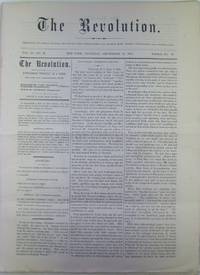
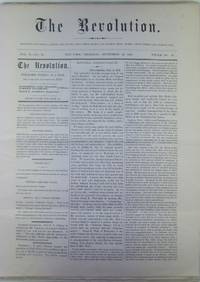
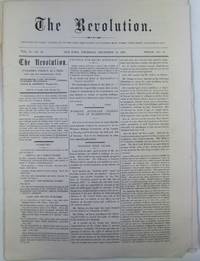
1868ref. 020147New York: Susan B. Anthony Proprietor; R.J. Johnson Publisher 1868. Wraps. Good. Side sewn journal. Approximately 12 ¼ by 9 inches. 16 pp. Early issue of the Revolution a groundbreaking and influential newspaper produced by Elizabeth Cady Stanton Susan B. Anthony and Parker Pillsbury. The paper was established to provide a voice to activists and suffragists such as Stanton and Anthony whose voices were marginalized by the mainstream press as well as many abolitionist publications with whom they had been previously allied. Anthony and Stanton advocated for an amendment giving suffrage to women along with the amendment sponsored by abolitionists that would give Black men the right to vote. Many abolitionists actively discouraged Stanton and Anthony from pursuing their amendment until the amendment enfranchising Black men passed creating a rift in the abolitionist movement as well as the women's suffrage movement. Feeling betrayed by abolitionists and Republicans who initially supported them they established the Revolution with financial help from George Francis Train a Democrat who supported women's rights but was openly racist. As the name indicates The Revolution adopted a combative radical tone with Stanton and others unafraid to take on critics. The paper openly discussed sexual and physical abuse in marriage and advocated better divorce laws that would offer women a way to escape abusive marriages. In 1869 the paper broke with Train who had supplied very little of the funding he initially offered. It published until 1872 struggling to make expenses along the way. This issue with a lengthy column editorial correspondence written by Elizabeth Cady Stanton on her travels in the US spanning almost two pages. Other pieces by Stanton discuss "National Labor Congress;" "Frank Blair on Woman's Suffrage;" and "Adah Isaacs Menken." Two lengthy pieces print quotes speaking from two meetings of the Workingwoman's Workingwomen's Association printing the discussion between Susan B. Anthony and others. GOOD condition. Several fold creases present with other general wrinkling. Minor toning and scattered soiling in the interior. Susan B. Anthony, Proprietor; R.J. Johnson, Publisher unknown
1868ref. 020196New York: Susan B. Anthony Proprietor; R.J. Johnson Publisher 1868. Wraps. Good. Side sewn journal. Approximately 12 ¼ by 9 inches. 16 pp. Early issue of the Revolution a groundbreaking and influential newspaper produced by Elizabeth Cady Stanton Susan B. Anthony and Parker Pillsbury. The paper was established to provide a voice to activists and suffragists such as Stanton and Anthony whose voices were marginalized by the mainstream press as well as many abolitionist publications with whom they had been previously allied. Anthony and Stanton advocated for an amendment giving suffrage to women along with the amendment sponsored by abolitionists that would give Black men the right to vote. Many abolitionists actively discouraged Stanton and Anthony from pursuing their amendment until the amendment enfranchising Black men passed creating a rift in the abolitionist movement as well as the women's suffrage movement. Feeling betrayed by abolitionists and Republicans who initially supported them they established the Revolution with financial help from George Francis Train a Democrat who supported women's rights but was openly racist. As the name indicates The Revolution adopted a combative radical tone with Stanton and others unafraid to take on critics. The paper openly discussed sexual and physical abuse in marriage and advocated better divorce laws that would offer women a way to escape abusive marriages. In 1869 the paper broke with Train who had supplied very little of the funding he initially offered. It published until 1872 struggling to make expenses along the way. This issue with a lengthy column written by Elizabeth Cady Stanton on her travels in the US spanning almost two pages. Another piece by Stanton discusses the upcoming presidential election and the potential affiliation of the Revolution with the Democrats. Three small paragraphs by Susan B. Anthony one on the National Unitarian Convention the National Workingmen's Congress and one soliciting more subscribers. A few pieces discuss voting rights for Black men. GOOD condition. Small piece torn from the upper edge of one leaf and another from the bottom corner of the last leaf. Several fold creases present with other general wrinkling. Minor toning and scattered soiling in the interior. Susan B. Anthony, Proprietor; R.J. Johnson, Publisher unknown
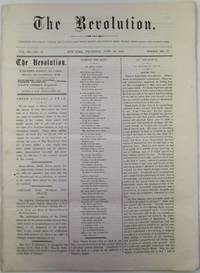
1868ref. 020221New York: Susan B. Anthony Proprietor; R.J. Johnson Publisher 1868. Wraps. Good. Side sewn journal. Approximately 12 ¼ by 9 inches. 16 pp. This issue with a front page "Appeal for Equal Suffrage" undersigned by Elizabeth Cady Stanton Abby Hopper Gibbons Mrs. Horace Greeley Susan B. Anthony and Elizabeth Smith Miller. With two pieces "Hester Vaughan" and "Our Children at School" both written by Elizabeth Cady Stanton. GOOD condition. Front page separating from the spine somewhat tenuously attached. Several fold creases present with other general wrinkling. Minor toning and scattered soiling in the interior. Minor staining to the front cover. Susan B. Anthony, Proprietor; R.J. Johnson, Publisher unknown
1868ref. 020242New York: Susan B. Anthony Proprietor; R.J. Johnson Publisher 1868. Wraps. Good. Side sewn journal. Approximately 12 ¼ by 9 inches. 16 pp. Early issue of the Revolution a groundbreaking and influential newspaper produced by Elizabeth Cady Stanton Susan B. Anthony and Parker Pillsbury. The paper was established to provide a voice to activists and suffragists such as Stanton and Anthony whose voices were marginalized by the mainstream press as well as many abolitionist publications with whom they had been previously allied. Anthony and Stanton advocated for an amendment giving suffrage to women along with the amendment sponsored by abolitionists that would give Black men the right to vote. Many abolitionists actively discouraged Stanton and Anthony from pursuing their amendment until the amendment enfranchising Black men passed creating a rift in the abolitionist movement as well as the women's suffrage movement. Feeling betrayed by abolitionists and Republicans who initially supported them they established the Revolution with financial help from George Francis Train a Democrat who supported women's rights but was openly racist. As the name indicates The Revolution adopted a combative radical tone with Stanton and others unafraid to take on critics. The paper openly discussed sexual and physical abuse in marriage and advocated better divorce laws that would offer women a way to escape abusive marriages. In 1869 the paper broke with Train who had supplied very little of the funding he initially offered. It published until 1872 struggling to make expenses along the way. This issue with a lengthy article written by Elizabeth Cady Stanton on US prisons and prison reform. Many shorter anonymous articles on suffrage labor and other topics present as well as a brilliant and scathing retort against the Warrick Indiana Herald which while reviewing the Revolution calls "women's suffrage an absurdity and an evil." GOOD condition. Several fold creases present with other general wrinkling. Minor toning and scattered soiling in the interior. Susan B. Anthony, Proprietor; R.J. Johnson, Publisher unknown
1868ref. 020291New York: Susan B. Anthony Proprietor; R.J. Johnson Publisher 1868. Wraps. Good. Side sewn journal. Approximately 12 ¼ by 9 inches. 16 pp. arly issue of the Revolution a groundbreaking and influential newspaper produced by Elizabeth Cady Stanton Susan B. Anthony and Parker Pillsbury. The paper was established to provide a voice to activists and suffragists such as Stanton and Anthony whose voices were marginalized by the mainstream press as well as many abolitionist publications with whom they had been previously allied. Anthony and Stanton advocated for an amendment giving suffrage to women along with the amendment sponsored by abolitionists that would give Black men the right to vote. Many abolitionists actively discouraged Stanton and Anthony from pursuing their amendment until the amendment enfranchising Black men passed creating a rift in the abolitionist movement as well as the women's suffrage movement. Feeling betrayed by abolitionists and Republicans who initially supported them they established the Revolution with financial help from George Francis Train a Democrat who supported women's rights but was openly racist. As the name indicates The Revolution adopted a combative radical tone with Stanton and others unafraid to take on critics. The paper openly discussed sexual and physical abuse in marriage and advocated better divorce laws that would offer women a way to escape abusive marriages. In 1869 the paper broke with Train who had supplied very little of the funding he initially offered. It published until 1872 struggling to make expenses along the way. This issue with a lengthy profile of Anna Elizabeth Dickinson written by Elizabeth Cady Stanton as well as an essay on marriage and mistresses that questions legal rulings favoring men in marriage over women. Also present is an essay by actor and writer Olive Logan titled "U.S". GOOD condition. Several fold creases present with other general wrinkling. Minor toning and scattered soiling in the interior. Small tear affecting the title at the top of the first page appearing to have happened during the printing. Susan B. Anthony, Proprietor; R.J. Johnson, Publisher unknown
1868ref. 020317New York: Susan B. Anthony Proprietor; R.J. Johnson Publisher 1868. Wraps. Good. Side sewn journal. Approximately 12 ¼ by 9 inches. 16 pp. Early issue of the Revolution a groundbreaking and influential newspaper produced by Elizabeth Cady Stanton Susan B. Anthony and Parker Pillsbury. The paper was established to provide a voice to activists and suffragists such as Stanton and Anthony whose voices were marginalized by the mainstream press as well as many abolitionist publications with whom they had been previously allied. Anthony and Stanton advocated for an amendment giving suffrage to women along with the amendment sponsored by abolitionists that would give Black men the right to vote. Many abolitionists actively discouraged Stanton and Anthony from pursuing their amendment until the amendment enfranchising Black men passed creating a rift in the abolitionist movement as well as the women's suffrage movement. Feeling betrayed by abolitionists and Republicans who initially supported them they established the Revolution with financial help from George Francis Train a Democrat who supported women's rights but was openly racist. As the name indicates The Revolution adopted a combative radical tone with Stanton and others unafraid to take on critics. The paper openly discussed sexual and physical abuse in marriage and advocated better divorce laws that would offer women a way to escape abusive marriages. In 1869 the paper broke with Train who had supplied very little of the funding he initially offered. It published until 1872 struggling to make expenses along the way. This issue with a lengthy column editorial correspondence written by Elizabeth Cady Stanton on her travels in the US spanning almost two pages. Another piece by Stanton discusses on "Miss Becker and the Difference of the Sexes." A lengthy piece prints a meeting/public event by the Women's Council in Mount Vernon New York that brought together women taxpayers. This prints the discussion between Susan B. Anthony and others. GOOD condition. Small piece torn from the upper edge of one leaf and another from the bottom corner of the last leaf. Several fold creases present with other general wrinkling. Minor toning and scattered soiling in the interior. Susan B. Anthony, Proprietor; R.J. Johnson, Publisher unknown
1868ref. 020339New York: Susan B. Anthony Proprietor; R.J. Johnson Publisher 1868. Wraps. Fair. Side sewn journal. Approximately 12 ¼ by 9 inches. 16 pp. Early issue of the Revolution a groundbreaking and influential newspaper produced by Elizabeth Cady Stanton Susan B. Anthony and Parker Pillsbury. The paper was established to provide a voice to activists and suffragists such as Stanton and Anthony whose voices were marginalized by the mainstream press as well as many abolitionist publications with whom they had been previously allied. Anthony and Stanton advocated for an amendment giving suffrage to women along with the amendment sponsored by abolitionists that would give Black men the right to vote. Many abolitionists actively discouraged Stanton and Anthony from pursuing their amendment until the amendment enfranchising Black men passed creating a rift in the abolitionist movement as well as the women's suffrage movement. Feeling betrayed by abolitionists and Republicans who initially supported them they established the Revolution with financial help from George Francis Train a Democrat who supported women's rights but was openly racist. As the name indicates The Revolution adopted a combative radical tone with Stanton and others unafraid to take on critics. The paper openly discussed sexual and physical abuse in marriage and advocated better divorce laws that would offer women a way to escape abusive marriages. In 1869 the paper broke with Train who had supplied very little of the funding he initially offered. It published until 1872 struggling to make expenses along the way. This issue with a lengthy column editorial correspondence written by Elizabeth Cady Stanton wherein she discusses her time in Philadelphia and Pennsylvania as well as the case of Hester Vaughn. There are two other lengthy articles on Hester Vaughn one written by Elizabeth Cady Stanton. Vaughan was tried and convicted of murdering her newborn baby to which she gave birth alone. The circumstances around the birth and death the child were murky and she was sentenced to death by an all male jury. The Revolution took up her case seeking her pardon and inferred she was raped. Stanton and Anthony attracted a lot of publicity to the case. Vaughn was eventually pardoned by the governor of Pennsylvania and sent back to England. The cause proved a bit divisive for Stanton and Anthony and the Revolution with modern historians asserting it helped to set back their work for women's suffrage. FAIR condition. Front leaf DETACHED with the binding a bit fragile. Several fold creases present with other general wrinkling. Minor toning and scattered soiling in the interior. Susan B. Anthony, Proprietor; R.J. Johnson, Publisher unknown
1868ref. 020366New York: Susan B. Anthony Proprietor; R.J. Johnson Publisher 1868. Wraps. Good. Side sewn journal. Approximately 12 ¼ by 9 inches. 16 pp. Early issue of the Revolution a groundbreaking and influential newspaper produced by Elizabeth Cady Stanton Susan B. Anthony and Parker Pillsbury. The paper was established to provide a voice to activists and suffragists such as Stanton and Anthony whose voices were marginalized by the mainstream press as well as many abolitionist publications with whom they had been previously allied. Anthony and Stanton advocated for an amendment giving suffrage to women along with the amendment sponsored by abolitionists that would give Black men the right to vote. Many abolitionists actively discouraged Stanton and Anthony from pursuing their amendment until the amendment enfranchising Black men passed creating a rift in the abolitionist movement as well as the women's suffrage movement. Feeling betrayed by abolitionists and Republicans who initially supported them they established the Revolution with financial help from George Francis Train a Democrat who supported women's rights but was openly racist. As the name indicates The Revolution adopted a combative radical tone with Stanton and others unafraid to take on critics. The paper openly discussed sexual and physical abuse in marriage and advocated better divorce laws that would offer women a way to escape abusive marriages. In 1869 the paper broke with Train who had supplied very little of the funding he initially offered. It published until 1872 struggling to make expenses along the way. This issue with a piece "The Dignity of the Ballot" and an account of the Boston Woman's Suffrage Convention both written by Elizabeth Cady Stanton. GOOD condition. Several fold creases present with other general wrinkling. Minor toning and scattered soiling in the interior. Small crease to the lower front page corner. Susan B. Anthony, Proprietor; R.J. Johnson, Publisher unknown
1868ref. 020395New York: Susan B. Anthony Proprietor; R.J. Johnson Publisher 1868. Wraps. Good. Side sewn journal. Approximately 12 ¼ by 9 inches. 16 pp. Early issue of the Revolution a groundbreaking and influential newspaper produced by Elizabeth Cady Stanton Susan B. Anthony and Parker Pillsbury. The paper was established to provide a voice to activists and suffragists such as Stanton and Anthony whose voices were marginalized by the mainstream press as well as many abolitionist publications with whom they had been previously allied. Anthony and Stanton advocated for an amendment giving suffrage to women along with the amendment sponsored by abolitionists that would give Black men the right to vote. Many abolitionists actively discouraged Stanton and Anthony from pursuing their amendment until the amendment enfranchising Black men passed creating a rift in the abolitionist movement as well as the women's suffrage movement. Feeling betrayed by abolitionists and Republicans who initially supported them they established the Revolution with financial help from George Francis Train a Democrat who supported women's rights but was openly racist. As the name indicates The Revolution adopted a combative radical tone with Stanton and others unafraid to take on critics. The paper openly discussed sexual and physical abuse in marriage and advocated better divorce laws that would offer women a way to escape abusive marriages. In 1869 the paper broke with Train who had supplied very little of the funding he initially offered. It published until 1872 struggling to make expenses along the way. This issue with a continuation of a lengthy profile of Anna Elizabeth Dickinson written by Elizabeth Cady Stanton as well as five shorter pieces by her: "The Old Year Gone" "Roll up the Petitions" "Henry Ward Beecher" "Henry James on Woman" and "Hearth and Home." A short column by Susan B. Anthony is present thanking their helpers. Also of note is a report on the Working Women's Association by Sarah Norton in which she reports in detail on the work of rag pickers in New York City. GOOD condition. Rear leaf very tenuously attached with the binding a bit fragile. Rear leaf also rather toned. Several fold creases present with other general wrinkling. Minor toning and scattered soiling in the interior. Susan B. Anthony, Proprietor; R.J. Johnson, Publisher unknown
1868ref. 020422New York: Susan B. Anthony Proprietor; R.J. Johnson Publisher 1868. Wraps. Fair. Side sewn journal. Approximately 12 ¼ by 9 inches. 16 pp. Early issue of the Revolution a groundbreaking and influential newspaper produced by Elizabeth Cady Stanton Susan B. Anthony and Parker Pillsbury. The paper was established to provide a voice to activists and suffragists such as Stanton and Anthony whose voices were marginalized by the mainstream press as well as many abolitionist publications with whom they had been previously allied. Anthony and Stanton advocated for an amendment giving suffrage to women along with the amendment sponsored by abolitionists that would give Black men the right to vote. Many abolitionists actively discouraged Stanton and Anthony from pursuing their amendment until the amendment enfranchising Black men passed creating a rift in the abolitionist movement as well as the women's suffrage movement. Feeling betrayed by abolitionists and Republicans who initially supported them they established the Revolution with financial help from George Francis Train a Democrat who supported women's rights but was openly racist. As the name indicates The Revolution adopted a combative radical tone with Stanton and others unafraid to take on critics. The paper openly discussed sexual and physical abuse in marriage and advocated better divorce laws that would offer women a way to escape abusive marriages. In 1869 the paper broke with Train who had supplied very little of the funding he initially offered. It published until 1872 struggling to make expenses along the way. This with a lengthy editorial by Elizabeth Cady Stanton on a proposed amendment for manhood suffrage harshly criticizing the amendment. FAIR condition. Front and rear leaf very tenuously attached with the binding a bit fragile. Front leaf being held on by a torn small section of margin. Several fold creases present with other general wrinkling. Minor toning and scattered soiling in the interior. Susan B. Anthony, Proprietor; R.J. Johnson, Publisher unknown
1868ref. 020444New York: Susan B. Anthony Proprietor; R.J. Johnson Publisher 1868. Wraps. Good. Side sewn journal. Approximately 12 ¼ by 9 inches. 16 pp. Early issue of the Revolution a groundbreaking and influential newspaper produced by Elizabeth Cady Stanton Susan B. Anthony and Parker Pillsbury. The paper was established to provide a voice to activists and suffragists such as Stanton and Anthony whose voices were marginalized by the mainstream press as well as many abolitionist publications with whom they had been previously allied. Anthony and Stanton advocated for an amendment giving suffrage to women along with the amendment sponsored by abolitionists that would give Black men the right to vote. Many abolitionists actively discouraged Stanton and Anthony from pursuing their amendment until the amendment enfranchising Black men passed creating a rift in the abolitionist movement as well as the women's suffrage movement. Feeling betrayed by abolitionists and Republicans who initially supported them they established the Revolution with financial help from George Francis Train a Democrat who supported women's rights but was openly racist. As the name indicates The Revolution adopted a combative radical tone with Stanton and others unafraid to take on critics. The paper openly discussed sexual and physical abuse in marriage and advocated better divorce laws that would offer women a way to escape abusive marriages. In 1869 the paper broke with Train who had supplied very little of the funding he initially offered. It published until 1872 struggling to make expenses along the way. This issue with a lengthy article written by Elizabeth Cady Stanton providing "editorial correspondence" on politics Democrats and Republicans etc. Many shorter anonymous articles on suffrage labor and other topics present." GOOD condition. Several fold creases present with other general wrinkling. Minor toning and scattered soiling in the interior. Front and rear leaf separating from the rest of the piece but still intact and tenuously holding on. Susan B. Anthony, Proprietor; R.J. Johnson, Publisher unknown
1868ref. 020469New York: Susan B. Anthony Proprietor; R.J. Johnson Publisher 1868. Wraps. Good. Side sewn journal. Approximately 12 ¼ by 9 inches. 16 pp. Early issue of the Revolution a groundbreaking and influential newspaper produced by Elizabeth Cady Stanton Susan B. Anthony and Parker Pillsbury. The paper was established to provide a voice to activists and suffragists such as Stanton and Anthony whose voices were marginalized by the mainstream press as well as many abolitionist publications with whom they had been previously allied. Anthony and Stanton advocated for an amendment giving suffrage to women along with the amendment sponsored by abolitionists that would give Black men the right to vote. Many abolitionists actively discouraged Stanton and Anthony from pursuing their amendment until the amendment enfranchising Black men passed creating a rift in the abolitionist movement as well as the women's suffrage movement. Feeling betrayed by abolitionists and Republicans who initially supported them they established the Revolution with financial help from George Francis Train a Democrat who supported women's rights but was openly racist. As the name indicates The Revolution adopted a combative radical tone with Stanton and others unafraid to take on critics. The paper openly discussed sexual and physical abuse in marriage and advocated better divorce laws that would offer women a way to escape abusive marriages. In 1869 the paper broke with Train who had supplied very little of the funding he initially offered. It published until 1872 struggling to make expenses along the way. This issue with a lengthy article written by Elizabeth Cady Stanton on women's suffrage in Texas as well as a shorter piece asking "What is a Democrat" Two short pieces on the front page look at a new suffrage movement in Boston regarding 18 year old boys and woman suffrage in Michigan. An anonymous piece discusses "Indian Troubles in Kansas" describing attacks on white settlers by various tribes in the region. The author asserts that the Native American image as described by Longfellow peaceful is wrong and asserting that "murder and plunder are their ruling spirit." GOOD condition. Several fold creases present with other general wrinkling. Minor toning and scattered soiling in the interior. Front and rear page tenuously attached along the spine. Susan B. Anthony, Proprietor; R.J. Johnson, Publisher unknown
1868ref. 020494New York: Susan B. Anthony Proprietor; R.J. Johnson Publisher 1868. Wraps. Good. Side sewn journal. Approximately 12 ¼ by 9 inches. 16 pp. Early issue of the Revolution a groundbreaking and influential newspaper produced by Elizabeth Cady Stanton Susan B. Anthony and Parker Pillsbury. The paper was established to provide a voice to activists and suffragists such as Stanton and Anthony whose voices were marginalized by the mainstream press as well as many abolitionist publications with whom they had been previously allied. Anthony and Stanton advocated for an amendment giving suffrage to women along with the amendment sponsored by abolitionists that would give Black men the right to vote. Many abolitionists actively discouraged Stanton and Anthony from pursuing their amendment until the amendment enfranchising Black men passed creating a rift in the abolitionist movement as well as the women's suffrage movement. Feeling betrayed by abolitionists and Republicans who initially supported them they established the Revolution with financial help from George Francis Train a Democrat who supported women's rights but was openly racist. As the name indicates The Revolution adopted a combative radical tone with Stanton and others unafraid to take on critics. The paper openly discussed sexual and physical abuse in marriage and advocated better divorce laws that would offer women a way to escape abusive marriages. In 1869 the paper broke with Train who had supplied very little of the funding he initially offered. It published until 1872 struggling to make expenses along the way. This issue with a lengthy article written by Elizabeth Cady Stanton providing "editorial correspondence" discussing mostly a visit with Anson Lapham and a trip in upstate New York. Many shorter anonymous articles on suffrage labor and other topics present." Eleanor Kirk discusses at length "the Marriage Question Again." Two longer pieces present one on the 14th amendment written by someone with the initials W.F.C. GOOD condition. Several fold creases present with other general wrinkling. Minor toning and scattered soiling in the interior. Susan B. Anthony, Proprietor; R.J. Johnson, Publisher unknown
1868ref. 020504New York: Susan B. Anthony Proprietor; R.J. Johnson Publisher 1868. Wraps. Poor. Side sewn journal. Approximately 12 ¼ by 9 inches. 16 pp. Early issue of the Revolution a groundbreaking and influential newspaper produced by Elizabeth Cady Stanton Susan B. Anthony and Parker Pillsbury. The paper was established to provide a voice to activists and suffragists such as Stanton and Anthony whose voices were marginalized by the mainstream press as well as many abolitionist publications with whom they had been previously allied. Anthony and Stanton advocated for an amendment giving suffrage to women along with the amendment sponsored by abolitionists that would give Black men the right to vote. Many abolitionists actively discouraged Stanton and Anthony from pursuing their amendment until the amendment enfranchising Black men passed creating a rift in the abolitionist movement as well as the women's suffrage movement. Feeling betrayed by abolitionists and Republicans who initially supported them they established the Revolution with financial help from George Francis Train a Democrat who supported women's rights but was openly racist. As the name indicates The Revolution adopted a combative radical tone with Stanton and others unafraid to take on critics. The paper openly discussed sexual and physical abuse in marriage and advocated better divorce laws that would offer women a way to escape abusive marriages. In 1869 the paper broke with Train who had supplied very little of the funding he initially offered. It published until 1872 struggling to make expenses along the way. This issue publishes an address by Susan B. Anthony at Tammany Hall; several articles by Elizabeth Cady Stanton including one on the Workingmen's Convention; a response to a letter from a subscriber complaining about the cost per issue where the paper points out the flaw in the writer's mathematics etc. POOR/FAIR condition. Front and rear page DETACHED from the rest. Heavy toning moderate soiling and some staining to the front page. Several fold creases present with other general wrinkling. Minor toning and scattered soiling in the interior. Susan B. Anthony, Proprietor; R.J. Johnson, Publisher unknown
1868ref. 020532New York: Susan B. Anthony Proprietor; R.J. Johnson Publisher 1868. Wraps. Good. Side sewn journal. Approximately 12 ¼ by 9 inches. 16 pp. Early issue of the Revolution a groundbreaking and influential newspaper produced by Elizabeth Cady Stanton Susan B. Anthony and Parker Pillsbury. The paper was established to provide a voice to activists and suffragists such as Stanton and Anthony whose voices were marginalized by the mainstream press as well as many abolitionist publications with whom they had been previously allied. Anthony and Stanton advocated for an amendment giving suffrage to women along with the amendment sponsored by abolitionists that would give Black men the right to vote. Many abolitionists actively discouraged Stanton and Anthony from pursuing their amendment until the amendment enfranchising Black men passed creating a rift in the abolitionist movement as well as the women's suffrage movement. Feeling betrayed by abolitionists and Republicans who initially supported them they established the Revolution with financial help from George Francis Train a Democrat who supported women's rights but was openly racist. As the name indicates The Revolution adopted a combative radical tone with Stanton and others unafraid to take on critics. The paper openly discussed sexual and physical abuse in marriage and advocated better divorce laws that would offer women a way to escape abusive marriages. In 1869 the paper broke with Train who had supplied very little of the funding he initially offered. It published until 1872 struggling to make expenses along the way. This issue with a lengthy piece on Hon. Henry Wilson being harshly critical and mocking written by Elizabeth Cady Stanton. GOOD condition. Several fold creases present with other general wrinkling. Minor toning and scattered soiling in the interior. Susan B. Anthony, Proprietor; R.J. Johnson, Publisher unknown
1862ref. 005613Hartford CT: Published by the Author 1862. Cloth. Good/No Jacket. Brown ribbed cloth with ruling and ornamentation in blind. X 11-192. With a frontis portrait of Abraham Lincoln. Drawing primarily from government documents and other sources Frost sought to provide an 'unvarnished' account of the early events of the Civil War. This includes troop movements descriptions of battles lists of killed and wounded as well as the politics that led up to the war. etc. Chronicled are the departures of various Northern regiments the fighting at Fort Sumter the burning of bridges blockades and other action at the outset of the war. Another volume was issued that covered the events of 1862. GOOD condition. Moderate scuffing and fading to the cloth with heavy scuffing along the extremities. This has resulted in the cloth being frayed and worn through along the edges with a few areas of minor loss including the tips of the spine and along the hinges. Minor soiling. A few small areas of faint staining/discoloration. First endpaper MISSING. Text block solid with scattered minor to moderate soiling foxing and staining. Sabin 26021. Published by the Author unknown
1822ref. 014338New-Ipswich NH: Salmon Wilder Publisher 1822. Wraps. Fair. Plain wraps. A collection of speeches from various politicians and people from a variety of towns from New England and beyond with responses made by President James Monroe. This includes towns such as Kittery Maine Newburyport Massachusetts women from the Windsor Female Academy Plattsburg Portsmouth New Hampshire etc. FAIR condition. Front cover almost detached. Moderate faint staining soiling and spotting to the wrappers with general fading. Upper front wrapper with chipping and loss along its entire length. Wrappers almost completely missing from the spine. Moderate uneven browning in the interior with scattered foxing soiling and staining. Not in Sabin. Salmon Wilder, Publisher unknown
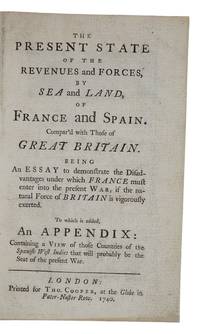
1740ref. AQ26617London: Printed for Tho. Cooper 1740. 2 v-viii 9-62pp. Without half-title. Recent marbled paper wrappers. Internally clean and crisp. An essay written during the early stages of the War of Jenkins' Ear 1739-1748 in which conflict between England and Spain mostly took place in the Caribbean sea. The author devotes a large portion of the essay to discussing the present military strength of France and Spain which he deems inferior to the English forces and argues that exerting English strength will be both profitable and inexpensive compared to the previous Anglo-Spanish war. Contains an appendix providing an interesting and detailed description of present Spanish territories in the Caribbean and Americas- including reference to the Spanish galleons and 'Mines of Gold the most famous of which is St Maria'. ESTC T711. First edition. 8vo. Printed for Tho. Cooper unknown
1967ref. 021535U.S. Government Printing Office: 1967. 371 pages Indices illustrated. "This report presents some of the evidence regarding modern Ku Klux Klan operations which the committee obtained as a result of a full-scale investigation during the 89th Congress." FINE HARDCOVER scarce. Hard Cover. Fine/Not Issued with a Dust Jacket. 8vo - over 7¾" - 9¾" tall. U.S. Government Printing Office: Hardcover
19728vo. First Edition, with numerous illustrations and facsimiles in the text, inked scribble on front free endpaper; blue cloth, gilt back, a near fine copy. With relevant cuttings mounted on endpapers. SCARCE.
1805ref. 019914Windsor VT: Nahum Bower Publisher 1805. Unbound. Good. Side folding newspaper format. 8 pp. Single issue of this short-lived newspaper from Vermont apparently only publishing for one year. With the usual sort of news politics political commentary that one would expect from a paper. Of note is a brief account of what appears to have been an insurrection or rebellion by enslaved African Americans in Savannah Georgia. The account says the African Americans killed whites by poisoning and that thirteen were in jail. Two were hung one was burned alive and others faced other punishments. Research did not turn up any accounts of rebellions in Savannah Georgia in 1805 but an account of a rebellion in Wayne County North Carolina bears a striking similarity to this one. The account in this paper indicates that the insurrectionists were held in Waynesboro jail so perhaps their was some confusion surrounding the name. Also present is a short account of piracy originating from St. Augustine as well as a letter questioning Thomas Jefferson's interaction with Benedict Arnold during the Revolutionary War. GOOD condition. Horizontal fold crease present. Moderate toning. Minor spotting soiling and staining to the paper. Heavy chipping and wear to the lower extremity. Nahum Bower, Publisher unknown
1939ref. BOOKS000283xiv555 pages with maps illustrations and bibliography. Thick royal octavo 9 3/4" x 6 3/4" bound in original publisher's green cloth with gilt lettering to spine in original jacket. signed First edition. Here for the first time is a well-rounded account of every aspect of the region's life and development as far as the War of 1812. Among the more than one hundred illustrations included are reproductions of contemporary pictures maps plans of forts portraits architectural photographs and drawings of equipment and utensils. Previous owner's inscription concerning the author on front end paper pencil notes on back paste down spine ends rubbed corners bumped crease at head front board. Jacket chipped at edges and spine ends with an inch or more loss else very good in good jacket. University of Pennsylvania Press hardcover