No author givenBiblio.com

1 979 résultats
1912réf. 011492New York: C.S. Hammond and Company 1912. Wraps. Very Good. Mustard yellow card stock covers 7 ½ by 3 ½ inches. Fold out color illustrated map measuring 23 ½ by 18 inches. Single sided. A bird's eye view map of the New York region of Long Island Sound and the East and North Rivers. VERY GOOD condition. Minor wrinkling and toning to the covers with some wrinkling and browning to the map. C.S. Hammond and Company unknown
réf. 019557New York: New York State Education Department. Pamphlet. Good. no date late 1942 early 1943. Single sheet 8 ½ by 11 inches folded in half to make four pages. Illustrated front cover and interior. A pamphlet praising women on the front cover for their war work effort in World War II and soliciting in the interior for 3000000 more women to join the war work force. The rear page has information about the local War Production Training Program in Richfield Springs New York. Gives information on class hours types of courses machinist's lathe etc. and transportation information. GOOD condition. Moderate to heavy scattered foxing to the piece. Minor soiling and staining. Pencil scribble on the front page. Some wrinkling and creasing. New York State Education Department unknown
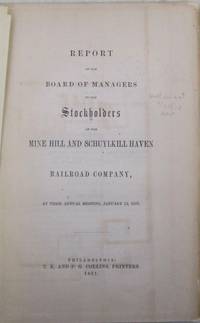
1857réf. 022510Philadelphia: T.K. and P.G. Collins Printers 1857. Pamphlet. Fair. Pamphlet perhaps disbound from a larger volume. Lacking any wrappers that may have issued. 31 28 pp. Fold out map of the railroad lines present at the front of the 1857. Not sure if the 1858 report is complete but no map present at the front of that report. Reports from the Mine Hill and Schuylkill Haven Railroad Company detailing upgrades and expenses along with other subjects related to the operation of the railroad. Financial tables also present. The Mine Hill and Schuylkill Haven Railroad Company began operation in 1831 to help transport coal from the mines of Pennsylvania. It became part of the Pennsylvania and Reading Railroad in 1862. FAIR condition. Some uneven toning and offsetting to the paper. Minor chipping tearing and creasing along the extremities. Map TORN in two and very fragile. In order to preserve it we have not handled it further to avoid risk of further deterioration thus no photo is available nor can we answer more questions about its condition. Minor pencil notation at the front of each report. T.K. and P.G. Collins, Printers unknown
1943réf. 021425Racine WI: Whitman Publishing 1943. Wraps. Poor. Wraps. Folio. 7 leaves plus covers. A collection of paper dolls featuring women who served in World War II as WACS or WAVES featuring 8 women and a variety of clothing and uniforms. The WACS and WAVES were units associated with the US Army and US Navy that allowed women to serve in the military in noncombat roles. POOR/FAIR condition. Top third of the front cover CUT UP missing the title and the stars that were once present. The book is otherwise intact with all dolls and clothing present and uncut. Moderate toning some wrinkling and minor soiling. Whitman Publishing unknown
1870réf. 022392New York: Susan B. Anthony Proprietor; R.J. Johnson Publisher 1870. Wraps. Good. Side sewn journal. Approximately 12 ¼ by 9 inches. 16 pp. Early issue of the Revolution a groundbreaking and influential newspaper produced by Elizabeth Cady Stanton Susan B. Anthony and Parker Pillsbury. The paper was established to provide a voice to activists and suffragists such as Stanton and Anthony whose voices were marginalized by the mainstream press as well as many abolitionist publications with whom they had been previously allied. Anthony and Stanton advocated for an amendment giving suffrage to women along with the amendment sponsored by abolitionists that would give Black men the right to vote. Many abolitionists actively discouraged Stanton and Anthony from pursuing their amendment until the amendment enfranchising Black men passed creating a rift in the abolitionist movement as well as the women's suffrage movement. Feeling betrayed by abolitionists and Republicans who initially supported them they established the Revolution with financial help from George Francis Train a Democrat who supported women's rights but was openly racist. As the name indicates The Revolution adopted a combative radical tone with Stanton and others unafraid to take on critics. The paper openly discussed sexual and physical abuse in marriage and advocated better divorce laws that would offer women a way to escape abusive marriages. In 1869 the paper broke with Train who had supplied very little of the funding he initially offered. It published until 1872 struggling to make expenses along the way. This issue with a piece by Elizabeth Cady Stanton "The Golden Wedding" reflecting on the life and legacy of Susan B. Anthony. Also present is a piece on the struggles of African Americans around Washington DC and elsewhere citing lack of efforts to relieve poverty etc. GOOD condition. Several faint fold creases present with other general wrinkling and creasing. Chipping and tearing along the edges. Minor toning and scattered foxing and soiling. Susan B. Anthony, Proprietor; R.J. Johnson, Publisher unknown
1869réf. 020904New York: Susan B. Anthony Proprietor; R.J. Johnson Publisher 1869. Wraps. Good. Side sewn journal. Approximately 12 ¼ by 9 inches. 16 pp. Early issue of the Revolution a groundbreaking and influential newspaper produced by Elizabeth Cady Stanton Susan B. Anthony and Parker Pillsbury. The paper was established to provide a voice to activists and suffragists such as Stanton and Anthony whose voices were marginalized by the mainstream press as well as many abolitionist publications with whom they had been previously allied. Anthony and Stanton advocated for an amendment giving suffrage to women along with the amendment sponsored by abolitionists that would give Black men the right to vote. Many abolitionists actively discouraged Stanton and Anthony from pursuing their amendment until the amendment enfranchising Black men passed creating a rift in the abolitionist movement as well as the women's suffrage movement. Feeling betrayed by abolitionists and Republicans who initially supported them they established the Revolution with financial help from George Francis Train a Democrat who supported women's rights but was openly racist. As the name indicates The Revolution adopted a combative radical tone with Stanton and others unafraid to take on critics. The paper openly discussed sexual and physical abuse in marriage and advocated better divorce laws that would offer women a way to escape abusive marriages. In 1869 the paper broke with Train who had supplied very little of the funding he initially offered. It published until 1872 struggling to make expenses along the way. This issue with two pieces by Elizabeth Cady Stanton "The 'Catholic World' on Woman's Suffrage" and "The Sixteenth Amendment" along with news on the anniversary of the American Equal Rights Association "Compliments to Colored Men" a short piece highlighting that hotels in Boston and New York would not board Black men. GOOD condition. Several fold creases present with other general wrinkling. Minor toning and scattered soiling in the interior. Susan B. Anthony, Proprietor; R.J. Johnson, Publisher unknown
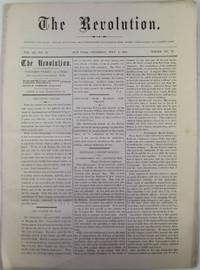
1869réf. 020903New York: Susan B. Anthony Proprietor; R.J. Johnson Publisher 1869. Wraps. Good. Side sewn journal. Approximately 12 ¼ by 9 inches. 16 pp. Early issue of the Revolution a groundbreaking and influential newspaper produced by Elizabeth Cady Stanton Susan B. Anthony and Parker Pillsbury. The paper was established to provide a voice to activists and suffragists such as Stanton and Anthony whose voices were marginalized by the mainstream press as well as many abolitionist publications with whom they had been previously allied. Anthony and Stanton advocated for an amendment giving suffrage to women along with the amendment sponsored by abolitionists that would give Black men the right to vote. Many abolitionists actively discouraged Stanton and Anthony from pursuing their amendment until the amendment enfranchising Black men passed creating a rift in the abolitionist movement as well as the women's suffrage movement. Feeling betrayed by abolitionists and Republicans who initially supported them they established the Revolution with financial help from George Francis Train a Democrat who supported women's rights but was openly racist. As the name indicates The Revolution adopted a combative radical tone with Stanton and others unafraid to take on critics. The paper openly discussed sexual and physical abuse in marriage and advocated better divorce laws that would offer women a way to escape abusive marriages. In 1869 the paper broke with Train who had supplied very little of the funding he initially offered. It published until 1872 struggling to make expenses along the way. This issue with two pieces by Elizabeth Cady Stanton "Free Trade" and "The Washington Monument" along with news on the anniversary of the American Equal Rights Association. GOOD condition. Several fold creases present with other general wrinkling. Minor toning and scattered soiling in the interior. Susan B. Anthony, Proprietor; R.J. Johnson, Publisher unknown
1869réf. 020902New York: Susan B. Anthony Proprietor; R.J. Johnson Publisher 1869. Wraps. Good. Side sewn journal. Approximately 12 ¼ by 9 inches. 16 pp. Early issue of the Revolution a groundbreaking and influential newspaper produced by Elizabeth Cady Stanton Susan B. Anthony and Parker Pillsbury. The paper was established to provide a voice to activists and suffragists such as Stanton and Anthony whose voices were marginalized by the mainstream press as well as many abolitionist publications with whom they had been previously allied. Anthony and Stanton advocated for an amendment giving suffrage to women along with the amendment sponsored by abolitionists that would give Black men the right to vote. Many abolitionists actively discouraged Stanton and Anthony from pursuing their amendment until the amendment enfranchising Black men passed creating a rift in the abolitionist movement as well as the women's suffrage movement. Feeling betrayed by abolitionists and Republicans who initially supported them they established the Revolution with financial help from George Francis Train a Democrat who supported women's rights but was openly racist. As the name indicates The Revolution adopted a combative radical tone with Stanton and others unafraid to take on critics. The paper openly discussed sexual and physical abuse in marriage and advocated better divorce laws that would offer women a way to escape abusive marriages. In 1869 the paper broke with Train who had supplied very little of the funding he initially offered. It published until 1872 struggling to make expenses along the way. This issue with two pieces by Elizabeth Cady Stanton "Lily Spencer" and "Rev. Joseph Thompson on Woman's Suffrage" along with news on the anniversary of the American Equal Rights Association. GOOD condition. Several fold creases present with other general wrinkling. Minor toning and scattered soiling in the interior. Susan B. Anthony, Proprietor; R.J. Johnson, Publisher unknown
1869réf. 020905New York: Susan B. Anthony Proprietor; R.J. Johnson Publisher 1869. Wraps. Good. Side sewn journal. Approximately 12 ¼ by 9 inches. 16 pp. Early issue of the Revolution a groundbreaking and influential newspaper produced by Elizabeth Cady Stanton Susan B. Anthony and Parker Pillsbury. The paper was established to provide a voice to activists and suffragists such as Stanton and Anthony whose voices were marginalized by the mainstream press as well as many abolitionist publications with whom they had been previously allied. Anthony and Stanton advocated for an amendment giving suffrage to women along with the amendment sponsored by abolitionists that would give Black men the right to vote. Many abolitionists actively discouraged Stanton and Anthony from pursuing their amendment until the amendment enfranchising Black men passed creating a rift in the abolitionist movement as well as the women's suffrage movement. Feeling betrayed by abolitionists and Republicans who initially supported them they established the Revolution with financial help from George Francis Train a Democrat who supported women's rights but was openly racist. As the name indicates The Revolution adopted a combative radical tone with Stanton and others unafraid to take on critics. The paper openly discussed sexual and physical abuse in marriage and advocated better divorce laws that would offer women a way to escape abusive marriages. In 1869 the paper broke with Train who had supplied very little of the funding he initially offered. It published until 1872 struggling to make expenses along the way. This issue with three pieces by Elizabeth Cady Stanton "George Francis Train " "The Clergy and Women" and "Madame D'Hericourt" along with news on the anniversary of the American Equal Rights Association etc. GOOD condition. Several fold creases present with other general wrinkling. Minor toning and scattered soiling in the interior. Susan B. Anthony, Proprietor; R.J. Johnson, Publisher unknown
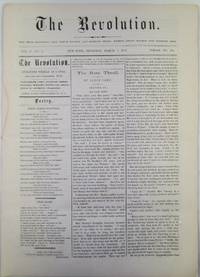
1869réf. 021007New York: Susan B. Anthony Proprietor; R.J. Johnson Publisher 1869. Wraps. Fair. Side sewn journal. Approximately 12 ¼ by 9 inches. 16 pp. Early issue of the Revolution a groundbreaking and influential newspaper produced by Elizabeth Cady Stanton Susan B. Anthony and Parker Pillsbury. The paper was established to provide a voice to activists and suffragists such as Stanton and Anthony whose voices were marginalized by the mainstream press as well as many abolitionist publications with whom they had been previously allied. Anthony and Stanton advocated for an amendment giving suffrage to women along with the amendment sponsored by abolitionists that would give Black men the right to vote. Many abolitionists actively discouraged Stanton and Anthony from pursuing their amendment until the amendment enfranchising Black men passed creating a rift in the abolitionist movement as well as the women's suffrage movement. Feeling betrayed by abolitionists and Republicans who initially supported them they established the Revolution with financial help from George Francis Train a Democrat who supported women's rights but was openly racist. As the name indicates The Revolution adopted a combative radical tone with Stanton and others unafraid to take on critics. The paper openly discussed sexual and physical abuse in marriage and advocated better divorce laws that would offer women a way to escape abusive marriages. In 1869 the paper broke with Train who had supplied very little of the funding he initially offered. It published until 1872 struggling to make expenses along the way. This issue with pieces by Elizabeth Cady Stanton "The Third Volume" and "Editorial Correspondence." Also present is a lengthy piece by Parker Pillsbury on the Fifteenth amendment stating why suffragists such as Stanton and Anthony are against it in that it gives Black men the power to vote but not women or Black women and highlights the hypocrisy of abolitionists. FAIR condition. Front leaf DETACHED but present. Several fold creases present with other general wrinkling. Minor toning and scattered soiling in the interior. Susan B. Anthony, Proprietor; R.J. Johnson, Publisher unknown
1849réf. 017978New York: No publisher 1849. Quarter Leather. Good. Quarter leather with brown cloth covers. 650 pp. Illustrated frontispiece portraits at the beginning of each month. Bound volume of this journal originally published to support the candidacy of Henry Clay who was ran for president against James Polk in 1844. The journal published literature politics history and other topics. This volume includes an article on gold hunting in California in the sixteenth century; historical and mythological traditions of the Algonquins which includes a translation of the Walum-Olum and illustrations of symbols used by Native Americans accompanied by definitions; a piece on California pondering its political future in the United States; an article contemplating problems and the future of Native Americans in the United States written by Kah-Ge-Ga-Gah-Bouh a chief of the Ojibwa Nation etc. GOOD condition. Covers a bit bowed. Moderate fading and scuffing to the covers with some soiling minor staining and areas of discoloration. Leather worn along the hinges and the corners. A few areas of minor dampstaining to the page edges throughout. Moderate to heavy scattered foxing throughout. No publisher unknown
réf. 020121Boston: Saco-Lowell Publisher. Leather. Good. 1930-31. Flexible black leather covers binding all issues with original wrappers in the interior. Pagination varies. Black and white photos throughout. A complete run of two years' worth of this bulletin issued by the Saco-Lowell Company. As one of the largest manufacturers in the world in the 1920s they had factories in Lowell and Newton Massachusetts as well as Biddeford Maine. But after merging with another company and consolidating the company shuttered all its mills in Lowell and Newton by 1932 keeping only the Biddeford one going. These bulletins discuss the operations and usefulness of the various textile machinery they produced as well as other concerns within the industry. Name of George F. Albrecht in the interior who apparently held patents for machinery he invented for the use of the Saco-Lowell company. GOOD condition. Covers rather grubby and soiled with some discoloration and staining. Minor wear to the interior. Saco-Lowell, Publisher unknown
réf. 021869New York: Greeley and McElrath Publisher. Wraps. Good. : no date circa 1847. Printed wraps. 64 pp. An almanac for 1847 issued by the Whig Party in the United States. Usual monthly almanac information along with election returns from various states an account of the US-Mexican War including a map of a battle a piece on the Oregon treaty etc. GOOD condition. General uneven toning. Minor soiling. Minor spotting. Light wrinkling and edgewear. Text block toned. Greeley and McElrath, Publisher unknown
1871réf. 017328New York: Van Evrie Horton and Co 1871. Tabloid. Good. Side folding tabloid newspaper 8 pages long. issue of the being as the by-line states "devoted to white supremacy state equality and federal union." The paper was published by John H. Van Evrie described by historian George M. Frederickson as "perhaps the first professional racist in American history." He used this paper to promote baseless ideas of scientific racism and to validate his views. Contents of this issue include politics racist diatribes and other subjects with any news of African-Americans written to portray them in a negative light. Not content with limiting the paper's racism to the US it also looks at natives of the Fiji Islands news from Europe etc. GOOD condition with horizontal and vertical fold creases present as well as some creasing and wrinkling. Moderate to heavy chipping and small tears along the extremities with some tearing and holes along the fold creases with perhaps loss of text. Minor foxing/spotting. Van Evrie, Horton and Co unknown
réf. 1560768940.Gpaperback. Good. Access codes and supplements are not guaranteed with used items. May be an ex-library book. paperback
1790réf. LBW-5313Paris, imprimerie de Demonville, 1790. In-8 de 23 pp., cartonnage de papier marbré à la bradel, pièce de titre de maroquin rouge avec le titre en long (reliure moderne).
1790réf. LBW-6686Paris, Demonville, 1790. In-8 de 23 pp.; cartonnage de papier marbré à la Bradel, pièce de titre verte (reliure moderne).
1790réf. LBW-6873Paris, Baudouin, 1790. In-4 de 14 pp. ; cartonnage de papier marbré marron à la Bradel, pièce de titre marron (reliure moderne).
1790réf. LBW-6690Paris, Didot, 1790. In-8 de 15 pp. ; cartonnage de papier marbré à la bradel, pièce de titre de maroquin rouge (reliure moderne).
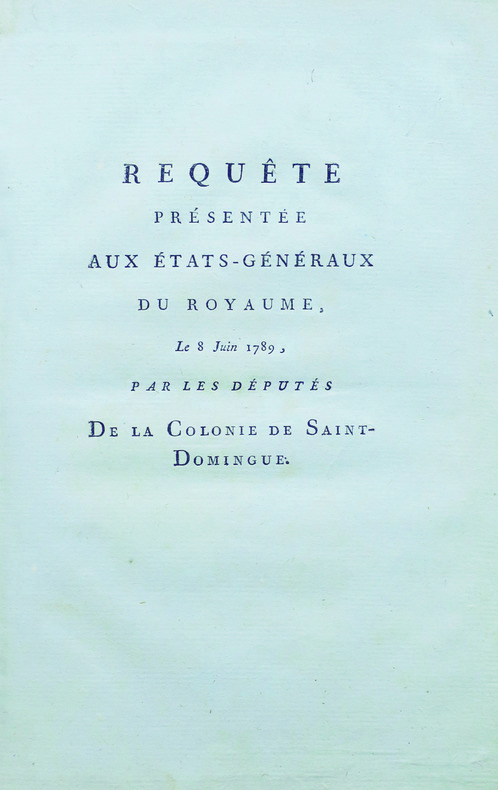
1789réf. LBW-68831789. In-8 de 7 pp. sur papier bleuté, non rogné ; cartonnage de papier marbré marron à la Bradel, pièce de titre marron (reliure moderne).
1789réf. LBW-6729Versailles, Ph.-D. Pierres, 1789. In-8 de 55 pp.; cartonnage de papier marbré à la Bradel, pièce de titre rouge (reliure moderne).
1818réf. 111571818 Paris, Gide fils, 1818; in-8°, demi-basane blonde époque,à tout petits coins verts, dos lisse orné de fleurons, palettes et petits fers dorés, titre sur étiquette de maroquin rouge, tomaison sur étiquette verte, tranches jaunes, plats de papier beige; (4) - 390pp. Manque la coiffe supérieure, fentes aux charnières mais reliure solide; très pales traces de mouillures en marge supérieure, quelques rousseurs ou taches rousses en marges en début en fin dues à la colle utilisée qui également bruni le papier des plats. Cachets.
réf. 236541Basse-Terre, Imprimerie du gouvernement, s.d. (1871) in-8, 6 pp., en feuilles.
réf. GF22458Photographie format 40 x 30 cm - beau tirage plastique noir et blanc - années 1980 pour l'émission "Apostrophes"-
réf. 14714Paris, Cercle du Livre Précieux, 1961. In-8, en feuilles, couverture rempliée, sous chemise et étui. (chemise et étui neufs refaits à l'identique).