1 993 résultats
réf. 55378The signatures are Lloyd Captain Ali Baichan Boyce Fredericks Gibbs Greenidge Holder Holding Julien Kallicharran possibly Murray Richards Rowe and Clive Walcott the Manager. On a conjugate leaf are the signatures of eight members of the Test team for Australia: Gilmour Jenner Lillee Mallett Marsh McCosker Turner and Walker. These were probably collected at the time of the First Test in Brisbane in which case the Australians not to have signed are Ian Chappell Captain Greg Chappell Redpath and Thomson. Leading edges of the leaves slightly silverfish-nibbled; all edges slightly discoloured; two small light marginal spots; in very good condition. unknown
1969réf. 029365Ira J. Friedman Inc. 1969. Volume I: 1774 - 1832 405 pages. Volume II: 1833 -1861 444 pages. Volume III: 1861 - 1882 561 pages. Volume IV: Four Famous New Yorkers 488 pages. Four volumes complete this set. This is a reprint of the 1909 edition. 4 FINE HARDCOVERS SCARCE. Red cloth covers lettering is bright. Hard Cover. Fine/No Dust Jackets Present. 8vo - over 7¾" - 9¾" tall. Ira J. Friedman, Inc. Hardcover
1989réf. 15375Inscribed by author; association copy; 1st edition. Near Fine HC in Very Good DJ. Navy blue cloth over boards gilt letters; map front end papers. Bright clean covers and spine are As New; tightly bound; single piece of cello-tape attaching publisher's presentation card to front free end paper with typed note 'I only wish that Ellsworth could have seen this book. It was written really for him.' and signed at bottom 'Bruce Palmer'; crisp clean interior. DJ is bright clean and complete; faintly scuffed; very slight rubbing wear at spine head. From the family collection of Ellsworth Bunker U.S. Ambassador to Argentina Italy India Nepal South Vietnam Organization of American States and twice recipient of U.S. Presidential Medal of Freedom. Bunker figures prominently in the book and was considered by this author President Johnson and others to have been a critical element in avoiding open civil war in the Dominican Republic. 8vo 226 pp; index biblio; illustrated. The University Press of Kentucky hardcover
1899réf. 021941Little Brown and Company: 1899. 360 pages with 79 b&w photographs. "The Spanish-American War of 1898 was the justification of the Massachusetts Volunteer Militia. The history of the 6th Massachusetts in the Spanish-American War is unique in that its campaign was almost a bloodless one the absence of battles and the few months it was in the field rendering its experiences different in kind and degree from those regiments which were in the Civil War almost as many years and even for its sister regiments in Cuba in '98. And while the following account is written with a full appreciation of the seemingly insuramountable difficulties overcome by the War Department in an incredibly short space of time in addition to the necessary hardships of army life and it not intended in any sense as a "lament" there is that to record of interest not only to the regiment itself but to its friends." VERY GOOD HARDCOVER brown illustrated covers. This book as two photographs tipped into the book. On the front blank endpaper "this photograph of Hazel W. Newton nice of Corporal Frank A. Haines was carried by him throughout his service in the Spanish War in 1898." In the back of the book there is a photograph of Corp. Frank A. Haines in uniform. Hard Cover. Very Good/No Dust Jacket Present. 8vo - over 7¾" - 9¾" tall. Little, Brown and Company: Hardcover
réf. 13983605Paris, Bordeaux: Musée du quai Branly, Editions Hervé Chopin, 2025 in-4 (22x28,5 cm), 240 pages, nombreuses illustrations. Chronologie, bibliographie, glossaire. Cartonnage illustré d'éd., état neuf
1978réf. 023333E. KOLODZIEJ - Édition et Diffusion de la Culture Antillaise 1978 Quatre volumes in-8° carré (230 x 182mm), 551, 537, 379, et 380 pp. Reliure éditeur en skyvertex lie-de-vin, dos et plats ornés. (légères marques à deux plats inférieurs, trois coins légèrement pincés). Frontispice. Réédition de cet important texte paru pour la première fois chez Jolly en 1667. Bel exemplaire.
Paris, Cercle du Livre Précieux, 1961. In-8, en feuilles, couverture rempliée, sous chemise et étui de l'éditeur. Les 12 gravures originales de Michel SIMEON ont été coloriées par Maurice Beaufumé et sont à part sous papier cristal. Edition limitée à 750 exemplaires numérotés sur vélin, celui-ci hors-commerce Apollinaire, Fleuret et Perceau, qui citent l'édition originale (1892), indiquent " roman licencieux qui nous donne l'apparence et les moeurs de Saint-Pierre de la Martinique peu avant la destruction de cette ville par l'éruption du Mont Pelé. Cet ouvrage est peut-être le seul où l'on ait recueilli des expressions créoles les plus libres. L'affabulation en est ingénieuse. " Bel exemplaire, état neuf.
réf. 22420Paris, Cercle du Livre Précieux, 1961. In-8, en feuilles, couverture rempliée, sous chemise et étui de l'éditeur.
réf. 66399aafParis, Albert Messein, 1924, gr. in-4to, 242 p., ill., brochure originale, plat supérieur très abîmé et détaché, emboîtage.
1860réf. 012222Columbus: Follett Foster and Company 1860. Pamphlet. Good. Pamphlet lacking any wrappers or binding originally issued. 232 pp. A detailed report and account of the 1860 presidential campaign recalling the events leading to the eventual nomination of Stephen Douglas and Abraham Lincoln as well some speculation at the time that Seward would be nominated over Lincoln. Some mention of slavery slave states and their political demands is found throughout. This includes reports from the Charleston Convention the Baltimore National Constitutional Union Convention the Chicago Convention the Constitutional Democratic Convention at Richmond The National Democratic Convention at Baltimore Institute Hall "Seceders" Convention and the Second Richmond Convention. Written by Murat Halstead a 19th century newspaper editor and writer. FAIR/GOOD condition. Lacking any binding or covers. Moderate scattered foxing throughout. Some curling and creasing at the corners. Minor scattered soiling. Sabin 29924. Follett, Foster and Company unknown
1898réf. 16677Limited 1028/1200 'Champlain Edition'; association copy. Near Fine HCs no DJs. Green calico-grain cloth over boards with paper spine panel printed with red and black titles; top edge gilt; untrimmed fore edges; 2 color title page; laid paper; tissue-guarded frontispiece and interior plates. Bright clean covers and spine but for very faint foxing-like shadows; spine cloth slightly faded; slightly bumped at cover top fore corners; paper label on spine age darkened but legible - new additional spine labels tipped in at rear end papers of each volume; tightly bound; bookplates on each front pastedown 'To Ellsworth Bunker with affecionate regards from the American Red Cross Staff December 31 1956'; bright clean interiors; many leaves unopened at fore edges - never been read. From the collection of Ellsworth Bunker U.S. Ambassador to Argentina Italy India Nepal South Vietnam Organization of American States; president of the American Red Cross; and twice recipient of U.S. Presidential Medal of Freedom. 8vo Paged 251 272 342 865 total pp; index; illustrated. Volumes 16 17 18 of Parkman's Works. Boston: Little, Brown and Co. hardcover
réf. #[36829]Amsterdam J.H. de Bussy 1887- 1903. 6 volumes. Original printed wrappers spines with tape. All published. - With stamp of the library of Dutch parliament. - Annual report of the History Language Land- and Ethnological Society established in Willemstad. unknown
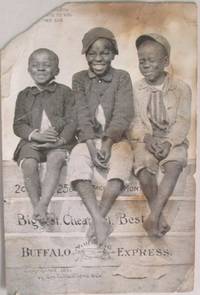
1891réf. 020605Buffalo NY: George E. Matthews and Co. Publisher 1891. Unbound. Fair. Single sheet thin card stock. 6 3/8 by 4 ¼ inches. Black and white photo on one side with advertising copy on the reverse along with a small illustration of the printing press. A promotional trade card for the newspaper the Buffalo Morning Express asserting it was the "biggest cheapest best." The reverse touts their typesetting machinery and maps that come with subscriptions. Of note is the front side photo depicting three African-American boys sitting on a wall giggling and laughing rendering this somewhat of an anomaly unfortunately of a 19th century trade card where racist stereotypes were more often than not the norm. FAIR condition. Upper left corner torn off on the diagonal. Moderate dampstaining to the whole piece. Some creasing minor soiling and edgewear. George E. Matthews and Co., Publisher unknown
1953réf. 021611No Place: No publisher 1953. Unbound. Good. Mickey Mantle Exhibit Card. Circa 1951-53 based on the "Made in U.S.A." printed in upper and lower case. 5 5/16 by 3 5/16 inches. No printing on the reverse. An exhibit baseball card featuring all time great Mickey Mantle. UNGRADED. Tiny dings/creases at the corners with the extremities bearing minor rubbing. Unfortunately the number 50 is written in pen at the top of the card both front and reverse. Small spot of soiling to the left of Mantle's head. UNGRADED. No publisher unknown
réf. 021455No Place: No publisher. Hard Cover. Very Good. Oblong format old photo album. 30 leaves with photographs on both sides. Each page averages around 10 photographs per page so we estimate there are around 600 photographs total give or take a few. This photo album belonged to Lillian F. Jones nee Geary and depicts her friends and family at a variety of locations. Names of many of the people were added underneath at a much later date as indicated at the front of the album. Two handwritten leaves provide a "Who's Who" of the people included mentioning their relationships to others etc. Of particular note perhaps is one page devoted to photos of several young women in suffragette "costume" and holding small hand signs that say "votes for women" or "we vote next year." One of the latter also has the initials "NIT" in quotes. Another woman holds a sign reading "Officer Call a Cop." This was the title of a 1917 short film although we could find no reason to associate this with suffrage for or against. In the images the women are adopting clownish poses and it appears they have purposely blacked out a tooth or two and added moles. Because of this we feel that these women may be anti-suffrage. One photograph depicts a young man pulling on the hat of a young woman holding a sign. Other photographs depict young men and women swimming or posing at the beach at Brant Rock in Massachusetts. Several other pages chronicle two young women apparently visiting Provincetown Massachusetts swimming etc. Other photos are of Cushing Maine etc. Photo album is in VERY GOOD condition. Very little wear to the photos. Most are glued in and a few have detached. Minor toning to the photos. Photo quality is good and the shots are well done as is the layout. No publisher unknown
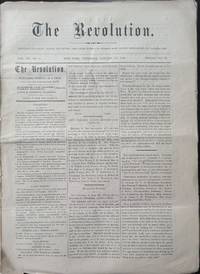
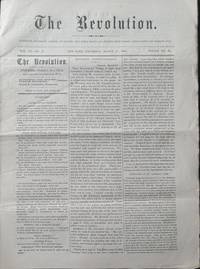
1869réf. 020893New York: Susan B. Anthony Proprietor; R.J. Johnson Publisher 1869. Wraps. Good. Side sewn journal. Approximately 12 ¼ by 9 inches. 16 pp. Early issue of the Revolution a groundbreaking and influential newspaper produced by Elizabeth Cady Stanton Susan B. Anthony and Parker Pillsbury. The paper was established to provide a voice to activists and suffragists such as Stanton and Anthony whose voices were marginalized by the mainstream press as well as many abolitionist publications with whom they had been previously allied. Anthony and Stanton advocated for an amendment giving suffrage to women along with the amendment sponsored by abolitionists that would give Black men the right to vote. Many abolitionists actively discouraged Stanton and Anthony from pursuing their amendment until the amendment enfranchising Black men passed creating a rift in the abolitionist movement as well as the women's suffrage movement. Feeling betrayed by abolitionists and Republicans who initially supported them they established the Revolution with financial help from George Francis Train a Democrat who supported women's rights but was openly racist. As the name indicates The Revolution adopted a combative radical tone with Stanton and others unafraid to take on critics. The paper openly discussed sexual and physical abuse in marriage and advocated better divorce laws that would offer women a way to escape abusive marriages. In 1869 the paper broke with Train who had supplied very little of the funding he initially offered. It published until 1872 struggling to make expenses along the way. This issue with editorial correspondence written by Elizabeth Cady Stanton as well as a letter by Susan B. Anthony addressing concerns from readers regarding George Train's contributions to the journal etc. GOOD condition. Several fold creases present with other general wrinkling. Minor toning and scattered soiling in the interior. Susan B. Anthony, Proprietor; R.J. Johnson, Publisher unknown
1878réf. 021488Boston: New England Publishing Company 1878. First Edition. Cloth. Good. First edition with 1878 present on title and copyright page. Green cloth decorated in blind and black. 373 pp. Photograph frontis of Bridgman along with two fold out plates of writing in the text. A biography of Laura Bridgman a woman who after being stricken with scarlet fever at the age of two was left deaf and blind. Showing an aptitude for learning Bridgman was enrolled at the Perkins Institute for the Blind successfully learning Braille and sign language as well as general knowledge including arithmetic. She gained some fame in her early teenage years when Charles Dickens wrote about her in 1842 but this fame eventually faded. Her story did inspire the mother of Helen Keller who then hired Anne Sullivan who was a student at the Perkins School. This biography was written by one of Bridgman's teachers. GOOD condition. Minor fading and edgewear to the covers. Faint evidence of dampstaining along the fore edge of the cover with dampstaining affecting the right third of the first 50 or so pages. New England Publishing Company unknown
1849réf. 006627No Place: No publisher 1849. Pamphlet. Good. Full titles: In the Senate of the United States. January 9 1849. Submitted read and Ordered to be Printed. Mr. Berrien made the following Report. 30th Congress 2d Session. Rep. Com. No. 256. Senate. With: In the Senate of the United States. January 15 1849. Submitted read and Ordered to be Printed. Mr. Downs made the following Report. 30th Congress 2d Session. Rep. Com. No. 256. Part II. Senate. No publisher or place. Presumed Washington DC: 1849. Two pamphlets. 6 pp with a blank rear endpaper; 10 pp with a blank rear endpaper. Both disbound from larger works with a single thread binding part II. Side folded. Two US government pamphlets regarding California and its potential admission to the Union as well as the minority report part II against the admission of California as a state. The first part proposes to make territory acquired with the treaty of peace with Mexico one state California although outlining potential land disputes with the state of Texas and its claims. Part II continues reports and debates on the recent land acquisitions alluding to potential problems but also containing the bill at the end that proposes to make California a state. It also describes in brief the vast dimensions of the proposed state. Much of this report derives from the then recent conclusion of the U.S.-Mexican War 1846-1848 and the territory gained at the end of the War. California officially gained statehood in September of 1850. Both in GOOD condition. Paper splitting along the spines in danger of becoming separated. General browning to the paper. Fore edges a bit rough with minor chipping. Minor wrinkling. A few pages unopened. No publisher unknown
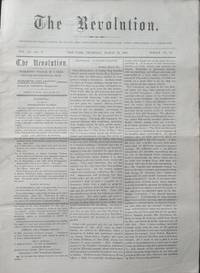
1869réf. 020897New York: Susan B. Anthony Proprietor; R.J. Johnson Publisher 1869. Wraps. Good. Side sewn journal. Approximately 12 ¼ by 9 inches. 16 pp. Early issue of the Revolution a groundbreaking and influential newspaper produced by Elizabeth Cady Stanton Susan B. Anthony and Parker Pillsbury. The paper was established to provide a voice to activists and suffragists such as Stanton and Anthony whose voices were marginalized by the mainstream press as well as many abolitionist publications with whom they had been previously allied. Anthony and Stanton advocated for an amendment giving suffrage to women along with the amendment sponsored by abolitionists that would give Black men the right to vote. Many abolitionists actively discouraged Stanton and Anthony from pursuing their amendment until the amendment enfranchising Black men passed creating a rift in the abolitionist movement as well as the women's suffrage movement. Feeling betrayed by abolitionists and Republicans who initially supported them they established the Revolution with financial help from George Francis Train a Democrat who supported women's rights but was openly racist. As the name indicates The Revolution adopted a combative radical tone with Stanton and others unafraid to take on critics. The paper openly discussed sexual and physical abuse in marriage and advocated better divorce laws that would offer women a way to escape abusive marriages. In 1869 the paper broke with Train who had supplied very little of the funding he initially offered. It published until 1872 struggling to make expenses along the way. This issue editorial correspondence by Elizabeth Cady Stanton "A Colored Woman's Voice" reflecting on suffrage for Black women etc. GOOD condition. Several fold creases present with other general wrinkling. Minor toning and scattered soiling in the interior. Susan B. Anthony, Proprietor; R.J. Johnson, Publisher unknown
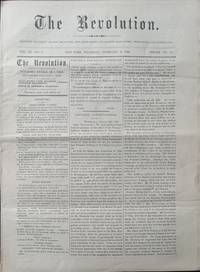
1869réf. 020892New York: Susan B. Anthony Proprietor; R.J. Johnson Publisher 1869. Wraps. Good. Side sewn journal. Approximately 12 ¼ by 9 inches. 16 pp. Early issue of the Revolution a groundbreaking and influential newspaper produced by Elizabeth Cady Stanton Susan B. Anthony and Parker Pillsbury. The paper was established to provide a voice to activists and suffragists such as Stanton and Anthony whose voices were marginalized by the mainstream press as well as many abolitionist publications with whom they had been previously allied. Anthony and Stanton advocated for an amendment giving suffrage to women along with the amendment sponsored by abolitionists that would give Black men the right to vote. Many abolitionists actively discouraged Stanton and Anthony from pursuing their amendment until the amendment enfranchising Black men passed creating a rift in the abolitionist movement as well as the women's suffrage movement. Feeling betrayed by abolitionists and Republicans who initially supported them they established the Revolution with financial help from George Francis Train a Democrat who supported women's rights but was openly racist. As the name indicates The Revolution adopted a combative radical tone with Stanton and others unafraid to take on critics. The paper openly discussed sexual and physical abuse in marriage and advocated better divorce laws that would offer women a way to escape abusive marriages. In 1869 the paper broke with Train who had supplied very little of the funding he initially offered. It published until 1872 struggling to make expenses along the way. This issue with three pieces written by Elizabeth Cady Stanton: "Woman's Protectors" "Rev. Newman Hall" Disenfranchisement is Degradation." Also present are pieces quoting John Stuart Mill on women's suffrage woman's wages etc. GOOD condition. Front page detaching along the spine tenuously hanging on. Several fold creases present with other general wrinkling. Minor toning and scattered soiling in the interior. A few tears along the edges. Susan B. Anthony, Proprietor; R.J. Johnson, Publisher unknown
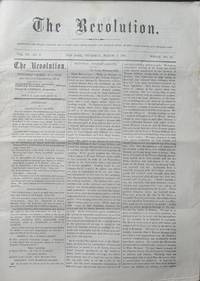
1869réf. 020898New York: Susan B. Anthony Proprietor; R.J. Johnson Publisher 1869. Wraps. Good. Side sewn journal. Approximately 12 ¼ by 9 inches. 16 pp. Early issue of the Revolution a groundbreaking and influential newspaper produced by Elizabeth Cady Stanton Susan B. Anthony and Parker Pillsbury. The paper was established to provide a voice to activists and suffragists such as Stanton and Anthony whose voices were marginalized by the mainstream press as well as many abolitionist publications with whom they had been previously allied. Anthony and Stanton advocated for an amendment giving suffrage to women along with the amendment sponsored by abolitionists that would give Black men the right to vote. Many abolitionists actively discouraged Stanton and Anthony from pursuing their amendment until the amendment enfranchising Black men passed creating a rift in the abolitionist movement as well as the women's suffrage movement. Feeling betrayed by abolitionists and Republicans who initially supported them they established the Revolution with financial help from George Francis Train a Democrat who supported women's rights but was openly racist. As the name indicates The Revolution adopted a combative radical tone with Stanton and others unafraid to take on critics. The paper openly discussed sexual and physical abuse in marriage and advocated better divorce laws that would offer women a way to escape abusive marriages. In 1869 the paper broke with Train who had supplied very little of the funding he initially offered. It published until 1872 struggling to make expenses along the way. This issue editorial correspondence by Elizabeth Cady Stanton many short pieces on women's rights and suffrage work etc. GOOD condition. Several fold creases present with other general wrinkling. Minor toning and scattered soiling in the interior. Susan B. Anthony, Proprietor; R.J. Johnson, Publisher unknown
1869réf. 020899New York: Susan B. Anthony Proprietor; R.J. Johnson Publisher 1869. Wraps. Good. Side sewn journal. Approximately 12 ¼ by 9 inches. 16 pp. Early issue of the Revolution a groundbreaking and influential newspaper produced by Elizabeth Cady Stanton Susan B. Anthony and Parker Pillsbury. The paper was established to provide a voice to activists and suffragists such as Stanton and Anthony whose voices were marginalized by the mainstream press as well as many abolitionist publications with whom they had been previously allied. Anthony and Stanton advocated for an amendment giving suffrage to women along with the amendment sponsored by abolitionists that would give Black men the right to vote. Many abolitionists actively discouraged Stanton and Anthony from pursuing their amendment until the amendment enfranchising Black men passed creating a rift in the abolitionist movement as well as the women's suffrage movement. Feeling betrayed by abolitionists and Republicans who initially supported them they established the Revolution with financial help from George Francis Train a Democrat who supported women's rights but was openly racist. As the name indicates The Revolution adopted a combative radical tone with Stanton and others unafraid to take on critics. The paper openly discussed sexual and physical abuse in marriage and advocated better divorce laws that would offer women a way to escape abusive marriages. In 1869 the paper broke with Train who had supplied very little of the funding he initially offered. It published until 1872 struggling to make expenses along the way. This issue editorial correspondence and a letter addressing women and Black men by Elizabeth Cady Stanton many short pieces on women's rights and suffrage work and an anonymous xenophobic racist screed against Chinese and Jewish immigrants among others etc. GOOD condition. Several fold creases present with other general wrinkling. Minor toning and scattered soiling in the interior. Susan B. Anthony, Proprietor; R.J. Johnson, Publisher unknown
réf. 8082Promenades aux Etats-Unis et aux Antilles.In 12 demi-cuir fauve, dos lisse,longs filets à froid, filets, roulette, titre dorés ;préface de M H.H.VILLEMASSANS,titre,VIII,304 pages,Alexandre Cadot 1856,édition originale,rousseurs habituelles,principalement concentrées en marges, mouillure angle supérieur droit page 243,marge extérieure plus courte, pages 131 à 134.Relation de la tournée en Amérique de la comédienne RACHEL
1979réf. 1718Charting the Discovery of Californias Capital from the arrival of German-born Swiss pioneer John Sutter to the area through to its first role as capital city. VG Large Format 11x9" Dec Brown Boards HB with tree logo Newspaper Repro Endpapers extensive previous owners sig on title pages. In similar VG Unpriceclipped John Beyer designed DJ. 207pp with index & bibliography ISBN ~ 144.50 ~ American Explorers Frontiersmen Sacramento San Francisco Sutters Fort Trappers ~ American History Personal dedications inside front cover. DJ in protective cover. Dark brown cloth boards. Tight binding. California Historical Society hardcover
(París, 1758), mapa coloreado a mano de 19 x 29 cm.