1851 risultati
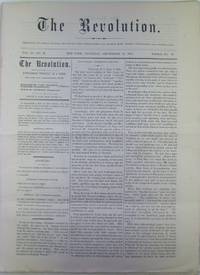
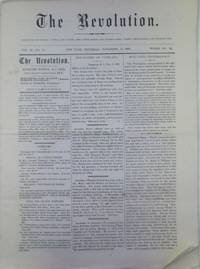
1868rif. 020102New York: Susan B. Anthony Proprietor; R.J. Johnson Publisher 1868. Wraps. Good. Side sewn journal. Approximately 12 ¼ by 9 inches. 16 pp. Single issue of the Revolution a groundbreaking and influential newspaper produced by Elizabeth Cady Stanton Susan B. Anthony and Parker Pillsbury. The paper was established to provide a voice to activists and suffragists such as Stanton and Anthony whose voices were marginalized by the mainstream press as well as many abolitionist publications with whom they had been previously allied. Anthony and Stanton advocated for an amendment giving suffrage to women along with the amendment sponsored by abolitionists that would give Black men the right to vote. Many abolitionists actively discouraged Stanton and Anthony from pursuing their amendment until the amendment enfranchising Black men passed creating a rift in the abolitionist movement as well as the women's suffrage movement. Feeling betrayed by abolitionists and Republicans who initially supported them they established the Revolution with financial help from George Francis Train a Democrat who supported women's rights but was openly racist. As the name indicates The Revolution adopted a combative radical tone with Stanton and others unafraid to take on critics. The paper openly discussed sexual and physical abuse in marriage and advocated better divorce laws that would offer women a way to escape abusive marriages. In 1869 the paper broke with Train who had supplied very little of the funding he initially offered. It published until 1872 struggling to make expenses along the way. This issue with a lengthy column written by Elizabeth Cady Stanton on her travels in the US spanning almost two pages. Very small paragraph by Susan B. Anthony present soliciting 6 to 8 women for potential employment. A few pieces discuss voting rights for Black men. GOOD condition. Several fold creases present with other general wrinkling. Minor toning and scattered soiling in the interior. Small hole in the upper front page. Susan B. Anthony, Proprietor; R.J. Johnson, Publisher unknown
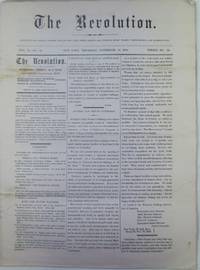
1868rif. 020196New York: Susan B. Anthony Proprietor; R.J. Johnson Publisher 1868. Wraps. Good. Side sewn journal. Approximately 12 ¼ by 9 inches. 16 pp. Early issue of the Revolution a groundbreaking and influential newspaper produced by Elizabeth Cady Stanton Susan B. Anthony and Parker Pillsbury. The paper was established to provide a voice to activists and suffragists such as Stanton and Anthony whose voices were marginalized by the mainstream press as well as many abolitionist publications with whom they had been previously allied. Anthony and Stanton advocated for an amendment giving suffrage to women along with the amendment sponsored by abolitionists that would give Black men the right to vote. Many abolitionists actively discouraged Stanton and Anthony from pursuing their amendment until the amendment enfranchising Black men passed creating a rift in the abolitionist movement as well as the women's suffrage movement. Feeling betrayed by abolitionists and Republicans who initially supported them they established the Revolution with financial help from George Francis Train a Democrat who supported women's rights but was openly racist. As the name indicates The Revolution adopted a combative radical tone with Stanton and others unafraid to take on critics. The paper openly discussed sexual and physical abuse in marriage and advocated better divorce laws that would offer women a way to escape abusive marriages. In 1869 the paper broke with Train who had supplied very little of the funding he initially offered. It published until 1872 struggling to make expenses along the way. This issue with a lengthy column written by Elizabeth Cady Stanton on her travels in the US spanning almost two pages. Another piece by Stanton discusses the upcoming presidential election and the potential affiliation of the Revolution with the Democrats. Three small paragraphs by Susan B. Anthony one on the National Unitarian Convention the National Workingmen's Congress and one soliciting more subscribers. A few pieces discuss voting rights for Black men. GOOD condition. Small piece torn from the upper edge of one leaf and another from the bottom corner of the last leaf. Several fold creases present with other general wrinkling. Minor toning and scattered soiling in the interior. Susan B. Anthony, Proprietor; R.J. Johnson, Publisher unknown
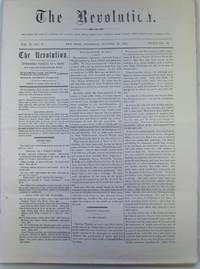
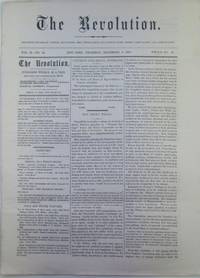
1868rif. 020221New York: Susan B. Anthony Proprietor; R.J. Johnson Publisher 1868. Wraps. Good. Side sewn journal. Approximately 12 ¼ by 9 inches. 16 pp. This issue with a front page "Appeal for Equal Suffrage" undersigned by Elizabeth Cady Stanton Abby Hopper Gibbons Mrs. Horace Greeley Susan B. Anthony and Elizabeth Smith Miller. With two pieces "Hester Vaughan" and "Our Children at School" both written by Elizabeth Cady Stanton. GOOD condition. Front page separating from the spine somewhat tenuously attached. Several fold creases present with other general wrinkling. Minor toning and scattered soiling in the interior. Minor staining to the front cover. Susan B. Anthony, Proprietor; R.J. Johnson, Publisher unknown
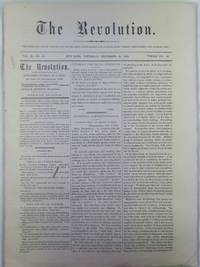
1868rif. 020291New York: Susan B. Anthony Proprietor; R.J. Johnson Publisher 1868. Wraps. Good. Side sewn journal. Approximately 12 ¼ by 9 inches. 16 pp. arly issue of the Revolution a groundbreaking and influential newspaper produced by Elizabeth Cady Stanton Susan B. Anthony and Parker Pillsbury. The paper was established to provide a voice to activists and suffragists such as Stanton and Anthony whose voices were marginalized by the mainstream press as well as many abolitionist publications with whom they had been previously allied. Anthony and Stanton advocated for an amendment giving suffrage to women along with the amendment sponsored by abolitionists that would give Black men the right to vote. Many abolitionists actively discouraged Stanton and Anthony from pursuing their amendment until the amendment enfranchising Black men passed creating a rift in the abolitionist movement as well as the women's suffrage movement. Feeling betrayed by abolitionists and Republicans who initially supported them they established the Revolution with financial help from George Francis Train a Democrat who supported women's rights but was openly racist. As the name indicates The Revolution adopted a combative radical tone with Stanton and others unafraid to take on critics. The paper openly discussed sexual and physical abuse in marriage and advocated better divorce laws that would offer women a way to escape abusive marriages. In 1869 the paper broke with Train who had supplied very little of the funding he initially offered. It published until 1872 struggling to make expenses along the way. This issue with a lengthy profile of Anna Elizabeth Dickinson written by Elizabeth Cady Stanton as well as an essay on marriage and mistresses that questions legal rulings favoring men in marriage over women. Also present is an essay by actor and writer Olive Logan titled "U.S". GOOD condition. Several fold creases present with other general wrinkling. Minor toning and scattered soiling in the interior. Small tear affecting the title at the top of the first page appearing to have happened during the printing. Susan B. Anthony, Proprietor; R.J. Johnson, Publisher unknown
1868rif. 020339New York: Susan B. Anthony Proprietor; R.J. Johnson Publisher 1868. Wraps. Fair. Side sewn journal. Approximately 12 ¼ by 9 inches. 16 pp. Early issue of the Revolution a groundbreaking and influential newspaper produced by Elizabeth Cady Stanton Susan B. Anthony and Parker Pillsbury. The paper was established to provide a voice to activists and suffragists such as Stanton and Anthony whose voices were marginalized by the mainstream press as well as many abolitionist publications with whom they had been previously allied. Anthony and Stanton advocated for an amendment giving suffrage to women along with the amendment sponsored by abolitionists that would give Black men the right to vote. Many abolitionists actively discouraged Stanton and Anthony from pursuing their amendment until the amendment enfranchising Black men passed creating a rift in the abolitionist movement as well as the women's suffrage movement. Feeling betrayed by abolitionists and Republicans who initially supported them they established the Revolution with financial help from George Francis Train a Democrat who supported women's rights but was openly racist. As the name indicates The Revolution adopted a combative radical tone with Stanton and others unafraid to take on critics. The paper openly discussed sexual and physical abuse in marriage and advocated better divorce laws that would offer women a way to escape abusive marriages. In 1869 the paper broke with Train who had supplied very little of the funding he initially offered. It published until 1872 struggling to make expenses along the way. This issue with a lengthy column editorial correspondence written by Elizabeth Cady Stanton wherein she discusses her time in Philadelphia and Pennsylvania as well as the case of Hester Vaughn. There are two other lengthy articles on Hester Vaughn one written by Elizabeth Cady Stanton. Vaughan was tried and convicted of murdering her newborn baby to which she gave birth alone. The circumstances around the birth and death the child were murky and she was sentenced to death by an all male jury. The Revolution took up her case seeking her pardon and inferred she was raped. Stanton and Anthony attracted a lot of publicity to the case. Vaughn was eventually pardoned by the governor of Pennsylvania and sent back to England. The cause proved a bit divisive for Stanton and Anthony and the Revolution with modern historians asserting it helped to set back their work for women's suffrage. FAIR condition. Front leaf DETACHED with the binding a bit fragile. Several fold creases present with other general wrinkling. Minor toning and scattered soiling in the interior. Susan B. Anthony, Proprietor; R.J. Johnson, Publisher unknown
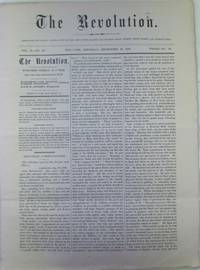
1868rif. 020366New York: Susan B. Anthony Proprietor; R.J. Johnson Publisher 1868. Wraps. Good. Side sewn journal. Approximately 12 ¼ by 9 inches. 16 pp. Early issue of the Revolution a groundbreaking and influential newspaper produced by Elizabeth Cady Stanton Susan B. Anthony and Parker Pillsbury. The paper was established to provide a voice to activists and suffragists such as Stanton and Anthony whose voices were marginalized by the mainstream press as well as many abolitionist publications with whom they had been previously allied. Anthony and Stanton advocated for an amendment giving suffrage to women along with the amendment sponsored by abolitionists that would give Black men the right to vote. Many abolitionists actively discouraged Stanton and Anthony from pursuing their amendment until the amendment enfranchising Black men passed creating a rift in the abolitionist movement as well as the women's suffrage movement. Feeling betrayed by abolitionists and Republicans who initially supported them they established the Revolution with financial help from George Francis Train a Democrat who supported women's rights but was openly racist. As the name indicates The Revolution adopted a combative radical tone with Stanton and others unafraid to take on critics. The paper openly discussed sexual and physical abuse in marriage and advocated better divorce laws that would offer women a way to escape abusive marriages. In 1869 the paper broke with Train who had supplied very little of the funding he initially offered. It published until 1872 struggling to make expenses along the way. This issue with a piece "The Dignity of the Ballot" and an account of the Boston Woman's Suffrage Convention both written by Elizabeth Cady Stanton. GOOD condition. Several fold creases present with other general wrinkling. Minor toning and scattered soiling in the interior. Small crease to the lower front page corner. Susan B. Anthony, Proprietor; R.J. Johnson, Publisher unknown
1868rif. 020469New York: Susan B. Anthony Proprietor; R.J. Johnson Publisher 1868. Wraps. Good. Side sewn journal. Approximately 12 ¼ by 9 inches. 16 pp. Early issue of the Revolution a groundbreaking and influential newspaper produced by Elizabeth Cady Stanton Susan B. Anthony and Parker Pillsbury. The paper was established to provide a voice to activists and suffragists such as Stanton and Anthony whose voices were marginalized by the mainstream press as well as many abolitionist publications with whom they had been previously allied. Anthony and Stanton advocated for an amendment giving suffrage to women along with the amendment sponsored by abolitionists that would give Black men the right to vote. Many abolitionists actively discouraged Stanton and Anthony from pursuing their amendment until the amendment enfranchising Black men passed creating a rift in the abolitionist movement as well as the women's suffrage movement. Feeling betrayed by abolitionists and Republicans who initially supported them they established the Revolution with financial help from George Francis Train a Democrat who supported women's rights but was openly racist. As the name indicates The Revolution adopted a combative radical tone with Stanton and others unafraid to take on critics. The paper openly discussed sexual and physical abuse in marriage and advocated better divorce laws that would offer women a way to escape abusive marriages. In 1869 the paper broke with Train who had supplied very little of the funding he initially offered. It published until 1872 struggling to make expenses along the way. This issue with a lengthy article written by Elizabeth Cady Stanton on women's suffrage in Texas as well as a shorter piece asking "What is a Democrat" Two short pieces on the front page look at a new suffrage movement in Boston regarding 18 year old boys and woman suffrage in Michigan. An anonymous piece discusses "Indian Troubles in Kansas" describing attacks on white settlers by various tribes in the region. The author asserts that the Native American image as described by Longfellow peaceful is wrong and asserting that "murder and plunder are their ruling spirit." GOOD condition. Several fold creases present with other general wrinkling. Minor toning and scattered soiling in the interior. Front and rear page tenuously attached along the spine. Susan B. Anthony, Proprietor; R.J. Johnson, Publisher unknown
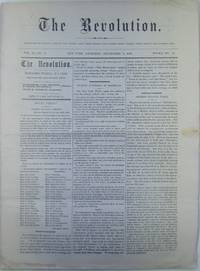
1868rif. 020532New York: Susan B. Anthony Proprietor; R.J. Johnson Publisher 1868. Wraps. Good. Side sewn journal. Approximately 12 ¼ by 9 inches. 16 pp. Early issue of the Revolution a groundbreaking and influential newspaper produced by Elizabeth Cady Stanton Susan B. Anthony and Parker Pillsbury. The paper was established to provide a voice to activists and suffragists such as Stanton and Anthony whose voices were marginalized by the mainstream press as well as many abolitionist publications with whom they had been previously allied. Anthony and Stanton advocated for an amendment giving suffrage to women along with the amendment sponsored by abolitionists that would give Black men the right to vote. Many abolitionists actively discouraged Stanton and Anthony from pursuing their amendment until the amendment enfranchising Black men passed creating a rift in the abolitionist movement as well as the women's suffrage movement. Feeling betrayed by abolitionists and Republicans who initially supported them they established the Revolution with financial help from George Francis Train a Democrat who supported women's rights but was openly racist. As the name indicates The Revolution adopted a combative radical tone with Stanton and others unafraid to take on critics. The paper openly discussed sexual and physical abuse in marriage and advocated better divorce laws that would offer women a way to escape abusive marriages. In 1869 the paper broke with Train who had supplied very little of the funding he initially offered. It published until 1872 struggling to make expenses along the way. This issue with a lengthy piece on Hon. Henry Wilson being harshly critical and mocking written by Elizabeth Cady Stanton. GOOD condition. Several fold creases present with other general wrinkling. Minor toning and scattered soiling in the interior. Susan B. Anthony, Proprietor; R.J. Johnson, Publisher unknown
rif. 013720New York: Virtue and Yorston. Half-Leather. Good. no date presumed circa 1867 or 1877 based on a date on the half title illustration of volume three and a misbound map in the same volume with a date of 1877. Half leather with brown cloth. Small folios. 664 680 738 pp. All illustrations present as called for although a map from volume 3 is misbound in volume one with a few other portraits misbound or DETACHED and laid in. A reprint of this work originally published under the title "The War with the South" and issued in parts. This edition continued and finished by Benjamin Smith. A general history of the Civil War looking at the various battles campaigns notable figures etc. GOOD condition. A few illustrations detached but present. Heavy scuffing to the leather along the extremities and spine with general fading and otherwise minor scuffing to the covers. Minor soiling and staining to the covers. Interiors with light scattered soiling and uneven heavy toning to some of the pages. Some foxing to some of the plates. See Dornbush Volume 3 #257 for this work with a Worthington imprint. Virtue and Yorston unknown
1887rif. 011564Washington: Government Printing Office 1887. Half Leather. Good. Half leather with marbled boards. Pagination varies throughout. Nine volumes including index volumes plus a report volume containing testimony from railroad officials government officials and others associated with railroads in the United States ascertaining their finances and benefit to the US government and how the financing and relationship between the government and railroads should continue. GOOD condition. Moderate to heavy scuffing to the leather along the extremities and hinges. Owner's name in gilt at the foot of each spine. Minor fading. Some dustiness and light soiling to the covers. Light toning to the paper. Government Printing Office unknown
(Núremberg), 1754, mapa con los contornos coloreados de 21’5 x 33 cm., que contiene las islas de Santo Domingo, Jamaica, Puerto Rico y la parte occidental de Cuba.
1927Generously illustrated with black and white photos and illustrations. Features: The "Goldenburg Coward" - True tale from the headwaters of Spruce River, British Columbia during the gold stampede of summer 1900; Hunting the Long-Haired Chinese Tiger - Lieut.-Commander the Hon. J.M. Kenworthy describes an eventful hunt for this tiger which is larger and more ferocious than the Indian variety; Through Arctic Seas - Part I - The eventful cruise of the Hudson Bay Company's steamer Baychimo to the Western Arctic to study the Eskimos and wild life - with photos; Through Spain in Disguise - Part V - The Count and Countess Malmignati, disguised as Arab beggars, sing and dance for a living; Photo of the smallest teapot in the world, fashioned by Mr. T.A. Vickery, of Main Street, Bantry; Rebecca's Vengeance - An odd story of "Black Man's Magic" in the West Indies from 1903; Looking for Trouble - Alexander MacNab experiences disaster while engaged in a Mexican revolution under General Carranza; ; A Near Thing - A British Intelligence agent arouses suspicion while in German territory; Painting Wild Indians - A. Hyatt Verrill describes his experiences after spending years painting the little-known Indians of Central and South America; Cowboys and Raiders - Jesse C. Carson relates his association with Pancho Villa as a rebel 'general'; Starting Life Afresh in South Africa - Grace Sprange describes two years of disappointment, disillusionment, and disaster attempting to grow oranges - with photos; The Last of the Little "Shanghai" - brief update and photo on this trusty craft which had previously sailed from Shanghai to Copenhagen; Trapped in a Flooded Tunnel - The terrible experience which befell a diver near the Hartebeestpoort Irrigation Dam, near Pretoria, South Africa; "For the Hounour of the Mounted Police of Canada" - Herbert Patrick Lee relates an experience from when he was a recruit at Regina. 84 pages plus 16 pages of nostalgic ads. Clean and unmarked with moderate external wear. Covers beginning to separate from textblock. A quality copy of this fascinating vintage issue. Book
1791rif. 5334A Bordeaux, Chez A. Levieux, 1791. In-8 broché de 8 pp.
1790rif. LBW-4716Paris, Didot, 1790. In-8 de 8 pp.; cartonnage de papier marbré à la bradel, pièce de titre en maroquin rouge avec le titre en long (reliure moderne).
1791rif. LBW-4732Paris, Imprimerie Nationale, 1791. In-8 de 7 pp.; cartonnage de papier marbré à la bradel, pièce de titre de maroquin brun avec le titre en long (reliure moderne).
1790rif. LBW-47041790. In-8 de 7 pp.; cartonnage de papier marbré à la bradel, pièce de titre de maroquin rouge avec le titre en long (reliure moderne).
1833rif. LBW-7788Paris, Imprimerie Royale, 1833. In-8 de 50 pp.; cartonnage de papier marbré fauve, pièce de titre noire (reliure moderne).
1790rif. LBW-47221790. In-8 de 16 pp. ; cartonnage de papier marbré, pièce de titre de maroquin rouge (reliure moderne).
1790rif. LBW-3349Vers 1790. In-8 de 31 pp. ; cartonnage de papier marbré, titre au dos (reliure moderne).
1831rif. c71101831 Paris, Imprimerie Nationale, 1831 ; plaquette in-4, pleine basane racinée de l'époque, roulette dorée encadrant les plats, dos lisse orné de palettes et fleurons dorés, titre doré sur étiquette de maroquin rouge, roulette dorée sur les coupes, tranches marbrées de bleu et brun, ; ( IV), 112pp. Martinique, Guadeloupe, Guyane ( Caienne et Mana), Saint-Pierre et Miquelon, Sénégal, Bourbon, Madagascar, Etablissements français dans l'Inde ( dont la rente de l'Inde).
rif. 238361Paris, L. Pelletier, an XII - 1804 in-8, [2] ff. n. ch., VIII pp., pp. 5-194, dérelié.
rif. 245759Paris, Imprimerie nationale, s.d. (1790) in-8, 48 pp., broché, couverture papier bleue postérieure
rif. LBW-9046Saint-Marc, 14 mai 1790. Manuscrit in-folio (31,6 x 19,9 cm) de 3 pp. sur une feuille double.
1790rif. LBW-7792Paris, Imprimerie Nationale, 1790. In-8 de 28 pp.; cartonnage de papier marbré rouge, pièce de titre marron (reliure moderne).
1789rif. LBW-47151789. In-8 de 14 pp.; cartonnage de papier marbré à la bradel, pièce de titre de maroquin rouge avec le titre en long (reliure moderne).