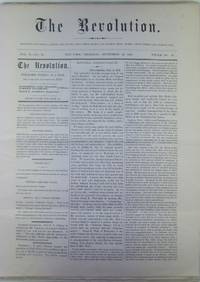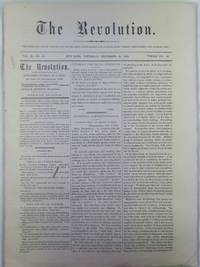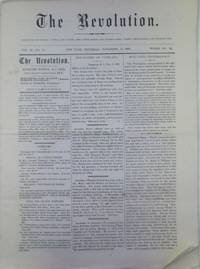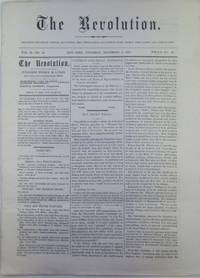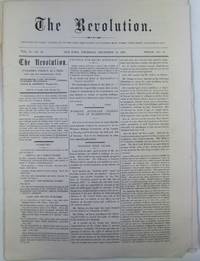
1868réf. 020291New York: Susan B. Anthony Proprietor; R.J. Johnson Publisher 1868. Wraps. Good. Side sewn journal. Approximately 12 ¼ by 9 inches. 16 pp. arly issue of the Revolution a groundbreaking and influential newspaper produced by Elizabeth Cady Stanton Susan B. Anthony and Parker Pillsbury. The paper was established to provide a voice to activists and suffragists such as Stanton and Anthony whose voices were marginalized by the mainstream press as well as many abolitionist publications with whom they had been previously allied. Anthony and Stanton advocated for an amendment giving suffrage to women along with the amendment sponsored by abolitionists that would give Black men the right to vote. Many abolitionists actively discouraged Stanton and Anthony from pursuing their amendment until the amendment enfranchising Black men passed creating a rift in the abolitionist movement as well as the women's suffrage movement. Feeling betrayed by abolitionists and Republicans who initially supported them they established the Revolution with financial help from George Francis Train a Democrat who supported women's rights but was openly racist. As the name indicates The Revolution adopted a combative radical tone with Stanton and others unafraid to take on critics. The paper openly discussed sexual and physical abuse in marriage and advocated better divorce laws that would offer women a way to escape abusive marriages. In 1869 the paper broke with Train who had supplied very little of the funding he initially offered. It published until 1872 struggling to make expenses along the way. This issue with a lengthy profile of Anna Elizabeth Dickinson written by Elizabeth Cady Stanton as well as an essay on marriage and mistresses that questions legal rulings favoring men in marriage over women. Also present is an essay by actor and writer Olive Logan titled "U.S". GOOD condition. Several fold creases present with other general wrinkling. Minor toning and scattered soiling in the interior. Small tear affecting the title at the top of the first page appearing to have happened during the printing. Susan B. Anthony, Proprietor; R.J. Johnson, Publisher unknown
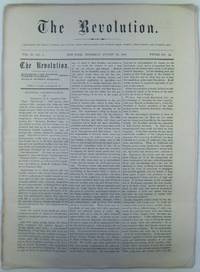
1868réf. 020317New York: Susan B. Anthony Proprietor; R.J. Johnson Publisher 1868. Wraps. Good. Side sewn journal. Approximately 12 ¼ by 9 inches. 16 pp. Early issue of the Revolution a groundbreaking and influential newspaper produced by Elizabeth Cady Stanton Susan B. Anthony and Parker Pillsbury. The paper was established to provide a voice to activists and suffragists such as Stanton and Anthony whose voices were marginalized by the mainstream press as well as many abolitionist publications with whom they had been previously allied. Anthony and Stanton advocated for an amendment giving suffrage to women along with the amendment sponsored by abolitionists that would give Black men the right to vote. Many abolitionists actively discouraged Stanton and Anthony from pursuing their amendment until the amendment enfranchising Black men passed creating a rift in the abolitionist movement as well as the women's suffrage movement. Feeling betrayed by abolitionists and Republicans who initially supported them they established the Revolution with financial help from George Francis Train a Democrat who supported women's rights but was openly racist. As the name indicates The Revolution adopted a combative radical tone with Stanton and others unafraid to take on critics. The paper openly discussed sexual and physical abuse in marriage and advocated better divorce laws that would offer women a way to escape abusive marriages. In 1869 the paper broke with Train who had supplied very little of the funding he initially offered. It published until 1872 struggling to make expenses along the way. This issue with a lengthy column editorial correspondence written by Elizabeth Cady Stanton on her travels in the US spanning almost two pages. Another piece by Stanton discusses on "Miss Becker and the Difference of the Sexes." A lengthy piece prints a meeting/public event by the Women's Council in Mount Vernon New York that brought together women taxpayers. This prints the discussion between Susan B. Anthony and others. GOOD condition. Small piece torn from the upper edge of one leaf and another from the bottom corner of the last leaf. Several fold creases present with other general wrinkling. Minor toning and scattered soiling in the interior. Susan B. Anthony, Proprietor; R.J. Johnson, Publisher unknown
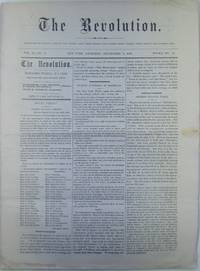
1868réf. 020339New York: Susan B. Anthony Proprietor; R.J. Johnson Publisher 1868. Wraps. Fair. Side sewn journal. Approximately 12 ¼ by 9 inches. 16 pp. Early issue of the Revolution a groundbreaking and influential newspaper produced by Elizabeth Cady Stanton Susan B. Anthony and Parker Pillsbury. The paper was established to provide a voice to activists and suffragists such as Stanton and Anthony whose voices were marginalized by the mainstream press as well as many abolitionist publications with whom they had been previously allied. Anthony and Stanton advocated for an amendment giving suffrage to women along with the amendment sponsored by abolitionists that would give Black men the right to vote. Many abolitionists actively discouraged Stanton and Anthony from pursuing their amendment until the amendment enfranchising Black men passed creating a rift in the abolitionist movement as well as the women's suffrage movement. Feeling betrayed by abolitionists and Republicans who initially supported them they established the Revolution with financial help from George Francis Train a Democrat who supported women's rights but was openly racist. As the name indicates The Revolution adopted a combative radical tone with Stanton and others unafraid to take on critics. The paper openly discussed sexual and physical abuse in marriage and advocated better divorce laws that would offer women a way to escape abusive marriages. In 1869 the paper broke with Train who had supplied very little of the funding he initially offered. It published until 1872 struggling to make expenses along the way. This issue with a lengthy column editorial correspondence written by Elizabeth Cady Stanton wherein she discusses her time in Philadelphia and Pennsylvania as well as the case of Hester Vaughn. There are two other lengthy articles on Hester Vaughn one written by Elizabeth Cady Stanton. Vaughan was tried and convicted of murdering her newborn baby to which she gave birth alone. The circumstances around the birth and death the child were murky and she was sentenced to death by an all male jury. The Revolution took up her case seeking her pardon and inferred she was raped. Stanton and Anthony attracted a lot of publicity to the case. Vaughn was eventually pardoned by the governor of Pennsylvania and sent back to England. The cause proved a bit divisive for Stanton and Anthony and the Revolution with modern historians asserting it helped to set back their work for women's suffrage. FAIR condition. Front leaf DETACHED with the binding a bit fragile. Several fold creases present with other general wrinkling. Minor toning and scattered soiling in the interior. Susan B. Anthony, Proprietor; R.J. Johnson, Publisher unknown
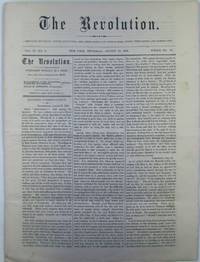
1868réf. 020366New York: Susan B. Anthony Proprietor; R.J. Johnson Publisher 1868. Wraps. Good. Side sewn journal. Approximately 12 ¼ by 9 inches. 16 pp. Early issue of the Revolution a groundbreaking and influential newspaper produced by Elizabeth Cady Stanton Susan B. Anthony and Parker Pillsbury. The paper was established to provide a voice to activists and suffragists such as Stanton and Anthony whose voices were marginalized by the mainstream press as well as many abolitionist publications with whom they had been previously allied. Anthony and Stanton advocated for an amendment giving suffrage to women along with the amendment sponsored by abolitionists that would give Black men the right to vote. Many abolitionists actively discouraged Stanton and Anthony from pursuing their amendment until the amendment enfranchising Black men passed creating a rift in the abolitionist movement as well as the women's suffrage movement. Feeling betrayed by abolitionists and Republicans who initially supported them they established the Revolution with financial help from George Francis Train a Democrat who supported women's rights but was openly racist. As the name indicates The Revolution adopted a combative radical tone with Stanton and others unafraid to take on critics. The paper openly discussed sexual and physical abuse in marriage and advocated better divorce laws that would offer women a way to escape abusive marriages. In 1869 the paper broke with Train who had supplied very little of the funding he initially offered. It published until 1872 struggling to make expenses along the way. This issue with a piece "The Dignity of the Ballot" and an account of the Boston Woman's Suffrage Convention both written by Elizabeth Cady Stanton. GOOD condition. Several fold creases present with other general wrinkling. Minor toning and scattered soiling in the interior. Small crease to the lower front page corner. Susan B. Anthony, Proprietor; R.J. Johnson, Publisher unknown
1868réf. 020395New York: Susan B. Anthony Proprietor; R.J. Johnson Publisher 1868. Wraps. Good. Side sewn journal. Approximately 12 ¼ by 9 inches. 16 pp. Early issue of the Revolution a groundbreaking and influential newspaper produced by Elizabeth Cady Stanton Susan B. Anthony and Parker Pillsbury. The paper was established to provide a voice to activists and suffragists such as Stanton and Anthony whose voices were marginalized by the mainstream press as well as many abolitionist publications with whom they had been previously allied. Anthony and Stanton advocated for an amendment giving suffrage to women along with the amendment sponsored by abolitionists that would give Black men the right to vote. Many abolitionists actively discouraged Stanton and Anthony from pursuing their amendment until the amendment enfranchising Black men passed creating a rift in the abolitionist movement as well as the women's suffrage movement. Feeling betrayed by abolitionists and Republicans who initially supported them they established the Revolution with financial help from George Francis Train a Democrat who supported women's rights but was openly racist. As the name indicates The Revolution adopted a combative radical tone with Stanton and others unafraid to take on critics. The paper openly discussed sexual and physical abuse in marriage and advocated better divorce laws that would offer women a way to escape abusive marriages. In 1869 the paper broke with Train who had supplied very little of the funding he initially offered. It published until 1872 struggling to make expenses along the way. This issue with a continuation of a lengthy profile of Anna Elizabeth Dickinson written by Elizabeth Cady Stanton as well as five shorter pieces by her: "The Old Year Gone" "Roll up the Petitions" "Henry Ward Beecher" "Henry James on Woman" and "Hearth and Home." A short column by Susan B. Anthony is present thanking their helpers. Also of note is a report on the Working Women's Association by Sarah Norton in which she reports in detail on the work of rag pickers in New York City. GOOD condition. Rear leaf very tenuously attached with the binding a bit fragile. Rear leaf also rather toned. Several fold creases present with other general wrinkling. Minor toning and scattered soiling in the interior. Susan B. Anthony, Proprietor; R.J. Johnson, Publisher unknown
1868réf. 020422New York: Susan B. Anthony Proprietor; R.J. Johnson Publisher 1868. Wraps. Fair. Side sewn journal. Approximately 12 ¼ by 9 inches. 16 pp. Early issue of the Revolution a groundbreaking and influential newspaper produced by Elizabeth Cady Stanton Susan B. Anthony and Parker Pillsbury. The paper was established to provide a voice to activists and suffragists such as Stanton and Anthony whose voices were marginalized by the mainstream press as well as many abolitionist publications with whom they had been previously allied. Anthony and Stanton advocated for an amendment giving suffrage to women along with the amendment sponsored by abolitionists that would give Black men the right to vote. Many abolitionists actively discouraged Stanton and Anthony from pursuing their amendment until the amendment enfranchising Black men passed creating a rift in the abolitionist movement as well as the women's suffrage movement. Feeling betrayed by abolitionists and Republicans who initially supported them they established the Revolution with financial help from George Francis Train a Democrat who supported women's rights but was openly racist. As the name indicates The Revolution adopted a combative radical tone with Stanton and others unafraid to take on critics. The paper openly discussed sexual and physical abuse in marriage and advocated better divorce laws that would offer women a way to escape abusive marriages. In 1869 the paper broke with Train who had supplied very little of the funding he initially offered. It published until 1872 struggling to make expenses along the way. This with a lengthy editorial by Elizabeth Cady Stanton on a proposed amendment for manhood suffrage harshly criticizing the amendment. FAIR condition. Front and rear leaf very tenuously attached with the binding a bit fragile. Front leaf being held on by a torn small section of margin. Several fold creases present with other general wrinkling. Minor toning and scattered soiling in the interior. Susan B. Anthony, Proprietor; R.J. Johnson, Publisher unknown
1868réf. 020444New York: Susan B. Anthony Proprietor; R.J. Johnson Publisher 1868. Wraps. Good. Side sewn journal. Approximately 12 ¼ by 9 inches. 16 pp. Early issue of the Revolution a groundbreaking and influential newspaper produced by Elizabeth Cady Stanton Susan B. Anthony and Parker Pillsbury. The paper was established to provide a voice to activists and suffragists such as Stanton and Anthony whose voices were marginalized by the mainstream press as well as many abolitionist publications with whom they had been previously allied. Anthony and Stanton advocated for an amendment giving suffrage to women along with the amendment sponsored by abolitionists that would give Black men the right to vote. Many abolitionists actively discouraged Stanton and Anthony from pursuing their amendment until the amendment enfranchising Black men passed creating a rift in the abolitionist movement as well as the women's suffrage movement. Feeling betrayed by abolitionists and Republicans who initially supported them they established the Revolution with financial help from George Francis Train a Democrat who supported women's rights but was openly racist. As the name indicates The Revolution adopted a combative radical tone with Stanton and others unafraid to take on critics. The paper openly discussed sexual and physical abuse in marriage and advocated better divorce laws that would offer women a way to escape abusive marriages. In 1869 the paper broke with Train who had supplied very little of the funding he initially offered. It published until 1872 struggling to make expenses along the way. This issue with a lengthy article written by Elizabeth Cady Stanton providing "editorial correspondence" on politics Democrats and Republicans etc. Many shorter anonymous articles on suffrage labor and other topics present." GOOD condition. Several fold creases present with other general wrinkling. Minor toning and scattered soiling in the interior. Front and rear leaf separating from the rest of the piece but still intact and tenuously holding on. Susan B. Anthony, Proprietor; R.J. Johnson, Publisher unknown
1868réf. 020469New York: Susan B. Anthony Proprietor; R.J. Johnson Publisher 1868. Wraps. Good. Side sewn journal. Approximately 12 ¼ by 9 inches. 16 pp. Early issue of the Revolution a groundbreaking and influential newspaper produced by Elizabeth Cady Stanton Susan B. Anthony and Parker Pillsbury. The paper was established to provide a voice to activists and suffragists such as Stanton and Anthony whose voices were marginalized by the mainstream press as well as many abolitionist publications with whom they had been previously allied. Anthony and Stanton advocated for an amendment giving suffrage to women along with the amendment sponsored by abolitionists that would give Black men the right to vote. Many abolitionists actively discouraged Stanton and Anthony from pursuing their amendment until the amendment enfranchising Black men passed creating a rift in the abolitionist movement as well as the women's suffrage movement. Feeling betrayed by abolitionists and Republicans who initially supported them they established the Revolution with financial help from George Francis Train a Democrat who supported women's rights but was openly racist. As the name indicates The Revolution adopted a combative radical tone with Stanton and others unafraid to take on critics. The paper openly discussed sexual and physical abuse in marriage and advocated better divorce laws that would offer women a way to escape abusive marriages. In 1869 the paper broke with Train who had supplied very little of the funding he initially offered. It published until 1872 struggling to make expenses along the way. This issue with a lengthy article written by Elizabeth Cady Stanton on women's suffrage in Texas as well as a shorter piece asking "What is a Democrat" Two short pieces on the front page look at a new suffrage movement in Boston regarding 18 year old boys and woman suffrage in Michigan. An anonymous piece discusses "Indian Troubles in Kansas" describing attacks on white settlers by various tribes in the region. The author asserts that the Native American image as described by Longfellow peaceful is wrong and asserting that "murder and plunder are their ruling spirit." GOOD condition. Several fold creases present with other general wrinkling. Minor toning and scattered soiling in the interior. Front and rear page tenuously attached along the spine. Susan B. Anthony, Proprietor; R.J. Johnson, Publisher unknown
1868réf. 020494New York: Susan B. Anthony Proprietor; R.J. Johnson Publisher 1868. Wraps. Good. Side sewn journal. Approximately 12 ¼ by 9 inches. 16 pp. Early issue of the Revolution a groundbreaking and influential newspaper produced by Elizabeth Cady Stanton Susan B. Anthony and Parker Pillsbury. The paper was established to provide a voice to activists and suffragists such as Stanton and Anthony whose voices were marginalized by the mainstream press as well as many abolitionist publications with whom they had been previously allied. Anthony and Stanton advocated for an amendment giving suffrage to women along with the amendment sponsored by abolitionists that would give Black men the right to vote. Many abolitionists actively discouraged Stanton and Anthony from pursuing their amendment until the amendment enfranchising Black men passed creating a rift in the abolitionist movement as well as the women's suffrage movement. Feeling betrayed by abolitionists and Republicans who initially supported them they established the Revolution with financial help from George Francis Train a Democrat who supported women's rights but was openly racist. As the name indicates The Revolution adopted a combative radical tone with Stanton and others unafraid to take on critics. The paper openly discussed sexual and physical abuse in marriage and advocated better divorce laws that would offer women a way to escape abusive marriages. In 1869 the paper broke with Train who had supplied very little of the funding he initially offered. It published until 1872 struggling to make expenses along the way. This issue with a lengthy article written by Elizabeth Cady Stanton providing "editorial correspondence" discussing mostly a visit with Anson Lapham and a trip in upstate New York. Many shorter anonymous articles on suffrage labor and other topics present." Eleanor Kirk discusses at length "the Marriage Question Again." Two longer pieces present one on the 14th amendment written by someone with the initials W.F.C. GOOD condition. Several fold creases present with other general wrinkling. Minor toning and scattered soiling in the interior. Susan B. Anthony, Proprietor; R.J. Johnson, Publisher unknown
1868réf. 020504New York: Susan B. Anthony Proprietor; R.J. Johnson Publisher 1868. Wraps. Poor. Side sewn journal. Approximately 12 ¼ by 9 inches. 16 pp. Early issue of the Revolution a groundbreaking and influential newspaper produced by Elizabeth Cady Stanton Susan B. Anthony and Parker Pillsbury. The paper was established to provide a voice to activists and suffragists such as Stanton and Anthony whose voices were marginalized by the mainstream press as well as many abolitionist publications with whom they had been previously allied. Anthony and Stanton advocated for an amendment giving suffrage to women along with the amendment sponsored by abolitionists that would give Black men the right to vote. Many abolitionists actively discouraged Stanton and Anthony from pursuing their amendment until the amendment enfranchising Black men passed creating a rift in the abolitionist movement as well as the women's suffrage movement. Feeling betrayed by abolitionists and Republicans who initially supported them they established the Revolution with financial help from George Francis Train a Democrat who supported women's rights but was openly racist. As the name indicates The Revolution adopted a combative radical tone with Stanton and others unafraid to take on critics. The paper openly discussed sexual and physical abuse in marriage and advocated better divorce laws that would offer women a way to escape abusive marriages. In 1869 the paper broke with Train who had supplied very little of the funding he initially offered. It published until 1872 struggling to make expenses along the way. This issue publishes an address by Susan B. Anthony at Tammany Hall; several articles by Elizabeth Cady Stanton including one on the Workingmen's Convention; a response to a letter from a subscriber complaining about the cost per issue where the paper points out the flaw in the writer's mathematics etc. POOR/FAIR condition. Front and rear page DETACHED from the rest. Heavy toning moderate soiling and some staining to the front page. Several fold creases present with other general wrinkling. Minor toning and scattered soiling in the interior. Susan B. Anthony, Proprietor; R.J. Johnson, Publisher unknown
1868réf. 020532New York: Susan B. Anthony Proprietor; R.J. Johnson Publisher 1868. Wraps. Good. Side sewn journal. Approximately 12 ¼ by 9 inches. 16 pp. Early issue of the Revolution a groundbreaking and influential newspaper produced by Elizabeth Cady Stanton Susan B. Anthony and Parker Pillsbury. The paper was established to provide a voice to activists and suffragists such as Stanton and Anthony whose voices were marginalized by the mainstream press as well as many abolitionist publications with whom they had been previously allied. Anthony and Stanton advocated for an amendment giving suffrage to women along with the amendment sponsored by abolitionists that would give Black men the right to vote. Many abolitionists actively discouraged Stanton and Anthony from pursuing their amendment until the amendment enfranchising Black men passed creating a rift in the abolitionist movement as well as the women's suffrage movement. Feeling betrayed by abolitionists and Republicans who initially supported them they established the Revolution with financial help from George Francis Train a Democrat who supported women's rights but was openly racist. As the name indicates The Revolution adopted a combative radical tone with Stanton and others unafraid to take on critics. The paper openly discussed sexual and physical abuse in marriage and advocated better divorce laws that would offer women a way to escape abusive marriages. In 1869 the paper broke with Train who had supplied very little of the funding he initially offered. It published until 1872 struggling to make expenses along the way. This issue with a lengthy piece on Hon. Henry Wilson being harshly critical and mocking written by Elizabeth Cady Stanton. GOOD condition. Several fold creases present with other general wrinkling. Minor toning and scattered soiling in the interior. Susan B. Anthony, Proprietor; R.J. Johnson, Publisher unknown
1970réf. 020528South Berwick ME: Old Berwick Historical Society 1970. Hard Cover. Good/No Jacket. Hard cover. No jacket. A reprint of the 1903 edition. 822 pages including index. With photos and illustrations. A list of patrons included in the rear. An extensive history of Kittery Maine from its establishment to the important families that settled in Kittery as well a history of skirmishes with Native Americans municipal history genealogical information etc. In GOOD condition. Minor soiling and edgewear to the covers. Foxing present along the page edges. Old Berwick Historical Society unknown
1942réf. 010425Cheyenne: Wyoming Stock Growers' Association Publisher 1942. First Edition. Wraps. Good. Stated first printing. Pictorial wraps. 273 pp. Black and white photos throughout. A history of the Wyoming Stock Growers' Association as well as the cattle industry as relating to this organization in Wyoming. GOOD condition. General fading to the wraps. Paper peeled back from the upper spine with minor tearing. Rear cover cracked along the interior hinge but intact. Adams Rampaging Herd 2141. Howes S850. Wyoming Stock Growers' Association, Publisher unknown
1949réf. 31161Partitions sur les Antilles Eschig Max 1949
réf. 17976Fort-de-France Desormeaux - L'Harmattan Fort In-8 511 pp, préface de René Acheen
1999réf. 79228Ibis Rouge 1999 1 vol. broché in-8, broché, couv. illustrée, 282 pp., bibliographie. Très bon état.
1999réf. 79228Ibis Rouge 1999 1 vol. broché in-8, broché, couv. illustrée, 282 pp., bibliographie. Très bon état.
réf. 19712broché -13.5 x 21- 494 pp - editions CNRS - 1956- en anglais
2005Broch?. 426 pages.
1939réf. BOOKS000283xiv555 pages with maps illustrations and bibliography. Thick royal octavo 9 3/4" x 6 3/4" bound in original publisher's green cloth with gilt lettering to spine in original jacket. signed First edition. Here for the first time is a well-rounded account of every aspect of the region's life and development as far as the War of 1812. Among the more than one hundred illustrations included are reproductions of contemporary pictures maps plans of forts portraits architectural photographs and drawings of equipment and utensils. Previous owner's inscription concerning the author on front end paper pencil notes on back paste down spine ends rubbed corners bumped crease at head front board. Jacket chipped at edges and spine ends with an inch or more loss else very good in good jacket. University of Pennsylvania Press hardcover
1889réf. 006146Paris: Librería Española de Garnier Hermanos 1889. Hardcover. Very Good. Nueva Edition Aumentada con un resúmen histórico desde la rendicion de Méjico hasta el fallecimiento de Hernan Cortés é ilustrada con notas." 4 597 p.; 18 cm. Contemporary polished calf spine with marbled paper over boards. Six spine compartments between raised bands. Leather labels in second and third compartments with gilt-tooled author and title "Conquista de Méjico." Gilt-tooled decoration in remaining compartments. All page edges marbled. Marbled endpapers. In Very Good Condition: edges rubbed; spine is sunned; minimal foxing; occasional minor pencilled marginal notations; otherwise clean and tight. Librería Española de Garnier Hermanos hardcover
réf. 353Paris : Au siège de la société (imp F. Paillart, Abbeville), octobre 1928 - avril-octobre 1930. UNE TRÈS RARE PUBLICATION SUR LES ANTILLES
1819réf. LBW-7761Paris, P. Dufart, 1819. In-8 de 23 pp.; cartonnage de papier marbré cuivre, pièce de titre marron (reliure moderne).
2012réf. 106885L'Harmattan 2012 In-8 broché 24 cm sur 15,2. 384 pages. Très bon état d’occasion.
réf. 007120No Place: No publisher. Pamphlet. Good. No publisher or place perhaps Montgomery Alabama. 1870. Pamphlet disbound from a larger work. 16 pp. A printing of a short letter undersigned by Thomas M. Peters and Alex. White and addressed to William H. Smith then governor of Alabama followed with a lengthy response to the letter by Smith. The first letter questions the governor's efforts in Alabama including that he had 'been indifferent or inert in your efforts to enforce the laws in punishing Ku-Klux outrages murders and assassinations' as well as mentioning that 'Union men dare not speak their sentiments in Alabama.' Smith answers the letter by citing his efforts to adhere to the policies of Reconstruction as well as the struggles to get Alabama citizens and delegates to go along with the US government stipulations. He also contradicts the claims of indifference to Ku-Klux Klan crimes as well as pointing out that he and other Republicans feel safe in Alabama and are under no threat of assassination. The letters are dated July 6 and July 9th of 1870. William H. Smith was the first Republican governor of Alabama and was considered a pro-Union advocate despite being a former owner of enslaved persons. One of the letter writers Thomas M. Peters may have been the pro-Union politician and State Supreme Court judge nominated by the Republican party Alabama Government Archives website. GOOD condition. Minor browning and very light foxing to the piece. A few faint fold creases present. No publisher unknown