255 résultats
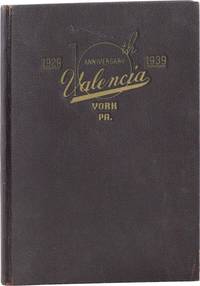
1939réf. 61627York Pennsylvania: The Valencia Ballroom 1939. Quarto. Spiral-bound leatherette boards hardcover; 94pp; illus. Trivial soil to covers with front board very slightly bowed at fore edge; internally fresh clean and unmarked; Near Fine. Promotional album for the storied Valencia Ballroom a popular musical venue during the Swing Band era. Strategically located on a route that connected New York Philadelphia and Baltimore the Valencia caught traveling orchestras on their way north or south thus bringing an impressive assortment of acts to the unlikely industrial city of York PA. Richly illustrated with photographs of the venue of the Tassia family owners and managers of the Valencia architectural views and dozens of portraits of the popular performers who played there including Eddie Duchin Kay Kyser Benny Goodman Sammy Kaye Guy Lombardo Bunny Berrigan the Dorseys and a host of others. Though the Valencia clearly favored white orchestras a few noteworthy African-American performers appeared there regularly and are pictured including Jimmy Lunceford Cab Calloway Duke Ellington and Claude Hopkins. A lavishly-produced souvenir and highly uncommon; OCLC notes four locations and we trace no other copies in the trade. The Valencia Ballroom unknown
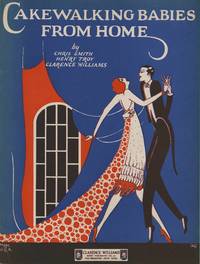
1924réf. List3678New York City: Clarence Williams 1924. Folio measuring 12 x 9 inches 5 pp. With an attractive period style illustration by Sydney Leff with his printed signature in the lower right corner. Fine condition. A very scarce surviving example of the sheet music for "Cakewalking Babies from Home" a cornerstone early jazz-blues composition issued through Clarence Williams’s publishing enterprise at the moment when New Orleans–derived ensemble practice was reshaping American popular music. Written by Williams with Chris Smith and Henry Troy the piece bridges late ragtime syncopation and emerging small-group jazz textures. Though widely disseminated through performance and recording it appears to have circulated only sparingly as domestic sheet music. The song achieved lasting fame through the celebrated 1924 New York recording sessions by the Clarence Williams Blue Five Okeh 8256 featuring Eva Taylor vocal Louis Armstrong cornet Sidney Bechet soprano saxophone Clarence Williams piano and Buddy Christian banjo; a landmark early small-ensemble performance often cited for its dynamic Armstrong–Bechet interplay and its role in defining early jazz ensemble language.12 Circulating widely among classic blues singers vaudeville performers and musicians within Williams’s publishing network and the TOBA circuit the composition reflects the porous boundary between theatrical blues dance music and emerging jazz repertory in mid-1920s Harlem and Chicago. As noted in Smithsonian jazz educational materials “the roots of jazz are heard clearly… in ‘Cake Walking Babies from Home’”.3 Despite its well-documented performance and recording history institutional holdings of the sheet music itself appear extremely limited. We locate a single copy at the Stanley King Jazz Collection at Oberlin with none presently recorded in OCLC. 1 Brian Rust Jazz records 1897–1942 Arlington House Publishers 1978. 2 Tom Lord Jazz Discography Lord Music Reference Inc. 1992. 3 “Act 3. New York Introduction: 1924–1925” Smithsonian Louis Armstrong Education Kit https://amhistory.si.edu/jazz/education/Act3.pdf. Clarence Williams unknown
1964réf. 1513341964. unbound. Signatures by Percy Humphrey Jim Robinson Albert Burbank James "Sing" Miller Louis Barbario and Narvin Kimball who appended his instrument banjo to his signature decorate the verso of the album sleeve corners slightly bumped small stain on verso does not obscure signatures. 12 1/2" x 12 1/2". No place no date. Circa 1964. Fine condition. unknown
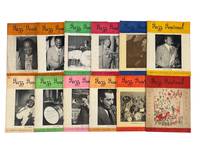
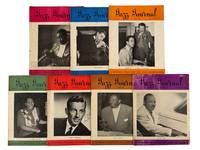
1950réf. 223221950. Complete 1950 run of Jazz Journal Vol. 3 Nos. 1-12. London: L. M. Publications 1950. Complete run of the 1950 volume. Twelve issues with each issue around 20 pages. Black-and-white photo illustrations throughout. Printed paper wraps. Founded in 1948 by editor Sinclair Traill Jazz Journal became a critical platform for serious jazz criticism in Britain at a time when the country began appreciating the impact of African American musical innovation. This volume features twelve monthly issues each spotlighting legendary musicians in deeply reverent portraits: Louis Armstrong Baby Dodds Coleman Hawkins Fats Waller Earl Hines and others. The December cover has a Christmas theme. This archive is a window into Britain's postwar jazz awakening. The articles range from retrospectives to musicology and artist discographies. Floyd Levin's "The American Jazz Scene" captures the transatlantic tone of the journal mourning the death of Buster Wilson and lauding figures like Sidney Anderson and Kid Ory as vanguards of "authentic" jazz-framed as endangered in a postwar America increasingly seduced by commercialism. Meanwhile Derrick Stewart-Baxter's "Preachin' the Blues" traces rural-to-urban migration patterns in blues development analyzing Sleepy John Estes' discography and folk influences. The December issue features a full-page bibliophilic essay "A Case for Books" reviewing A Treasury of the Blues by W. C. Handy whom it names "the composer of the classic Memphis Blues and Joe Turner Blues" emphasizing the book's role in preserving "the true and historical survey of the blues." Taken together the essays discographies and image curation construct a coherent theory of jazz not only as music but as cultural heritage. Moderate and consistent soiling and creasing to wrappers; binding intact but some covers remain delicate. Occasional chipping at spine. Covers remain vivid with strong photographic contrasts. Overall good condition. A complete year's run of one of the earliest and most influential British jazz journals with signatures from leading musicians of the era such as Armstrong Dodds and Hawkins. unknown
réf. 100-30786Happy Hairy Zeno. Audio CD. Very Good. CD in case with booklet. Happy Hairy Zeno unknown
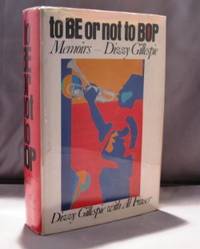
1979réf. 22006New York:: Doubleday 1979. First Printing of the First US Edition. A Near Fine tight copy in a Very good plus unclipped unfaded dust jacket with some tiny nicks to the edges of the spine and two short closed edge tears. This autobiography blends Dizzy's own story along with the thoughts and remembrances of those who knew and with him over the years including such notables as Miles Davis Billy Eckstine Cab Calloway Kenny Clarke to name but a few. Doubleday, unknown
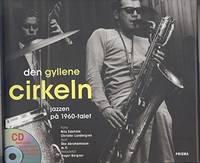
2002réf. 5000889Stockholm: Prisma 2002. Bound in black boards stamped in gold with matching illustrated dust jacket. This is a 216 pp. book of Jazz History in Stockholm in the 1960's. CD included in pocket at rear. Rare -- no copies on the internet or on OCLC. In terrific condition. Text mostly in Swedish some English. Long inscription on half-title page in Swedish. . First Edition. Hard Cover. Near Fine/Near Fine. Oblong 4to. Prisma Hardcover
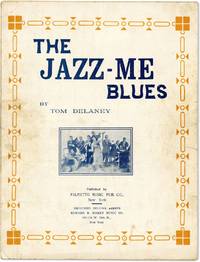
1921réf. 82277New York: Palmetto Music Pub. Co 1921. First Edition. Slim quarto 30.5cm; original pictorial wrappers; 6pp. Moderate wear handling and dust-soil to wrappers some creases and edge-tears with inner spine-fold archivally reinforced with a patch of paper tape remnant to upper end of same; complete Good to Very Good. One of the earliest hits by African American songwriter and composer Thomas Henry Delaney 1889-1963. Born in Charleston SC he would eventually become one of the most popular jazz and blues composers on Tin Pan Alley. The front wrapper reproduces a photograph of Lucille Nelson Hegamin 1894-1970 backed by the band Albury's Blues and Jazz Seven. In 1920 she became the second African American blues singer to record following Mamie Smith and Perry Bradford's August 1920 recording of "Crazy Blues." She recorded "Jazz-Me Blues" in 1921 backed by her husband Bill and his band the Blue Flame Syncopators; thanks to her recording Delaney's song would go on to become a jazz standard. OCLC notes a scant 8 holdings. 82277. Palmetto Music Pub. Co unknown
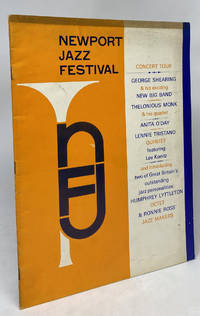
1960réf. 9446New York: Weston Associates 1960. Staplebound. Very good. Quarto unpaginated 24pp. illustrated. Very good in the publisher's stapled wraps with a thin area of dust-soiling to the top of the front wrap and some gentle creasing to the spine. Staples gently rusted but sound. A fantastically designed concert program for the 1960 Newport Jazz Festival Concert Tour. Within are profiles of Anita O'Day Thelonious Monk George Shearing and others. We could find very little material written about this concert tour though Newport Jazz Festival producer George Wein is known to have organized some tours involving some of the major performers at the storied festivals during the late 1950s and early 1960s. The actual Newport festival in 1960 was one of the most memorable - there were several riots mostly involving frustrated would-be concertgoers who were unable to secure tickets and fought with police in the small ritzy town of Newport. OCLC records no holdings of this program nor any other from a Newport Jazz Festival Concert Tour. A rare and significant piece of jazz history. Weston Associates unknown
1924réf. 47496Dayton OH: The Comer Manufacturing Co. 1924. Tall 8vo. 5.5 x 10.5 in. 36 pp. Numerous illustrations 4 colour plates 4 sepia-tinted plates 64 wool wool blend canvas linen leather cotton and patterned fabrics some treated w/ coating tipped-in occasional offsetting from samples either surrounding the sample or on facing leaves. Dark red printed softcovers decoration & lettering in orange & blue minor soiling some creasing still a VG- copy. First edition of this scarce salesman sample catalogue for men and women’s Jazz Age raincoats and overcoats in the mid-1920s. The company was founded before World War I by Charles E. Comer b. 1887 who quickly established the company as one of the largest manufacturers in Ohio of raincoats. The colour fashion plates are quite striking for the period and offer invaluable historical reference for the styles and weight of raincoats sold during the Flapper Era. Comer produced rubber-lined coats offered deals if you ordered two coats at once and also offered Mackinaws General Purpose coats Rubber rain slickers reversible coats and even waterproof aprons for housewives. This catalogue notes that they had just completed their new 40000 square foot and even offered waterproof luggage and garment bags. They were well known for advertising in labor magazines trade magazines and professional magazines constantly promoting their product and recruiting new salesmen. Worldcat locates only 1 copy Vol. 166. The Comer Manufacturing Co., paperback
réf. 22405The interview appeared in the July and August 1966 numbers of 'Crescendo' magazine London. The interview was published in two numbers of 'Crescendo' 'The world's most authoritative music magazine' founded 1962. The first part retitled 'Music & Moore Les Tomkins interviews “The Genuine Dud”' – was the leading article pp.18-19 of the July 1966 number of with Moore featuring on the cover. The second part was published in the following number August 1966 pp.18-19 and 25. Four items all in good condition with light aging. ONE: Carbon typescript of first part of interview with title replaced on publication: 'The Serious Side of Dudley Moore A Les Tomkins Interview'. 8pp 4to. On leaves of blue and yellow paper. The typescript appears to correspond to the published version other than a few minor stylistic changes and the correction of a few errors such as 'Maudlen' to 'Magdalen'. TWO: Carbon typescript of second part of interview titled 'More Music and Moore Part Two of the Les Tomkins interview with "The Genuine Dud"'. 8pp 4to. With ink notes indicating that one short passage should be moved and the correction of a typing error. THREE: Carbon of typed letter from 'Les' to 'Victor' i.e. Victor Graham the magazine's editor. 1p 12mo. In what is a covering note to Item One Tomkins writes: 'This is about half of it. The remainder is equally good. He talks about working with the bands of Vic Lewis and Johnny Dankworth the hostility he encountered his development as an accompanist; speaks of Tony Coe as “the perfect hornman for our Trio”; Peterson's accompaniments; his experience in the States; his high regard for Pete and Chris detailing their qualities; the fun he had at the Establishment and how he misses it; his plans for using jazz more extensively in films; Beyond the Fringe; humour in music; putting jazz across to a wider public; shyness of musicians; the ego of Miles Davis; his dislike of the atmosphere of listening to jazz; his desire to work with a big band of his own.' He ends by asking when the second half should be used. FOUR: Carbon typescript titled 'ROUND & ABOUT'. 2pp 4to. Mostly taken up with a gig review beginning: 'Sonny Rollins unavoidably detained missed the first two days of his engagement. On the Monday this resulted in a welcome one-night stand being played by the Dudley Moore Trio.' Comparing the gig with a previous engagement at Ronnie Scott's the review comments on Moore's 'microphone prescence today' 'hilarity caused by the funny voices he is expected to adopt between tunes' and his 'accomplished' and 'irresistibly groovy' piano playing. Moore 'brought off a "first" at the club - with his falsetto singing of an old English madrigal'. Two other reports: the first one a short item on Sonny Rollins' music for the film 'Alfie'; the second on Tubby Hayes being 'well in evidence on the London scene again' with details of his 'new quartet'. The material comes from an archive of typescripts by Tomkins of his Crescendo contributions including interviews with Louis Armstrong Sonny Rollins Bud Freeman Stan Tracey Erroll Garner Stan Kenton Quincy Jones Joe Turner Tubby Hayes Stan Getz. The interview appeared in the July and August 1966 numbers of 'Crescendo' magazine [London]. unknown
réf. 22406The interview appeared in the April 1964 number of 'Crescendo' magazine London. The interview – retitled 'Duke looks back – and forward in an interview with Les Tompkins' – features on pp.6-7 of the April 1964 number of 'Crescendo'. Sammy Davis Jr features on the cover with the announcement 'NOT A WORD ABOUT THE BEATLES!' Three items the typescript of the interview and two accompanying pieces one not used. All three in good condition lightly aged. ONE: Carbon typescript titled 'That's where the tailoring comes in Duke Ellington talks to Les Tomkins'. 6pp 4to. On six leaves stapled together at a corner. Of particular interest in this typescript is the following passage – suppressed in the published version – in which Ellington names Jimmy Forrest as one of his imitators: 'we've had people like Jimmy Forrest – who took a couple of pages out of our book wrote a number and called it something else. It became the biggest thing since “St. Louis Blues”. And that's “Night Train” - you know from “Happy Go Lucky Local”'. In a couple of instances the typescript appears closer to Ellington's voice than the published version. It features the Americanism 'specialty' rather than the published 'speciality'; and has the following passage which was recast for publication: '… and as the refreshments would take over and he would roll of the piano stool – why they would call in the soda jerker i.e. Ellington to come and play the piano.' The published version reads: 'As the refreshments took over and he rolled off the piano stool they'd call in the soda jerker to play the piano.' Other changes are relatively minor: 'Some people don't like to have to – what is it … to follow something they are not familiar with' printed as 'Some people don't like to have to apply themselves. … to follow something unfamiliar'; 'Then you don't have to worry about how many drinks you take' printed as 'Then they don't have to worry about how many drinks they take'; 'the English audience has' printed as 'the British audiences have'; 'is a thing which is rare' printed as 'is rare'. In the typescript the preamble to the article ends rather lamely 'However here are some of his interesting utterances about:' this is replaced in the printed version with 'But the printed words alone have their own value. – L.T.' In addition the published version exhibits a few minor editorial changes such as the correction of 'fit' to 'fitted' and 'less notes' to 'fewer notes'. The typescript has the following headings: 'His jazz beginnings' 'When he was a fixer' 'The men in the band' 'Billy Strayhorn' 'Their writing approach' 'Ellington imitators' 'His view of the present band' and 'His view of the future'. These are replaced in the published version by 'Smart' 'So loud!' 'Cutting' 'Renaissance' and 'Protection'. TWO: Carbon typescript headed: 'The Duke presents a bouquet to our audiences'. 1p 4to. Published in a box at bottom left of first page of interview under the title 'An Ellington bouquet'. THREE: Carbon typescript of one-sentence quotation from Ellington under title 'Duke Ellington's comments on Crescendo'. 1p 4to. Reads: 'I think it's wonderful reading. And it's very exciting thrilling – interesting mainly – and enjoyable.' This endorsement does not appear to have been used by the magazine. The material comes from an archive of typescripts by Tomkins of his Crescendo contributions including interviews with Louis Armstrong Sonny Rollins Bud Freeman Stan Tracey Erroll Garner Stan Kenton Quincy Jones Joe Turner Tubby Hayes Stan Getz. The interview appeared in the April 1964 number of 'Crescendo' magazine [London]. unknown
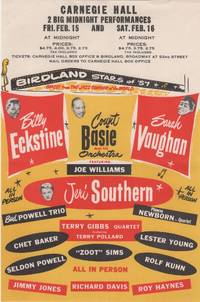
1957réf. 206793New York 1957. Old horizontal fold barely detectable; fine and bright. Original handbill 6 x 9 in. printed on one side only in black red and yellow. Vintage boxing-style handbill for the Carnegie Hall dates of this 1957 tour featuring a dizzying array of Jazz stars headlined by Count Basie with Joe Williams Billy Eckstine and Sarah Vaughan. Other performers included Jeri Southern Bud Powell Lester Young Zoot Sims Chet Baker Phineas Newborn Roy Haynes and others. unknown
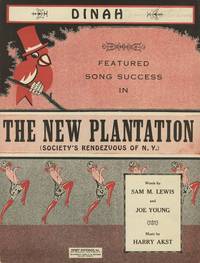
1925réf. List3672New York City: Henry Waterson Inc 1925. Folio illustrated wraps. 5 pp. Fine condition. A striking Jazz Age sheet music issue and likely first edition for “Dinah” the widely popular song composed by Harry Akst with lyrics by Sam M. Lewis and Joe Young here promoted as a “Featured Song Success” from The New Plantation Society’s Rendezvous of N.Y. a Harlem revue-style theatrical production. The revue was advertised as an all-Black production reopening the Plantation Cabaret at 50th Street and Broadway featuring prominent performers including blues singer Ethel Waters alongside Will Vodery’s Parisian Orchestra Josephine Baker Bessie Allison Leonard Harper Jimmy Ferguson and the Plantation beauty chorus.1 “Dinah” would go on to become one of the most enduring standards of the decade. Multiple versions were published in 1925 this one in June and though we are not able to establish definitive priority we guess that this is the first edition. Very scarce with three copies found institutionally at the Francis G. Spencer collection at Baylor University BYU and the British Library reference collection. 1 “Ethel Waters Is Featured In New Plantation Revue” The New York Age June 20 1925 6. Henry Waterson, Inc unknown
réf. BN66418Süddeutsche Zeitung Jazz-Edition: Dive into Jazz Dombrowski Ralf unknown
1925réf. 54342Philadelphia PA: Otto F. Schumann Philadelphia Textile School ca. 1925. Small 4to. 8.25 x 9.2 in. 75 leaves unnumbered including 32 leaves with detailed colour charts on weave formations producing various kinds of cloth 3 tipped-in textile samples together w/ weaving instructions in manuscript. Original limp leather 3-ring binder gilt lettering stamped on front cover ink lettering & association of Otto F. Schumann on front cover some soiling dustsoiling edgewear still VG exemplar. This Jazz Age weaving manuscript notebook complete with weave formation design plates fabric samples and instructions offer a remarkable and invaluable artifact of how a young American textile designer and weaver received training at the famed Philadelphia Textile School now Philadelphia University during the 1920s. These course books were judged on completeness and the aspiring weaver’s skill in presenting the details about the instruction as well as their abilities in running the machinery required to produce the cloth. This manuscript notebook includes Schumann’s detailed plates and notes on producing color effect on the plain weave creating Broken Twills Crowfoot Satins Checked & Figured Broken Twills Entwining Twills Basket Weaves and Broken Satins. The extensive manuscript notes detail the loom instructions how many lines are required composition and more in producing the assorted effects. Because of the poor quality of United States textiles exhibited at the Centennial Exhibition in 1876 the Philadelphia Textile Manufacturers pushed for a formalized vocational school to train weavers designers and textile workers. In 1884 it became part of the Pennsylvania Museum and School of Industrial Art with 81 students enrolled by 1885 and by 1894 the School of Textiles added a Department of Wool Carding & Spinning and a Department of Cloth Finishing and Design. By the 1920s the Philadelphia Textile School was offering extensive three-year textile courses chemistry and dyeing courses as well as design courses in cottons woolens worsteds silks Jacquard design and more. Schumann 1906-1967 was the son of Hugo Schumann founder and owner of the Maid Hosiery Mills in Reading PA through the opening decades of the 20th century for whom he worked with until after World War II as designer and sales executive. Otto F. Schumann, Philadelphia Textile School, hardcover
1948réf. 223231948. 1 Traill Sinclair ed. Jazz Journal issues 1948 document postwar British jazz culture as readers collectors critics and musicians rebuilt access to American jazz after wartime disruption and expanding record scarcity. Founded by Sinclair Traill in 1948 Jazz Journal became a major English-language jazz periodical; its inaugural year placed African American performers blues aesthetics revivalist debate discography and record reviews at the center of British jazz criticism. These issues support research into jazz reception in the United Kingdom transatlantic music journalism record collecting racialized cultural admiration and the postwar circulation of African American musical authority through British print culture. Jazz Journal. Volume 1 Nos. 1-3 5-6 8-9. London: J.J. Publications May-November 1948. Seven issues each approximately 12 pages in pictorial wrappers. The run includes the May June July September October and November 1948 issues with one additional issue represented by number rather than month in the supplied description and contains record reviews discographies artist profiles editorials criticism and jazz news. The premier issue opens with Traill's editorial appeal to jazz readers recalling that "Even in those far-off days between the two wars when paper was to be had for the asking and printers' costs didn't resemble a millionaire's hotel bill it was always a dubious endeavour" and closing with the hope that readers would see "a new issue of JAZZ JOURNAL on the first of each month for many years to come." Contents cited in the supplied description include "Make Way for Dixieland or Return to Sanity" a Thomas Waller discography a September 1948 appreciation of Hoagy Carmichael with signed portrait cover and Hugues Panassié's November essay "Count Basie and the Blues" which argues that "Count Basie knows how to play the blues as well as it seems possible to do so on the piano." Cover portraits include Louis Armstrong Nellie Lutcher Count Basie and Humphrey Lyttelton placing African American jazz innovators alongside British revivalist musicians within a magazine aimed at a postwar readership hungry for recordings biographical knowledge and critical guidance. Traill Sinclair ed. Jazz Journal. Vol. 1 No. 1. London: J.J. Publications 1948. The opening issue establishes the magazine's postwar purpose through Traill's editorial address to jazz enthusiasts and its promise of sustained monthly criticism. Its contents including revivalist commentary and discographical attention to Thomas "Fats" Waller show the early publication's effort to organize jazz knowledge for British readers dependent on print mediation and record collecting. 2 Traill Sinclair ed. Jazz Journal. Vol. 1 No. 2. London: J.J. Publications 1948. This issue continues the magazine's early program of criticism record commentary and performer-centered coverage for a readership attentive to American jazz and its British reception. It belongs to the first sequence of issues issued after the May 1948 relaunch from Traill's earlier Pick Up whose final issue preceded the first Jazz Journal in May 1948. 3 Traill Sinclair ed. Jazz Journal. Vol. 1 No. 3. London: J.J. Publications 1948. The third issue forms part of the magazine's initial attempt to stabilize a postwar jazz readership through recurring reviews essays and documentation of recordings and artists. Its position in the first volume is useful for tracing how British jazz criticism developed a regular periodical form in 1948. 4 Traill Sinclair ed. Jazz Journal. Vol. 1 No. 5. London: J.J. Publications 1948. This issue continues the first-year sequence with the supplied description emphasizing the magazine's mix of artist portraits discographical writing and critical essays. The issue contributes to the archive's broader value as evidence of how British jazz readers encountered American performers through images reviews and commentary. 5 Traill Sinclair ed. Jazz Journal. Vol. 1 No. 6. London: J.J. Publications 1948. The September 1948 issue features an appreciation of Hoagy Carmichael with a signed portrait cover connecting jazz readership to popular song composition and the American music industry. Its treatment of Carmichael alongside coverage of African American jazz performers demonstrates the publication's wide understanding of jazz-adjacent culture in the late 1940s. 6 Traill Sinclair ed. Jazz Journal. Vol. 1 No. 8. London: J.J. Publications 1948. This issue belongs to the later portion of the inaugural-year run and continues the magazine's regular pattern of record culture criticism and performer documentation. In the context of the seven-issue group it helps show the durability of Traill's monthly editorial project beyond the launch months. 7 Traill Sinclair ed. Jazz Journal. Vol. 1 No. 9. London: J.J. Publications 1948. The November issue includes Hugues Panassié's "Count Basie and the Blues" a critical essay distinguishing blues feeling and phrasing from commercialized improvisation. Its attention to Basie foregrounds African American musical authority within British jazz discourse and gives the archive direct relevance to the study of blues reception swing-era memory and postwar criticism. Moderate soiling and creasing to wrappers occasional spine chipping intact stapled bindings delicate covers and vivid photographic contrasts good overall. Substantial inaugural-year run of a long-lived British jazz periodical preserving the early critical vocabulary through which postwar British readers studied African American jazz swing-era performers blues expression and record collecting. unknown
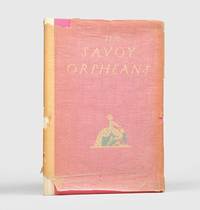
1924réf. 139822London: Published Privately at the Savoy 1924. First and only edition one of 1000 copies issued as a "first birthday" celebratory publication; scarce particularly so in the fragile glassine jacket. Loosely inserted in this copy is a slip printing soprano Luisa Tetrazzini's birthday wishes in green. The Savoy Orpheans were formed by former army bandmaster Debroy Somers in 1923 and were resident at the Savoy Hotel until contractual wrangles between W. F. De Mornys entertainments manager at the Savoy and the hotel company led to the orchestra disbanding on New Year's Eve 1927. During their four year tenure the Orpheans were among the cream of British dance bands and "patterned their instrumentation arrangements and classy presentations upon Whiteman's model" Baade p. 25. This attractive publication was printed at the Baynard Press which "employed highly skilled craftsmen. and printed many of London Transport's pictorial posters. the Baynard Press was amongst the largest and most technically accomplished printing firms in Britain" Science Museum. Library Hub locates only the British Library copy among British and Irish institutional libraries; WorldCat adding another copy at Rutgers University New Jersey. Square octavo pp. 16. With 3 tipped-in photogravures 2 showing the Orpheans the other the Savoy-Havana band all in situ in the Savoy Ballroom title page printed in green and pink decorative head- and tailpieces and occasional decorative sprays of notes in pink. Original white quarter cloth pink pictorial boards endpapers with musical notation in pink. With the glassine jacket Negligible rubbing to board edges faintest offsetting to endpapers; else a fine copy in the toned jacket with creasing and a couple of closed tears and chips to edges. Christina L. Baade Victory through Harmony: The BBC and Popular Music in World War II 2012. hardcover
2014réf. 90409New York: The Caliban Press 2014. First Limited Edition. Small Quarto. 27cm. Limited to 125 copies. Dark green cloth spine with paper "5 Spot" label over limp grey die-cut card wraps. 10pp with additional internal mechanical elements. A fine bright copy. An artistic reworking of a 1964 "Down Beat Magazine" article by Williams describing the experience of seeing the legendary Thelonius Monk playing at NYC's legendary 5 Spot jazz cafe on 4th and Bowery with a spectacular centrepiece of die cut card by Berard based of a 1958 photo of Monk and his quartet playing. Signed out of sequence by McMurray to limitation page with the accompanying Caliban Press prospectus sheet. The Caliban Press unknown
1922réf. 53307Beaver Dam WI: Malleable Iron Range Co. 1922-23. Three works in one. Oblong 4to. 38; 3-24; 34 pp. 35-39A leaves 39-66 i.e. 68 pp. 1st -- Colour-illustrated title in gray black orange & light blue printed and illustrated throughout with each black & white illustration of stove w/ orange & gray border; 2nd -- numerous plates in black & white black printed borders text illustrations diagrams; 3rd -- illustrated title numerous plates 5 linen-backed colour-tinted photographs w/ linen hinges text illustrations. Tan softcovers bound w/ two brass screw-posts at upper margin w/ Monarch Malleable range instructions cooking times and thermometer instructions preserved in original printed envelope laid-in minor shelfwear very minor thumbing rubbing still VG copy w/ ownership stamp of J.ohn Y. Hicks b. 1881 Malleable Iron Range sales rep who worked as railroad messenger and then machinist and salesman following World War I. First edition thus of these nicely illustrated salesman sample catalogues of Jazz Age electric stove appliances with electric cook tops insulating blocks an electric appliance plug-in on the side as well as automatic timer and temperature controls. These beautiful stoves could be purchased with enamel finish and as one oven cabinet ranges two oven cabinet ranges one oven square ranges one oven H type cabinet range with built-in kitchen heaters and more. The nicely executed colour-tinted linen-backed photographs showing Malleable stoves provide excellent contemporary visual documentation of the actual colours of the popular stoves folloowing World War I. Malleable Iron Range Company existed from 1896-1985 and at its height after World War I employed over 1200 employees producing a variety of stove and oven appliances which were coal & wood burning electric and gas. No copies located in Worldcat. Malleable Iron Range Co., paperback
1924réf. 53221New York: The Charles William Stores Inc. 1924-1925. Two vols. 4to. 548 8; 518 8 pp. With numerous colour plates colour-tinted text illustrations over 1000 black & white text illustrations diagrams. Colour-illustrated softcovers minor soiling wear slight sunning front cover of vol. 1 creasing to spine; minor creasing shelfwear vol. 2 light uniform interior toning as usual still VG- set. First edition of the complete year of Jazz Age catalogues from the Charles William Stores which offered a treasure trove of everyday fashions work clothes and household and consumer goods during the Roaring 20s offering the glamour and style of New York to the rest of the country. Their fashions were intended for the average American with emphasis on the more “endowed” woman and “stout” man during the Jazz Age emphasizing chic styles and well-woven fabrics. These catalogues detail the high grade work pants riding breeches denim jeans corduroy work pants along with triple-sewed work denim overalls and coats which could be purchased as well as those made out of Wabash Stripe Stifel denim cloth noted for its durability. No copies located in Worldcat of Spring & Summer 1925; 3 copies located of Fall & Winter 1925 Henry Ford Harvard American Textile History Museum. The Charles William Stores, Inc., paperback
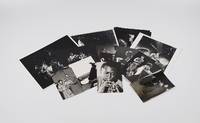
réf. 68854The Netherlands 1950-1991. Set of 18 original photos. Various sizes. = Mostly from jazz concerts in the Netherlands in the 1950's to 1990's. Includes Ella Fitzgerald 31 March - 1 April 1962 - photos by Hans van den Busken; Duke Ellington The Hague 28 April 1950 together with the female crooner Kathryn Elisabeth Wimp 1920-2012 professionally known as Kay Day Miles Davis several including a young dated 1956; photo Nico van der Stam and older Miles photos dated 10 January 1980 and 1991; including photos by Vincent Mentzel Mahalia Jackson Fela Kuti Melkweg concert Sidney Bechet The Hague 7 October 1956 Eartha Kitt North Sea Jazz Festival 1988 Chet Baker photo Ernst Nieuwenhuis 1975 etc. Several with light creasing due to handling but otherwise a delightful set. unknown
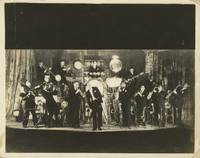
1932réf. List3818New York City 1932. Silver gelatin photograph measuring 8 x 10 inches. Stage photograph of Cab Calloway and His Cotton Club Orchestra with Calloway at center before the band brass and reed sections drums bass guitar and stage lighting visible. Verso with mounting residue and manuscript note reading in part "from Irondome Bessemer album" or similar. Some wear creasing toning and mounting residue; very good. A large stage photograph of Cab Calloway and His Cotton Club Orchestra corresponding to a known 1932 image of the band made to mark the arrival of trumpeter Doc Cheatham. The photograph shows Calloway at center bending forward in his characteristic theatrical posture with the orchestra arranged behind him on the Cotton Club stage. By 1932 Calloway had become one of the defining entertainers of the Cotton Club era. He had taken over the Missourians in 1930 and the success of "Minnie the Moocher" in 1931 helped make him a national figure. The orchestra was also being reshaped during these years with musicians such as Doc Cheatham Morris White Walter "Foots" Thomas Benny Payne and others forming the sound and stage presentation of Calloway's early 1930s band.1 Mills Music used this same image in another press photograph indicating that it functioned as a promotional view of Calloway and the orchestra rather than merely as a private stage snapshot. 1 Jean-François Pitet "Morris 'Fruit' White: from the Missourians' banjo to Calloway's guitar" The Hi de Ho Blog May 20 2021 accessed July 21 2026 https://www.thehidehoblog.com/blog/2021/05/morris-fruit-white-from-the-missourians-banjo-to-calloways-guitar. . unknown
2007réf. 1769150102074Imports 2007-10-23. Audio CD. Like New. CD plays perfectly & the case looks good. Imports unknown
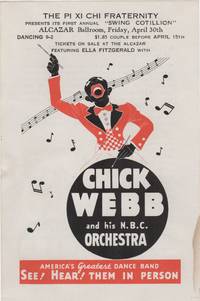
1937réf. 206792Philadelphia: Pi Xi Fraternity 1937. Small stain at edge otherwise fine and fresh. Double sided handbill 6 x 9 in. printed on both sides. Original advertising handbill promoting the event at Philadelphia's Alcazar Ballroom Friday April 30th 1937. A colorful flyer featuring the caricature picture of the drummer-bandleader clad in a red tuxedo and swinging his sticks against a backdrop of flying musical notes. On the verso is "An Open Letter to the Dance Lovers of this City" touting the group as "America's Greatest Rhythm Band." After winning first prize at the famed Apollo Theatre's Amateur Night in 1934 at the age of seventeen Ella Fitzgerald was soon introduced to Webb and joined his band the following year. By 1937 she had become a mainstay of the group with her name being prominently highlighted in promotions. After Webb's early death in 1939 she carried on as leader of the band. An excellent evocation of the height of the Swing Era. Pi Xi Fraternity unknown