12,308 results
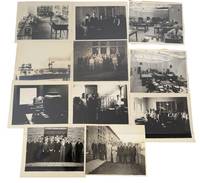
1930ref. 232561930. Stanford University Military Engineering Archive Documenting the First Army Ordnance Reserve Gauging Program ca. 1930. Stanford University photo archive documenting the emergence of interwar military-industrial technical education ordnance gauging instruction and precision engineering research on campus during the early development of Stanford's engineering and applied science programs. Rather than depicting science classrooms in a general sense these photographs specifically document the technical culture surrounding Army ordnance training instrumentation systems machine calibration and laboratory-based engineering instruction that linked universities to the expanding infrastructure of American military preparedness between World War I and World War II. Taken together the archive captures Stanford at the moment when higher education increasingly merged scientific research industrial precision manufacturing and military technical training into a unified research model that later shaped the wartime and Cold War defense university system. Photo archive of 11 large silver gelatin photographs each approximately 8" x 10" Stanford University California dating from 1930 into the 1950s; two later views mounted to decorative yellow board. Several photographs depict laboratory interiors filled with precision instrumentation gauging apparatus optical and mechanical measuring devices machine-tool equipment calibration benches microscopes drafting stations and technical worktables arranged for instruction and inspection work. One especially important close-up photograph shows a large precision gauging or rotational calibration apparatus associated with ordnance measurement and machine tolerance testing. Surrounding the device are machined cylindrical components threaded fittings gauge rings and polished metal parts likely used in dimensional inspection bore alignment concentricity testing or interchangeable manufacturing instruction. Another darkened workshop view depicts what appears to be a heavy precision lathe or gauging bench fitted with a mounted cylindrical test component equipment consistent with ordnance inspection and military engineering instruction during the interwar period. Additional photographs show groups of students and instructors posed around technical apparatus inside instrumentation laboratories while later mounted photographs document more formalized postwar engineering office and drafting environments associated with large-scale technical administration and research organization. Most important is a detailed handwritten verso inscription reading: "Equipment used Feb 1930 Ordnance School at Stanford University. This was first time a course in gauging was given in any Army Ordnance Reserve Unit permanent facilities excepted. Instructor; Lieut Merrill S. Hingo. Photo; Lieut Howard Story Taylor." The inscription firmly identifies the archive as documentation of early Army ordnance reserve technical instruction conducted at Stanford and specifically ties the machinery to military gauging education. In the 1920s-30s "gauging" referred not merely to ordinary measurement but to the specialized science of precision dimensional inspection used in artillery manufacture weapons-part standardization shell tolerances bore measurement interchangeable machining systems and industrial calibration. Such instruction formed a critical component of modern military-industrial production where even minor deviations in machining tolerances could affect artillery accuracy chamber pressure shell seating or mechanical reliability. Several outdoor group portraits further reinforce the military context. One large group stands beneath a doorway marked "Military Science and Tactics" while another includes Colonel Donald C. Cubbison a career U.S. Army officer and West Point graduate who served as professor of military science and tactics at Stanford from 1930 to 1935 before later attaining the rank of major general during World War II. His appearance situates the archive directly within Stanford's interwar military training system and links the photographs to broader national efforts to train technically educated reserve officers in engineering ordnance artillery science and industrial preparedness. The archive also reflects Stanford's broader transformation into a modern research university centered on applied science and engineering. During the interwar years Stanford's scientific departments expanded laboratory instruction instrumentation programs and research-based technical education under faculty including Robert E. Swain John P. Mitchell William H. Sloan and George S. Parks. Parks in particular became associated with analytical chemistry and geochemical laboratory science disciplines heavily dependent upon precision instrumentation and calibrated measurement systems. The engineering and laboratory culture documented here overlaps with contemporary developments in industrial metrology applied physics materials testing optical measurement and machine-tool inspection that increasingly tied university research to industrial production and military logistics. What makes the archive especially significant is the way it documents the transitional infrastructure between traditional university instruction and the emerging defense-oriented research university model. These photographs preserve not simply classrooms but the physical systems of technical education itself: calibration benches inspection machinery gauging apparatus optical instruments drafting rooms and laboratory spaces where students and reserve officers were trained in the precision engineering practices underlying twentieth-century industrial warfare and mass manufacturing. In doing so the archive visually traces the early foundations of the university-based defense engineering culture that would later expand dramatically during World War II and the Cold War throughout California research institutions and the broader military-industrial complex. Photographs are sharp and highly detailed with clear views of equipment and interiors; handwritten identifications remain legible. The two mounted 1950s photographs have several large tears without image loss with lighter handling wear elsewhere. Overall good condition. unknown
1930ref. 232561930. Stanford University Military Engineering Archive Documenting the First Army Ordnance Reserve Gauging Program ca. 1930. Stanford University photo archive documenting the emergence of interwar military-industrial technical education ordnance gauging instruction and precision engineering research on campus during the early development of Stanford's engineering and applied science programs. Rather than depicting science classrooms in a general sense these photographs specifically document the technical culture surrounding Army ordnance training instrumentation systems machine calibration and laboratory-based engineering instruction that linked universities to the expanding infrastructure of American military preparedness between World War I and World War II. Taken together the archive captures Stanford at the moment when higher education increasingly merged scientific research industrial precision manufacturing and military technical training into a unified research model that later shaped the wartime and Cold War defense university system. Photo archive of 11 large silver gelatin photographs each approximately 8" x 10" Stanford University California dating from 1930 into the 1950s; two later views mounted to decorative yellow board. Several photographs depict laboratory interiors filled with precision instrumentation gauging apparatus optical and mechanical measuring devices machine-tool equipment calibration benches microscopes drafting stations and technical worktables arranged for instruction and inspection work. One especially important close-up photograph shows a large precision gauging or rotational calibration apparatus associated with ordnance measurement and machine tolerance testing. Surrounding the device are machined cylindrical components threaded fittings gauge rings and polished metal parts likely used in dimensional inspection bore alignment concentricity testing or interchangeable manufacturing instruction. Another darkened workshop view depicts what appears to be a heavy precision lathe or gauging bench fitted with a mounted cylindrical test component equipment consistent with ordnance inspection and military engineering instruction during the interwar period. Additional photographs show groups of students and instructors posed around technical apparatus inside instrumentation laboratories while later mounted photographs document more formalized postwar engineering office and drafting environments associated with large-scale technical administration and research organization. Most important is a detailed handwritten verso inscription reading: "Equipment used Feb 1930 Ordnance School at Stanford University. This was first time a course in gauging was given in any Army Ordnance Reserve Unit permanent facilities excepted. Instructor; Lieut Merrill S. Hingo. Photo; Lieut Howard Story Taylor." The inscription firmly identifies the archive as documentation of early Army ordnance reserve technical instruction conducted at Stanford and specifically ties the machinery to military gauging education. In the 1920s-30s "gauging" referred not merely to ordinary measurement but to the specialized science of precision dimensional inspection used in artillery manufacture weapons-part standardization shell tolerances bore measurement interchangeable machining systems and industrial calibration. Such instruction formed a critical component of modern military-industrial production where even minor deviations in machining tolerances could affect artillery accuracy chamber pressure shell seating or mechanical reliability. Several outdoor group portraits further reinforce the military context. One large group stands beneath a doorway marked "Military Science and Tactics" while another includes Colonel Donald C. Cubbison a career U.S. Army officer and West Point graduate who served as professor of military science and tactics at Stanford from 1930 to 1935 before later attaining the rank of major general during World War II. His appearance situates the archive directly within Stanford's interwar military training system and links the photographs to broader national efforts to train technically educated reserve officers in engineering ordnance artillery science and industrial preparedness. The archive also reflects Stanford's broader transformation into a modern research university centered on applied science and engineering. During the interwar years Stanford's scientific departments expanded laboratory instruction instrumentation programs and research-based technical education under faculty including Robert E. Swain John P. Mitchell William H. Sloan and George S. Parks. Parks in particular became associated with analytical chemistry and geochemical laboratory science disciplines heavily dependent upon precision instrumentation and calibrated measurement systems. The engineering and laboratory culture documented here overlaps with contemporary developments in industrial metrology applied physics materials testing optical measurement and machine-tool inspection that increasingly tied university research to industrial production and military logistics. What makes the archive especially significant is the way it documents the transitional infrastructure between traditional university instruction and the emerging defense-oriented research university model. These photographs preserve not simply classrooms but the physical systems of technical education itself: calibration benches inspection machinery gauging apparatus optical instruments drafting rooms and laboratory spaces where students and reserve officers were trained in the precision engineering practices underlying twentieth-century industrial warfare and mass manufacturing. In doing so the archive visually traces the early foundations of the university-based defense engineering culture that would later expand dramatically during World War II and the Cold War throughout California research institutions and the broader military-industrial complex. Photographs are sharp and highly detailed with clear views of equipment and interiors; handwritten identifications remain legible. The two mounted 1950s photographs have several large tears without image loss with lighter handling wear elsewhere. Overall good condition. unknown books
1929ref. 025041Pasadena 1929. Original Drawing . No Binding. Near Fine. 13 3/4" x 12 1/4. Original Pencil Engineering Drawing Of Three Views Of A "Latitude Finder At Any Hour Angle With Three Reflections" Dated 1929 Signed Rwp. The Drawing Is 9 5/8" X 11 1/8" With Ample Margins. Porter Is Famous For His Prescient Pre-Construction Drawings Of The Palomar Observatory And Its Telescopes Machinery And Buildings So Well Visualized That They Were Used As Guides During Construction. unknown
1909ref. 53577Evansville IN: A.L. Swanson Electrical & Manufacturing Co. ca. 1909-1925. Oblong 4to. 62 original silver gelatin photos nearly all backed in linen some w/ embossed photographer’s stamp in lower right corner or photographer’s logo in negative several marked in pencil or ink on versos occasional fraying and dustsoiling to fore-edges of linen. Recent black post-binder original brass split pin posts at gutter margin gilt lettering stamped on front cover VG exemplar. This factory sales photo album for the Swanson Electrical & Manufacturing Co. offers an important visual record of the growth of a Midwestern American manufacturing firm after World War I through the Jazz Age. Founded originally in 1900 by Albert Swanson 1876-1949 in Evansville IN this firm became one of the largest Midwestern companies engaged in electrical engineering construction repair maintenance and retail sales. These photos show how the company built and sold washing machines electric motors radios lighting systems industrial fans installed lighting displays for department stores repaired electric motors rewound generators and installed massive electric generating steam plants for factories. These include photos of the new mill built after 1909 for Swans Down Flour showing the exterior stack for steam the control panels and more; followed by images of the electrical conduits and sea of electric motors for the spinning mill machinery of the Cannelton Cotton Mill in Indiana for the Rumble & Wensel Company; a Heinz plant near Indianapolis IN; and of special interest are the photos of the generating plant installed for the Mead Johnson Co. infant formula plant built in Evansville IN in the wake of World War I. These photos also show the repair shops the massive electrical machines the winding of coils the oil and grease-soaked workers amidst a sea of electrical machine parts work benches metal lathes and more. In addition there are a number of photos of the interior of the new Monitor Furniture Co. Plant on East Virginia St. in Evansville IN finished at the end of 1920. Swanson began repairing and installing electrical equipment in a small downtown shop before the end of the 19th century and by 1915 was refurbishing and selling giant Westinghouse and General Electric motors and generators. In 1919 the Company was incorporated and began quickly expanding finally changing its name to the Swanson-Nunn Co. which continued to install and sell equipment out of their building on 8th street much of the 20th Century. Mason 1886-1944 was a commercial photographer who specialized in architectural and advertising photography in Evansville IN throughout his career. See: Evansville Electrical Concern Re-organzied In: Electrical Review August 2 1919 pp. 209-210. A.L. Swanson Electrical & Manufacturing Co., unknown
4to. (8), 237, (3) pp. Bound in contemporary 'carta rustica', faded manuscript title to spine. Rare first edition of this treatise on bread and bread-making, by the physician and naturalist Saverio Manetti (1723-85). The work deals with wheat, flour, different kind of bread (corn, rye, buckwheat and sweat bread, donuts, farinata, waffles, bread with raisins etc.), how to prepare and bake it, substitutes of bread and molds and worms that can grow on it. A separate section details the specifics of oriental bread - "Pane Etiopico, e Saracenico", and varieties "in grand' uso appresso l' Egitto" (pp. 148ff.). "This work precedes Parmentier's 'Parfait Boulanger' by 13 years" (Westbury). - Very lightly foxed, but a very good copy, uncut. With Lord Westbury's bookplate to front pastedown. Bitting 185 (1766 edition only, s.v. "Ginori"). Gamba 2328 (1768 ed. only). Re III, 103. Westbury 138-140.
Messing, vergoldet und graviert. Oktogonalform mit zentral eingelassener, verglaster Kompassdose. Aufstellbarer Schattenwerfer mit Stellzeiger für Polhöhen. Auf der Unterseite des Bodens Polhöhenangaben und Monogramm "L.T.M". 49 x 53 mm. Hübsche Taschensonnenuhr des Augsburger Instrumentenmachers L. T. Müller (1710-70), auf der Unterseite des Deckels sind die Polhöhen von 9 Städten eingraviert, darunter Lissabon, Venedig, Wien, München und Krakau. Tadellos erhalten mit intakter Stundenskala und Gradbogen. Vgl. Syndram, Wissenschaftliche Instrumente und Sonnenuhren, Kataloge der Kunstgewerbesammlung Stiftung Huelsmann Bd. 1, Nrn. 182/183.
FIRST AND ONLY EDITION of the MOST IMPORTANT MONOGRAPH ON THE CANAL LINKING PARIS WITH THE SEA, one of the great engineering projects of its time. XI, 221 pp. plus 3 lithographed maps. The book is divided into two sections: Besons (near Paris) to Rouen, and Rouen to Le Havre. Each section is divided into numerous (and very detailed) subsections. Numerous tables throughout. At the end are three large folding lithographed maps, with the course of the Seine colored by hand in blue. Beautifully printed by Didot on fine wove paper, with large margins. From the library of noted engineer Rudolph Glossop (1902-1993), with his bookplate on pastedown. 4to. Attractively bound in half crimson morocco. FINE AND BRIGHT, with no defects. An outstanding copy of an important book.
1662ref. d3372Cologne: Pauli Pricipus. Worn condition. Boards detached rubbed and scuffed. Occasional edge foxing and browning but content in overall good condition. 1662. First Latin Edition. Brown hardback leather cover. 350mm x 220mm 14" x 9". xi 53pp plates. 131 of 154 b/w plates. Lacking plates 15 31 32 43 44 46 49 63 64. 84 86 108 - 112 116 132 133 141 142 145 153. Text in Latin. . Pauli Pricipus hardcover
4to. (6), 36, (4) pp. With a folding table and a folding engraved map in hand colour, 147 cms in length. Modern marbled boards. First monograph about the just-completed Strömsholm Canal connecting Grangärde (in Dalarna, middle Sweden) with Strömsholm on Lake Mälaren, from where ships have easy access to Stockholm. Work on the 62-mile canal, intended to facilitate transport for the numerous steel works along the waterway, had begun in 1772: based on plans by Johan Ullström, a series of lakes were connected by short canals and a total of 25 locks. The fine map, nearly one and a half metres long, shows the entire stretch of the structure. Earlier the same year, the author Magnus Schenström (1775-1848) had published an eight-page Latin dissertation "De canalibus et catarractis in Svecia generatim, speciatim vero Strömsholmensibus", which he subsequently expanded into the present account of the canal. - Some slight marginal waterstaining, but a good, wide-margined copy. Rare; only four copies listed in OCLC (Baker Library-Harvard Business School; National Library of Sweden; Danish National Library; Staatsbib. Berlin). OCLC 186273921.
4to (167 x 215 mm). Persian illuminated manuscript on paper. 31 ff., written on both sides, 11 lines per extensum. Black ink with rubricated titles, written in a thin and very cursive Indian nastaliq style tending already to perform the "shorthand" writing infractions of the shekasteh ("broken") variety. With a coloured headpiece and 10 full-page coloured illustrations. Blindstamped red leather with reinforced spine. A prose work of anecdotal moral tales, most likely from North-Western India (now Pakistan) from the mid or third quarter of the 19th century. Untitled and without a colophon or marginalia, beginning abruptly, it appears to be incomplete, despite the conventional presence of an - apparently overpainted - headpiece of the sarlawh type. - Unlike similar Persian allegorical prose works, whose tales revolve mostly around allegorical animal characters, this narrative, oriented towards moral and spiritual instruction, appears to be inspired on the one hand by Saadi’s gently ironic works such as "Gulestan". Divided into several chapters, or "abvab", it focuses on the moral analysis of human deeds and intentions, informed by Indian Sufi spiritual tradition. - The scene is set in an exquisitely Indian historical context: the text mentions a "raj" (Hindu king), and the Mughal Empire also make an appearance with the protagonist of the final tale, Alamgir Padshah (the "World-Seizing Emperor", likely the Mughal ruler Awrangzeb, who reigned 1658-1707), encountering a certain Mard-i murtaz (a spiritually well-versed man). The manuscript is embellished by full-page miniatures, one depicting a hunting scene, another illustrating a valiant horseman slaying a dragon-like monster. The illustrations are colourful and lively, if conventional in their disposition of the human figures and landscape before a background without depth.
1768Large 4to. (2), 13, (1), 10 pp. With 85 engraved plates. Contemporary calf with giltstamped label to richly gilt spine. Leading edges gilt. Second edition of this principal work, first published in 1741. Dillenius is considered the founder of scientific investigation of cryptogams, especially mosses (cf. Hirsch/H. II, 271). "The beginning of bryology. The exact descriptions of the species, as well as the excellent illustrations, drawn and engraved by himself, made his 'historia muscorum' a standard work, not superseded for many years" (cf. NDB III, 718). - Binding slightly rubbed and bumped; small defect to spine. A good, wide-margined copy; the engravings printed in good impressions. With signature and heraldic bookplate of Otto Leiner. Nissen BBI 491. Stafleu/C. 1472. Henrey 641. DNB V, 984 ("his greatest work").
(16), 140 SS. Mit 24 Kupfer- und 2 Holzschnitt-Porträts. Halbpergamentband der Zeit. Dreiseitiger Rotschnitt. 8vo. Seltene einzige Ausgabe eines der frühesten Werke über die Semiologie des Auges. "Samuel Fuchs, a native of Koslin in Pomerania, was professor of rhetoric at Königsberg. In this curious and little known work the author suggests a system for the estimation of character based on the shape of the head and eyes [...] Among the finely executed engravings and woodcuts are portraits of Cosimo Medici, Andrea Doria, Christopher Columbus, and Philip II, Duke of Pomerania" (Becker). - Papierbedingt wie stets etwas gebräunt bzw. braunfleckig; einige Blätter der Vorstücke angerändert. Zeitgenöss. Besitzvermerk (mit Verzeichnung des Kaufpreises und der Bindekosten) am vorderen Innendeckel. BM-STC F 1306. Krivatsy 4457. Waller 3303. Wellcome I, 2468. Becker Coll. 95. Hirschberg 483 (III, S. 20, 1). Sabin 26106. Caillet 4248. Graesse, Bibl. mag.-pneum. 104. Rosenthal 953 ("Piece fort rare").
ref. Z1-T-008-01103Stationery Office Books. Used - Good. Ships from UK in 48 hours or less usually same day. Your purchase helps support Sri Lankan Children's Charity 'The Rainbow Centre'. Ex-library so some stamps and wear but in good overall condition. 100% money back guarantee. We are a world class secondhand bookstore based in Hertfordshire United Kingdom and specialize in high quality textbooks across an enormous variety of subjects. We aim to provide a vast range of textbooks rare and collectible books at a great price. Our donations to The Rainbow Centre have helped provide an education and a safe haven to hundreds of children who live in appalling conditions. We provide a 100% money back guarantee and are dedicated to providing our customers with the highest standards of service in the bookselling industry. Stationery Office Books unknown
ref. Z1-U-017-02146New York Academy of Sciences. Used - Good. Ships from UK in 48 hours or less usually same day. Your purchase helps support Sri Lankan Children's Charity 'The Rainbow Centre'. Ex-library so some stamps and wear but in good overall condition. 100% money back guarantee. We are a world class secondhand bookstore based in Hertfordshire United Kingdom and specialize in high quality textbooks across an enormous variety of subjects. We aim to provide a vast range of textbooks rare and collectible books at a great price. Our donations to The Rainbow Centre have helped provide an education and a safe haven to hundreds of children who live in appalling conditions. We provide a 100% money back guarantee and are dedicated to providing our customers with the highest standards of service in the bookselling industry. New York Academy of Sciences unknown
1850ref. 11825London: Day and Son. Very Good with no dust jacket. 1850. First Edition. Hardcover. Rubbed at the top of the spine. Covers faded. Owner's name & later note on the fep of volume one. ; Large 8vo 9" - 10" tall . Day and Son hardcover
2002ref. 51904Emergency Services Training Instutite Et Al. As New. Paperback. FREE UPGRADE to Courier/Priority Shipping Upon Request – – IN STOCK AND IMMEDIATELY AVAILABLE FOR SHIPMENT - Spiral-bound training manual - TOC: Fire Safety; Fire Behavior; Communications; Personal Protective Equipment; Portable Fire Extinguishers; Self-Contained Breathing Apparatus SCBA ; Fire Hose Appliances & Fire Streams; Master Streams and Monitor Applications; Firefighting Foam; Fixed Fire Protection Systems; Ladders; Identification; Considerations for Effective Response; Appendix A Sample Incident Report ; Appendix B Data Sheet & Layout. -- with a bonus offer-- . 2002. Emergency Services Training Instutite Et Al paperback
ref. Z1-T-032-02120Intl Specialized Book Services. Used - Good. Ships from UK in 48 hours or less usually same day. Your purchase helps support Sri Lankan Children's Charity 'The Rainbow Centre'. Ex-library so some stamps and wear but in good overall condition. 100% money back guarantee. We are a world class secondhand bookstore based in Hertfordshire United Kingdom and specialize in high quality textbooks across an enormous variety of subjects. We aim to provide a vast range of textbooks rare and collectible books at a great price. Our donations to The Rainbow Centre have helped provide an education and a safe haven to hundreds of children who live in appalling conditions. We provide a 100% money back guarantee and are dedicated to providing our customers with the highest standards of service in the bookselling industry. Intl Specialized Book Services unknown
ref. Z1-W-023-00981Enginrg. Ind. Training Bd. Used - Acceptable. Used - Acceptable. Sticker on cover. Ships from UK in 48 hours or less usually same day. Your purchase helps support Sri Lankan Children's Charity 'The Rainbow Centre'. Ex-library with wear and barcode page may have been removed. 100% money back guarantee. We are a world class secondhand bookstore based in Hertfordshire United Kingdom and specialize in high quality textbooks across an enormous variety of subjects. We aim to provide a vast range of textbooks rare and collectible books at a great price. Our donations to The Rainbow Centre have helped provide an education and a safe haven to hundreds of children who live in appalling conditions. We provide a 100% money back guarantee and are dedicated to providing our customers with the highest standards of service in the bookselling industry. Enginrg. Ind. Training Bd unknown
ref. Z1-E-014-02427Amer Society of Civil Engineers. Used - Good. Ships from UK in 48 hours or less usually same day. Your purchase helps support Sri Lankan Children's Charity 'The Rainbow Centre'. Ex-library so some stamps and wear but in good overall condition. 100% money back guarantee. We are a world class secondhand bookstore based in Hertfordshire United Kingdom and specialize in high quality textbooks across an enormous variety of subjects. We aim to provide a vast range of textbooks rare and collectible books at a great price. Our donations to The Rainbow Centre have helped provide an education and a safe haven to hundreds of children who live in appalling conditions. We provide a 100% money back guarantee and are dedicated to providing our customers with the highest standards of service in the bookselling industry. Amer Society of Civil Engineers unknown
1902ref. 375732Building News London 1902. Hardcover. Good Condition. 37 volumes : 82 85 90-92 94-105 107-110 112-113 115-127 129. All in original period bindings. These are working copies and have minor wear and typical age related signs of use. They are not intended to be glamorous shelf bindings but useable working books for reference and research. Due to the complex and extensive nature of these substantial volumes it is not guaranteed that there are no missing plates or pages but they are priced appropriately to account for that uncertainty. These books have come in recent years from a private working collection and should be considered as ideal for that ongoing purpose. Given the weight it is very unlikely that overseas postage will be available on these volumes. UK delivery costs will be by arrangement our standard delivery price will not apply. Size: Folio Approx. A4 size. Category: Builder & Building News; Antiquarian & Rare; New Arrivals; Architectural Interest Complete Volumes. Building News hardcover
2003ref. 2080502106907324Not Available 2003. Soft Cover. Fine. The book is in fine condition. Not Available paperback
ref. 25118Hardcover. 4to. 27.5cm printed in double column format several thousand illustrations plates diagrams drawing etc from engravings in contemporary half sheep double red and black leather labels gilt titles standard french marbled boards hinges cracked or shaken some spines chipped needs re-backing internally fine very rare cnds. hardcover
17804to. Part 2 (of 2) only. VIII, 84, 395 pp. With engraved title vignette, 1 folding table, and 18 folding engravings and mezzotints. Contemporary calf with 2 giltstamped labels to spine. All edges red. Contains seven first printings of treatises by Leonhard Euler: De integratione formulae. - De valore formulae integralis. - Novae demonstrationes circa resolutionem numerorum in quadrata. - Considerationes circa brachystochronas. - Sur l’effet de la refraction dans les observations terrestres. - De motu oscillatorio penduli cuiuscunque, dum arcus datae amplitudinis absolvit. - De theoria lunae ad maiorem perfectionis gradum evehenda.
193058 Bll. Hektographiertes Typoskript. Mit 30 Textskizzen und 11 einmontierten Originalphotographien. Kartonschnellhefter. Folio. Hübsches Dokument der österreichischen Luftfahrtsinstruktion zu Beginn der 1930er Jahre. - Stellenweise unbedeutend braunfleckig; einige Textstellen mit einmontierten Typoskriptstreifen mit alternativem Text überklebt. Am Vorderdeckel hs. Besitzvermerk "Muller Oblt." in rotem Buntstift.
12mo. 117, (3) pp. Publisher's original printed wrappers. Only edition; extremely rare. Entitled "The Champagne Physician", this pamphlet offers a light-spirited discussion of the medicinal and dietary benefits of champagne and sparkling wines, in particular of their excellent effects on stomach cramps, vomiting, anemia, menstrual disorders, etc. - Light browning; upper wrapper cover repaired. Provenance: from the collection of the French liqueur magnate Max Cointreau (1922-2016) with his bookplate to the inside cover. A single copy known in libraries internationally (British Library, Reference Collections). OCLC 751391874.


