12,308 results
1985ref. ZB3937711985. volumes 1-10 1985-1994 an uninterrupted run of complete volumes unbound library markings textually clean & tight price is for the set. - If you are reading this this item is actually physically in our stock and ready for shipment once ordered. We are not bookjackers. Buyer is responsible for any additional duties taxes or fees required by recipient's country. Photos available upon request. unknown
1968ref. 5022Antarctica 1968. Very good. 65pp. report typed on rectos only plus 28 leaves illustrated with eighty-six black-and-white mounted photographs each approximately 5 x 7 inches most accompanied by typed paper caption strips plus three loose photographs. Quarto. Original pressboard wrappers with metal spine fastener with printed title leaf pasted to front board. Minor wear to binding photos in generally nice condition. A typed report accompanied by detailed photographs documenting the 1967-1968 projects carried out by U.S. Naval Construction Battalion Unit 201 in Antarctica dubbed "Deep Freeze '68." The projects involved the upgrading and expansion of facilities at McMurdo Station and Palmer Station including water sewer and energy infrastructure improvements and laboratory and living-quarters construction. The original photographs here provide more than eighty-five detailed and well-captioned views of Antarctic construction architecture and engineering involved in the execution of “Deep Freeze ‘68” with sixty-five pages of typed reports providing a dense written summary in support of the project. Battalion Unit 201 had been newly established in 1967 as a Seabee unit specializing solely in Antarctic construction to continue supporting the series of "Operation Deep Freeze" missions first headed by Admiral Richard E. Byrd in the 1950s to establish a permanent research infrastructure on the then-largely unexplored Antarctic continent. Plagued by material shortages and the savage regional climate Unit 201 was disbanded at the end of “Deep Freeze ‘71” as the brief building season made the continuation of a dedicated Antarctic construction unit unfeasible. unknown
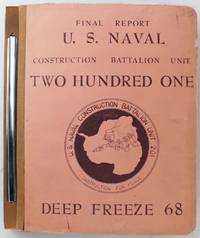
1968ref. 5022Antarctica 1968. Very good. 65pp. report typed on rectos only plus 28 leaves illustrated with eighty-six black-and-white mounted photographs each approximately 5 x 7 inches most accompanied by typed paper caption strips plus three loose photographs. Quarto. Original pressboard wrappers with metal spine fastener with printed title leaf pasted to front board. Minor wear to binding photos in generally nice condition. A typed report accompanied by detailed photographs documenting the 1967-1968 projects carried out by U.S. Naval Construction Battalion Unit 201 in Antarctica dubbed "Deep Freeze '68." The projects involved the upgrading and expansion of facilities at McMurdo Station and Palmer Station including water sewer and energy infrastructure improvements and laboratory and living-quarters construction. The original photographs here provide more than eighty-five detailed and well-captioned views of Antarctic construction architecture and engineering involved in the execution of “Deep Freeze ‘68” with sixty-five pages of typed reports providing a dense written summary in support of the project. Battalion Unit 201 had been newly established in 1967 as a Seabee unit specializing solely in Antarctic construction to continue supporting the series of "Operation Deep Freeze" missions first headed by Admiral Richard E. Byrd in the 1950s to establish a permanent research infrastructure on the then-largely unexplored Antarctic continent. Plagued by material shortages and the savage regional climate Unit 201 was disbanded at the end of “Deep Freeze ‘71” as the brief building season made the continuation of a dedicated Antarctic construction unit unfeasible. unknown books
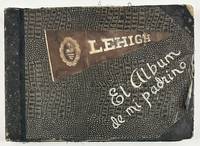
ref. 12844Various locations in Cuba and Pennsylvania: contents ca 1973. 25 leaves totaling 40pp. illustrated with thirty black-and-white and sepia-toned photographs with detailed manuscript captions plus seven large clippings from school publications and six additional ephemeral items. Oblong folio. Black cloth with alligator-patterned cloth on front board with manuscript title below a drawn representation of a small pennant for Lehigh University. Covers worn frayed and chipped alligator-style cloth curling a bit along fore edge. A few items loose from adhesive and a few with small tears scattered spotting and soiling. Overall very good condition with fascinating materiality. A lovingly-compiled photograph album and memorial book created by a young woman named Magdalena Sofia Guitart in tribute to her godfather Rafael Genó a Cuban engineer who studied at Lehigh University in Pennsylvania. Juan Rafael Genó Rizo was born in Santiago de Cuba in 1883. A doctoral thesis on Cuban architecture found online deems him one of the premiere Art Deco architects of Santiago and the only one to obtain a degree abroad. Genó graduated with a degree in Civil Engineering from Lehigh in 1909 and from the University of Havana in 1913. He died in Miami Florida in 1973. This doting scrapbook was compiled and heavily captioned in Spanish which we hereafter present in translation as a "Memorial which with love and pride I dedicate to my godfather and some of his works; a pale reflection of all the good he has done in his life" by Magdalena Sofia Guitart who was born in 1936 in Santiago and arrived in Miami in 1958. She includes photos of Genó as a baby and a boy of 11 "From a very young age as you can see here my godfather was a little gentleman" as well as in uniform alongside Mexican and Costa Rican comrades at Pennsylvania's Wayne Field. She lauds his "triumphs" and "genius" in "thousands of battles." Genó likely came to the United States following the Spanish-American War during the growth of Cuban immigration resulting from increased American attention of the island country. All of the content in the album is artfully presented within decorative rules or floral borders providing an unusual flair to the presentation. The book displays not only the hand-drawn Lehigh pennant on the cover but also large artistic renditions of the campus and an internal shot of its library clipped from school publications and comparing views from 1873 1909 and 1933 the relevance of Lehigh at the later date is unclear. Additional photographs and decorative designs share the story as "our engineer" returns to Cuba and "begins to demonstrate his knowledge" in the mines of Ponupo. Soon "his hard work integrity and honesty led him to be chosen" for other feats of engineering including "la Iglesia church Los Desamparados constructed by my godfather 1932" and a train terminal in Guantánamo. Images and a photographic clipping laud his renovations of "Colegio La Salle" in 1937. There are also six photos and a clipping showing Genó's work on the altar for the Eucharistic Congress held in Santiago in 1936 during which the original statue of Our Lady of Charity of El Cobre Patroness of Cuba was granted a canonical coronation by Pope Pius XI. The album also holds a clipping naming Genó as president of the Board of Directors of Santiago's Urban Property Center an inauguration ribbon and brochure for the Municipal Food Market in 1950 with which he was also involved and photos of the celebrated engineer later in life. A captivating and carefully-assembled homage created by a Cuban immigrant to the United States honoring a loved one who was educated in Pennsylvania and then returned to his home country to serve as a noted engineer during the first half of the 20th century. contents ca unknown
ref. 12844Various locations in Cuba and Pennsylvania: contents ca 1973. 25 leaves totaling 40pp. illustrated with thirty black-and-white and sepia-toned photographs with detailed manuscript captions plus seven large clippings from school publications and six additional ephemeral items. Oblong folio. Black cloth with alligator-patterned cloth on front board with manuscript title below a drawn representation of a small pennant for Lehigh University. Covers worn frayed and chipped alligator-style cloth curling a bit along fore edge. A few items loose from adhesive and a few with small tears scattered spotting and soiling. Overall very good condition with fascinating materiality. A lovingly-compiled photograph album and memorial book created by a young woman named Magdalena Sofia Guitart in tribute to her godfather Rafael Genó a Cuban engineer who studied at Lehigh University in Pennsylvania. Juan Rafael Genó Rizo was born in Santiago de Cuba in 1883. A doctoral thesis on Cuban architecture found online deems him one of the premiere Art Deco architects of Santiago and the only one to obtain a degree abroad. Genó graduated with a degree in Civil Engineering from Lehigh in 1909 and from the University of Havana in 1913. He died in Miami Florida in 1973. This doting scrapbook was compiled and heavily captioned in Spanish which we hereafter present in translation as a "Memorial which with love and pride I dedicate to my godfather and some of his works; a pale reflection of all the good he has done in his life" by Magdalena Sofia Guitart who was born in 1936 in Santiago and arrived in Miami in 1958. She includes photos of Genó as a baby and a boy of 11 "From a very young age as you can see here my godfather was a little gentleman" as well as in uniform alongside Mexican and Costa Rican comrades at Pennsylvania's Wayne Field. She lauds his "triumphs" and "genius" in "thousands of battles." Genó likely came to the United States following the Spanish-American War during the growth of Cuban immigration resulting from increased American attention of the island country. All of the content in the album is artfully presented within decorative rules or floral borders providing an unusual flair to the presentation. The book displays not only the hand-drawn Lehigh pennant on the cover but also large artistic renditions of the campus and an internal shot of its library clipped from school publications and comparing views from 1873 1909 and 1933 the relevance of Lehigh at the later date is unclear. Additional photographs and decorative designs share the story as "our engineer" returns to Cuba and "begins to demonstrate his knowledge" in the mines of Ponupo. Soon "his hard work integrity and honesty led him to be chosen" for other feats of engineering including "la Iglesia church Los Desamparados constructed by my godfather 1932" and a train terminal in Guantánamo. Images and a photographic clipping laud his renovations of "Colegio La Salle" in 1937. There are also six photos and a clipping showing Genó's work on the altar for the Eucharistic Congress held in Santiago in 1936 during which the original statue of Our Lady of Charity of El Cobre Patroness of Cuba was granted a canonical coronation by Pope Pius XI. The album also holds a clipping naming Genó as president of the Board of Directors of Santiago's Urban Property Center an inauguration ribbon and brochure for the Municipal Food Market in 1950 with which he was also involved and photos of the celebrated engineer later in life. A captivating and carefully-assembled homage created by a Cuban immigrant to the United States honoring a loved one who was educated in Pennsylvania and then returned to his home country to serve as a noted engineer during the first half of the 20th century. contents ca unknown books
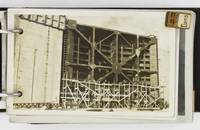
1919ref. 2655Various locations including Wyoming Nebraska and Iowa 1919. Very good plus. Forty-two original black-and-white photographs and real photo postcards most with manuscript annotations bound into a two-ring leather binder. Two additional postcards laid in. Minor occasional dust soiling but overall in excellent shape. An intriguing pocket-sized binder containing a collection of photographs and real photo postcards documenting large-scale construction projects in the American West mostly involving concrete projects such as dams drainage reservoir infrastructure railroads and more between about 1913 to 1920. All of the projects occur on or west of the Mississippi River in locations such as Keokuk Iowa; Ardmore South Dakota; Grand Island Nebraska; and Arminto Wyoming. The projects cover a wide range of subject matter from a simple base for a railroad mail sack crane to entire dam wall construction and seem to feature several involving sprayable concrete commonly known as gunite. This material was rather new in the 1910s but is still widely in use to the present day. The majority of the images are captioned in manuscript identifying the project or location or often both. These include a power-generating dam in Keokuk; reinforcement of a reservoir dam near Lysite Wyoming; widening of a cut for the Chicago Burlington and Quincy Railroad through Arminto; memorializing a concrete crib wall for the same railroad at the Bancroft St. Vincent Omaha; the installation of an eighteen-inch wall casting and sinking the Kelly well in Grand Island; documenting frost action on a brick chimney and water tank and also picturing a "concrete gun" in Worland Wyoming; and others. The images are organized into two sections with small tabs one reading "Dams" and the other "Miscellan." The compiler of the pictures is not identified but he or she was most likely involved in the operational aspects of the construction projects. One of the captions is initialed at the bottom "JRH" which may help scholars identify the compiler with further research. The binder itself was produced in Kansas City which may be an additional clue to the compiler's identity. A small but focused collection featuring major western construction projects from the early-20th century. unknown
1919ref. 2655Various locations including Wyoming Nebraska and Iowa 1919. Very good plus. Forty-two original black-and-white photographs and real photo postcards most with manuscript annotations bound into a two-ring leather binder. Two additional postcards laid in. Minor occasional dust soiling but overall in excellent shape. An intriguing pocket-sized binder containing a collection of photographs and real photo postcards documenting large-scale construction projects in the American West mostly involving concrete projects such as dams drainage reservoir infrastructure railroads and more between about 1913 to 1920. All of the projects occur on or west of the Mississippi River in locations such as Keokuk Iowa; Ardmore South Dakota; Grand Island Nebraska; and Arminto Wyoming. The projects cover a wide range of subject matter from a simple base for a railroad mail sack crane to entire dam wall construction and seem to feature several involving sprayable concrete commonly known as gunite. This material was rather new in the 1910s but is still widely in use to the present day. The majority of the images are captioned in manuscript identifying the project or location or often both. These include a power-generating dam in Keokuk; reinforcement of a reservoir dam near Lysite Wyoming; widening of a cut for the Chicago Burlington and Quincy Railroad through Arminto; memorializing a concrete crib wall for the same railroad at the Bancroft St. Vincent Omaha; the installation of an eighteen-inch wall casting and sinking the Kelly well in Grand Island; documenting frost action on a brick chimney and water tank and also picturing a "concrete gun" in Worland Wyoming; and others. The images are organized into two sections with small tabs one reading "Dams" and the other "Miscellan." The compiler of the pictures is not identified but he or she was most likely involved in the operational aspects of the construction projects. One of the captions is initialed at the bottom "JRH" which may help scholars identify the compiler with further research. The binder itself was produced in Kansas City which may be an additional clue to the compiler's identity. A small but focused collection featuring major western construction projects from the early-20th century. unknown books
ref. 159Earthquake Spectra - Total of 60 Volumes - Engineering Research Professional Journal Volume 5-20 Softcovers 1989-2004 Subtitle: "The Professional Journal of Earthquake Engineering Research Institute." Published by the Earthquake Engineering Research Institute California. Softcovers throughout the set may have slight creases impressions spots or smudges. A few volumes have small tears or bumps on the covers or spines as well as the pre- or proceeding pages. The last six 6 volumes are still in the original shipping packaging. No writing or markings. Overall the set is in Very Good condition. PLEASE REVIEW THE LIST OF VOLUMES INCLUDED BELOW AS THERE ARE SEVERAL VOLUMES THAT ARE INTERUPTED OR INCOMPLETE FOR EXAMPLE: VOLUMES 5 16 17 18 19 AND 20 ARE MISSING NUMBERS OR QUARTERLY PRINTINGS & OTHER VOLUMES INCLUDE ADDITIONAL SUPPLEMENTS. 1. Volume 5 Number 3 - August 1989 2. Special Supplement - August 1989 3. Volume 5 Number 4 - November 1989 4. Volume 6 Number 1 - February 1990 5. Volume 6 Number 2 - May 1990 6. Volume 6 Number 3 - August 1990 7. Volume 6 Number 4 - August 1990 8. Volume 7 Number 1 - February 1991 9. Volume 7 Number 2 - May 1991 10. Volume 7 Number 3 - August 1991 11. Supplement A to Volume 7 - October 1991 12. Supplement B to Volume 7 - October 1991 13. Volume 7 Number 4 - November 1991 14. Volume 8 Number 1 - February 1992 15. Volume 8 Number 2 - May 1992 16. Volume 8 Number 3 - August 1992 17. Volume 8 Number 4 - November 1992 18. Volume 9 Number 1 - February 1993 19. Volume 9 Number 2 - May 1993 20. Supplement to Volume 9 - July 1993 21. Volume 9 Number 3 - August 1993 22. Volume 9 Number 4 - November 1993 23. Volume 10 Number 1 - February 1994 24. Volume 10 Number 2 - May 1994 25. Volume 10 Number 3 - August 1994 26. Volume 10 Number 4 - November 1994 27. Volume 11 Number 1 - February 1995 28. Supplement A to Volume 11 - April 1995 29. Supplement B to Volume 11 - April 1995 30. Volume 11 Number 2 - May 1995 31. Volume 11 Number 3 - August 1995 32. Volume 11 Number 4 - November 1995 33. Supplement C to Volume 11 - January 1996 34. Special Supplement to Volume 11 - November 1996 35. Volume 12 Number 1 - February 1996 36. Volume 12 Number 2 - May 1996 37. Volume 12 Number 3 - August 1996 38. Volume 12 Number 4 - November 1996 39. Volume 13 Number 1 - February 1997 40. Volume 13 Number 2 - May 1997 41. Volume 13 Number 3 - August 1997 Bumped back top corner that affected the processing pages too 42. Volume 13 Number 4 - November 1997 43. Volume 14 Number 1 - February 1998 Small tear on cover and first few pages 44. Volume 14 Number 2 - May 1998 45. Volume 14 Number 3 - August 1998 46. Volume 14 Number 4 - November 1998 47. Volume 15 Number 1 - February 1999 48. Volume 15 Number 2 - May 1999 49. Volume 15 Number 3 - August 1999 50. Volume 15 Number 4 - November 1999 51. Volume 16 Number 1 - February 2000 52. Supplement A to Volume 16 - December 2000 Regional Fault Rupture Map Small tear on cover 53. Supplement A to Volume 17 - April 2001 54. Supplement A to Volume 18 - July 2002 55. Volume 19 Number 2 - May 2003 Still in packaging 56. Volume 19 Number 3 - August 2003 Still in packaging 57. Volume 19 Number 4 - November 2003 Still in packaging 58. Volume 20 Number 1 - February 2004 Still in packaging 59. Volume 20 Number 2 - May 2004 Still in packaging 60. Volume 20 Number 3 - August 2004 Still in packaging Earthquake Engineering Research Institute paperback
1880ref. g0966Paris: Au Bureau des Publications. G : in good condition. Cover rubbed. Slight foxing. 1880. First edition thus. Dark blue hardback cloth cover. 320mm x 240mm 13" x 9". 120 plates. 120 b/w plates. Over 300 ironwork patterns. Grills Balconies Canopies Gates Fences Girders Frames Bridges etc. Heavy item - shipping supplement may apply for overseas. . Au Bureau des Publications hardcover
18026 Teile (7-12 von 12) in 1 Band. IV, 5-160 SS. 142 SS., 2 gefalt. Tabellen (paginiert 143-144), (2) SS. 198, (2) SS. 142 SS. 206, (2) SS. VI, 158, (12) SS. Mit zus. 28 mehrf. gefalt. gest. Tafeln. Marmorierter Halblederband der Zeit mit doppeltem goldgepr. Rückenschildchen und -vergoldung. Gr.-8vo. Teile 7-12 der 12teiligen Reihe, zu Wasserhähnen, Blitzableitern, Bohr- und Dampfmaschinen, Feuerspritzen und -löschern, mechanischen und optischen Instrumenten, Windmühlen, verschiedenen Meßinstrumenten, zum Perpetuum mobile u. v. m. Mit zahlreichen Beiträgen. - Teils minimal braunfleckig; insgesamt sehr gutes, sauberes Exemplar in dekorativem Einband. Poggendorff I, 869 (kennt nur Teile 1-6). Engelmann I, 115.
1772Large 4to. (8), 234, (14) pp. With 6 engr. plates in contemp. colour. Contemp. half calf with giltstamped spine and traces of a spine label. Fifth and last edition of this rare Book of Herbs, mainly in the form of tables. With two additional plates not contained in the earlier editions; the engravings depict mainly phanerogams and their parts. The Regensburg theologian and naturalist Jacob Christian Schäffer (1718-90) concerned himself especially with entomological studies and created a series of collections. In 1757 he was made a member of the German Naturalists' Academy, "Leopoldina". - Interior slightly browned due to paper. Pritzel 8111 ("1743"). Stafleu/C. 10.472. Cf. Ferchl 4711. OCLC 312016311. Not in Nissen.
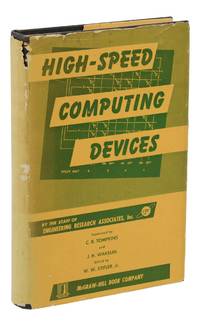
1950ref. 118811New York: McGraw-Hill Book Company Inc. 1950. First edition first printing of the first treatise on how to build an electronic digital computer. An important contribution to computing literature in its own right it also provided some of the most complete bibliographies available on the subject at the time. Charles Brown Tompkins a pioneering academic in the fields of numerical analysis and computing wrote the majority of the text much of which summarises the work of the Engineering Research Associates computer company of which he was a founder in 1946. Octavo. With diagrams throughout. Original navy cloth spine lettered and ruled in gilt front cover ruled in blind. With dust jacket. Minimal shelfwear cloth bright contents clean. A near-fine copy in the very good jacket lightly soiled chipped at extremities spine panel faded with two slight indentations and a faint patch of dampstain visible on verso bookseller's stamp on front flap. Origins of Cyberspace 584; Tomash & Williams E14. hardcover
1844ref. 2178Couverture souple 1ère Édition Carilian-Goeury et V. Dalmont 1844 Paris 23x14 cm
175662, (2) SS. Halblederband der Zeit auf 5 Bünden mit goldgepr. rotem Rückenschildchen. Dreiseitiger Rotschnitt. 8vo. Erste Ausgabe; von großer Seltenheit: Blake und Wellcome kennen nur die Neuausgabe von 1764 unter dem veränderten Titel "Sammlung merckwürdiger Abhandlungen vom Krebs worinnen die Ursachen desselben untersucht und zwey bisher geheim gehaltene Mittel zu dessen Heilung bekandt gemacht werden", die daher oft fälschlich als Erstausgabe bezeichnet wird. Hauptwerk des Darmstädter Pfarrerssohns J. P. Berchelmann (1718-83), der in Gießen Medizin studierte, wo er 1764 Amtsarzt und Hessen-Darmstädtischer Leibarzt wurde. Kein Exemplar auf deutschen Auktionen der letzten Jahrzehnte. - Am hinteren Vorsatzblatt zeitgenöss. hs. Inhaltsverzeichnis. Hinterer Innendeckel und hintere Vorsätze mit unbedeutender Wurmspur, sonst sehr ansprechendes Exemplar. Engelmann 52. Hirsch I, 403. Nicht bei Blake, Wellcome, Waller etc.
Folio (334 x 420 mm). (2), VIII, 48 pp. With 20 zincographic plates, the final one supersized and folded several times, all with tissue guards intact. Publisher's half cloth with printed boards and giltstamped spine title. Rare study of the crocodile's skeleton by the Austrian physician and anatomist C. B. Brühl (1820-99), a pioneer of comparative osteology and a champion of women's rights. Sigmund Freud writes that it was his hearing Brühl's reading of Goethe's "Die Natur" that persuaded him to enter medical school. - Binding rubbed; some foxing throughout, but well-preserved.
Folio (ca. 250 x 330 mm). IX, (1), 388 pp. With 15 numbered lithographed folding plates, including 1 chromolithographed, by Vassalli. Original printed boards. First and only edition of an extensive monograph on the silkworm by Emilio Cornalia (1824-82), conservator and director of the Milan Museum of Natural History. It was published as volume 6 of the "Memorie of the Instituto Lombardo di scienze, lettere ed arti". - With a presentation inscription by the author to Conte Lebregondi on the title-page. Binding slightly soiled, otherwise in very good condition. WorldCat records 6 copies. Horn/Schenkling 3868. Not in BMC NH.
1723(4), 112 SS. Titel in rot und schwarz gedruckt mit gest. Titelvignette. Gesprenkelter Pappband der Zeit. 4to. Erste Ausgabe; nicht häufig (Blake und Wellcome verzeichnen nur spätere Ausgaben). Kompendium der Rezeptierkunst durch den "wohl bedeutendsten Verbreiter der Stahlschen Lehre" (SBPK). Johann Juncker (1680-1759), ein Anhänger des pietistisch geprägten "Animismus" Georg Stahls, wurde 1717 Arzt an Franckes Waisenhaus in Halle "und im folgenden Jahr zum Dr. med. promoviert. 1729 zum o.Prof. an der medizinischen Fakultät ernannt, entwickelte Juncker die Krankenanstalt der Stiftungen zum Modellinstitut für den damals noch unbekannten klinischen Unterricht der Studenten" (DBE). "Seine Lehrbücher, unter dem charakteristischen Titel 'Conspectus' herausgebracht und sämtlich 'methodo Stahliana' entworfen, erlangten in immer wiederholten Auflagen weite Verbreitung [... Sein] 'Conspectus chemiae' war das beste Chemie-Handbuch seiner Zeit (Ferchl)" (NDB). - Teils leicht (finger-)fleckig; mehrere zeitgenössische Marginalien und hs. Ergänzungen. Gegen Ende winzige Wurmspuren im w. Rand. Hirsch/Hübotter III, 472. Kat. SBPK (Chemie im 18. Jh.), S. 48 (u. vgl. Nr. 85). NDB X, 662. Jöcher/Adelung II, 2348. Vgl. Wellcome III, 372. Blake 238.
XII, 199, (5) SS. Marmorierter Halbleinenband der Zeit mit goldgepr. Rückentitel. Dreiseitiger Marmorschnitt. 4to. Erste deutsche Ausgabe, die erste überhaupt in einer westlichen Sprache. Es war diese Ausgabe, die dem Werk Pawlows (1849-1936) ihre weltweite Bedeutung verschaffte. Zugleich die früheste Edition dem Sammler zugängliche Ausgabe (die russische Auflage von 1897 gilt als praktisch unauffindbar). - "Speichelbildung ist eine geläufige Erfahrung; sie kann auch ohne den Anblick oder Geruch von Speisen erzeugt werden. Bei einem Menschen kann sich diese Reaktion zum Beispiel dann einstellen, wenn er hört, wie im Nebenraum der Tisch zum Essen gedeckt wird, und beim Hund ist dieselbe Erscheinung zu verzeichnen, wenn er beispielsweise das Klappern seines Freßgeschirrs hört. In einer Reihe von Vorlesungen, die Pawlow in Petersburg hielt und die im Jahr darauf veröffentlicht wurden, befaßte er sich eingehend mit der Erforschung dieser Vorgänge und lieferte damit einen bedeutenden Beitrag zu unserem Wissen über die Physiologie der Verdauung. Im Verlauf dieser Vorlesungen beschrieb er den künstlichen Magen für Hunde, mit dem es ihm gelang, zum ersten Mal Magensäfte ohne Nahrungszufuhr zu erzeugen [...] Pawlows Ergebnisse bilden eine Ergänzung zu denen Freuds, und viele schreiben ihnen eine wesentlichere Bedeutung zu. Wie bei Freud, so haben wir es auch hier mit dem Werk eines einzigen Mannes und mit einem völlig neuen Weg zu tun. Pawlow erhielt den Nobelpreis für Medizin im Jahre 1904" (Carter/Muir, S. 689f.). - "This first edition in German is the first translation of this classic work on the digestive glands, published in Russia the year before" (Heirs of Hippocrates). - Papier schwach gebräunt; Anstreichungen eines zeitgenöss. Lesers in Bleistift und blauem Buntstift. Ungarisches Buchhändleretikett "Lévay Márton", Nagyvárad (heute Oradea in Rumänien). Dibner 135. Heirs of Hippocrates 1105. Horblit 83. Waller 7257. Garrison/Morton 1022. Fischer 1183. Vgl. PMM 385 (russ. EA von 1897). Nicht bei Borst.
17178vo. (6), 360, (16) pp. Title-page printed in red and black. With engraved frontispiece. - (Bound with) II: Deventer, Hendrik van. Neues Hebammen-Licht, bey welchen die Hebammen-Kunst und was darzu gehöret durch geschickte Handgriffe aufrichtig gelehret wird. Jena, Heinrich Christoph Cröcker, 1717. (12), 489, (23) pp. Title-page printed in red and black. With engraved frontispiece and 33 (instead of 37) engraved plates. Contemporary vellum with handwritten spine title. Edges sprinkled red. I: Rare first independently published German edition (first printed in Paris in 1597 as "Opusculum physiologum & anatomicum"), translated by Christoph von Hellwig (1663-1721). "In 1595 Pineau demonstrated the vestigial foramen ovale in the adult heart, settling the question of the perviousness of the septum of the heart [...] [In 1597] he published this study in a frank treatise on virginity and the ways of losing it" (Garrison/M.). "The German edition was prohibited by the magistrates. The chief interest of the book now relates to the supposed parturition of the pubic bones during parturition [...] Pineau was a lithotomist and had the Collot family secret" (Osler). The work has previously been issued in German as part of Louise Bourgeois Boursier's "Hebammen Buch" (1626). - II: Second German edition of Deventer's magnum opus, "Operationes chirurgicae novum lumen exhibentes obstetricantibus" (first published in Leiden in 1701, also in Dutch), one of the most important works in the history of obstetrics. "Gives the first accurate description of the female pelvis and its deformities, and the effect of the latter in complicating labour" (Garrison/M.). Van Deventer (1651-1724) is the first to appreciate fully the importance of the osseous pelvis, the axis in particular, for parturition; the procedure he recommends to midwives is exemplary. The diagnosis of abnormal foetal positions and the obstetrical techniques show great refinement. While Deventer championed manual procedures and discouraged the use of instruments if they could at all be avoided, he is hailed as the inventor of the most important obstetrical instrument of all: the forceps. "Deventer is unquestionably the greatest and scientifically the best-educated obstetrician of his age. His research not only blazed new trails, but formed the basis on which modern obstetrics is built to this day" (cf. Hirsch). - Lacks plates no. 5, 10, 12, and 14; large defects to frontispiece and two additional engravings; several engravings trimmed closely near the edge. - From the collection of the Swedish Polar explorer and mineralogist Gösta Bodman (1875-1960), who participated in the Swedish Antarctic Expedition of 1901-04, with his pretty, topical bookplate (showing a penguin and a research ship) on the pastedown. I: Hayn/Gotendorf IX, 460. Cf. Blake 205. Wellcome IV, 388. Garrison/Morton 802. Waller 7450ff. Osler 3679. - II: Blake 118. Waller 2420. Hirsch II, 173. Cf. Wellcome II, 460. Garrison/Morton 6253. Norman 631. Eimas 678.
4to. (12), 225, (3) pp. Contemporary half cloth over marbled boards with later title label. First edition. - A well-preserved copy of this important work on chronology, edited by the mathematician and artillery officer Georg von Vega, who mentions "H. A. C. v. K." as the author in the foreword. The book covers various issues of chronology, such as the division of time, dominical letters, epacts, golden numbers and the calculation of the same, as well as the origin and significance of eclipses and solstices. Furthermore, the author discusses various calendars, such as the Gregorian, the French, the Jewish and the Islamic ones, and provides numerous tables and examples for calculations. - Paper variously browned and brownstained. Some flaws to the margins (without loss of text). From the library of the Viennese collector Werner Habel. Kayser VI, 43. Cf. Houzeau/Lancaster I, Sections II-VI, p. 1439, 13499. Not in Ebert, Graesse, Lalande.
1991ref. x-0419167501Spanish Professionals in Amer 1991. Hardcover. New. 1st edition. 422 pages. 9.75x6.50x1.00 inches. Spanish Professionals in Amer hardcover
Roma, por Antonio Fulgoni, 1803. 4to. mayor; XV pp., 118 pp. y seis láminas plegadas, grabadas por Giovanni Battista Cipriani, una de ellas un gran mapa del Piamonte diseñado por Andrea Cattaneo. Encuadernación moderna en tela. Giuseppe Teresio Michelotti, de la saga turinesa de los Michelotti, ingenieros y arquitectos especialistas en Hidráulica, de renombre universal, era hermano de Ignazio Maria Lorenzo Michelotti (1764-1846) e hijos ambos de Francesco Domenico Michelotti (1710-1787). El último de los Michelotti, Giovanni, fue ya en nuestros dias uno de los grandes diseñadores de automóviles en la FIAT de Turín. La presente obra sobre el Piamonte y su hidrografía podría considerarse el mejor estudio existente sobre cuatro ríos y una ciudad, ó bien: una ciudad y cuatro rios.
1941ref. 097322United Kingdom 1941. A run in the engineering Weekly Journal from 1941 to 1946 January 1941 to December 1946 lacking January to June 1943. 11 volumes in all. circa 6000 pages. Books measure 14 x 11 inches. Bound in cloth. Cloth light rubbed faded on spines scuff marking. Good solid working bindings. Internally pages clean throughout. A nice run in good solid working bindings. Some of the articles in these volumes. Early Naval Flying. The '' Marathon '' Civil-Transport Aircraft. North Atlantic Ice Patrol. The British '' Valentine '' Infantry Tank Air Raid Shelter Air Purification. Side Launching of Submarines. Ranney Water-Collecting Installation; Indian Ordnance Work. Mud Mountain Dam. Washington. Production-Line Welded Shipbuiling. Pre-Fabricated Ship Construction in the United States. Timber Hanger for the United States Navy. Rebuilt 2-8-0 Locomotive for the L.N.E.R. Trench-Excavation Machine. The '' Superfortress '' Long-Range Bomber. Floating Concrete Arch Bridge Across River Derwent at Hobart. . Very Good. Folio - over 12" - 15" tall. hardcover
1950ref. 140949395New York: McGraw-Hill Book Company 1950. First edition. Near Fine/Very Good. First edition first printing. xiii. 1 451 pp. Bound in publisher's navy cloth ruled in blind on front board and lettered in gilt on spine. Near Fine with trivial foxing to upper textblock edge light offsetting from jacket to endpapers and owner inscription to front pastedown. In a scarce Very Good unclipped dust jacket with sunned and creased spine panel light foxing and moderate wear. The first edition of the foundational text of the American computer industry. This well-organized compendium of components techniques and concepts was developed by a research team that had its roots in wartime naval cryptanalysis. McGraw-Hill Book Company unknown
1950ref. 140949395New York: McGraw-Hill Book Company 1950. First edition. Near Fine/Very Good. First edition first printing. xiii. 1 451 pp. Bound in publisher's navy cloth ruled in blind on front board and lettered in gilt on spine. Near Fine with trivial foxing to upper textblock edge light offsetting from jacket to endpapers and owner inscription to front pastedown. In a scarce Very Good unclipped dust jacket with sunned and creased spine panel light foxing and moderate wear. The first edition of the foundational text of the American computer industry. This well-organized compendium of components techniques and concepts was developed by a research team that had its roots in wartime naval cryptanalysis. McGraw-Hill Book Company unknown books