985 Ergebnisse
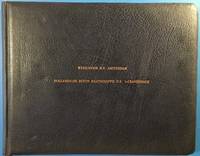
1954Best.-Nr. 26605The Hague: N.V. Nederlandsche Nieuw Guinee Petroleum Maatschappij 1954. Very good condition modest wear to corners of spine. Oblong 14" x 11" padded artificial leather gilt title on front cover. Site map with legend pasted in Twenty stiff pages with 82 black-and-white photographs tipped in with captions with fancy spiderweb patterned separating tissue guards. One additional site photo laid-in. Photo-record featuring in chronology the so-called Moetoeri-Project the construction of a pressure oil pipeline in the former territory of Dutch New Guinea taking place from October 1952-August 1954 from Wasian via Mogoi-Temboeni; further to Moetoeri Terminal with Gravity loading. Introduction supplies extensive technical information on materials applied. Construction carried-out by Werkspoor Ltd. Amsterdam and Hollandsche Beton Maatschappij Ltd. The Hague by order of the Dutch New Guinea Petroleum Company Ltd. N.V. Nederlandsche Nieuw Guinee Petroleum Maatschappij unknown
194636 pages. Magnificent two-colour cover illustration of Montreal Canadiens great Maurice "Rocket" Richard. Features: Du Petrole en Gaspesie!; Quand la Debacle Fait Des Siennes; Galeries D'Artistes; Tout Chateau a Son Histoire; La Statue Vivante; Dans Le Monde Sportif; Colombinette; Miserables Destinees - notre feuilleton; Tom L'Intrepide; O'Keefe's brewing ad on back cover features photo of trappers on snowshoes. All text in French. Moderate wear. A splendid vintage collectible for a serious fan of the Montreal Canadiens. Magazine
Best.-Nr. DADAX0824792556New unknown
1929Best.-Nr. 235181929. Photo archive of 12 silver gelatin photographs depicting drilling crews derricks lease camps well stimulation pumpers machinery suppliers and industrial worksites associated with the Salt Flat Oil Field originally known as the Bruner Field near Luling Caldwell County Texas during the peak of the 1929 oil boom and the years immediately following. The photographs document petroleum labor and field operations at one of the most productive Texas oil discoveries of the late 1920s. Contemporary captions preserve the working language of the oil patch identifying a "full gang" a "pusher" a "pumper" a named lease a specific well and a well "shot" on October 4 1929. Together with the verso photo-processing stamps these annotations provide unusually precise evidence for identifying the location and activities depicted. Rather than representing an unidentified Texas oil field the photographs can be tied to the historic Salt Flat Oil Field near Luling in Caldwell County approximately forty-five miles northeast of San Antonio. The 12 Photographs range from approximately 2.5" x 3.5" to 3" x 5.5". Several photographs show derricks rising above sandy and scrub-covered ground with drilling rigs trucks timber supports tanks sheds and rough lease roads surrounding the wells. Workers pose in oil-stained coveralls beside machinery buildings sit outside wooden lease structures stand atop storage tanks and gather around drilling equipment preserving both crew portraiture and active worksite environments. Additional images depict industrial buildings machinery yards and processing facilities connected to the broader petroleum economy. The captions identify the famous Davis Lease one of the most productive properties in the Salt Flat Field located near the marshy lowlands of the San Marcos River outside Luling. Another image is captioned "Rumbaugh No. I Well 5 shot on 10/4-1929." The notation refers to a well drilled on the Rumbaugh family lease during the intensive drilling campaign that transformed the region between 1928 and 1929. To "shoot" a well meant lowering a nitroglycerin torpedo into the borehole and detonating it to fracture the Edwards Limestone formation and increase oil flow. The photograph records the exact day this operation occurred preserving a rarely documented example of a dangerous production technique widely employed before modern hydraulic fracturing. Other captions identify key participants in the field hierarchy. "W. B. Morrison pusher" refers to the toolpusher responsible for supervising drilling operations personnel supplies and equipment. "Full gang and at 1 clearance" appears to document an entire drilling or roustabout crew maneuvering equipment within extremely tight tolerances. "Naldo by pumper" likely identifies a field pumper the worker responsible for operating producing wells and monitoring storage tanks after completion. A photograph captioned "Panama Machinery Co." records one of the supply firms that emerged to furnish drilling components cables boilers and pumping equipment during the boom. Two versos bear "Cooper Photo Tone San Antonio Texas" stamps. While the oil field itself was located in Caldwell County San Antonio served as the principal commercial center for the region and photographs were commonly processed through city photographic studios and commercial darkrooms. The stamps provide a direct connection between the remote lease camps and the urban infrastructure that supported South Texas petroleum development. The date October 1929 gives the archive particular historical significance. The Salt Flat Field reached its peak production during that month producing approximately 97000 barrels of oil per day and standing among the most productive oil fields in Texas. These photographs therefore capture the field at its zenith only weeks before the Wall Street Crash of October 1929 and the onset of the Great Depression. By September 1930 the field had already produced nearly twenty million barrels of oil illustrating the extraordinary pace of development represented in these images. Light surface wear minor edgewear and occasional verso staining; overall very good condition. An unusually well-captioned photographic archive documenting named workers identified leases specific wells and field operations during the peak production years of the Salt Flat Oil Field one of the defining Texas petroleum booms of the late 1920s. unknown
1929Best.-Nr. 235181929. Photo archive of 12 silver gelatin photographs depicting drilling crews derricks lease camps well stimulation pumpers machinery suppliers and industrial worksites associated with the Salt Flat Oil Field originally known as the Bruner Field near Luling Caldwell County Texas during the peak of the 1929 oil boom and the years immediately following. The photographs document petroleum labor and field operations at one of the most productive Texas oil discoveries of the late 1920s. Contemporary captions preserve the working language of the oil patch identifying a "full gang" a "pusher" a "pumper" a named lease a specific well and a well "shot" on October 4 1929. Together with the verso photo-processing stamps these annotations provide unusually precise evidence for identifying the location and activities depicted. Rather than representing an unidentified Texas oil field the photographs can be tied to the historic Salt Flat Oil Field near Luling in Caldwell County approximately forty-five miles northeast of San Antonio. The 12 Photographs range from approximately 2.5" x 3.5" to 3" x 5.5". Several photographs show derricks rising above sandy and scrub-covered ground with drilling rigs trucks timber supports tanks sheds and rough lease roads surrounding the wells. Workers pose in oil-stained coveralls beside machinery buildings sit outside wooden lease structures stand atop storage tanks and gather around drilling equipment preserving both crew portraiture and active worksite environments. Additional images depict industrial buildings machinery yards and processing facilities connected to the broader petroleum economy. The captions identify the famous Davis Lease one of the most productive properties in the Salt Flat Field located near the marshy lowlands of the San Marcos River outside Luling. Another image is captioned "Rumbaugh No. I Well 5 shot on 10/4-1929." The notation refers to a well drilled on the Rumbaugh family lease during the intensive drilling campaign that transformed the region between 1928 and 1929. To "shoot" a well meant lowering a nitroglycerin torpedo into the borehole and detonating it to fracture the Edwards Limestone formation and increase oil flow. The photograph records the exact day this operation occurred preserving a rarely documented example of a dangerous production technique widely employed before modern hydraulic fracturing. Other captions identify key participants in the field hierarchy. "W. B. Morrison pusher" refers to the toolpusher responsible for supervising drilling operations personnel supplies and equipment. "Full gang and at 1 clearance" appears to document an entire drilling or roustabout crew maneuvering equipment within extremely tight tolerances. "Naldo by pumper" likely identifies a field pumper the worker responsible for operating producing wells and monitoring storage tanks after completion. A photograph captioned "Panama Machinery Co." records one of the supply firms that emerged to furnish drilling components cables boilers and pumping equipment during the boom. Two versos bear "Cooper Photo Tone San Antonio Texas" stamps. While the oil field itself was located in Caldwell County San Antonio served as the principal commercial center for the region and photographs were commonly processed through city photographic studios and commercial darkrooms. The stamps provide a direct connection between the remote lease camps and the urban infrastructure that supported South Texas petroleum development. The date October 1929 gives the archive particular historical significance. The Salt Flat Field reached its peak production during that month producing approximately 97000 barrels of oil per day and standing among the most productive oil fields in Texas. These photographs therefore capture the field at its zenith only weeks before the Wall Street Crash of October 1929 and the onset of the Great Depression. By September 1930 the field had already produced nearly twenty million barrels of oil illustrating the extraordinary pace of development represented in these images. Light surface wear minor edgewear and occasional verso staining; overall very good condition. An unusually well-captioned photographic archive documenting named workers identified leases specific wells and field operations during the peak production years of the Salt Flat Oil Field one of the defining Texas petroleum booms of the late 1920s. unknown books
1964Best.-Nr. 187922Awali Bahrain: 1964. Telephone directory unrecorded elsewhere used at the office of Bahrain Petroleum Company BAPCO in Awali a town founded in the 1930s for the oil workers at the Sitrah refinery. Hundreds of landline extensions illustrate the intricate network of BAPCO employees in the 1960s from refinery tanks supervisors to geologists shipping agents safety advisers chemists and payroll operators. A directory on yellow paper comprises the phone and house numbers of hundreds of employees and even the number to reach Rifa's Palace and Sheikh Isa bin Sultan Al Khalifa. A directory on pink paper lists the phone extensions of all BAPCO buildings according to their house numbers. The map of Awali at rear identifies all the buildings mentioned in the directory. Folio. Folding map at rear diagrams. Original black leatherette folder gilt lettered wire-stitched as issued. Pencilled annotations rubbed out from title page. Extremities a bit rubbed or creased small tear on outer edge of front wrapper contents lightly toned title page a little soiled small loss on folding map: a good copy. hardcover
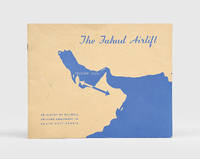
1955Best.-Nr. 195609Hull: Newcom Press for Blackburn and General Aircraft Ltd after 1955. First edition recording the transport of over 129 tons of equipment from Umm Said in Qatar to Fahud in Oman the operational centre of Petroleum Development Oman. We have traced only two other copies: one at the Solway Aviation Museum and another we sold last year. The 365-mile journey "unique in the history of aviation" p. 3 was undertaken by a Blackburn "Universal" XB260 freighter the civilian equivalent of the RAF's "Beverley" model and was a collaboration between Blackburn and General Aircraft and Hunting-Clan Air Transport. The photographs illustrate the various phases of the operation as well as the drilling machinery and aircraft. Oblong octavo pp. 20. Illustrations throughout. Original pictorial wrappers wire-stitched as issued wrappers lettered in blue. Light creasing and marking: very good. unknown
Best.-Nr. 9781685078386NOVA SCIENCE PUBLISHERS INC
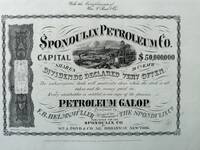
1865Best.-Nr. List2532New York: Wm. A. Pond 1865. Folio 13 ½ x 10 ½ inches. Fine condition. Fine. An unusual use of sheet music as satire with the lithographed cover showing a fake stock certificate. The cover - engraved by Major & Knapp - advertises an ownership share in the Spondolix Petroleum company and states that F.B. Helmsmuller who was actually a noted composer was the “Treasurer and General Manager” of the company. This is a particularly fine example of the piece. In our research we found several references to this piece as being a real stock certificate for a real company however this is clearly a parody of the oil business. This was printed in 1865 when the Pennsylvania oil industry was booming and the engraved illustration appears to show a countryside scene in Pennsylvania or somewhere similar. Four copies in OCLC. Wm. A. Pond unknown
1865Best.-Nr. List2532New York: Wm. A. Pond 1865. Folio 13 ½ x 10 ½ inches. Fine condition. Fine. An unusual use of sheet music as satire with the lithographed cover showing a fake stock certificate. The cover - engraved by Major & Knapp - advertises an ownership share in the Spondolix Petroleum company and states that F.B. Helmsmuller who was actually a noted composer was the “Treasurer and General Manager” of the company. This is a particularly fine example of the piece. In our research we found several references to this piece as being a real stock certificate for a real company however this is clearly a parody of the oil business. This was printed in 1865 when the Pennsylvania oil industry was booming and the engraved illustration appears to show a countryside scene in Pennsylvania or somewhere similar. Four copies in OCLC. Wm. A. Pond unknown books
2011Best.-Nr. Atlantic-9780415620840CRC Press 2011. 1. Hardcover. New. CRC Press hardcover
2011Best.-Nr. Atlantic-9780415620840CRC Press 2011. 1. Hardcover. New. CRC Press hardcover
Best.-Nr. 6346411John Wiley & Sons . Hardback. New. pp. 488 John Wiley & Sons hardcover
Best.-Nr. 6346408John Wiley & Sons . Hardback. New. pp. 488 John Wiley & Sons hardcover
2002Best.-Nr. __0470850213John Wiley & Sons Inc 2002. Hardcover. New. 6th edition. 488 pages. 10.00x7.75x1.25 inches. John Wiley & Sons Inc hardcover
1925Best.-Nr. 56537Chicago IL & La Crosse WI: Standard Oil Company Indiana; Stanolind Record 1925-1929. Two vols. 1st - 4to. 9 x 11.5 in. Approx 120 leaves many added leaves over numbering. mimeographed sheets throughout w/ text illustrations diagrams and decorative lettering with 15 sample sales brochures & catalogues most 12mo. & 16mo. w/ 4 to 24 pp. most illustrated several printed in colour inks and all retaining their original covers carefully tipped-in to their respective sections. Three-quarter black cloth over gray boards post-binder brass split-pin posts at gutter margin occasional minor creasing to a few corners light interior toning still VG copy; together with 2nd -- 8vo. 72 pp. Numerous photo & text illustrations. Colour-illustrated softcovers bound into simulated black calf gilt lettering stamped on front cover rounded corners minor shelfwear rubbing still VG copies of both from the library of Andrew Edward MacMeekin 1884-1949 who was the purchasing manager for Standard Oil of Indiana at the main offices in Chicago IL from before World War I to his death w/ his ownership stamp on front cover of the Stanolind vol. First editions of these very scarce Standard Oil Company Indiana sales publications by one of the independent oil companies to emerge after the breakup of Standard Oil in 1911. Standard Oil Indiana pioneered the “cracking” process for refining crude oil under pressure resulting in far higher yields of gasoline and the many byproducts and by the mid-1920s was the third largest oil refiner in the U.S. behind Standard Oil New Jersey and Standard Oil California. This very scarce salesman’s advertising manual was created for distribution around the time that Standard Indiana had merged with the American Oil Co. Amoco and was looking to streamline both their purchasing and marketing pitches to service stations wholesalers and jobbers. The manual continually extolls the product diversity and reach of the Standard Indiana Company with Sinclair Dixie Pan-American Petroleum and Midwest Refining as subsidiaries the extensive fleet of oil tankers railroad tank cars and chain of service stations. The splendid sample catalogues encompass a range of styles and products including Red Crown gasoline featuring an Art Deco cover of a Standard Oil service station; the high octane Red crown Gasoline; Neolite kerosene for more efficiently and economically raising poultry; competing motor oils of Iso-Vis and Polarine designed for Ford engines; as well as Mica Axle Grease used to coat hog scratching poles; Merusol Petrolatum White petrolatum used as a non-stick coating for bakeries and with a number of “medical” applications as well or the KIP insecticide used for everything from ants and flies to bed bugs and mosquitoes. Also included are customer sales letters sample thank you letters sales goals tips and more. The second volume focuses on an extended article by MacMeekin on the Standard Indiana purchasing department which at the end of the 1920s was spending over $ 50 million a year on 14000 different items ranging from rare Asian flowers to wax from the head of whales pins by the ton locomotives and everything else to fuel the massive oil company. Detailed list of tipped-in catalogues available upon request. No copies located in Worldcat for Sales Manual very incomplete runs and records for holdings of Stanolind Record BP Archive appears to have an issue as well as Univ. of Illinois but incomplete records and run; See: Mark Wilson Stephen Porter Janice Reiff Standard Oil Company Indiana Dictionary of Leading Chicago Businesses 1820-2000. Standard Oil Company (Indiana); Stanolind Record, paperback
2002Best.-Nr. __0470850221John Wiley & Sons Inc 2002. Hardcover. New. 6th edition. 488 pages. 10.00x7.75x1.25 inches. John Wiley & Sons Inc hardcover
1969Very Good English Original bdg. 4to. (30 x 25 cm). In English. [4], 96 p., 7 folding plans of plants, drawn by T. Wood, one folded huge map in the end-pocket (size: 141x50 cm) showing proposed gas pipeline, Dodan to Raman (Batman), alternative routes of the area. Scarce and very detailed typewritten report on the piping and utilization of natural gas and oil in the Batman area of Turkey, prepared under the British Technical Assistance arrangements for the Turkish Petroleum Corporation (T.P.A.O.), in September 1969. "In response to a request from the Government of Turkey, this report has been prepared under the British Technical Assistance arrangements to advise the Turkish Petroleum Corporation (T.P.A.O.) in matters relating to the use of and piping of natural gas in the Batman area of Turkey." The Dodan gas field lies approx. 70 kilometers from Batman refinery and the Bati Raman Oil Field. This study investigates the economics of piping the gas from Dodan to Batman and the separation and utilization of the gas fractions.
1989Best.-Nr. 872010461book in excellent condition never used no mark satisfied guaranteed. A customer service. shipping within 2 working days. John Wiley And Sons / Institute Of Petroleum hardcover
Best.-Nr. 6376030John Wiley & Sons . Hardback. New. pp. 2 v John Wiley & Sons hardcover
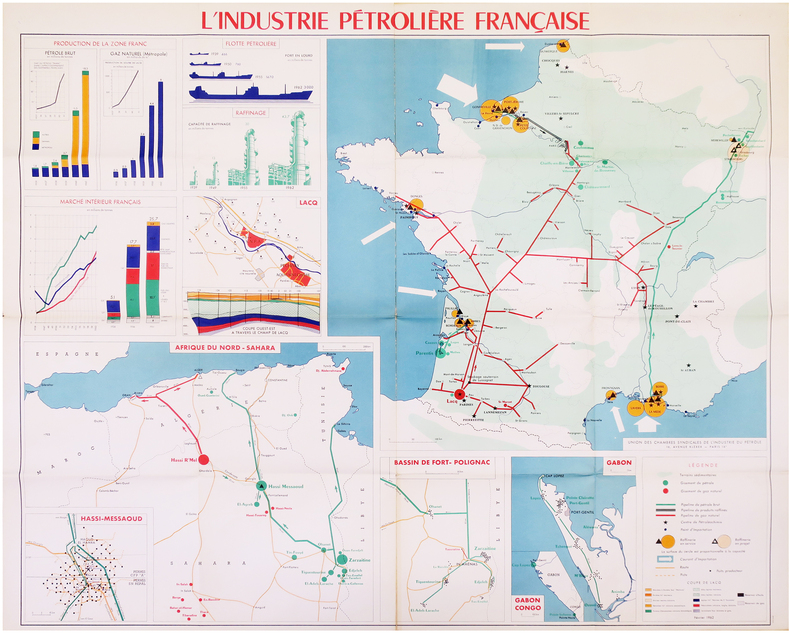
1962Best.-Nr. LBW-7972Paris, Union des Chambres Syndicales de l'Industrie du Pétrole, Février 1962. 0,97 x 1,14 m.
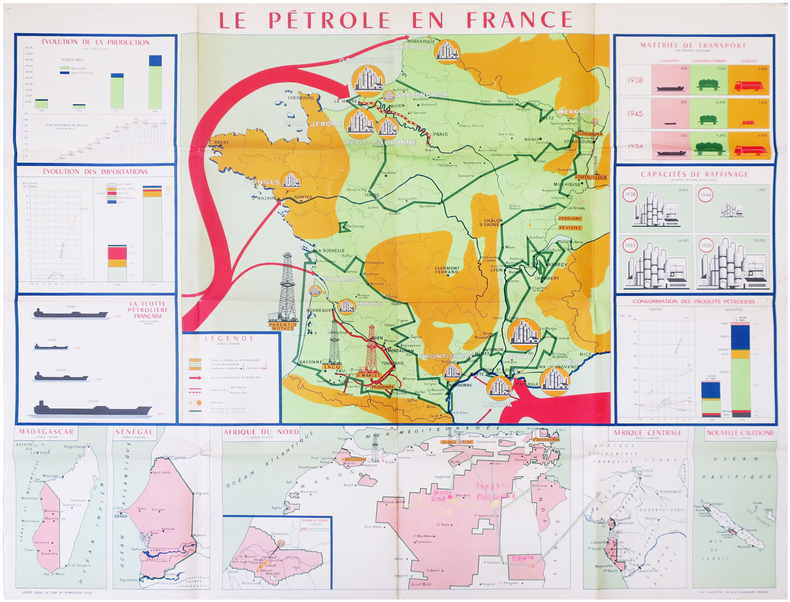
1955Best.-Nr. LBW-7973Paris, Union des Chambres Syndicales de l'Industrie du Pétrole, 1955. 0,97 x 1,22 m.
1961Best.-Nr. 016282köln Galerie Haro Lauhus 1961 Dépliant in-8 En feuilles
2000Best.-Nr. __0471984116John Wiley & Sons Inc 2000. Hardcover. New. 6th sub edition. 976 pages. 9.50x7.25x2.50 inches. John Wiley & Sons Inc hardcover