875 risultati
1980rif. 87266Bartlesville: Phillips Petroleum Company 1980. Later Reprint. Quarto 28.5cm; black cloth-covered boards with titling and illustrations stamped in gilt on spine and front cover; publisher's plastic dustjacket; xii12-1764pp; colorful plates. This copy is from the library of noted poet translator and anthropologist Nathaniel Tarn 1928-2024 with his pictorial bookplate to front pastedown. Trace shelf-wear; Very Good. Dustwrapper has trivial surface wear and light soil; Very Good. Collection includes information and illustration of grasses forbs woody plants and miscellaneous poisonous plants. Phillips Petroleum Company unknown books
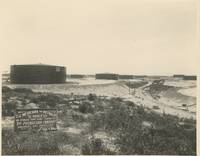
1929rif. 235181929. Photo archive of 12 silver gelatin photographs depicting drilling crews derricks lease camps well stimulation pumpers machinery suppliers and industrial worksites associated with the Salt Flat Oil Field originally known as the Bruner Field near Luling Caldwell County Texas during the peak of the 1929 oil boom and the years immediately following. The photographs document petroleum labor and field operations at one of the most productive Texas oil discoveries of the late 1920s. Contemporary captions preserve the working language of the oil patch identifying a "full gang" a "pusher" a "pumper" a named lease a specific well and a well "shot" on October 4 1929. Together with the verso photo-processing stamps these annotations provide unusually precise evidence for identifying the location and activities depicted. Rather than representing an unidentified Texas oil field the photographs can be tied to the historic Salt Flat Oil Field near Luling in Caldwell County approximately forty-five miles northeast of San Antonio. The 12 Photographs range from approximately 2.5" x 3.5" to 3" x 5.5". Several photographs show derricks rising above sandy and scrub-covered ground with drilling rigs trucks timber supports tanks sheds and rough lease roads surrounding the wells. Workers pose in oil-stained coveralls beside machinery buildings sit outside wooden lease structures stand atop storage tanks and gather around drilling equipment preserving both crew portraiture and active worksite environments. Additional images depict industrial buildings machinery yards and processing facilities connected to the broader petroleum economy. The captions identify the famous Davis Lease one of the most productive properties in the Salt Flat Field located near the marshy lowlands of the San Marcos River outside Luling. Another image is captioned "Rumbaugh No. I Well 5 shot on 10/4-1929." The notation refers to a well drilled on the Rumbaugh family lease during the intensive drilling campaign that transformed the region between 1928 and 1929. To "shoot" a well meant lowering a nitroglycerin torpedo into the borehole and detonating it to fracture the Edwards Limestone formation and increase oil flow. The photograph records the exact day this operation occurred preserving a rarely documented example of a dangerous production technique widely employed before modern hydraulic fracturing. Other captions identify key participants in the field hierarchy. "W. B. Morrison pusher" refers to the toolpusher responsible for supervising drilling operations personnel supplies and equipment. "Full gang and at 1 clearance" appears to document an entire drilling or roustabout crew maneuvering equipment within extremely tight tolerances. "Naldo by pumper" likely identifies a field pumper the worker responsible for operating producing wells and monitoring storage tanks after completion. A photograph captioned "Panama Machinery Co." records one of the supply firms that emerged to furnish drilling components cables boilers and pumping equipment during the boom. Two versos bear "Cooper Photo Tone San Antonio Texas" stamps. While the oil field itself was located in Caldwell County San Antonio served as the principal commercial center for the region and photographs were commonly processed through city photographic studios and commercial darkrooms. The stamps provide a direct connection between the remote lease camps and the urban infrastructure that supported South Texas petroleum development. The date October 1929 gives the archive particular historical significance. The Salt Flat Field reached its peak production during that month producing approximately 97000 barrels of oil per day and standing among the most productive oil fields in Texas. These photographs therefore capture the field at its zenith only weeks before the Wall Street Crash of October 1929 and the onset of the Great Depression. By September 1930 the field had already produced nearly twenty million barrels of oil illustrating the extraordinary pace of development represented in these images. Light surface wear minor edgewear and occasional verso staining; overall very good condition. An unusually well-captioned photographic archive documenting named workers identified leases specific wells and field operations during the peak production years of the Salt Flat Oil Field one of the defining Texas petroleum booms of the late 1920s. unknown books
1865rif. 377852Philadelphia: J. B. Lippincott & Co 1865. Second edition revised and enlarged. 153pp. 12mo. Publisher's brown cloth blocked in blind spine lettered in gilt. Second edition revised and enlarged. 153pp. 12mo. The second edition considerably enlarged published the same year as the 95-page first edition. An interesting work on the oil fields of Pennsylvania Ohio and West Virginia with stories of early oils wells and their owners and how oil companies operate. The first oil well in the United States was drilled by E. L. Drake in Oil Creek Pennsylvania near Titusville in 1859 and America's first oil rush ensued peaking in the late 1860s. The Titusville population exploded from 250 residents in 1860 to over 10000 in little more than five years. Output of crude went from 2000 barrels in 1859 to 4000000 barrels in 1869. The present work is one of the earliest separate publications on the American oil industry still in its infancy. "This is a good history of the oil development thus far in Pennsylvania with much shorter accounts of the West Virginia Southern Ohio and Kentucky regions with a day-by-day account of a trip through the Pennsylvania oil region" Streeter. Howes B598; Streeter sale 4040 first edition; Sabin 6298 J. B. Lippincott & Co unknown books
1953rif. 45772New York: American Petroleum Institute Division of Refining 1953. First edition 4to pp. iv 2 188; original red printed wrappers; ex-Franklin Institute Library with usual markings and their gift bookplate spine head pulled small loss at bottom fore-edge corner of upper cover interior about fine. With an appendix showing the Pitman and Gregg shorthand forms of the glossary terms. American Petroleum Institute, Division of Refining unknown books
1953rif. 29280New York: American Petroleum Institute Division of Refining 1953. First edition 4to pp. 6 188; small area of water staining at lower spine end also affecting lower gutter edges of textblock the spine lightly faded but overall still very good in original pebble-grained red cloth lettered in gilt on front cover and spine. With an appendix showing the Pitman and Gregg shorthand forms of the glossary terms. American Petroleum Institute, Division of Refining unknown books
1953rif. S4092Dallas:: AIMME 1953. 1953. Series: Transactions of the American Institute of Mining and Metallurgical Engineers vol. 198. 4to. xi 344 pp. Illus. throughout. Cloth. Ownership signature. Fine. Contains numerous papers on drilling and producing equipment drilling fluids and cement electric logging fluid injection physical properties natural gas technology reservoir engineering etc. AIMME, 1953. hardcover books
1917rif. 14764Sacramento. 1917. Contains much information on the industry around the world but concentrates mostly on California and the Pacific Coast. The maps show locations of the oil fields around the world and the charts illustrate statistics etc. 191pp. plus many folding charts and maps. Cloth. Bit rubbed cloth slightly discolored. Very good. hardcover books
1867rif. 145710Cincinnati Ohio: R. W. Carroll & Co 1867. Sixth Edition. Hardcover. G- Bookplate & pocket remnants and few marks from previous library; this copy is missing 2 of the 8 illus. and pp.63-64 as well; some instances of foxing on pages; may have been rebound once. Blue cloth 424 pp. 8 BW illus. A satire of mid-19th-century American history politics and culture written in twangy rural vernacular and from the point of view of the fictional author Petroleum Vesuvius Nasby "Lait Pastor uv the Chuch of the New Dispensashun." Includes an opening "indorsement" of Nasby's literary worth and relevance from Abraham Lincoln. R. W. Carroll & Co hardcover books
1867rif. 18050301Boston: Lee and Shepard 1867. First Edition. Hardcover. Very good. Nast Thomas. Duodecimo size 299 pp. The popular work of ironic fiction written by journalist and political commentator David Ross Locke 1833-1888. Locke's greatest influence was through his satirical writings as "Petroleum Vesuvius Nasby". The Nasby letters harshly ridiculed the plight of peoples in the Confederate states and the complicity of Northern politicians. Both Abraham Lincoln and Ulysses S. Grant recognized Nasby as a significant source of support for their presidencies. Thomas Nast 1840-1902 eventually heightened the work with his illustrations and was also credited by Lincoln for inspiring people to support the war effort. His work marked an important shift in shift in political cartoons which had before relied mainly on text rather than imagery. "Swinging Round the Cirkle" is made up of some of the most weighted of Nasby's moral statements especially concerning the plight of African Americans. The letters were composed in response to a comment by Andrew Johnson on an "uninspired" tour of the country. ___DESCRIPTION: Original pebbled green cloth with blind-stamped panels to both boards and gilt decorations on backstrip frontis and seven additional plates with captions; duodecimo size 7 5/8" by 5 1/8" 1-4 5-299 pp. first edition. ___CONDITION: A very good copy; covers clean other than a few minor spots on the back board a strong text block with solid hinges complete with all plates the only prior owner marking being a very small plate to the front free endpaper; minor rubbing to edges and corners foxing throughout though plates are still bright; overall a very good copy. ___CITATION: BAL 11820. ___POSTAGE: International customers please note that additional postage may apply as the standard shipping charge does not always cover costs; please inquire for details. ___Swan's Fine Books is pleased to be a member of the ABAA ILAB and IOBA and we stand behind every book we sell. Please contact us with any questions you may have we are here to help. Lee and Shepard hardcover books
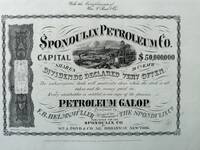
1865rif. List2532New York: Wm. A. Pond 1865. Folio 13 ½ x 10 ½ inches. Fine condition. Fine. An unusual use of sheet music as satire with the lithographed cover showing a fake stock certificate. The cover - engraved by Major & Knapp - advertises an ownership share in the Spondolix Petroleum company and states that F.B. Helmsmuller who was actually a noted composer was the “Treasurer and General Manager” of the company. This is a particularly fine example of the piece. In our research we found several references to this piece as being a real stock certificate for a real company however this is clearly a parody of the oil business. This was printed in 1865 when the Pennsylvania oil industry was booming and the engraved illustration appears to show a countryside scene in Pennsylvania or somewhere similar. Four copies in OCLC. Wm. A. Pond unknown books
1922rif. List01111Mexico 1922. Various sizes and formats generally preserved in excellent condition. Near Fine. Founded in 1902 the Foundation Company was a subaqueous concrete construction firm based in New York City. According to the Smithsonian the company was “a leader in the development of the pneumatic caisson method for the construction of foundations” — this method was used to build the skyscrapers of New York City and applied to many other types of construction projects as well. The Foundation Company archive consists of photographs blueprints correspondences and business documents relating to construction work that the company undertook in Tampico Mexico between 1915-1922. Tampico was the center of the Mexican oil boom that began at the beginning of the century. The foreign oil industry’s role in this boom was a key issue in the Mexican revolution that spanned roughly 1910-1920. After an American drilled the first oil well in Tampico in 1901 foreign companies descended into the town and took full advantage of the oil boom. The large amounts of oil in the region paired with the demand created by the allies in World War I — the United States and British Navies had converted from coal to oil — contributed to the rapid growth of the industry. According to historian Jonathan Brown “A booming foreign market and anemic domestic consumption of Mexican oil production gave many advantages to the foreign oilmen. They proceeded to create an Anglo-American capitalist haven out of the Huasteca.” The Foundation Company contracted with some of the most prominent oil companies in Tampico: El Aguila La Corona and the Transcontinental Petroleum Company. These companies were British Dutch and American. Foreign companies were attracted to Mexico because of the abundance of oil as well as the loose regulations: “At a time when the federal and state authorities in the United States were tightening the regulation of business and busting the trusts the expatriot American oilmen viewed Mexico as the new frontier of deregulation.” One reason that the Mexican government did not tighten regulations was because of the politics of the revolution. The competing factions of the revolution took advantage of the success of the oil industry — the only sector of the economy that continued to grow during that time — through taxes and forced loans. “Those who fought for political power and there were many sought to deny the federal authorities control of the oil fields. The result was a buildup of government resentment toward the freewheeling powerful foreign interests threats of drastic action against the oil companies but little governmental influence on how the nation's oil business was being conducted.” In this way the oil industry financed the revolution and also catalyzed increased economic nationalism. “Economic nationalism in Mexico had a social base and that is why the social revolution of 1910 to 1920 also produced an economic nationalism bent on reducing the power of the foreign oil companies.” The Mexican revolution produced the 1917 constitution still in place today which changed the rules for foreign businesses operating in Mexico. After years of companies resisting these regulations in 1938 President Lazaro Cardenas expropriated the foreign owned oil industry. The bulk of the documents in this archive are from 1921 and 1922 towards the end of the revolution. The documents are all written in English demonstrating the extent to which foreign companies were able to operate on their own terms despite their projects being in Mexico. The photographs and documents show the flurry of projects that the company quickly acquired in Tampico. In 1921 the Industrial Development and Manufacturers Record reported that “more big construction contracts are being carried out in the Tampico region at this time than ever before in the history of the oil industry in Mexico.” Indeed only a few months after beginning work in Mexico in 1921 the Foundation Company had 4000 men on payroll and 12 projects. These projects included a 30000-barrel refinery and 120 kilometer pipeline for the Corona Petroleum Co. and a 5 story office building for the Transcontinental Petroleum Co. The documents in this archive do not reference the revolution but they do demonstrate the rapid growth and resulting power that foreign businesses in Tampico enjoyed. Inventory 25 photographs 8x10 inches April 19- Sept 30 1921. 12 undated. One cardboard pouch containing 5 photo negatives; pouch is 5 x 7 inches negatives are 3.5 x 5.5 inches. Most of the photographs are of construction sites and the company has used a placard to write the name of the contracting company the project type their own company name and the date. These signs show that the Foundation Company was working on an Oil Storage Tank Farm and a Bulkhead for El Aguila; and a pipeline super pumps “boilers valley” and pump house for La Corona. Two letters 8.5 x 11 inches 1921-1922. Dec 3 1921 letter is addressed to Grant Huntly and contains a list of materials required for the wall size used in the Transcontinental Building. July 12 1922 letter is from Edward Swann DA of County New York saying that Grant Huntley does not have a criminal record in the last 5 years. Addressed to Hon. Ernesto C. Perez Argentine Consul-General at a New York City address. Grant Huntley was an engineer at the Foundation Company. 5 documents relating to business operations 1915-1921. Ranging in size from 6.5x 8.5- 11x17 inches. These inventories spreadsheets and progress reports reference a bag loading plan in Richmond VA; a La Corona Warehouse at Panuco Valley Terminal; and the cost data of the Transcontinental Petroleum Company’s Office Building. 5 blueprints March - August 1921. One undated. Blueprints are all different sizes ranging from 16.5x27 - 30.5x41 inches. Blueprints depict plans for: an Oil Barge; a Pile Driver to be used at Aguila’s Bulkhead; a 64000 bbl tank; the Richmond VA Bag Loading Plant. unknown books
1867rif. D20169Boston: Lee & Shepard 1867. First Edition. Hardcover. Very Good. 8vo. 299 pp. Original burgundy cloth. Ownership signature of J. L. More dated the year of publication March 1867. A unique and interesting copy with illustrated newspaper clippings pertaining to the book carefully pasted in on final three blank leaves. Lee & Shepard hardcover books
1944rif. 271901New York: American Petroleum Institute 1944. Pamphlet. 7p. wraps minor toning else very good condition 4x9.5 inches. Petroleum industry celebrates its role in the Normandy invasion during World War 2. American Petroleum Institute unknown books
1965rif. 38493London:: Institute of Petroleum. Very Good. 1965. Hardcover. First edition. Previous owner's name and address on front free endpaper light foxing to boards else very good in yellow cloth. No dust jacket. . Institute of Petroleum, hardcover books
rif. 32139Other: Other. Very Good. Hardcover. 6 pamphlets published 1959-1960: Native Grasses Legumes and Forbs; Undesirable Grasses and Forbs; Poisonous Grassland Plants; Introduced Grasses and Legumes. . Other hardcover books
1929rif. 28330Tulsa: AAPG. Very Good. 1929. Hardcover. very good . AAPG hardcover books
1989rif. 1000171London: Collins 1989. First UK edition first prnt. Drawings by Elizabeth Hughes. Signed & dated "7/96 Yaak" by Bass on the title page. Unread copy in Fine condition in a Fine dustjacket with an archival cover. Signed UK copies are less common than the US edition copies. Bass' fourth book and third non-fiction. Signed & Dated by Author. First Edition. Hardcovers. Fine/Fine. 8vo - over 7¾" - 9¾" tall. Collins Hardcover books
1989rif. 121035Boston: Houghton Mifflin 1989. First edition first prnt. Signed by Bass on the title page. Small soil rub on the bottom edge; otherwise an unread copy in Fine condition in a Fine dustjacket with an archival cover. Bass's fourth book and third non-fiction. Signed by Author. First Edition. Hard Cover. Fine/Fine. 8vo - over 7¾" - 9¾" tall. Houghton Mifflin Hardcover books
1867rif. 4402Boston lee and Shepard 1867. 1867. First edition. 8vo. Illustrated by Thomas Nast. Original gilt and blindstamped terra-cotta cloth slight rubbing light foxing; small marginal stain on top foredge of some pages. Very good. 299 pages. Ink signature of J. M. Howard 1867 on the front free endpaper. BAL 11820. 1st Edition. Hardcover. Very Good. Boston, lee and Shepard, 1867. hardcover books
1958rif. NATW0528aWien, Montan-Vlg. 1958. LXIII S. Firmenanzeigen (unter Einbeziehung der Innendeckel), 262 S., mit zahlr. Tabellen, Diagrammen u. Statistiken im Text, mit Karte der wichtigsten Bergbaue Österreichs, OHln., leichte Gebrauchsspuren, Text papierbed. leicht gebr.
1969rif. NATW0528kWien, Montan-Vlg. 1969. LV S. Firmenanzeigen (unter Einbeziehung der Innendeckel), 287 S., mit zahlr. Tabellen, Karten, Diagrammen u. Statistiken im Text, teilw. farb. Papier, OKunstldr., Bibl.-Expl. mit den üblichen Kennzeichnungen
1917rif. NATW3356aBerlin, Springer 1917. V, 171 S., 2 Bl., 7 Abb. im Text, OBrosch., ausgeschied. Bibl.-Expl. mit den üblichen Kennzeichnungen, gut erhalten
1951rif. TECH3480Wien, Springer 1951-55. 4°. VIII, 170 ; X, 332 Seiten. Mit insgesamt 120 Abb., 321 Tafeln u. 100 Tabellen, OLnbde., ausgeschied. Bibl.-Expl. mit den üblichen Kennzeichnungen. I.: Die Eigenschaften von Kohlenwasserstoffen, Mineralölprodukten und Hilfsstoffen. / II.: Grundlagen und Grundoperationen der Mineraloelverarbeitung.
1996rif. 27861Göttingen, : Lamuv (198), 1996. Die Hinrichtung des Umweltschützers und Schriftstellers Ken Saro-Wiwa und weiterer Oppositioneller, der Kampf des Ogoni-Volkes gegen Shell und die Lage in Nigeria (Mit Beiträgen von Bob Drogin, Holger Ehling, Willfried Feuser und Wole Soyanka) 112 S. Taschenbuch
1920rif. 77CBCairo, Government Press, 1920. Gr.-8°. 14 p. 7 (thereof 2 in colour and folded, 2 folded) plates. Orig. half cloth (used). + Wichtig: Für unsere Kunden in der EU erfolgt der Versand alle 14 Tage verzollt ab Deutschland / Postbank-Konto in Deutschland vorhanden + = Petroleum Research. Bulletin No. 2.