5,930 results
1871ref. 52438London: John Murray 1871. Darwin disliked having to open the unopened pages of books--a common aspect of many 19th century publications. For that reason he ordered a small number of presentation copies from John Murray with trimmed edges. Trimming the edges made the book blocks shorter so the original cloth bindings in which these presentation copies were issued are slightly shorter than the regular edition. John Murray unknown
1871ref. 52438London: John Murray 1871. Darwin disliked having to open the unopened pages of books--a common aspect of many 19th century publications. For that reason he ordered a small number of presentation copies from John Murray with trimmed edges. Trimming the edges made the book blocks shorter so the original cloth bindings in which these presentation copies were issued are slightly shorter than the regular edition. John Murray unknown books
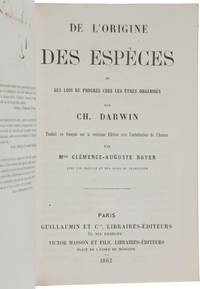
1862ref. 6677Paris: Guillaumin et Cie; Victor Masson et Fils 1862. First edition. First edition in French of Darwin's Origin translated with his authorisation from the third English edition of 1861 and the most disputed of its early translations - rendered prefaced footnoted retitled and intellectually re-framed by Clémence Royer 1830-1902 the self-taught philosopher whom Darwin reading the finished book in June 1862 pronounced "one of the cleverest & oddest women in Europe." Royer's sixty-four-page preface is a manifesto - anti-clerical positivist proto-eugenic - enlisting Darwin's biology for a programme he had never endorsed. Her footnotes override his hedges; her rendering of natural selection as élection naturelle drifted toward the voluntarism he abhorred; her retitling ou des Lois du Progrès chez les êtres organisés substituted Lamarckian ascent for Darwin's competitive statistics. Darwin replaced her with Moulinié in 1873 and Barbier in 1876; but French Darwinism in its first decade was shaped as much by Royer's preface as by Darwin's text and the present book is the edition in which the two first appeared together. . First Edition in the French Translation Darwin Regretted. First edition in French of Darwin's Origin translated with his authorisation from the third English edition of 1861 and the most disputed of its early translations - rendered prefaced footnoted retitled and intellectually re-framed by Clémence Royer the self-taught philosopher economist and feminist whom Darwin reading the finished book in June 1862 pronounced "one of the cleverest & oddest women in Europe." Royer's sixty-four-page translator's preface is a manifesto: an anti-clerical positivist and proto-eugenic document that enlists Darwin's biology for a social and political programme he had never endorsed and would spend the rest of his life partly repudiating. Her footnotes run through the main text sometimes clarifying often disputing and occasionally correcting Darwin from positions he did not share. Her rendering of natural selection as élection naturelle rather than the later-standard sélection naturelle was a lexical choice he quietly detested. Her substitution of his sober subtitle - or the Preservation of Favoured Races in the Struggle for Life - with her own progressivist formula - ou des Lois du Progrès chez les êtres organisés - was an ideological edit. Darwin had seen none of this before publication. By 1873 he had arranged a new translation by Jean-Jacques Moulinié; by 1876 a further one by Edmond Barbier. French Darwinism in its first decade was shaped as much by Royer's preface as by Darwin's text and the present book is the edition in which the two first appeared together. Darwin had had difficulty finding a French translator at all. Louise Belloc the first he approached declined on the grounds that the material was too scientific. Pierre Talandier a French political exile who had offered to undertake the work withdrew when no publisher would associate with him. Royer who was already placing her own two-volume Théorie de l'Impôt with the Parisian publishing house of Guillaumin learned of the vacancy and approached Darwin with a firm publishing agreement from Guillaumin et Cie and Victor Masson et Fils already in hand. On 10 September 1861 Darwin wrote to John Murray asking that a copy of the third English edition of the Origin be sent to her at 2 Place de la Madeleine Lausanne. What he knew of her was modest and on its face reassuring: she had delivered a course of scientific lectures in Lausanne in 1859; she had paid careful attention to Lamarck; she had corresponded with republican radicals across Europe; she had written on economics and on logic. The authorisation went forward. The French title page prints avec l'autorisation de l'Auteur in small capitals as if the phrase endorsed the whole enterprise; in fact it referred only to Darwin's permission to translate the third English edition of 1861. Royer proceeded without supervision. The absence of supervision is in retrospect the decisive error. Born in Nantes on 21 April 1830 the illegitimate daughter of Augustin-René Royer - an army captain and Bourbon legitimist - and of Joséphine-Gabrielle Audouard a Nantes seamstress she acquired her full name only when her parents married in 1837. Her earliest childhood was spent in Swiss exile her father having taken part in the 1832 rebellion to restore the Bourbon dynasty; the family returned to France on his surrender and acquittal in Orléans. She received patchy formal schooling and a year at a convent school before after her father's death in 1849 educating herself through self-study and teaching certificates. In 1854 she taught at a girls' school in Wales - acquiring the English that would later serve her for Darwin - and there encountered a religious diversity that precipitated her own drift from Catholicism. She returned to France in 1855; a year later to Lausanne where she read systematically through the municipal library. She opened a women's course in logic in 1859 followed by a forty-lesson course on the Philosophy of Nature and History in which she was already arguing a Lamarckian transformism before she had so much as heard of Darwin. She began writing for the journals of Pascal DuPrat - the French republican politician with whom she would from 1865 live openly as "wife." In 1860 her entry on tax reform took second place in the canton of Vaud's competition; her two-volume Théorie de l'Impôt was published by Guillaumin in 1862 and it was through this connection that the Origin commission reached her. Her intellectual loyalties - to Comte to the Saint-Simonians to philosophical positivism in its most anti-theological form - were formed and in print before Darwin's book arrived on her desk. She saw in it the scientific foundation her programme had been waiting for. She did not see - or more likely did not care - that Darwin's argument was narrower than the use to which she proposed to put it. Her preface running to sixty-four pages before Darwin's own Introduction begins is accordingly a document of French intellectual life as much as of Darwinian biography. It opens with the creedal sentence of nineteenth-century positivism: a profession of faith in revelation - not the Mosaic or the Christian but the permanent revelation of man to himself through the cumulative acquisition of scientific truths and the elimination of inherited errors. A survey of world history follows arranged as the progressive overcoming of religious superstition by reasoned knowledge with Zoroaster Moses Confucius Pythagoras Plato and the Catholic Fathers adduced as steps in a single ascending arc and Darwin's theory of descent with modification presented as the latest and most decisive revelation of this secular kind. Royer is explicit that Darwin's theory must displace the Mosaic account of creation that it renders natural theology untenable that it is fundamentally and irremediably heretical and that those who attempt to reconcile it with Christian doctrine are either dishonest or confused. In the second half of the preface she applies the theory to human society arguing that the struggle for life observed in nature should be allowed to run its course in human populations without the artificial protections of charity welfare and the preservation of the weak by the strong - the passage which more than any other has earned her the retrospective label of an early eugenicist. The argument is made with verve and in excellent French. It is also wholly absent from Darwin's own text. The reader of this French first edition meets Royer before meeting Darwin and a great many of those readers - Clemenceau Zola the circle around the Revue des Deux Mondes the young Gustave Le Bon - took their first impression of Darwinism from her preface. Her interventions did not end at the preface. Footnotes occur throughout the main text sometimes briefly and technically more often at length and argumentatively; where Darwin hedges she is firm; where he defers to theological sensitivities she removes the deferrals. Her choice of élection naturelle was defended on philological grounds - sélection she argued carried misleading overtones of deliberate choice - but in practice the word drifted toward a voluntarist almost teleological reading that was the opposite of Darwin's blind-statistical mechanism. Her retitling - the addition of ou des Lois du Progrès chez les êtres organisés - moved the centre of the book from the preservation of favoured races under competitive pressure to a supposed lawful ascent of organised beings an inflection Darwin took pains to resist throughout his career. Supervision had in fact been attempted: the Geneva zoologist Édouard Claparède whom Royer had enlisted for biological advice tried and failed to temper her commentary and wrote to Darwin with some exasperation describing the attempt as hopeless. The book that resulted falls into three parts: the preface the French rendering of Darwin's own Historical Sketch newly added to the third English edition of 1861 and the body of the text with Royer's notes running beneath it. Lithographed as the single illustration Darwin's branching diagram from Chapter IV was reset in Paris by the firm of Delarue preserving the fourteen geological horizons and the ancestral species A through L but carrying its captions and chapter head in French. The book was issued on 31 May 1862. When his copy reached Down House in early June Darwin read it with a growing and characteristic unease. In mid-June he sent the American botanist Asa Gray the assessment that has become the most-quoted fragment of this whole episode describing the translator as one of the cleverest and oddest women in Europe an ardent deist violently hostile to Christianity convinced that the struggle for life could be made to account for all morality politics and human nature and about to publish he predicted a strange production on exactly those subjects. The tone is recognisable. Darwin was rarely sharp about anyone; his method of expressing disapproval was to call a colleague odd or a book strange. The deeper problem was that a theory he had spent twenty years writing up with methodological caution was about to enter French intellectual life attached to Royer's philosophical programme and there was in the short term nothing he could do. A month later he would regret to Armand de Quatrefages that his translator had not known more of natural history; to Hooker that Royer corrected his own expressed doubts by appending footnotes denying that any doubt was warranted at all; to Claparède private thanks for an intervention that had plainly not worked. He could at least wait. A second edition of Royer's translation appeared in 1866 with expanded notes a new avant-propos and - in response to corrections Darwin had by now supplied - a switch from élection to sélection naturelle flagged by a defiant footnote in which Royer conceded the popular usage but declined to concede the underlying linguistic point. A third edition further revised but published without Darwin's knowledge appeared in 1870 from the same houses; by this time Darwin had issued the fourth and fifth English editions of the Origin none of whose corrections Royer had incorporated. Worse she had added to the third edition a further preface attacking the theory of pangenesis that Darwin had propounded in his Variation of Animals and Plants under Domestication of 1868 - a theory with no direct bearing on the Origin at all. That was the breaking point. In late 1869 Darwin wrote to his Paris publisher C.-F. Reinwald and through him to the young Geneva naturalist Jean-Jacques Moulinié asking for a fresh translation. Moulinié began the work at the end of 1869 rendering first from the fifth English edition and then as Darwin's sixth edition appeared in 1872 incorporating its new chapter and additions as an appendix. The Franco-Prussian war of 1870-71 and Moulinié's own illness delayed him and he died in 1872 before his translation could be published. The book appeared in 1873 from Reinwald with a prefatory letter from Darwin dated 23 September 1872 and printed in both English and French explaining the change of translator and renouncing any royalty from the new edition. Moulinié's successor at Reinwald Edmond Barbier then produced in 1876 a second fresh translation - this time from Darwin's definitive sixth English edition of 1872 - which became and has remained the standard French Origin. Royer was not finished. A fourth edition of her translation appeared from Flammarion in 1882 the year of Darwin's death; it continued to be reprinted by that house into the 1930s thirty years after Royer's own death in Paris on 6 February 1902. The book itself aside from these celebrated peculiarities of its making carries the full text of Darwin's third English edition including the Historical Sketch that Darwin had added in 1861 in response to accusations of having neglected his predecessors. It is the earliest form in which a French reader could encounter the third-edition apparatus - Lamarck Geoffroy Saint-Hilaire Erasmus Darwin Chambers Wallace and the others whom Darwin acknowledged as having anticipated one or another piece of his theory. The branching diagram of Chapter IV the only illustration survives here in the Delarue lithograph. Darwin's closing sentence - on the grandeur of the view of life with its several powers having been originally breathed by the Creator into a few forms or into one - appears in Royer's French in perceptibly softened form with the divinely breathed-in creative act rendered as an impersonal first cause. Small as the adjustment is it is characteristic of her hand. Provenance: an unidentified Château de Beaulieu with its library stamp - an oval in blue ink with the legend CHÂTEAU DE BEAULIEU around the circumference and the owner's initials G. T. F. in the centre - at the upper margin of the half-title above an ink signature Beaulieu and a flourished calligraphic initial D. Several Châteaux de Beaulieu are candidates - in the Allier the Charente the Loir-et-Cher and the Mayenne among others - and the monogram G. T. F. has not yet been matched to a documented collector. The consequences for French intellectual life were considerable. The working French naturalists of the 1860s were slow to embrace Darwin: Quatrefages Milne-Edwards and Claude Bernard either ignored the book or engaged with it sceptically and the Académie des Sciences declined to elect Darwin a correspondant until 1878 and then only in botany. Part of this reluctance was the French scientific establishment's native attachment to a Lamarckian transformism which it preferred to defend rather than replace; part of it was the tendency of French Darwinism as refracted through Royer to be dismissable as anti-clerical propaganda dressed up as science. Paul Broca coined the neologism transformisme in 1868 to name the hypothesis in its Lamarck-to-Darwin arc and it is symptomatic that French readers through the 1870s continued to locate Darwin inside Lamarck's genealogy rather than outside it. Royer's progressivist framing made it harder for them to distinguish Darwin's argument from the older broader and less biologically rigorous evolutionism of Lamarck and of Herbert Spencer with which her preface actively confused it. Darwin writing to Gaston de Saporta in 1872 remarked wistfully that French opinion of his work had been formed in large part on the basis of a translation that was not his own. Royer for her part prospered in Paris. In 1870 she became the first woman elected to the Société d'Anthropologie de Paris a body founded and still led by Broca; she published her own major work Origine de l'homme et des sociétés the same year; and Ernest Renan in a phrase that became famous and eventually furnished the title of Joy Harvey's modern biography described her as almost a man of genius. The preface to the first French Origin is today reprinted as a standalone text in Geneviève Fraisse's Clémence Royer philosophe et femme de sciences of 1985 and discussed at length in Harvey's Almost a Man of Genius: Clémence Royer Feminism and Nineteenth-Century Science of 1997 where its status as a founding document of French social Darwinism - and more quietly of French feminist scientific writing - is now generally acknowledged. References: PMM 344b Dibner Heralds of Science 199 Horblit 18b and Garrison-Morton 220 all for the English first edition of 1859 - Freeman 655 - Fraisse Clémence Royer philosophe et femme de sciences 1985 reprinting Royer's preface in full - Harvey Almost a Man of Genius: Clémence Royer Feminism and Nineteenth-Century Science 1997. 8vo 175 × 111 mm: LXIV XXIII 25-712 pp. Folding lithographed plate by Delarue of Paris bound between pp. 160 and 161. Printed at Saint-Denis by A. Moulin. Contemporary French half red morocco over marbled paper-covered boards spine with five raised bands set off by gilt double fillets gilt-lettered CH. DARWIN and ORIGINE DES ESPÈCES in the second and third compartments small gilt ornament to the remaining compartments red-speckled endpapers edges yellowed. Library stamp of the Château de Beaulieu monogrammed G. T. F. at the head of the half-title. Joints and hinges sound and unrestored; morocco fresh and unrubbed at the bands gilt bright; corners lightly bumped; text block clean and tight with the usual scattered light foxing to preliminaries; folding plate unreinforced without tears or repairs at the folds. . Guillaumin et Cie; Victor Masson et Fils unknown
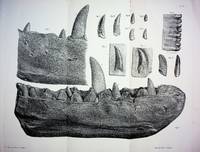
1847ref. 1641FIRST EDITION MAGNIFICENT SET OF THE INAUGURAL 24 VOLUMES PUBLISHED BY THE NEW PALAEONTOGRAPICAL SOCIETY OF LONDON—100 MONOGRAPHS 1000 PLATES 7000 PAGES INCLUDING SEMINAL WORKS OF CHARLES DARWIN AND RICHARD OWEN. 24 quarto volumes 8 x 11 inches later half leather gilt-lettered on spine with gilt panel lines over green textured cloth with gilt-rules green patterned endpapers each containing up to 7 monographs with lithographic or engraved plates many folding and some wood engravings in the text. The volumes appear to be unread with tight bindings that are as new and bright plates. Preliminary pages of each volume contain a perforated stamp of the Carnegie Library of Pittsburgh—there are no other ownership marks only rare light foxing. Very good. The Palaeontographical Society was established in 1847 and is the oldest society devoted to the study of paleontology worldwide. Its primary role is to promote the description and illustration of the British fossil flora and fauna via publication of an authoritative monograph series. The monographs were issued annually to members of the society. They cover a wide range of taxonomic groups from microfossils trilobites and ammonites through to Coal Measure plants mammals and reptiles and from all ages from Cambrian to Pleistocene. They form a benchmark for understanding the past life of the British Isles and many include the original descriptions of numerous key species. The first monograph Vol. 1 on the Crag Mollusca was published in March 1848 and the Society continues this work today. Notable authors in the series include Charles Darwin and Richard Owen both members of the Society. Darwin's interest in barnacles had first arisen in his student days in Edinburgh under the guidance of Robert Grant and increased during his detailed work in dissecting and classifying the specimens he had collected on the Beagle voyage. Darwin published his papers on fossil barnacles included in volumes 5 1851 and 8 1854 reflecting the 8 years that he devoted to the study of extinct and living barnacles establishing his credentials for formulating his theory of natural selection in The Origin of Species in 1859. In his analysis of reptilian British fossils Darwin's leading opponent Richard Owen identified unique characteristics of Megalosaurus vol. 9 Iguanodon and Hylaeosaurus vol. 10 that distinguished them from extant lizards and coined the term dinosaur "terrible lizard" in 1841. There are 22 monographs by Owen in the first 24 volumes including 16 on dinosaurs 4 on other reptiles and turtles and 2 on mammals including whales. British fossil hunter William Buckland found some fossils in 1819 and he eventually described them and named them in 1824. Like scientists before him Buckland thought the fossils belonged to an ancient larger version of a modern reptile. The first edition of a work which laid the foundation to vertebrate paleontology was Georges Cuvier's Recherches sur les ossements fossiles de quadrupèdes Researches on quadruped fossil bones published in France in 1812. In 1822 Cuvier's disciple and editor of the scientific publication Journal de physique Henri de Blainville introduced the term palaeontologie as the study of fossilized organisms—translated to the English paleontology. The word palaeontographical was coined by members of the Clay Club that established the new society whose goal was to describe and illustrate newly discovered fossils. The rapid progress in geology and paleontology during the 1830s and 1840s was aided by a growing international network of geologists and fossil specialists whose work was organized and reviewed by an increasing number of geological societies. Many of these geologists and paleontologists were now paid professionals working for universities museums and government geological surveys. The relatively high level of public support for the earth sciences was due to their cultural impact and their proven economic value in helping to exploit mineral resources such as coal. Another important factor was the development in the late 18th and early 19th centuries of museums with large natural history collections. The first 24 years of the Palaeontographical Society Monographs spans the middle of the 19th century and brackets publication of The Origin of Species in 1859. The intense activity in British paleontology at this time is reflected in the 110 monographs contained in these 24 volumes and provides a visual as well as a narrative context for the contributions of Darwin and Owen. The 27 contributing authors reveal the strong attraction of paleontology for physicians and the wide variety of species whose ancestors were pursued. These ranged from minute foraminifera to larger marine invertebrates including corals tunicates brachiopods mollusks echinoderms ammonites belemnites trilobites and eurypterids and vertebrates fish reptiles and mammals. Because photography did not become widely available until the end of the 19th century illustrations in the monographs were executed as lithographs or engravings. The most prominent London lithographers of the day were recruited to produce the dramatic plates. Many of these artists were themselves accomplished naturalists. These included Day & Son Lithographers to Queen Victoria; George Henry Ford a member of the British Museum; Michael & Nicholas Hanhart who developed a complex layering of tint stones; Charles Joseph Hullmandel author of The Art of Drawing on Stone; and the Sowerby family a British family of several generations of naturalists illustrators botanists and zoologists active from the late 18th century to the mid twentieth century. The three George Sowerbys produced major works on mollusks and their systematics including the many monographs by the Society as well as Darwin's barnacles. Notably the Sowerbys were responsible for also producing the copper plate engravings for these monographs including James De Carle Sowerby who founded the Royal Botanic Society and Gardens and was its secretary for 30 years. The Paleontographical Society Monographs are cited by Darwin in his reading notebooks. NOTE: Available upon request info@BiomedRarebooks.com A 22-page detailed description of the set containing large magnification images of selected plates list of individual monographs in each volume and list of authors subjects plates sorted by subject. Palaeontographical Society hardcover
1871ref. 18750London: John Murray 1871. FIRST EDITION FIRST ISSUE. Numerous text illustrations. Original publisher's green cloth binding; an excellent set. First edition first issue of Darwin’s classic work in comparative anatomy his first inclusion of man in the general theory of natural selection and the first appearance of the term “evolution” in any of his works see Volume I page 2. In the twelve years since the publication of Origin the author had expanded his thinking as to man's inclusion with the other animals and this title which grew out of his Variations of Animals and Plants is based on his vast collection of data dating from 1837. Here by comparing the physiological and psychological aspects of man and ape he fills in what had been merely suggested in Origin that man's ancestor if still alive today would be classified among the primates and on a lower scale than the apes. The last chapter is an added essay on sexual selection that is the preferential chances of mating that some individuals of one sex have over their rivals. “Perhaps Darwin’s greatest contributions in this area was to show that secondary sexual characteristics had evolved in relation to a complex pattern of reproductive behavior which must itself be the product of natural selection” DSB III p. 575. This essay ends with the famous and often misquoted statement “Man still bears in his bodily frame the indelible stamp of his lowly origin.” Freeman 937; Garrison & Morton 170. John Murray unknown
1871ref. 18750London: John Murray 1871. FIRST EDITION FIRST ISSUE. Numerous text illustrations. Original publisher's green cloth binding; an excellent set. First edition first issue of Darwin’s classic work in comparative anatomy his first inclusion of man in the general theory of natural selection and the first appearance of the term “evolution” in any of his works see Volume I page 2. In the twelve years since the publication of Origin the author had expanded his thinking as to man's inclusion with the other animals and this title which grew out of his Variations of Animals and Plants is based on his vast collection of data dating from 1837. Here by comparing the physiological and psychological aspects of man and ape he fills in what had been merely suggested in Origin that man's ancestor if still alive today would be classified among the primates and on a lower scale than the apes. The last chapter is an added essay on sexual selection that is the preferential chances of mating that some individuals of one sex have over their rivals. “Perhaps Darwin’s greatest contributions in this area was to show that secondary sexual characteristics had evolved in relation to a complex pattern of reproductive behavior which must itself be the product of natural selection” DSB III p. 575. This essay ends with the famous and often misquoted statement “Man still bears in his bodily frame the indelible stamp of his lowly origin.” Freeman 937; Garrison & Morton 170. John Murray unknown books
1847ref. 1641FIRST EDITION MAGNIFICENT SET OF THE INAUGURAL 24 VOLUMES PUBLISHED BY THE NEW PALAEONTOGRAPICAL SOCIETY OF LONDON—100 MONOGRAPHS 1000 PLATES 7000 PAGES INCLUDING SEMINAL WORKS OF CHARLES DARWIN AND RICHARD OWEN. 24 quarto volumes 8 x 11 inches later half leather gilt-lettered on spine with gilt panel lines over green textured cloth with gilt-rules green patterned endpapers each containing up to 7 monographs with lithographic or engraved plates many folding and some wood engravings in the text. The volumes appear to be unread with tight bindings that are as new and bright plates. Preliminary pages of each volume contain a perforated stamp of the Carnegie Library of Pittsburgh—there are no other ownership marks only rare light foxing. Very good. The Palaeontographical Society was established in 1847 and is the oldest society devoted to the study of paleontology worldwide. Its primary role is to promote the description and illustration of the British fossil flora and fauna via publication of an authoritative monograph series. The monographs were issued annually to members of the society. They cover a wide range of taxonomic groups from microfossils trilobites and ammonites through to Coal Measure plants mammals and reptiles and from all ages from Cambrian to Pleistocene. They form a benchmark for understanding the past life of the British Isles and many include the original descriptions of numerous key species. The first monograph Vol. 1 on the Crag Mollusca was published in March 1848 and the Society continues this work today. Notable authors in the series include Charles Darwin and Richard Owen both members of the Society. Darwin's interest in barnacles had first arisen in his student days in Edinburgh under the guidance of Robert Grant and increased during his detailed work in dissecting and classifying the specimens he had collected on the Beagle voyage. Darwin published his papers on fossil barnacles included in volumes 5 1851 and 8 1854 reflecting the 8 years that he devoted to the study of extinct and living barnacles establishing his credentials for formulating his theory of natural selection in The Origin of Species in 1859. In his analysis of reptilian British fossils Darwin's leading opponent Richard Owen identified unique characteristics of Megalosaurus vol. 9 Iguanodon and Hylaeosaurus vol. 10 that distinguished them from extant lizards and coined the term dinosaur "terrible lizard" in 1841. There are 22 monographs by Owen in the first 24 volumes including 16 on dinosaurs 4 on other reptiles and turtles and 2 on mammals including whales. British fossil hunter William Buckland found some fossils in 1819 and he eventually described them and named them in 1824. Like scientists before him Buckland thought the fossils belonged to an ancient larger version of a modern reptile. The first edition of a work which laid the foundation to vertebrate paleontology was Georges Cuvier's Recherches sur les ossements fossiles de quadrupèdes Researches on quadruped fossil bones published in France in 1812. In 1822 Cuvier's disciple and editor of the scientific publication Journal de physique Henri de Blainville introduced the term palaeontologie as the study of fossilized organisms—translated to the English paleontology. The word palaeontographical was coined by members of the Clay Club that established the new society whose goal was to describe and illustrate newly discovered fossils. The rapid progress in geology and paleontology during the 1830s and 1840s was aided by a growing international network of geologists and fossil specialists whose work was organized and reviewed by an increasing number of geological societies. Many of these geologists and paleontologists were now paid professionals working for universities museums and government geological surveys. The relatively high level of public support for the earth sciences was due to their cultural impact and their proven economic value in helping to exploit mineral resources such as coal. Another important factor was the development in the late 18th and early 19th centuries of museums with large natural history collections. The first 24 years of the Palaeontographical Society Monographs spans the middle of the 19th century and brackets publication of The Origin of Species in 1859. The intense activity in British paleontology at this time is reflected in the 110 monographs contained in these 24 volumes and provides a visual as well as a narrative context for the contributions of Darwin and Owen. The 27 contributing authors reveal the strong attraction of paleontology for physicians and the wide variety of species whose ancestors were pursued. These ranged from minute foraminifera to larger marine invertebrates including corals tunicates brachiopods mollusks echinoderms ammonites belemnites trilobites and eurypterids and vertebrates fish reptiles and mammals. Because photography did not become widely available until the end of the 19th century illustrations in the monographs were executed as lithographs or engravings. The most prominent London lithographers of the day were recruited to produce the dramatic plates. Many of these artists were themselves accomplished naturalists. These included Day & Son Lithographers to Queen Victoria; George Henry Ford a member of the British Museum; Michael & Nicholas Hanhart who developed a complex layering of tint stones; Charles Joseph Hullmandel author of The Art of Drawing on Stone; and the Sowerby family a British family of several generations of naturalists illustrators botanists and zoologists active from the late 18th century to the mid twentieth century. The three George Sowerbys produced major works on mollusks and their systematics including the many monographs by the Society as well as Darwin's barnacles. Notably the Sowerbys were responsible for also producing the copper plate engravings for these monographs including James De Carle Sowerby who founded the Royal Botanic Society and Gardens and was its secretary for 30 years. The Paleontographical Society Monographs are cited by Darwin in his reading notebooks. NOTE: Available upon request info@BiomedRarebooks.com A 22-page detailed description of the set containing large magnification images of selected plates list of individual monographs in each volume and list of authors subjects plates sorted by subject. Palaeontographical Society hardcover books
1860ref. 28009John Murray 1860. 8vo. Fifth Thousand Second Edition Second Issue with folding diagram neat contemporary signature in pencil at head of title with second pencilled signature lower down front free endpaper a little chafed at fore-edge three or four small fox-spots each on half-title title and diagram; original green cloth boards elaborately blocked in blind gilt back brown endpapers uncut expertly recased with original endpapers preserved a remarkably bright fresh copy in minimally restored publisher's binding. With 32pp publisher's catalogue dated January 1860 bound in at end and the binder's ticket of Edmonds & Remnants on rear paste-down. The second edition second issue is not so named on title but simply labelled 'Fifth Thousand'; Freeman records that 3000 copies were printed following the 1250 copies of the first edition. Although Darwin considered this edition a rapid revision to meet demand his changes are much more than mere correction. 'The total number of changes in this edition is impressive enough. No chapter was untouched' Peckham. The most famous alteration is the dilution of the whale bear passage on p.184 which Darwin later regretted although he never restored it. With the signed and ruled advertisements which Freeman considers the first issue. Freeman 113 variant a; Freeman F376. John Murray, hardcover
1861ref. 304713Third edition with additions and corrections seventh thousand. Octavo. Half title page folding diagram at p. 123. 2 pages of advertisements at end. Original green cloth stamped in gilt and blind; brown coated endpapers. Binder's ticket of Edmonds & Remnants on back pastedown. A fresh bright tight copy of a book that is usually found in worn condition. No foxing. Small booksellers label on verso front free endpaper. Neat signatures of two previous owners on the half title page. Freeman 381. "The most important biological book ever written" Freeman p. 73. John Murray hardcover
1861ref. 304713Third edition with additions and corrections seventh thousand. Octavo. Half title page folding diagram at p. 123. 2 pages of advertisements at end. Original green cloth stamped in gilt and blind; brown coated endpapers. Binder's ticket of Edmonds & Remnants on back pastedown. A fresh bright tight copy of a book that is usually found in worn condition. No foxing. Small booksellers label on verso front free endpaper. Neat signatures of two previous owners on the half title page. Freeman 381. "The most important biological book ever written" Freeman p. 73. John Murray hardcover books
1896ref. 133260New York: D. Appleton and Company 1896-97. The Authorized edition of the works of Charles Darwin. Octavo 15 volumes bound in original three quarters morocco gilt titles to the spine top edge gilt illustrated with in-text drawings and plates some volumes with frontispieces. In near fine condition. An exceptional set. Charles Darwin has been widely recognized since his own time as one of the most influential writers in the history of Western thought. His books were widely read by specialists and the general public and his influence had been extended by almost continuous public debate over the past 150 years. His most well known works are The Origin of Species The Descent of Man and Voyage of the Beagle. D. Appleton and Company unknown
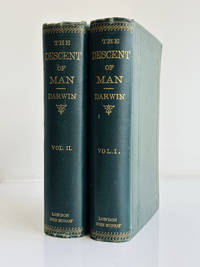
1871ref. 12819First Edition First Issue. Extremely scarce. With "transmitted" the first word on p.297 in the first volume; in the second volume printer's note on verso of half-title errata on verso of title and the postscript leaf after p.viii. January ads in both volumes. The First Edition contains two parts: The Descent of Man itself and Selection in Relation to Sex. "The word 'evolution' in Volume 1 .2 occurs for the very first time in any of Darwin's worlds." Freeman 128-9. Often misunderstood Darwin never said that man was descended from apes let alone monkeys; that statement of his -- what he claimed and that highly important and still controversial statement today was that man's ancestors if alive today would have to be classified among the primates. One of the most significant books ever written SIGMUND FREUD Freeman 937; GarrisonMorton 170; Printing and the Mind of Man 169; Rieber 12. SCARCE AND HIGHLY COLLECTIBLE Both volumes endpapers highly foxed otherwise in surprisingly decent condition gilt titles clean and in volume two surprisingly bright. John Murray hardcover books
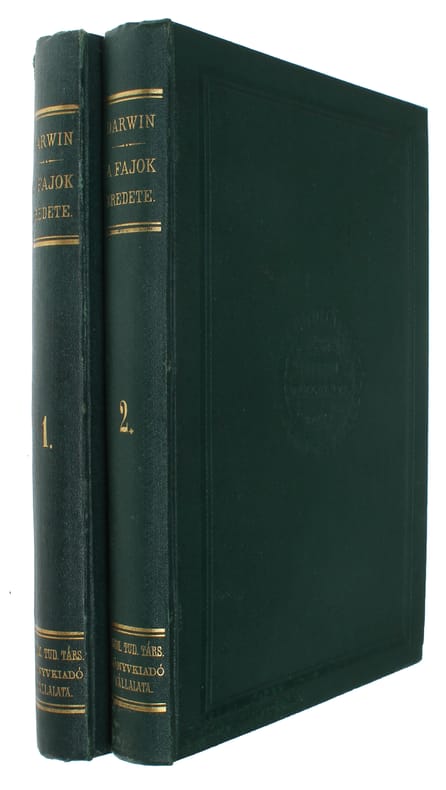
1874ref. 60158Budapest, Kiadja a Természettudományi Társulat [Academy of Sciences], 1873 & 1874. 8vo. In two contemporary embossed full cloth bindings with gilt letter- and numbering to spine. Bindings with light wear, primarily affecting hindges. Previous owner's stamp to half title and title page in both volumes. Light occassional brownspotting, primarily affecting first and last leaves. An overall nice copy. XVI, (2), 303, (1)"" VII, (1), 361, (1) pp. + 1 leaf of Advertisement + 2 plates (A frontiespiece of Darwin and one listing the evolution of the different generations).
1881ref. feb01441881. First Japanese Edition 3 books of The descent of man and selection in relation to sex by Charles Darwin. .人祖論. Used book For more details and availability please contact me Ichibe Yamanaka
ref. 18098London: John Churchill. 1844 and 1845. First edition first printing. First edition first printing. Two volumes. 8vo. Publisher's original red cloth with gilt titles to the spines. A very good set the bindings square and firm with minor nicks to the head of the spine of 'Vestiges' minor cracking to the inner hinges and chipping with loss to the spine ends of 'Explanations' the corners of both volumes a little bumped. The contents of 'Vestiges' with minor toning to page edges and the occasional minor mark to a couple of page margins are otherwise in excellent order clean throughout and without previous owners' inscriptions or stamps. The contents of 'Explanations' with a small contemporary bookseller's ticket to the front pastedown minor toning to the page edges the odd marginal mark a few faint pencil underlings a very minor water mark to the rear pastedown and free endpaper and a paper flaw to p.59 are otherwise in very good condition. All in all an attractive and appealing set in entirely original unsophisticated condition. Housed in a bespoke quarter morocco solander case. The first edition of the first full-length exposition of an evolutionary theory in English and the most important precursor to Darwin's 'On the Origin of Species'. "This outspoken statement of a belief in evolution published anonymously to protect Chambers' reputation as a publisher anticipated Darwin's Origin by 16 years Garrison and Morton p.218. Bringing "together a large variety of data from both geology and the life sciences to support the idea of the origin of species through a process of transmutation. It played a significant role in the history of mid-nineteenth century biology by making evolutionism a commonplace topic of discussion" becoming a sensational best-seller read widely by the intellectual and cultural elite thus easing the way for Darwin's own writings Norman. Notably the work also contains what is probably the first discussion of computing within the context of biology with Chambers demonstrating "that evolutionary change occurring over long periods of time could be seen as similar to the workings of Babbage's Difference Engine programmed from the beginning of its operation to produce in sequence several different series of numbers according to a succession of mathematical rules". Vestiges in fact served to significantly aid public understanding of Babbage's work with his ideas receiving "a much wider circulation through Chamber's text than through the two editions of the "Ninth Bridgewater Treatise" Hook et al. Origins of Cyberspace p.147. The October 1844 first edition of Vestiges consisted of 750 copies with a second edition of 1000 copies quickly following in December. The book was constantly revised with Chambers refining arguments addressing criticism and reacting to new scientific publications. Late in 1845 largely in response to Adam Sedgwick's review of the work in the Edinburgh Review Chamber's wrote "Explanations: A Sequel to Vestiges of the Natural History of Creation" consisting of 1500 copies and which was subsequently appended to later editions DSB III:192. The 11th edition of 1860 included a three page discussion of Darwin's recently published Origin a book which according to historian James A. Secord Vestiges outsold up until the early twentieth century. It was not until the 12th edition of 1884 in the preface written by his friend Alexander Ireland that Robert Chambers was revealed to have written Vestiges ending several decades of public speculation that had named everyone from Prince Albert to Darwin himself as the potential author. Secord James: Victorian Sensation The Extraordinary Publication Reception and Secret Authorship of Vestiges of the Natural History of Creation 2001. Further details and images for any of the items listed are available on request. All items are catalogued by humans. Lucius Books welcomes direct contact with our customers. London: John Churchill. 1844 and 1845 hardcover
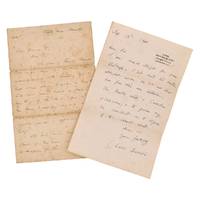
1881ref. 611Autograph letter signed concerning carnivorous beetles. Down Beckenham Kent 13th September 1881 8vo 205 x 131mm horizontal mailing folds 1pp. in fine condition signed "Charles Darwin"; with retained copy of Harmer's letter to Darwin Wick near Arundel 1881 8vo 205 x 130mm horizontal mailing folds weak at folds. A fine unpublished letter to John Harmer thanking him for his account of a beetle attacking a six-inch worm and for the beetle itself which Harmer had enclosed. Harmer had captured the beetle in Arundel Park in Sussex after witnessing the beetle attack the worm he writes "not having noticed any thing of the kind before I carried him home to satisfy myself whether such was his food or whether his appetite would be affected by captivity. He has since disposed of the fluids of two more which he cuts up in a very business like manner." Harmer fed it more worms then sent it to Darwin in case there was "an element of interest in the circumstance". Darwin's response reads "I am much obliged for your kindness. I had read that beetles attacked worms but did not know how far this was authentic. The beetle sent is Carabus Violaceus; & the genus may be considered as the tiger of the insect world." The posthumous revised edition of "The Formation of Vegetable Mould Through the Action of Worms" 1882 notes that "the larger species of Carabus and Staphylinus… attack… worms ferociously". This observation is absent from the first edition of 1881 so it seems Harmer's efforts were put to good use. Not in the Darwin Correspondence Project but Harmer's letter to Darwin is DCP-LETT-13332.
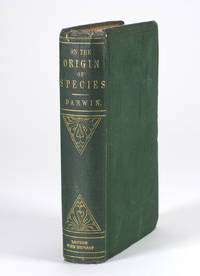
1860ref. 001613London: John Murray 1860. 5 vi-ix 2 2-502pp 1 2-32pp. Original embossed cloth title author and publisher in gilt to spine chocolate coloured endpapers. Later recased on an Oxford hollow corners gently bumped couple of minor bumps to board edges minor rubbing to extremities. Internally some light foxing especially to first two sections an old repair to tiny tears to fore edge of half title and title former owner's name and address to front endpaper but generally fairly clean. With the folding lithographic chart by William West between pages 116 and 117; 32pp of adverts dated January 1860 to rear. Bookseller's label of Folthorp of Brighton to front pastedown and the binder's ticket of Edmonds & Remnants to lower pastedown. Now housed in a cloth drop back box with title and author in gilt to spine made by Temple Bookbinders. The fifth thousand or second edition second issue though not so-called on the title page one of three thousand copies with the misprint 'speceies' corrected and the whale-bear story diluted see Freeman page 78 binding variant 'a' with upright of L in London over right hand upright of H in John. Freeman 376. Second Edition. Hardback. Good/No Jacket. 8vo. John Murray Hardcover
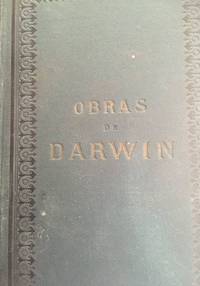
1877ref. feb027271877. First Spanish Edition - On the Origin of Species by Means of Natural Selection or the Preservation of Favoured Races in the Struggle for Life by Charles Darwin. El origen de las especies Used book For more details and availability please contact me Biblioteca Perojo hardcover
1860ref. 200052New York: D. Appleton & Company 1860. First Edition; First Printing. Hardcover. First American edition first printing first issue with two quotes/reviews opposite the title page. Near fine condition. 432 pp. Bound in publisher's green pebbled cloth decorated in blind titles in gilt on the spine original coated brown endpapers folding chart intact. A Near Fine copy. Light rubbing to cloth at corners/tips. Light foxing and occasional offsetting to contents. Small tear at rear endpaper. Text is unaffected. No other interior marks bar owner's name in pencil remained for potential provenance. D. Appleton & Company hardcover
1881ref. 60016Tokyo, Ichibe Yamanaka., Meiji 14. (1881). 8vo. 3 volumes, all in the contemporary (original?) yellow wrappers (Traditional Fukuro Toji binding/wrappers). Extremities with wear and with light soiling, promarily affecting vol. 1. Title in brush and ink to text-block foot. A few ex-ownership stamps. Folding plate with repair. A fine set. 46 ff" 70 ff. + 9 plates of which 1 is folded" 72 ff. ""Vol. I contains prefaces to 1st and 2d editions of Descent of man Nos 936 & 944"" vol. II contains chapter 1 and vol. III chapter 2. All published, intended to form 9 vols containing chapters 1-7 and 21."" (Darwin-Online).
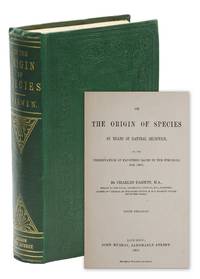
1860ref. 42820886SECOND EDITION published on January 7 1860 less than two months after the first edition. Three thousand copies were printed. On the Origin of Species is "certainly the greatest biological book ever written" Freeman and "the most important single work in science" Dibner. Darwin's theory of the origin of species by means of natural selection arose out of his studies in the 1830s during and after the voyage of H.M.S. Beagle. From 1831 to 1836 Darwin sailed around the world on the Beagle. During this five-year voyage Darwin and the Beagle visited the Galapagos Islands Brazil Argentina Tierra del Fuego Chile Peru Tahiti Australia New Zealand and other islands and countries finally returning to England by sailing around the Cape of Good Hope. Darwin observed "It appears to me that nothing can be more improving to a young naturalist than a journey in distant countries." The voyage of the Beagle was "the most important event in Darwin's intellectual life and in the history of biological science. Darwin sailed with no formal scientific training. He returned a hard-headed man of science knowing the importance of evidence almost convinced that species had not always been as they were since creation but had undergone change. … The experiences of his five years … and what they led to built up into a process of epoch-making importance in the history of thought" DSB. Over the coming thirty years Darwin refined the ideas that had germinated aboard the Beagle and finally published them in On the Origin of Species. Darwin concluded his book "There is grandeur in this view of life with its several powers having been originally breathed into a few forms or into one; and that whilst this plan has gone cycling on according to the fixed law of gravity from so simple a beginning endless forms most beautiful and most wonderful have been and are being evolved." Darwin's ideas about evolution and natural selection are the underpinnings of modern biological science. Moreover they have given us a new way of viewing and talking about the world. "Darwin not only not only drew an entirely new picture of the workings of organic nature; he revolutionized our methods of thinking and our outlook on the order of natural things. The recognition that constant change is the order of the universe had finally been established" Printing and the Mind of Man 344b. Provenance: nineteenth-century bookplate and signature of William Pearce. Original green cloth. Light wear to spine ends. A fine copy with the fragile inner hinges intact. Freeman 376. John Murray hardcover
1860ref. 179998London: John Murray 1860. With a gift inscription by the inventor of the fuel cell Second edition revised to include the author's response to criticisms of the first edition published the year before. This copy is inscribed on the title page by William Robert Grove the physicist and proponent of natural selection "Imogen from her loving Father WRG" and is intelligently annotated throughout. Grove 1811-1896 was the inventor of the first fuel cell a pioneer of energy conservation and the first person to demonstrate that molecules thermally dissociated into atoms. In his 1866 inaugural address he became the first president of the British Association for the Advancement of Science to publicly announce his support for the theory of evolution although "Darwin was displeased that the address did not discuss what was specific to his theory. In a letter that has not been found he voiced his criticisms to Grove who replied that he had wanted the address to be accessible to non-specialists" Darwin Correspondence Project. Grove instilled an interest in science in his family presenting this copy to his daughter Imogen Emily 1848-1886 and nurturing the interests of his grandson the astronomer Edmond Herbert Grove-Hills 1864-1922. This copy additionally has the partially erased ownership signature of a member of the Grove family presumably Imogen on the half-title. The Origin of Species is "the most important biological book ever written" Freeman. The changes to the second edition include the correction of the misprint "speceies" and the dilution of the "whale-bear" story which speculates that a bear scooping insects from the water may evolve into a whale-like creature. This hypothesis was seen as absurd and was seized upon by Darwin's critics to ridicule both the scientist and his evolutionary theory; Charles Lyell advised him to remove it entirely. "This story is not found again in any printing except in the American editions of 1860 until the end of copyright" Freeman p. 78. All copies of the second edition save for a handful dated 1859 are marked "fifth thousand" on the title page; the edition is not otherwise indicated as the second. This second issue the form in which the second edition is almost always seen was published on 7 January 1860 in a print run of 3000 copies. Octavo in 12s. Folding diagram facing p. 117. With 32 pp. of publisher's advertisements dated January 1860 at rear. Original green diagonal-wave-grain cloth spine lettered ruled and decorated in gilt covers blocked in blind Freeman's variant a light brown coated endpapers binder's ticket of Edmonds & Remnants on rear pastedown. With the ownership signature dated 1895 of Ada Mary Charles Montagu Douglas Scott 1855-1943 on title page. Cloth bright and clean spine slanted extremities and inner hinges reinforced damp stains to endpapers: a very good copy indeed. Freeman 376. "Darwin in letters 1866" Darwin Correspondence Project accessible online. hardcover
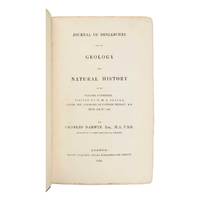
1839ref. 612London Henry Colburn 1839 FIRST EDITION FIRST ISSUE publisher's cloth rebacked replacing original spine. 8vo uncut pp xiv i.e. xii 615 1 blank Addenda 609-629 two folding charts a little foxing to charts as usual with 16 pp inserted publisher's advertisements dated August 1839 8pp prospectus for other publications. First edition first issue an attractive copy of the first separate issue of Darwin's Journal his first formal publication and a classic of natural history travel narrative. It was perhaps the most important scientific voyage ever undertaken for it gave impetus and direction to all of Darwin's later research. 'The five years of the voyage were the most important event in Darwin's intellectual life and in the history of biological science. Darwin sailed with no formal scientific training. He returned a hard-headed man of science knowing the importance of evidence almost convinced that species had not always been as they were since the creation but had undergone change. He also developed doubts of the value of the Scriptures as a trustworthy guide to the history of the earth and of man with the result that he gradually became an agnostic. The experiences of his five years in the Beagle how he dealt with them and what they led to built up into a process of epoch-making importance in the history of thought' Gavin de Beer in DSB. The Journal of Researches was issued as part of the Voyage of the Beagle volumes and also as a separate book as above; this separate issue comprises sheets from the same print-run but with cancel half-title and title-page. Both were published and available in June 1839. Freeman 11 Henry Colburn hardcover
1871ref. 20642London: John Murray 1871. John Murray London 1871. First edition first issues of both volumes with "transmitted" the first word on p. 297 in the first volume; in the second the printer's note on the verso of the half-title errata on title verso and the postscript leaf after p. viii. The first issue had a print-run of just 2500 copies. Both volumes in comparable excellent near fine condition. One small name within each F. Bond. Neat internal repair to each gutter of both volumes. Internally exceptionally clean and externally also remarkably fresh with only a little wear to the spine tips and edges and a little bubbling to the bottom of the rear panels. The binding is exceptionally tight. Not usually encountered in such beautiful condition. Charles Darwin expands on his theory of evolution focusing on human origins and the role of sexual selection. In this groundbreaking work Darwin argues that humans share a common ancestor with other animals particularly apes emphasising the continuity between humans and the rest of the natural world. He explores how natural selection and sexual selection have shaped human physical and behavioural traits including differences between sexes and races. Darwin also discusses the development of moral sense intellect and social behaviour suggesting that these too evolved gradually. The book was controversial challenging religious and scientific views of the time by placing humans firmly within the framework of evolutionary biology. 'The Descent of Man' not only deepened public understanding of human evolution but also laid the foundation for later studies in anthropology psychology and evolutionary theory making it a landmark in scientific literature and is claimed to be such by Sigmund Freud "One of the ten most significant books ever written". John Murray unknown
1860ref. 140949121London: John Murray 1860. Second Edition. Very Good. Second edition second issue with "fifth thousand" listed on the title page. x 502 32 pp. Bound in publisher's emerald green cloth with decorative stamping in blind and gilt brown coated endpapers. Very Good with slight darkening and lean to spine and crimping at head and tail light bumping to corners and board edges and shallow indentation to rear board center. Hinges repaired two preliminary leaves beginning to detach overopened throughout; binding cracked but holding at p. 121. Occasional foxing to margins. Gift inscription dated 1860 to half-title page recipient's bookplate to front pastedown small binder ticket to rear pastedown. A remarkably good copy with crisp blindstamping and bright gilt. An immensely influential work considered to be the foundation of evolutionary biology in which Darwin postulates that species evolve over the course of generations through natural selection. This copy was gifted to the Reverend Archibald Weir by a grateful student "in remembrance of his preparing him in Classics for the preliminary examination at Apothecaries Hall. John Murray unknown