7647 resultados
ref. 41945London : John Murray 1890. Second edition revised and augmented. Twenty-seventh thousand. Octavo gilt-lettered green cloth very slightly marked light foxing to patterned endpapers pp. xvi; 693; blank 78 text illustrations a few leaves very slightly crumpled a fine copy. The second edition thirteenth issue of Darwin's important work on natural selection. As Freeman notes: the word 'evolution' occurs for the first time in any of Darwin's works on Page 2 of the first volume of the first edition before its appearance in the sixth edition of the 'Origin' in the following year. This edition includes the Supplemental Note on Sexual Selection in Relation to Monkeys Reprinted from Nature November 2 1876 p. 18. This first appeared in the 12th Thousand of 1877. Freeman 970. Â hardcover
2016ref. BN100274Darmstadt : Theiss Verlag 2016. 2016. Die Fahrt der Beagle : Darwins illustrierte Reise um die Welt. Die Fahrt der Beagle : Darwins illustrierte Reise um die Welt. Darmstadt : Theiss Verlag unknown
1875ref. 75850Torino: U.t.e. 1875. Cm. 26 pp. 509 3. Solida legatura coeva in mezza pergamena dorso liscio con fregi e titoli impressi. Esemplare particolarmente genuino e ben conservato. Seconda edizione italiana ma prima integrale non comune. U.t.e. unknown
186516 cm, brossura edtoriale con titolo e testo incorniciato, p. (I) 70. Antiporta inciso, illustrato da A. Colombo con una "Testa di Gorilla". De Filippi fu un grande sostenitore dell'evoluzionismo e con questa pubblicazione diffuse in italia le teorie darwiniane teorizzando e supportando scentificamente la discendenza dell'uomo dalle scimmie e scontrandosi con le teorie creazioniste. Dalla rprima pagina: " La infinitamente bella e grande varietà di forme di piante e di animali che popolano ora la superficie della terra, non è apparsa tutta insieme d’un sol getto, ma è stata preceduta da una successione di altre forme diverse, di altri mondi di viventi, che hanno lasciate, a documento della loro passata esistenza, spoglie più o meno complete negli strati della corteccia terrestre." Raro esemplare, conserva le copertine originali, dorso con piccolo rinforzo cartaceo, pagine in barbe ottimamente conservate.
1990ref. DADAX0521255910Cambridge University Press 1990-06-29. Illustrated. hardcover. New. 6.75x2.00x9.75. Buy with confidence. Excellent Customer Service & Return policy. Cambridge University Press hardcover
18978vo., with a portrait frontispiece (original tissue guard present) and 6 illustrations in the text, neat signature on half-title; original dark green, rhea hunt blocked in gilt on upper board, gilt back, patterned endpapers, joints lightly rubbed corners very lightly bruised, lower hinge starting (but binding entirely sound), a little age-worn else a very good, clean copy. With 32p publisher's catalogue (dated January 1898 and partially unopened) bound in at end. Quite apart from its scientific value, Darwin's first published work (1839) is an important travel work in its own right. This is essentially a re-issue of Murray's 1890 edition (Freeman 28) with the postscript incorporated in the text, but preserving the gilt 'rhea' hunt on upper board and gilt '3/6' on backstrip first seen in the 1889 edition (Freeman 21). In addition Captain Fitzroy's name is reset as 'Fitz Roy' on title. Freeman (Darwin), 49.
1915ref. 112663NY.: D. Appleton & Company 1915. Hardcover. Very Good/No Jacket. 8vo - over 7¾" - 9¾" Tall. Sixth edition Two volumes set. Specialy published by D. Appleton for the Brunswick subscription CO. Olive green color pebbled-cloth boards.Text unmarked. Charles Darwin's On the Origin of Species is a work of scientific literature which is considered to be the foundation of evolutionary biology. Its full title was On the Origin of Species by Means of Natural Selection or the Preservation of Favoured Races in the Struggle for Life. For the sixth edition of 1872 the short title was changed to The Origin of Species. Darwin's book introduced the scientific theory that populations evolve over the course of generations through a process of natural selection. It presented a body of evidence that the diversity of life arose by common descent through a branching pattern of evolution. Darwin included evidence that he had gathered on the Beagle expedition in the 1830s and his subsequent findings from research correspondence and experimentation. D. Appleton & Company hardcover
1930ref. 3794Brown grained cloth with gilt lettering on the spine. Embossed ship on front cover. On the Origin of Species or more completely On the Origin of Species by Means of Natural Selection or the Preservation of Favoured Races in the Struggle for Life published on 24 November 1859 is a work of scientific literature by Charles Darwin that is considered to be the foundation of evolutionary biology. Darwin's book introduced the scientific theory that populations evolve over the course of generations through a process of natural selection. The book presented a body of evidence that the diversity of life arose by common descent through a branching pattern of evolution. Darwin included evidence that he had collected on the Beagle expedition in the 1830s and his subsequent findings from research correspondence and experimentation. Various evolutionary ideas had already been proposed to explain new findings in biology. There was growing support for such ideas among dissident anatomists and the general public but during the first half of the 19th century the English scientific establishment was closely tied to the Church of England while science was part of natural theology. Ideas about the transmutation of species were controversial as they conflicted with the beliefs that species were unchanging parts of a designed hierarchy and that humans were unique unrelated to other animals. The political and theological implications were intensely debated but transmutation was not accepted by the scientific mainstream. The book was written for non-specialist readers and attracted widespread interest upon its publication. Darwin was already highly regarded as a scientist so his findings were taken seriously and the evidence he presented generated scientific philosophical and religious discussion. The debate over the book contributed to the campaign by T. H. Huxley and his fellow members of the X Club to secularise science by promoting scientific naturalism. Within two decades there was widespread scientific agreement that evolution with a branching pattern of common descent had occurred but scientists were slow to give natural selection the significance that Darwin thought appropriate. During "the eclipse of Darwinism" from the 1880s to the 1930s various other mechanisms of evolution were given more credit. With the development of the modern evolutionary synthesis in the 1930s and 1940s Darwin's concept of evolutionary adaptation through natural selection became central to modern evolutionary theory and it has now become the unifying concept of the life sciences. Charles Robert Darwin FRS FRGS FLS FZS 12 February 1809 – 19 April 1882 was an English naturalist geologist and biologist best known for his contributions to the science of evolution. His proposition that all species of life have descended from common ancestors is now widely accepted and considered a fundamental concept in science. In a joint publication with Alfred Russel Wallace he introduced his scientific theory that this branching pattern of evolution resulted from a process that he called natural selection in which the struggle for existence has a similar effect to the artificial selection involved in selective breeding. Darwin has been described as one of the most influential figures in human history and he was honoured by burial in Westminster Abbey. Darwin published his theory of evolution with compelling evidence in his 1859 book On the Origin of Species. By the 1870s the scientific community and a majority of the educated public had accepted evolution as a fact. However many favoured competing explanations which gave only a minor role to natural selection and it was not until the emergence of the modern evolutionary synthesis from the 1930s to the 1950s that a broad consensus developed in which natural selection was the basic mechanism of evolution. Darwin's scientific discovery is the unifying theory of the life sciences explaining the diversity of life. Darwin's early interest in nature led him to neglect his medical education at the University of Edinburgh; instead he helped to investigate marine invertebrates. Studies at the University of Cambridge Christ's College encouraged his passion for natural science. His five-year voyage on HMS Beagle established him as an eminent geologist whose observations and theories supported Charles Lyell's conception of gradual geological change and publication of his journal of the voyage made him famous as a popular author. Puzzled by the geographical distribution of wildlife and fossils he collected on the voyage Darwin began detailed investigations and in 1838 conceived his theory of natural selection. Although he discussed his ideas with several naturalists he needed time for extensive research and his geological work had priority. He was writing up his theory in 1858 when Alfred Russel Wallace sent him an essay that described the same idea prompting immediate joint publication of both of their theories. Darwin's work established evolutionary descent with modification as the dominant scientific explanation of diversification in nature. In 1871 he examined human evolution and sexual selection in The Descent of Man and Selection in Relation to Sex followed by The Expression of the Emotions in Man and Animals 1872. His research on plants was published in a series of books and in his final book The Formation of Vegetable Mould through the Actions of Worms 1881 he examined earthworms and their effect on soil Odhams Press, London. hardcover
1997ref. x-0762301309Jai 1997. Hardcover. New. 210 pages. 9.25x6.50x0.75 inches. Jai hardcover
2021ref. x-3030699390Humana Pr Inc 2021. Hardcover. New. 178 pages. 9.25x6.10x0.50 inches. Humana Pr Inc hardcover
1872ref. 55430New York: D. Appleton and Company 1872. Early American Edition. Hardcover. Good condition. Octavo. vi 409 2 v 3 436 12pp. Original brown cloth with black decorative border on covers gilt lettering and ruling on spines. Yellow endpapers. With printed postscript in volume two correcting error relating to the sexual differences of animals on pp. 287-289 of the first volume. With two pages of advertisements for Herbert Spencer publications in volume one extensive index plus twelve pages of advertisements for Appleton publications at rear of volume two including title by Spencer Darwin and others. Binding with some light wear along edges and lightly rubbed. Spines sunned. Light smudging of front free endpaer of volume one. Inscriptions of R. D. Maxwell inked to free endpaper of both volumes. Block lightly age-toned. D. Appleton and Company hardcover books
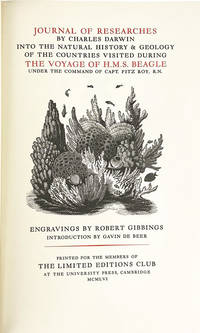
1956ref. 022366Cambridge: Limited Editions Club 1956. Hardcover. Fine in lightly worn glassine and an intact near Very Good slipcase. Robert Gibbings. Tall quarto 7-1/2" x 12" bound in full sailcloth stamped in brown with a native tapa design; 490 pages. Introduction by Sir Gavin de Beer. Illustrated with text wood engravings by Robert Gibbings. Copy #751 of 1500 SIGNED by the artist on the colophon page. Monthly Letter laid in. Limited Editions Club hardcover books
1860ref. 1296Boston: Ticknor and Fields 1860. First edition. 1860 THE ATLANTIC MONTHLY JULY-DECEMBER 1860--CONTAINS 3 REVIEWS OF DARWIN'S ORIGIN OF SPECIES AND AN EDITORIAL PROMOTING LINCOLN'S CANDIDACY FOR PRESIDENT BOTH MEN WERE BORN FEBRUARY 12 1809. 9 1/2 inches tall hardcover 3/4 black leather binding spine with raised bands gilt ruled compartments and gilt title and initials of previous owner Fr. A. Bryan. Edges marbled marbled endpapers with armorial bookplate of Fr. A. Bryan to front paste-down iv 764 pp; joints starting binding tight light foxing to endpapers pages crisp and unmarked very good. Darwin first wrote to Asa Gray in 1855. A correspondence and intellectual comradeship quickly developed to the point where in July 1857 Darwin informed Gray of his as yet unpublished theory of natural selection thereby making Gray the third person after Joseph Hooker and Charles Lyell to know his secret. Part of this letter to Gray was later included in the presentation to the Linnean Society in July 1858 when Darwin first made his theory and Wallace's public. After the publication of The Origin of Species Gray became Darwin's foremost American defender against his Harvard colleague Louis Agassiz and other critics. Gray arranged for the publication of an American edition of the Origin of Species and wrote a positive review for the American Journal of Science. Then in the three issues-July pp 109-116 August pp 229-239 October pp 406-425 1860--of The Atlantic Monthly contained in this volume he wrote again anonymously in defense of Darwin the first two parts "Darwin on the Origin of Species" the third "Darwin and His Reviewers". Darwin was extremely pleased with Gray's Atlantic Monthly piece and eventually funded its publication-retitled and under Gray's name-by Ticknor and Fields the publisher of The Atlantic Monthly and had 250 copies sent to him for distribution by Trubner and Co. Because James Fields was a close friend of Louis Agassiz the pamphlet was never sold by Ticknor and Fields in the United States. "Thus although actually printed in America the pamphlet was in effect a British publication and received the impetus of Darwin's promotional efforts there" Dupree Asa Gray p. 299. Notably also contained in this volume is a report in the October issue pp 492-502 titled The Election in November: ""We believe that this election is a turning-point in our history . . . It is in a moral aversion to slavery as a great wrong that the chief strength of the Republican party lies. . . . We are persuaded that the election of Mr. Lincoln will do more than anything else to appease the excitement of the country. He has proved both his ability and his integrity; he has head experience enough in public affairs to make him a statesman and not enough to make him a politician. The encroachments of Slavery upon our national policy have been like those of a glacier in a Swiss valley. Inch by inch the huge dragon with his glittering scales and crests of ice coils itself onward an anachronism of summer the relic of a bygone world where such monsters swarmed. But it has its limit the kindlier forces of Nature work against it and the silent arrows of the sun are still as of old fatal to the frosty Python. Geology tells us that such enormous devastators once covered the face of the earth but the benignant sunlight of heaven touched them and they faded silently leaving no trace but here and there the scratches of their talons and the gnawed boulders scattered where they made their lair. We have entire faith in the benignant influence of Truth the sunlight of the moral world and believe that slavery like other worn-out systems will melt gradually before it. 'All the earth cries out upon Truth and the heaven blesseth it; ill works shake and tremble at it and with it is no unrighteous thing.'" Psalm 66 Isaiah 13 Hebrews 6. Abraham Lincoln and Charles Darwin were born on the same day February 12 1809. Both lost their mother at a young age and despite their differences in upbringing both men saw themselves as autodidacts. In his book Lincoln and Darwin 2010 James Lander argues that they also shared an interest in science and a skeptical approach to religion. Darwin closely followed the events of the American Civil War and wanted Lincoln and the Union to prevail. Lander explores similarities in the intellectual development concerns and impacts of Abraham Lincoln and Charles Darwin focusing in particular on the issue of slavery in the United States which both men influentially opposed. Lander's broader argument is that Lincoln and Darwin shared the same outlook on the central issues of race science and religion. He also looks at the relationship between science and race in the 19th century United States and the emergence and influence of scientific racism. Of particular interest in this volume of The Atlantic the article on the coming presidential election refers to geologic time and extinction of the dinosaurs as a metaphor for the hoped-for extinction of slavery. Also in this volume a review of Home Ballads and Poems by John Greenleaf Whittier concluding "We have had no more purely American poet thn Mr. Whittier none in whom the popular thought found such ready and vigorous expression." THE ATLANTIC was founded in 1857 in Boston as The Atlantic Monthly a literary and cultural magazine that published leading writers' commentary on education the abolition of slavery and other major political issues of that time. In 1860 three years into publication The Atlantic's then-editor James Russell Lowell endorsed Republican Abraham Lincoln for his first run for president and also endorsed the abolition of slavery. Ticknor and Fields hardcover books
1892ref. 549489London: John Murray 1892. Hardcover. Very Good. Stated eleventh thousand. Octavo. 394pp. Illustrated with photogravure plates from photographs by Oscar Rejlander. Light edgewear tiny rubbed spot on the lower shoulder and small light stain on lower board both hinges neatly strengthened very good or better. A bright copy. John Murray hardcover books
1860ref. 32971New York: D. Appleton and Company 1860. 1st Edition Clamshell Collector's Case. 1st Edition Clamshell Collector's Case. Custom Clamshell Case. No Binding. First Edition Clamshell Case for Darwin's scientific breakthrough discoveries: ON THE ORIGIN OF SPECIES. Superb Custom Fitted Modern Collector's Clamshell Bookcase Not A Book HAND-CRAFTED by our conservation team each box is Gilt-stamped at the spine. The case is finished in black Nuba® with a 'sculpted' DNA design and gold sides. Every TBCL case can be finished in a selection of fine leathers & cloths or Nuba® or a combination of both. Nuba® is a fine supple & durable covering with a neutral ph that has the feel of velvety soft Italian Nubuck leather. This clamshell is perfectly sized to accommodate your first edition. A Terrific Collector's Custom Case for an important Book. TBCL Web Site photo/link available for OVER 100 generally in-stock titles. Custom Craft available upon request. "Book definitely NOT included" When you place your order: Please confirm the actual size of your first edition as sizes may vary with age. The text can be altered to add "signed" or other special requests.Sized to fit: 8" x 5.4" x 1.5". D. Appleton and Company unknown
1871ref. 11131D. Appleton and Company 549 & 551 Broadway New York 1871. First American Edition 1871. Volume II only. Very Good Bound in the publisher's original brown cloth featuring a distinct black stamped circular/geometric design in the corners. Spine features bright un-faded gilt lettering and rules. 436 numbered pages beginning with 387 pages ending in concluding remarks followed by 388–436 comprehensive index. Rear advertisements feature a detailed catalog of scientific works including Herbert Spencer First Principles Social Statics Principles of Biology Sir John Lubbock Origin of Civilisation and Huxley. Binding is tight square and structurally sound. Hinges are firm with no split webbing. The bright gilt on the spine remains highly legible and attractive. Text block is clean and free of foxing or writing. The exterior brown cloth shows minor uniform surface rubbing to the faces of the boards and typical light shelfwear to the spine ends but otherwise presents as a remarkably clean crisp copy of this foundational scientific work. An excellent orphan volume for a collector looking to complete a set or secure a premium early American printing. D. Appleton and Company hardcover
1998ref. 1143330The Easton Press 1998. Hard cover. Near fine/No jacket. Collectors edition. Leather bound with gilded edges. Includes Vol 1 & 2 only. Both Vols: Book is in excellent condition with no visible flaws apart from some light handling wear. Binding is tight and inside is clean and unmarked. The Easton Press unknown
1888ref. 67784John Murray 1888. Hardcover. Used very good. Dark green cover second 1888 edition revised fourth thousand John Murray 300pp plus list of books currently available from the publisher. Very slight fraying at top and bottom of spine two minor dings on spine cloth barely worn through on the very tips of two outer corners; interior hinges just starting. moderate foxing on first couple and last couple of pages; about five pages in text where marks in margins have been erased but are still just barely detectable upon very close inspection. Nice condition. We are a small family business selling fine new and pre-owned books online since 1999. We provide professional service and individual attention to your order daily shipments and sturdy packaging. FREE TRACKING ON ALL SHIPMENTS WITHIN USA. John Murray, hardcover
1860ref. 1296Boston: Ticknor and Fields 1860. First edition. 1860 THE ATLANTIC MONTHLY JULY-DECEMBER 1860--CONTAINS 3 REVIEWS OF DARWIN'S ORIGIN OF SPECIES AND AN EDITORIAL PROMOTING LINCOLN'S CANDIDACY FOR PRESIDENT BOTH MEN WERE BORN FEBRUARY 12 1809. 9 1/2 inches tall hardcover 3/4 black leather binding spine with raised bands gilt ruled compartments and gilt title and initials of previous owner Fr. A. Bryan. Edges marbled marbled endpapers with armorial bookplate of Fr. A. Bryan to front paste-down iv 764 pp; joints starting binding tight light foxing to endpapers pages crisp and unmarked very good. Darwin first wrote to Asa Gray in 1855. A correspondence and intellectual comradeship quickly developed to the point where in July 1857 Darwin informed Gray of his as yet unpublished theory of natural selection thereby making Gray the third person after Joseph Hooker and Charles Lyell to know his secret. Part of this letter to Gray was later included in the presentation to the Linnean Society in July 1858 when Darwin first made his theory and Wallace's public. After the publication of The Origin of Species Gray became Darwin's foremost American defender against his Harvard colleague Louis Agassiz and other critics. Gray arranged for the publication of an American edition of the Origin of Species and wrote a positive review for the American Journal of Science. Then in the three issues-July pp 109-116 August pp 229-239 October pp 406-425 1860--of The Atlantic Monthly contained in this volume he wrote again anonymously in defense of Darwin the first two parts "Darwin on the Origin of Species" the third "Darwin and His Reviewers". Darwin was extremely pleased with Gray's Atlantic Monthly piece and eventually funded its publication-retitled and under Gray's name-by Ticknor and Fields the publisher of The Atlantic Monthly and had 250 copies sent to him for distribution by Trubner and Co. Because James Fields was a close friend of Louis Agassiz the pamphlet was never sold by Ticknor and Fields in the United States. "Thus although actually printed in America the pamphlet was in effect a British publication and received the impetus of Darwin's promotional efforts there" Dupree Asa Gray p. 299. Notably also contained in this volume is a report in the October issue pp 492-502 titled The Election in November: ""We believe that this election is a turning-point in our history . . . It is in a moral aversion to slavery as a great wrong that the chief strength of the Republican party lies. . . . We are persuaded that the election of Mr. Lincoln will do more than anything else to appease the excitement of the country. He has proved both his ability and his integrity; he has head experience enough in public affairs to make him a statesman and not enough to make him a politician. The encroachments of Slavery upon our national policy have been like those of a glacier in a Swiss valley. Inch by inch the huge dragon with his glittering scales and crests of ice coils itself onward an anachronism of summer the relic of a bygone world where such monsters swarmed. But it has its limit the kindlier forces of Nature work against it and the silent arrows of the sun are still as of old fatal to the frosty Python. Geology tells us that such enormous devastators once covered the face of the earth but the benignant sunlight of heaven touched them and they faded silently leaving no trace but here and there the scratches of their talons and the gnawed boulders scattered where they made their lair. We have entire faith in the benignant influence of Truth the sunlight of the moral world and believe that slavery like other worn-out systems will melt gradually before it. 'All the earth cries out upon Truth and the heaven blesseth it; ill works shake and tremble at it and with it is no unrighteous thing.'" Psalm 66 Isaiah 13 Hebrews 6. Abraham Lincoln and Charles Darwin were born on the same day February 12 1809. Both lost their mother at a young age and despite their differences in upbringing both men saw themselves as autodidacts. In his book Lincoln and Darwin 2010 James Lander argues that they also shared an interest in science and a skeptical approach to religion. Darwin closely followed the events of the American Civil War and wanted Lincoln and the Union to prevail. Lander explores similarities in the intellectual development concerns and impacts of Abraham Lincoln and Charles Darwin focusing in particular on the issue of slavery in the United States which both men influentially opposed. Lander's broader argument is that Lincoln and Darwin shared the same outlook on the central issues of race science and religion. He also looks at the relationship between science and race in the 19th century United States and the emergence and influence of scientific racism. Of particular interest in this volume of The Atlantic the article on the coming presidential election refers to geologic time and extinction of the dinosaurs as a metaphor for the hoped-for extinction of slavery. Also in this volume a review of Home Ballads and Poems by John Greenleaf Whittier concluding "We have had no more purely American poet thn Mr. Whittier none in whom the popular thought found such ready and vigorous expression." THE ATLANTIC was founded in 1857 in Boston as The Atlantic Monthly a literary and cultural magazine that published leading writers' commentary on education the abolition of slavery and other major political issues of that time. In 1860 three years into publication The Atlantic's then-editor James Russell Lowell endorsed Republican Abraham Lincoln for his first run for president and also endorsed the abolition of slavery. Ticknor and Fields hardcover
1875ref. 68936New York:: D. Appleton and Company 1875. First American edition. publisher's rust cloth stamped in gold and black. Small ownership stamp and signature; very light use to extremities; tight and sound. . 8vo. Engraved text illustrations. Freeman 1220. D. Appleton and Company, hardcover
1899ref. 1045316th Edition 2vols. bound in one.: D. Appleton & Company. Very Good. 1899. Hardcover. Hardcover bound in publisher's red brick buckram gilt titles to spine; black stamped decor to cover. Corrected sixth edition; two volumes in one. Very good in and out. 8vo. 702pp. ; 8vo 8" - 9" tall . D. Appleton & Company hardcover
1952ref. 110694Hafner 1952-01-01. Hardcover. Very Good. Leather bound limited edition 29/250 especially prepared for the Book Collection Society bound in full top-grain cowhide gilt titles and top edge sewn in marker. Tight and unmarked. Small moisture stain to bottom edge that does not intrude into the pages. Illustrated. Facsimile reprint of the first edition of 1839. A46 Please email for photos. Hafner hardcover
1888ref. 38451London: John Murray 1888. Second edition revised and augmented. Leather. Good. Second edition revised and augmented 1888 22nd thousand. 2 volume set complete. A Good set. 12mo. Vol. 1 xvii i 507; Vol. 2 viii i 528 pp. Uniformly bound in half leather and marbled paper boards. Titles on spine in gilt. Top edge gilt. "English Bubble" marbled paper end papers. Spines are dry and beginning to crack else a Very Good copy. John Murray unknown
1872ref. 55430New York: D. Appleton and Company 1872. Early American Edition. Hardcover. Good condition. Octavo. vi 409 2 v 3 436 12pp. Original brown cloth with black decorative border on covers gilt lettering and ruling on spines. Yellow endpapers. With printed postscript in volume two correcting error relating to the sexual differences of animals on pp. 287-289 of the first volume. With two pages of advertisements for Herbert Spencer publications in volume one extensive index plus twelve pages of advertisements for Appleton publications at rear of volume two including title by Spencer Darwin and others. Binding with some light wear along edges and lightly rubbed. Spines sunned. Light smudging of front free endpaer of volume one. Inscriptions of R. D. Maxwell inked to free endpaper of both volumes. Block lightly age-toned. D. Appleton and Company hardcover
1906ref. 655856John Murray 1906. Second Edition. Hardcover. Very Good. A very good copy in a prize binding from Britain's celebrated Rugby School. Bound in full brown polished calf by Lawrence Binder of Rugby spine with raised bands red morocco label and gilt floral tooling covers bordered with twin gilt fillets and rosettes at corners upper cover with gilt arms of Rugby School at center marbled edges and endpapers expertly rebacked in matching calf with original spine laid down some prior rubbing to spine and boards; mended tear to blank at front; Rugby School bookplate. Second Edition later printing. John Murray hardcover