7 675 résultats
réf. elala2638London: John Murray 1872. Sixth Edition Twelfth Thousand. Generally regarded as the last edition the sixth was extensively revised and included a new chapter VII inserted to refute the views of the Roman Catholic biologist St. George Mivart and a glossary compiled by W.S.Dallas. The title was changed to The Origin of Species and the word evolution in this text for the first time. Prepared under the advice of Lyell and Hooker this was Darwins greatest work and one of the most important books ever published The evidence for the existence of evolution and that it resulted from the survival of the fittest by natural selection is marshaled and set out as never before. Garrison considered this the most wonderful piece of synthesis in the history of science. Darwins influence on biology was fundamental its full implications being by no means yet exhausted. Garrison & Morton Freeman 392. cfGarrison & Morton 220. cfGrolier/Horblit 23b. cfPrinting and the Mind of Man 344b. 8vo. pp. xxi 458. folding diagram. original cloth spine ends frayed inner hinges partly cracked London: John Murray, 1872 hardcover
1884réf. 53520Budapest, Kiadja A. K. M., 1884. 8vo. In the publisher's original two embossed full red cloth bindings with gilt lettering to spine. Small vague stamp to both half-titles. Hindges loose on volume i. A fine fine and clean copy. LXXI, (1), 542 pp."" VII, 5, 436 pp.
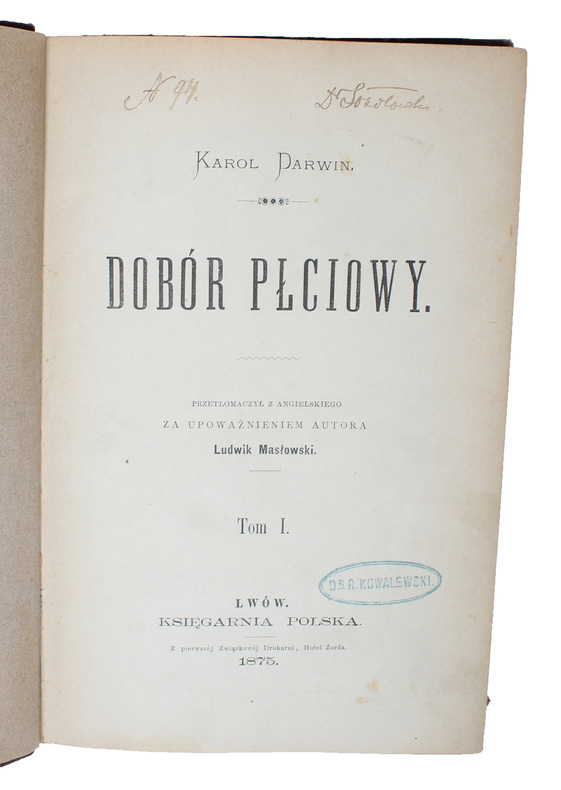
1875réf. 55758Lwów, Ksiegarnia Polska, 1875-1876. 8vo. In contemporary half cloth with gilt lettering to spine. Previous owner's stamp and another owner's sginature to title-page. Light wear to extremities, otherwise a fine and clean set. 262, (2)"" 313, (3) pp.
1884réf. 53520Budapest Kiadja A. K. M. 1884. 8vo. In the publisher's original two embossed full red cloth bindings with gilt lettering to spine. Small vague stamp to both half-titles. Hindges loose on volume i. A fine fine and clean copy. LXXI 1 542 pp.; VII 5 436 pp. The exceedingly rare first Hungarian translation of Darwin's The Descent of Man. "Compared with the original and with a biography by Margó Tivador" Freeman. The Hungarian public was introduced to Darwinism early on when Ferenc Jánosi reviewed The Origin of Species in the Budapesti Szemle Budapest Review a half year after it first appeared in English. Darwin's principal works were first published in Hungarian translation by the Royal Hungarian Natural Science Society Királyi Magyar Természettudományi Társulat. The Origin of Species translated by László Dapsy was published in 1873; The present work in 1884 and a few years later in 1897 the latter work was translated anew and published by László Seress. "It is characteristic of the enlightened spirit of the country in this period that Darwin received academic recognition earlier in Hungary than in England. Although Cambridge did not honor Darwin until 1879 he was elected an honorary member of The Hungarian Academy of Sciences in 1872 the same year on this occasion the renowned Hungarian zoologist Tivadar Margó visited him at Down.Historical circumstances played a major role in this quick appearance of Darwinism and its popularity in Hungary. The failure of the 1848-49 revolution and war of independence seemingly put an end to progressive political discourse signaling an ideological crisis among the intelligentsia. In this context the natural sciences with their 'eternal truths' promised a way out inasmuch as science's promised objectivity might well serve as a politically neutral expression of progressive values" Mund The Reception of Charles Darwin in Nineteenth-Century Hungarian Society."Darwin wrote in the preface to the second edition of 'the fiery ordeal through which this book has passed'. He had avoided the logical outcome of the general theory of evolution bringing man into the scheme for twelve years and in fact it had by that time been so much accepted that the clamour of the opposition was not strident. He had also been preceded in 1863 by Huxley's Man's place in nature. The book in its first edition contains two parts the descent of man itself and selection in relation to sex. The word 'evolution' occurs for the first time in any of Darwin's works on page 2 of the first volume of the first edition that is to say before its appearance in the sixth edition of The origin of species in the following year." Freeman.Freeman no. 1084. hardcover
1875réf. 55758Lwów Ksiegarnia Polska 1875-1876. 8vo. In contemporary half cloth with gilt lettering to spine. Previous owner's stamp and another owner's sginature to title-page. Light wear to extremities otherwise a fine and clean set. 262 2; 313 3 pp. Rare first Polish edition of the second and third parts of the Descent of Man but published separate from the first part as one work hence the title 'Sexual Selection' a translation authorised by Darwin in response to Malowski's request to make the translation Letter 8910 14 May 1873. Whereas "Origin of Species" established Darwinism as a turning point in nineteenth-century biology "The Descent of Man" helped built a bridge between biology the social sciences and the humanities and made Darwinism a broad system of research designs theoretical principles and philosophical outlook.The numeration of parts is from Chapter I to Chapter VI vol. I and from Chapter VII to Chapter XIV vol. II. It is generally based on the first English edition 1871 but at the end of vol. II the Polish publisher has added the short note on the brains of man and apes of T. H. Huxley which was originally published in the second English edition 1874. "It was translated into Danish Dutch French German Italian Polish Russian and Swedish in Darwin's lifetime and into ten further languages since." Freeman.Maslowski 1847-1928 studied medicine and natural sciences in Paris before returning to Poland where he took part in the January Uprising: he remained active in politics primarily as a journalist. At first an ardent Darwinian he later became a fierce opponent.Not in FreemanDarwin Online: F1101b.1 F1101b.2.OCLC locates four copies worldwide Cornell Univ. Huntington Libr. Yale Univ. Libr. National Library of Poland hardcover
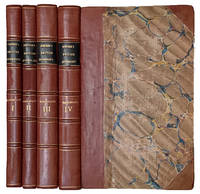
1828réf. S13985London:: Printed for the Author; published by Baldwin and Cradock 1828-31. 1828. Four volumes. 8vo. 9.5 inches tall. Vol. I: 2 iv 186 2 pp. 9 plates. Vol. II: ii 200 pp. 6 plates. Vol. III: ii 374 6 pp. 4 plates. Vol. IV: ii 413 1 pp. 4 plates. Original marbled boards with modern half-calf raised bands gilt-stamped spines black leather spine labels marbled endsheets. Small ownership labels of the Lowther Collection. Nice set. CONTAINING THE FIRST PUBLICATIONS OF CHARLES DARWIN. The full edition was issued in 12 volumes. "While at the University of Cambridge the student Charles Darwin became an enthusiastic insect collector. He sent Stephens records of the rarer insects he had captured and was delighted when Illustrations of British entomology gave him credit for capturing insects described in 33 entries quoting his words in all but two of the cases. Darwin recalled in his autobiography "No poet ever felt more delight at seeing his first poem published than I did at seeing in Stephen's Illustrations of British Insects the magic words 'captured by C. Darwin Esq.'" though the closest wording as published actually appeared slightly differently as "captured by the Rev. F. W. Hope and C. Darwin Esq. in North Wales" and "Taken in North Wales by C. Darwin Esq." – Wikip. / The exquisite plates are colored by hand after drawings by Charles M. Curtis 1795-1839 and John Obadiah Westwood 1905-1893 who was among the first entomologists with an academic position at Oxford University. Although he worked on insect classification and diversity for more than sixty years from the publication of Darwin's Origin of Species he never accepted the ideas on evolution. / James Francis Stephens was an English entomologist and naturalist. He was elected fellow of the Linnean Society on 17 February 1815 and of the Zoological Society of London in 1826. From 1815 to 1825 he took a great interest in ornithology and contributed to the work of George Shaw 1751-1813. He was granted leave from office to assist William Elford Leach in 1818 to arrange the insect collection at the British Museum and eventually described as many as 2800 British insect species. In 1833 he was founder of what became the Royal Entomological Society of London. Stephens made a large insect collection that included many specimens. After his death the insect collection was purchased by the British Museum. PROVENANCE: Bruce Lowther 1926-1999 Collection c/o J.T. Barnes 503 Royal Trust Building Victoria B.C. Lowther was a journalist broadcaster author and historian with a particular interest in British Columbia labor history. From 1954-76 he worked as a reporter and columnist for the Victoria Daily Colonist. His collection of books was donated to the Saanich Archives Saanich British Columbia. Printed for the Author; published by Baldwin and Cradock, 1828-31. hardcover
1828réf. S13985London:: Printed for the Author; published by Baldwin and Cradock 1828-31. 1828. Four volumes. 8vo. 9.5 inches tall. Vol. I: 2 iv 186 2 pp. 9 plates. Vol. II: ii 200 pp. 6 plates. Vol. III: ii 374 6 pp. 4 plates. Vol. IV: ii 413 1 pp. 4 plates. Original marbled boards with modern half-calf raised bands gilt-stamped spines black leather spine labels marbled endsheets. Small ownership labels of the Lowther Collection. Nice set. CONTAINING THE FIRST PUBLICATIONS OF CHARLES DARWIN. The full edition was issued in 12 volumes. "While at the University of Cambridge the student Charles Darwin became an enthusiastic insect collector. He sent Stephens records of the rarer insects he had captured and was delighted when Illustrations of British entomology gave him credit for capturing insects described in 33 entries quoting his words in all but two of the cases. Darwin recalled in his autobiography "No poet ever felt more delight at seeing his first poem published than I did at seeing in Stephen's Illustrations of British Insects the magic words 'captured by C. Darwin Esq.'" though the closest wording as published actually appeared slightly differently as "captured by the Rev. F. W. Hope and C. Darwin Esq. in North Wales" and "Taken in North Wales by C. Darwin Esq." – Wikip. / The exquisite plates are colored by hand after drawings by Charles M. Curtis 1795-1839 and John Obadiah Westwood 1905-1893 who was among the first entomologists with an academic position at Oxford University. Although he worked on insect classification and diversity for more than sixty years from the publication of Darwin's Origin of Species he never accepted the ideas on evolution. / James Francis Stephens was an English entomologist and naturalist. He was elected fellow of the Linnean Society on 17 February 1815 and of the Zoological Society of London in 1826. From 1815 to 1825 he took a great interest in ornithology and contributed to the work of George Shaw 1751-1813. He was granted leave from office to assist William Elford Leach in 1818 to arrange the insect collection at the British Museum and eventually described as many as 2800 British insect species. In 1833 he was founder of what became the Royal Entomological Society of London. Stephens made a large insect collection that included many specimens. After his death the insect collection was purchased by the British Museum. PROVENANCE: Bruce Lowther 1926-1999 Collection c/o J.T. Barnes 503 Royal Trust Building Victoria B.C. Lowther was a journalist broadcaster author and historian with a particular interest in British Columbia labor history. From 1954-76 he worked as a reporter and columnist for the Victoria Daily Colonist. His collection of books was donated to the Saanich Archives Saanich British Columbia. Printed for the Author; published by Baldwin and Cradock, 1828-31. hardcover books
1868réf. 013502London: John Murray 1868. Complete in 2 volumes. First edition first issue. Collation viii 411pp 32pp ads dated April 1867 viii 486pp 2pp ads February 1868 with 1-line publisher's imprint on cloth at base of spines 5 lines of errata in vol. I and 7 in vol. II and 43 in-text wood engravings. Bound in original publishers green cloth blind stamped tooling gilt lettering. At some time both volumes has been repaired. Cloth lightly rubbed some minor abrasion wear minor light rippling lightly bumped. Both bindings in good clean firm condition. Internally some light dust marking. Pages in good clean condition. Generally a very nice set. F. First Edition. Cloth. Near Very Good. 8vo. John Murray Hardcover
1869réf. 2002020London: John Murray 1869. 5th. very good. Fifth edition tenth thousand as stated on title page and copyright page. Book very good repair at front and rear gutters. Page 29/30 missing. Comes with custom-made slipcase. John Murray unknown
1869réf. 2002020London: John Murray 1869. 5th. very good. Fifth edition tenth thousand as stated on title page and copyright page. Book very good repair at front and rear gutters. Page 29/30 missing. Comes with custom-made slipcase. John Murray unknown books
1864réf. 000780New York: Appleton 1864 "A new edition revised and augmented by the author" on title page three quotes on page facing title page. Internally a fresh clean copy with two small fox spots on each of the first few leaves and gone by page ix mostly unread. Respined with new spine covering retaining the original title. i -xi 4-440 2 pp ads. Appleton hardcover
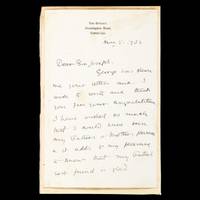
réf. 419752 pp. manuscript in ink written on the first two sides of an octavo-size bifolium of notepaper 180 x 115 mm with Horace Darwin's letterhead 'The Orchard Huntingdon Road Cambridge'; dated 5 May 1903 the letter is addressed 'Dear Sir Joseph' i.e. Sir Joseph Dalton Hooker and is signed in full at the foot of the second side 'Horace Darwin'; the writer thanks Hooker for his congratulations by inference on his becoming a Fellow of the Royal Society although this event is not referred to explicitly; mounted on a section cut from an album page; some toning from the old glue on the verso else clean and legible. An unpublished and hitherto unrecorded piece of private correspondence between Cambridge scientist Horace Darwin 1851-1928 - the son of Charles Darwin - and the eminent botanist Sir Joseph Dalton Hooker 1817-1911 - Charles Darwin's closest friend. Horace thanks Hooker for congratulating him on becoming a Fellow of the Royal Society an achievement which elicits fond memories of his father: for although he had passed away more than twenty years earlier we sense that Horace's emotional and deeply sincere words sum up accurately and concisely how much Charles Darwin meant to both men - as a proud and loving father as a loyal friend and as a brilliant intellect. 'Dear Sir Joseph George Horace's older brother has shown me your letter and I wish to write and thank you for your congratulations. I have wished so much that I could have seen my Father & Mother's pleasure & it adds to my pleasure to know that my Father's best friend is glad. My wife and I are sorry that you are so far from well but we hope you may be able to get to George's later & that we may see you then. Ever sincerely Horace Darwin'. Horace's obvious attachment to and respect for his father is to a large extent explained in this extract from The Darwin Correspondence Project: Darwin and Fatherhood University of Cambridge: 'The close relationships that developed with many of his adult children were highly prized by Darwin. So how exceptional was Darwin as a father In most respects the concerns and beliefs that Darwin expressed about fatherhood were ones that were very typical of men from similar backgrounds in the mid-Victorian period. He frequently discussed his own and other people’s children in letters to friends and relatives. He sought to ensure that his children would be successful when measured according to conventional norms of professional middle-class behaviour. The importance that Darwin attached to his paternal responsibilities and the enjoyment that he gained from his relationships with each of his sons and daughters were typical. However the characteristic that made Darwin unusual when compared to his neighbours and friends was the nature of his work. As a gentleman scientist who worked from home and was frequently not well enough to go to public events his life was centred on his home and family to an exceptional extent. His wife children and servants thus contributed to his research and writing and the practical and intellectual consequences of his scientific work were central to the relationships that he formed with his children.' Provenance: Autograph album compiled by Jane Emma Murphy Balcombe 1854–1924 ""The Briars"" Mornington Victoria Australia; à Beckett family Melbourne by descent. Â unknown
1922réf. 68590London: Mills & Boon 1922. First edition of this collection of Darwin's golf columns from The London Times. Octavo original cloth. Presentation copy inscribed by Bernard Darwin on the front free endpaper "To G.M. from the author with his best regards. Sept. 1922." It was customary for Darwin to sign "from the author" which denoted a personal affiliation with the recipient. Rare and desirable signed and inscribed. It has been said that Darwin's writings established the standards for golf reporting against which all others are measured" D&J. Murdoch 178; D&M 13880; D&J D4000. Mills & Boon hardcover
1862réf. feb026371862. First German Edition of Fertilisation of Orchids by Charles Darwin. Über die Einrichtungen zur Befruchtung Britischer und ausländischer Orhideen durch Insekten Used book For more details and availability please contact me E. Sclnveizerbart'sche Verlagshandlung hardcover
1886réf. feb026561886. First German Edition of Observations on the Parallel Roads of Glen Roy and of other parts of Lochaber in Scotland. Über den geringen Betrag der alluvialen Thätigkeit seit der Bildung der Simse im Roy-Thal Found on pp. 251-261 Used book For more details and availability please contact me E. Günther hardcover
1871réf. feb027131871. First Russian Edition of The descent of man and selection in relation to sex in 2 Volumes by Charles Darwin. ПроиÑхождение человека Used book For more details and availability please contact me St. Petersburg hardcover
1875réf. feb027091875. First Polish Edition of The descent of man and selection in relation to sex in 2 Volumes by Charles Darwin. Dobór płciowy Used book For more details and availability please contact me Lwów hardcover
1873réf. feb026891873. First Dutch Edition of The Expression of the Emotions in Man and Animals y Charles Darwin. Het uitdrukken der gemoedsaandoeningen bij den mensch en de dieren Used book For more details and availability please contact me Joh. Ykema hardcover
1873réf. feb01481873. First Polish Edition of The Expression of the Emotions in Man and Animals by Charles Darwin. Wyraz uczuć u człowieka i zwierząt Used book For more details and availability please contact me Józefa Sikorskiego hardcover
1884réf. feb01241884: Polish Edition of On the Origin of Species by Means of Natural Selection or the Preservation of Favoured Races in the Struggle for Life O powstawaniu gatunków drogą doboru naturalnego czyli o utrzymywaniu się doskonalszych ras w walce o byt Ikon Teralitera hardcover
1912réf. feb027381912. First Japanese Edition of The Voyage of the Beagle and selection in relation to sex by Charles Darwin. ビーグルå·èˆªæµ·è¨˜ åŒæ–‡é¤¨ Used book For more details and availability please contact me Dobun-kan hardcover
1870réf. feb027291870. First Danish Edition of The Voyage of the Beagle and selection in relation to sex by Charles Darwin. Rejseiagttagelser Used book For more details and availability please contact me Copenhagen hardcover
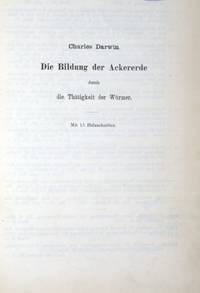
1882réf. feb026861882. First German Edition of Vegetable Mould and Worms by Charles Darwin. Die Bildung der Ackererde durch die Thätigkeit der Würmer Used book For more details and availability please contact me E. Schweizerbartsche Verlagshandlung hardcover
1839réf. 008349London: Henry Colburn 1839. Book. Good. Full-Leather. First Edition. 8vo - over 7¾ - 9¾" tall. The first two volumes of the four volume set. Volume I - Proceedings of the First Expedition. 1826-1830 under command of Captain P. Parker King. xxviii 2 l. 597pp; Vol. II. - Proceedings of the Second Expedition 1831-1836 under the command of Captain Robert Fitzroy. xiv 1 l. 694p addenda 41 plates including 2 frontispieces lacking the four loose folding maps 2 maps in each volume and the "Chart of a part of South America" in volume I. Volume II is lacking the title page but has the half-title page. Browning mostly front portions of both books and plates some old marginal damp stains both books in full tree calf bindings recased with new marbled endpapers using original spine strips lower half of Vol. II spine strip sympathetically replaced. Gilt monogram of General Assembly library on both volumes. Please enquire if you are interested in purchasing volumes separately. Henry Colburn Hardcover
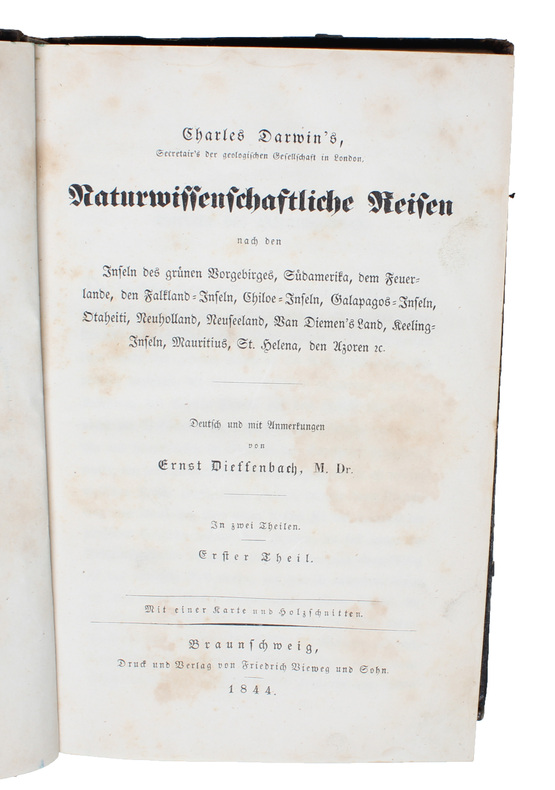
1844réf. 54590Brunswick, F. Vieweg und Sohn, 1844. 8vo. 2 volumes bound in one contemporary half calf binding with gilt lettering to spine. Previous owner's stamp to front free end-paper. Light brownspotting throughout, especially to first and last leaves. XVI, 319, VIII, 301, (3) pp. + 1 folded map.