7 655 résultats
1935réf. 33269Garden City: Doubleday Doran 1935. Hardcover. Fine/Fine. First edition. Fine in a lovely fresh and fine dustwrapper with a few tiny tears. Witty picaresque comic novel of a husband in pursuit of his wayward wife in France where they become enmeshed in a traveling circus. A beautiful copy. Doubleday Doran hardcover books
1976réf. 107758Norwalk:: Easton Press. Near Fine. 1976. Hardcover. Preface by Charles G. Darwin. Wood engravings by Paul Landacre. Collector's edition "The 100 Greatest Books Ever Written". Quarto fully bound in black leather with gilt lettering and design raised bands along the spine all edges gilt silk moire endpapers sewn-in ribbon bookmark. About fine.; 470 pages . Easton Press, hardcover books
1956réf. 258366NJ: Prentice-Hall 1956. Hardcover. Very Good. Later. Very good plus Clean text and end pages minor soil on text edges cloth covers are slightly soiled corners are worn. Later printing. Prentice-Hall hardcover books
1969réf. 267711New York: Frommer / Pasmantier Publishing 1969. Softcover. Very Good. First edition. Octavo. 312pp. Pictorial wrappers. Pages lightly age-toned moderately soiled wrappers else very good. Frommer / Pasmantier Publishing unknown books
1973réf. 194949New York: Arthur Frommer 1973. Softcover. Very Good. 1973-74 edition. Mass market paperback. 191pp. Illustrated. Corner of front cover creased thus very good. Arthur Frommer unknown books
1897réf. 107462NY:: D. Appleton and Company. Very Good. 1897. Hardcover. Volume I only. With additions and corrections from the sixth English edition authorized edition. Fold-out chart. Octavo bound in burgundy clothwith gilt lettering and borders on the spine top edge gilt. Light shelf wear and aging else very good or better. Some unopened pages. Text is clean and binding is sound. ; 365 pages . D. Appleton and Company, hardcover books
1890réf. 97629NY:: D. Appleton and Company. Very Good. 1890s. Hardcover. An incomplete set: 14 of 15 volumes Volume I of The Origin of Species is missing. Animals and Plants Under Domestication two volumes Structure and Distribution of Coral Reefs The Descent of Man and Selection in Relation to Sex Expression of the Emotions in Man and Animals The Different Forms of Flowers on Plants of the Same Species Geological Observations on the Volcanic Islands and Parts of South America Insectivorous Plants The Life and Letters of Charles Darwin two volumes edited by his son Francis Darwin The Power of Movement in Plants The Origin of Species Volume II only The Formation of Vegetable Mould Through the Action of Worms Journal of Researches Into the Natural History and Geology of the Countries Visited During the Voyage of H. M. S. Beagle Round the World. Author's Edition Limited: this set is number 223 of 1000. Octavos half bound in burgundy leather marbled boards raised bands along the spines gilt lettering and design on the spines top edges gilt marbled endpapers illustrations photographs and fold-out maps. Light shelf wear and aging aptly the Insectivorous Plants volume has two small holes at the fore edge of the text block - insect damage one of the volumes has the previous owner's name and address on a front endpage else all volumes are very good. Texts are clean and bindings are sound. . D. Appleton and Company, hardcover books
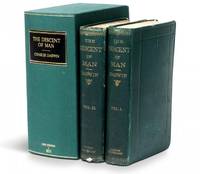
1871réf. 2980London: John Murray 1871. First edition. Original cloth. Very Good. FIRST EDITION FIRST ISSUE one of only 2500 copies in original cloth of Darwin's seminal work on the evolution of man. "This is really two works. The first demolished the theory that the universe was created for Man while in the second Darwin presented a mass of evidence in support of his earlier hypothesis regarding sexual selection. In the Origin Darwin had avoided discussing the place occupied by homo sapiens in the scheme of natural selection stating only that `light will be thrown on the origin of man and his history.' Twelve years later he made good his promise with The Descent of Man in which he compared man's physical and psychological characteristics to similar traits in apes and other animals showing how even man's mind and moral sense could have developed through evolutionary processes. In discussing man's ancestry Darwin did not claim that man was directly descended from apes as we know them today but stated simply that the extent ancestors of homo sapiens would have to be classified among the primates; however this statement as misinterpreted by the popular press caused a furor second only to that raised by the Origin" Norman 599. "The word `evolution' occurs for the first time in any of Darwin's works on page 2 of the first volume of the first edition" Freeman p.129. London: John Murray 1871. Octavo original green cloth; custom box. Two volumes. First issue with second volume with errata on verso of title and Postscript leaf tipped in after Contents. With 16-page publishers' catalog at end of each volume dated January 1871 first issue. Nearly invisible expert repair to upper hinge of volume 1; small blindstamp on front free endpapers; foxing to last few leaves of ads in both volumes as often; small hole likely paper flaw and line of soiling to volume 2 title page. A very good copy in original cloth. John Murray unknown books
1871réf. 18750London: John Murray 1871. FIRST EDITION FIRST ISSUE. Numerous text illustrations. Original publisher's green cloth binding; an excellent set. First edition first issue of Darwin’s classic work in comparative anatomy his first inclusion of man in the general theory of natural selection and the first appearance of the term “evolution” in any of his works see Volume I page 2. In the twelve years since the publication of Origin the author had expanded his thinking as to man's inclusion with the other animals and this title which grew out of his Variations of Animals and Plants is based on his vast collection of data dating from 1837. Here by comparing the physiological and psychological aspects of man and ape he fills in what had been merely suggested in Origin that man's ancestor if still alive today would be classified among the primates and on a lower scale than the apes. The last chapter is an added essay on sexual selection that is the preferential chances of mating that some individuals of one sex have over their rivals. “Perhaps Darwin’s greatest contributions in this area was to show that secondary sexual characteristics had evolved in relation to a complex pattern of reproductive behavior which must itself be the product of natural selection” DSB III p. 575. This essay ends with the famous and often misquoted statement “Man still bears in his bodily frame the indelible stamp of his lowly origin.” Freeman 937; Garrison & Morton 170. John Murray unknown books
1884réf. 15825Torino: Unione Tipografico-Editrice Torinese 1884. FIRST EDITIONS IN ITALIAN. Original printed wrappers. I: First and only Italian edition of Insectivorous plants first published in London in 1875. Darwin’s meticulous study of the adaptation of plants particularly under impoverished conditions. A chance observation of flies caught on a leaf of Drosera rotundifolia led the author to a series of experiments and subsequent conclusion about the significance of carnivorous feeding and how this remarkable adaptation ensures the survival of the plant. Of particular interest to Darwin was his observation that the living plant cells possessed a capacity for irritability and response much like that of the nerve and muscle cells of animals. II: First Italian edition of Different forms of flowers on plants of the same species London 1877. A very technical work devoted to dimorphism of plants with a specific attention to primrose and primulaceous plants. Darwin noticed that in some species flowers differ by the lengths of their anthers and styles like the primroses which show two conditions or loosestrife which shows three. This work was only translated into French and German during Darwin’s lifetime. Unione Tipografico-Editrice Torinese unknown books
1862réf. 16360London: John Murray 1862. FIRST EDITION. Text illustrations. Original plum cloth with an orchid in gilt on front cover. Covers and spine worn spine a bit shabby chipped at foot. Interior is excellent with a modern presentation signature on front flyleaf. First edition of Darwin's primary work on plant fertilization. Detailing the relationship between the sexual structure of orchids and the insects that fertilize them this was the first of three volumes that followed the publication of the Origin which contained supporting evidence for the author's theory of natural selection. Darwin concludes that plants are equal to animals in the marvels of their adaptation; for example he observes that wind-pollinated flowers have no colours; it is only those insect-pollinated varieties that have bright coloured petals and sweet smelling nectars. John Murray unknown books
1860réf. 16363London: John Murray 1860. Third edition 1st printing 10th Thousand. With 14 text woodcuts. Original publisher’s cloth front cover a bit worn; interior very good. Second edition later issue tenth thousand with new preliminaries and a postscript at the end of the preface the final definitive text with extensive revisions from its first appearance of Darwin’s first published work which chronicles his historic five-year voyage on the Beagle to Brazil Argentina Tierra del Fuego Chile Peru the Galapagos Islands New Zealand Australia and other countries and islands along the way. This journey was the most important event in Darwin’s intellectual life. The appearance of this record was a turning point in the history of biological science and marked the beginnings of a whole new conception of the origin of the various species of life on earth. Freeman 20. John Murray unknown books
1878réf. 15656Paris: C. Reinwald 1878. FIRST EDITION IN FRENCH. Woodcut illustrations and tables in text. Original cloth; an excellent copy uncut and unopened. First edition in French of the author’s important work on the adaptation of plants. In these investigations Darwin crosses a “long styled” individual with another long styled flower to produce a comparatively infertile primrose illustrating a degree of sterility within the limits of a single species comparable to that produced in the crossing of distinct species. Darwin’s work on heterostyled plants bears on one of the most difficult points in the statement of the case for evolution the sterility of interspecific crosses and of hybrids. Darwin writes that the time involved in this research gave him more pleasure than almost any other. Freeman 1296. C. Reinwald unknown books
1846réf. 14205London: Smith Elder and Co 1846. I: First edition. Includes a description of six species of corals from the Palaeozoic formation of Van Diemen’s Land by W. Lonsdale. “Darwin’s published work during this period secured his position as one of Britain’s foremost naturalists. His study of the volcanic islands visited during the Beagle voyage was based on a wide range of rock and mineral specimens including his own and considerable research into contemporary theories of volcanic activity mountain formation and the elevation of extensive tracts of land relative to the sea” Correspondence Vol. 3 p. 331. II: First edition. When Darwin sailed on the Beagle he had with him the first volume of Lyell’s Principles of geology which advanced a gradualist theory of geological evolution through elevation subsidence and erosion over an immense period of time contrary to the dominant catastrophist theory of sudden upheaval. Darwin was able to interpret the geology of South America according to Lyell’s principles and his book offered the first adequate geological investigation of the continent. His “demonstration of the origin of metamorphic rocks by deformation and of the distinction between cleavage and sedimentary bedding was a major contribution to geology” DSB. He also worked out an accurate model for fossil formation from which he demonstrated the erratic and incomplete nature of the fossil record. Freeman 272; 273. Smith, Elder and Co unknown books
1868réf. 13360London: John Murray 1868. FIRST EDITION FIRST ISSUE. With several text illustrations. Original publisher's green cloth a few small bumps minor wear to boards; approximately 2 inches of the top of the fly-leaf of both volumes cut out. Generally a very nice set uncut with the presentation bookplate of the University of Southern California Messrs. Milton and Stanley Slotkin in each volume ownership signature on the title to Volume II. First edition first issue of Darwin's great contribution to the descent theory and the foundation on which all later racial-biological research was based. This work expands in detail material that Darwin had intended to include in his Origin. The most novel element in the work is Darwin's hypothesis of pangenesis by which he attempts to explain hereditary resemblance inheritance of acquired characteristics atavism and regeneration. Although proven invalid this theory was nevertheless of prime importance in the history of genetics. "Darwin carried out numerous investigations with pigeons and various plants. He recognized continuous and discontinuous variation; he concluded that crossing tends to keep populations uniform" G&M. John Murray unknown books
1877réf. 14434London and New York: Macmillan and Co. 1877. FIRST EDITION. Half-calf and marbled boards; an excellent copy with the bookplate of Charles Edward Fewster of Hull. First printing of Darwin’s original paper discussing sexual selection in his 1871 work Descent of man stating that the case of the “brightly-coloured hinder ends and adjoining parts of certain monkeys” was the most interesting and perplexing to him. He quotes a work by Johan von Fischer partly published in Der zool. Garten. April 1876 dealing with the expression of monkeys under various emotions “which is well worthy of study by any one interested in the subject.” An interesting article on an interesting subject. Also included in this volume are two reviews of Darwin books as follows: 1 Review of the second edition of Geological observations on the volcanic islands and parts of South America London Smith Elder and Co. 1876 by John W. Judd. pp. 289-290; and 2 Review of The effects of cross- and self-fertilisation in the vegetable kingdom London Murray 1876 by W. T. Thiselton Dyer pp. 329-332. In addition there are two testimonials to Darwin. The first p. 356 is a testimonial on Darwin’s sixty-ninth birthday a mistake in that he was sixty-eight in February 1877 from a group of 154 men of science of Germany presenting to him an album of their photographs. Darwin also received an album with the photographs of 217 distinguished professors and lovers of science from Holland. The second testimonial pp. 410-412 comes from Prof. P. Harting of Utrecht University also on the occasion of Darwin’s birthday who has sent a letter along with the photograph album referred to above from the Directors of the Netherlands Zoological Society and includes Darwin’s reply. The volume includes articles by many of the most important scientists of the day. Freeman 1773; Freeman 1776. Macmillan and Co. unknown books
1832réf. 4893England 1832. Letter written in brown ink on a folded sheet the back leaf containing an address in manuscript with a black wax seal a dragon with a D. The stamp has been cut from the letter without affecting the text. Letter by Francis Darwin announcing the death of his mother. The letter has been addressed to Samuel Tertius Galton in Birmingham the stamp has been cut from the letter without affecting the text. There is a black wax seal a dragon with a D on the verso. The text of the letter reads: My dear Galton /It has pleased God to remove our dearest mother from this world of sin & sorrow. She appeared to be much as usual until 2 o'clock & whilst sitting in her chair by the fire complained of general uneasiness. Sophie & I assisted her to the bed & she expired at 1/4 before 3 oclock in the presence of Dr. Bent & ourselves. She had thought herself so much better lately that Mrs. Hadley & Millicent were both sent home yesterday & the day before. /I hope Violetta will not suffer from this severe shock to us all. You shall hear again in a day or two. /Believe me affectionately yours / Frans S. Darwin. Violetta Darwin was the eldest daughter of Erasmus Darwin from his second marriage to Elizabeth Chandos Pole which took place in 1781. Violetta was married to Samuel Tertius Galton and the mother of Francis Galton. It is therefore likely that the Francis of this letter was one of her four brothers. unknown books
1881réf. 12585London: Longmans Green Reader and Dyer and Williams and Norgate 1881. FIRST PRINTING. With 3 plates and 17 woodcuts in text. Original blue printed wrappers some minor chipping otherwise a very good unopened copy. FIRST PRINTING of this extensive article on the phototropism of plants written by Charles Darwin's son. He expounds upon a topic that his father had discussed on numerous occasions. Francis collaborated with him on the book On the power of movement in plants which was published a year earlier and this article is an extension of the research done with his father. Darwin 1848-1925 was his father's assistant as well as a botanist in his own right. He was the foreign secretary of the Royal Society a lecturer in botany at Cambridge and served as President of the British Association for the Advancement of Science. He edited and in 1887 had published The life and letters of Charles Darwin. Longmans, Green, Reader, and Dyer and Williams and Norgate unknown books
réf. 006341New York: Harper & Brothers 1928. Pictorial boards light wear to corners and spine ends else Near Fine. Sequel to Mr. Tootleoo illustrated with 20 beautifully printed color plates. A wonderful fantasy written for children by noted golf author Bernard Darwin. Scarce. Probable First Amer. Edition. Near Fine/No Jacket. Oblong 4to. Harper & Brothers hardcover books
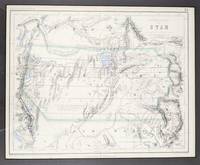
1857réf. 57211London and Edinburgh: John Murray; W. & A. K. Johnston 1857. A well-executed beautifully engraved map. Hand-colored. 16 x 13 inches 25 x 22 inches in mat and frame. Faint vertical center fold line else fine. Wheat 934. Not in Moffat. From the rare Atlas of the United States. 1857 by Rogers and Johnston. This is the only commercial atlas map of its time to show the Utah Territory on a single map and it is in its own right one of the rarest maps of the territory. In addition to county boundaries and information from Fremont's report the map provides a good deal of detail on springs Indians topographical features forts early roads and more. Portions of Nevada Colorado Arizona and New Mexico are included. The first separately printed map of Utah. This map was published at the time of the Utah War 1857-58 and depicts Brigham Young's original view of the large Deseret Territory. Fillmore City is shown as the capitol. The map includes a note from Fremont's report which states "The Great Basin is elevated above the sea between 4000 and 5000 ft. it is surrounded by lofty mountains and is believed to be filled with rivers and lakes which have no communication with the sea deserts and oases which have never been explored and savage tribes which no traveller has seen or described. John Murray; W. & A. K. Johnston unknown books
1861réf. 304713Third edition with additions and corrections seventh thousand. Octavo. Half title page folding diagram at p. 123. 2 pages of advertisements at end. Original green cloth stamped in gilt and blind; brown coated endpapers. Binder's ticket of Edmonds & Remnants on back pastedown. A fresh bright tight copy of a book that is usually found in worn condition. No foxing. Small booksellers label on verso front free endpaper. Neat signatures of two previous owners on the half title page. Freeman 381. "The most important biological book ever written" Freeman p. 73. John Murray hardcover books
1980réf. 68194Stanfordville: Earl M. Coleman 1980. Hardcover. Very good. Hardcover. Very good hardback in a lightly rubbed jacket that is foxed on the spine. Earl M. Coleman hardcover books
2007réf. 1402906Cambridge: Cambridge University Press 2007. Softcover. Octavo three volumes. In Very Good condition. Green and yellow spines with green lettering. Covers and textblocks have mild shelving wear. NOTE: Shelved in Locked Annex Area Multi-Volume Area ND-MV. 1402906. FP New Rockville Stock. Cambridge University Press unknown books
2005réf. 568497New york: Blood Moon Productions 2005. Softcover. Fine. Fist edition. Small quarto. 194 13 pp. Illustrated from black and white photographs. Pictorial wrappers. Fine. Blood Moon Productions unknown books
1860réf. 68677New York: D. Appleton and Company 1860. Full Description: DARWIN Charles. On the Origin of Species by Means of Natural Selection or the preservation of favoured races in the struggle for life. New York: D. Appleton and Company 1860. First American edition third issue. "Revised Edition" on title-page and three quotations to verso of half-title. Octavo 7 11/16 x 4 7/8 inches; 196 x 125 mm. 1-432 pp. With folding chart. Original pebbled brown cloth with covers decoratively stamped in blind. Spine lettered in gilt. Green-coated endpapers. A very slight bit of fraying to top and bottom of the spine. Spine lightly sunned. Previous owner's pencil signature on front free endpaper. And an old ink gift inscription dated 1895 on front flyleaf. Some intermittent light foxing. Housed in a custom full black morocco clamshell. Overall a very good unrestored copy. One of the most influential scientific works of the nineteenth century On the Origin of Species was and still is one of the most controversial. The book caused an uproar immediately upon its publication and many early copies were burned in protest of its author's ideas. In it "Darwin not only drew an entirely new picture of the workings of organic nature; he revolutionized our methods of thinking and our outlook on the natural order of things. The recognition that constant change is the order of the universe had been finally established and a vast step forward in the uniformity of nature had been taken" Printing and the Mind of Man. Although published the same year as the second English edition the text of the first American edition with the two stereo reprints of the same year is identical to the first English edition Freeman 373 with the whale-bear story surviving intact. Freeman 376 "the most important biological book ever written". Grolier/Horblit 23b "the most influential scientific work of the nineteenth century"; Printing and the Mind of Man 344b first edition. Freeman Darwin 379. Printing and the Mind of Man 344. HBS 68677. $6000. D. Appleton and Company unknown books