7 307 résultats
2017réf. x-1107158869Cambridge Univ Pr 2017. Hardcover. New. 350 pages. 8.98x5.98x0.79 inches. Cambridge Univ Pr hardcover
1996réf. x-076180451XUniversity Press Of America 1996. Paperback. New. 2nd sub edition. 305 pages. 9.25x6.25x0.75 inches. University Press Of America paperback
1989réf. x-0806113960University of Oklahoma Press 1989. Paperback. New. n third printing edition. 406 pages. 7.50x5.00x1.25 inches. University of Oklahoma Press paperback
2005réf. x-1441938702Springer US 2005. Paperback. New. 236 pages. 9.00x6.00x0.55 inches. Springer US paperback
2015réf. x-1107088720Cambridge Univ Pr 2015. Hardcover. New. 855 pages. 9.50x6.00x2.00 inches. Cambridge Univ Pr hardcover
2017réf. x-1449374433Oreilly & Associates Inc 2017. Paperback. New. 2nd edition. 700 pages. 9.00x7.00x1.75 inches. Oreilly & Associates Inc paperback
2018réf. x-0760361541Motorbooks Intl 2018. Hardcover. New. reissue edition. 415 pages. 9.25x10.50x1.50 inches. Motorbooks Intl hardcover
réf. 237582John Murray 1882. Second edition revised octavo green cloth boards with gilt lettering to spine xvi 300pp illus VG light rubbing to boards light bruising to spine extrems light foxing to page edges John Murray 1882 hardcover
1957réf. 57927Bucharest National Academy 1957. Folio. With the original printed wrappers in publisher's full cloth with gilt lettering to spine and gilt ornamentation to spine forming 6 compartments. A fine copy. 2 LXXXIV 398 2 pp. plate with genealogical tree included in the pagination. Rare first complete Romanian translation of Darwin's "Origin of Species". A preliminary and incomplete translation was made and published in 1950 48 pp. which also included a biography of Darwin Freeman 746.Freeman 747. hardcover
1881réf. 57971Tokyo Nishimura Tomijiro Fukuda Eizo Meiji 21 1881. 8vo. In the original cloth binding with printed front board depicting a monkey reading a newspaper. Light wear and soiling to extremities and end papers soiled otherwise in fine condition. 285 pp. 3 plates. The rare first Japanese translation of W. P. Lyon's anti-evolutionary text ' Homo versus Darwin'. It constitutes the very first publication in Japanese to reject Darwin's theory. A year after the publication the book was banned for 'corrupting public morals'.The present work is Lyon's reply to the publication of Darwin's The Descent of Man. Here he sees Darwin being charged by Homo of denying him from being a creature made by a God and declaring man to be merely some kind of animal. The author is recorded as being 'Eisa Gurei' Asa Gray but in 1986 a study confirmed the text to be a translation of Lyon's work.'Saru no Saiban' is an important work in the history of the reception of Darwinism in Japan. Darwin's theories had a profound influence on Japan and Japanese culture but in a slightly different way than in the West: Darwinism was marked as social and political principles primarily embraced by social thinkers philosophers and politicians to advocate the superiority of Japanese culture and society and military and not by biologists and zoologists. "It was as if Darwin's famous oceanic journey and the meticulous research into the animal and plant kingdoms that he spent his life undertaking had all been staged as an elaborate excuse for composing a theory whose true object was Victorian society and the fate of the world's modern nations." Golley Darwinism in Japan: The Birth of Ecology. hardcover
1890réf. 126612c. 1890. A folding gallery of Victorian eminence An unusual photographic polyptych of 12 cabinet-card portraits bringing together prominent figures in late-Victorian science religion politics and the arts. Presented in a folding red skiver case with gilt-bordered windows and an embossed blue silk lining it includes some of Charles Darwin's closest associates notably Sir John Lubbock and T. H. Huxley alongside Queen Victoria and two prime ministers. Darwin's neighbour and friend Lubbock led the appeal for his burial in Westminster Abbey in 1882. He Huxley and the clergyman Frederic Farrar all served as pall-bearers. Huxley nicknamed "Darwin's Bulldog" was a prominent public defender of evolutionary theory. Darwin cited Farrar's Chapters on Language 1865 in The Descent of Man 1871 and supported his candidature for the Royal Society. Frederick Temple later Archbishop of Canterbury argued that evolution was compatible with Christianity declaring in 1884 that "the doctrine of Evolution restores to the science of Nature the unity which we should expect in the creation of God". Other identified sitters include John Ruskin whom Darwin visited at Brantwood in 1879; William Ewart Gladstone who visited Down House in March 1877 shown with his wife Catherine; and Lord Salisbury whose wife Georgina was among the personal friends invited to Darwin's funeral. Also represented are Sir Frederic Leighton president of the Royal Academy and William Booth founder of the Salvation Army. Booth's ambitious programme for relieving poverty proposed in In Darkest England and the Way Out 1890 provoked a sustained critique from Huxley in letters to The Times in 1890-91. Queen Victoria's portrait is the work of the celebrated royal photographers W. & D. Downey. Folding arch-topped display case covered in red skiver 360 x 135 mm unfolding to 855 mm wide with gilt-bordered portrait windows and dark blue silk lining embossed with a foliate pattern. 12 original cabinet-card photographs approximately 140 x 105 mm each some trimmed to fit the windows. A few light abrasions to case glass missing from Booth's portrait; otherwise very well preserved. R. B. Freeman Charles Darwin: A Companion. T. H. Huxley Evolution and Ethics and Other Essays 1894; Frederick Temple The Relations between Religion and Science 1884. unknown
2006réf. G1581735480I3N00London Folio Society 2006. Hardcover. Good. Disclaimer:A copy that has been read but remains in clean condition. All pages are intact and the cover is intact. The spine may show signs of wear. Pages can include limited notes and highlighting and the copy can include previous owner inscriptions. At ThriftBooks our motto is: Read More Spend Less.Dust jacket quality is not guaranteed. London Folio Society hardcover
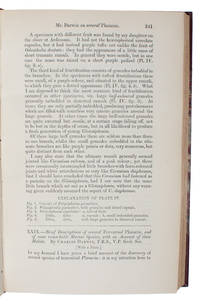
1844réf. 56991London Taylor and Francis 1844. 8vo. In a nice later half morocco binding with five raised bands and gilt lettering to spine. Blind stamped to upper outer corner of first leaf of table of contents. In "The Annals and Magazine of Natural History" volume 14. A very fine and clean copy. Darwin's paper pp. pp. 241-251. Entire volume: vii 1 - 472 12 plates. First edition of Darwin's paper on flatworms collected by him during the Beagle voyage one of the important early papers by Darwin on invertebrates originally intended for publication in The Zoology of the Voyage of HMS Beagle. This is Darwin's first publication on taxonomy: illustrated with a plate drawn by Darwin it describes a new genus and 15 new species of flatworm. Extremely rare on the market."The paper on flatworms . was Darwin's first venture into taxonomy. In it he described a new genus and 15 new species; most of the latter are still recognised as valid. He took a great deal of interest in these animals making extensive notes on their morphology and behaviour" Porter Darwin's Sciences.Previously familiar only with marine species Darwin was astounded to discover two new species of flatworm living on dry land in Brazil. He was intrigued by their close resemblance to snails and evolutionary questions may well lie behind his strong interest in them. PROVENANCE: From the collection William Pickett Harris Jr. 1897 - 1972 pencil note on p. iii. American investment banker and biologist. Following a career in banking Harris was appointed Associate Curator of the Museum of Zoology at the University of Michigan in 1928. "Harris played a highly important role in developing mammalogy and systematic collections of mammals at the University of Michigan" Hooper p. 923.Freeman 1669 hardcover
réf. 56501Kjøbenhavn Copenhagen 1872 - Kristiania Oslo 1890 - Stockholm 1871. A very nice and harmonious set in four excellent half calf bindings.1 The Danish translation: 1 volume 8vo. A nice contemporary half calf with gilding to spine and gilt title-label. Only light wear. Internally some light brownspotting. 19 XIII 605 1 pp.2 The Norwegian translation: 2 volumes small 8vo. Bound in two excellent uniform recent red morocco bindings in pastiche-style with gilt lines to spines. The work is printed in quite bad paper which is always yellowed and quite brittle. Thus the first title-page has two small restorations from verso far from arrecting printing. The second title-page had an old owener's signature and a previous owner's stamp. 379 5; 383 pp.3 The Swedish translation: 1 volume large 8vo. Bound uncut and with the extremely scarce original front wrapper in a lovely later brown half morrocco binding in contemporary style with five raised bands and gilt author and year to spine. Front wrapper bound on a strip at inner hinge and with a missing outer coner far from affecting printing. Old owner's name to front wrapper. An excellent copy. XI 1 420 pp. A magnificent collection of first editions of the first Danish Norwegian and Swedish translations of Darwin's masterpiece "The Origin of Species" together constituting the introduction to "The Darwinian Revolution in Scandinavia".The first Scandinavian translation to appear was the Swedish which is also the rarest of the three. Darwinism was strongly opposed in Sweden where the primary reaction to the work came from religious institutions that were outraged and fiercely fought against spreading the ideas presented in "origin" in their country. The second Scandinavian translation to appear was the Danish which was translated in 1872 by the then young botanist J. P. Jacobsen who was soon to become one f Scandinavia's most celebrated and influential authors. He received world-wide fame as the author of "Marie Grubbe" and "Niels Lyhne" which founded literary naturalism in Europe. "In the early 1870's however he was still dedicated to science. In 1873 he received the University of Copenhagen's Gold Medal for his work on desmids single-celled green freshwater algae. The Descent of Man was also translated by Jacobsen and appeared in 1874-75."Darwin's ideas found great resonance in scientific circles in Denmark and his ideas were immediately recognized. "In the early 1870s With the Danish translation the literary critic Georg Brandes started promoting Darwin's ideas as part of his liberal ideology and soon Darwinism became the mark of a new generation of intellectuals. Both the Steenstrup circle and the Brandes circle held Darwin in high esteem but made completely different attributions to his theory. Consequently they both decided to raise money separately for the same Darwin. Darwin had borrowed the collection of barnacles from the Zoology Museum in Copenhagen with the help of Steenstrup. As a compliment Darwin sent him a signed copy of the Origin. Steenstrup acknowledged Darwin as an important fellow naturalist but like many of his colleagues at the University of Copenhagen he never accepted evolutionary theory. The initial scientific reaction to Darwin's work on evolution by means of natural selection was respectful but made few converts. memorial in 1882. Independently Darwinism transformed as it became part of popular culture. " Kjærsgaard Darwinism comes to Denmark.The Norwegian translation was the last of the three to appear but it is quite scarce and very difficult to come by. It was published by businessman and publisher Johan Sørensen 1830-1918 as a part of 'Bibliothek for de tusen hjem' Library for Every Home."The first volume came out at the end of 1889 in five parts and a total of 379 pages. Each part cost 30 øre making a total price of 1 kroner 50 øre. The following year 1890 the second volume appeared and this consisted of four parts totaling 383 pages and cost 1 kroner 20 øre. The books were translated from the English sixth and final edition by the Master of the Arendal Public Secondary College Ingebret Suleng 1852-1928" Glick The Reception of Charles Darwin in Europe.1. The Danish translation: Om Arternes Oprindelse ved Kvalitetsvalg eller ved de heldigst stillede Formers Sejr i Kampen for Tilværelsen. Efter Originalens femte Udgave oversat af J.P. Jacobsen. Kjøbenhavn Gyldendalske Boghandel F. Hegel 1872. 8vo. 10XIII6051 pp. - Freeman No 643 Freeman with wrong collation as he omits half-title and content-leaves.2. The Norwegian translation: Arternes Oprindelse gjennem naturligt Udvalg eller de bedst skikkede Formers bevarelse i Striden for Livet. Oversat efter Originalens VI. Udgave af Ingebret Suleng. I- II. Kristiania Bibliothek for de tusen hjem. Fagerstrand pr. Høvik 1890. Small 8vo. 1-34-3794;1-34-383 pp. - Not in Freeman.3. The Swedish translation: Om Arternas Uppkomst genom naturligt Urval eller de bäst utrustade Rasernas Bestånd i Kampen för Tillvaron. Öfversättning från femte Originalupplagan af A.M. Selling. Stockholm L.J. Hiertas Förlagsexpedition 1871. I-IVV-XI420 pp. 1 plate. - Freeman No 793 Freeman having the wrong year of publication and not mentioning the plate. hardcover
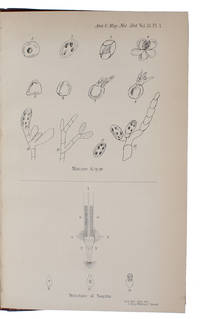
1844réf. 56990London Taylor and Francis 1844. 8vo. In a nice later half morocco binding with five raised bands and gilt lettering to spine. Blind stamped to upper outer corner of first leaf of table of contents. In "The Annals and Magazine of Natural History" volume 13. A very fine and clean copy. Darwin's paper pp. 1-6 1 plate. Entire volume: viii 1 - 528 14 plates 4 hand-coloured. First edition of Darwin's paper on marine arrow worms collected by him on his voyage on the Beagle. It is one of Darwin's early papers on invertebrates which was originally intended for publication in The Zoology of the Voyage of HMS Beagle. Described by Darwin as "one of the most anomalous animals in the world" the origin of these strange carnivorous animals which Darwin found highly interesting is still unresolved. These early works are rarely seen on the market. The plate drawn by Darwin is based on his drawings made during the Beagle Voyage.Darwin arrived back in England from his voyage around the world on the Beagle in October 1836. He immediately set about writing up the results of the expedition-first his general account the Journal of the Beagle and then publishing the scientific observations and collections he had made while on the Beagle. The majority of these were published in the Zoology-including parts on mammals fish birds and reptiles but Darwin ran out of funds beforehe could bring out the volume on invertebrates:"Darwin undertook to provide a comprehensive programme for the publication of the zoological results of the Beagle voyage - he obtained a Treasury grant to pay for the necessary engravings and having enlisted the leading taxonomical specialists in the several fields he superintended the publication of the Zoology of the voyage of H.M.S. Beagle from February 1838 to October 1843 - The work comprises five parts: Fossil Mammalia by Richard Owen; Mammalia by G. R. Waterhouse; Birds by John Gould; Fish by Leonard Jenyns; and Reptiles by Thomas Bell-a total of nineteen quarto issues. Darwin contributed a substantial portion of the text drawing uponhis field notes for geological and geographical data and for the descriptions of the habits and habitats of the species - Darwin had originally planned to include descriptions of invertebrates in the Zoology but the exhaustion ofthe government grant forced him to abandon the idea. Instead he decided to publish his own observations and descriptions of the specimens that he considered to be important new discoveries and did so in articles on Sagitta finished during the autumn of 1843 and Planariae described in 1844" Burkhardt 1986 p. xv.PROVENANCE: From the collection William Pickett Harris Jr. 1897 - 1972 pencil note on p. iii. American investment banker and biologist. Following a career in banking Harris was appointed Associate Curator of the Museum of Zoology at the University of Michigan in 1928. "Harris played a highly important role in developing mammalogy and systematic collections of mammals at the University of Michigan" Hooper p. 923.Freeman 1664. hardcover
1905réf. 55802Tokyo Tokyo Kaiseikan Meiji 38 1905. 8vo. In the original full bloth cloth with gilt letteing in both Japanese and Latin characters. Light occassional brownspotting otherwise a fine copy. 4 894 28 12 pp. frontispiece and folded plate with genealogical tree. Rare second translation and arguably the most important of the Japanese translation of Darwin's "Origin of Species" the first being from 1896 and only published once. This is the first translation to be made by a professional biologist. The previous translation "Seibutsu Shigen" was made by a law student which presumably was a contributing factor to the fact that the work primarily was embraced by social thinkers philosophers and politicians to advocate the superiority of Japanese culture and society and military and not by biologist and zoologist. With the present translation Darwin's ideas and theories were finally properly introduced to the people they were intended for: biologist and zoologist. The popularity of Darwin's works and theories became immensly popular in Japan: "Curiously there are more versions of "The Origin" in Japanese than in any other language. The earliest were literary with subsequent translations becoming more scientific as the Japanese developed a technical language for biology." Glick The Comparatice Reception of Darwinism P. XXII."It was as if Darwin's famous oceanic journey and the meticulous research into the animal and plant kingdoms that he spent his life undertaking had all been staged as an elaborate excuse for composing a theory whose true object was Victorian society and the fate of the world's modern nations." Golley Darwinism in Japan: The Birth of Ecology.Darwin's work had in Japan - as in the rest of the world - profound influence on the academic disciplines of zoology and biology however in Japan the most immediate influence was not on these subjects but on social thinkers: ". it exerted great influence on Japanese social thinkers and social activists. After learning of Darwin's theory Hiroyuki Kato the first president of Tokyo Imperial University published his New Theory of Human Rights and advocated social evolution theory social Darwinism emphasizing the inevitable struggle for existence in human society. He criticized the burgeoning Freedom and People's right movement. Conversely Siusui Kautoku a socialist and Japanese translator of the Communist Manifesto wrote articles on Darwinism such as "Darwin and Marx" 1904. In this and other articles he criticized kato's theory on Social Darwinism insisting that Darwinism does not contradict socialism. The well known anarchist Sakae Osugi published the third translation of On the Origin of Species in 1914 and later his translation of peter Kropotokin's Mutial Aid: A Factor of Evolution. Osugi spread the idea of mutual aid as the philosophical base of Anarcho-syndicalism." Tsuyoshi The Japanese Lysenkoism and its Historical Backgrounds p. 9 "Charles Darwin's theory of evolution was introduced to Japan in 1877 Morse 1936/1877 during Japan's push to gain military modernity through study of western sciences and technologies and the culture from which they had arisen. In the ensuing decades the theory of evolution was applied as a kind of social scientific tool i.e. social Spencerism or social Darwinism Sakura 1998:341; Unoura 1999. Sakura 1998 suggests that the theory of evolution did not have much biological application in Japan. Instead Japanese applied the idea of 'the survival of the fittest' which was a misreading of Darwin's natural selection theory to society and to individuals in the struggle for existence in Japan's new international circumstances see also Gluck 1985: 13 265.However at least by the second decade of the 1900s and by the time that Imanishi Kinji entered the Kyoto Imperial University the curricula in the natural and earth sciences were largely based on German language sources and later on English language texts. These exposed students to something very different from a social Darwinist approach in these sciences. New sources that allow us to follow" ASQUITH Sources for Imanishi Kinji's views of sociality and evolutionary outcomes p. 1."After 1895 the year of China's defeat in the Sino-Japanese War Spencer's slogan "the survival of the fittest" entered Chinese and Japanese writings as "the superior win the inferior lose." Concerned with evolutionary theory in terms of the survival of China rather than the origin of species Chinese intellectuals saw the issue as a complex problem involving the evolution of institutions ideas and attitudes. Indeed they concluded that the secret source of Western power and the rise of Japan was their mutual belief in modern science and the theory of evolutionary progress. According to Japanese scholars traditional Japanese culture was not congenial to Weastern science because the Japanese view of the relationship between the human world and the divine world was totally different from that of Western philosophers. Japanese philosophers envisioned a harmonious relationship between heaven and earth rather than conflict. Traditionally nature was something to be seen through the eyes of a poet rather than as the passive object of scientific investigations. The traditional Japanese vision of harmony in nature might have been uncongenial to a theory based on natural selection but Darwinism was eagerly adopted by Japanese thinkers who saw it as a scientific retionalization for Japan's intense efforts to become a modernized military and industial power. Whereas European and American scientists and theologians became embroiled in disputes about the evolutionary relationship between humans and other animals Japanese debates about the meaning of Darwinism primarily dealt with the national and international implications of natural selection and the struggle for survival. Late nineteenth-century Japanese commentators were likely to refer to Darwinism as an "eternal and unchangeable natural law" that justified militaristic nationalism directed by supposedly superior elites". Magner A History of the Life Sciences Revised and Expanded p. 349"Between 1877 and 1888 only four works on the subject of biological evolution were published in Japan. During these same eleven years by contrast at least twenty Japanese translations of Herbert Spencer's loosely "Darwinian" social theories made their appearance. The social sciences dominated the subject and when Darwin's original The Origin of Species Seibutsu shigen finally appeared in translation in 1896 it was published by a press specializing in economics. It is not surprising then that by the early 20th century when Darwin's work began to make an impact as a biological rather than a "social" theory the terms "evolution" shinka "the struggle for existence" seizon kyôsô and "survival of the fittest" tekisha seizon had been indelibly marked as social and political principles. It was as if Darwin's famous oceanic journey and the meticulous research into the animal and plant kingdoms that he spent his life undertaking had all been staged as an elaborate excuse for composing a theory whose true object was Victorian society and the fate of the world's modern nations." Golley Darwinism in Japan: The Birth of Ecology.Freeman 719 hardcover
1884réf. 53520Budapest Kiadja A. K. M. 1884. 8vo. In the publisher's original two embossed full red cloth bindings with gilt lettering to spine. Small vague stamp to both half-titles. Hindges loose on volume i. A fine fine and clean copy. LXXI 1 542 pp.; VII 5 436 pp. The exceedingly rare first Hungarian translation of Darwin's The Descent of Man. "Compared with the original and with a biography by Margó Tivador" Freeman. The Hungarian public was introduced to Darwinism early on when Ferenc Jánosi reviewed The Origin of Species in the Budapesti Szemle Budapest Review a half year after it first appeared in English. Darwin's principal works were first published in Hungarian translation by the Royal Hungarian Natural Science Society Királyi Magyar Természettudományi Társulat. The Origin of Species translated by László Dapsy was published in 1873; The present work in 1884 and a few years later in 1897 the latter work was translated anew and published by László Seress. "It is characteristic of the enlightened spirit of the country in this period that Darwin received academic recognition earlier in Hungary than in England. Although Cambridge did not honor Darwin until 1879 he was elected an honorary member of The Hungarian Academy of Sciences in 1872 the same year on this occasion the renowned Hungarian zoologist Tivadar Margó visited him at Down.Historical circumstances played a major role in this quick appearance of Darwinism and its popularity in Hungary. The failure of the 1848-49 revolution and war of independence seemingly put an end to progressive political discourse signaling an ideological crisis among the intelligentsia. In this context the natural sciences with their 'eternal truths' promised a way out inasmuch as science's promised objectivity might well serve as a politically neutral expression of progressive values" Mund The Reception of Charles Darwin in Nineteenth-Century Hungarian Society."Darwin wrote in the preface to the second edition of 'the fiery ordeal through which this book has passed'. He had avoided the logical outcome of the general theory of evolution bringing man into the scheme for twelve years and in fact it had by that time been so much accepted that the clamour of the opposition was not strident. He had also been preceded in 1863 by Huxley's Man's place in nature. The book in its first edition contains two parts the descent of man itself and selection in relation to sex. The word 'evolution' occurs for the first time in any of Darwin's works on page 2 of the first volume of the first edition that is to say before its appearance in the sixth edition of The origin of species in the following year." Freeman.Freeman no. 1084. hardcover
1871réf. 56375S.-Peterburg Izdanie redaktsii zhurnala "Znanie 1871. 8vo. In recent half calf with four rasied bands and gilt lettering to spine. Soiling and damp stain to title-page. Light brownspotting throughout. 2 VII 5 439 7 pp. The exceedingly rare first Russian translation of Darwin's 'Descent of Man' published only four months after the original English. The Russian publisher was eager to have a translation published hence this early abridged edition - two other Russian translations followed later the same year - The present translation being the very first into any language. "The Descent of Man showed that the process of organic evolution propelled by the struggle for existence and natural selection applied to man no less than to the rest of the animal kingdom. It gave explicit recognition to the idea of the anthropoid origin of man. This claim surprised no one for it was clearly hinted at in the great work of 1859 and was elaborated in Thomas Huxley's Man's Place in Nature and Vogt's Lectures on Man. Nor was it much of a surprise when three Russian translations of The Descent appeared within one year after the publication of the English original. Two general ideas represented the essence of The Descent: natural selection is not only behind the physical survival of man but also behind the evolution of cultural values; and the differences between animal and human behavior are differences of degree rather than of kind." Darwin in Russian Thought "The Expression helped lay the foundations for a scientific study of the psychological aspect of the evolution of species. The book appeared in a Russian translation only a few months after the publication of the English original. The paleontologist Vladimir Kovalevskii was the translator and the embryologist Aleksandr Kovalevskii was in charge of editorial tasks. In 1874 Vladimir wrote to Darwin that nearly two thousand copies of the Russian translation were sold." " The Expression deals much more extensively with selected aspects of human and animal behavior than with general problems of evolutionary biology. The Russian reviewers were generally impressed with Darwin's descriptions and categorizations of animal behavior. The Journal of the Ministry of Public Education was unusually profuse in praising the book's content and writing style. The reviewer commended Darwin's impartiality and avoidance of "materialistic trappings." Even the adherents of spiritualism could read the book he wrote without the least discomfort. The reviewer thought that psychologists would benefit from the information the book presented on the "physiological" basis of behavior. Indeed he recommended the book to all readers interested in the scientific foundations of human behavior. The liberal journal Knowledgewas equally laudatory. It noted that the book was eminently successful on two counts: it offered a "rational explanation" of many expressions of human emotions and it integrated the study of animal and human behavior into the universal process of organic evolution. In fact no educated person could afford to ignore it.N. P. Vagner professor of zoology and comparative anatomy at St. Petersburg University called The Expression a book with "great strengths and minor flaws." The volume reminded him of Darwin's previous works which marked "turning points in the history of science." The strength of the book lay much more in its suggestion of new topics for comparative-psychological research than in a presentation of a theoretically and logically integrated system of scientific thought. Insufficient exploration of the physiological underpinnings of mental activities represented the book's major shortcoming" Darwin in Russian Thought In Russia Darwinism had a profound influence not only upon the different sciences but also on philosophy economic and political thought and the great literature of the period. For instance both Tolstoy and Dostoevsky referenced Darwin in their most important works as did numerous other thinkers of the period.Like Strakhov however Dostoevsky acknowledging the significance of the "Origin of Species" saw the dangers of the theory. In the same year as the publication of Rachinsky's translation he lets the narrator in "Notes from Underground" 1864 launch his attack on Darwinism beginning: "As soon as they prove you for instance that you are descended from a monkey then it's no use scowling you just have to accept it."In "Crime and Punishment" two years later 1866 the Darwinian overtones inherent in Raskolnikov's theory of the extraordinary man are unmistakable. He describes the mechanism of "natural selection" where according to the laws of nature by the crossing of races and types a "genius" would eventually emerge. In general Darwinian themes and Darwin's name occur in many contexts in a large number of Dostoevsky's works.'Descent of Man' was transted into Danish Dutch French German Italian Polish Russian and Swedish in Darwin's lifetime. Freeman 1107. unknown
réf. GOR009911828Paperback. Very Good. paperback
1905réf. 56932Vidin Pechatnitsa na Diukmedzhiev 1905. 8vo. Uncut unopened in the original printed wrappers. The present volume includes includes "Autobiography" and first half of the "Origin". The second half was published shortly after. Spine lacking upper 5 cm and front wrapper with several nicks. Internally very fine and clean. Autobiography: 67 2 Origin of Speicies: 236 pp. frontiespiece of Darwin. Genealogical tree included in the pagination on p. 133. Exceedingly rare first Bulgarian translation of Darwin's Origin of Species prefixed by his Autobiography translated from the sixth London edition by M. Fiampova and I. H. A Timiryazova. Freeman lists the first Bulgarian translation of Origin of Species to be published in 1946. Darwin-Online states that: "I have found very little information on this translation or the associated names. It is a rare book with no copies located in OCLC KVK or EL; however NALIS finds two at the Bulgarian Central Medical Library and the Bulgarian Academy of Sciences.". Notice however OCLC list two copies. The present publication was published in two separate publications the first being offered here. OCLC list two copies: The Thomas Fisher Library Toronto and University Library of Oklahoma. unknown
1985réf. G0931689023I4N00Be Good To Your Self 1985. Paperback. Very Good. Disclaimer:May have limited writing in cover pages. Pages are unmarked. ~ ThriftBooks: Read More Spend Less.Dust jacket quality is not guaranteed. Be Good To Your Self paperback
1925réf. 130309London: The Nonesuch Press 1925. First edition first printing. The first Mr. Tootleoo book. Bernard Darwin 1876-1961 was the grandson of the naturalist Charles Darwin. He and his wife collaborated on their children's books with Bernard providing the text and Elinor the illustrations. With a handwritten note on the publisher's stationery loosely inserted apparently unconnected to this copy. Oblong quarto. With 22 full-page coloured illustrations by Elinor Darwin. Original brown boards with red decoration red blindstamped roundel to front cover. With dust jacket. Covers a little cockled else a very good copy in the dust jacket a little chipped and toned around extremities. hardcover
1932réf. 130310London: The Nonesuch Press 1932. First edition first impression of the first joint appearance of the first two Tootleoo books. The author the grandson of the naturalist Charles Darwin collaborated with his wife on children's books with Bernard providing the text and Elinor the illustrations. Octavo. With black and white illustrations by Elinor Darwin throughout. Original boards pale blue printed in red red endpapers. With flap of original glassine jacket loosely inserted. Very minor foxing to endpapers and toning to contents; a near-fine copy. hardcover
1927réf. 130307London: The Nonesuch Press 1927. First edition first impression of the second Mr. Tootleoo book. Bernard Darwin 1876-1961 was the grandson of the naturalist Charles Darwin. He and his wife collaborated on their children's books with Bernard providing the text and Elinor the illustrations. Oblong quarto. With 20 full-page coloured illustrations by Elinor Darwin. Original brown boards lettered and decorated in blue. With dust jacket. A very good copy in the scarce dust jacket heavily torn and chipped a little sunned around extremities. hardcover
1862réf. 55642Paris Guillaumin et Cie Victor Masson et Fils 1862. 8vo. Bound partly uncut with the original wrappers in a very nice later full calf pastiche binding with four raised band and richly gilt spine. Gilt boarders to boards. Small repair to upper right corner of title-page not affecting text. An exceptionally fine and clean copy. LXIV incl. half-title I-XXIII 24- 712. pp. and 1 folded plate between pp.160 a. 161. The scarce first edition of the controversial first French translation - bound partly uncut and with the original wrappers - of Darwin's masterpiece one of the most important books ever printed. This famed translation - done by self-taught female scholar - ended up causing quite a stir and adding to the theory of evolution some for Darwin quite unforeseen interpretations. Because of this the translator Clémence Royer gained notoriety as one of the leading eugenicists of the time. Darwin was very eager to have his work published in French. It is not known exactly how he happened on Royer as the translator but as she was familiar with the works of Lamarck and Malthus immediately realized the importance of Darwin's work and also had close connections to the French publisher Guillaumin she must have seemed perfect for the job. She had a naturalist help her with the biologically technical parts and made an excellent job of the translation. There was one big problem however - she went well beyond her role as a translator and added a 60-page preface and numerous explanatory footnotes that Darwin had not seen before publication. In the preface she challenged the belief in religious revelation she discussed the application of natural selection to the human race and she presented a pure eugenic theory explaining the negative consequences of protecting the weak and the infirm. She also promoted her concept of progressive evolution which had more in common with the ideas of Lamarck than with those of Darwin. Right after having seen the translation Darwin wrote in a letter to the American botanist Asa Gray: "I received 2 or 3 days ago a French translation of the Origin by a Madelle. Royer who must be one of the cleverest & oddest women in Europe: is ardent deist & hates Christianity & declares that natural selection & the struggle for life will explain all morality nature of man politicks &c &c!!!. She makes some very curious & good hits & says she shall publish a book on these subjects & a strange production it will be."After some reflection however Darwin began having more serious doubts and about a month later he wrote to the French zoologist Armand de Quatrefages: "I wish the translator had known more of Natural History; she must be a clever but singular lady; but I never heard of her till she proposed to translate my book." He had now also read the footnotes and wrote to Joseph Hooker: "Almost everywhere in Origin when I express great doubt she appends a note explaining the difficulty or saying that there is none whatever!! It is really curious to know what conceited people there are in the world."Freeman No 655 Freeman does not mention the plate which is present here. hardcover