DARWIN, CharlesABAA

7 647 résultats
1971réf. 005400Adelaide: Limited Editions Club 1971. Hardcover. Fine in a Fine slipcase. Fritz Kredel. Quarto 8" x 10-3/4" bound in tan oasis morocco-backed genuine wood veneer boards with a spine decorated and lettered in pure gold leaf; 384 pages. Edited with an introduction by Ashley Montagu. Type set printed and bound by the Griffin Press in Australia. Illustrated with 14 full-page black-and-maroon line drawings and a profusion of smaller black-and-white drawings by Fritz Kredel. One of 1500 copies SIGNED by the illustrator on the colophon page this copy not numbered. Limited Editions Club hardcover books
1838réf. 69522London: Smith Elder and Co 1838. OWEN Richard. WATERHOUSE George R. The Zoology of the Voyage of the H.M.S. Beagle. Under the Command of Captain Fitzroy R.N. During the Years 1832 to 1836. Part I II. Mammalia. London: Smith Elder and Co. 1838. Full Description: DARWIN Charles. OWEN Richard. WATERHOUSE George R. The Zoology of the Voyage of the H.M.S. Beagle. Under the Command of Captain Fitzroy R.N. During the Years 1832 to 1836. Part I II. Mammalia. London: Smith Elder and Co. 1838-1840. First editions of Part I and Part II of Mammalia in two quarto volumes 12 1/8 x 9 1/2 inches; 307 x 241 mm. Part I. Owen Richard. Fossil Mammalia. 1838-1840. 2 iv iv 111 1 colophon pp. Complete with thirty-two lithographic plates by G. Scharf one of which is folding and two which are double paged. With the preface to the whole work and a geological introduction by Charles Darwin. Bound without the half-title but with the additional fly-title. Part II. Waterhouse George Robert. Mammailia. 1839. 4 xii 97 3 blank pp. Complete with thirty-two hand-colored lithographic plates and three numbered engraved plates. With the errata slip bound in before B1. Bound without the half-title but with the additional fly-title. This volume with a geographical introduction and notes by Darwin. Two volumes uniformly bound in half tan calf over contemporary marble boards. Spines each with red and green morocco spine labels lettered in gilt. Contemporary endpapers. All edges speckled red. Some repairs to inner hinges. Text is very clean. The final three plates in volume II with some foxing otherwise all plates are very clean. Overall a very good copy of these two volumes. These first two volumes out of the complete work in 5 volumes are the only two volumes to be published with introductions by Charles Darwin. In the first volume he writes a Geological Introduction and in the second volume he writes a Geographical Introduction. "Darwin contributed a geological introduction to Part I the Fossil Mammalia pp. 3-12 and a geographical introduction to Part II the Mammalia pp. i-iv." Freeman p 26. In 1832 Captain Robert Fitzroy of the Royal British Navy undertook a five-year circumnavigation of the earth. Fitzroy who was only twenty-seven at the time asked a young Charles Darwin to be the naturalist for the voyage. The five-year journey included passing the coastlines of South America and particularly the Galapagos Islands near Ecuador. Darwin collected numerous specimens and data from this now famous area and these became the basis for his theory of natural selection which was a key component in his masterful theory of evolution. "The lavish scientific record of Darwin's collecting endeavours during the five-year voyage of the Beagle originally issued in 19 numbers. The 166 plates 82 finely hand-colouredof the complete works were due to the tireless energy and flair which the relatively untrained ship's scientist put first into the collection of specimens and then into ensuring that the zoological specialists duly reported on them after his return. The cost of the plates was covered by a treasury grant of one thousand pounds but to complete the work for Smith and Elder who were publishers of large illustrated books and government publications Darwin had to persevere as steadily with his pen as with his gun and geological hammer turning himself into a considerable authority during the course of five years spent editing the work of others." Christies "He superintended the Zoology's text wrote introductions for the different parts and added notes from his various Beagle records about animal behaviour and habitats wherever appropriate while also supervising the printers proofreading the sheets arranging artists for the plates chivying the experts and keeping them all moving forward within a tight self-imposed budget" Janet Browne Charles Darwin: Voyaging 2003 p. 370. Freeman Darwin 9.1 & 9.2. Nissen IVB 384. Nissen ZBI 1391. Sabin 18649. HBS 69522. $25000. Smith, Elder and Co unknown books
1859réf. 69648London: John Murray 1859. Full Description: DARWIN Charles. On the Origin of Species by Means of Natural Selection or the Preservation of Favoured Races in the Struggle for Life. London John Murray 1859. First edition first issue. With two quotations on p. ii. Octavo 7 3/4 x 4 7/8 inches; 198 x 125 mm. ix 1 1-502 32 pp. Publisher's advertisements dated June 1859. One folding diagram. Original green diagonal wave-grain cloth decoratively stamped in blind on covers. Spine decorated and lettered in gilt. Brown coated endpapers. Corners very slightly rubbed. Bookplate to front pastedown. Front inner hinge cracked but firm rear inner hinge just starting. Tiny short tears to top and bottom of spine from shelf-wear else fine. A clean fresh and bright copy. Housed in a custom green cloth clamshell. Overall a near fine good copy of Darwin's greatest achievement that created a revolution in biology and in almost every department of thought. Housed in a full green morocco clamshell case. One of the most influential scientific works of the nineteenth century On the Origina of Species was and still is one of the most controversial. In it "Darwin not only drew an entirely new picture of the workings of organic nature; he revolutionized our methods of thinking and our outlook on the natural order of things. The recognition that constant change is the order of the universe had been finally established and a vast step forward in the uniformity of nature had been taken" Printing and the Mind of Man. Dibner 199. Freeman 373 "the most important biological book ever written". Garrison and Morton 220. Grolier 100 English 96. Grolier/Horblit 23b "the most influential scientific work of the nineteenth century". Printing and the Mind of Man 344b. HBS 69648. $325000. John Murray unknown books
1839réf. 69647London: Henry Colburn 1839. KING Capt. Philip Parker; FITZROY Robert. FITZROY Robert editor. KING Capt. Philip Parker contributor. Narrative of the Surveying Voyages of His Majesty's Ships Adventure and Beagle. between the years 1826 and 1836 describing their examination of the southern shores of South America and the Beagle's circumnavigation of the globe. In three i.e. four volumes. London: Henry Colburn 1839. Full Description: DARWIN Charles and others. FITZROY Robert editor. Narrative of the Surveying Voyages of His Majesty's Ships Adventure and Beagle between the years 1826 and 1836 describing their examination of the southern shores of South America and the Beagle's circumnavigation of the globe. In three i.e. four volumes. London: Henry Colburn 1839. First edition with Volume III comprising the first edition first issue of Darwin's first published book. Four octavo volumes including appendix to Volume II. xxviii 4 597 3 blank; xiv 2 694 1 1 blank; viii 352; xiv 608 609-629 addenda 609-615 index 1 blank pp. Volume I with seventeen plates including frontispiece and one folding and two folding maps bound at rear. Volume II with twenty-five plates and maps including frontispiece and two folding maps bound at rear. Appendix to Volume II with six charts and diagrams and two folding maps bound at rear. Volume III with two folding maps bound at front and two more bound at the rear plus four woodcuts in the text. All half-titles called for present. Bound without publisher's ads at end of Appendix. Contemporary half red morocco over marbled boards spines with gilt and blind tooled bands and gilt lettering green-gray endpaper top edges gilt. Minor old dampstain to lower blank margin of last volume. Frontispiece of first volume with outer margin a bit trimmed. Previous ower's bookplates to front pastedowns of each volume. Overall an excellent set very bright and fresh of this monumental work. One of the most famous nineteenth-century accounts of voyages of exploration "Darwin's first published book is undoubtedly his most often read and stands second only to On the origin of species as the most often printed. It is an important travel book in its own right and its relation to the background of his evolutionary ideas has often been stressed.The first issue forms as is well known the third volume of The narrative of the voyages of H.M. Ships Adventure and Beagle edited by Captain Robert Fitzroy and published in three volumes and an appendix to Volume II in 1839. In this form it bears the subsidiary title Journal and remarks. Since then it has changed its name four times so that today it is universally referred to as The voyage of the Beagle" Freeman Darwin pp. 31-32. Freeman Darwin 10. Hill I pp. 104-105. Norman Library 584. HBS 69647. $45000. Henry Colburn unknown books
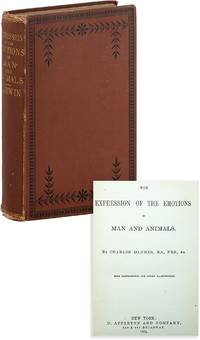
1873réf. 90263New York: D. Appleton & Co 1873. First Edition. First printing. Octavo 20cm. Publisher's terra-cotta cloth with gilt titles on spine; decorative devices stamped in black on upper and lower covers; i-vii; 1-374pp 14pp ads; seven inserted leaves of plates three folding; text illus. Spine ends and board edges a bit rubbed with tiny bit of cloth flaking at base of spine; internally complete and quite fresh the endpapers and hinges clean and strong text firm and unmarked; in all a tight Very Good copy. A key work in Darwin's evolutionary canon originally intended as a section of The Descent of Man but published separately for cost considerations. Darwin's meticulously documented thesis that certain expressions of emotion are if not universal then at least highly correlated across human cultures as well as across animal species has never been seriously challenged. The heliotype plates most of which are printed from original negatives represented an important milestone in scientific book illustration; they were included at considerable expense despite the objections of Darwin's publishers who warned that their inclusion would "poke a terrible hole" in the book's profits. A quite nice copy of a book which while not strictly uncommon is typically found well-worn. D. Appleton & Co unknown books
1958réf. 168233Beverly Hills CA: United Artists 1958. Vintage studio still photograph from the 1958 film noir showing Dana Andrews. Based on the 1945 novel by Darwin Teilhet about a Korean War veteran who upon returning home to Washington DC discovers that his research firm has been overtaken by communists. The third and final film collaboration between Andrews and director Jacques Tourneur following "Canyon Passage" 1946 and "Curse of the Demon" 1957. Shot on location in Washington DC. 8 x 10 inches. Lightly toned else about Fine. Grant US. United Artists unknown books
1871réf. 69501London: John Murray 1871. Full Description: DARWIN Charles. The Descent of Man and Selection in Relation to Sex. With illustrations. London: John Murray 1871. First edition first issue with "transmitted" appearing as the first word on p. 297 of Volume I with printer's imprint on the verso of the half-title of Volume II and with twenty-five errata seventeen for Volume I and eight for Volume II on the verso of the title leaf to Volume II and with the leaf pp. ix-x containing Darwin's note on "a serious and unfortunate error" tipped in leaf after p. viii in Volume II. Two small octavo volumes 7 1/2 x 4 15/16 inches; 191 x 126 mm Volume II is 5 mm shorter than volume I. viii 423 1 printer's imprint 16 publisher's ads; viiiix-x "Postscript" 475 1 printer's imprint 16 publisher's ads pp. The 16 pages of publisher's advertisements at the end of each volume are both dated January 1871 . Wood-engraved text illustrations. Original green cloth with covers stamped in blind and spines stamped and lettered in gilt. Black-coated endpapers. Head and tail of spines with some minor shelf-wear. Corners slightly bumped. Some very light rubbing to board edges. Some minor bubbling to cloth of front board of volume II. Front inner hinge of volume I with a mostly closed crack holding firm. Previous owner's armorial bookplate on front pastedown of volume II. Some minor pencil markings to volume I otherwise very clean inside. Overall an exceptional set. The first issue of 2500 copies was published on February 24 1871 and the second of 2000 copies in March. "The book in its first edition contains two parts the descent of man itself and selection in relation to sex. The word 'evolution' occurs for the first time in any of Darwin's works on page 2 of the first volume of the first edition that is to say before its appearance in the sixth edition of The Origin of Species in the following year. The last chapter is about sexual selection in relation to man and it ends with the famous peroration about man's lowly origin the wording of which differs slightly in the first edition from that which is usually quoted" Freeman p. 129. "In the Origin Darwin had avoided discussing the place occupied by Homo sapiens in the scheme of natural selection stating only that 'light will be thrown on the origin of man and his history.' Twelve years later he made good his promise with The descent of man in which he compared man's physical and psychological characteristics to similar traits in apes and other animals showing how even man's mind and moral sense could have developed through evolutionary processes. In discussing man's ancestry Darwin did not claim that man was directly descended from apes as we know them today but stated simply that the extinct ancestors of Homo sapiens would have to be classified among the primates; however this statement as misinterpreted by the popular press caused a furor second only to that raised by the Origin" Norman Library. This title created almost as much sensation as his Origin of Species. In it he elaborated further on his views adding sexual selection and using the word 'evolution' for the first time. Milestones of Science 48. Freeman Darwin 937. Garrison-Morton 170. Norman Library 599. HBS 69501. $5500. John Murray unknown books
1890réf. 9032323New York: D. Appleton and Co 1890. Hardcover. Very Good. Author's Edition stamped with same and faux author signature on half-title pages. One of 1000 numbered copies copyright page states "Authorized Edition." Bound in half burgundy leather with marbled boards and five raised bands spines and covers stamped in gilt marbled endpapers. Top edges gilt. Illustrated with engravings charts drawings maps photographs and geological studies including fold-outs in black and white and color. All pages clean and bright. Minor wear to corners and extremities. Includes: Animals and Plants Under Domestication I & II Structure and Distribution of Coral Reefs The Descent of Man and Selection in Relation to Sex Expression of the Emotions in Man and Animals The Different Forms of Flowers on Plants of the Same Species Geological Observations on the Volcanic Islands and Parts of South America Insectivorous Plants The Life and Letters of Charles Darwin I & II The Power of Movement in Plants The Origin of Species I & II The Formation of Vegetable Mould Through the Action of Worms Journal of Researches Into the Natural History and Geology of the Countries Visited During the Voyage of H.M.S. Beagle Round the World. A bright and beautiful set. 5 1/2 x 8 1/4 inches. D. Appleton and Co hardcover books
2006réf. 9029403New York: Norton 2006. 1st. Hardcover. Fine/fine. Bound in publisher's original tan and brown quarter boards with spine and front cover stamped in gilt. Printed slipcase. Contains the complete texts of four books by Charles Darwin: The Voyage of the Beagle On the Oirgin of Species The Descent of Man The Expression of the Emotions in Man and Animals. Edited and with a running commentary on each title by Edward O. Wilson. 6 x 9 1/4 inches. 1704 pages. Norton hardcover books
1984réf. 9020590London: Souvenir 1984. 1st. Hardcover. Fine/near fine. Bound in the publisher's original cloth over boards spine stamped in gilt. Light rubbing to edges and extremities of dust jacket else fine. Souvenir hardcover books
1860réf. 55674London: John Murray 1860. Very good plus. Second edition of this epochal work - extensively and argumentatively annotated by a 19th-century reader who is both reasonably scientifically informed and morally shocked by its contents. The first printing of ORIGIN famously sold out in a single day in November 1859 leading publisher Murray to issue a second edition as soon as Darwin had made revisions in January 1860. The book was met with both considerable acclaim and criticism sparking heated debates across the country. It is possible that our annotator was among those who rushed out to obtain a copy of the second edition amidst this furor as aniline ink was commercially available by the 1860s. The comments range in length tone and depth of engagement suggesting an intense and frankly emotional reading experience for the annotator. Some annotations are insulting or flippant as when the annotator calls Darwin "cocksure" 477 or simply writes "stuff!" as in "rubbish" often used as a euphemism in place of cursing. Other annotations engage with the substance of the science asking "how can a genus descend from a species" 446 which does indeed contradict Linnaeus's traditional hierarchical taxonomy; and comparing Darwin unfavorably to Lyell whom "one has not to read over and over again in hopeless despair of finding meaning!" 282. ORIGIN OF SPECIES "dealt a body blow to traditional Western religious thought" Larsen 89 and some of the annotations are religiously inflected especially on the question of how Darwin's arguments were perceived to conflict with the belief in a divine Creator. The annotator argues "of course to talk of a Creator or God to sic odious to Mr D" 413 - a not unfounded comment as Darwin had actually revised this second edition to add the phrase "by the Creator" on the last page "in order to conciliate angry clerics" Kutschera. Indeed even Darwin's supporters were aware of the threatening religious implications: Thomas Henry Huxley claimed in an 1860 review that "Old ladies of both sexes consider it a decidedly dangerous book" quoted in Larson 83. These religious comments appear to underlie the fury of the annotator who expands them into a moral argument: "How arrogant how almost insolent for any man to write in this style as if he had been present throughout the ages and know the whole secret of animated nature" 356. The annotator injects morality into the science as when he complains about Darwin germinating seeds sourced from the droppings of birds: "I hope for the sake of his family he washed his hands. But these naturalists are dirty both in thought and conduct" 361. In a section on fertility in flowers the annotator argues "He must have had a very bawdy mind" 257 and wishes Darwin had never been born: "I wish to heavens either his male or female progenitor had been sterile" 256. The private nature of the marginalia here allows us an unfiltered glimpse at the raw response of a contemporary reader. At a later point someone appears to have attempted to erase many of them suggesting the effacer was themself angered or embarrassed or just annoyed by the commentary - yet the annotations remain important as both a distillation and reflection a broader wave of outrage that the book's publication spurred perhaps best summed up by the final marginal comment. Darwin's last line describes "endless forms most beautiful and wonderful have been and are being evolved." The annotator has underlined "and are being" and written "are they" A tremendously rich copy worthy of further research offering a detailed case study in the contemporary backlash to one of the most controversial books of all time. 8'' x 5''. Original green cloth stamped in blind gilt-stamped spine. Brown coated endpapers. Second issue as usual "fifth thousand". Publisher's catalogue at rear. 10 502 32 pages. Annotated by "E.H. Morels" throughout in pencil and aniline ink often very faded or effaced but largely legible more than 100 in all including an extensive note on the final page. Light wear and spotting to cloth with short nick to center of spine. Hinges firm. John Murray unknown books
1859réf. 372885London: John Murray 1859. First Edition one of only 1250 copies. 1 vols. 8vo. Bound with half-title and without publisher's adverts. Folding diagram lithographed by W. West. Late 19th-century half brown morocco by Zaehnsdorf spine lettered and ruled in gilt raised bands marbled sides and endpapers top edge gilt brown silk bookmarker. Red morocco book label of Valentine Hollingsworth 1883-1942. Front joint repaired. Light rubbing slight darkening to spine a few light spots of foxing to preliminaries but otherwise crisp and clean tiny closed tear at foot of title page folding diagram with short closed tear and neat repair at foot: a very good smartly bound copy. First Edition one of only 1250 copies. 1 vols. 8vo. "The most important single work in science brought man to his true place in nature" Heralds of Science 199. Darwin "revolutionized our methods of thinking and our outlook on the natural order of things. The recognition that constant change is the order of the universe had been finally established and a vast step forward in the uniformity of nature had been taken" PMM 344. "The publication of the Origin of Species ushered in a new era in our thinking about the nature of man. The intellectual revolution it caused and the impact it had on man's concept of himself and the world were greater than those caused by the works of Copernicus Newton and the great physicists of more recent times. Every modern discussion of man's future the population explosion the struggle for existence the purpose of man and the universe and man's place in nature rests on Darwin" Mayr. Freeman 373; PMM 344; Norman 593; Garrison-Morton 220; Grolier/Horblit 23b; Brent Charles Darwin p. 427 John Murray unknown books
1871réf. 376128London: John Murray 1871. First edition first issue with errata on verso of vol. II title-leaf. viii 423 1; viii ii 475 1 pp. 1 vols. 8vo. Publisher's green cloth. Light wear to covers expertly recased. Bookplate. First edition first issue with errata on verso of vol. II title-leaf. viii 423 1; viii ii 475 1 pp. 1 vols. 8vo. Darwin's Descent of Man created an uproar second only to his Origin of the Species; however "contrary to popular error prevalent now as well as then Darwin never said that man was descended from apes let alone monkeys; what he claimed was that man's ancestors if alive today would have to be classified among the Primates" De Beer Charles Darwin pp. 210-1. ODNB further clarifies "The Descent understood by Darwin as a sequel to the Origin was written with a maturity and depth of learning that marked Darwin's status as an élite gentleman of science" Freeman 937 John Murray unknown books
1846réf. 371065New York: Harper & Brothers 1846. First American edition. 2 vols. Small 8vo. Publisher's cloth spine chipped with loss wityh blindstamps on title-page from GTS. First American edition. 2 vols. Small 8vo. First American edition of Darwin's important first published book containing the observations and field work that form the basis for On the Origin of Species. "The five years of the voyage were the most important event in Darwin's intellectual life and in the history of biological science. Darwin sailed with no formal scientific training. He returned a hard-headed man of science knowing the importance of evidence almost convinced that species had not always been as they were since the creation but had undergone change. The experiences of his five years in the Beagle how he dealt with them and what they led to built up into a process of epoch-making importance in the history of thought" DSB. Darwin's Journal "his first published book is undoubtedly the most often read" Freeman 31. It is "one of the most interesting records of natural history exploration ever written and is one of the most important for it was on this voyage that Darwin prepared for his lifework ultimately leading to The Origin of Species" Hill I 104-5. First published in 1839 as "the third volume of The Narrative of the Voyages of H.M. Ships Adventure and Beagle edited by Captain Robert Fitzroy. Since then it has changed its name four times so that today it is universally referred to as The Voyage of the Beagle. On its first appearance in its own right also in 1839 it was called Journal of Researches into the Geology and Natural History etc. The second edition of 1845 transposes 'Geology' and 'Natural History'. and the spine title is Naturalist's Voyage" Freeman 32. This first American edition is based on that 1845 second London edition. Issued as Harper's New Miscellany Volumes X and XI. Freeman 16; Sabin 18647 Harper & Brothers unknown books
1901réf. 52738London: Jarrold & Sons 1901. First printing. Near fine. First edition advance review copy of this scarce turn-of-the-century primer on Darwinism for "every day people." A popular introduction to evolution by means of natural selection for "the young person the person with little education the person who is not studious the masses in short." Influenced by renowned naturalist Alfred Russel Wallace with whom he became acquainted due to their mutual work in land nationalization projects Ogilvy turned his attention to the still widely misunderstood concept of evolution. Wallace who had already provided the introduction for Ogilvy's THE THIRD FACTOR OF PRODUCTION also reviewed the manuscript for this book. Certainly with his connection to Darwin as "a co-discoverer and friend" he was one of the best possible beta readers for such a text. Ogilvy stresses that this book was written to make the principles of Darwinism accessible to all by making the subject "simple clear and interesting" and avoiding "technicalities and dry structural details" - addressing what he felt was a general misunderstanding of Darwin's findings amongst the population he sought to reach. A contemporary review in the science journal NATURE confirms this referring to a "widespread . ignorance and misapprehension of Darwin's teaching among the general public." Another from THE EXPOSITORY TIMES praises the "blessed simplicity in Mr. Ogilvy's way of presenting the subject." Laid into this copy is a typed letter signed by the publisher sending it to a journal editor for review. OCLC locates only a handful of US holdings and only a few more elsewhere. A gorgeous copy. 7.25'' x 4.75''. Original green cloth with dark green stamped Art-Nouveau design lettered in red to front board and in gilt to spine. Pictorial endpapers. 160 pages. Single typed sheet dated 21 March 1901 and signed "Jarrold Sons" laid in. Boards with touch of wear to extremities. Faint offsetting to endpapers light foxing to edges. Crisp and tight. Jarrold & Sons unknown books
1892réf. 48692London: John Murray 1892. Very good plus. Sixth edition "forty-third thousand" overall - and the first to use the term "evolution" to describe the mechanism of natural selection that Darwin introduced in the book. "Evolution" - the word now most associated with THE ORIGIN OF SPECIES - was not used to describe natural selection in the publication until the sixth edition. By then Darwin was well aware that he had a phenomenon on his hands with the title - it was time to widen his audience. The 6th edition was purposefully set in smaller type slimming the book's profile and making it more affordable "I have been told on authority which I can trust that . workmen club together to buy the Origin" Darwin noted of previous editions in correspondence in 1871. It also contains a glossary for the first time making the text more accessible to a non-specialist audience. Appropriately this copy was once owned by James G. Mead whale biologist and longtime curator of marine mammals at the Smithsonian. Mead is a particular proponent of the anatomical study of marine mammals a method of examination that Darwin also favored; THE NEW YORK TIMES notes that Mead's use of this technique "has given scientists a detailed look at species that often can be observed only fleetingly in the wild." A notable edition of an iconic work. 7.5'' x 5''. Publisher's green cloth boards with gilt spine lettering. Floral patterned endpapers of the John Murray monogram. xxii 432 pages including index; folds from page 185 on are unopened. Small owner name to front flyleaf "J. G. Mead" dated Feb. 1972. Small owner name to title page "Jas Probert" dated July 1893. Binding with faint spotting to edges light bumping to corners and spine ends. Light foxing to endpapers. Interior clean. John Murray unknown books
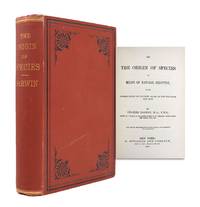
1878réf. 365957New York: D. Appleton and Company 1878. New Edition from the Sixth English Edition with Additions and Corrections. xxi 1 1-458pp. 1 vols. Small 8vo. Publisher's russet cloth blocked in black. Near fine. New Edition from the Sixth English Edition with Additions and Corrections. xxi 1 1-458pp. 1 vols. Small 8vo. "Certainly the most important biological book every written . The sixth edition which is usually regarded as the last appeared in London in February 1872 . It is again extensively revised and contains a new chapter VII. . It is in the edition that the word 'evolution' occurs for the first time. It had been used in THE DESCENT OF MAN in the previous year but not before in this work" Freeman p. 79. The present 1878 edition is the fifth issue of the American edition based on the sixth edition. A lovely copy of an early American edition. Freeman 403 D. Appleton and Company unknown books
1944réf. 41454Boston: Brown and Company 1944. Very good plus in very good jacket. First edition of this WWII-era Dick Whittington mystery set in London. 7.5'' x 5''. Original brown cloth red lettering to front spine. In original unclipped $2.50 dust jacket. 300 pages. Old Capital Club ink stamp to front free endpaper. Jacket moderately edgeworn with some shallow chipping at spine faint spot of dampstain to rear corner. Foxing to top edge. Sound unmarked clean. Brown and Company unknown books
1927réf. 300754London: The Nonesuch Press 1927. First editions. Illustrated in color by Elinor Darwin. 2 vols. Oblong 8vo. Original decorated paper over boards fine copies IN ORIGINAL DUST JACKETS Volume II with loss and Vol. I VG. First editions. Illustrated in color by Elinor Darwin. 2 vols. Oblong 8vo. Dreyfus 27 45 The Nonesuch Press unknown books
1952réf. 59401New York: HaFiner Press 1952. Number 55 of 250 copies of a facsimile reprint of the First edition done for the Book Collectors Society. 1 vols. 8vo. Green polished calf t.e.g. About fine. Number 55 of 250 copies of a facsimile reprint of the First edition done for the Book Collectors Society. 1 vols. 8vo. HaFiner Press unknown books
1903réf. 16794New York: D. Appleton and Company 1903. First Edition. Hardcover. Good. About Good. Brown cloth heavily mottled some red and green stains. Square bound with some reading wear gilt top edge a tear to the front endpaper. D. Appleton and Company hardcover books
1900réf. 16961New York: A.L. Burt Publisher 1900. Hardcover. Very Good. Reprinted from Second English Edition Revised and Augmented. Illustarted. Very Good. Red cloth faded at the spine lightly rubbed and bumped. Square and firmly bound though the rear hinge is starting clean internally. A.L. Burt, Publisher hardcover books
1900réf. 16960New York: A.L. Burt Publisher 1900. Hardcover. Good. Reprinted from Second English Edition Revised and Augmented. Illustarted. Published as part of Burt's Library of the World's Best Books. Good. Brown publisher's binding generally worn. Square and firmly bound with a gilt top edge hinges cracked but reglued stained at the fore-edge clean otherwise. A.L. Burt, Publisher hardcover books
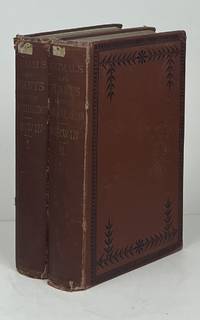
1894réf. 16963New York: D. Appleton and Company 1894. Second Edition. Hardcover. Good. Complete in two volumes. Good. Matching publisher's bindings generally rubbed and worn small white labels at the heads of the spines. Bound with reading wear and forward leans former owner's name inside each marginalia and some notes at the endpapers. D. Appleton and Company hardcover books
1877réf. 16962New York: D. Appleton and Company 1877. First Edition. Hardcover. Very Good. Erratum slip tipped-in before the Content page. About Very Good. Brown publisher's binding rubbed and bumped at the edges and corners some fraying at the spine. Square and firmly bound old store blindstamp on the front endpapers clean otherwise. D. Appleton and Company hardcover books