Charles DarwinBiblio.com
7 338 résultats
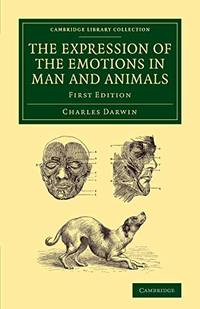
réf. B9781108061834Paperback / softback. New. After thirty years' research during which he consulted missionaries doctors and photographers from around the world Charles Darwin 1809-1882 published this monograph in 1872. Drawing on his work on evolution it represents the earliest systematic investigation into the shared features of human and animal expression. paperback
réf. B9781108004831Paperback / softback. New. A study of the muscular movements of the face both human and animal triggered by the emotions being felt - a 'physical' response to a 'mental' sensation. Darwin's detailed analysis of what actually happens to the body in a state of fear or joy or anger is illustrated by photographic images. paperback
1998réf. Q-0195112717Oxford University Press 1998-04-09. Hardcover. New. In shrink wrap. Looks like an interesting title! Oxford University Press hardcover
réf. A9780226136561Paperback / softback. New. Darwin's work of 1872 still provides the basis of research in the theory of emotion and expression. Though strides have been made behavorial scientists still rely on it. paperback
1989réf. 96757Birmingham AL: Gryphon Editions 1989. First Edition; First Printing. Hardcover. Fine. Leather bound Accented in 22kt gold. Printed on archival paper with gilded edges. The endsheets are of moire fabric with a silk ribbon page marker. Smyth sewing and concealed muslin joints. This book is in full leather with hubbed spines. A Limited Edition.; First Gryphon Edition.; 8vo - over 7¾" - 9¾" tall. Gryphon Editions hardcover
réf. 697311645Standard Publications Incorporated . Papeback. New. pp. 388 Standard Publications, Incorporated unknown
réf. 6131521580Standard Publications Incorporated . Papeback. New. pp. 388 Standard Publications, Incorporated unknown
réf. 63117940Oxford University Press OUP . Papeback. New. pp. 512 3 Oxford University Press OUP unknown
réf. 650499147Cambridge University Press CUP . Papeback. New. pp. 400 Index Cambridge University Press CUP unknown
réf. 63820912University of Chicago Press . Papeback. New. pp. 386 University of Chicago Press unknown
1998réf. DADAX0195112717OXFORD UNIVERSITY PRESS 1998-04-09. 3rd. hardcover. New. 5.75x1.50x8.75. Buy with confidence. Excellent Customer Service & Return policy. OXFORD UNIVERSITY PRESS hardcover
réf. 6684269Oxford University Press OUP . Papeback. New. Oxford University Press OUP unknown
2026réf. Gyan-9788167372161Facsimile Publisher 2026. Hardcover. New. 22.59 x 14.34 x 3.48 cm. English Facsimile Publisher hardcover
2026réf. Gyan-9788167372161Facsimile Publisher 2026. Hardcover. New. 22.59 x 14.34 x 3.48 cm. English Facsimile Publisher hardcover
1888réf. 000856John Murray 1888. Hardcover. Good. Tenth thousand corrected 1888 published by John Murray. Tidy green covers a small bump to one corner corners a little rubbed gilt lettering to the spine is bright a few scuffs to the rear cover a forward lean rough cut page edges but very neat. Dark brown endpapers previous owners inscription in ink to the reverse of the free endpaper foxing up to the title page plus the last two pages otherwise pages are clear plus a little age toned there are slight indentations to the top corner of the pages where they have been turned. Good condition. John Murray hardcover
1897réf. 271427D. Appleton 1897. Hardcover. Very Good. 8vo in 3/4 burgundy morocco marbled boards. Binding tight and square hinges firm corners rubbed through rubbing and shallow chipping at both ends of the spine p.o. bookplate on the front pastedown rubber stamp on the title page. D. Appleton hardcover
réf. 1528447476.Ghardcover. Good. Access codes and supplements are not guaranteed with used items. May be an ex-library book. hardcover
1882réf. B6801London: John Murray William Clowes. 1882. Slight browning to early and last leaves. Interior otherwise clean and crisp. Pp. 65/66 bound between 48/49. Edition: First edition Binding: Full original green cloth boards. Blind framing on boards. Spine with gilt lettering decorative gilt fillet and stamp. Brown paste-in and free endpapers. Notes: A near fine example of this last scientific book by Darwin on earthworm behaviour and ecology. Charles Robert Darwin 1809 – 1882 was an English naturalist geologist and biologist renown for his contributions to the understanding of evolutionary biology and he has been described as one of the most influential figures in human history. His proposition that all species of life have descended from a common ancestor is now generally accepted and considered a fundamental concept in science. In a joint publication with Alfred Russel Wallace he introduced his scientific theory that this branching pattern of evolution resulted from a process that he called natural selection in which the struggle for existence has a similar effect to the artificial selection involved in selective breeding. The Formation of Vegetable Mould though the Action of Worms sometimes known simply as Worms continued the theme common throughout Darwin’s work which is that gradual changes over long periods of time can lead to large and sometimes surprising consequences. It was the first significant work on soil bioturbation although that term was not used by Darwin it first appeared in the soil and geomorphic literature one hundred years later. The inspiration for Worms likely stemmed from a visit to his uncle’s home where Darwin’s uncle pointed out an area of ground where lime and cinders spread years previously had vanished into the soil forming layers under a top layer of loam. His uncle suggested that this might have been the work of earthworms but apparently thought that this would be of little interest to his nephew who was working on continental scale geological problems. The subject was in fact of interest to Darwin; when he returned to London later that year he prepared a paper on worms forming mould. The paper on the role of earthworms in soil formation was read out by Darwin at the Geological Society of London on 1 November 1837. This was an uncommonly mundane subject for the society and his peers may have hoped to hear of something more grandiose even seeing this paper as highlighting Darwin's growing idiosyncrasies. The leading geologist William Buckland subsequently recommended Darwin's paper for publication. This later led to Darwin’s renewed work on earthworms that led to the publication of the present volume. When asked why he had turned to such an ‘insignificant’ subject such as worms Darwin answered "I have been studying their habits for forty years." In Darwin's view the "insignificant" was the foundation of much greater phenomena. Size: 8vo.188x125 mm Illustration: With many in-text illustrations. First edition seventh thousand corrected. Pages: Blank 2. Title. Printer’s signature. Contents iii-vii. Blank. P. 1 – 328. Advertisement. Printer’s signature. Category: Book Science & Technology; John Murray, William Clowes. hardcover
1897réf. 267586D. Appleton 1897. Hardcover. Very Good. 8vo in 3/4 burgundy morocco and marbled paper gilt spine title. Binding tight and square hinges firm Corners rubbed through shallow chipping at the top of the spine. D. Appleton hardcover
réf. B9781108005128Paperback / softback. New. This book published in 1881 was the result of many years of experimentation and observation by Darwin in the open-air laboratory of his garden at Down House in Kent. His insights are as important and his descriptions of his experiments as fascinating now as they were then. paperback
réf. 0226136639.Gpaperback. Good. Access codes and supplements are not guaranteed with used items. May be an ex-library book. paperback
1892réf. SKU1012731John Murray 1892. Hardcover. Good. Overall in great condition with a few minor points. Dark green cloth with gilt lettering on the spine. Some dark spots to the bottom cover. The spine is slightly cocked. The spine is cracked at the back blank page but the binding is solid. Pictures available upon request. John Murray hardcover
1897réf. 138075New York: D. Appleton & Company 1897. Authorized Edition. Fine Binding. Very Good in boards. Rubbing along spine edges. D. Appleton & Company unknown
réf. 6103719920Benediction Classics . Hardback. New. pp. 348 Benediction Classics hardcover
réf. 6610841Cambridge University Press CUP . Papeback. New. pp. 340 Cambridge University Press CUP unknown