78.856 risultati
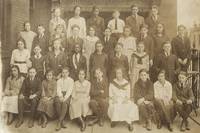
1935rif. 153921935. Integrated class photograph 1935 identifies African American student James Thompson among a predominantly white group of classmates nearly two decades before Brown v. Board of Education. Thompson stands among the students with his arm around a classmate while a contemporary notation on the verso identifies him by name and adds a personal assessment: "See big black guy James Thompson. A great guy." The combination of Thompson's identification and his placement within the class provides specific evidence for the history of African American education and interracial schooling before the Supreme Court's 1954 decision against state-mandated segregation in public schools. The school and location are not identified in the supplied information and the photograph by itself does not establish the institution's racial policies or the circumstances under which Thompson attended the school. Original sepia-toned gelatin silver class photograph 1935 approximately 3 x 5 inches. The class consists predominantly of white students with Thompson standing among them; his arm rests around another student. The children are formally dressed for the group portrait and numerous students smile toward the camera. Verso inscribed: "See big black guy James Thompson. A great guy." The inscription is particularly useful in preserving Thompson's name which would otherwise be absent from the visual record. The photograph dates nineteen years before the Supreme Court decided Brown v. Board of Education in 1954. Because racial segregation in education differed substantially according to state and local law the image should not be treated as evidence of a broader institutional integration policy without identification of the school and its location. It does however document Thompson's presence within this predominantly white class in 1935 and preserves a named African American student within a specific pre-Brown educational setting. Very good condition. unknown books
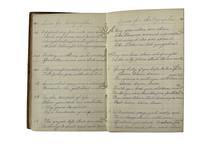
1831rif. 167191831. Patterson Elizabeth N. Friendship album begun 1831 documenting early nineteenth century American album culture among young women educated in New England academies with emphasis on sentimental expression moral instruction and the maintenance of social bonds through handwritten verse and prose. Entries written across several decades and locations including Medford Windham Dunstable Derry and Nashua record friendship networks shaped by piety domestic responsibility emotional refinement and shared educational experience. Poems letters and reflective prose addressed to Patterson preserve the literary practices through which women articulated expectations of conduct friendship religion and domestic life in the antebellum Northeast. Patterson Elizabeth N. Friendship album. Circa 1831-1899. 76 pages containing 36 handwritten entries contributed by multiple individuals across New England. 8.5 x 5.25 inches. The contents include handwritten poems letters and reflective prose addressed to Elizabeth Patterson frequently commemorating shared school experiences and articulating ideals of womanhood and moral conduct. A letter titled "To a School Mate" recalls "four years.at the school where we were taught from our childhood up" and expands into prescriptive reflections on female responsibility asserting "Of every domestic circle woman is the centre.home is the empire of woman" and linking domestic governance to "the comfort of communities and the welfare of states." Additional entries emphasize friendship and spiritual aspiration including verses such as "May all your years be spent in bliss.Then die and be a Saviour's guest." The album opens with an elaborate poetic introduction invoking natural imagery and allegorical figures positioning the book itself as a symbolic vessel of affection and memory. Later contributors engage directly with prior entries noting the presence of "wit eloquence learning and poetry" indicating an awareness of the album as a curated literary space. The album belongs to a period in which sentimental culture and female academies fostered structured forms of emotional expression and moral discourse among young women. Friendship albums served as personal keepsakes and instruments of social continuity particularly as students dispersed geographically following their education. The recurring emphasis on domestic virtue religious faith and intellectual cultivation corresponds with broader antebellum ideals of womanhood while the geographic spread of contributors reflects expanding regional mobility and communication networks in the Northeast. Gilt quarter morocco binding with marbled boards and green marbled endpapers. Light wear consistent with handling; overall very good condition. A multidecade manuscript record of women's education sentimental expression domestic ideology religious aspiration and the preservation of friendship networks across nineteenth century New England. unknown books
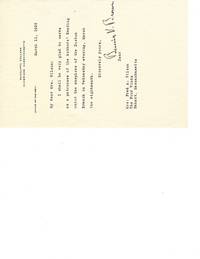
1915rif. 166841915. Bernice Veazey Brown born July 23 1823 d. 1983 in Calais Maine grew up in Providence Rhode Island. She entered Radcliffe in 1922 receiving her B.A. in 1916 her M.A. in 1918 and her P.h. D in 1920 specializing in government and international law. In 1915 and 1916 she won the Baldwin prize for essays pertaining to municipal government. From 1918 to 1920 she held a Carnegie Endowment International Law Fellowship. In 1920-1921 she was awarded a fellowship by the Commission for Relief in Belgium for advanced study in Brussels. Upon her return to the U.S. she was active in the School of Citizenship and Politics at Radcliffe. Brown was appointed Dean of Radcliffe College in 1923 when Ada Comstock became President. In 1934 she became Dean of the Radcliffe Graduate School a post she held until 1959. She married Leonard Wolsey Cronkhite on July 21 1933. She worked hard to promote the status of women graduate students at Radcliffe. One page 8"x 5 1/2" typed letter signed Bernice V. Brown Dean Radcliffe College Cambridge Massachusetts dated March 11 1925 to Mrs. Fred A. Wilson of Nahant Massachusetts. "My dear Mrs. Wilson: I shall be very glad to serve as patroness of the Author Reading under the auspices of the Boston Branch on Wednesday evening March the eighteenth. The author's reading was for the Association of American University Women a national organization that promotes equity for all women and girls lifelong education and positive social change. The AAUW offers scholarship action for gender equity and support for personal and professional growth community leadership and friendship. unknown books
1877rif. 163421877. Carpenter Mary autograph letter signed dated January 10 1877 documents Carpenter's support for women's participation in school governance during the final months of her life providing direct evidence of her work across women's education juvenile reform prison reform and public advocacy. Carpenter founded ragged schools and reformatories for poor children and young offenders in Bristol advocated for women's education engaged anti-slavery work and traveled to India where she examined schools prisons and female education. Carpenter Mary. Autograph Letter Signed to Alderman Mansfield. Bristol: Mary Carpenter 1877. January 10 1877. 1 page. Original mailing envelope and two obituaries of Carpenter are pasted into the volume. The letter congratulates Mansfield on the election of his wife to the School Board stating "Thanks for sending us the paper containing the very gratifying announcement of the election of Mrs. Mansfield.It is a grand triumph!" A note at the bottom signed M. P. Mansfield explains "This letter was written on the receipt of a paper containing the account of the election of my wife to the School Board." Written months before Carpenter's death in June 1877 the letter links her educational reform career to the expanding civic role of women in nineteenth-century Britain. A biography materially strengthened by Carpenter's own signed letter joining printed memorialization with direct manuscript presence from a major woman reformer. Condition not stated in the supplied description. Strong association copy documenting Carpenter's support for women's public educational authority. unknown books
1887rif. 164551887. Hughes Elizabeth Phillips. The Education of Welsh Women 1887 an early statement advocating improved educational opportunities for Welsh girls and women delivered at Cardiff in January 1887 during the first public meeting of the Association for Promoting the Education of Girls in Wales. Hughes then principal of the Cambridge Training College for Women was a leading advocate for women's secondary and higher education in Britain. Her address belongs to the organized campaign to improve girls' schooling in Wales during the years preceding the Welsh Intermediate Education Act of 1889 which established a framework for publicly supported secondary education. The pamphlet records Hughes's participation in a movement seeking greater educational provision for Welsh women and their inclusion in the country's developing educational institutions. Hughes Elizabeth P. The Education of Welsh Women. London: W. Speaight & Sons 1887. 8 pages. Original printed wrappers. The pamphlet contains the substance of Hughes's address at the Association's inaugural public meeting in Cardiff presenting the case for improved education for Welsh girls and women. Accompanied by a separate document titled The Education of Girls in Wales listing six pamphlets published by the Association for Promoting the Education of Girls in Wales. This accompanying publication identifies further printed material issued in support of the Association's educational campaign documenting its efforts to disseminate arguments for reform. Born in Carmarthen Hughes became the first principal of the Cambridge Training College for Women in 1884 an institution established to prepare women graduates for teaching careers and subsequently renamed Hughes Hall in her honor. She maintained a lifelong commitment to Welsh education later serving as secretary of the Association for Promoting the Education of Girls in Wales and helping establish a teachers' training college in Barry in 1914. She was also the only woman appointed to the committee responsible for drafting the original charter of the University of Wales. This 1887 address documents her early involvement in organized educational reform in Wales accompanied by a contemporary listing of the Association's other publications. Minor chipping to wrapper edges; otherwise in very good condition. unknown books
1841rif. 167561841. Women's Educational Movement. Rural Repository News Journal 1841 Poughkeepsie Female Academy Founding Story and Engraving. Large Item. Poughkeepsie Female Academy- Hudson NY. This news journal the "Rural Repository" leads with a full page story on the opening of the Poughkeepsie Female Academy and engravings. More than 30 years later Vassar College would open near the same site. Women's colleges proliferated in the mid- to late- 19th century to fill the void created by their exclusion from most institutions of higher education. The prevailing notion that women were too delicate for a rigorous academic education was openly challenged when Elizabeth Cady Stanton spoke at the Seneca Falls Convention of 1848 "Man's intellectual superiority cannot be a question until woman has had a fair trial.When we shall have had our colleges our professions our trades for a century a comparison then may be justly instituted." This document predates Seneca Falls by 7 years. unknown books
1891rif. 160751891. Wordsworth Elizabeth. William Wordsworth 1891 is an inscribed presentation copy from the educationalist who served as the first Principal of Lady Margaret Hall and founded St Hugh's Hall two institutions central to the establishment of women's higher education at Oxford. Great-niece of William Wordsworth she combined her literary work with direct responsibility for expanding women's access to Oxford study. She was selected as Lady Margaret Hall's first Principal in 1878; its first nine students arrived in 1879 when University lectures and examinations were still largely closed to women. In 1886 she founded St Hugh's Hall specifically for women unable to afford the fees charged by the existing women's halls initially accommodating four students in a house on Norham Road. Wordsworth Elizabeth. William Wordsworth. London: Percival 1891. Inscribed presentation copy "from the author." First edition. Wordsworth's study concerns her great-uncle the poet William Wordsworth and joins her work as a biographer and author to her place within the Wordsworth family. The presentation inscription gives this copy a direct association with its author. Its publication also coincided with a formative period in her educational career: by 1891 she was overseeing Lady Margaret Hall while St Hugh's founded five years earlier as her private educational venture was developing as a lower-cost route to Oxford study for women. When this volume appeared Oxford women could pursue increasingly advanced courses and examinations but could not become full members of the University or receive Oxford degrees; women gained those rights only in 1920. Wordsworth's educational work addressed both access and cost: Lady Margaret Hall was the first higher educational institution for women at Oxford while St Hugh's charged lower fees for students for whom the existing halls were financially inaccessible. Original dark blue cloth with gilt lettering slightly faded light soiling and small tears to spine panel. Overall very good. An author-inscribed first edition connecting Wordsworth's literary authorship and family history with her contemporary work establishing opportunities for women to study at Oxford. unknown books
1877rif. 167481877. Women's Education Movement. Goddard Seminary Catalog 1877. Pamphlet Catalog for the 1877 class of Goddard Seminary a coeducational school in Barre VT. Including the names of students. Goddard College began in 1863 in Barre Vermont as the Green Mountain Central Institute and in 1870 was renamed Goddard Seminary. Founded by Universalists Goddard Seminary was a four-year preparatory high school primarily for Tufts College. For many years the Seminary prospered. But the opening of many good public high schools made many of the New England academics obsolete. The trustees added a Junior College to the Seminary in 1935 and in 1938 Goddard College was chartered. It remains progressive Universalist institution. At the time that this description is being written no copies are recorded in American institutions. OCLC search results are at best an estimate and can vary over time. Women's Academy and Seminary Archive recording the first important movement of women into higher education in the United States seminary was synonymous with "academy" and did not have the religious connotation of today. In the 1800's the Female Academy and Seminary Movement transformed American educational norms allowing women the opportunity to receive secular non-religious college-level education. Women's colleges proliferated in the mid- to late- 19th century to fill the void created by their exclusion from most institutions of higher education. The prevailing notion that women were too delicate for a rigorous academic education was openly challenged when Elizabeth Cady Stanton spoke at the Seneca Falls Convention of 1848 "Man's intellectual superiority cannot be a question until woman has had a fair trial.When we shall have had our colleges our professions our trades for a century a comparison then may be justly instituted." Young women were quick to step up to the challenge; as quickly as female colleges opened they filled up. unknown books
1876rif. 167211876. Wakelee Cora B. Diary 1876 records a young Connecticut student's firsthand account of the Centennial Exposition alongside later entries documenting her high school achievements and social writing practices. The manuscript provides primary evidence of how a young woman experienced and interpreted the first official World's Fair held in the United States while also preserving the social and literary conventions of adolescent friendship in the late nineteenth century. The diary supports research into youth education gendered experience at national exhibitions and the integration of public spectacle into personal narrative. Wakelee Cora B. Diary. 1876-1881. Manuscript volume containing 48 handwritten pages including early entries partially overwritten with inscription "Cora B. Wakelee Huntington Conn. May 22 1876" on the front endpaper. The opening section details Wakelee's visit to the Philadelphia exposition describing exhibits with specificity: a large-scale model of Niagara Falls "160 ft long and 80 ft high" state buildings including a New England log house furnished with objects "100 years old or over" and displays of industrial production such as carpet weaving and tinware manufacturing. She records encounters with global and historical curiosities including "Egyptian mummies" horticultural specimens such as fig orange lemon and pineapple trees and commemorative objects tied to George Washington including his carriage and textile portraits. Later entries document her academic life including transcribed newspaper recognition of her spelling achievement and scholarship prizes. Pages 14 through 48 contain a substantial collection of short poems and inscriptions intended for autograph albums combining sentimental and humorous tones such as "Though short our acquaintance has been.Permit me to call you my friend" alongside moral reflections and religious wishes. The volume also includes original mourning verse for a deceased acquaintance "Mattie Otis passed away.She has gone yes gone forever" situating personal loss within poetic expression. The diary emerges from a period in which international expositions functioned as sites of national identity formation and technological display while expanding educational opportunities exposed young women to broader cultural experiences. Wakelee's account demonstrates how large-scale public events were absorbed into individual memory and recorded alongside everyday academic and social life. The inclusion of autograph album verses reflects widespread practices among students where poetry circulated as a medium of friendship and remembrance. Original leather boards; approximately 48 pages of manuscript content; measures 8 x 5 inches. Losses to spine and loose hinges; some toning throughout; good condition. A combined record of the 1876 exposition as experienced by a young attendee and of late nineteenth-century female student literary culture. unknown books
1862rif. 166581862. Women Education 19th Century Handwritten composition notebook of a young woman filled with poems and verses in many hands dating from 1862-1863. Includes poetry about studying for school examinations and writing compositions. 7 1/2 x 6 1/2 in. Original green boards. 78 pages full of handwritten poems and verses. Handwritten on front end page: "Katie E. Kimmens. Providence 11th Mo. 1862." "A week before Examination" "One has a headache one a cold One has her neck in flannel rolled; Ask the complaint and you are told 'Next week's examination'.One bangs the books then grasps them tight And studies morning noon and night As though she took some strange delight In these examinations/ The books are marred defaced and thumbed The brains with midnight tasks benumed Still all in that account is summed Next week's examinations" "Compositions" "Some have a lesson hard to get And have not even seen it yet Ask when what tis that makes them fret "Oh dear tis Composition Day"!/ One's last and cannot find her pen Another has no paper then The cause of this but ask of them And each in sighing tones will say "Oh dear tis Composition Day"!/ One rises with the morning light Takes up her pen begins to write; And seems to take some strange delight When e'er she hears a scholar say "Oh dear tis Composition Day"! Includes poems by well-known writers such as Lord Tennyson "St. Agnes Eve" and "Come Not When I Am Dead" Henry Wadsworth Longfellow "The Village Blacksmith" and Thomas Hood "The Bridge of Sighs". Also includes poems about the perils of war "The Soldier's Dream of Home" and the difficulty of losing a parent: "I cannot call her Mother" "The marriage rites are over And though I turned aside To keep the guests from seeing The tears I could not hide I . my face in smiling And led my little brother To greet my father's chosen But I could not call her Mother." Light toning to first page and occasional light stains throughout. Very good condition. unknown books
1881rif. 167551881. Women's Education Movement. New Hampshire Conference Seminary and Female College Catalog 1881. Tilton NH. The catalog has 36 pages of courses personnel and other information including tuition and fees. The most expensive were Piano and Voice Culture which were each $12 per semester. The seminary exists today at Tilton School. At the time that this description is being written no copies are recorded in American institutions. OCLC search results are at best an estimate and can vary over time. Women's Academy and Seminary Archive recording the first important movement of women into higher education in the United States seminary was synonymous with "academy" and did not have the religious connotation of today. In the 1800's the Female Academy and Seminary Movement transformed American educational norms allowing women the opportunity to receive secular non-religious college-level education. Women's colleges proliferated in the mid- to late- 19th century to fill the void created by their exclusion from most institutions of higher education. The prevailing notion that women were too delicate for a rigorous academic education was openly challenged when Elizabeth Cady Stanton spoke at the Seneca Falls Convention of 1848 "Man's intellectual superiority cannot be a question until woman has had a fair trial.When we shall have had our colleges our professions our trades for a century a comparison then may be justly instituted." Young women were quick to step up to the challenge; as quickly as female colleges opened they filled up. unknown books
1940rif. 160881940. Edith Reverend Mother. Autograph letter signed to William Nourse December 22 1940 records wartime conditions at Ascot Priory while its Anglican religious community operated St. Augustine's School for girls during the Blitz. Written three months into the German bombing campaign the letter describes bombs falling near the Priory quieter nights as Christmas approached and the financial strain affecting the institution's supporters. Ascot Priory was the mother house of the Society of the Most Holy Trinity an Anglican women's religious community whose work included nursing care of orphans and education; St. Augustine's School was among the schools operated by the sisters. Edith Reverend Mother. December 22 1940. Autograph letter signed to William Nourse on Ascot Priory letterhead Ascot Berkshire England. Writing three days before Christmas Edith acknowledges the continuing support of friends despite wartime hardship: "I appreciate the kindness of our friends more than ever this year for I know how much financially hit everyone is." Her Christmas wishes immediately turn to the war: "I do hope you will have as happy a Christmas is possible Xmas 1941 bring us peace!" She then gives a direct account of the danger experienced at Ascot: "We have had some bombs unpleasantly near but lately I am glad to say the nights have been much quieter." The letter was written during the Blitz when German aerial attacks on Britain had begun in September 1940 and would continue into May 1941. Ascot Priory had housed the Society of the Most Holy Trinity since the nineteenth century; its sisters maintained religious medical charitable and educational work including the care of girls at St. Christopher's Orphanage and instruction at St. Augustine's School. Edith's December 1940 letter records how that women-led institution continued during wartime through a concise firsthand account of nearby bombing strained finances and hopes for peace. Her remarks are especially immediate because they were written during the first winter of the Blitz rather than retrospectively after the war. No condition defects are specified in the supplied description. A contemporary account of the British home front from the woman responsible for an Anglican community and girls' school during the aerial campaign of 1940. unknown books
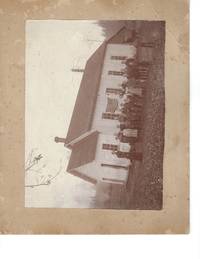
1890rif. 153931890. Rural school class photograph circa 1890 records a female teacher with approximately twenty students of varying ages outside their schoolhouse. The broad age range of the children and rural setting provide direct visual evidence of late nineteenth-century American schooling when rural teachers commonly instructed children of several ages within a single school. The school's name and location are unidentified preventing more specific claims about its district curriculum or organization. Albumen photograph on heavy backing circa 1890. Approximately twenty students pose outdoors with a young female teacher dressed in late nineteenth-century clothing. An American flag hangs prominently on the exterior wall of the schoolhouse. Behind the building is a substantial stack or load of firewood while trees surround the clearing and the distant wooded area appears hazy. The combination of schoolhouse pupils teacher flag and firewood records both the class and elements of the physical environment in which the school operated. The image preserves a rural educational setting before the widespread consolidation of small country schools into larger graded institutions during the twentieth century. Its mixed-age student body isolated wooded surroundings and visible supply of firewood provide concrete details of schooling and the maintenance of a rural school building in the late nineteenth century. Some age staining to the mount; photograph itself in very good condition. unknown books
1912rif. 153961912. Zwingle School classroom photograph 1912 documents teacher Guy Brouillard with approximately forty first- through eighth-grade students in the small agricultural community of Zwingle Iowa. The students are seated together in a single classroom recording the multigrade instruction characteristic of many rural American schools in the early twentieth century where one teacher could be responsible for children across several grade levels. The identified teacher school and grade range give the photograph unusually specific evidence of rural Iowa education during the Progressive Era. Original albumen photograph mounted on heavy card 1912. Image approximately 7 x 5 inches on original 10 x 8 inch mount. Approximately forty students occupy rows of cast-iron desks while Brouillard stands at the rear of the classroom. Visible furnishings and instructional materials include the students' desks and a large reference volume or teacher's manual resting on a dedicated bench at the front of the room. Clothing seating arrangements classroom fixtures and the placement of instructional materials preserve details of the physical environment in which children from first through eighth grade were taught. Captioned: "Guy Brouillard. Zwingle School. First to 8th Grade." The photograph records Zwingle School before twentieth-century school consolidation and expanded transportation contributed to the decline of small rural multigrade schools. Rather than illustrating rural education generically the contemporary caption connects the classroom to a named teacher a specific Iowa community and the full first-through-eighth-grade span taught there in 1912. These details permit the photograph to be used as evidence for the study of rural Iowa schooling childhood classroom organization and changes in public education during the early twentieth century. Some age toning and wear to mount; photograph remains in very good condition. unknown books
1868rif. 167531868. Women's Education Movement. Western Female Seminary Catalog 1868-1869. Oxford OH. Western Female Seminary was founded in 1853 as a daughter school of Mount Holyoke College in South Hadley Massachusetts. Its first principal Helen Peabody and most of the early faculty had been students and teachers at Mount Holyoke. Mary Lyon Residence Hall on the Western campus is named for Mount Holyok's founder Mary Lyon. It later received a charter and became Western College an all-female institution. Women's colleges proliferated in the mid- to late- 19th century to fill the void created by their exclusion from most institutions of higher education. The prevailing notion that women were too delicate for a rigorous academic education was openly challenged when Elizabeth Cady Stanton spoke at the Seneca Falls Convention of 1848 "Man's intellectual superiority cannot be a question until woman has had a fair trial.When we shall have had our colleges our professions our trades for a century a comparison then may be justly instituted." Young women were quick to step up to the challenge; as quickly as female colleges opened they filled up. At the time that this description is being written no copies are recorded in American institutions. OCLC search results are at best an estimate and can vary over time. Women's Academy and Seminary Archive recording the first important movement of women into higher education in the United States seminary was synonymous with "academy" and did not have the religious connotation of today. In the 1800's the Female Academy and Seminary Movement transformed American educational norms allowing women the opportunity to receive secular non-religious college-level education. Women's colleges proliferated in the mid- to late- 19th century to fill the void created by their exclusion from most institutions of higher education. The prevailing notion that women were too delicate for a rigorous academic education was openly challenged when Elizabeth Cady Stanton spoke at the Seneca Falls Convention of 1848 "Man's intellectual superiority cannot be a question until woman has had a fair trial.When we shall have had our colleges our professions our trades for a century a comparison then may be justly instituted." Young women were quick to step up to the challenge; as quickly as female colleges opened they filled up. unknown books
1839rif. 167601839. Early American Women's Education Movement. Catalog of the Officers and Members of The Seminary For Female Teachers. Salem Massachusetts. Printed at the Register Press. April 1839. Women's Academy and Seminary Archive recording the first important movement of women into higher education in the United States seminary was synonymous with "academy" and did not have the religious connotation of today-This is an important point but seems awkwardly placed. Maybe either use the phrase "into secular higher education" in first sentence or in next sentence say "In the 1800's the Female Academy and Seminary Movement transformed American educational norms allowing women the opportunity to receive secular non-religious college-level education Women's colleges proliferated in the mid- to late- 19th century to fill the void created by their exclusion from most institutions of higher education. The prevailing notion that women were too delicate for a rigorous academic education was openly challenged when Elizabeth Cady Stanton spoke at the Seneca Falls Convention of 1848 "Man's intellectual superiority cannot be a question until woman has had a fair trial.When we shall have had our colleges our professions our trades for a century a comparison then may be justly instituted." Young women were quick to step up to the challenge; as quickly as female colleges opened they filled up. This document dates 10 years before Seneca Falls. unknown books
1886rif. 167511886. Women's Educational Movement. Bradford Female Academy Catalog 1886. A catalog from one of the most important historical female academics. Contains names of current students and an outline of the curriculum. Bradford opened as the first coeducational institution in Massachusetts but due to overwhelming interest from parents of girls with no other options for education Bradford soon transitioned to become the first all-female academy in Massachusetts and among the first in the United States in 1836. At the time that this description is being written no copies are recorded in American institutions. OCLC search results are at best an estimate and can vary over time. Women's colleges proliferated in the mid- to late- 19th century to fill the void created by their exclusion from most institutions of higher education. The prevailing notion that women were too delicate for a rigorous academic education was openly challenged when Elizabeth Cady Stanton spoke at the Seneca Falls Convention of 1848 "Man's intellectual superiority cannot be a question until woman has had a fair trial.When we shall have had our colleges our professions our trades for a century a comparison then may be justly instituted." Young women were quick to step up to the challenge; as quickly as female colleges opened they filled up. unknown books
1905rif. 167101905. Handwritten project book from primary school student. Story of the Pilgrims. 1905. Child's notebooks with original yellow card-stock boards bound in green cloth. 7 in x 6 in. 17 handwritten pages. Gilt title on front cover and spine. Includes drawings and pasted images of Plymouth Rock Native Americans ships and others. Charming handwritten project book from a child at the turn of the century. Handwritten report on "The Story of the Pilgrims and the first Thanksgiving". "There was a King that sent all the people of England to go to the Church of England but there were some people that did not like that at all and sometime they had a little meeting in their cellar so that they went tot Holland and all the Holland people welcomed the Pilgrims and the Pilgrims stayed in Holland for two years. Then the Pilgrims went over to America in the boat called the Mayflower and the Speedwell but the Speedwell broke down so that all the Pilgrims and the people in Holland were so sorry to have them leave.they had a very hard time crossing the ocean. They landed on Plymouth Rock in 1620 4 days before Christmas. They saw a few Indians they said they had better always keep their guns with them. " The last page lists things to be thankful for: "We should be thankful for our homes and kind parents and our food for our nice things to with for clothes for flowers and for being well." Also includes report on Holland and a story about a girl named Gretchen. unknown books
1919rif. 165861919. Photograph album women's college student life 1919 to 1922 documents the lived experience of a young woman pursuing higher education in the years immediately following World War I when increasing numbers of women entered academic institutions and participated in structured campus life. The album centers on dormitory living peer networks and extracurricular activities providing direct evidence of how female students documented identity independence and social belonging within early twentieth-century educational environments. The material supports research into women's education student culture and the social history of American colleges in the interwar period. Album consists of 85 vernacular black and white silver gelatin photographs mounted across 23 pages with three additional loose prints primarily taken in Washington State between 1919 and 1922. Photographs range in size from approximately 2.5" x 1.5" to 5.5" x 3.5" housed in a volume measuring approximately 7" x 10.5" in original black cloth boards. Inscribed on the front pastedown: "From Papa Merrie Christmas 1921." Images depict dormitory interiors classmates and organized activities including social dances and boating excursions. Captions identify specific rooms and relationships including "Taken in my room '77' 1922" "Lookout Mt taken from my window '77'" "My old roommate of 1919 Room 44" and "Miss Fiddler Roommate 'Room 28' Summer School 1920." Additional annotations record impressions of peers including "A Good Kid" and humorous commentary such as "W.L. asleep after the dance Ha! Ha!" and "Do you think I look natural" A Harvard pennant displayed within one dormitory scene suggests aspirational or collegiate affiliation. The album also includes a photograph of a Home Economics class family scenes and several images referencing recent wartime experience including soldiers in uniform dated 1919. Created during a transitional period in American higher education the album illustrates how women students navigated expanding academic opportunities alongside established social expectations including domestic training and structured leisure. The inclusion of humor nicknames and detailed room identifications reflects the importance of spatial and social memory within collegiate life while references to wartime imagery situate the album within a generation shaped by recent global conflict. Such albums provide granular insight into daily routines interpersonal dynamics and the formation of female student identity in the early twentieth century. Minor wear to boards; photographs well-preserved with clear detail; overall in very good condition. unknown books
rif. 16337Carpenter Mary. Signed carte de visite portrait circa mid-1860s records the English educational and social reformer during the period in which her work on ragged schools reformatories prison conditions and female education had made her a prominent public advocate for institutional reform. Carpenter devoted much of her career to expanding educational opportunities for poor children and young offenders and argued that reformatory institutions should foster discipline education and personal improvement rather than rely solely on punishment. She was also active in anti-slavery work and later carried her educational and penal reform interests to India where she promoted female education reformatory schooling and prison reform. Albumen carte de visite photograph by T. R. Williams of London circa mid-1860s. A slip of paper bearing Carpenter's name in ink has been pasted across the lower margin of the mount. The portrait dates from a period when Carpenter was widely engaged in public speaking and reform work in Britain and abroad and the signed identification connects the image directly to the sitter rather than relying solely on later attribution. Carpenter's portrait belongs to the visual record of nineteenth-century women reformers whose public authority was built through lectures publications institutional work and transnational advocacy. Her campaigns linked educational access juvenile reform prison conditions women's education and anti-slavery activism across Britain and India. Condition not stated in the supplied description. unknown books
1856rif. 167261856. Cleveland Female Seminary Catalog 1856-1857 Cleveland OH. Founded by Rev. Eli N. Sawtell. Sawtell the seminary opened on 3 May 1854 an earlier enterprise by the same name had been established in April 1837. Located in a new $50000 building the school commanded a hefty $300 annual tuition. The seminary had 2 major departments Preparatory which admitted girls under 12 years of age and Academic for those over 12. Emphasis was placed on teaching both languages and science so students could over 12. Emphasis was placed on teaching both languages and science so that students could acquire a wholesome mental discipline. In 1865 a Telegraph Dept was established to provide instruction in the principles of telegraphy for students in natural philosophy and chemistry It was reincorporated in 1871 as the Cleveland Seminary for Girls at which time it acquired the rights and privileges of a college including the authority to grant degrees but closed in 1883. Not in OCLC Worldcat. Women's Academy and Seminary Archive recording the first important movement of women into higher education in the United States seminary was synonymous with "academy" and did not have the religious connotation of today-This is an important point but seems awkwardly placed. Maybe either use the phrase "into secular higher education" in first sentence or in next sentence say "In the 1800's the Female Academy and Seminary Movement transformed American educational norms allowing women the opportunity to receive secular non-religious college-level education Women's colleges proliferated in the mid- to late- 19th century to fill the void created by their exclusion from most institutions of higher education. The prevailing notion that women were too delicate for a rigorous academic education was openly challenged when Elizabeth Cady Stanton spoke at the Seneca Falls Convention of 1848 "Man's intellectual superiority cannot be a question until woman has had a fair trial.When we shall have had our colleges our professions our trades for a century a comparison then may be justly instituted." Young women were quick to step up to the challenge; as quickly as female colleges opened they filled up. This document dates less than a decade after Seneca Falls. At the time that this description is being written no copies are recorded in American institutions. OCLC search results are at best an estimate and can vary over time. Very rare. unknown books
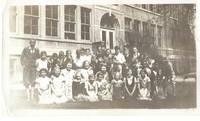
rif. 15401Moorhead School class photograph circa 1895-1905 records several African American students among approximately thirty predominantly white students outside an urban brick school building. The students appear to be of secondary-school age and pose together on the entrance steps beneath the school's name carved into the doorway. Dating approximately half a century before Brown v. Board of Education the image preserves visual evidence of Black and white students within the same Moorhead School group. The school's location is not identified in the supplied information preventing determination of the local laws admissions policies or other circumstances governing their attendance. Original silver gelatin photograph circa 1895-1905 approximately 3 x 5 inches. Approximately thirty students stand in several rows on the steps of the brick schoolhouse. Several African American students are visible among the group. Clothing worn by the young men and women supports the supplied turn-of-the-century dating. Architectural details include the substantial brick façade and entrance with "Moorhead School" carved above the doorway providing an internal identification of the institution even though its city or state remains unknown. The photograph predates the Supreme Court's 1954 Brown v. Board of Education decision by approximately fifty years. Educational segregation and access for Black students differed according to state and locality during this period so the photograph does not by itself establish that Moorhead School maintained a formal policy of racial integration. It does document several African American students participating in this predominantly white school group and preserves the school's name within the image offering a potential basis for further identification of the institution and its educational history. Very good condition. unknown books
1877rif. 160891877. Forster William Edward. Autograph letter signed to Miss Vernon October 22 1877 concerns girls' participation in an educational competition and specifically asks whether daughters of working men would be represented. The letter was written seven years after Forster introduced the Elementary Education Bill of 1870 the first legislation devoted specifically to educational provision across England and Wales; the resulting Act established elected school boards empowered to provide schools where existing provision was inadequate. Forster's questions to Miss Vernon extend beyond the mechanics of the competition to its social composition culminating in the pointed inquiry "Are there any daughters of working men" Forster William Edward. October 22 1877. Autograph letter signed to Miss Vernon. Two pages 8vo. Wharfeside Burley-in-Wharfedale Leeds. Forster thanks Miss Vernon for her note and requests material concerning an examination: "Any printed documents you may have bearing on the Examination would be really useful to me." He then writes "I am delighted to find I shall give a prize to my friend Mr Smith's daughter" before asking about the range of entrants: "I suppose all classes will be represented at the competition. Are there any daughters of working men" The questions document Forster's interest in both female participation and the class composition of an educational competition while his request for printed documents indicates that he intended to examine its organization or results more closely. Forster's inquiry belongs to the decade in which access to elementary schooling was being substantially reorganized in England and Wales. The 1870 Act authorized locally elected boards to establish and manage schools where additional provision was required although universal compulsory attendance was not established by that Act; further legislation in 1876 strengthened parental obligations concerning children's education and nationwide compulsory attendance followed in 1880. Written during this transition Forster's question about "daughters of working men" records his attention to whether an educational competition crossed both gender and class boundaries rather than merely attracting girls from socially advantaged families. No condition defects are specified in the supplied description. A signed letter connecting the principal architect of the 1870 Education Act with the practical question of girls' and working-class participation in education seven years after its passage. unknown books
1873rif. 167491873. Women's Education Movement. Moravian Seminary Catalog 1873-1874. The Moravian Seminary traces its roots to the earliest institution of female education in the United States the Bethlehem Female Seminary founded in 1742 by Countess Benigna Zinzendorf. Originally providing only primary school the Bethlehem responded to demand for higher education for women in 1785 when it reorganized as a secondary educational institution that became known as the Moravian Female Seminary. In 1913 the Seminary officially became a College and in 1954 merged with a male institution to become the coeducational Moravian College. At the time that this description is being written only one copy is recorded in American institutions. OCLC search results are at best an estimate and can vary over time. Women's Academy and Seminary Archive recording the first important movement of women into higher education in the United States seminary was synonymous with "academy" and did not have the religious connotation of today. In the 1800's the Female Academy and Seminary Movement transformed American educational norms allowing women the opportunity to receive secular non-religious college-level education. Women's colleges proliferated in the mid- to late- 19th century to fill the void created by their exclusion from most institutions of higher education. The prevailing notion that women were too delicate for a rigorous academic education was openly challenged when Elizabeth Cady Stanton spoke at the Seneca Falls Convention of 1848 "Man's intellectual superiority cannot be a question until woman has had a fair trial.When we shall have had our colleges our professions our trades for a century a comparison then may be justly instituted." Young women were quick to step up to the challenge; as quickly as female colleges opened they filled up. unknown books
1927rif. 166041927. Leslie Reva C. My Memories of School Days album and photograph scrapbook 1923-1927 documents female student life social networks and extracurricular culture at Lincoln High School in Los Angeles during the 1920s. The material captures daily experiences of a young woman engaged in school activities including dances athletics and clubs while also preserving peer relationships through inscriptions photographs and ephemera. The album provides direct evidence of how young women recorded and interpreted their social and educational environments in an urban West Coast setting during the interwar period. Leslie Reva C. My Memories of School Days Album. New York: C. R. Gibson & Company 1924. Photograph and scrapbook album containing 73 gelatin silver print photographs in sizes ranging from approximately 1 x 1 inch to 5 x 7 inches accompanied by 14 handwritten inscriptions from friends 3 extended manuscript entries by Leslie 2 newspaper clippings referencing her as a student 11 ticket stubs from Los Angeles-area school events and performances dated 1923-1924 and decorative elements including hand-colored Kewpie cutouts. The photographs depict Leslie and classmates in a variety of settings including large class portraits with individuals identified Leslie marked as "me" beach outings theatrical productions athletic activities such as girls playing hockey in uniform and informal groupings labeled with captions such as "Three of a kind" and "one of the three musketeers." Manuscript entries describe participation in dances parties and school organizations including reference to her role as Secretary and designation as "Captain" of the Girls Reserves. Inscriptions from peers emphasize close friendships and shared social life with messages recalling "parties dances and everywhere we went" while one later inscription reflects a post-graduation relationship revised to read "To the Dearest Wife." The album documents a period in which American high schools expanded social and extracurricular programming particularly for young women integrating athletics clubs and organized events into student life. The inclusion of ticket stubs photographs and written reflections illustrates how these activities structured social identity and peer relationships. The setting in Los Angeles further situates the material within a rapidly growing urban environment in the 1920s where public schooling played a central role in shaping youth culture. Green cloth boards with moderate handling wear; contents complete with minor edge wear to pages and photographs; overall very good condition. A detailed and cohesive record of female high school experience and social life in early twentieth-century California. unknown books