82 232 résultats
2000réf. mon0003765829National Academies Press 4/21/2025 12:00:01 A. paperback. Very Good. . Cover and edges may have some wear. National Academies Press paperback
2000réf. mon0003764791National Academies Press 4/21/2025 12:00:01 A. paperback. Like New. . National Academies Press paperback
2000réf. mon0003765796National Academies Press 4/21/2025 12:00:01 A. paperback. Very Good. . National Academies Press paperback
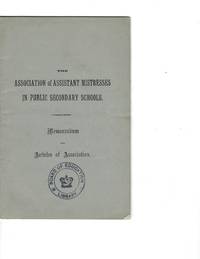
1897réf. 164571897. Association of Assistant Mistresses in Public Secondary Schools. Memorandum and Articles of Association 1897 the constitutional document formalizing an organization created by women secondary teachers to represent their professional and employment interests in Britain. Founded in 1884 the Association of Assistant Mistresses developed as a national body advocating for women employed below the headmistress level in secondary schools and was incorporated in 1897 the year of the present publication. Contemporary descriptions later emphasized that it was founded and organized by women teachers themselves and participated in official bodies concerned with secondary education. The document therefore records the institutional system through which female teachers organized collectively defined their governing structure and developed an independent professional voice providing primary-source evidence for the study of women's employment teaching as a profession labor organization and gender within British secondary education. Association of Assistant Mistresses in Public Secondary Schools. Memorandum and Articles of Association. London: Printed by Charles North The Blackheath Press S.E. 1897. Pagination dimensions and binding beyond the surviving format are not supplied. As a memorandum and articles of association issued in the year the organization was incorporated the publication established the formal framework under which the Association operated. The organization had been formed specifically to promote the interests of women teachers in secondary schools and later participated alongside the associations of headmistresses headmasters and assistant masters in collective representation of the secondary teaching profession. The pamphlet consequently demonstrates the mechanism by which women teachers moved beyond individual employment relationships toward organized professional representation establishing an institutional structure capable of addressing working conditions educational policy and the collective interests of its membership. The Association's incorporation in 1897 belongs to a broader late nineteenth-century expansion of women's professional organization as increased access to secondary education created growing numbers of salaried teaching positions for women. Its subsequent longevity underscores the importance of the structure codified here: the Association continued through the twentieth century ultimately reaching tens of thousands of members before merging with the Assistant Masters' Association in 1978. Ex-library copy with institutional stamp and pencil notation on the first page; otherwise no specific defects supplied; overall very good. A substantive organizational document showing women secondary teachers establishing the legal and administrative machinery through which they could collectively represent their professional interests at the close of the nineteenth century. unknown
1841réf. 167561841. Women's Educational Movement. Rural Repository News Journal 1841 Poughkeepsie Female Academy Founding Story and Engraving. Large Item. Poughkeepsie Female Academy- Hudson NY. This news journal the "Rural Repository" leads with a full page story on the opening of the Poughkeepsie Female Academy and engravings. More than 30 years later Vassar College would open near the same site. Women's colleges proliferated in the mid- to late- 19th century to fill the void created by their exclusion from most institutions of higher education. The prevailing notion that women were too delicate for a rigorous academic education was openly challenged when Elizabeth Cady Stanton spoke at the Seneca Falls Convention of 1848 "Man's intellectual superiority cannot be a question until woman has had a fair trial.When we shall have had our colleges our professions our trades for a century a comparison then may be justly instituted." This document predates Seneca Falls by 7 years. unknown books
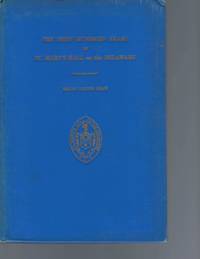
1936réf. 155971936. Shaw Helen Louise. The First 100 Years of St. Mary's Hall on the Delaware 1936 documents the development of St. Mary's Hall in Burlington New Jersey from its 1837 establishment by Episcopal Bishop George Washington Doane through nearly a century of education for girls and young women. Doane acquired an existing girls' school and established St. Mary's Hall under Episcopal direction; the institution became closely associated with the expansion of advanced female education in nineteenth-century New Jersey. Shaw traces the school's founding principles administrative leadership students curriculum religious instruction and physical growth along the Delaware River recording how an Episcopal institution organized academic and religious education for women across successive generations. The history consequently preserves evidence of the administration and educational practices of a long-lived denominational girls' school during a period in which opportunities for women's advanced education expanded substantially in the United States. Shaw Helen Louise. The First 100 Years of St. Mary's Hall on the Delaware. 1936. Written in connection with the school's centennial period the volume follows St. Mary's Hall from its founding in 1837 and describes the institutional mechanisms through which its educational program developed: governance curriculum faculty and administrative leadership student life religious instruction and campus expansion. Shaw's account records the Episcopal conception of female education as both intellectual and religious training and supplies an institutional history against which changes in American girls' schooling during the nineteenth and early twentieth centuries can be examined. As a retrospective history produced nearly a century after the school's founding it is particularly relevant as documentation of how St. Mary's Hall understood and recorded its own educational history by the 1930s. St. Mary's Hall belongs to the nineteenth-century expansion of organized secondary and advanced schooling for American women and its establishment under Bishop Doane in 1837 places its history within both women's education and the Episcopal Church's educational activity in the United States. Shaw's century-long chronology preserves names administrative developments curricular practices and changes to the Burlington campus that permit the institution's development to be followed beyond its founding claims. Light toning to endpapers and faint wear to extremities; otherwise clean and sound. Overall very good. A substantial institutional history documenting nearly a century of Episcopal education for girls and young women in Burlington New Jersey. unknown books
1911réf. 156061911. Burstall Sara A. The Story of the Manchester High School for Girls 1911 records the founding and development of Manchester High School for Girls established in 1874 by nine Manchester men and women seeking expanded educational opportunities for girls. First opened in Chorlton on Medlock under headmistress Elizabeth Day the school developed during a period of substantial change in British secondary and higher education for women. Its founders included Professor A. S. Wilkins Harriet Darbishire Robert Dukinfield Darbishire and Edward Donner later Sir Edward Donner among prominent Manchester citizens associated with the undertaking. Burstall wrote from direct institutional experience: she succeeded Day as headmistress in 1898 and also served as Special Lecturer in Education at the University of Manchester. Burstall Sara A. The Story of the Manchester High School for Girls. Manchester: Manchester University Press 1911. First edition. The history follows the school from its establishment in 1874 through its subsequent development including the move to a purpose-built school in Dover Street in 1881. Burstall records the people responsible for establishing and administering the institution and the development of a girls' school within Manchester's expanding educational environment. Her position as headmistress gives the volume a direct institutional perspective on the governance and educational development of a school founded specifically for girls. The school's history belongs to the nineteenth-century expansion of organized secondary education for British girls and to Manchester's development as a center of educational reform. Its progression from the original Chorlton on Medlock premises to the Dover Street building records the physical expansion of an institution established when girls' secondary schooling was undergoing substantial change in Britain. The Dover Street building later became part of the University of Manchester estate occupied by its School of Social Sciences. Red cloth boards with minor staining. Overall good condition. Burstall's account preserves the school's early history through the perspective of the headmistress who led it from 1898. unknown books
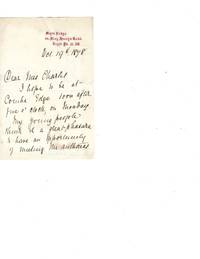
1874réf. 160221874. Buss Frances Mary autograph letter signed to Elizabeth Rundle Charles records a personal exchange between a leading campaigner for British girls' secondary education and the author of The Chronicles of the Schönberg Cotta Family. Founder of the North London Collegiate School in 1850 Buss developed an academically demanding curriculum and supported external examinations that could demonstrate girls' capacity for advanced study; North London Collegiate pupils later prepared for University of London and Cambridge examinations. Her letter to Charles provides a more personal record of that educational work through Buss's pupils whom she describes as eager to meet an author whose writing they knew. Buss Frances Mary. October 19 no year. Autograph letter signed to Elizabeth Rundle Charles. Two sides 8vo. Myre Lodge 89 King Henry's Road Regent's Park. Buss hopes to be "at Combe Edge soon after five o'clock" and tells Charles "My young people think it a great pleasure to have an opportunity of meeting the authoress of the Schonberg Cotta family." She also writes that she is deeply touched "to hear your kind expressions about the two persons dearest in life to me!" The recipient Elizabeth Rundle Charles was the author of The Chronicles of the Schönberg Cotta Family a historical novel centered on Martin Luther and the Reformation. Buss's reference to "my young people" connects the correspondence directly with her work as a headmistress and records her pupils' engagement with a contemporary woman writer. Buss's educational career belonged to the nineteenth-century campaign to establish academically rigorous secondary schooling for girls and to secure their access to the examinations and higher education increasingly available to men. The University of London admitted women to degrees on equal terms with men in 1878 while North London Collegiate students were among the girls prepared for university examinations during Buss's headship. The letter documents the literary culture surrounding Buss's pupils through their anticipated meeting with Charles rather than addressing educational reform directly. Small tear repaired; otherwise condition not further specified. A personal letter linking Frances Mary Buss's school circle with a prominent nineteenth-century woman author and the reading interests of her pupils. unknown books
1891réf. 160751891. Wordsworth Elizabeth. William Wordsworth 1891 is an inscribed presentation copy from the educationalist who served as the first Principal of Lady Margaret Hall and founded St Hugh's Hall two institutions central to the establishment of women's higher education at Oxford. Great-niece of William Wordsworth she combined her literary work with direct responsibility for expanding women's access to Oxford study. She was selected as Lady Margaret Hall's first Principal in 1878; its first nine students arrived in 1879 when University lectures and examinations were still largely closed to women. In 1886 she founded St Hugh's Hall specifically for women unable to afford the fees charged by the existing women's halls initially accommodating four students in a house on Norham Road. Wordsworth Elizabeth. William Wordsworth. London: Percival 1891. Inscribed presentation copy "from the author." First edition. Wordsworth's study concerns her great-uncle the poet William Wordsworth and joins her work as a biographer and author to her place within the Wordsworth family. The presentation inscription gives this copy a direct association with its author. Its publication also coincided with a formative period in her educational career: by 1891 she was overseeing Lady Margaret Hall while St Hugh's founded five years earlier as her private educational venture was developing as a lower-cost route to Oxford study for women. When this volume appeared Oxford women could pursue increasingly advanced courses and examinations but could not become full members of the University or receive Oxford degrees; women gained those rights only in 1920. Wordsworth's educational work addressed both access and cost: Lady Margaret Hall was the first higher educational institution for women at Oxford while St Hugh's charged lower fees for students for whom the existing halls were financially inaccessible. Original dark blue cloth with gilt lettering slightly faded light soiling and small tears to spine panel. Overall very good. An author-inscribed first edition connecting Wordsworth's literary authorship and family history with her contemporary work establishing opportunities for women to study at Oxford. unknown books
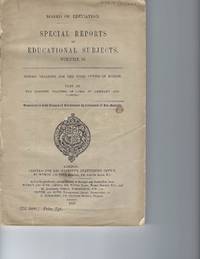
1907réf. 164981907. Great Britain Board of Education. School Training for the Home Duties of Women. Part III. The Domestic Training of Girls in Germany and Austria 1907. British government report examining women's domestic education in Germany and Austria during the early twentieth-century expansion of vocational and secondary schooling for girls. Written by M. Cecile Matheson the study documents the curricula and organization of housewifery schools while addressing growing demands to extend women's education beyond household management into social legal and economic subjects. Particularly concerned with the education of middle- and upper-class women the report records contemporary efforts to broaden domestic training into a more comprehensive course of intellectual and practical instruction. Great Britain Board of Education. Special Reports on Educational Subjects. School Training for the Home Duties of Women. Part III. The Domestic Training of Girls in Germany and Austria. London: Printed for His Majesty's Stationery Office 1907. Volume 19 of the Board's Special Reports on Educational Subjects series issued in original printed paper wrappers. The report examines domestic training in German and Austrian schools with an appendix containing statistical tables detailing the institutions studied. Its discussion of educational reform identifies a demand for instruction extending beyond practical housewifery: ".there has been a demand for linking the training in the practical arts of the home to a study of the the many social legal and economic problem which affect home life and indeed any kind of institutional life in their relation to the general life of the people." Published as British educational authorities investigated foreign approaches to domestic science and vocational instruction the report records debates over the responsibilities and educational opportunities of women in pre-First World War Europe. Its examination of German and Austrian institutions provides comparative evidence of the relationship between women's schooling social class household economics and emerging expectations for female education. Some wear to spine. Ex-library copy. Very good condition. unknown books
1893réf. 155941893. Brackett Anna C. Woman and the Higher Education 1893 brings together nineteenth-century arguments for expanding women's education at a time when women's access to colleges and professional life remained a subject of sustained public debate. Edited by educator and philosopher Anna Callender Brackett 1836-1911 the volume traces changes in American arguments for women's intellectual training from Emma Willard's 1819 appeal for female education through essays by women teaching and administering colleges by the 1880s and 1890s. Brackett presents this progression explicitly in her preface contrasting Willard's appeal to male legislators in 1819 with Maria Mitchell's later demand for the "enlightenment of our present rulers." The collection documents the development of arguments for women's intellectual independence collegiate education and participation beyond the domestic sphere. Brackett Anna C. ed. Woman and the Higher Education. New York: Harper & Brothers 1893. First edition. The volume collects seven essays spanning 1819 to 1892: Emma Willard's "A Plan for Improving Female Education"; Emma C. Embury's "Female Education"; Maria Mitchell's "The Collegiate Education of Girls"; Lucia Gilbert Runkle's "A New Knock at an Old Door"; Alice Freeman Palmer's "A Review of the Higher Education of Women"; Lucy Maynard Salmon's "The Teaching of History in Academies and Colleges"; and Brackett's "The Private School for Girls." Willard argues for women as an "essential part of the body politic" while the later contributions document a changed educational landscape in which women served as college professors and presidents. Brackett herself had previously addressed the intellectual consequences of restricting women to domestic life and defended education as necessary to women's moral and intellectual development independence and participation in public life. Published near the end of a century in which American women moved from campaigns for female seminaries toward established collegiate education Woman and the Higher Education preserves arguments made across more than seventy years by women directly involved in that transformation. Brackett was also a translator of Karl Rosenkranz's educational philosophy and a contributor to The Education of American Girls and her editorial work here places her own writing beside that of Mitchell Palmer Salmon Willard Embury and Runkle. The sequence permits direct comparison between early appeals for women's schooling and later discussions of collegiate instruction academic disciplines and the education of girls. Good condition. unknown books
1877réf. 160891877. Forster William Edward. Autograph letter signed to Miss Vernon October 22 1877 concerns girls' participation in an educational competition and specifically asks whether daughters of working men would be represented. The letter was written seven years after Forster introduced the Elementary Education Bill of 1870 the first legislation devoted specifically to educational provision across England and Wales; the resulting Act established elected school boards empowered to provide schools where existing provision was inadequate. Forster's questions to Miss Vernon extend beyond the mechanics of the competition to its social composition culminating in the pointed inquiry "Are there any daughters of working men" Forster William Edward. October 22 1877. Autograph letter signed to Miss Vernon. Two pages 8vo. Wharfeside Burley-in-Wharfedale Leeds. Forster thanks Miss Vernon for her note and requests material concerning an examination: "Any printed documents you may have bearing on the Examination would be really useful to me." He then writes "I am delighted to find I shall give a prize to my friend Mr Smith's daughter" before asking about the range of entrants: "I suppose all classes will be represented at the competition. Are there any daughters of working men" The questions document Forster's interest in both female participation and the class composition of an educational competition while his request for printed documents indicates that he intended to examine its organization or results more closely. Forster's inquiry belongs to the decade in which access to elementary schooling was being substantially reorganized in England and Wales. The 1870 Act authorized locally elected boards to establish and manage schools where additional provision was required although universal compulsory attendance was not established by that Act; further legislation in 1876 strengthened parental obligations concerning children's education and nationwide compulsory attendance followed in 1880. Written during this transition Forster's question about "daughters of working men" records his attention to whether an educational competition crossed both gender and class boundaries rather than merely attracting girls from socially advantaged families. No condition defects are specified in the supplied description. A signed letter connecting the principal architect of the 1870 Education Act with the practical question of girls' and working-class participation in education seven years after its passage. unknown books
1925réf. 162981925. Truro Cornwall Teacher Training College Photo Album 1925-1927 records the daily lives and friendships of women training for professional teaching careers at Truro Diocesan Training College in Cornwall. Founded in the nineteenth century specifically to train women teachers the college remained in operation until 1938. Across 164 snapshots students appear on outings and picnics pose individually and in groups and visit sites around Cornwall with handwritten captions identifying people activities and private jokes. "Help yourself to the cream" accompanies one excursion while "the long and short of it" captions a portrait of a tall young woman. Created during a period when women teachers received lower salaries than men and some local education authorities required women to resign upon marriage the album records the social world of young women preparing to enter a profession in which employment offered economic independence but remained subject to explicitly gendered restrictions. Truro Cornwall UK 1925-1927. 164 glossy-finish snapshot photographs both black-and-white and sepia in several formats including 3½ x 5½ 2½ x 4½ and 3½ x 2½ inches. Most photographs are captioned in white ink. The images concentrate on the women themselves rather than formal classroom instruction: students pose together take excursions and picnics and appear individually in informal portraits interspersed with views of Cornwall and its architecture. These captions preserve the students' own language for their experiences and companions giving the album a personal record distinct from official college registers or administrative documentation. Oblong octavo album in bradbound brown boards patterned to resemble leather with "Album" stamped in gilt on front board. The album dates from a consequential period in the professional organization of British women teachers. The National Union of Women Teachers campaigned against women's lower salaries and the marriage bars maintained by numerous local education authorities; women's salaries under the Burnham scale were set below those of men while marriage could require a teacher to leave her post. The marriage bar was not universal in application-contemporary records document differences among local authorities-and it was abolished nationally by the Education Act of 1944. Against that background these informal photographs preserve the period immediately preceding professional life: women living and training with other prospective teachers traveling through Cornwall and recording one another outside the institutional documentation that ordinarily survives from teacher-training colleges. Modest rubbing at front hinge and slight bumping to corners; some photographs slightly warped from mounting with occasional fingerprint residue. Overall very good condition. A substantial visual record of women's teacher training and student life in interwar Cornwall preserving 164 privately captioned images from a college established specifically for the training of women teachers. unknown books
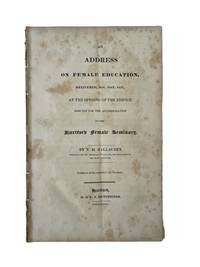
1827réf. 182321827. Gallaudet Thomas Hopkins. An Address on Female Education at the Opening of the Edifice Erected for the Accommodation of the Hartford Female Seminary 1827 presents an early nineteenth-century argument for expanding women's education delivered in connection with the institution founded by educator Catharine E. Beecher in 1823. Gallaudet best known as a founder and principal of the American Asylum for the Education and Instruction of the Deaf and Dumb in Hartford addressed women's intellectual development while acknowledging the political and professional restrictions imposed upon them. He writes: "Woman cannot plead at the bar or preach in the pulpit or thunder in the senate house. yet hers is no trifling eloquence. Its power though unostentatious in display is mighty in result." Gallaudet Thomas Hopkins. An Address on Female Education at the Opening of the Edifice Erected for the Accommodation of the Hartford Female Seminary. Hartford: H. and F. J. Huntington 1827. 34 pages. 5 x 8.25 inches. The address was prepared for the opening of a new building for the Hartford Female Seminary connecting Gallaudet's discussion of women's education to a specific institutional expansion. Beecher had founded the seminary four years earlier to provide young women with advanced educational opportunities at a time when access to comparable schooling remained sharply restricted by sex. The address belongs to the antebellum expansion of female seminaries and academies that enlarged women's access to formal education before women were broadly admitted to American colleges and universities. Its language also records the limitations within which advocates framed female education: Gallaudet argues for women's intellectual and rhetorical influence while explicitly identifying the law ministry and legislature as male domains. Foxing throughout; wrappers missing; text block clean and intact. Overall good condition. The address documents both the expansion of educational opportunities for American women and the gendered boundaries that continued to define arguments for female education in the 1820s. unknown books
1854réf. 165031854. Hale Sarah Josepha Woman's Record 1855 is a major nineteenth-century biographical dictionary of women by the editor of Godey's Lady's Book supporting research into women's education female authorship historical memory and the construction of women's achievement in antebellum American print culture. Hale described her purpose as preparing "a comprehensive and accurate record of what women have accomplished" and the volume gathers women's lives into a reference work meant to argue for women's intellectual and moral influence. Hale Sarah Josepha. Woman's Record; or Sketches of All Distinguished Women from Creation to A.D. 1854. New York: Harper & Brothers Publishers 1855. Second edition revised with additions. 1 volume. 900 pages. Illustrated with 239 wood-engraved portraits by Lossing and Barritt including frontispiece portrait of Hale. Original hardcover with gilt title and spine decoration. 4to 10 x 7 inches. The book includes entries on more than a thousand women across history literature religion politics reform and public life. The volume belongs to Hale's broader editorial program as one of the most influential women editors in the United States; she edited Godey's Lady's Book for decades promoted women's education supported women writers and campaigned for a national Thanksgiving holiday which Abraham Lincoln proclaimed in 1863. Extremities lightly worn with light foxing on first pages; very good. Substantial illustrated reference work documenting how women's historical authority was collected organized and defended in mid-nineteenth-century America. unknown books
1903réf. 180101903. Association of Head Mistresses. List of Public Secondary Schools for Girls 1903 and 1905 records the geographic extent of secondary schooling available to girls in Britain during the early twentieth-century expansion of women's education. Founded in 1874 by Frances Mary Buss and other headmistresses of endowed and proprietary schools the Association developed from efforts to improve the standards and institutional position of girls' secondary education. These two successive lists arrange schools by county providing contemporary evidence of where public secondary education for girls was available and allowing comparison across localities and between the two publication years. Their dates follow three decades in which girls gained broader access to academically oriented schools and universities although educational equality remained contested; in 1897 Cambridge rejected a proposal granting women the titles of degrees followed by riotous celebrations by male undergraduates. Women were not admitted to full membership of Cambridge until 1948. Two pamphlets issued by the Association of Head Mistresses dated 1903 and 1905 each measuring 8.5 x 5.5 inches. Soft blue covers are printed "One Shilling Published by the Educational Supply Association 42 Holborn Viaduct E.C." Entries within each pamphlet are organized by county and identify public secondary schools open to girls at the time of publication. The format turns the changing institutional landscape of girls' education into a contemporary directory recording individual schools by place rather than describing educational reform retrospectively. Both front covers bear stamps reading "Board of Education Library" and "Supplied Public Service" each incorporating the royal crown; the back covers retain red "Board of Education Reference Library" stickers. These official library markings document their presence within a government educational reference collection. 1 Association of Head Mistresses. List of Public Secondary Schools for Girls. London: Educational Supply Association 1903. Arranged geographically by county the pamphlet enumerates secondary schools then available to girls and provides a contemporary reference point for the distribution of female secondary education at the beginning of the Edwardian period. Its Board of Education Library markings also preserve evidence of institutional reference use. 2 Association of Head Mistresses. List of Public Secondary Schools for Girls. London: Educational Supply Association 1905. Issued two years after the first pamphlet this updated county-by-county listing permits direct comparison of the provision of girls' secondary schools between 1903 and 1905. The directory appeared during the continuing expansion of educational opportunities that connected secondary schooling with women's increasing access to higher education; the University of London had begun awarding degrees to women on equal terms with men in 1878 while access elsewhere remained uneven. Textblocks tight bright and clean. Both pamphlets overall very good condition. The consecutive editions preserve a measurable record of girls' secondary education by county at a time when women educators and school leaders were establishing institutions capable of preparing girls for examinations professional training and higher education. unknown books
1868réf. 167531868. Women's Education Movement. Western Female Seminary Catalog 1868-1869. Oxford OH. Western Female Seminary was founded in 1853 as a daughter school of Mount Holyoke College in South Hadley Massachusetts. Its first principal Helen Peabody and most of the early faculty had been students and teachers at Mount Holyoke. Mary Lyon Residence Hall on the Western campus is named for Mount Holyok's founder Mary Lyon. It later received a charter and became Western College an all-female institution. Women's colleges proliferated in the mid- to late- 19th century to fill the void created by their exclusion from most institutions of higher education. The prevailing notion that women were too delicate for a rigorous academic education was openly challenged when Elizabeth Cady Stanton spoke at the Seneca Falls Convention of 1848 "Man's intellectual superiority cannot be a question until woman has had a fair trial.When we shall have had our colleges our professions our trades for a century a comparison then may be justly instituted." Young women were quick to step up to the challenge; as quickly as female colleges opened they filled up. At the time that this description is being written no copies are recorded in American institutions. OCLC search results are at best an estimate and can vary over time. Women's Academy and Seminary Archive recording the first important movement of women into higher education in the United States seminary was synonymous with "academy" and did not have the religious connotation of today. In the 1800's the Female Academy and Seminary Movement transformed American educational norms allowing women the opportunity to receive secular non-religious college-level education. Women's colleges proliferated in the mid- to late- 19th century to fill the void created by their exclusion from most institutions of higher education. The prevailing notion that women were too delicate for a rigorous academic education was openly challenged when Elizabeth Cady Stanton spoke at the Seneca Falls Convention of 1848 "Man's intellectual superiority cannot be a question until woman has had a fair trial.When we shall have had our colleges our professions our trades for a century a comparison then may be justly instituted." Young women were quick to step up to the challenge; as quickly as female colleges opened they filled up. unknown books
1881réf. 167551881. Women's Education Movement. New Hampshire Conference Seminary and Female College Catalog 1881. Tilton NH. The catalog has 36 pages of courses personnel and other information including tuition and fees. The most expensive were Piano and Voice Culture which were each $12 per semester. The seminary exists today at Tilton School. At the time that this description is being written no copies are recorded in American institutions. OCLC search results are at best an estimate and can vary over time. Women's Academy and Seminary Archive recording the first important movement of women into higher education in the United States seminary was synonymous with "academy" and did not have the religious connotation of today. In the 1800's the Female Academy and Seminary Movement transformed American educational norms allowing women the opportunity to receive secular non-religious college-level education. Women's colleges proliferated in the mid- to late- 19th century to fill the void created by their exclusion from most institutions of higher education. The prevailing notion that women were too delicate for a rigorous academic education was openly challenged when Elizabeth Cady Stanton spoke at the Seneca Falls Convention of 1848 "Man's intellectual superiority cannot be a question until woman has had a fair trial.When we shall have had our colleges our professions our trades for a century a comparison then may be justly instituted." Young women were quick to step up to the challenge; as quickly as female colleges opened they filled up. unknown books
1873réf. 167491873. Women's Education Movement. Moravian Seminary Catalog 1873-1874. The Moravian Seminary traces its roots to the earliest institution of female education in the United States the Bethlehem Female Seminary founded in 1742 by Countess Benigna Zinzendorf. Originally providing only primary school the Bethlehem responded to demand for higher education for women in 1785 when it reorganized as a secondary educational institution that became known as the Moravian Female Seminary. In 1913 the Seminary officially became a College and in 1954 merged with a male institution to become the coeducational Moravian College. At the time that this description is being written only one copy is recorded in American institutions. OCLC search results are at best an estimate and can vary over time. Women's Academy and Seminary Archive recording the first important movement of women into higher education in the United States seminary was synonymous with "academy" and did not have the religious connotation of today. In the 1800's the Female Academy and Seminary Movement transformed American educational norms allowing women the opportunity to receive secular non-religious college-level education. Women's colleges proliferated in the mid- to late- 19th century to fill the void created by their exclusion from most institutions of higher education. The prevailing notion that women were too delicate for a rigorous academic education was openly challenged when Elizabeth Cady Stanton spoke at the Seneca Falls Convention of 1848 "Man's intellectual superiority cannot be a question until woman has had a fair trial.When we shall have had our colleges our professions our trades for a century a comparison then may be justly instituted." Young women were quick to step up to the challenge; as quickly as female colleges opened they filled up. unknown books
1877réf. 167481877. Women's Education Movement. Goddard Seminary Catalog 1877. Pamphlet Catalog for the 1877 class of Goddard Seminary a coeducational school in Barre VT. Including the names of students. Goddard College began in 1863 in Barre Vermont as the Green Mountain Central Institute and in 1870 was renamed Goddard Seminary. Founded by Universalists Goddard Seminary was a four-year preparatory high school primarily for Tufts College. For many years the Seminary prospered. But the opening of many good public high schools made many of the New England academics obsolete. The trustees added a Junior College to the Seminary in 1935 and in 1938 Goddard College was chartered. It remains progressive Universalist institution. At the time that this description is being written no copies are recorded in American institutions. OCLC search results are at best an estimate and can vary over time. Women's Academy and Seminary Archive recording the first important movement of women into higher education in the United States seminary was synonymous with "academy" and did not have the religious connotation of today. In the 1800's the Female Academy and Seminary Movement transformed American educational norms allowing women the opportunity to receive secular non-religious college-level education. Women's colleges proliferated in the mid- to late- 19th century to fill the void created by their exclusion from most institutions of higher education. The prevailing notion that women were too delicate for a rigorous academic education was openly challenged when Elizabeth Cady Stanton spoke at the Seneca Falls Convention of 1848 "Man's intellectual superiority cannot be a question until woman has had a fair trial.When we shall have had our colleges our professions our trades for a century a comparison then may be justly instituted." Young women were quick to step up to the challenge; as quickly as female colleges opened they filled up. unknown books
1866réf. 167271866. Cleveland Female Seminary Catalog: 1866-1867. Cleveland OH founded by Rev. Eli N. Sawtell the seminary opened on 3 May 1854 an earlier enterprise by the same name had been established in Apr.1837. Located in a new $50000 building the school commanded a hefty $300 annual tuition. The seminary had 2 major departments Preparatory which admitted girls under 12 years of age and Academic for those over 12 . Emphasis was placed on teaching both languages and science so that students could acquire a wholesome mental discipline. In a Telegraph Dept was established to provide instruction in the principles of telegraphy for students in natural philosophy and chemistry. It was reincorporated in 1871 as the Cleveland Seminary for Girls at which time it acquired the rights and privileges of a college. including the authority to grant degrees but closed in 1883. At the time that this description is being written no copies are recorded in American institutions. OCLC search results are at best an estimate and can vary over time. Women's Academy and Seminary Archive recording the first important movement of women into higher education in the United States seminary was synonymous with "academy" and did not have the religious connotation of today. In the 1800's the Female Academy and Seminary Movement transformed American educational norms allowing women the opportunity to receive secular non-religious college-level education. Women's colleges proliferated in the mid- to late- 19th century to fill the void created by their exclusion from most institutions of higher education. The prevailing notion that women were too delicate for a rigorous academic education was openly challenged when Elizabeth Cady Stanton spoke at the Seneca Falls Convention of 1848 "Man's intellectual superiority cannot be a question until woman has had a fair trial.When we shall have had our colleges our professions our trades for a century a comparison then may be justly instituted." Young women were quick to step up to the challenge; as quickly as female colleges opened they filled up. unknown books
1877réf. 163421877. Carpenter Mary autograph letter signed dated January 10 1877 documents Carpenter's support for women's participation in school governance during the final months of her life providing direct evidence of her work across women's education juvenile reform prison reform and public advocacy. Carpenter founded ragged schools and reformatories for poor children and young offenders in Bristol advocated for women's education engaged anti-slavery work and traveled to India where she examined schools prisons and female education. Carpenter Mary. Autograph Letter Signed to Alderman Mansfield. Bristol: Mary Carpenter 1877. January 10 1877. 1 page. Original mailing envelope and two obituaries of Carpenter are pasted into the volume. The letter congratulates Mansfield on the election of his wife to the School Board stating "Thanks for sending us the paper containing the very gratifying announcement of the election of Mrs. Mansfield.It is a grand triumph!" A note at the bottom signed M. P. Mansfield explains "This letter was written on the receipt of a paper containing the account of the election of my wife to the School Board." Written months before Carpenter's death in June 1877 the letter links her educational reform career to the expanding civic role of women in nineteenth-century Britain. A biography materially strengthened by Carpenter's own signed letter joining printed memorialization with direct manuscript presence from a major woman reformer. Condition not stated in the supplied description. Strong association copy documenting Carpenter's support for women's public educational authority. unknown books
1873réf. 170201873. Sargeson L. manuscript composition book 1873 to 1874 documents a young woman's literary scientific historical and moral education through the nineteenth-century classroom practice of copying and composing texts by hand. Signed "Miss L. Sargeson" the notebook records how female students were trained in handwriting spelling grammar literary memory elocution and general knowledge through selected passages from canonical writers as well as original or assigned compositions on natural science and history. Sargeson L. Composition book. 1873 to 1874. Manuscript student notebook with 119 handwritten pages including a two-page index at the conclusion. Original boards with floral decorative pattern in white blue and gold on both covers gilt page edges 9 x 7.5 inches. Contents include copied poems and prose associated with Edgar Allan Poe James Montgomery William Wordsworth Charles Dickens Elizabeth Barrett Browning Shakespeare Washington Irving and Oliver Goldsmith as well as "The Monk" from Laurence Sterne's A Sentimental Journey Through France and Italy a text often used in nineteenth-century elocution instruction. Scientific and historical entries include a composition on "The Eye" discussing human and animal vision starfish and eyeless creatures material on Thermopylae and a letter from Martin Luther to his son. The volume provides a substantial example of young women's schoolwork in the 1870s showing an education that combined literary refinement moral instruction scientific observation history religious biography and performance-oriented reading. Thirteen pages have stray marks or scribbles from a later hand in purple blue and orange ink mostly in margins and not affecting legibility; first page has a vertical tear at the upper left edge along the binding; spine has losses and damage good to very good. A strong manuscript record of female education and classroom literary practice in the post-Civil War period. unknown books
1903réf. 155931903. Webster Jean. When Patty Went to College 1903 uses the daily life of a women's college to portray female higher education friendship academic expectations independence and the transition from college to adult life at the beginning of the twentieth century. Webster drew upon a setting she knew directly: she entered Vassar College in 1897 graduated in 1901 wrote for the Vassar Miscellany and the Poughkeepsie Sunday Courier while a student and published When Patty Went to College as her first novel two years after graduation. The daughter of Mark Twain's publisher Charles L. Webster and Twain's niece Annie Moffett Webster she was Twain's great-niece. Webster Jean. When Patty Went to College. New York: The Century Co. 1903. First edition. The novel follows senior Patty Wyatt through college examinations friendships pranks chapel faculty encounters and questions about responsibility after graduation. Patty resists unquestioning conformity and approaches academic requirements on her own terms while episodes such as her intervention on behalf of the homesick freshman Olivia Copeland place friendship and mutual assistance alongside the comic treatment of college regulations. In the concluding encounter with a bishop after Patty skips chapel her discussion turns toward the habits she will carry beyond college. The Century Co. copyright dates the work to 1903 and records publication in March of that year. Early ownership signature to inside front cover. Published during a period of expanding opportunities for women in American higher education Webster's first novel places women students at the center of campus life rather than treating college merely as preparation for marriage. Her own Vassar education included English and economics settlement-house work and study of social reform; these concerns developed further in her later writing and public support for suffrage and institutional reform. The supplied description does not provide pagination binding illustrations size dust-jacket status or sufficient condition information beyond the ownership signature; these details should be added from examination of the copy rather than inferred. unknown books
1889réf. 167661889. Lea Jean Sprunger. Manuscript art history lecture notebook 1889 records the curriculum taught by a woman lecturer at Cincinnati's Mount Auburn Young Ladies' Institute through an extended essay "Art North of the Alps" and biographical entries on fifty European artists. Lea identifies herself on the front cover as "Jean Sprunger Lea. Art Lecturer. Mt. Auburn Institute '89. Cin Ohio" while the first page records her appointment as "Senior Art Lecturer from January to June '89. Cincinnati Ohio." Founded in 1856 the Mount Auburn Young Ladies' Institute educated girls from age ten and offered advanced study in art music literature and languages; contemporary accounts also record its library reading room scientific apparatus and examinations. Lea's notebook documents art history instruction within this program through the working notes of the lecturer herself including pencil additions and corrections that preserve evidence of preparation and revision. Lea Jean Sprunger. Art North of the Alps and Artist Biographies. Cincinnati Ohio 1889. Original handwritten notebook 66 pages of which the final 20 are blank; 8 x 6½ inches in original paper boards. Accompanied by two later typed mimeographed copies of "Art North of the Alps." Lea organizes the opening essay geographically around "Teutonic German Dutch Flemish Spanish French and English art" discussing Gothic architecture and such examples as the cathedrals of Freiburg Strasbourg and Chartres before turning to individual artists. Fifty biographical entries include Jan van Eyck Albrecht Dürer Hans Holbein Peter Paul Rubens Anthony van Dyck and Diego Velázquez among others. Her entry on Dürer describes his Nuremberg upbringing as the son of a goldsmith his travels to Venice and his writings on geometry and astronomy concluding that offers from Venice and Antwerp could not induce him to leave his "beloved Nuremburg." Pencil additions and corrections appear in the manuscript providing evidence of Lea's continued work with the lecture material. Mount Auburn Young Ladies' Institute belonged to Cincinnati's nineteenth-century network of private schools providing advanced education to women. Historical accounts confirm that the school opened in 1856 and after reopening in 1878 continued to offer post-secondary instruction to graduates seeking further study in art music literature and languages. Lea's 1889 manuscript identifies the artists monuments chronology and biographical information presented to senior female students and preserves a named woman educator's preparation for six months of art instruction. A later owner's inscription appears on the first page. Rust staining from a paperclip affects the inside front cover and first page; otherwise very good condition. The manuscript provides direct evidence of art-historical pedagogy for women in late nineteenth-century Cincinnati through a surviving lecturer's working notebook rather than a published school curriculum. unknown books