75 349 résultats
1877réf. 163421877. Carpenter Mary autograph letter signed dated January 10 1877 documents Carpenter's support for women's participation in school governance during the final months of her life providing direct evidence of her work across women's education juvenile reform prison reform and public advocacy. Carpenter founded ragged schools and reformatories for poor children and young offenders in Bristol advocated for women's education engaged anti-slavery work and traveled to India where she examined schools prisons and female education. Carpenter Mary. Autograph Letter Signed to Alderman Mansfield. Bristol: Mary Carpenter 1877. January 10 1877. 1 page. Original mailing envelope and two obituaries of Carpenter are pasted into the volume. The letter congratulates Mansfield on the election of his wife to the School Board stating "Thanks for sending us the paper containing the very gratifying announcement of the election of Mrs. Mansfield.It is a grand triumph!" A note at the bottom signed M. P. Mansfield explains "This letter was written on the receipt of a paper containing the account of the election of my wife to the School Board." Written months before Carpenter's death in June 1877 the letter links her educational reform career to the expanding civic role of women in nineteenth-century Britain. A biography materially strengthened by Carpenter's own signed letter joining printed memorialization with direct manuscript presence from a major woman reformer. Condition not stated in the supplied description. Strong association copy documenting Carpenter's support for women's public educational authority. unknown books
1873réf. 170201873. Sargeson L. manuscript composition book 1873 to 1874 documents a young woman's literary scientific historical and moral education through the nineteenth-century classroom practice of copying and composing texts by hand. Signed "Miss L. Sargeson" the notebook records how female students were trained in handwriting spelling grammar literary memory elocution and general knowledge through selected passages from canonical writers as well as original or assigned compositions on natural science and history. Sargeson L. Composition book. 1873 to 1874. Manuscript student notebook with 119 handwritten pages including a two-page index at the conclusion. Original boards with floral decorative pattern in white blue and gold on both covers gilt page edges 9 x 7.5 inches. Contents include copied poems and prose associated with Edgar Allan Poe James Montgomery William Wordsworth Charles Dickens Elizabeth Barrett Browning Shakespeare Washington Irving and Oliver Goldsmith as well as "The Monk" from Laurence Sterne's A Sentimental Journey Through France and Italy a text often used in nineteenth-century elocution instruction. Scientific and historical entries include a composition on "The Eye" discussing human and animal vision starfish and eyeless creatures material on Thermopylae and a letter from Martin Luther to his son. The volume provides a substantial example of young women's schoolwork in the 1870s showing an education that combined literary refinement moral instruction scientific observation history religious biography and performance-oriented reading. Thirteen pages have stray marks or scribbles from a later hand in purple blue and orange ink mostly in margins and not affecting legibility; first page has a vertical tear at the upper left edge along the binding; spine has losses and damage good to very good. A strong manuscript record of female education and classroom literary practice in the post-Civil War period. unknown books
1903réf. 155931903. Webster Jean. When Patty Went to College 1903 uses the daily life of a women's college to portray female higher education friendship academic expectations independence and the transition from college to adult life at the beginning of the twentieth century. Webster drew upon a setting she knew directly: she entered Vassar College in 1897 graduated in 1901 wrote for the Vassar Miscellany and the Poughkeepsie Sunday Courier while a student and published When Patty Went to College as her first novel two years after graduation. The daughter of Mark Twain's publisher Charles L. Webster and Twain's niece Annie Moffett Webster she was Twain's great-niece. Webster Jean. When Patty Went to College. New York: The Century Co. 1903. First edition. The novel follows senior Patty Wyatt through college examinations friendships pranks chapel faculty encounters and questions about responsibility after graduation. Patty resists unquestioning conformity and approaches academic requirements on her own terms while episodes such as her intervention on behalf of the homesick freshman Olivia Copeland place friendship and mutual assistance alongside the comic treatment of college regulations. In the concluding encounter with a bishop after Patty skips chapel her discussion turns toward the habits she will carry beyond college. The Century Co. copyright dates the work to 1903 and records publication in March of that year. Early ownership signature to inside front cover. Published during a period of expanding opportunities for women in American higher education Webster's first novel places women students at the center of campus life rather than treating college merely as preparation for marriage. Her own Vassar education included English and economics settlement-house work and study of social reform; these concerns developed further in her later writing and public support for suffrage and institutional reform. The supplied description does not provide pagination binding illustrations size dust-jacket status or sufficient condition information beyond the ownership signature; these details should be added from examination of the copy rather than inferred. unknown books
1889réf. 167661889. Lea Jean Sprunger. Manuscript art history lecture notebook 1889 records the curriculum taught by a woman lecturer at Cincinnati's Mount Auburn Young Ladies' Institute through an extended essay "Art North of the Alps" and biographical entries on fifty European artists. Lea identifies herself on the front cover as "Jean Sprunger Lea. Art Lecturer. Mt. Auburn Institute '89. Cin Ohio" while the first page records her appointment as "Senior Art Lecturer from January to June '89. Cincinnati Ohio." Founded in 1856 the Mount Auburn Young Ladies' Institute educated girls from age ten and offered advanced study in art music literature and languages; contemporary accounts also record its library reading room scientific apparatus and examinations. Lea's notebook documents art history instruction within this program through the working notes of the lecturer herself including pencil additions and corrections that preserve evidence of preparation and revision. Lea Jean Sprunger. Art North of the Alps and Artist Biographies. Cincinnati Ohio 1889. Original handwritten notebook 66 pages of which the final 20 are blank; 8 x 6½ inches in original paper boards. Accompanied by two later typed mimeographed copies of "Art North of the Alps." Lea organizes the opening essay geographically around "Teutonic German Dutch Flemish Spanish French and English art" discussing Gothic architecture and such examples as the cathedrals of Freiburg Strasbourg and Chartres before turning to individual artists. Fifty biographical entries include Jan van Eyck Albrecht Dürer Hans Holbein Peter Paul Rubens Anthony van Dyck and Diego Velázquez among others. Her entry on Dürer describes his Nuremberg upbringing as the son of a goldsmith his travels to Venice and his writings on geometry and astronomy concluding that offers from Venice and Antwerp could not induce him to leave his "beloved Nuremburg." Pencil additions and corrections appear in the manuscript providing evidence of Lea's continued work with the lecture material. Mount Auburn Young Ladies' Institute belonged to Cincinnati's nineteenth-century network of private schools providing advanced education to women. Historical accounts confirm that the school opened in 1856 and after reopening in 1878 continued to offer post-secondary instruction to graduates seeking further study in art music literature and languages. Lea's 1889 manuscript identifies the artists monuments chronology and biographical information presented to senior female students and preserves a named woman educator's preparation for six months of art instruction. A later owner's inscription appears on the first page. Rust staining from a paperclip affects the inside front cover and first page; otherwise very good condition. The manuscript provides direct evidence of art-historical pedagogy for women in late nineteenth-century Cincinnati through a surviving lecturer's working notebook rather than a published school curriculum. unknown books
1940réf. 160881940. Edith Reverend Mother. Autograph letter signed to William Nourse December 22 1940 records wartime conditions at Ascot Priory while its Anglican religious community operated St. Augustine's School for girls during the Blitz. Written three months into the German bombing campaign the letter describes bombs falling near the Priory quieter nights as Christmas approached and the financial strain affecting the institution's supporters. Ascot Priory was the mother house of the Society of the Most Holy Trinity an Anglican women's religious community whose work included nursing care of orphans and education; St. Augustine's School was among the schools operated by the sisters. Edith Reverend Mother. December 22 1940. Autograph letter signed to William Nourse on Ascot Priory letterhead Ascot Berkshire England. Writing three days before Christmas Edith acknowledges the continuing support of friends despite wartime hardship: "I appreciate the kindness of our friends more than ever this year for I know how much financially hit everyone is." Her Christmas wishes immediately turn to the war: "I do hope you will have as happy a Christmas is possible Xmas 1941 bring us peace!" She then gives a direct account of the danger experienced at Ascot: "We have had some bombs unpleasantly near but lately I am glad to say the nights have been much quieter." The letter was written during the Blitz when German aerial attacks on Britain had begun in September 1940 and would continue into May 1941. Ascot Priory had housed the Society of the Most Holy Trinity since the nineteenth century; its sisters maintained religious medical charitable and educational work including the care of girls at St. Christopher's Orphanage and instruction at St. Augustine's School. Edith's December 1940 letter records how that women-led institution continued during wartime through a concise firsthand account of nearby bombing strained finances and hopes for peace. Her remarks are especially immediate because they were written during the first winter of the Blitz rather than retrospectively after the war. No condition defects are specified in the supplied description. A contemporary account of the British home front from the woman responsible for an Anglican community and girls' school during the aerial campaign of 1940. unknown books
1887réf. 164551887. Hughes Elizabeth Phillips. The Education of Welsh Women 1887 an early statement advocating improved educational opportunities for Welsh girls and women delivered at Cardiff in January 1887 during the first public meeting of the Association for Promoting the Education of Girls in Wales. Hughes then principal of the Cambridge Training College for Women was a leading advocate for women's secondary and higher education in Britain. Her address belongs to the organized campaign to improve girls' schooling in Wales during the years preceding the Welsh Intermediate Education Act of 1889 which established a framework for publicly supported secondary education. The pamphlet records Hughes's participation in a movement seeking greater educational provision for Welsh women and their inclusion in the country's developing educational institutions. Hughes Elizabeth P. The Education of Welsh Women. London: W. Speaight & Sons 1887. 8 pages. Original printed wrappers. The pamphlet contains the substance of Hughes's address at the Association's inaugural public meeting in Cardiff presenting the case for improved education for Welsh girls and women. Accompanied by a separate document titled The Education of Girls in Wales listing six pamphlets published by the Association for Promoting the Education of Girls in Wales. This accompanying publication identifies further printed material issued in support of the Association's educational campaign documenting its efforts to disseminate arguments for reform. Born in Carmarthen Hughes became the first principal of the Cambridge Training College for Women in 1884 an institution established to prepare women graduates for teaching careers and subsequently renamed Hughes Hall in her honor. She maintained a lifelong commitment to Welsh education later serving as secretary of the Association for Promoting the Education of Girls in Wales and helping establish a teachers' training college in Barry in 1914. She was also the only woman appointed to the committee responsible for drafting the original charter of the University of Wales. This 1887 address documents her early involvement in organized educational reform in Wales accompanied by a contemporary listing of the Association's other publications. Minor chipping to wrapper edges; otherwise in very good condition. unknown books
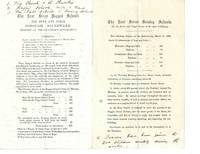
1868réf. 160851868. Newton H. Autograph letter signed on a handbill for the Lant Street Ragged Schools for Boys and Girls April 13 1868 documents free education for poor children and adults in Southwark and records substantially higher attendance among girls than boys. Newton identified as Vicar of St. Michael's Mission Schools Lant Street writes to a donor concerning the schools' work while the printed handbill describes an institution located "in the midst of the poorest population in Southwark" and reports approximately 850 attendances daily. The surviving enrollment figures give particular evidence for girls' participation: 243 girls attended the upper school room compared with 167 boys in the lower school room while afternoon attendance numbered 233 girls and 162 boys. Newton H. April 13 1868. Autograph letter signed on verso of a printed handbill for The Lant Street Ragged Schools for Boys and Girls Borough Southwark. The handbill describes the schools as "the largest with about 850 attendances daily and the most important in South London" and supplies separate attendance figures for boys and girls. It also records an evening school of approximately 65 "grown persons of both sexes" who were taught to read and write showing that the institution combined children's schooling with adult literacy instruction. Newton annotated the printed portion in his own hand including the notation "Ragged Schools male & female." His manuscript communication to a donor links the printed statistics and public appeal directly to the school's fundraising activity and administration. Ragged schools developed in nineteenth-century Britain to provide free instruction to children excluded by poverty from other forms of schooling commonly combining elementary education with religious and charitable work. The Lant Street handbill records that work before the Elementary Education Act of 1870 established a national framework for elected school boards in England and Wales. Its sex-specific figures are especially informative for the history of women's education: girls exceeded boys in both reported daytime sessions while the evening school extended literacy instruction to adult women as well as men. The handbill and Newton's signed letter preserve two aspects of the institution on the same sheet-the statistics used to describe its educational work and a clergyman's direct appeal to a supporter. No condition defects are specified in the supplied description. A contemporary record of schooling adult literacy charitable fundraising and female attendance among the poor of Victorian Southwark. unknown books
1823réf. 160841823. Preston John Howard. Autograph letter to his daughter Sarah November 29 1823 records a father's detailed expectations for his daughter's education including independent composition disciplined study reading comprehension and instruction under a female tutor. Addressing Sarah as "My dear child" Preston praises a letter she had sent to her brother after learning that "you had not only written it but composed it." His distinction between copying or assisted writing and original composition shows his attention to Sarah's intellectual development while his references to her "Cousin and Tutoress" identify a woman responsible for her instruction. Preston John Howard. November 29 1823. Autograph letter signed three pages folded from a large sheet with the fourth page retaining the original stampless address panel. Preston urges Sarah to "profit every Day by the kind and good instruction of your Cousin and Tutoress" adding "you must never esteem anything too difficult which you are set to do." He places disciplined education above social rank: "If you were the King's Daughter you would have to learn in patient submission; and how much more ready should you be to do so in your situation in Life!" Preston then addresses reading noting that he and Sarah's mother had "always been glad to see your fondness for reading" but instructing her to "understand and remember what you read-as it is not the quantity of reading but duly improving it which is the thing to be desired-and that makes it of real worth." He closes by assuring his absent daughter "we do not forget you but love you much tho' you are at a distance from us." Written while Sarah was living away from her parents and receiving instruction from a female relative identified specifically as her tutor the letter supplies direct evidence of one family's expectations for a girl's education in 1823. Preston's comments identify composition perseverance comprehension memory and purposeful reading as measures of Sarah's progress and show both parents taking an active interest in her studies. The surviving address panel preserves the letter's original postal format. Usual losses where the original wax seal was opened; otherwise well preserved. An unusually detailed family letter documenting the substance of a young woman's education through a father's contemporary instructions to his daughter. unknown books
1891réf. 160801891. Spanish royal teaching license Madrid 1891 authorizes a twenty-one-year-old woman to teach at the primary-school level during the regency of Queen María Cristina of Austria for her minor son King Alfonso XIII. Issued within the educational framework established by Spain's nineteenth-century public-instruction laws the document records the formal credentialing of a woman for professional employment as a teacher. The Ley Moyano of 1857 established a national framework for public instruction and made elementary schooling compulsory for children from six to nine years of age; the professionalization of women teachers developed within this expanding system. Madrid 1891. Royal license authorizing a twenty-one-year-old woman to teach primary school. Vellum document with ornate printed border royal heraldic device and 10-peseta revenue-stamp imprint. The license is issued by order of His Majesty the King and the "Governing Queen of the Kingdom" language corresponding to the regency of María Cristina of Austria who governed during Alfonso XIII's minority from 1885 to 1902. The document records the administrative process by which a woman's qualifications were formally recognized for primary-school teaching and preserves the fiscal and governmental apparatus surrounding that authorization through its revenue stamp official language and royal insignia. The license dates from the Restoration monarchy when the educational structure created under the 1857 Ley Moyano continued to govern Spanish schooling. That law remained a central framework for Spanish education for decades while the female teaching profession had begun to acquire formal training and professional definition during the middle decades of the nineteenth century. The recipient's age sex professional qualification and authorization to teach make the document direct evidence of women's entry into credentialed educational employment in late nineteenth-century Spain. Condition not stated. A government-issued record of a twenty-one-year-old woman's qualification for the teaching profession under the Spanish monarchy in 1891. unknown books
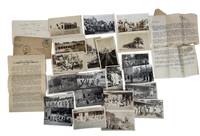
1941réf. 209861941. Gregson Anita. A.P. Mission City School archive 1941-1942 documenting girls' education missionary activity and community life in Ambala Punjab during World War II. This material records daily instruction social interaction and local conditions within a mission-run school for girls alongside written correspondence and institutional reporting that situate the school within wartime pressures and colonial India's educational landscape. The archive provides direct evidence of classroom practices gendered education and the integration of local families into school environments as well as the impact of global conflict on regional communities. Archive comprises 21 original black and white and sepia photographs one typed letter and one annual report. Photographs measuring approximately 2" x 3" to 3" x 5" frequently bear handwritten or typed captions on the verso likely by Anita Gregson identifying subjects and activities. Images show groups of schoolgirls engaged in classroom exercises and outdoor instruction including one scene of students constructing a ground map of India to illustrate agricultural production. Another photograph depicts a semicircle of young children seated outdoors during a lesson with their teacher identified as Miss Atmaran and a veiled mother observing her burkha partially drawn back. Additional images document craft instruction including girls weaving coconut palm leaves into fans and producing woven ties on frames. Musical activity is also present with students playing instruments. Beyond the school photographs depict village life in Punjab including oxen operating a water-drawing mechanism children gathered around a missionary playing a ukulele and a merchant carrying goods suspended from a yoke. The accompanying letter dated June 14 1942 from Gregson to a correspondent in New York references World War II noting international observances and local enlistment: "The young men in our Indian community are continuing to sign up for the army navy and air force." The annual report for the 1941-1942 school year details wartime financial strain fundraising efforts and instructional programs including an adult literacy course for women teaching reading writing and arithmetic. Created while India functioned as part of the British Empire during World War II these materials document the intersection of missionary education wartime mobilization and local social life. The inclusion of adult literacy instruction for women reflects ongoing efforts to expand female education under colonial conditions while the letter and report connect the school directly to global conflict and its local consequences. Light wear and minor fading to photographs; handling wear present. Letter on thin paper with tears and fragility consistent with wartime materials poor to fair condition; remaining materials overall very good condition. This archive provides a concentrated visual and textual record of girls' education and community experience in wartime Punjab. unknown books
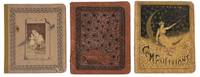
1880réf. 196981880. Fraister Belle. Iowa Schoolgirl Handwritten Notebook Archive documents the classroom work of a late nineteenth-century Iowa girl preserving evidence of women's education through manuscript exercises in history English penmanship grammar and arithmetic. The notebooks show how a schoolgirl practiced factual recall moral phrasing written style and practical calculation during a period when secondary education for girls increasingly prepared students for teaching clerical work and public intellectual participation as well as domestic life. The material provides direct evidence of everyday pedagogy handwriting discipline and curriculum formation in Iowa between 1880 and 1890. Iowa 1880-1890. Archive of 3 handwritten school notebooks belonging to Belle Fraister totaling 146 pages many blank in decorated pictorial wrappers; notebooks measure approximately 8" x 7" and 8" x 7½". The notebooks contain written work in history English penmanship and arithmetic with one history section summarizing states through structured categories such as time cause place and people. For Georgia Fraister writes "Time - 1733" "Cause - Refuge for the poor and persecuted" "Place - Savannah" "People - English" and notes "1752 - Geogia became the first Royal Province." Other pages show repeated penmanship practice including the phrases "Promise little but do much" and "Union is strength" calligraphic stroke exercises and grammar notes on pronunciation inflection pitch synonyms and related language study. One notebook includes a small newspaper clipping on the death of John G. Saxe with a brief handwritten biographical note beneath it. All notebooks bear stamps from the original stationery store. 1 Fraister Belle. History Notebook. Iowa 1880-1890. Contains structured state-history summaries including entries for Georgia organized by date motive for settlement location and people showing classroom methods for memorizing colonial and state history. 2 Fraister Belle. Penmanship Notebook. Iowa 1880-1890. Includes repeated letters words phrases and calligraphic strokes documenting handwriting instruction as both practical skill and moral exercise through maxims such as "Promise little but do much" and "Union is strength." 3 Fraister Belle. English and Arithmetic Notebook. Iowa 1880-1890. Contains notes on grammar pronunciation inflection pitch synonyms arithmetic and a clipped notice with a manuscript biography of John G. Saxe showing the combination of language study numeracy and literary awareness in Fraister's schoolwork. Decorated wrappers with light handling wear; interior pages generally legible; many pages blank as noted. Overall very good. A compact manuscript archive documenting the subjects methods and written discipline of girls' education in late nineteenth-century Iowa. unknown books
1813réf. 150361813. Women's education materials 1813-1926 document the lived experience of female schooling across the nineteenth and early twentieth centuries including seminary training scientific study and political awareness prior to national suffrage. The grouping places early republic religious education alongside mid-nineteenth-century academic instruction and late nineteenth-century political consciousness concluding with a twentieth-century pedagogical lecture directed toward women teachers. Together the materials capture women's direct engagement with intellectual scientific and civic life through personal correspondence and formal educational discourse. Four items 1813-1926 consisting of three Autograph Letters Signed and one printed pamphlet. 1 Hillner Louis. Autograph Letter Signed in response to guardian of Eliza Climer. Bethlehem April 22 1813. Two letters on one sheet including a request from Climer's guardian for her removal from the Bethlehem Female Seminary and Hillner's reply noting that she "lamented and wept" at the prospect of leaving and petitioned to remain which he supports as "for her best" if permitted to continue her studies. 2 Hemstreet Eloise. Autograph Letter Signed to her mother 1854. Letter describing her school as "the best of schools and one of the edens of the earth" with specific reference to scientific instruction and anticipation of viewing "the eclipse through the telescope" indicating active participation in astronomy. 3 Unidentified student. Autograph Letter Signed. Western Female Seminary Oxford Ohio October 19 1879. Letter discussing recent gubernatorial elections and public political discourse stating "The principal topic here for the last week has been the election.It will be so nice to be at home next Presidential Election" documenting student engagement with electoral politics prior to the ratification of the Nineteenth Amendment. 4 Gould Frederick J. Why Educate Chesterfield: National Union of Women Teachers 1926. Printed pamphlet of a lecture delivered before women educators advocating intellectual breadth beyond rote instruction declaring "Education must no longer bend over the desk and cramp its soul into spelling writing and sums.It must live in and live by and live for great ideas." Female seminaries in the early nineteenth century including Bethlehem Female Seminary operated within religious institutional frameworks that emphasized moral discipline alongside academic study while mid-century curricula increasingly incorporated scientific subjects such as astronomy. By the late nineteenth century women students were actively observing and discussing electoral politics despite lacking formal voting rights indicating participation in public discourse prior to the ratification of the Nineteenth Amendment to the United States Constitution. Gould's 1926 lecture reflects interwar educational reform movements that advocated broader intellectual development for both teachers and students. Minor fold lines and light handling wear to manuscript letters; pamphlet with slight edge wear and light toning; text throughout clear and legible; overall very good condition. A chronologically layered grouping demonstrating continuity and change in women's educational experience from early seminary culture to modern pedagogical theory. unknown books
1908réf. 174501908. Mills Susan. Typed letter signed 1908 documents the academic administration of Mills College under one of the central figures in women's higher education in the American West. Addressed to Dr. Clifton Price a Latin professor at the University of California Berkeley the letter shows Mills coordinating intellectual life at the school and seeking outside scholarly support for classical study. The material documents women's college administration through presidential correspondence revealing how Mills cultivated curriculum faculty networks and academic seriousness for women students in California. Mills Susan. Typed letter signed to Dr. Clifton Price. Oakland California October 28 1908. One page. 11 x 8.5 inches. Mills writes "It is a comfort that you are with us. Some time in the near future I would like to have you speak to the entire school for a half hour about the importance of studying Latin." The letter records a specific curricular concern: persuading students of the value of Latin within a women's college setting. Mills College began in 1852 moved to Oakland in 1871 became Mills College in 1885 and is widely identified as the first women's college west of the Rocky Mountains. Mills served as president from 1890 until her retirement in 1909 and her final presidential year gives this letter added significance as a late document of her educational leadership. The correspondence offers a concise record of how women's institutions built academic legitimacy through classical education public lectures and connections with major universities. Very good. A direct letter from Susan Mills preserving the daily administrative work behind women's higher education in early twentieth-century California. unknown books
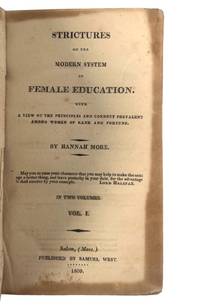
1809réf. 175631809. More Hannah. Strictures on the Modern System of Female Education 1809 argues that elite women required serious moral religious and intellectual education in order to shape family life philanthropy and national conduct. First published in 1799 More's influential educational work criticized ornamental female instruction and urged women of rank and fortune to become rational companions moral mothers and agents of social reform. The book belongs to a conservative reform tradition that expanded women's public usefulness through education charity and religious duty rather than through political equality. More Hannah. Strictures on the Modern System of Female Education. With a View of the Principles and Conduct Prevalent Among Women of Rank and Fortune. Salem Mass.: Samuel West 1809. Later edition. Two volumes. Vol. 1: xi 146 pages. Vol. 2: 130 pages. The text argues that superficial education left women poorly prepared for conversation domestic responsibility moral example and charitable work while recommending Biblical reading serious literature rational discussion compassion and generosity as central elements of female formation. More's educational program influenced nineteenth-century debates over women's activity beyond the household particularly philanthropy religious reform and instruction of the poor. Light browning throughout loose front free endpaper with 1828 ownership inscription; very good. A two-volume American edition of More's major work on women's education preserving a formative conservative model of female intellectual and social agency. unknown books
1860réf. 165381860. Hanson Mary A. friendship album 1860 documents mid-nineteenth-century girls' education in western Pennsylvania through a school reward presented for academic achievement in spelling. Given to Hanson at Laurel Hill Schoolhouse in McDonald Pennsylvania the album records how teachers used gift books moral instruction and sentimental inscription to encourage literacy discipline friendship and feminine virtue within the antebellum classroom. Hanson Mary A. Friendship Album. McDonald Pennsylvania: Laurel Hill Schoolhouse 1860. Manuscript presentation album with original black leather boards embossed front and back covers gilt-edged pages gilt spine decoration and gilt and red printed title page. The volume contains 64 pages six full-page engravings showing subjects including a woman writer figures reading in a garden a lady falconer and children playing and a hand-colored "Reward of Merit" card presented to Mary A. Hanson by a friend. The first page bears a lengthy teacher's dedication instructing Mary to use the album as "the repository of friendly names and of the purest thoughts and feelings" with "Sincerity purity and truth" guiding its entries; the teacher closes with a verse wishing that "love and friendship here unite" as the school year ends. The remaining pages are blank leaving the album as both a completed school presentation and an unused vessel for adolescent memory-making. Presented on March 31 1860 for "outstanding spelling work" during the preceding school year the album offers evidence of reward culture gendered moral pedagogy and literary sentiment in a rural Pennsylvania school setting before the Civil War. Very light foxing to engraving pages and wear to lower front hinge; original boards remain intact with gilt edges and decorative details present very good. A strong documentary artifact of girls' education classroom reward practices and the emotional language of friendship and moral formation in antebellum Pennsylvania. unknown books
1910réf. 150271910. Association pour l'Enseignement Secondaire des Jeunes Filles. Geography prize medal 1910 documenting formal recognition of young women's academic achievement in France during the expansion of secondary education for girls in the early twentieth century. Awarded in connection with the Association pour l'Enseignement Secondaire des Jeunes Filles at the Sorbonne the medal identifies geography as the field of achievement and belongs to the institutional culture through which women students received increasingly formal academic instruction and distinction. Bronze medal measuring 1.75 inches in diameter. The obverse depicts a seated classical female figure beside a pedestal decorated with laurel wreaths extending a wreath in her right hand as a symbol of academic reward. The reverse is engraved in part: "Association Pour L'Ensegnement Secondaire des Jeunes Filles a la Sorbonne.Geographie.1910." The inscription directly associates the award with secondary education for young women the Sorbonne and achievement in geography. The medal dates from a period when French girls' secondary education was expanding but remained institutionally distinct from that provided to boys. Its academic imagery and engraved subject record the formal recognition of a young woman's achievement in geography in 1910. The earlier identification of the figure as Terpsichore cannot be confirmed from the supplied evidence; Terpsichore is traditionally the Muse of dance rather than education. No condition defects have been supplied. unknown books
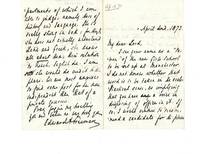
1873réf. 160861873. Freeman Edward Augustus. Autograph letter signed April 2 1873 recommends Scottish educator and historian Margaret A. R. Macarthur for appointment as headmistress of a new girls' school in Manchester explicitly arguing that her abilities warranted a position "more independent than that of a private governess." Freeman a historian who would later become Regius Professor of Modern History at Oxford had employed Macarthur as governess to his daughters for nearly five years and writes from direct experience of her teaching. His recommendation documents the professional transition available to an educated woman from domestic governess work to leadership in the expanding field of girls' secondary education and identifies history and languages as Macarthur's particular strengths. Freeman Edward Augustus. April 2 1873. Autograph letter signed to "My Dear Lord." Somerleaze Wells Somerset England. Four pages on a single folded sheet. Having seen his correspondent named as a "Patron of the new Girls School to be set up at Manchester" Freeman asks whether he has influence over appointments and recommends Macarthur for headmistress. "She is a woman of powers far above the common" he writes "and I can witness that she has practiced them well in the only two departments of which I am able to judge namely those of History and language." Freeman adds that although Macarthur did not know Latin and Greek directly "she knows all about them their relation to French English etc." As evidence of his confidence in her historical abilities he explains "I have set her to write one of my series of small histories a History of Scotland which I hope will soon be out." He concludes "I am sure she would do credit to the place. We are most anxious to find some post for her more independent than that of a private governess." Margaret A. R. Macarthur born in Scotland in 1842 subsequently published History of Scotland in Freeman's Historical Course for Schools confirming the literary project Freeman describes while it was still in preparation. The letter thus precedes publication and records Freeman using Macarthur's authorship as evidence of her qualifications for educational leadership. Although the supplied information states that Macarthur was not appointed to the Manchester position the reason given-that better-qualified candidates prevailed-cannot be established from the letter itself and is therefore omitted. Fine condition. Freeman's detailed recommendation preserves contemporary evidence of a woman educator seeking advancement beyond private governess work and of published historical scholarship being cited as a qualification for the headship of a girls' school. unknown books
1827réf. 165591827. Chapone Hester; Gregory John; Pennington Sarah. Chapone Letters on the Improvement of the Mind; Dr. Gregory's Legacy to his Daughters; Lady Pennington's Advice to her Absent Daughters; with an additional Letter on the Management and Education of Infant Children circa 1827 brings together major eighteenth-century texts on women's education moral formation reading domestic responsibility and female conscience. The volume belongs to the conduct-book tradition but is especially significant for pairing prescriptive instruction with arguments for women's rational cultivation including Chapone's emphasis on history literature and disciplined judgment and Pennington's insistence on moral conscience in the face of marriage family separation and social expectation. Chapone Hester; Gregory John; Pennington Sarah. Chapone Letters on the Improvement of the Mind; Dr. Gregory's Legacy to his Daughters; Lady Pennington's Advice to her Absent Daughters; with an additional Letter on the Management and Education of Infant Children. London: Scott Webster & Geary c. 1827. Early edition. 262 pages. Illustrated with two engravings including a frontispiece with tissue guard and an illustrated title page. Bound in marbled leather boards 32mo approximately 3.25 x 5.5 inches. The texts address religion economy government politeness the heart and affections reading habits maternal duty and the education of children with Chapone's letters originally written for her fifteen-year-old niece and warning against sentimental novels while encouraging serious intellectual formation. Issued in a compact illustrated format this omnibus shows the continued nineteenth-century circulation of women's educational writing that had already passed through numerous editions in Britain and America. Light wear to boards and extremities contents clean with illustrations present very good. A useful collecting item for the study of women's education conduct literature female authorship and the contested boundaries between obedience intellectual independence and moral agency in early nineteenth-century Britain. unknown books
1918réf. 166281918. Unidentified compiler. Photograph album of young woman student 1911-1918 documents school life recreation and community activity in Washington State and the Pacific Northwest during the 1910s. The album centers on a female student's progression from school-age years through graduation capturing educational environments organized physical activities and civic participation. The material records the presence of young women in structured school settings alongside informal leisure and public events providing visual evidence of student life and gendered social experience in the years surrounding the First World War. Photograph album. Washington State and British Columbia 1911-1918. Oblong format 7 x 10.5 inches containing 209 gelatin silver print photographs mounted across 40 pages supplemented by 12 postcards depicting locations in Washington State and Victoria British Columbia. The images include a graduation portrait of a young woman in cap and gown holding a pennant reading "Haddon H.S. 1911" along with later images referencing "1918" suggesting continued documentation across her school years. Photographs depict female students engaged in organized activities including tennis bicycling and calisthenics with groups of girls in uniform marching in formation across open fields. Additional sequences show camping excursions with tents and forest settings indicating school-sponsored outdoor programs. The album also includes scenes of younger children in school environments at play and participating in staged productions some in historical or theatrical costume including colonial-era dress and one child in a Japanese kimono. Community scenes include parades with extensive displays of American flags and images of shipbuilders at work situating the album within a broader civic and labor context. Scattered captions in manuscript such as "cutie" and "happy" provide limited but personal commentary. The album spans a period of expanding public education and increasing visibility of organized physical training and extracurricular programming for girls reflecting broader educational reforms of the early twentieth century. The inclusion of civic events and industrial labor scenes connects student life to wider community structures during the wartime era. The Pacific Northwest setting including references to regional institutions such as the University of Washington situates the material within a developing regional identity shaped by education industry and cross-border movement. Black cloth boards with light handling wear; photographs generally well-preserved with occasional minor wear; album complete and fully populated; overall very good condition. A substantial visual record of female student experience and community life in the early twentieth-century Pacific Northwest. unknown books
1927réf. 166041927. Leslie Reva C. My Memories of School Days album and photograph scrapbook 1923-1927 documents female student life social networks and extracurricular culture at Lincoln High School in Los Angeles during the 1920s. The material captures daily experiences of a young woman engaged in school activities including dances athletics and clubs while also preserving peer relationships through inscriptions photographs and ephemera. The album provides direct evidence of how young women recorded and interpreted their social and educational environments in an urban West Coast setting during the interwar period. Leslie Reva C. My Memories of School Days Album. New York: C. R. Gibson & Company 1924. Photograph and scrapbook album containing 73 gelatin silver print photographs in sizes ranging from approximately 1 x 1 inch to 5 x 7 inches accompanied by 14 handwritten inscriptions from friends 3 extended manuscript entries by Leslie 2 newspaper clippings referencing her as a student 11 ticket stubs from Los Angeles-area school events and performances dated 1923-1924 and decorative elements including hand-colored Kewpie cutouts. The photographs depict Leslie and classmates in a variety of settings including large class portraits with individuals identified Leslie marked as "me" beach outings theatrical productions athletic activities such as girls playing hockey in uniform and informal groupings labeled with captions such as "Three of a kind" and "one of the three musketeers." Manuscript entries describe participation in dances parties and school organizations including reference to her role as Secretary and designation as "Captain" of the Girls Reserves. Inscriptions from peers emphasize close friendships and shared social life with messages recalling "parties dances and everywhere we went" while one later inscription reflects a post-graduation relationship revised to read "To the Dearest Wife." The album documents a period in which American high schools expanded social and extracurricular programming particularly for young women integrating athletics clubs and organized events into student life. The inclusion of ticket stubs photographs and written reflections illustrates how these activities structured social identity and peer relationships. The setting in Los Angeles further situates the material within a rapidly growing urban environment in the 1920s where public schooling played a central role in shaping youth culture. Green cloth boards with moderate handling wear; contents complete with minor edge wear to pages and photographs; overall very good condition. A detailed and cohesive record of female high school experience and social life in early twentieth-century California. unknown books
1930réf. 168501930. Germaine Smith high school scrapbook 1929-1930 documenting female student life Catholic education and youth social networks in interwar Detroit. Created by a graduating student of St. Anthony High School the album preserves written exchanges photographs and ephemera that record peer relationships institutional culture and expectations for young women at the end of secondary education. The volume supports research on women's education adolescent identity formation and the role of religious schooling in shaping social and moral frameworks during the late 1920s. Scrapbook album titled "The Girl Graduate: Her Own Book" compiled by Germaine Smith of St. Anthony High School in Detroit containing 107 pieces of ephemera including tickets invitations table cards programs letters newspaper clippings and pressed flowers along with 13 photographs depicting female students posing at school and walking with nuns. The album includes 36 handwritten inscriptions from classmates and teachers featuring poems and personal messages such as "In your chain of friendship Consider me a link" and "When you are old and sipping tea Remember your classmate of 1930" alongside reflections on future marriage and adulthood. Additional contents include references to girls' athletics such as speed skating and gymnastics programs honor roll listings theater tickets from Detroit venues and a Japanese language newspaper clipping. A pair of "Shadowgraph Glasses" with colored lenses is also present illustrating contemporary novelty entertainment. Produced at the close of the 1920s this scrapbook captures the intersection of education religion and social life for young women during a period of shifting expectations around gender roles and modern leisure. The presence of Catholic instructional figures athletic participation and popular entertainment materials situates the compiler within both institutional and urban cultural environments. The handwritten entries emphasize friendship morality and anticipated life transitions providing insight into how young women articulated identity and community at graduation. Light toning at page edges with general handling wear; overall very good. A cohesive and content rich example of female student life and social documentation in early twentieth century America. unknown books
1941réf. 171641941. Walker Marjorie O. scrapbook 1941 to 1942 documents women's teacher training coeducational student life campus music culture and wartime institutional change at Oswego State Normal School as it became Oswego State Teachers College. Kept by Marjorie O. Walker of Woodridge New York the scrapbook records the teacher-training system through report cards student directories handbooks campus newspapers correspondence and event programs revealing how Oswego organized student life while responding to wartime mobilization selective service air-raid fears and the 1942 shift to four-year degree-granting status. Walker Marjorie O. Scrapbook album. Oswego New York 1941 to 1942. Scrapbook with 155 pieces of ephemera including newspaper clippings full issues of the campus paper ticket stubs programs invitations typed notices correspondence and student publications. Original paper wraps with large color fall foliage image on front cover 80 pages 15 x 11 inches. Contents include material from both Oswego State Normal School and Oswego State Teachers College a 1939-1940 report card listing Child Development History of Civilization Composition and Speech Intro to Science Art 102 Essentials of Music and Recreational Activities; a 1941 Summer Session pamphlet; Student Handbook; Personnel Directory; Student Directory for 1941-1942; Halloween Party invitation; and newspaper coverage of Epsilon Pi Tau Sigma Pi Rho campus music groups and the Bel Canto singing group in which Walker participated. Walker annotates several clippings with notes identifying classmates and friends including "this is one of my classmates" and "they're all swell singers." The strongest historical material concerns Oswego's wartime campus life before and after American entry into World War II including February 1941 clippings urging cooperation against Nazi victory and calling male students to register for selective service later reports anticipating air raids and city bombings an Armistice Day program presented with the American Legion and U.S. Coast Artillery and coverage of wartime delays to rebuilding after the January 1941 campus fire. Newspaper headlines also record the institutional milestone "Oswego Normal becomes State Teachers College" marking the school's elevation in 1942 to a four-year degree-granting teachers college. Pages thin with a few very small closed edge tears very good. A substantial documentary record of women's education teacher preparation student music culture home-front anxiety and institutional adaptation at Oswego during the first year of American involvement in World War II. unknown books
1923réf. 168781923. Chamberlain Ola. The Girl Graduates Record Book 1923 to 1925 documents rural Texas girls' education adolescent friendship school ritual athletics domestic expectations and female self-expression at Goree High School. Kept by Ola Chamberlain of Goree Texas the album captures a young woman's final high school years through photographs teacher and classmate inscriptions certificates invitations press clippings and an original "Class Prophecy" providing direct evidence of how one Texas student recorded academic achievement peer culture humor courtship-inflected friendship extracurricular life and the movement "Out of school life into life's school." Kubinyi Victor de designer. The Girl Graduates Record Book. New York: Barse & Hopkins copyright 1920. Manuscript memory book and scrapbook kept by Ola Chamberlain Goree Texas 1923 to 1925. 190 pages. Original cloth boards with embossed floral motif 10.25 x 7 inches. Contains 85 silver gelatin photographs most approximately 4.5 x 2.75 inches more than 25 handwritten inscriptions from friends and teachers an original handwritten class prophecy and approximately 85 pieces of ephemera including ribbons party invitations commencement materials press clippings seven perfect-attendance certificates a Texas public school report card and a pressed sweet pea dated May 15 1925. Photographs and captions identify Goree High School called by Chamberlain "The Prison" classmates with nicknames including "Pie Face" "Preacher" "Shot Gun" "Lilliums" and "Hankie" class officers the Spanish Class Pep Club "Senior Girls" basketball players and eight images of students in colonial costume for "The Virginia Reel." The inscriptions preserve affectionate student memory and gendered academic praise including one classmate's statement that in mathematics Ola was "a wizard-ess" while teacher entries address her transition from school into adult life: "Life's School is open to you." The album's strongest research value lies in its unusually full record of a girl's educational world in small-town Texas during the 1920s including formal coursework in Geometry English Physics Civics Economics and Arithmetic alongside a parent-signed "Home Report" grading Cooking Care of Stock General Farm Work Providing Fuel Washing Dishes and Obedience. Chamberlain's manuscript "And How It All Came Out" imagines the futures of her graduating class through a supernatural vision prompted by the class flower placing classmates in roles from department-store worker to sheriff mayor and secretary and giving the album a rare sustained example of student-authored narrative. First two pages detached front hinge detached edges toned some pages brittle with small edge chips good. A substantial documentary record of women's education rural Texas youth culture school sociability athletics and the gendered expectations surrounding a young woman's graduation in the mid-1920s. unknown books
1921réf. 171091921. Hinshaw Mary Jane scrapbook 1921 to 1943 documents women's education teacher training library studies sorority life and student identity through the life of a Missouri and Kansas student from childhood through college. The album follows Hinshaw from baptism and early school photographs to Stephens College and Kansas State Teachers College of Emporia preserving evidence of how a young woman's education moved from family and local schooling into collegiate social life professional preparation and library-centered coursework during the 1930s and early 1940s. Hinshaw Mary Jane. Scrapbook album. Missouri Kansas and western United States 1921 to 1943. Scrapbook with 78 original silver gelatin photographs and 43 pieces of ephemera. Original cream boards with embossed front cover 39 pages 10.5 x 13.5 inches. Photographs range from 2.5 x 2 inches to 8 x 10 inches and include family images childhood portraits elementary and high school class photographs school groups and western United States travel views with expansive landscapes and rock formations. Ephemera includes baptism and birth announcements Stephens College commencement invitation from 1941 report cards certificates two cloth varsity letters a felt bulldog debate letter Delta Sigma Epsilon membership card party invitations and dance cards from Sigma Tau Gamma Delta Sigma Epsilon and Alpha Delta. Academic records document coursework at Stephens College in English literature French English history psychology sociology music appreciation physical education and educational psychology followed by Kansas State Teachers College coursework in teaching history of education American history library administration cataloguing and classification reference book selection library work with children and literature of high school subjects. A handwritten postcard from a Stephens classmate at the University of Wisconsin states "I am having a glorious time-It certainly isn't like Stephens much much better." The scrapbook's research value lies in its unusually broad view of female education from childhood through professional training including Hinshaw's connection to Marysville High School where her father served on the Board of Education and her later preparation for teaching and library work. Tear with loss above right portrait adhered to first page; one page detached; front hinge loose good to very good. A substantial documentary record of women's higher education teacher preparation sorority culture school achievement and library training in the Midwest from the interwar period into World War II. unknown books
1942réf. 171381942. Walker Marjorie O. scrapbook 1939 to 1942 documents women's teacher training coeducational campus life and institutional transition at Oswego State Normal School as it became Oswego State Teachers College. Kept by Marjorie O. Walker of Woodridge New York the scrapbook records the system of teacher preparation through admissions materials course records student regulations directories newspapers and campus communications revealing how Oswego organized academic instruction boarding life extracurricular culture and crisis response during the years immediately before and after its 1942 elevation to a four-year bachelor's degree-granting teachers college. Walker Marjorie O. Scrapbook album. Oswego New York 1939 to 1942. Scrapbook with 142 pieces of ephemera including report cards correspondence newspaper clippings student publications event programs postcards athletic songs sorority material and notices concerning campus operations. Original paper wraps with large color fall foliage image on front cover 76 pages 15 x 11 inches. Contents include a 1940 admission letter noting a waiting list for applicants course schedule report card 1939 student handbook 1940-1941 student directory boarding regulations for landladies and roommates programs for plays and musical performances full issues of The Oswegonian postcards of Oswego and nearby sites Alpha Delta Sorority material and printed fight songs. Academic records document coursework in Child Development History of Civilization Written Composition General Math Essentials of Music Essentials of Art and Recreational Activities. Newspaper material includes coverage of a Korean national student at Syracuse University speaking at Oswego about the Japanese occupation of Korea. The final pages are especially significant for documenting the January 1941 campus fire that caused an estimated $100000 in damage including student newspaper coverage describing students "carrying coupling and manning hoses" alongside firemen and later notices emphasizing "Business As Usual" through revised examination schedules and relocated classes. This crisis documentation combined with admissions housing academic and social material makes the scrapbook a strong record of how a teachers college functioned in practice during wartime-era institutional change. Ephemera and scrapbook pages intact as described with general handling consistent with use very good. A substantial documentary record of women's education teacher preparation student life campus administration and emergency response at Oswego during its transition from normal school to state teachers college. unknown books