512 résultats
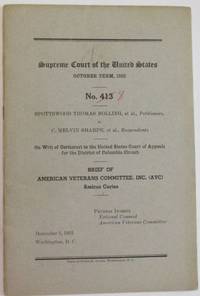
1952réf. 33220Washington D.C.: Press of Byron S. Adams 1952. Original printed wrappers with wrapper title as issued and original staples. ii 13 1 pp. Near Fine. The Supreme Court heard argument in December 1952 but held the cases over for reargument in the following term. This is the Amicus Curiae brief submitted by the American Veterans Committee for the first argument. Supporting the District of Columbia children seeking to integrate the Washington public schools the Committee contends that the Fifth and Fourteenth Amendments guarantee the right to be free from racial discrimination that equality of education is impossible under a regime of racially segregated schools that equality can be achieved only by abolition of compulsory segregation by race and that "The people of Washington are ready for and will accept integration of their public schools." The brief is signed in type by the Committee's National Counsel Phineas Indritz who was a distinguished civil rights and constitutional lawyer. Press of Byron S. Adams unknown books
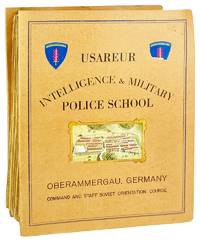
1954réf. 31165Oberammergau Germany: Intelligence and Military Police School 1954. Very Good. Oberammergau Germany: Intelligence and Military Police School 1954. Quarto; stiff illustrated covers with hundreds of pages of reports bound in. Includes charts and graphs of Soviet governmental and military organization. Additional monographs laid in include Armed Forces Talk's four-part Communism Series and three issues of the U.S. Constabulary School's Department of Geopolitics series covering German History up to the rise of the Nazi Party the United Nations and International Relations. Staining to rear cover; pages toned but largely unmarked; a Very Good copy. Binder prepared by the United States Army for training Cold War-era officers and staff on USSR history ideology and military capabilities. The trove of documents here covers nearly everything an early Cold War American military or intelligence officer would need to know at the time: a history of Marxist ideology and its development in the 19th-century; details on the physical geography of the USSR; an ethnography of Central Asia detailing the Turkomen Kazakhs and Tatars; as well as extended analyses on who the power players in the Communist Party were and what the capabilities of their rifle and artillery division might be. Logistics psychological warfare and the role of Communism in the Middle East are also covered with detailed but succinct chapters on each. An impressive array of information highlighting the early Cold War Western perspective. No copies in retail and three holdings found in OCLC at the US Army War College Georgetown University and the University of Iowa. Intelligence and Military Police School unknown books
1948réf. 35695Hanoi: Vien Dong-Phuong Bac-co Xuat Ban 1948. 3 volumes in 2 4to text alternately in Vietnamese and French; table of alphabets 3 maps 2 folding 2 plates with 15 photographic illustrations on rectos and versos 6 of 7 folding plans large folding table tables and illustrations in the text text occasionally in double column; original printed wrapper for the second volume only bound in; some toning of the text as well as some browning and wear but generally a good sound set. The missing Plan du Palais Imperial is provided here in facsimile on old paper. An early Vietnamese scientific periodical emphasizing archaeology ethnography philology and history. It began publication with no. 1 in May 1948 and ceased with no. 3 in Aug. 1949. Issued under the auspices of École francais d'Extreme-Orient. Vien Dong-Phuong Bac-co Xuat Ban unknown books
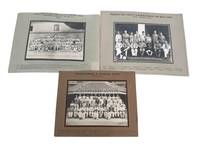
1930réf. 236621930. British Indian railway and military administrative staff photo archive circa 1930s to 1943 documenting the trained Indian clerical instructional stores and supervisory personnel who operated institutions central to colonial transportation and wartime logistics. The principal photograph depicts the instructional and clerical staff of the Railway Training School at Bina the first Area School established by the Great Indian Peninsula Railway which operated there from 1926 until its transfer to Bhusawal in 1962. The two dated portraits extend this administrative record to the Rawalpindi Arsenal in 1942-43 and the Cantonment Board at Ambala in 1941 placing railway education beside military supply and cantonment government during the Second World War. Photo archive of 3 Large silver gelatin photographs mounted on cardstock Each Photographer boards measure 12 x 16 inches and Photograph 8½ x 11 inches Bina Rawalpindi and Ambala India circa early 1940s. The Bina portrait identifies approximately sixty members of the "Instructional & clerical staff R.T.S. Bina" posed in six rows before a tiled railway building bearing the sign "The Railway Training School." A second photograph captioned "Clerical staff including Stores Branch of Rawalpindi Arsenal" records employees photographed at the departure of S. Avtar Singh in 1942-43; a printed roster identifies staff by row and includes many locals. The third photograph records a farewell to Lieutenant Colonel G. Leslie-Mold president of the Cantonment Board at Ambala on April 25 1941 with British military officers and Indian civilian officials identified beneath the image. Leslie-Mold later served as Assistant Adjutant General and Director of Personnel Services at Army Headquarters in India. Railway schools developed as the expanding colonial network required standardized instruction in traffic control station procedure accounting freight handling signaling and the clerical routines through which trains goods and personnel were coordinated across long distances. Railways allowed the British administration to move troops rapidly supply cantonments and arsenals connect agricultural and mineral districts with ports and impose common schedules and bureaucratic procedures across the colony; they also created a large Indian technical and clerical workforce whose knowledge kept the system operating. The portraits record this institutional hierarchy with European officers occupying senior positions while Indian instructors accountants clerks store employees and subordinate officials form the numerical body of each organization. Surface wear toning rubbed edges corner losses and occasional marks to the mounts; photographs remain generally clear and well defined. Overall in good condition. A concentrated visual record of the Indian personnel who sustained railway instruction military provisioning and cantonment administration within the transport and defense infrastructure of late British rule. unknown books
1923réf. 180751923. Unique. Commercial album meas. 180 x 285 mm. Very good. Oblong 4to string-tied commercial album containing 104 black and white photographs majority with hand written captions. A keepsake album assembled by an anonymous female student of her classmates and friends at the nursing school. It shows the hospital grounds and groups of doctors and nurses all identified with patients in the operating room etc. and also on outings. unknown books
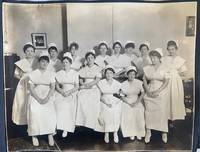
1915réf. 174731915. Nursing student photograph album circa 1915 to 1920 documenting the training social life and professional formation of fourteen young women entering nursing during the First World War and the public health crises of the period. The album records a generation of women entering a rapidly expanding medical profession while wartime mobilization increased demand for trained nurses across the United States. Its chronology overlaps both with Wold War one smallpox and the 1918 influenza pandemic which reached the United States in 1918 and produced its deadliest wave during the fall of that year. Photo album of 184 silver gelatin photographs multiple sizes ranging from approximately 1.5 x 1 inches to 11 x 8 inches most approximately 4 x 2.5 inches United States circa 1915 to 1920. Many photos have handwritten captions. The photographs are mounted on black pages and center on a class of fourteen student nurses shown in uniform in formal group portraits and in clinical settings including operating rooms. One photograph shows the nurses posed behind a sign reading "Smallpox!" directly recording the infectious disease concerns incorporated into nursing education and public health practice. Other photographs show the women together in informal settings family members and children soldiers American towns and landscapes and early aviation. Several images appear to have been taken from or around a World War I era biplane including views above the clouds suggesting a personal connection to an early aviator. Locations extend across the United States including Michigan San Antonio Texas and mountainous regions of the American West. The album belongs to the period when nursing education was becoming increasingly standardized and the First World War transformed the scale and social role of professional nursing. Following U.S. entry into the war in April 1917 the Army Nurse Corps expanded rapidly while the American Red Cross mobilized thousands of nurses for military and civilian relief. The influenza pandemic then placed extraordinary pressure on hospitals and communities in 1918 and 1919 making the album's nursing training especially relevant to the public health environment in which these women were coming of age professionally. One photo displays the nurses behind a sign that states "Smallpox!" which was a a recurrent and deadly public health issue throughout the first half of the 20th century and pushed many to enter the nursing field. In 1918 Many photos are in San Antonio and at the time Texas public health officials were simultaneously managing smallpox outbreaks and the cataclysmic arrival of the 1918 H1N1 Spanish flu pandemic. While the terrifyingly rapid spread of the flu dominated headlines smallpox was an ongoing deeply entrenched threat across Texas counties By September 1918 the Spanish flu collided with these ongoing localized smallpox containment efforts. Cities like Dallas Houston San Antonio were completely overwhelmed. The combination of clinical instruction nursing class portraits close friendships family life military imagery of Navy officers Also includes early aviation biplane photographs of the era. This nurse seems to have been dating an early fighter pilot with a few photos taken above the clouds in a WWI-era biplane. Locations span the US from Michigan to Texas to a few photos which resemble the alpine regions of the American West. Overall in very good condition. The photo album documents the women within the broader social transformations experienced by young Americans during the First World War. Minor wear consistent with use; photographs show occasional toning and fading. Album with textured black covers black interior pages photographs adhered to the leaves and tight binding. Overall in very good condition. A concentrated visual record of women entering professional nursing amid wartime mobilization infectious disease concerns and the social changes of the 1910s and early 1920s. unknown books
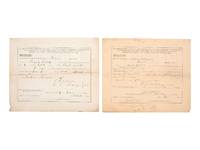
1888réf. 215331888. Rowan County Board of Education teacher pay vouchers 1888 and 1892 documenting African American education within the segregated public school system of post-Reconstruction North Carolina. The vouchers record segregated public education and its funding mechanisms through payments to Black teachers approved at the county level. These documents show how African American educators were paid through formally structured systems requiring countersignature by the county superintendent and approval by district committee members. Two manuscript teacher salary vouchers each approximately 8.5 x 7 inches and written on both sides. The first dated March 26 1888 authorizes payment of $30.00 to Maggie Locke for teaching in "School District No. 4 Rowan County for Colored Race" covering the period from January 3 to March 2 1888 in Atwell Township. The printed form specifies that payment is contingent upon countersignature by the county superintendent and approval by at least two district committee members establishing formal oversight procedures. The verso bears Locke's signed receipt dated March 27 1888 acknowledging payment from county treasurer J. M. McCubbins. The second voucher dated January 16 1892 records payment of $25.00 to Isaac Kerns for teaching in "School District No. 2 Salisbury & No. 2 Prov. Rowan County for Colored Race" with similar requirements for administrative approval prior to disbursement. The verso includes Kerns's signed acknowledgment of payment. Both documents explicitly designate the schools as serving the "Colored Race" indicating the formalized racial segregation embedded within the educational system. These vouchers document the operation of segregated schooling in the decades following the Civil War when African American education expanded under conditions of systemic underfunding and institutional control. The requirement for multiple authorizations before payment records the bureaucratic regulation of Black teachers' labor while the recorded wages provide quantitative evidence for comparative study of compensation disparities. Produced during a period when access to education for African Americans remained contested these documents contribute to research on Reconstruction-era legacies Jim Crow governance and the role of Black educators in sustaining community institutions. Light wear minor creasing and typical manuscript handling marks; overall very good condition. Documentary record of the administrative structure and lived realities of segregated education in the late nineteenth-century South. unknown books
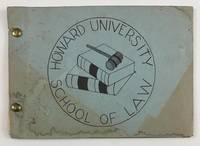
1959réf. 3137Washington D.C. 1959. Good plus. 19pp. mimeographed on rectos only. Original printed blue wrappers brad bound. Covers stained and worn. Mild uneven toning to a few leaves. A seemingly unrecorded directory for the Howard University School of Law published by the Student Bar Association in 1959. This humble handmade directory includes a short acknowledgement followed by listings of the faculty administrative staff Student Bar Association the Howard Law Journal the National Moot Court Team the Legal Assistance Program the "Law Wives" the class officers and finally the "Student Directory 1959-1960" arranged alphabetically. The directory lists the name expected year of graduation address phone number if any and undergraduate institution for each of the seventy-nine law students attending Howard at the time. Among the more notable names in the directory is Vernon Jordan Jr. who was then in his final year at Howard Law School. No listings for this ephemeral and homespun African American law school directory. unknown books
1868réf. 13286Selma AL: J.P. Armstrong Printer 1868. Broadside 12.25 x 8.25 inches printed in three columns. Numerous old folds substantial wear and foxing some wrinkling edges scuffed and chipped but ample margins remain small hole in upper right corner. Good only. A striking unrecorded broadside publishing the lyrics to six songs intended to be sung by students of the Selma Union Sabbath School on an "excursion pic-nic" in the Spring of 1868. The songs printed here include "Festive Song" "Sunday School Volunteer Song" "The Happy Song" "By-and-Bye" "Around the Throne" and "Beautiful River." Little is known about the Selma Union Sabbath School; the only newspaper records we could locate concern the same picnic advertised on the present broadside held at Marion Alabama on May 12 1868. The Selma Morning Times published an advertisement in a few issues that week. Not in Ellison Hummel or OCLC. J.P. Armstrong, Printer unknown books
2000réf. 410762000. UCLA Law Review. Los Angeles School of Law University of California Los Angeles. Vols. 1 to 39 42 to 46 47 part 1 51 part 1 1953-2004 Together 77 books. Sixteen 16 linear feet of shelf space. Ex-private law firm library tan buckram very good. Special $695. unknown books
2004réf. 541752004. Lacking issue volume 101 no. 1. Lacking issue volume 101 no. 1. Yale Law Journal. New Haven: Yale Law Journal. Bound Volumes 86 to 91 1976-1982 blue buckram with silver lettering; vols. 100 no. 5 to 106 no. 8 1990-1998; 111 no.1 to 117 no.7 paper issues 2001-May 2008 Lacking issue volume 101 no. 1. Together 24 volumes. Ex-library with stamps. Very good condition. Reprint Price USD 4307. Special $695. unknown books
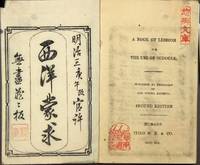
1872réf. 21891Numadz i.e. Numazu Japan: Itiro W. N. & Co. Meiji 4th published by permission of the school Kaiseijo 1872. Second and last edition small 8vo approx. 7" x 4¾" pp. 2 42 plus printed pastedowns the first the title page in Japanese 3 red chopmarks on title pages one of them Shogo who amassed I am told a famous collection of language books in Tokyo text in Roman letter throughout and printed from metal type; original blue wrappers sewn in Japanese manner printed paper label on upper cover; externally worn and with some limpness to the wrappers all else very good and sound. A Critical Bibliography of Materials for English Studies in Japan. Collected by Osaka Women's University 1962 no. 97. The text contains 7 brief histories including Columbus Discovers America History of Isaac Newton Washington's Regard for his Mother and Alfred and his Mother. Harvard only in OCLC. Itiro W. N. & Co., Meiji 4th [published by permission of the school Kaiseijo] unknown books
1957réf. 5265St. Louis: The School Press 1957. Very good. 180pp. Profusely illustrated with photographs. Original orange printed self wrappers staple. Minor rubbing soiling and some edge wear to wrappers. Internally clean. A seemingly unrecorded photographic annual for a prominent African-American dance school in Jim Crow Missouri. The Les Pierrettes Dance School was a well-respected institution for the training of young dancers in St. Louis. The school's director identified in the present work as "Maitre d'Ecole" was Anita W. Roland a prominent dancer with experience on the stage in North America Latin America and Europe. The work opens with a couple of introductory poems and a table of contents; thereafter the work features almost sixty dance students both male and female in two-page spreads with a poem on the verso and a photographic portrait of the students in their dance uniforms on the rectos. This section is described on the table of contents as "A group of mirth-laden girls and boys make truth-laden statements about themselves" indicating the biographical poems were written by each of the students. The middle of the work features the dancing school staff and "Studio Demonstrators" i.e. dance instructors with some biographical details about each person. This is followed by a long section of well wishes and congratulatory messages from the dance students' family friends and the larger community. The rear of the work also includes a section of advertisements from local businesses. The present work was edited by Anita Roland's husband Philip Roland here listed as the Director of Program Activities for the dance school and editor of Foto-Feature. The work itself is identified on the table of contents as "Vol. 2 No. 1" indicating it is likely the second in a series. We could locate no exact matches of the present work in OCLC or auction records though there might be one other example at the Missouri History Museum the OCLC record does not specify volume number. The School Press unknown books
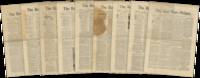
1904réf. List3876Carlisle Pennsylvania: Carlisle Indian Industrial School 1904. Nine issues. 12 x 18 inches folio folded as issued. Generally folded vertically twice with some wear and tearing at folds; toned with wear and damage especially to margins. Very good. The Red Man and Helper a newspaper published by Carlisle Indian Industrial School had several iterations first published under the title Eadle Keatah Toh 1880-82-Lakota meaning roughly "morning star" the title was an interesting choice for the newspaper of a school where only the English language was allowed. It was published as The Morning Star then The Red Man: His Past Present and Future until "His Past" was removed in 1888; then The Red Man until 1900 when it merged with The Indian Helper running as The Red Man and Helper from 1900 to 1904.1 The contents with contributions from students educators and other publications generally concern the value of an off-reservation Euro-American education and the capabilities of Indigenous students to assimilate into the Euro-American way of life. Offered here are nine issues of The Red Man and Helper: Vol. I no. 30 Feb. 8 and 15 1901 Vol. II no. 48 July 11 1902 Vol. III no. 1 Aug. 15 1902 Vol. III no. 40 May 29 1903 Vol. III no. 42 June 12 1903 Vol. V no. 38 May 20 1904 Vol. V no. 39 May 27 1904 Vol. V no. 40 June 3 1904 and Vol. V no. 41 June 10 1904. Note that these are enumerations for The Red Man and Helper; each edition also provides a separate enumeration indexed to the first edition of The Red Man. Carlisle Indian School Digital Resource Center hosts digitized copies of the school's publications and OCLC finds physical holdings of two editions Vol. XVII no. 39 and Vol. XIX nos. 47-48 at Gettysburg College. Of interest to historians of Carlisle and the assimilationist project. 1 Jennifer Bess "Casting a Spell: Acts of Cultural Continuity in Carlisle Indian Industrial School's the Red Man and Helper" Wicazo Sa Review 26 no. 2 Fall 2011: 13-38. . Carlisle Indian Industrial School unknown books
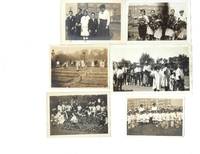
1916réf. 156401916. Collection of 43 original vintage photographs documenting the Public School Gardening Movement in Queens New York City 1916-1920 provides concentrated visual evidence of Progressive Era educational reform linking urban environmental transformation to child development and civic formation. Produced at the height of the national school gardening movement which flourished between 1900 and 1920 these photographs capture the integration of nature study playground reform tenement house activism and City Beautiful urbanism into the daily life of immigrant and working class children. The images support research in Progressive Era reform environmental education immigration history urban studies and the construction of civic identity through public schooling demonstrating how agricultural labor was reframed as moral physical and democratic training within dense metropolitan neighborhoods. Forty three original photographs primarily silver gelatin prints Queens New York City 1916-1920. Most measure approximately 2 by 4 inches with several bearing manuscript dates between 1916 and 1920 and occasional notations identifying individuals or activities. The photographs depict schoolchildren planting seeds watering beds harvesting produce carrying baskets of vegetables and working collaboratively under teacher supervision in organized garden plots. Visual evidence indicates structured rows tool distribution and adult oversight underscoring the pedagogical framework rather than informal recreation. The movement in New York was shaped by the work of reformer Frances Griscom Parsons who established the Children's School Farm in Hell's Kitchen in 1902 to provide immigrant youth living amid warehouses factories and docks with access to cultivated land. Parsons articulated gardening as instruction in "brotherhood cooperation self respect and the dignity of labor" envisioning children as "little farmers" rehearsing democratic citizenship within an idealized urban microcosm structured into "boroughs" with its own elected governance. The Queens photographs reflect the diffusion of this model into outer borough public schools during the final years of the First World War and immediate postwar period. The timing of the archive coincides with national concern over urban crowding industrialization and the assimilation of immigrant communities as well as wartime food production campaigns that reinforced agricultural instruction in schools. School gardens functioned simultaneously as environmental intervention civic laboratory and instrument of Americanization embedding Progressive reform ideals directly into children's bodily practice and daily routine. The photographs materially document how educational institutions operationalized nature study principles and urban reform agendas on the ground offering granular evidence of children's participation in structured agricultural labor within New York City's public school system. Minor edge wear and light surface handling marks to several prints; occasional light fading consistent with age; manuscript annotations legible. Overall very good condition. A cohesive visual archive illuminating the intersection of urban reform environmental education and immigrant childhood in Progressive Era New York. unknown books
1871réf. 2437Charterhouse School 1871. Hardcover. Very good. Dates: 1871-1877 and 1910. Small 4to. 37 ff. mostly with newspaper clippings neatly pasted in on both sides 4 ff. in manuscript "Summary of Scores" from 1871-1877 and 1910. Several leaves excised; it is possible that the present album had been re-purposed. On a few of the stubs appear fragmentary MS notations suggesting that the notebook may have once been divided alphabetically. We find on certain stubs "Ai" followed immediately by "Ao" and then several leaves later: "Her. - Hes" followed by "Io." Binding rebacked with smooth calf. In very good condition. Highly interesting homemade album of Cricket Scores available nowhere else specifically documenting the triumphs of three young members of the Blomfield family namely: E.G. Edward George C.J. Charles James and R.T. Reginald Theodore. One wonders if the present album was created in order to promote friendly competition between the brothers two of whom went to Haileybury School and one went to Charterhouse; all three went up to Oxford. There are scores and game synopsis of matches were between Haileybury Charterhouse Marylebone Cricket Club MCC Westminster Trinity College Oxon. Exeter Oxon. and more. One of the more interesting features about the album is that it provides a fascinating record of one family's love of the game: ¶ Edward George 1853-1885 entered Charterhouse School London in 1865 and transfer upon the School's removal to Godalming in 1872; in 1873 he went to Trinity College Oxon. where he earned a B.A. in 1877 and M.A. in 1879; thereafter he served as Curate of St. Mary's Portsea until 1883 and then Vicar of St. Mark's Woolston until his death in London in 1885. ¶ Charles James 1855-1928 went to Haileybury School; he underwent military training at Sandhurst and served as an army officer in India Sudan and Natal. He attained the rank of Major General before his retirement in 1917. NB: this individual is not to be confused with a noted architect of the same name b. 1862 d. 1932. ¶ Reginald Theodore 1856-1942 also went to Haileybury School; he earned his B.A. from Exeter Oxon. in 1880 and M.A. in 1884. He became an architect and was knighted in 1919. He is remembered mainly for his work designing British war memorials. ¶ The parents of the three young men were Rev. George John and his first cousin Isabella Blomfield of Bow Devonshire whose own father Charles James Blomfield was Bishop of London. ¶ At the end is a "Summary of Scores" for the years 1871-1877. Following this in a different hand is the year 1910; although the initial of the last name "Blomfield" remains the same the other initials belong to Reginald Thomas and his two sons Henry George and Austin. ¶ See Stedman Charterhouse Register 1872-1900 passim. CATALOGUER'S NOTE: We are grateful to Catherine Smith Archivist of Charterhouse School for much useful information concerning the Blomfield Family. hardcover books
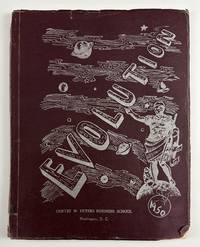
1950réf. 5036Washington DC: Cortez W. Peters Business School 1950. About very good. 60pp. Original purple wrappers printed in silver. Some soiling and staining to covers minor chipping and rubbing. Small unobtrusive stain to fore-edge of text overall even toning. A seemingly-unrecorded yearbook from the Washington D.C. branch of the Cortez W. Peters Business School the first African-American-owned business school in the United States. The co-educational school was founded in 1834 in the Nation's Capital followed in the next few years by branches in Chicago and Baltimore. The founder Cortez W. Peters taught himself to type as a child and went on to become the first African-American champion of the World's Amateur Typing Contest. Peters' school was one of the first to teach typing to Black students while also offering instruction in shorthand and other clerical skills. The present yearbook begins with a message from Peters which strikes a conciliatory tone in the wake of racial tensions that followed the conclusion of the Second World War: "We naturally resent discrimination lack of opportunities oppression.But on the other hand there are many other values to be considered which should make us tolerant and willing to work out these traditional handicaps generally." This is followed by messages from the dean and class president Eva Itene Brown then portraits of students and faculty a class history a class prophecy class will class poem and twelve pages of group photographs including shots of the men's and women's basketball teams the coronation ball and images featuring students in the classroom. Many of the students both men and women have included words of advice or stated their personal goals which are printed beside their portraits "To be a good typist" "To be a stenographer" and so forth. OCLC lists a single copy of three similar yearbooks all under different titles from other years and branches of the school Washington D.C. and Chicago in 1948 and an undated yearbook from Baltimore but not this particular year at the school's home base. Cortez W. Peters Business School unknown books
réf. 21824NP: NP ND. Fine. 21 x 16 inches gouache on paper of Art Deco jewelry shop designed by R. Tailliard. NP unknown books
1890réf. 210011890s. Commercial album. Good but essentially disbound; mounts are pulp paper on deteriorating linen tabs. A good portion of the photos improperly chemically fixed but still "present". Small folio commercial album of appx. 75 identified albumen prints of various sizes Although haphazardly mounted and identified the photographs offer a group of early views of the Cape Colony South Africa and its surroundings. The front endpaper is signed: Winifred C Karfe Milburn House Claremount C. C. S. Africa Dec. 1897. Milburn House was a school for "young ladies" located in Claremount six miles outside of Cape Town. There are a number pictures of the building staff children who for the most part are quite young. These are accompanied by a variety of interesting photographs - some apparently commercial - of Madeira Dakar and towns and villages apart from Cape Town. unknown books
1948réf. 29372Hanoi: Vien Dong-Phuong Bac-co Xuat Ban 1948. 3 volumes 4to text alternately in Vietnamese and French; table of alphabets 3 maps 2 folding 2 plates with 15 photographic illustrations on rectos and versos 7 folding plans including one of the Imperial Palace large folding table tables and illustrations in the text text occasionally in double column; original printed wrappers; some toning of the text as well as some browning and wear but generally a good sound set. An early Vietnamese scientific periodical emphasizing archaeology ethnography philology and history. It began publication with no. 1 in May 1948 and ceased with no. 3 in Aug. 1949. Issued under the auspices of École francais d'Extreme-Orient. Vien Dong-Phuong Bac-co Xuat Ban unknown books
1933réf. 175261933. Archive of Walter Johnson's 1933 Atlantic City High School yearbook and related reunion materials documents African American student life within a formally integrated but socially segregated New Jersey public school during the Great Depression. Johnson a graduating senior in 1933 appears in a yearbook extensively inscribed by classmates whose messages span both commencement year and later reunions preserving contemporaneous peer networks across four decades. Created in a city where redlining confined most Black residents to Atlantic City's Northside neighborhood the volume and accompanying ephemera situate one student's educational experience within broader histories of African American urban life public schooling in the Jim Crow North Depression-era youth culture and Black alumni civic organization. Archive dates primarily from 1933 with later additions from 1978 and subsequent reunion years; ten items total. Central volume is Atlantic City High School yearbook published by Westbrook Publishing Company Philadelphia 1933 183 pages hardcover 10.5 x 7.75 inches extensively inscribed throughout by classmates in 1933 and again at the 45th reunion in 1978. The school's divisions are organized by Technical Classical and Commercial tracks with individual portrait sections and personal profile prompts listing favorite activities characteristic phrases and anticipated futures including one sardonic entry predicting a destination "In the ranks of the unemployed." Accompanying materials include a June 16 1933 telegram in original envelope from the Negro Alumni Associates of Atlantic City High School congratulating Johnson on his graduation; two reunion pamphlets from the 45th and 50th reunions; several envelopes including one bearing a lengthy handwritten note from reunion organizer Ben Ginsburg; and two printed advertisements for Atlantic Coast Amusement Enterprises promoting comedians and song-and-dance acts associated with Atlantic City's boardwalk entertainment industry. Produced in the depths of the Great Depression the yearbook captures a graduating class confronting economic uncertainty while articulating ambition humor and collective identity. Its Art Deco stylistic elements and commercial advertising reflect Atlantic City's resort economy during its interwar peak while the presence of a formal Negro Alumni organization in 1933 demonstrates structured African American institutional engagement within a multiracial public school setting. Later reunion annotations underscore continuity of alumni networks across five decades. Light general wear consistent with age; inscriptions legible and internally clean; associated ephemera well preserved with minor handling wear. Overall very good condition. Cohesive documentation of African American secondary education alumni organization and urban community formation in Depression-era New Jersey extending into the late twentieth century. unknown books
1850réf. 8857Paris 1850. Pencil pen and wash drawing with numerous detailed measurements. A fascinating and beautiful drawing--or "rendu"--of an ancient Roman sarcophagus. A fine drawing from an architectural student at the Ecole des Beaux-Arts in Paris the most influential architectural school in existence during much of the 18th century the whole of the 19th century and the first part of the 20th century. 'Students were eligible for the Ecole if they were at least fifteen years old or under thirty. They began with the seconde classe in which they competed in the concours d'émulation. These alternated between an esquisse --a rough sketch for which up to twelve hours was allowed--and a rendu --the large-scale finished drawing for which one to three months were allowed.Two to four years were usually required for a student to accumulate enough credits to enter the première classe. The same system was followed again usually for two to three years after which the student should have accumulated enough credits to compete for the Grand Prix de Rome. The winner of the Grand Prix was entitled to five years study under the auspices of the French Academy in Rome. For each of his first three years he was required to submit an analytical study of an ancient monument. For his fourth year he had to submit a complete reconstruction of a major classical work. For his fifth year he was required to submit an original work designed to a program of his own invention. "This study of the sarcophagus of Lucius Cornelius Scipio Barbatus was part of an Ecole de Beaux Arts student's portfolio. The sarcophagus was one of many in the Scipio family tomb on the Via Appia just outside of Roma and it dates from c. 290 B.C. The obituary text reads English "Lucius Cornelius Scipio Barbatus son of Gnaeus a valiant gentleman and wise whose fine form matched his bravery very well was aedile consul and censor among you he conquered Taurasia and Cisauna in fact Samnium he overcame all the Lucanian lands and brought back hostages." Arthur Drexler The Architecture of the Ecole des Beaux-Arts. New York MoMA 1977. unknown books
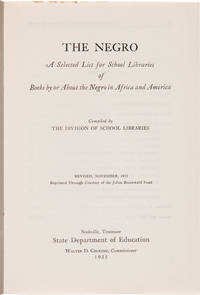
1935réf. 57636Nashville: State Department of Education 1935. Encouraging Library Acquisitions of African-American Works An interesting bibliography and guide for school librarians in Tennessee during the Great Depression and the tail end of the Harlem Renaissance. This edition was revised in November 1935 and we are unaware of the date of any earlier editions no earlier publications are recorded in OCLC. It was reprinted "through courtesy of the Julius Rosenwald fund" an endowed foundation which contributed large sums to education programs for African Americans in the first half of the 20th century. The bibliography was produced specifically to recommend books to all Black elementary and high school libraries with the mission that "If Negro children are to acquire a knowledge of and respect for the achievement of members of their own race it is essential that books dealing with this subject be made readily available to them." Titles are listed alphabetically by author within sections divided by grade level and subject; those marked with a star "are considered to be of especial value for school libraries." In addition to basic publication information each entry includes the author's race the book's current retail price and a brief annotation describing its content and usefulness to a school library. The compilers present an interesting collection of titles including works by Langston Hughes and Zora Neale Hurston in addition to numerous other children's books histories and other titles that are lesser known today such as NAACP president Mary White Ovington's ZEKE. This list was published by the Tennessee Department of Education during Walter D. Cocking's tenure as commissioner. Shortly afterwards Cocking became dean of the University of Georgia's College of Education until he was fired by Governor Eugene Talmadge in 1941 over alleged support for integration and his connection with the progressive Rosenwald Fund. University of Georgia president Harmon Caldwell threatened to resign unless Cocking was rehired and Cocking was returned briefly to his position. This incensed Talmadge to the degree that he went on public tirade in news outlets and instituted a purge of the Board of Regents replacing them almost entirely with his own supporters using the newly stacked board to fire Cocking again anyway. The so-called "Cocking Affair" was only the first step in what would become an epidemic of ousted educators and administrators purged libraries and interference with education that resulted in all state-supported schools in Georgia losing their accreditation. A valuable look at the state of African-American education in the South in the early 1900s and a useful and interesting bibliography in its own right. Original printed grey wrappers. Small dark stain along top edge throughout otherwise internally and externally clean. Near fine. James Cook "Cocking Affair" in NEW GEORGIA ENCYCLOPEDIA online. unknown books
1870réf. 433066Germantown Ohio: Germantown High School 1870. Hardcover. Very Good. First edition. Tall octavo. 153pp. Half sheep and pebbled cloth. Top edge gilt. Owner's name in gilt on front board Alice Dechant co-editor of several issues joints a little tender faint staining on the boards modest foxing in the text a good or better copy. The full run of this high school newspaper issued together with a preface. According to the preface the book was published as: "limited to a few copies perhaps a score or two" thus presumably 40 or fewer copies likely published as a souvenir for the graduates probably in 1870 or very slightly later. OCLC locates two copies both in Ohio. Germantown High School hardcover books
réf. 63194Nineteenth Century. Apx. 7 x 11 inches image size. Matted framed and glazed. Apx. 7 x 11 inches image size. Provenance: Estate of Esmond Bradley Martin unknown books