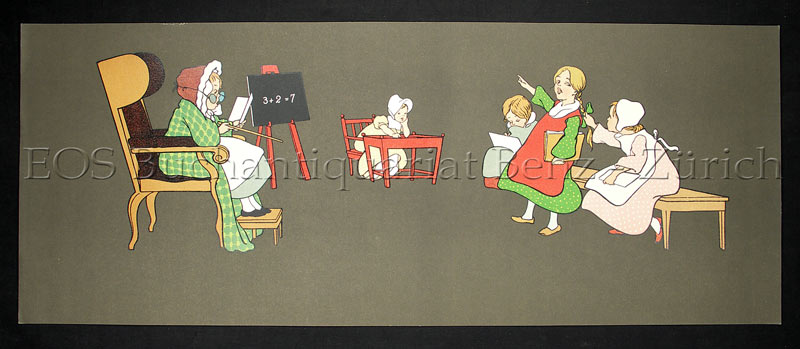
réf. 2478Paris Hazan, Paris 1954; In-4 , pleine reliure janséniste en maroquin havane, couvertures et dos conservés. Tirage à 1350 exemplaires, celui-ci un des 1239 numérotés sur papier chiffon de Lana. des 1350 exemplaires numérotés sur papier chiffon de Lana. 10 planches hors-texte en couleurs et quelques dessins.
réf. 91039In-8, basane fauve, dos orné à nerfs, triple filets à froid d'encadr. sur les plats, tranches rouges (rel. pastiche). Dos passé et plats en partie décolorés.
réf. 18482Paris, Imprimerie Royale, 1765. In-12 de 30, 19, 16 et 86 pages. Veau d'époque, dos plat orné, bon état.
réf. 110693Paris, Camille Bloch, 1919, 366 rue Saint Honoré, 1 volume in-12 de 198x118 mm environ, 71 pages, 2ff. (table, achevé d'imprimer), cartonnage recouvert de papier marbré, titres dorés sur dos lisse, couvertures conservées, quelques feuillets non coupés. Exemplaire N° 364, un des 500 exemplaires sur papier rose vergé à la forme, numérotés de 37 à 536, orné de gravures au burin de J.-E. Laboureur (1 frontispice et 5 H.T.). Des rousseurs, petits frottements sur la coiffe supérieure, bon état.
réf. awd-436Mai 68. Affiche imprimée en bleu foncé sur papier blanc. Tampons "Atelier populaire / Comité d’action St Séverin". Quelques traces de plis (42/62 cm).
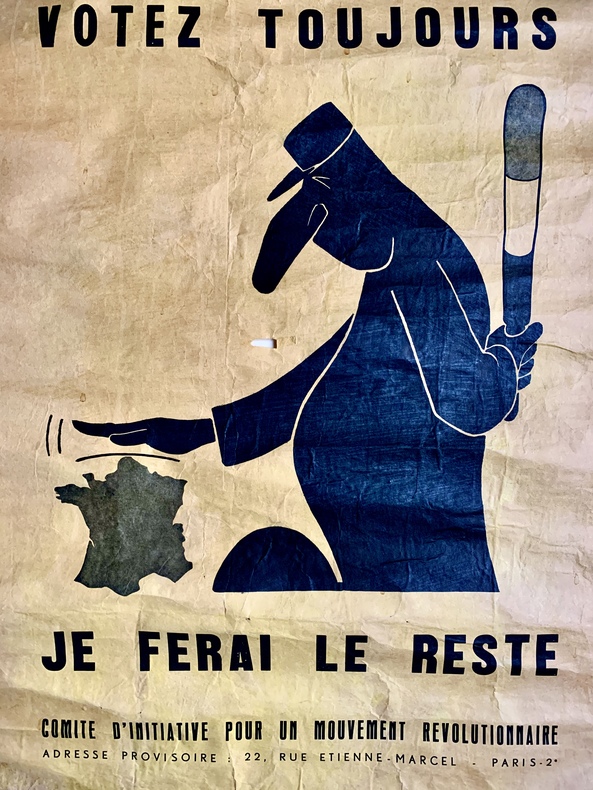
réf. awd-422Paris, Comité d’initiative pour un mouvement révolutionnaire. Imprimerie Robert et Cie, mai 68. Affiche d'époque imprimée en noir sur un papier légèrement brun. Décollée avec traces de plis et restes de colle ancienne. Minces déchirures avec légers manques (55,4/75,4 cm).
1795Copia di un niello già conservato nella collezione Durazzo (n. 2869), di cui sopravvivono due impronte originali (Gabinetto Rothschild al Louvre; British Museum, Londra). L'opera può essere datata alla fine del XV secolo e attribuita con una certa sicurezza alla scuola bolognese. Il giovane uomo e la donna sono probabilmente ritratti di persone reali, una coppia di fidanzati o sposati da poco. La loro disposizione, uno di fronte all'altro di profilo, è conforme alla pratica convenzionale del Quattrocento per i ritratti in pendant di mariti e mogli. I nielli della collezione Durazzo vennero fatti riprodurre in incisioni dal proprietario, tra fine XVIII e inizio XIX secolo, a Venezia - come specificato anche dal Malaspina nel suo catalogo del 1824 - costituendo una serie che venne diffusa e collezionata dagli amatori. Bartsch descrive queste copie nel suo volume edito nel 1811, data che quindi costituisce il terminus ante quem per l'esecuzione. Copy of a niello print formerly kept in the Durazzo collection (n. 2869), of which two original impression survives (Cabinet Rothschild at the Louvre; British Museum, London). The work may be dated to the end of the fifteenth century and attributed with some confidence to the Bolognese school. The young man and woman are probably portraits of actual people, a betrothed or recently married couple. Their arrangement, facing each another in profile, conforms to conventional quattrocento practise for pendant portraits of husbands and wives. The nielli of the Durazzo collection were reproduced in engravings by the owner himself, between the end of the 18th and the beginning of the 19th century, in Venice - as also specified by Malaspina in his catalog of 1824 - constituting a series that was circulated and collected by amateurs. Bartsch describes these copies in his volume published in 1811, a date that therefore constitutes the terminus ante quem for the execution. TIB 2401.019; Duchesne, p. 271 n. 337; Zanetti pp. 99-100 n. 128
1910réf. 488DG(Leipzig, Hollerbaum & Schmidt), ca. 1910. Farbige Lithographie. 70 x 28 cm. + Wichtig: Für unsere Kunden in der EU erfolgt der Versand alle 14 Tage verzollt ab Deutschland / Postbank-Konto in Deutschland vorhanden +, 488DG
1975Appears to be a 1970s or 1980s replica of the pre-WWII original. Features lovely young lady in elegant long light-blue dress seated on bench with floral backdrop. Illustration at bottom suggests this is an ad for a high-quality fabric brand. Approximately 30" x 20". Crimped metal strips protect top and bottom edges. Unmarked with moderate wear and soiling. Last few inches of lower right corner detached from metal strip. A charming memento of 1930s Shanghai. Will be shipped in a sturdy mailing tube. Poster
1975Appears to be a 1970s or 1980s replica of the iconic pre-WWII original. Features comely young lady on bicycle wearing shorts, heels, and an open top revealing a tantalizing glimpse of her right breast. Approximately 30" x 20". Crimped metal strips protect top and bottom edges. Clean and unmarked with light wear. A charming memento of 1930s Shanghai. Will be shipped in a sturdy mailing tube. Poster
1975Appears to be a 1970s or 1980s replica of the pre-WWII original. Features lovely young lady in long red floral print dress with white fur around her neck. Illustrations of Gold Bar and Hateman cigarette boxes along bottom edge. Approximately 30" x 20". Crimped metal strips protect top and bottom edges. Clean and unmarked with light wear. A charming memento of 1930s Shanghai. Will be shipped in a sturdy mailing tube. Poster
1975Appears to be a 1970s or 1980s replica of the pre-WWII original. Features lovely young lady in long red and white dress seated in what appears to be an elegant restaurant. Illustrations of cigarette packs across the bottom include the Fiddle, 5 Bats and Good Crop brands. Approximately 30" x 20". Crimped metal strips protect top and bottom edges. Clean and unmarked with light wear. A charming memento of 1930s Shanghai. Will be shipped in a sturdy mailing tube. Poster
1975Appears to be a 1970s or 1980s replica of the pre-WWII original. Features lovely young lady in pearls and red-checked vest holding adorable Pekingese dog close to her breast. Approximately 30" x 20". Crimped metal strips protect top and bottom edges. Clean and unmarked with very light wear. A charming memento of 1930s Shanghai and a great gift idea for any fan of the Pekingese breed. Will be shipped in a sturdy mailing tube. Poster
189075 pages. The first eight pages are devoted to "Drills, Pantomines and Motion Songs - Swimming Drill" and are cutely illustrated with sketches of children performing the various motions. Next come 9 pages of "Marching and Motion Songs for Schools" which include words and piano music. Pages 19 through 61 cover Motion Songs with piano music included for most - songs include The Brook, Our Flag, The Violets, The Leaves, What the Wind Says, Fife and Drum, Little Things, On the Lake, Pussies, The Farm, The Meadows, Good Night, Song of the Waves, and Japanese Parasol Drill. Pages 62 through 75 are devoted to Marches and include diagrams. Heavily worn, soiled and stained yet binding remains intact. Page 17 missing. Prior owner's name atop front free endpaper else unmarked. While copy has seen considerable use, it retains its vintage charm. Book
1870Acquaforte, circa 1870, dimensioni 160 x 255 mm, impressa su carta coeva, in ottimo stato di conservazione. Firma a matita in basso a desta. Dalla attivissima calcografia Lovera di Torino è stampata l'acquaforte di Vittorio Avondo, artista torinese che studiò a Pisa e Ginevra, per poi approdare al naturalismo morbido e sfumato di Fontanesi. Visse anche a Roma dal 1857 al 1865; forse di quel soggiorno resta un ricordo in questa acquaforte della campagna Romana (della quale esistono anche alcuni dipinti in collezione privata), splendido brano intriso di un'atmosfera elegiaca, malinconica, pervaso di una luce vibrante e sfumature delicate. Le acqueforti dell'artista che si conservano non sono molte, forse una decina. Grande collezionista e conoscitore dell’arte medievale e moderna, oltre che pittore paesaggista, Avondo ebbe un ruolo fondamentale nella storia culturale del Piemonte contribuendo, insieme a Alfredo d’Andrade, allo studio e alla tutela del patrimonio artistico del territorio. Importante la sua figura anche per la GAM, egli fu infatti Direttore del Museo Civico di Torino per un lungo periodo, dal 1890 al 1910, e contribuì in modo significativo alla definizione della raccolta d’arte moderna accogliendo ad esempio la donazione delle opere di Antonio Fontanesi. La nascita in una famiglia dalle ampie possibilità economiche gli permise di coltivare a tempo pieno la passione per la pittura di paesaggio e di compiere viaggi per l’Europa che ne arricchirono la formazione. Tappa obbligata di questa educazione, dopo un primo alunnato presso Alexandre Calame a Ginevra concluso nel 1857, fu un lungo soggiorno a Roma che si protrasse sino al 1860 e che si rinnovò intorno al 1865. Qui egli ebbe modo di conoscere Nino Costa e frequentare un entourage colto e ricco di stimoli in cui spiccavano artisti come Enrico Gamba, Frederic Leighton, George Mason e i tedeschi legati ai Deutsch Römer, come Anselm Feuerbach, Hans von Marées e lo stesso Böcklin. Ma fu sopratutto la sua sensibilità a contatto con il vasto scenario della campagna romana a condurlo a superare lo stile minuzioso e finito appreso in Svizzera, a favore di un nuovo linguaggio scarno ed essenziale, in grado di restituire per sintesi gli ampi orizzonti del paesaggio laziale. In questa svolta pare di cogliere un gusto artistico in rapido cambiamento, in cui si riflette l’interesse per la resa del paesaggio “sul vero” - tema che anima il fronte degli artisti più avanzati di quegli anni - e che pare testimoniata anche dall’acquisto delle prime stampe fotografiche di quei luoghi. Una scelta che la mostra restituisce attraverso alcune preziose carte salate di Giacomo Caneva che fanno parte della generosa eredità dei beni che Vittorio Avondo lasciò alla Città di Torino alla sua morte. Il rapporto tra i suoi schizzi, originariamente raccolti in taccuini, e quelle prime immagini fotografiche offre un ulteriore spunto di riflessione su come si modifichi il modo di guardare al paesaggio in quegli anni: uno sguardo che coglie la natura in presa diretta ma che può anche tornarvi in tempi successivi attraverso gli appunti grafici e le prime immagini fotografiche. Una riflessione che porta a interrogarsi sulla stessa funzione del disegno e su scelte e soluzioni che si discostano radicalmente dalla tradizione accademica. Si apprende da Giubbini che l'opera è stata pubblicata su "L'Arte in Italia" (agosto 1870, tav. 22) con commento di Camerana a p. 128. Riguardo allo stile Giubbini ha commentato molto favorevolmente questa acquaforte, mettendola in relazione con "il gruppo delle incisioni più 'finite' di Appian"; sul piano della tecnica ha osservato: "Da notare che il processo di semplificazione, probabilmente già forte nel passaggio dal disegno preparatorio al disegno tracciato con la punta sulla vernice, continua nelle fasi successive della lavorazione della lastra attraverso la mancata o parziale morsura di molti dei segni ... Etching, circa 1870, size 160 x 255 mm, impressed on coeval paper, in excellent condition. Signature in pencil in the lower right corner. Printed by chalcography Lovera in Turin. Light, and brilliant landscape with the poetical expression of trees, that recalls the traditional Italian painting of the XIX century. The work is characterized by a well-balanced lightening which created a strong feeling of the scene, with the movement of trees in the wind through intense black made shadows and light in far behind of landscapae. Vittorio Avondo, an artist from Turin who studied in Pisa and Geneva, and then came to the soft and nuanced naturalism of Fontanesi. He also lived in Rome from 1857 to 1865; perhaps a memory of that stay remains in this etching of the Roman Campagna (of which there are also some paintings in a private collection), a splendid piece imbued with an elegiac, melancholic atmosphere, pervaded by a vibrant light and delicate nuances. The etchings of the artist that are preserved are not many, perhaps a dozen. We learn from Giubbini that the work was published in "L'Arte in Italia" (August 1870, table 22) with a comment by Camerana on p. 128. Regarding the style, Giubbini commented very favorably on this etching, relating it to "the group of Appian's most 'finished' etchings"; as far as technique is concerned, he observed: "It should be noted that the process of simplification, probably already strong in the passage from the preparatory drawing to the drawing traced with the tip on the varnish, continues in the successive phases of the working of the plate through the lack or partial biting of many of the marks corresponding to the branches of the trees". A great collector and connoisseur of medieval and modern art, as well as a landscape painter, Avondo (1836 – 1910) played a fundamental role in the cultural history of Piedmont, contributing, together with Alfredo d'Andrade, to the study and protection of the artistic heritage of the territory. He devoted himself to painting from an early age, training in Italy, Switzerland and France. After his return to Piedmont, he became a consultant to the City of Turin and since 1863 is part of the commission responsible for selecting the works for the collections of the Civic Museum. His activities are varied: painter, antiquarian, city councilor and member of numerous cultural institutions. In 1872 he bought the castle of Issogne (Aosta) which he restored and redecorated with the help of Alfredo d'Andrade and Giuseppe Giacosa: starting from this experience he collaborated, from 1882, to the construction of the medieval village of Turin and with Emanuele Tapparelli d'Azeglio to the restoration of Casa Cavassa in Saluzzo. In 1890, he succeeded Tapparelli d'Azeglio as director of the Civic Museum: upon his death in 1910, his personal collection was transferred to the Museum. G. Giubbini, L’acquaforte originale in Piemonte e in Liguria 1860 - 1875, Genova 1976, n.3; A. Dragone, J. Conti, I paesisti piemontesi dell'Ottocento, Milano, 1947; R. Maggio Serra e B. Signorelli, a cura di, Tra verismo e storicismo. Vittorio Avondo (18
1977128 pages. Features: Gorgeous one-page color-photo Chanel ad featuring Catherine Deneuve; Two-page Vantage cigarette ad features Dave Ness of Seattle; Ending an End to Cosmic Loneliness - Goldstone Tracking Center radiotelescope seeks out intelligent life; Behind the Lazar Berman Legend; In England Now, by John le Carre; When Fat was in Fashion - abundant flesh was a thing of beauty to artist Peter Paul Rubens, who was born 400 years ago; To be Young, Black and Out of Work - depressing photos and stats on the 'Clockwork Orange' epidemic in the ghettos of America's cities; Great two-page color-photo ad for the Talon Channel-Zip zipper features stuntmen in action; Color-photo ad for Lakeland coats features New York Giants running back Gordon Bell; Silent Fall - Dissidents behind the iron curtain are being suppressed - with photos of folk singer Wolf Biermann, Rumanian writer Paul Goma, correspondent Rober Toth, Czech playwright Paul Kohout, Yugoslav writer Mihajlo Mihajlov, and Anatoly Shcharansky; Tennis player Marty Riessen is featured in a tennis school ad; At Home with a Skyscraper - architects Oliver Lundquist and John Stonehill build a townhouse next to a 50-story skyscraper in New York; The Maestro - Cellist Mstislav Rostropovich; "Dewar's Profile" on back cover features film animation producer, director and designerJim Simon of North Hollywood. Average wear. Unmarked. A sound vintage copy. Book
1977112 pages. Features: The Hodding Carters - Working for decades in the intransigent heartland of the South, they dedicated themselves and their newspaper to exposing the cruelties and injustice around them and reaffirming the basic goodness of the South they loved - article with photos (including cover); New Battles Over School Budgets - landmark California decisioin affecting John Serrano; Ten Days That Shook Me Up in Russia - the tormented world of Soviet dissidents; "Dewar's Profiles" features David O. Hill, Wildlife Conservationist of New York City; Swept Away - people continue to build along coastal areas despite terrible storms and the damage they cause; Poirot's First Case - Agatha Christie describes how she created her first detective story, and her grandest sleuth, while surrounded by poisons; Fantastic two-page centerfold ad for Jovan fragrances; Photos of Nubby Knits; Throwing a Curve - John Saladino designed this curved apartment; Sexy color-photo ad for luxurious silk bikini panties by Macy's; A Mess of Mopeds; Toyota Celica ad on back cover. Unmarked with moderate wear. A sound vintage copy. Book
196476 pages. Features: 25 Years Ago - Hitler Strikes and WWII begins - article with photos; A Private Opinion on the Polls; How the President Keeps Informed - the LBJ way; Strange alliance between East and West as Cold War continues; Long Island is becoming Long City; What's In a Flag? - Everything; Early Camera-maker Louis Jacques Mande Daguerre - photo-illustrated brief article; Yoga is the fashionable way to keep in shape; Airy Manhattan apartment of Aivi Gallen-Kallela and David Kenneth Specter; That First Day of School; Broxodent automatic toothbrush ad; Beautiful color-photo fashion ads; and more. Average wear. Faint library stamp on front cover. A sound vintage copy. Book
1873Suggestiva veduta pastorale, intitolata "Brughiera", forse raffigurazione della campagna romagnola o toscana o piemontese, località dove visse l'autore, il noto artista bolognese. Incisione originale all'acquaforte, impressa dallo stampatore torinese Carlo Lovera. Il Bignami coniugò l’attività di pittore a quella, prevalente, di acquafortista, legato al gruppo degli incisori piemontesi della seconda metà dell’Ottocento dominato dalla personalità di A. Fontanesi. Tra il 1869 e il 1870 visse a Firenze, che raffigurò spesso nei suoi paesaggi. A Torino partecipò, dal 1863, alle mostre della Società Promotrice, affermandosi nel 1871 con tre dipinti: Il pasto ai pulcini, L'ultima ora del lavoro e Le nebbie del mattino in riva all'Arno. Nello stesso anno si segnalò alla Promotrice di Bologna con due paesaggi giudicati «d’impronta vera e di fattura coscienziosa». Le notizie sulla sua attività espositiva si fermano al 1877, poiché l’artista dovette rinunciare precocemente alla pittura per una malattia agli occhi e per vicissitudini familiari. In ottimo stato di conservazione. Etching, lettered along bottom 'Adolfo Bignami inc Lovera imp.' followed by title “Brughiera”. Printed by Carlo Lovera The plate shows a shepherd herding sheep in the Brughiera. Very good condition. Bignami combined the activity of painter to that, prevalent, etching, linked to the group of Piedmontese engravers of the second half of the nineteenth century dominated by the personality of A. Fontanesi. Between 1869 and 1870 he lived in Florence, which often depicted in his landscapes. In Turin participated, since 1863, the exhibitions of the Society Promotrice, establishing himself in 1871 with three paintings: The meal of chicks, The last hour of work and The morning mists on the banks of the Arno. In the same year he was noticed at the Promotrice of Bologna with two landscapes judged "of true imprint and conscientious workmanship". The news about his exhibition activity stop in 1877, since the artist had to give up painting early because of an eye disease and family vicissitudes.
1872Acquaforte originale (cm. 21,8x11,2 più ampi margini) da un dipinto dello stesso Bignami. L'opera fu impressa nella celebre Calcografia torinese di C. Lovera nel marzo 1872. Il Bignami coniugò l’attività di pittore a quella, prevalente, di acquafortista, legato al gruppo degli incisori piemontesi della seconda metà dell’Ottocento dominato dalla personalità di A. Fontanesi. Tra il 1869 e il 1870 visse a Firenze, che raffigurò spesso nei suoi paesaggi. A Torino partecipò, dal 1863, alle mostre della Società Promotrice, affermandosi nel 1871 con tre dipinti: Il pasto ai pulcini, L'ultima ora del lavoro e Le nebbie del mattino in riva all'Arno. Nello stesso anno si segnalò alla Promotrice di Bologna con due paesaggi giudicati «d’impronta vera e di fattura coscienziosa». Le notizie sulla sua attività espositiva si fermano al 1877, poiché l’artista dovette rinunciare precocemente alla pittura per una malattia agli occhi e per vicissitudini familiari. In ottimo stato di conservazione. Etching, lettered along bottom 'Adolfo Bignami dip e inc C. Lovera imp.' followed by title 'Dietro la masseria '(Behind the farmhouse). After a Bignami’ painting. A girl seated behind a building surrounded by poultry The plate was printed by Carlo Lovera in 1872. Excellent condition. Bignami combined the activity of painter to that, prevalent, etching, linked to the group of Piedmontese engravers of the second half of the nineteenth century dominated by the personality of A. Fontanesi. Between 1869 and 1870 he lived in Florence, which often depicted in his landscapes. In Turin participated, since 1863, the exhibitions of the Society Promotrice, establishing himself in 1871 with three paintings: The meal of chicks, The last hour of work and The morning mists on the banks of the Arno. In the same year he was noticed at the Promotrice of Bologna with two landscapes judged "of true imprint and conscientious workmanship". The news about his exhibition activity stop in 1877, since the artist had to give up painting early because of an eye disease and family vicissitudes.
1870Acquaforte di Adolfo Bignami da un dipinto di Ernesr Allason. Acquaforte, 202x166 mm. foglio 360x 260. Esemplare stampato a Torino da Carlo Lovera per Arte in Italia del 1870. Il Bignami coniugò l’attività di pittore a quella, prevalente, di acquafortista, legato al gruppo degli incisori piemontesi della seconda metà dell’Ottocento dominato dalla personalità di A. Fontanesi. Tra il 1869 e il 1870 visse a Firenze, che raffigurò spesso nei suoi paesaggi. A Torino partecipò, dal 1863, alle mostre della Società Promotrice, affermandosi nel 1871 con tre dipinti: Il pasto ai pulcini, L'ultima ora del lavoro e Le nebbie del mattino in riva all'Arno. Nello stesso anno si segnalò alla Promotrice di Bologna con due paesaggi giudicati «d’impronta vera e di fattura coscienziosa». Le notizie sulla sua attività espositiva si fermano al 1877, poiché l’artista dovette rinunciare precocemente alla pittura per una malattia agli occhi e per vicissitudini familiari. In ottimo stato di conservazione. Etching, lettered along bottom 'Ernesto Allason dip Adolfo Bignami inc' followed by title and 'C. Lovera imp.'. Example (platemark mm 202x166; sheet mm 360c260) printed by Carlo Lovera for the monthly magazine L’Arte in Italia, 1870. A cottage set beneath a huge mountain, figures and sheep in the foreground. Bignami combined the activity of painter to that, prevalent, etching, linked to the group of Piedmontese engravers of the second half of the nineteenth century dominated by the personality of A. Fontanesi. Between 1869 and 1870 he lived in Florence, which often depicted in his landscapes. In Turin participated, since 1863, the exhibitions of the Society Promotrice, establishing himself in 1871 with three paintings: The meal of chicks, The last hour of work and The morning mists on the banks of the Arno. In the same year he was noticed at the Promotrice of Bologna with two landscapes judged "of true imprint and conscientious workmanship". The news about his exhibition activity stop in 1877, since the artist had to give up painting early because of an eye disease and family vicissitudes.
1930Pages 103-188 plus 10 pages of wonderful vintage advertisements. Features: A Quebec Sketch book - article with colour plates of paintings by Esther Brann; Full-page colour plate of painting entitled "The Skeena River"; An Indian Paradise Lost - Abundantly photo-illustrated article on scenery and native peoples in the Skeena River, British Columbia, district; Writer James DeMille - photo and brief bio plus his poem The Maiden of Quoddy; Photo portrait and message from Prime Minister Mackenzie King; A Fragment of China - article with many wonderful photos from China by John Stone, with emphasis upon architectural features; A Look at London - photo-illustrated article; Dr. Henri Ami and the work of a Canadian school of prehistory in France; Black and white painting by F.G. Banting of a lonely outpost in the Arctic; Nice one-page Canada Steamship Lines ad features The Manoir Richilieu; Color Canadian National one-page ad for Jasper National Park features illustration of the lodge; Nice back cover ad by Canadian Pacific features A. Sherriff Scott colour painting of Mountie gazing down upon the Banff Springs Hotel. Average external wear and soiling. Binding intact. Unmarked. A sound copy of this wonderful vintage item. Book
1932Acquaforte, 1932, firmata e datata a matita in basso a destra “E. Brugnoli inc e imp 1932”. Bellissima prova, su carta coeva, con margini, in ottimo stato di conservazione. Emanule Brugnoli ha studiato all'Accademia della sua città, allievo dello scenografo Valentino Solmi. Suicidatosi il maestro, si recò a Venezia per trascorrervi qualche settimana, ma la città della Laguna lo conquistò e dal 1880 restò a Venezia dedicandosi a ritrarre quelle vedute caratteristiche all’acquarello e all’acquaforte. Nel 1912 fu nominato professore di acquarello e d’incisione nell’Accademia, ove sorse appunto la scuola acquafortista che guadagnò tanta rinomanza. In una confessione resa a Luigi Servolini, il Brugnoli indica in James Whistler come suo vero maestro nell’arte dell’acquaforte. Fu un assiduo espositore alle Internazionali Veneziane. Tutti i suoi lavori all’acquarello e all’acquaforte raffigurano canali, lagune, sagre, scene popolari veneziane. Bibliografia: Luigi Servolini, Dizionario Illustrato degli incisori italiani moderni e contemporanei, Milano, Gorlich, p. 126; Zeno Davoli, La Raccolta di Stampe “Angelo Davoli”. Etching, 1932, signed and dated in pencil at lower right "E. Brugnoli inc e imp 1932". Beautiful proof, on contemporary paper, with margins, in excellent condition. Emanule Brugnoli studied at the Academy of his city, student of the set designer Valentino Solmi. Suicide of the master, he went to Venice to spend a few weeks, but the city of the Lagoon conquered him and since 1880 he remained in Venice, devoting himself to portray those views characteristic of watercolor and etching. In 1912 he was appointed professor of watercolor and engraving in the Academy, where he was born precisely the school etching that earned so much fame. In a confession made to Luigi Servolini, Brugnoli indicated James Whistler as his true master in the art of etching. He was an assiduous exhibitor at the Internazionali Veneziane. All his works in watercolor and etching depict canals, lagoons, festivals, popular Venetian scenes.
1816Acquaforte, 1816, firmata e datata in basso, con indicazione della produzione nel margine inferiore: "I. Van Os" e "2,3 ½ per 2,10 3/8". Bella impressione su carta coeva, meravigliosa coloritura a mano, in buono stato di conservazione. Elizabeth Byrne è stata una pittrice di paesaggio e incisore, in Gran Bretagna. Figlia del paesaggista William Byrne (1743-1805); sorella di Letitia Byrne (1779-1849) e John Byrne (1786-1847). Quest'opera fa parte della "Stafford Gallery" che aveva come titolo completo: "Engravings of the Most Noble the Marquis of Stafford's Collection of Pictures in London: Arranged According to Schools and in Chronological Order with Remarks on Each Picture". Questa collezione fu costituita dal III conte di Bridgewater, aumentata da George Granville Leveson-Gower, I duca di Sutherland e ospitata a Cleveland House a Londra. Fu aperta al pubblico nel 1806. La pubblicazione fu curata da W Y Ottley e P W Tomkins, edita in quattro volumi, 1810-1818, da Tomkins, Longman, Hurst, Rees & Orme, J White & Co. e Cadell & Davies, con illustrazioni incise da Tomkins, Fittler, Romney, Heath e altri, su disegni di W M Craig. Il libro comprendeva anche le piante delle tredici stanze, con l'indicazione della posizione di ogni dipinto. Bibliografia R K Engen, 'Dictionary of Victorian Engravers, Print Publishers and Their Works', 1979. Still-life of an urn with flowers, fruits lying in foreground, a garden beyond; after Jan van Os. Etching, 1816, signed and dated at the bottom, lettered in lower margin with production details: "I. Van Os" and "2.3 ½ by 2.10 3/8". A fine impression on contemporary paper, with fine later hand colour, in good condition. Elizabeth Byrne was a landscape painter & engraver, in Britain. Daughter of landscape-engraver William Byrne (1743-1805); sister of Letitia Byrne (1779-1849) and John Byrne (1786-1847). This work is a part of the "Stafford Gallery" had as its full title: 'Engravings of the Most Noble the Marquis of Stafford's Collection of Pictures in London: Arranged According to Schools and in Chronological Order with Remarks on Each Picture'. This collection was formed by the 3rd Earl of Bridgewater, augmented by George Granville Leveson-Gower, 1st Duke of Sutherland and housed at Cleveland House in London. It was opened to the public in 1806. The publication was undertaken by W Y Ottley and P W Tomkins, issued in four volumes, 1810-1818, by Tomkins; Longman, Hurst, Rees & Orme; J White & Co. and Cadell & Davies, with illustrations engraved by Tomkins, Fittler, Romney, Heath and others, from drawings by W M Craig. The book also included plans of the thirteen rooms, showing the location of each picture. Bibliografia R K Engen, 'Dictionary of Victorian Engravers, Print Publishers and Their Works', 1979
196464 pages. Features: Pop Art Sells On and On - Why? - illustrated article; A Grand Boulevard for Washington - plans for improving Pennsylvania Avenue; The California Voter is Maddeningly Unpredictable; Plea for a 'New Phase in Negro Leadership' - suggestions for what should be done beyond protest; Travelling Across Siberia; Great two-page color-photo ad for Manhattan shirts features athletes Y.A. Tittle, Clete Boyer, Stirling Moss and Warren Spahn; Tracing the emotions and attitudes behind the new African States; Great color-photo ladies' fashion ads; Tips on Tipping and Tippees; The Big Daddies of Little League Baseball; Photos of Omaha Beach; Interior Design Photos featuring the 'Built-In" look of designs by Ward Bennett; Shirt fashion photos; Desegregation - After School; United States Lines ad features color photos of Mrs. Sally Victor, Mr. and Mrs. Max E. Kruger and Howard Schenken. Average wear. Unmarked. A sound vintage copy Book