Army Air Forces Intelligence SchoolBiblio.com
36 848 résultats
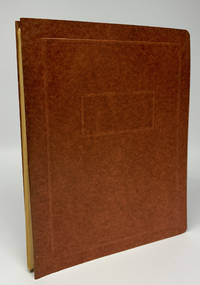
1943réf. 12163Harrisburg PA: Army Air Forces Intelligence School 1943. Very good. Quarto unpaginated about 100pp. illustrated with 83 original tipped-in photographs and an envelope containing 13 more loose and unidentified images laid-in. Housed in the original cardstock clasped folder. Many of the pages have a bottom fold which does not fully open without the potential to tear though all of the contents can be read with some effort. Some pages a touch foxed and a few prints are loosened from their pages and laid-in in the right place. Overall in very good condition. A well-organized and illustrated military textbook for a wartime class on aircraft identification which was probably taught in many places but organized at the US Army Air Force base in Harrisburg. An introductory sheet in perfect bureaucratic fashion placed near the end of this textbook states: "The course in Aircraft Identification consists of ten hours spaced over a period of six weeks." It goes on to list a series of 42 aircraft--American German Italian French and Japanese--which will be easily identified by all successful students by the end of the course. The first few dozen pages consist of detailed folding charts with data on dimensions payloads etc. Another section of about 12pp. gives a background on various best practices when trying to identify aircraft as well as some of the principles behind the course. The course utilized the "WEFT" system wings engine fuselage tail to help individuals soldiers intelligence agents etc. identify planes in the field from various angles at different heights and in certain contexts. Most of the pages dedicated to individual planes contain two photographs from different angles and with different shading trying to mimic real battlefield conditions under which someone might try to identify an aircraft. An unusually engaging wartime military textbook appealing to photography aviation and military collectors alike. Not located in OCLC thus notably absent in the holdings of the Army War College Library which retains most technical manuals and course books. Army Air Forces Intelligence School unknown
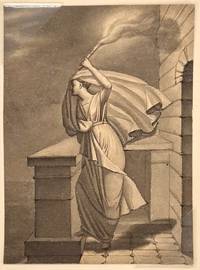
1860réf. 25031860. Excellent. Pen and ink and wash on cream wove paper 5 x 3 3/4 inches 128 x 95mm the full sheet. In excellent condition with minor toning and some light scattered soiling on the verso. Hero is shown holding a torch to guide her lover Leander as he swims across the strait from Abydos each night to be with her. The dramatic billowing of her cloak and the flickering flame of the torch suggest the "stormy night" mentioned in the myth. According to the legend the wind eventually blew out her light causing Leander to lose his way and drown after which Hero threw herself from the tower in grief. unknown
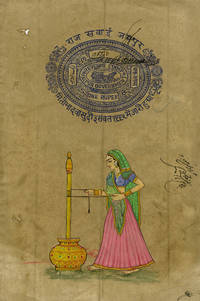
1890réf. 13411890. Good. Ink and gouache with gold heightening on fibrous brown laid paper with a Jaipur Court Fee tax stamp in purple ink on the recto 13 1/4 x 8 7/8 inches 336 x 226 mm. Toning handling creases and minor scattered surface soiling throughout. There are scattered coeval inscriptions in ink on the recto and verso. A traditional Indian butter churn is operated by rapidly pulling a rope which turns a paddled spindle. The paddles churn cows milk inside a large jar until milk solids form. Ghee is made from cow milk butter which is treated with low heat until the water evaporates leaving behind milk solids. The solids are skimmed off or strained if needed. Ghee is a staple food on the Indian subcontinent and as a cooking oil it is the most widely used food in India apart from wheat and rice. Because of its exalted status at Hindu weddings ghee is expensive and in high demand. Male wedding guests are expected to compete with each other to see who can eat the most of it; consuming two pounds or more at a sitting is considered a proof of virility. On the stamp: The first revenue stamps in India were issued in the mid-nineteenth century during the Raj and they are still being issued to this day. Apart from issues for the whole of India many princely states provinces and other states also had or still have their own revenue stamp issues. Before independence Indian revenue stamps were closely modeled on similar designs from Great Britain as is the case with this carriage motif stamp from Jaipur. The stamps were issued to denote various denominations including rupees and annas. An anna or Änna was a currency unit formerly used in British India equal to 1â„16 of a rupee. It was subdivided into four old Paisa or twelve pies thus there were 192 pies in a rupee. When the rupee was decimalized and subdivided into 100 new paise one anna was therefore equivalent to 6.25 paise. This particular stamp was used as evidence of court taxes remitted for property dealings. unknown
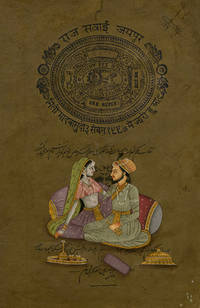
1890réf. 13331890. Good. Ink and gouache with gold heightening on brown laid paper with a Jaipur Court Fee tax stamp in black ink 13 3/8 x 8 3/4 inches 340 x 222 mm. Toning handling creases and minor scattered surface soiling throughout. Scattered coeval Hindi inscriptions in ink on the recto and verso. The first revenue stamps in India were issued in the mid-nineteenth century during the Raj and they are still being issued to this day. Apart from issues for the whole of India many princely states provinces and other states also had or still have their own revenue stamp issues. Before independence Indian revenue stamps were closely modeled on similar designs from Great Britain as is the case with this carriage motif stamp from Jaipur. The stamps were issued to denote various denominations including rupees and annas. An anna or Änna was a currency unit formerly used in British India equal to 1â„16 of a rupee. It was subdivided into four old Paisa or twelve pies thus there were 192 pies in a rupee. When the rupee was decimalized and subdivided into 100 new paise one anna was therefore equivalent to 6.25 paise. This particular stamp was used as evidence of court taxes remitted for property dealings. unknown
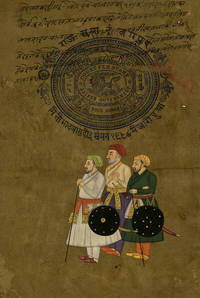
1890réf. 13341890. Good. Ink and gouache with gold heightening on brown laid paper with a Jaipur Court Fee tax stamp in black ink 12 5/8 x 8 9/16 inches 320 x 217 mm. Toning handling creases and minor scattered surface soiling throughout. Scattered coeval Hindi inscriptions in ink on the recto and verso. The first revenue stamps in India were issued in the mid-nineteenth century during the Raj and they are still being issued to this day. Apart from issues for the whole of India many princely states provinces and other states also had or still have their own revenue stamp issues. Before independence Indian revenue stamps were closely modeled on similar designs from Great Britain as is the case with this carriage motif stamp from Jaipur. The stamps were issued to denote various denominations including rupees and annas. An anna or Änna was a currency unit formerly used in British India equal to 1â„16 of a rupee. It was subdivided into four old Paisa or twelve pies thus there were 192 pies in a rupee. When the rupee was decimalized and subdivided into 100 new paise one anna was therefore equivalent to 6.25 paise. This particular stamp was used as evidence of court taxes remitted for property dealings. unknown
1935réf. 1901251935. Kräftiger vollrandiger Druck auf festem Bütten mit Wasserzeichen. 31,7 x 22,5 cm. Papier: 44,2 x 33 cm.
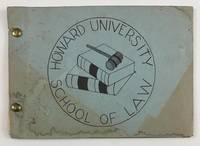
1959réf. 3137Washington D.C. 1959. Good plus. 19pp. mimeographed on rectos only. Original printed blue wrappers brad bound. Covers stained and worn. Mild uneven toning to a few leaves. A seemingly unrecorded directory for the Howard University School of Law published by the Student Bar Association in 1959. This humble handmade directory includes a short acknowledgement followed by listings of the faculty administrative staff Student Bar Association the Howard Law Journal the National Moot Court Team the Legal Assistance Program the "Law Wives" the class officers and finally the "Student Directory 1959-1960" arranged alphabetically. The directory lists the name expected year of graduation address phone number if any and undergraduate institution for each of the seventy-nine law students attending Howard at the time. Among the more notable names in the directory is Vernon Jordan Jr. who was then in his final year at Howard Law School. No listings for this ephemeral and homespun African American law school directory. unknown books
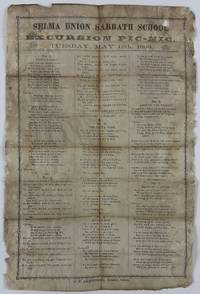
1868réf. 13286Selma AL: J.P. Armstrong Printer 1868. Broadside 12.25 x 8.25 inches printed in three columns. Numerous old folds substantial wear and foxing some wrinkling edges scuffed and chipped but ample margins remain small hole in upper right corner. Good only. A striking unrecorded broadside publishing the lyrics to six songs intended to be sung by students of the Selma Union Sabbath School on an "excursion pic-nic" in the Spring of 1868. The songs printed here include "Festive Song" "Sunday School Volunteer Song" "The Happy Song" "By-and-Bye" "Around the Throne" and "Beautiful River." Little is known about the Selma Union Sabbath School; the only newspaper records we could locate concern the same picnic advertised on the present broadside held at Marion Alabama on May 12 1868. The Selma Morning Times published an advertisement in a few issues that week. Not in Ellison Hummel or OCLC. J.P. Armstrong, Printer unknown books
1867Acquaforte e bulino, circa 1810/15. Il titolo dell’opera è tratto da una scrittura a mano in una prova di stampa dell’opera che Goya include nell’album dei “Disastri della guerra” che donò al suo amico Ceán Bermúdez e che ora è conservato al British Museum di Londra. Il disegno preparatorio dell’opera è conservato al Prado di Madrid. Esemplare nel terzo stato di quattro, inserito nella Gazette des Beaux-Arts (1867); si tratta della prima vera edizione dell’opera, conosciuta altrimenti solo attraverso due prove di stampa. "A seated prisoner raises his clasped hands, both fastened with chains, in a gesture of supplication. We cannot see his features since his face is hidden beneath his long, dark hair. His feet are fastened in large shackles. Both the chains and the shackles are of considerable size, underlining their importance in any interpretation of the print. In fact, just as the title of the etching shows, the painter is comparing the excessive zeal employed in preventing the prisoner from escaping to the brutality of the crime he is accused of. It is possible that the way in which the prisoner is secured in this work by Goya was habitual at the time, an idea which is supported by certain passages of Forensic Discourses (Discursos forenses), by Juan Meléndez Valdés (Ribera del Fresno, Badajoz, 1754- Montpellier, 1814), whose portrait Goya painted in 1797. This book, published in Madrid in 1821, speaks of the cumbersome chains and shackles used to hold one María Vicente, put to death on the 23rd April 1798. Goya could well have known of her story: "But it is said that Doña María Vicente must have been treated, as the noblewoman that she is, in a very different manner, and not locked in shackles; and even thus fettered it was the judge's responsibility to examine their state and quality beforehand, to order them put on correctly". The painter has made extensive use of the etching technique here, building up the background with short, horizontal lines, whilst leaving large areas on the prisoner's clothing untouched and white, underlining his innocence. This etching would have been made at the same time as two others: The custody of a prisoner does not call for torture and If he is guilty, let him die quickly. In these images, Goya openly expresses his repulsion of the way in which prisoners were treated, as well as his opposition to the death penalty, echoing the ideas of Cesare Beccaria (Milan, 1738- Milan, 1794). In the pages of the work entitled Dei deliti e delle pene, published between 1763 and 1764, the Milanese talks of the need to modify the penal system, to lessen the severity of punishments and to seek out mechanisms for preventing crime. It is possible that these etchings also contributed to the debate on the abolition of torture which was being discussed in the Courts of Cádiz. Goya reiterates this same topic in some of the prints in his Disasters of War series, such as no. 15, And it can't be helped, no. 31, That's tough!, no. 32, Why?, no. 34, On account of a knife, no. 35, One can't tell why and no. 36, Not in this case either. Despite the gritty subject matter, the figure depicted in this etching possesses great dignity, recalling some earlier precedents which Goya may have been familiar with. One of these is an anonymous print based on Interior of a Prison (16th century, Museum of Fine Arts, Boston), by Giulio Romano (Rome, 1499-Mantua, 1596). When he was making this print, Goya may also have had in mind the disturbing, gloomy ambience of the prisons of Giambattista Piranesi (Mogliano Veneto, Treviso, 1720- Roma, 1778)." (cfr. https://fundaciongoyaenaragon.es/eng/obra/tan-barbara-la-seguridad-como-el-delito/712). Tomás Harris ritiene che la matrice di rame si trovi in una collezione privata di Parigi. Bibliografia Harris 26 III/IV; Delteil 31. Etching and engraving, circa 1810/15. The title of this work is taken from the handwritten title of a state proof that Goya included in the album of his Disasters of War prints which he gave to his friend Ceán Bermúdez and which is now in the British Museum, London. The preparatory drawing for this etching is in the Prado Museum, Madrid. Example of the third state of four, form the Gazette des Beaux-Arts (1867), firts edition of this work, before known only for proof states. "A seated prisoner raises his clasped hands, both fastened with chains, in a gesture of supplication. We cannot see his features since his face is hidden beneath his long, dark hair. His feet are fastened in large shackles. Both the chains and the shackles are of considerable size, underlining their importance in any interpretation of the print. In fact, just as the title of the etching shows, the painter is comparing the excessive zeal employed in preventing the prisoner from escaping to the brutality of the crime he is accused of. It is possible that the way in which the prisoner is secured in this work by Goya was habitual at the time, an idea which is supported by certain passages of Forensic Discourses (Discursos forenses), by Juan Meléndez Valdés (Ribera del Fresno, Badajoz, 1754- Montpellier, 1814), whose portrait Goya painted in 1797. This book, published in Madrid in 1821, speaks of the cumbersome chains and shackles used to hold one María Vicente, put to death on the 23rd April 1798. Goya could well have known of her story: "But it is said that Doña María Vicente must have been treated, as the noblewoman that she is, in a very different manner, and not locked in shackles; and even thus fettered it was the judge's responsibility to examine their state and quality beforehand, to order them put on correctly". The painter has made extensive use of the etching technique here, building up the background with short, horizontal lines, whilst leaving large areas on the prisoner's clothing untouched and white, underlining his innocence. This etching would have been made at the same time as two others: The custody of a prisoner does not call for torture and If he is guilty, let him die quickly. In these images, Goya openly expresses his repulsion of the way in which prisoners were treated, as well as his opposition to the death penalty, echoing the ideas of Cesare Beccaria (Milan, 1738- Milan, 1794). In the pages of the work entitled Dei deliti e delle pene, published between 1763 and 1764, the Milanese talks of the need to modify the penal system, to lessen the severity of punishments and to seek out mechanisms for preventing crime. It is possible that these etchings also contributed to the debate on the abolition of torture which was being discussed in the Courts of Cádiz. Goya reiterates this same topic in some of the prints in his Disasters of War series, such as no. 15, And it can't be helped, no. 31, That's tough!, no. 32, Why?, no. 34, On account of a knife, no. 35, One can't tell why and no. 36, Not in this case either. Despite the gritty subject matter, the figure depicted in this etching possesses great dignity, recalling some earlier precedents which Goya may have been familiar with. One of these is an anonymous print based on Interior of a Prison (16th century, Museum of Fine Arts, Boston), by Giulio Romano (Rome, 1499-Mantua, 1596). When he was making this print, Goya may also have had in mind the disturbing, gloomy ambience of the prisons of Giambattista Piranesi (Mogliano Veneto, Treviso, 1720- Roma, 1778)." (cf. https://fundaciongoyaenaragon.es/eng/obra/tan-barbara-la-seguridad-como-el-delito/712). Tomás Harris believes that the plate for this etching may be in a private collection in Paris. Literature Harris 26 III/IV; Delteil 31. Harris 26, III/IV; Delteil 31.
1745Xilografia a chiaroscuro, 1745, in basso al centro la dedita dello stampatore: Illustrissimo, & Erudito Viro CAROLO FREDERICK Armigero, liberalium Artium Patrono, / Pauli Cagliari praeclarum hoc Opus in Ligno coelatum, in grati animi argumentum humiliter D. D. D. / J: B: Jackson”. Da un dipinto di Paolo VeroneseBell’esemplare, impresso su carta vergata coeva, completo dei margini bianchi, in ottimo stato di conservazione.La tavola è una della 24 dell’opera dal titolo “Titiani Vecelli, Pauli Caliarii, Jacobi Robusti, et Jacobi de Ponte opera selectiora” edita da J. B. Jackson nel 1745.La stampa è tratta dal dipinto di Paolo Caliari, detto il Veronese (1528-1588) per la cassa dell’organo della chiesa di S. Sebastiano, a Venezia, realizzato tra il 1558 e il 1560: le portelle dell’organo, chiuse, mostrano la “Presentazione di Gesù al Tempio”, mentre sul retro, visibile quando lo strumento è in uso, appare la scena della “Probatica piscina”. Chiaroscuro woodcut, 1745. inscribed lower center: “Illustrissimo, & Erudito Viro CAROLO FREDERICK Armigero, liberalium Artium Patrono, / Pauli Cagliari praeclarum hoc Opus in Ligno coelatum, in grati animi argumentum humiliter D. D. D. / J: B: Jackson”. After Paolo Veronese.Good example, printed on contemporary laid paper, white margins, in very good condition.Published as 1 of 24 prints and originally issued in portfolio with title: “Titiani Vecelli, Pauli Caliarii, JacobiRobusti, et Jacobi de Ponte opera selectiora”The plate is after an organ shutter of ca. 1588 painted by Paolo Veronese (1528-1588) for the Church of San Sebastiano, Venice. In 1558, Paolo designed the organ and painted its external shutters with the Presentation of Christ and the internal ones with a Pool of Bethesda (1560). The Presentation represents the bringing of the infant Jesus by Mary and Joseph to the Temple in Jerusalem to be 'consecrated to the Lord.' The Jewish rite of the 'purification' of the mother was celebrated simultaneously and involved the sacrifice of doves or pigeons and incorporated a procession of candles, both of which are portrayed by Veronese. The painted and actual architecture of Paolo's organ in San Sebastiano are coordinated so that, whether the shutters are open or closed, painted architecture continues the organ’s exterior architecture in both perspective and vocabulary. Kainen, Jacob. John Baptist Jackson : 18th-century master of the color woodcut, 1962
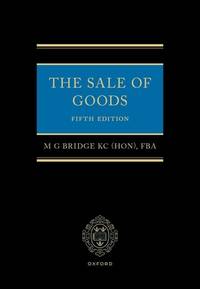
2026réf. x-0198959095Oxford University Press 2026. Hardcover. New. 5th edition. 954 pages. 6.89x2.22x9.92 inches. Oxford University Press hardcover
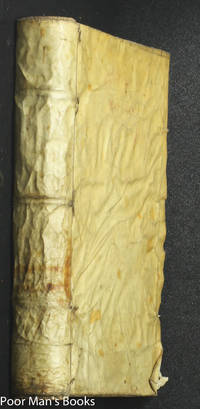
1673réf. 34321Zaragoca: : Por Agustin Verges Y Iuan De Ybar. Very Good with no dust jacket. 1673. Vellum. 4to 11" - 13" tall; El cordero vivo y muerto : vestigios sangrientos. By Jeromimo Escuela El cordero vivo y muerto : vestigios sangrientos del Redentor con la Cruz mansiones del Agnus Dei en su jornada al sacrificio passos a la vida por el camino de la muerte enpleos seraficos de la tercera orden de N. S. P. S. Francisco en la Estaciones de la Via Sacra. Provenance- Michael A Spencer small bookplate. 11" x 8.5". Collation: title 7 other prelim leaves a-e4 A-2B4 2C-2E8 2F-3H4 3L-3P4 3Q6 10 index leaves. Text portion of the volume is paginated from page 1-432 and 445-496 except for the 3 8-leaf signatures 2C 2D and 2E which are numbered by leaf from 201 to 224. Page 432 is the last page of "Via Crucis XI" and p445 is the first page of "Via Crucis XII." Despite the gap in signings the catchword between p432 and p445 matches "Via". Pages 149 353-354 459 mis-paginated 349 343 344 and 229. 3H2 and 3H4 mis-signed. Woodcut letters several woodcut tailpieces printed marginalia. Old limp vellum. Wrinkled owners rubber stamp and notation at lower corner of front pastedown front hinge cracked. Corners of prelims and last leaves and lower corner of front cover have some dog-earing/creasing also occuring in the text thereafter some edgewear to first/least leaves. Minor worming to lower margin resulting in chipping to base of a few leaves inner margin. Occasional old ink marks. Old neatly written paragraph of commentary on back fly leaf in Spanish. Presumed 1st as I can locate no earlier copies. WorldCat locates but 6 copies of this book. Contemporary and possibly original covers. Jesucristo ---Pasión Via Crucis . : Por Agustin Verges Y Iuan De Ybar, hardcover
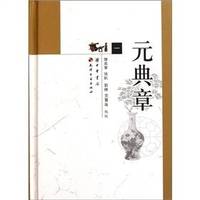
2011réf. 2081502111905944China Chunghwa Book Bureau/Tianjin Ancient Books Publishing House 2011. Soft Cover. Fine. Number of pages: 2490p Size: A5 Hardcover Number of books: 4 China Chunghwa Book Bureau/Tianjin Ancient Books Publishing House paperback
2012réf. 2092902144101012Kishin Shobo 2012. Soft Cover. Fine. Size: A5 Kishin Shobo paperback
réf. 0229QUPE6CPPamphlet. Good. ORIGINAL Prospectus for the first year at Swarthmore College. A little edgeworn and creased. Please see our photos. Scarce. $300 /year included wash room board AND books! unknown
réf. DADAX0064385051New unknown
1819réf. 2110502151100336Not Available 1819. Soft Cover. Fine. Number of books: 1 Not Available paperback
1944réf. 77-1610NY:: GPO/Arrow Press May July and Sept 1944. 1944. Title page date is May. Printing date is June. About 400p. Photos. Illustrations. Covers Machine guns Sights Turrets Martin Sperry Lower Sperry Ball Sperry Upper Consolidated Tail Emerson Nose Bendix Chin Bendix Upper Bell Adapter Aircraft Recognition. Two Sections on B-29 gunnery added: dated July and Sept. 1944. In Original printed grey cloth binder. Heavy/Oversize. Near Fine Copy. Hardcover. Near Fine. GPO/Arrow Press, May, July and Sept 1944. Hardcover
réf. R1278/1-2*Etutes Asiatiques Vol. 1-2 PRINT Paris 1924 WL CODE R1278/1-2 SIZE 383438 pp. fully illus. 190 x 285 mm BOOK WEIGHT 3.300 Kg PACKING WEIGHT 0.200 Kg paperback
1925réf. ZB1178343New Haven: Yale University Press 1925-1960. Price HAS BEEN REDUCED by 10% until Monday Oct. 26 weekend SALE item Numbers 8-10; 28-46; 49; 56; 67-113 1926-1960. We are assuming the December 1949 and May 1950 issues are number 95 although there MAY be an actual #95 that we do not have all issues in original paper wrappers and in very good condition except #87 which has detached covers. - If you are reading this this item is actually physically in our stock and ready for shipment once ordered. We are not bookjackers. Buyer is responsible for any additional duties taxes or fees required by recipient's country. Photos available upon request. New Haven: Yale University Press unknown
1880réf. 21937Librarie De L'Art 1880 Introduction de J. Comyns Carr. London, Librarie De L'Art, (c. 1880), in-folio, vélin à la Bradel biseauté estampé à froid d'un décor aux amours à l'or fin.
1937réf. 2886Bourges, sans éditeur (manuscrit, pièce unique), 1937. 5 Volumes. Formats divers, de 22 x 17,5 cm à 32,5 x 22 cm. 4 Cahiers à la couverture souple (3 en papier bleu et 1 de la marque Vogésia), 1 cahier relié à la bradel en demi-toile noire et aux plats cartonnés couverts de papiers marbrés. 74 Pages ; 170 pages ; 58 pages ; 47 pages ; 42 pages. Rare cours complet d'artifices militaires, rédigé à l'École Centrale de Pyrotechnie de Bourges, illustré de schémas techniques, dont plusieurs exécutés en couleurs. Le contenu, d'une grande technicité, couvre l'analyse, l'identification, la composition, le fonctionnement, l'emploi, la construction, les propriétés et la conservation des principales matières et engins pyrotechniques et militaires : poudres et explosifs, grenades, obus, cartouches, douilles, mèches, mines, fusées détonantes et percutantes, amorces, détonateurs, ainsi que les munitions correspondantes, les mécanismes d'armement et les procédés de chargement. Les schémas techniques, en partie rehaussés de couleurs, décrivent avec précision les coupes et le fonctionnement des différents mécanismes. Le cinquième cahier (170 pages) est daté du 7 décembre 1937 et signé sur la dernière page, la signature demeurant malheureusement illisible.
réf. DADAX0877288011New unknown
2002réf. ANAIS-0153366923HARCOURT SCHOOL PUBLISHERS 2002-05-01. 1. paperback. Good. 0x0x0. Buy with confidence. Excellent Customer Service & Return policy. HARCOURT SCHOOL PUBLISHERS paperback
1994réf. ZB394382Punjab School of Economics. 1994. Price HAS BEEN REDUCED by 10% until Monday Oct. 26 weekend SALE item volume 10. 1994. partly bound library markings textually clean & tight . - If you are reading this this item is actually physically in our stock and ready for shipment once ordered. We are not bookjackers. Buyer is responsible for any additional duties taxes or fees required by recipient's country. Photos available upon request. Punjab School of Economics. unknown