35.730 Ergebnisse
1799Acquaforte, acquatinta brunita e bulino, 1799. Dalla rara prima edizione di dodici della serie detta Los Caprichos, tavola 15. Magnifica prova, particolarmente nitida, impressa su carta vergata coeva, con usuali ampli margini, piccoli strappi di carta alle estremità dei margini, per il resto in perfetto stato di conservazione. La serie chiamata Los Caprichos, è composta da ottanta incisioni. Questa prima edizione del 1799, l’unica a non essere pubblicata postuma, è impressa su soffice carta vergata di gran qualità ed è stampata usando un delicato inchiostro seppia. Curata in fase d’edizione dallo stesso artista, la serie fu commercializzata e dopo poco tempo ritirata dal mercato. Infatti, a causa dei numerosi soggetti che ironizzavano sulla società spagnola di fine secolo, il Goya subì una censura. Per questo ne sono stimati solo circa 300 esemplari. L’interpretazione dei soggetti rappresentati su queste lastre, sempre enigmatiche, è spesso controversa - First edition -Etching, burnished aquatint and engraving, 1799. From the rare first edition (of twelve) of Los Caprichos, plate 15. A very fine impression, showing a good contrast, on contemporary paper, with usual wide margins, small tears at left white margin, otherwise in perfect condition. The series called Los Caprichos, consists of eighty etchings. This first edition of 1799, the only one not to be published posthumously, is imprinted on soft laid paper of great quality and is printed using a delicate sepia ink. Cured in phase edition by the same artist, the series was marketed and before long withdrawn from the market. In fact, because of the many subjects that mocked the Spanish society of the century, Goya suffered censorship. For this it is estimated only about 300 copies. The interpretation of the subjects represented on these plates, always enigmatic, is often controversial. The title can be translated into: Pretty teachings. Harris 50, Delteil 52.
1799Acquaforte, acquatinta brunita e bulino, 1799.Dalla rara prima edizione di dodici della serie detta Los Caprichos, tavola 54.Magnifica prova, particolarmente nitida, impressa su carta vergata coeva, con usuali ampli margini, in perfetto stato di conservazione.La serie chiamata Los Caprichos, è composta da ottanta incisioni. Questa prima edizione del 1799, l’unica a non essere pubblicata postuma, è impressa su soffice carta vergata di gran qualità ed è stampata usando un delicato inchiostro seppia. Curata in fase d’edizione dallo stesso artista, la serie fu commercializzata e dopo poco tempo ritirata dal mercato. Infatti, a causa dei numerosi soggetti che ironizzavano sulla società spagnola di fine secolo, il Goya subì una censura. Per questo ne sono stimati solo circa 300 esemplari. L’interpretazione dei soggetti rappresentati su queste lastre, sempre enigmatiche, è spesso controversa In questo soggetto Goya affronta il tema del mondo alla rovescia. Nella scena ci sono tre personaggi, il centro dell'attenzione è l'uomo che sta mangiando, e che cerca di evitare tutti gli sguardi, vergognandosi dei tratti osceni del suo viso. L'artista ha chiaramente indicato il suo pensiero disegnando la cintura di un paio di pantaloni sopra la testa del personaggio. I nasi sono una presenza notevole sul viso, e nel linguaggio popolare "nasi" è un chiaro eufemismo sessuale. Il modo in cui il viso è costruito, in modo che sopracciglia, occhi e naso evochino l'apparato genitale maschile, rafforzerebbe lo stesso senso. Altri commenti insinuano che la figura, nel piano superiore, con i suoi grandi pugni serrati, stia commettendo sodomia con la figura che tiene il vaso da cui mangia l'uomo vergognoso. L'anno 1799 è uno dei momenti chiave nella vita e nel lavoro di Francisco de Goya. Oltre ad essere nominato primo pittore da camera di Goya, a godere di un crescente prestigio come ritrattista e ad inaugurare la cappella di San Antonio de la Florida, che aveva decorato, il 6 febbraio il Diario de Madrid pubblicò un annuncio in cui venivano messe in vendita le ottanta stampe che compongono la serie dei Caprichos. Bellissimo esemplare. Al verso timbro di collezione HENRI MARIE PETIET (Saint-Prix, Seine-et-Oise, 1894-1980), editore, libraio e mercante di stampe a Parigi (Lugt 5031). - The rare first edition -Etching, burnished aquatint and engraving, 1799.From the rare first edition (of twelve) of Los Caprichos, plate 54.A very fine impression, showing a good contrast, on contemporary paper, with usual wide margins, perfect condition.The series called Los Caprichos, consists of eighty etchings. This first edition of 1799, the only one not to be published posthumously, is imprinted on soft laid paper of great quality and is printed using a delicate sepia ink. Cured in phase edition by the same artist, the series was marketed and before long withdrawn from the market. In fact, because of the many subjects that mocked the Spanish society of the century, Goya suffered censorship. For this it is estimated only about 300 copies. The interpretation of the subjects represented on these plates, always enigmatic, is often controversial. In this print Goya approaches the theme of the world upside down. In the scene there are three characters, being the focus of attention the man who is eating, and tries to avoid all eyes, ashamed of the obscene features of his face. The artist has clearly indicated his thinking by drawing above the character's head the waistband of a pair of pants. The noses take on a notable presence on the face, and in popular language "noses" is a clear sexual euphemism. The way the face is constructed, so that eyebrows, eyes and nose evoke the male genital apparatus, would reinforce the same sense. Other comments insinuate that the figure, in the upper plane, with his large clenched fists, is committing sodomy with the figure holding the vessel from which the shameful man eats. The year 1799 is one of the key moments in the life and work of Francisco de Goya. In addition to being named first chamber painter, enjoying a growing prestige as a portrait painter and the inauguration of the chapel of San Antonio de la Florida, which he had decorated, on February 6 the announcement of the sale of the eighty prints that form the series of the Caprichos was published in the Diario de Madrid. Here, Goya focuses his social criticism on the bestiality of a deformed man whose head emerges from his breeches. Among the slight variations between the print and the preparatory drawing, the most striking is that, in the former, he wears his trousers, but in the latter, he does not. As a result, the latter came to be known as The satire of man’s lechery. Moreover, this is the only drawing in the series to mix red-ink wash with pen. Valentín Carderera’s handwritten commentaries on the Caprichos, which are in both the Biblioteca Nacional and the Museo del Prado, further clarify this subject. The first reads: Men with large noses also tend to have large arrows [here, “arrow” is a euphemism for penis] and fat gandumbas [testicles]. As they are often sodomites, this one is depicted with his breeches on his head, with his pudenda hanging out as he lies on top of a poor devil and pulls up his skirts. The second commentary completes the information: There are men whose face is the most indecent part of their body, and it would be good if those whose face is that disgraceful and ridiculous would stick it in their breeches. Example from the HENRI MARIE PETIET (Saint-Prix, Seine-et-Oise, 1894-1980) collection (Lugt 5031). Harris 1964, 89.
1950"Ranks with Smith's Wealth of Nations, Ricardo's Principles, Marx's Capital, Marshall's Principles, and Keynes' General Theory, as one of the six most important books ever written in its influence upon the development of modern economic theory. Menger's influence was not, however, confined to theoretical economics. The Austrian School of which he was the founder, was a fountainhead of classical liberalism in the European continent. The ideas of the school and its founder are, therefore, relevant to the modern debate between socialism and liberalism. Since many of the staunchest modern advocates of laissez faire, such as L.M. Mises and F.A.V. Hayek, find their intellectual roots in Menger's Principles, the translation of his work is of interest to those concerned about the relations between government and business as well as to economic theorists." - dust jacket. The long overdue first English edition of the 1871 German first edition. Menger [1840-1921] "attacked the half-decayed fabric of economics and is to be ranked among those who have torn down the structure of a science and placed it upon entirely new foundations." - Joseph Schumpeter. "Menger's Principles are the best introduction to the understanding of the theory of value which we possess." - F.A. Hayek. Former library copy with usual markings and moderate wear to original black cloth lettered in silver. Above-average wear to undulating dust jacket which is patched on spine and now preserved in archival-grade Brodart. A sound copy of this economic tour de force. Fundaburk 9739, Hutchinson 347, Hazlitt p.115, Blaug p.160-162, Pressman p.89-94. Book
1746Best.-Nr. 2110502151103514Kara Bookstore Kichizaemon 1746. Soft Cover. Fine. Number of books: 2 Kara Bookstore Kichizaemon paperback
Best.-Nr. 106200Lyon, Cercle Lyonnais du Livre, 1934, 1 volume in-folio de 315x240x55 mm environ, 302 pages, luxueuse reliure signée et datée : M. Bernard 1936, plein maroquin caramel, dos lisse portant titres dorés orné de filets horizontaux à froid et doré, décor sur les plats de formes géométriques de carrés entrecroisés autour d'un petit carré de maroquin ivoire au centre de premier plat avec inscription tifinar dorée, tranches dorées, gardes mordorées encadrées de maroquin, sous étui bordé recouvert papier mordoré assorti aux gardes, couvertures et dos conservés. Tirage à 162 exemplaires, celui-ci est un des 120 nominatifs pour les Membres du Cercle. Avec 92 compositions en couleurs : Peintures et Dessins du Hoggar de Paul-Elie DUBOIS, interprétés en gravure sur bois par Pierre BOUCHET, chaque chapitre débute par une lettrine ornée de motifs adaptés de la décoration touareg. Contient in-fine 7 feuillets constituant les pages et illustrations remplacées, un bandeau inédit en noir a également été joint. Une petite tache au bas du dos, menus frottements sur les angles de l'étui, sinon très bel exemplaire, dans une belle reliure en bon état.
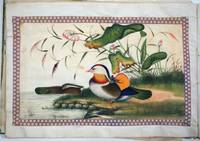
1830Best.-Nr. 27903Canton: SunQua Studio 1830. Silk covered boards. The 12 bird images are full page finely done with grass rocks and flowers with shrubs or trees. Unusually the half page images are mounted on the verso of the sheets of bird images. The half page images include collections of shells 4; women playing musical instruments 8; men sitting a scribe man smoking butcher melon fish and vegetable sellers and a few of the punishment images. Oblong 4to 8 1/4 x 13 1/4". Leaves mounted with to paper leaves with an unusual paper border with a purple circle pattern on pale background paper. Chinese style binding opening from the back of the album. Bound in a green gold blue and red silk woven in a daisy pattern which sometimes appears with a Sunqua stamp. Without background painting. The first image with some cracking but not affecting the characters some slight browning. Most in very good condition. SunQua Studio unknown
1942Best.-Nr. 47-408Camp Lee 1942-1945. 1942. 6 vols. bound in red cloth. "A Training Aid to Officers & Instructors". Early issues are mimeographed later printed on glossy paper. Photos. Illustrated. Ex. Lib. VERY GOOD SET. Hardcover. Very Good. Camp Lee, 1942-1945. Hardcover
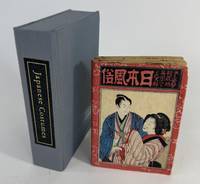
1890Best.-Nr. 2044Osaka: Poole Women's College 1890. A delicate and magnificent Japanese rarity in fine condition: 3 volumes contained within a printed wrap-around band together in a single pictorial sleeve each volume approx. 4½ x 3¼" printed and bound in the Japanese manner in decorative paper wrappers each with a double-page folding color woodblock panorama The Daimyos Procession The Procession of the Mikado and The Bridal Procession of the Common People and each followed by 26 for a total of 78 color woodblocks of samurai court officials nobles servants merchants girls of high and low station nurses weavers cooks soldiers courtiers fishermen etc. - the entire panoply of Japanese society. "Every page has color woodcuts showing people of all classes and professions each with caption in English and Japanese. The books were written by an English teacher at the 'Pool' School for Girls." - Miles. From the Preface "These books are not only designed to please children but to show the manners and customs of the ancient and modern people of Nippon. The fine illustrations afford an important aid in this respect. It is through the eye that the understanding itself is most quickly reached." . Poole Women's College unknown
1930A PRISTINE COPY ON JAPANESE PAPER OF ONE OF THE TRULY GREAT LIVRES D'ARTISTE, AND PERHAPS THE MOST BEAUTIFUL BOOK DEVOTED TO MARSEILLES. Illustrated with 94 original etchings by Raoul Dufy. From a total edition of 340 copies, this is ONE OF ONLY 35 COPIES ON LUMINOUS JAPON SUPERNACR… PAPER (common called "pearl Japan" in English). Folio. Loose as issued in original wraps. Cloth case. FINE AND BRIGHT, WITH NO DEFECTS. Chapon, p. 281; Erving 12; Skira 107; Rauch 47; Manet to Hockney 85; Strachan, p. 331; Garvey & Wick 15; Stern 38; Wheeler, pp. 42 and 101; The Artist & the Book 93; Jentsch 22; Johnson 185.
Best.-Nr. 005982Columbia High School Yearbook Staff 1973 1973. Hardcover. Very Good/No Jacket. 31 cm. green and blue cloth ; numerous photos several in color ; extremely rare Beatles-related collectible: This is the high school annual for the senior year of MARK DAVID CHAPMAN the murderer of JOHN LENNON. Chapman is featured in the seniors section with the photo that was first used in worldwide distribution during the breaking news story in 1980. Included are photos of Chapman's teachers friends and siblings ; VG [Columbia High School Yearbook Staff], 1973 hardcover
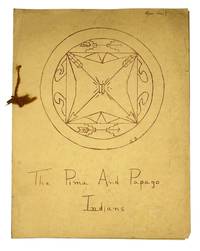
1936Best.-Nr. 15319Escuela Arizona 1936. Quarto 11.5 x 8.5" stitched hand titled and illustrated wrappers 26 pp. A homemade book mimeographed from handwritten text completed in original watercolor prepared by Fourth Grade students at the Tucson Indian Training School a Presbyterian run boarding school in Arizona. During this era students at the school published several books "to promote pride in their culture and ethnic heritage" "The Tohono O'odham and Pimeria Alta" 102 however this volume appears to be entirely unpublished. The book begins with a title page followed by an introduction by teacher Angeline Badger who states that "In writing this history of the Pima and Papago Indians every child had a part. Each child made his own history and illustrated it. The best paper or parts of several papers were used for the different chapters of this book. Each child drew an illustration for each chapter. The class chose the picture that was to be used in this book. Different children did the manuscript writing in the original book.Our authority for many facts was the Twenty Sixth Annual Report of the Bureau of Ethnology.Much of the information came from the children themselves especially the chapters on the 'Foods of the Desert' and 'Basket Making'." Chapters include "The Early Pimas and Papagos" "Contact With the White Man" "The Pima Calendar" "The Pima Round House" "Foods of the Desert" discussing the Pima and Papago diet "Making Pottery" "Making Baskets" "Pima and Papago Homes of Today" "The Pimas and Papagos at Work" discussing the agricultural work by the men "The Pimas and Papagos at Play" and "How the Sahuaro and Paloverde Came to Be." The booklet contains 21 original illustrations all but one in color and each initialed by the student artist. These show early pueblos white missionaries Christianizing the early Natives the Pima Round House "gathering cactus fruit" making pottery and baskets grinding corn a Native American playing "the ball game" desert scenes and more. The text acknowledges that "The Indians had a bad time.The worst sort of white people came to the Indians and sold them whiskey and taught them bad things." At the same time it goes on to recognize missionary Charles H. Cook the founder of the Tucson school as a savior: "At that time they had no teacher. In 1871 Charles H. Cook came out to the Pimas. He was sorry for the Pimas and Papagos. He helped the sick babies and made them well he built a little adobe house near Sacaton. That was the first school for these Indians." Nothing by this title in OCLC. Inscribed "Miss Holt" to upper edge of front wrapper lacking lower binding string mild wear and soiling to wrappers slight waviness to pages mild damp staining to last few pages in quite presentable condition overall. unknown
Best.-Nr. 2081502111901819beijing chinese bookstore N.A. Soft Cover. Fine. The book is in fine condition. beijing chinese bookstore paperback
1931Best.-Nr. 2092902141000173Watanabe Print Shop 1931. Soft Cover. Fine. The book is in fine condition. Watanabe Print Shop paperback
1807Best.-Nr. 2092902144201822Not Available 1807. Soft Cover. Fine. The book is in fine condition. Not Available paperback
1960Best.-Nr. ZB255748Command and General Staff School 1960. volumes 40 42 44 45 47-49 52-55 57 59 62 63 70 71 75 76 78 1960-1998; mostly original paper wrappers library markings else textually clean; price is for the lot. - If you are reading this this item is actually physically in our stock and ready for shipment once ordered. We are not bookjackers. Buyer is responsible for any additional duties taxes or fees required by recipient's country. Photos available upon request. Command and General Staff School unknown
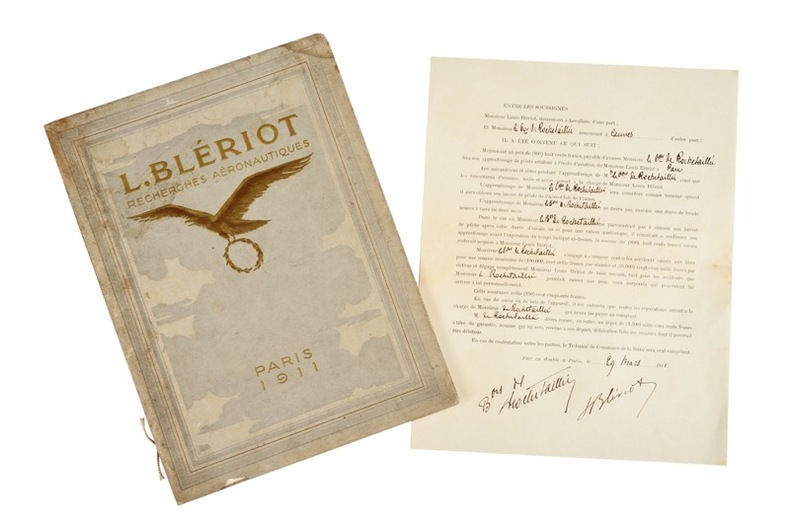
Best.-Nr. 21757formulaire imprimé et complété et signé des deux parties (1 feuillet blanc recto, 274 x 212 mm), en vue d’obtenir le brevet de pilote de l’Aéro-Club de France. L’apprentissage coutait 800 francs soit en terme de pouvoir d’achat 251 455 € d’aujourd’hui !
1620Bulino, 1610/20 circa, in basso al centro l'excudit di Claes Janz. Visscher (CJV intrecciate). Sotto l'immagine una spiegazione in francese e in olandese e un riferimento al testo biblico di Matteo (15:14). Numerato 3, in basso a destra. Da un soggetto di Pieter Brueghel il Vecchio. L'opera traduce in immagini la parabola evangelica del cieco che guida un altro cieco, riportata da Matteo 15:14, in cui Cristo si rivolge ai Farisei: «Sono ciechi e guide di ciechi. E quando un cieco guida un altro cieco, tutti e due cadranno in un fosso!». Il cui significato è: quando l'incompetente consiglia altri incompetenti, le cose vanno male. L'acquaforte pubblicata da Claes Jansz. II Visscher è apparentemente ispirata a De parabel der blinden [La parabola del cieco], dipinta da Pieter Bruegel il Vecchio nel 1568. Questa ipotesi è stata avanzata dal Rijksmuseum, che conserva due impressioni di questa incisione. È incisa al contrario rispetto al quadro, e utilizza la stessa composizione: uomini ciechi, vestiti come vagabondi, seguono una linea diagonale attraverso il quadro, che porta a un fiume in cui cadranno presto; hanno mancato per poco un piccolo ponte di assi a monte, vicino a un albero. Come nel quadro, c'è un villaggio sullo sfondo. Tuttavia, ci sono solo tre ciechi invece dei sei del quadro di Bruegel, e quello di fronte, con la stessa ghironda del quadro sulla spalla, non è ancora caduto in acqua. Non descritto da Leeber, Bastealer e Hollstein. Il Rijksmuseum, che suggerisce una data del 1643 nella descrizione di una delle loro due impressioni, certifica che quest'opera è inserira dalla serie Theatrum Biblicum Hoc Est Historiae Sacrae Veteris et Novi Testamenti Tabulis Aeneis Expressae. Crediamo che una datazione più pertinente per l'opera sia tra il 1610 e il 1620 e che solo successivamente venga a far parte della Bibbia pubblicata da Claesz J. Visscher. L'incisore rimane anonimo, ma è possibile che si tratti dello stesso autore. Figlio di Jan Claesz Visscher, un incisore e editore di Amsterdam, padre di Nicolaes e nonno di Nicolaes II, fu attivo nella sua città natale dal 1601 fino al 1652. Nel 1605 lavorò come incisore per l'editore di Amsterdam Willem Jansz. Blaeu, realizzando tra l'altro alcune vedute dei più importanti monumenti di Amsterdam, e per Theodoor Galle. Molto presto però, Visscher iniziò a pubblicare stampe di propria fattura, caratterizzate dal logo del “pescatore”, riferimento al suo nome latino di Piscator. Immagazzinò, inoltre, stampe, acquisendo su larga scala lastre di rame da altri editori e stampatori, non solo prodotte da artisti viventi, ma anche vecchie tavole da Maarten van Heemskerck e altri noti pittori, prodotte da Hieronymus Cock e dai suoi successori. Contribuì, in questo modo, a costituire una delle più importanti case editrici dell'epoca. Rappresentò soggetti religiosi, paesaggi, in particolare invernali, e architetture, e realizzò stampe di devozione. Nonostante la più importante pubblicazione dell'epoca, la “Bibbia”, nella versione autorizzata nei Paesi Bassi, fosse senza illustrazioni, Visscher, come pure altri editori dell'epoca, realizzarono stampe, che, inizialmente separate dal testo religioso, vi furono in seguito incorporate. Bellissima impressione, su carta vergata coeva, con ampi margini, in perfetto stato di conservazione. Engraving, signed at the lower center with the excudit of Claes Janz. Visscher (CJV entwined). Beneath the image an explanation in French and in Dutch and a reference to the Bible text in Matthew 15:14. Numbered 3. After Pieter Brueghel the Elder. The blind leader is about to step into a ditch, taking his equally blind followers with him. The guide has a hurdy-gurdy under his cloak. A village can be seen in the background. The scene is a depiction of the proverb and parable: “if the blind lead the blind, both shall fall into a ditch”. The meaning of which is: when the incompetent advises other incompetents, things go wrong. The etching published by Claes Jansz. II Visscher is seemingly inspired by De parabel der blinden [The parable of the blind], painted by Pieter Bruegel the Elder in 1568. This hypothesis has been put forward by the Rijksmuseum, which keeps two impressions of this etching. It is etched in reverse compared to the painting, and uses the same composition: blind men, dressed like vagrants, follow a diagonal line across the picture, leading to a river in which they will soon fall; they narrowly missed a small plank bridge upstream, next to a tree. As in the painting, there is a village in the background. However, there are only three blind men instead of six in Bruegel's picture, and the one at the front, wearing the same hurdy gurdy as in the painting over his shoulder, hasn't fallen into the water yet. Not described by Leeber, Bastealer and Hollstein. The Rijksmuseum suggests a date of 1643 in the notice to one of their two impressions, this work is taken from the series Theatrum Biblicum Hoc Est Historiae Sacrae Veteris et Novi Testamenti Tabulis Aeneis Expressae. We believe that a more pertinent date for the work is between 1610 and 1620 and that it only later became part of the Bible published by Claes Jansz. Visscher. The engraver remains anonymous, but it is possible that it is the same author. Visscher, who was born and died in Amsterdam, was also known as Nicolas Joannes Piscator or Nicolas Joannis Visscher II, after his father who lived ca. 1550–1612. He learned the art of etching and printing from his father, and helped grow the family printing and mapmaking business to one of the largest in his time. It was a family business; his son Nicolaes Visscher I (1618–1679), and his grandson Nicolaes Visscher II (1649–1702) were also mapmakers in Amsterdam on the Kalverstraat. The times were with the Visschers for other reasons; due to the Protestant reformation, the older Bibles with their "Roman Catholic" illustrations were seen as outdated and apocryphal, but to liven up the new Protestant Bibles for the less well-read clergy, the Visschers produced illustrated maps and even landscapes of the places in the Bible. This became a very successful family business, with collaboration with many respected draughtsmen of the day. A new translation of the Bible was underway in the Netherlands, and until then, the new German translation done by Johannes Piscator, published in 1602–1604, was translated into Dutch. Though probably not a relative, his Bible translation was accepted by the Dutch Staten-General in 1602, which only lent more publicity and authenticity to the "Fisher" name. The trademark of the Visschers was a “fisherman”, after their name (thus the Latin nickname Piscator). A small fisherman would be strategically placed somewhere near water. If the subject was a landscape without a stream or pond, then often a figure walking with a fishing rod can be seen. Their map plates were reused for a century by other printers who unknowingly copied the entire plates, including the tell-tale fishermen. Observant scholars are thus able to trace the provenance of Bibles, maps, and landscapes from these signs. A fine impression, printed on contemporary laid paper, with margins, perfect condition.
1505Xilografia, 1505 circa, monogrammata nella tavoletta in basso a destra. Stato unico, nella terza variante, di cinque, descritte da Meder (n. 233 c/e) Magnifica prova, nitida e ben contrastata, nella terza variante descritta da Meder, caratterizzata da una piccola rottura del legno che comporta una mancanza di circa 5 mm nella parte superiore della linea d’inquadramento. In ottimo stato di conservazione. San Nicola, a sinistra, è identificato dal pane che tiene in mano, che gli fu portato durante una carestia sull'isola dove viveva, dalla barca sullo sfondo. Sant'Erasmo, a destra, sta portando le sue viscere, avvolte intorno a un rocchetto, e inoltre, è identificato dalla ruota con una candela accesa. Al centro c'è Sant'Ulrico, il patrono di Augusta, con in mano il suo simbolo, un pesce. Poiché è al posto d'onore, è stato ipotizzato che questo foglio sia stato commissionato o inteso per essere venduto ad Augusta. Il nome Ulrich non era comune a Norimberga. Questa stampa è spesso considerata come la controparte di un’altra xilografia, raffiguranti i SS. Lorenzo, Sisto e Stefano, sebbene le figure siano più allungate. Alcuni critici hanno anche riconosciuto un concetto spaziale che sembra corrispondere ad alcuni fogli de La Piccola Passione. Di conseguenza, datano questo foglio dopo il ritorno di Dürer dal suo secondo viaggio in Italia, cioè verso il 1508. Ma – osserva Strauss - questa xilografia corrisponde in troppi dettagli ad altre due: il soggetto, lo sfondo, gli uccelli, e inoltre il tipo di carta su cui è stampata, che non la distingue affatto dalle altre cosiddette "modest woodcuts", tutte riferibili agli anni 1503-1505. La forma della tavoletta che porta il monogramma è unica, ma rudimentale. Queste differenze possono essere più propriamente attribuite alla presenza di un'altra mano nella bottega di Dürer che ha modificato il disegno di Dürer in fase di intaglio. Bibliografia Bartsch, 118; Meder, 233 (c/e); Tietze, 398; Panofsky 338; Strauss n. 88. Woodcut, 1505 circa, signed with monogram on tablet lower right. Only state. Impression of Meder variant c/e, with a 5 mm gap in the upper border. Good impression, black, full-bordered, with a 5mm gap in the upper border according the variant c/e described by Meder. Very good condition “St. Nicholaus, on the left, is identified by the bread he is holding, which was brought to him during a famine on the island where he lived by the boat in the background. St. Erasmus, on the right, is carrying his entrails, wound around a reel, and in addition, is identified by the wheel with a burning candle. In the center is St. Ulrich, the patron saint of Augsburg, holding his symbol, a fish. Because he is in the place of honor, it has been surmised that this sheet was commissioned or intended to be sold in Augsburg. The name Ulrich was not common in Nuremberg. This print is often regarded as the counterpart to the preceding one (no. 87), although the figures are longer elongated. Some commentators have also detected a spatial concept that seemingly corresponds to some of the sheets of "The Small Passion' (nos. 106-142). Accordingly, they date this sheet after Dürer's return from his second Italian journey, i.e. c.1508.2 We find that assumption highly speculative. This woodcut corresponds in too many details with at least the two preceding ones: the subject, the background, the birds, and moreover the type of paper that it is printed on, which in no way sets it apart from the other "modest" woodcuts. The shape of the tablet bearing the monogram is unique, yet primitive. These differences can more properly be ascribed to the presence of another hand in Dürer's workshop who modified Dürer's design in preparation for the cutter.” (cf. Strauss, n. 88, p. 296). Literature Bartsch, 118; Meder, 233 (c/e); Tietze, 398; Panofsky 338; Strauss n. 88.
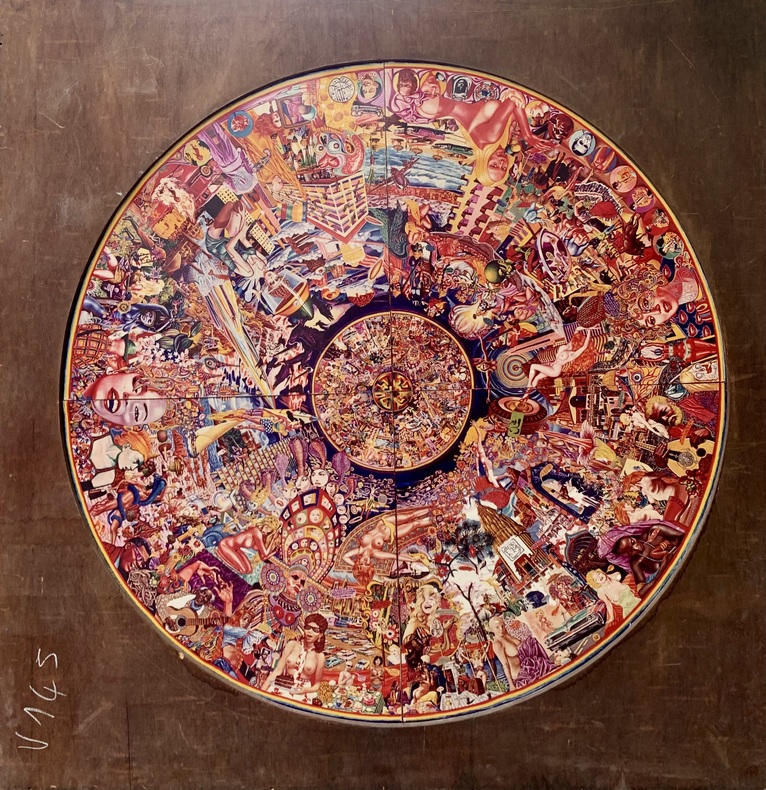
Best.-Nr. awd-1157Important tirage photographique en couleurs monté dans un encadrement carré en bois, ajouré en cercle au centre. Très rare épreuve, peut-être tirée pour un essai de couleurs lors de la commercialisation d’une affiche en 1969. Mentions Mati Klarwein, Grain of Sand, Robert Crandall Assoc., 1968 sur le côté avec échelles chromatiques, petits manques de pigmentation dans la partie basse (111,5/117,2 cm dans un cadre de 122/122 cm).
1790Veduta della festa di Sant’Andrea ad Amalfi, tratta da un disegno di Luois Jean Desprez. Amalfi festeggia Sant’Andrea, patrono della città, ben due volte all'anno, una il 30 novembre, l'altra il 27 giugno nell'anniversario del miracolo che salvò la città di Amalfi dall'invasione del pirata Kair-Ad-Din detto Barbarossa nel 1544. Sant'Andrea è protettore dei pescatori di tutto il mondo, di pescivendoli e di tutti coloro che hanno a che fare con la pesca. Ai festeggiamenti del 30 novembre, partecipa tutta la popolazione, ed è in questa occasione che avviene il “miracolo di Sant’Andrea”, per tanti versi molto simile al miracolo della liquefazione del sangue di San Gennaro. Probabile che il Desprez realizzi il disegno durante il suo viaggio in Italia, durante il quale descrive molto luoghi dell'Italia meridionale, poi base iconografica per il "Voyage Pittoresque" dell'abate Richard de Saint-Non.Incisione all'acquatinta ad inchiostro bistro, lievemente rifilata all'interno della linea marginale, piccole crepe di carta, per il resto in ottimo stato di conservazione. Rarissima. View of the feast of St. Andrew in Amalfi , taken from a drawing by Louis Jean Desprez. Amalfi celebrates St. Andrew, patron saint of the city, twice a year, on Nov. 30, the other June 27 anniversary of the miracle that saved the city from the invasion of Amalfi pirate Kair -Ad- Din said Barbarossa in 1544. St. Andrew is the patron of fishermen from all over the world, fishmongers and all those that have to do with fishing . The celebrations of November 30 , participates in the entire population, and it is on this occasion that happens the "miracle of St. Andrew " , in many ways very similar to the miracle of the liquefaction of the blood of San Gennaro.Likely that the realized design Desprez during his trip to Italy, during which describes a lot of places in southern Italy , then iconographic basis for the " Voyage Pittoresque " by the Richard de Saint-Non.Aquatint printed with bistro ink, slightly trimmed within the marginal line, small cracks of paper, otherwise in excellent condition. An extremely rare work. Frölich, Johan Fredrik Martins gravyrer, Stockholm, 1939, 291 II.
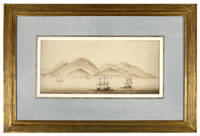
Best.-Nr. 87196ca. 1830 . Sepia ink and pencil early view of Hong Kong showing sailing boats in the foreground probably executed by an English military or naval officer. Laid on card size: 320mm x 143mm. ca. 1830] unknown
1915Best.-Nr. 10097Weybridge: Unpublished 1915. A remarkable educationala experiment and book-making in the form of a collection of lino-cut prints lithographs watercolours woodblock prints and accompanying text which was created by the ground breaking educationalist Eva Margaret Gilpin and her school's gifted art teacher Miss E Cassels Gillespy. Under the sponsorship and protection of Sir Michael Sadler later the husband of Eva Gilpin the school was likely the first in England to put linoleum and tools into the hands of its pupils: 'Miss Gilpin and I saw the work at an Educational Conference at Leipzig in 1908 or 1909; she said 'Can we do it' I said 'Yes' and we started. We made tools out of umbrella spokes We had carving tools shortened and set in engravers' handles' E Gillespy. The preliminaries list the names of the 31 contributors followed by sections titled 'On the Making of the Book' ' A Schoolroom' 'Singing' 'Little Ones Artwork' 'Gymnastics' 'Gardening' 'Arithmetic' 'Pond dipping' 'Our Pets' 'Stencilling' 'Cricket' 'Pear' 'Net Ball' 'Napoleon' and 'Dalcroze'. Eva Gilpin began in Ilkley Yorkshire as governess to Michael Sadler's children before the household moved to Weybridge where she founded The Village Hall School. Attended by Sadler's son in Weybridge Village Hall the decorations on the walls included a painting by Paul Gauguin The Vision after the Sermon on loan from Sadler. Miss E Cassels Gillespy was a practising artist herself with a studio in Cobham and introduced the pupils to the wide range of illustrative techniques which the contents of the book exemplify. Four institutional copies of the book survive The British Library The University of Leeds and The University of Melbourne and from its labour-intensive construction it seems unlikely that more than a couple of dozen can ever have been created. PHYSICAL DESCRIPTION: Vernacular stitched card binding held together by a thick flat dark ribbon which threads through punched eyelets to top and tail securing the spine and contents. Paper covers a little age toned; titled in bold black font with decorative chequered pattern to tail of upper. Cream endpapers good; toned as expected. Contents pasted onto blue leaves many of which fold out containing up to six sections. Occasional leaves a little scuffed to fore edges. One fold out section to rear cracked and sits loosely within binding. All very clean and unmarked throughout. Measures 24cm x 30cm. Please contact Christian White Rare Books Ltd for more information or images of this item 1915 Unpublished unknown
Best.-Nr. 2081502111905940Chinese social sciences N.A. Soft Cover. Fine. The book is in fine condition. Chinese social sciences paperback
1775Best.-Nr. c2412110474xbvkLouvain / Leuven, Belgium; 1775. Titlesheet (former blank front flyleaf), (9) pages 'Proemium Rhetorica / ...' and 'Deperiodo.', 5 blank sheets, pages 17-257 (of?), 1 blank sheet, blank rear flyleaf. - Vellum binding of the period over 5 raised bands with colour-marble-paper covered panel with vellum corners and red edges; small 4to.(ca. 19 x 16 x 2 cm).
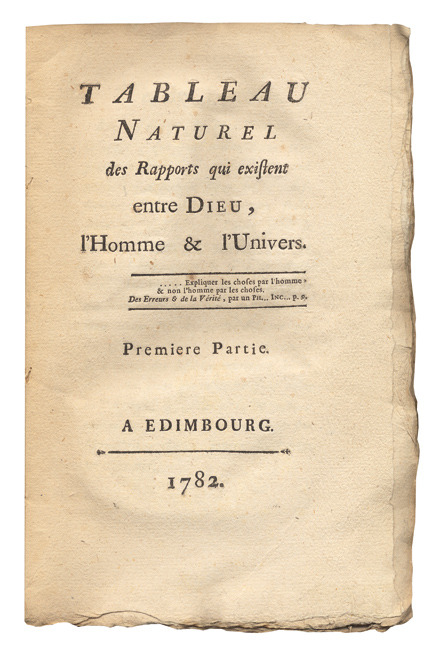
1782Best.-Nr. 16243A Edimbourg (Lyon), s.n., 1782 ; 2 tomes in-8, brochés dans leur première couverture de papier dominoté en couleurs marqué "A Orléans chez Leblond N°68" ; (4) de titre, blanc, avis des Editeurs et table, 276 pp. ; (4) faux-titre et titre, 244 pp.