ITALIAN SCHOOL, 19th centuryBiblio.com

17 744 résultats
1850réf. 42496Italy 1850. Watercolour over faint etched line black gouache border. Period gilt and faux bois frames. A splendid panoramic view of Lake Maggiore. Catering to the foreigners flocking to the region on The Grand Tour this hand-painted print beautifully depicts the famed picturesque lake with rich bands of blue highlighting the water and sky with the surrounding hills and mountains dotted with luxurious villas. In this view of Lake Maggiore we see from a very high vantage point the Borromean Islands: Isola Bella Isola Madre and Isola dei Pescatori with their extraordinary gardens. unknown
1993réf. 0025381993. Hardcover. Good. Publisher: Island Press 1993 Good HB ISBN: 1-55963-189-9 hardcover
1982réf. 0044651982. Hardcover. Good. Publisher: Pergamon Press 1982 Good HB ISBN: 0-08-028815-4 rear cover sticker residue. hardcover
1979réf. 3383ml1979. Hardcover. Good. Gd. condition : Santa Cruz High School Cardinal 1979 - . F7 hardcover
1970réf. 2224ml1970. Soft Cover. Good. Gd. condition / Rea; Stories Dictated by Twenty-one First Graders at Thousand Oaks School in Berkeley California . KH6 paperback
1970réf. 2018ml1970. Soft Cover. Good. Gd. condition / PB/. A collection of recipes for Gumbo Desserts Breads Seafood Poultry Meats and Side Dishes . H6 paperback
1950réf. 873ml1950. Soft Cover. Good. Gd. condition - A navy Training course in dentistry . TN8873ml paperback
2004réf. 0092052004. Soft Cover. Very Good. V.Good Spiral Bound - Medical Handbook paperback
2003réf. 0122152003. Soft Cover. Good. Publisher: Harcourt School Publishers 2003 Good Spiral Bound Soft Cover ISBN: 0-15-321961-0 Examination Copy paperback
1969réf. 0037271969. Hardcover. Good. Author. Publisher: The Junior League of Oakland Inc. 1969 Good HB 64 pp EX-LIB with usual markings hardcover
1988réf. 0072281988. Soft Cover. Very Good. Publisher: American High School 1988 V.Good HB 224 pp mylar protector. paperback
2014réf. 23577Bright Sky Press 2014. Hardcover. Very Good. Hardcover with dust jacket. Light shelf wear to jacket. Contents clean and tight. 216 pages color and b&w photos. History of Houston private school. Bright Sky Press hardcover
réf. 3521719like new. unknown
réf. 0076036081.Gpaperback. Good. Access codes and supplements are not guaranteed with used items. May be an ex-library book. paperback
réf. 1530966582.Gpaperback. Good. Access codes and supplements are not guaranteed with used items. May be an ex-library book. paperback
1942réf. 86449Aberdeen Proving Ground MD: Reproduction Plant The Ordnance School 1942. PRE-FIRST EDITION!!! Temporary Expedient Publication. Wraps. Good. 6 83-160 plus covers. Illustrations. Bibliography. Index. RARE Surviving Copy. The NOTE on the first page unpaginated states: This publication is a temporary expedient pending the incorporation of the information contained herein in an approved War Department Manual. Front cover erroneously is for Volume I and there is an ink correction identifying this as Volume II. Cover and some pages are worn and soiled. This was prepared under the direction of the Commandant The Ordnance School. The contents of Chapter 2. Job Analysis and Course Planning includes sections: Introduction; Divisions and Operations of the trade; Equipment materials and mathematics; Job information; Arranging material in an instructional order; The job or project as the vehicle of instruction; and The need for course organization. The Ordnance Specialist School for enlisted personnel was transferred from Raritan Arsenal N.J to the Aberdeen Proving Ground in 1931. Aberdeen Proving Ground was established in 1917 as an answer to an immediate need for national defense. The United States Army was not fully prepared to meet its new obligations as a consequence of America's declaration of war on the Central Powers in April 1917. One of the urgent issues was to obtain facilities for testing war munitions. Due to its proximity to New York’s populated suburbs and busy harbor the then-Sandy Hook Proving Ground at Fort Hancock N.J. was unable to expand to test all incoming war materiel. As demands for munitions to fight the war in Europe increased the Ordnance Department's need to obtain test facilities for munitions and equipment became urgent. Secretary of War Newton D. Baker commissioned Sandy Hook’s commanding officer Col. Colden L. Ruggles to find a new site for the Army's ordnance testing. The qualifications for the new site were specific. It had to be near the nation's industrial and manufacturing centers yet far enough away from population centers so year-round testing would cause neither community disturbance nor public hazard. Ruggles' search took him to the Chesapeake Bay area. Influenced by Maj. Edward V. Stockham who lived in Perryman Ruggles reviewed an area along the western shore of the Chesapeake Bay near the city of Aberdeen. The government took formal possession of the land at Aberdeen on Oct. 20 1917 and immediately began building testing facilities. The new proving ground at Aberdeen would be used for proof-testing field artillery weapons ammunition trench mortars air defense guns and railway artillery. The mission was later expanded to include operation of an Ordnance training school and developmental testing of small arms. On Jan. 2 1918 during a blinding snowstorm Edward V. Stockham fired the first gun at Aberdeen Proving Ground. Despite the snow within two hours the regular work of ammunition acceptance testing was underway. Reproduction Plant, The Ordnance School paperback
réf. 94201893. Rugby: Printed by J. H. Pepperday 24 High Street. 12mo: unpaginated. Pamphlet of eight leaves on good laid paper stitched with lilac ribbon. A total of 14 pp with the body of the text on 12 pp plus title on front cover and woodcut vignette 'S. JULIANI' on back. Creased and with light staining to front cover otherwise fair. Eight poems preceded by a quotation from 'We and the World' and followed by three pages of notes containing background information about the writing of the poems. Scarce: issued with a programme not present for 'Entertainment to be given in New Big School' at Rugby. Only copies on COPAC at the British Library and Cambridge. From a small archive of Mrs Ewing's brother Sir Stephen Herbert Gatty 1849-1922 Chief Justice of Gibraltar 1895 to 1905. [1893.] Rugby: Printed by J. H. Pepperday, 24, High Street. unknown
réf. 78671941. Eton College: Spottiswoode Ballantyne & Co. Ltd. 'Printed at Eton College by Spottiswoode Ballantyne & Co. Ltd.'. 12mo: 36 pp. Stitched. In original blue printed wraps. Internally tight and clean in worn and creased wraps. Signed 'T F Cattley' on title-page. In pencil at head of front wrap 'one of only 60'. A collection of jeux d'esprit addressed to individuals only identified by their initials. Uncommon: copies on COPAC at the British Library Oxford National Library of Scotland and Trinity College Dublin. 1941. Eton College: Spottiswoode, Ballantyne & Co. Ltd. ['Printed at Eton College by Spottiswoode, Ballantyne & Co. Ltd.'] paperback
réf. 1531653561.Ghardcover. Good. Access codes and supplements are not guaranteed with used items. May be an ex-library book. hardcover
réf. 0153450797.Ghardcover. Good. Access codes and supplements are not guaranteed with used items. May be an ex-library book. hardcover
réf. 0153450789.Ghardcover. Good. Access codes and supplements are not guaranteed with used items. May be an ex-library book. hardcover
1932réf. 90559Fort Sill OK: United States Army. Field Artillery School. Department of Tactics & Communication 1932. Presumed First Edition First printing thus. Single sheet printed on one side. Fair. The format is approximately 18 inches by 17 inches. RARE SURVIVING COPY. FRAGILE. Flimsy overlay paper. Tear in the lower right panel. Numerous pencil notations adjusting number printed on the overlay sheet. Several perforations noted. Short text notation at lower right corner. The United States Army Field Artillery School USAFAS trains Field Artillery Soldiers and Marines in tactics techniques and procedures for the employment of fire support systems in support of the maneuver commander. The school further develops leaders who are tactically and technically proficient develops and refines warfighting doctrine and designs units capable of winning on future battlefields. The school is currently located at Fort Sill Oklahoma. The mission of the Field Artillery is to destroy neutralize or suppress the enemy by cannon rocket or missile fire and to help integrate all fire support assets into combined arms operations. The U.S. Army Field Artillery School trains educates and develops agile adaptive and decisive Soldiers and leaders; engages collaborates and partners with other branches sister-services and other fires warfighting function proponents; and serves as the lead agent for the development of Field Artillery doctrine concepts and dissemination of that knowledge to the Field Artillery force in support of commanders operating across the full spectrum of conflict and in the joint inter-organizational and multinational JIM environment. The U.S. Army Field Artillery enables maneuver commanders to dominate in Unified Land Operations through effective targeting integration and delivery of fires. The vanguard sometimes abbreviated to van and also called the advance guard is the leading part of an advancing military formation. It has a number of functions including seeking out the enemy and securing ground in advance of the main force. The vanguard derives from the traditional division of a medieval army into three battles or wards; the Van the Main or Middle and the Rear. The term originated from the medieval French avant-garde i.e. "the advance guard". The vanguard would lead the line of march and would deploy first on the field of battle either in front of the other wards or to the right if they deployed in line. The origin of USAFAS can be traced back to the 1907 reorganization of the Artillery Corps and to the character of Fort Sill at that time. The 1907 reorganization created Coast and Field Artillery Branches. In the process of this reorganization the Field Artillery was deprived of its former home at Fort Monroe Virginia. Fort Sill was considered the best location for a Field Artillery school since its 15000-acre reservation allowed ample room for target practice and its great variety of terrain offered an excellent area for different types of tactical training. In addition the post had already assumed the character of the home of artillery with a large number of artillery units assigned. The first artillery school the US Army School of Fire was organized in 1911 by Captain Dan Tyler Moore. With the exception of a brief period in 1916 when school troops were used as frontier security guards during the Mexican Revolution the School has operated and expanded continuously. Hundreds of thousands of artillerymen have been trained at Fort Sill since the inception of the School. After the United States entered World War I the school reopened in 1917 with Col. William J. Snow as commandant. The Field Artillery School as it was now known added more courses. After the war school commandants began a long-range program to improve field artillery mobility gunnery and equipment. Budget cuts during the 1920s hampered their efforts but innovative directors of the Gunnery Department with support from school commandants helped modernize the field artillery in the 1930s. Maj. Carlos Brewer director of the Gunnery Department in the late 1920s and early 1930s introduced new fire direction techniques so fire support would be more responsive. Maj. Orlando Ward the next department director developed the fire direction center to centralize command and control and to facilitate massing fire. Brewer Ward and Lt. Col. H.L.C. Jones encouraged replacing horses with motor vehicles for moving field artillery guns. During World War II to best use new long-range guns and better response times the Field Artillery School championed the use of air observation to control artillery fires. The War Department approved organic field artillery air observation in 1942. The artillery air observers adjusted massed fire and performed liaison reconnaissance and other missions during the war. Following the war the school adapted to the atomic age and the Cold War. The War Department consolidated all artillery training and developments under the U.S. Army Artillery Center at Fort Sill in 1946. At that time the center included the Artillery School the Antiaircraft and Guided Missile School at Fort Bliss Texas and the Coast Artillery School at Fort Scott Calif. United States Army. Field Artillery School. Department of Tactics & Communication unknown
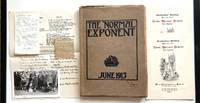
1913réf. 12308Los Angeles: LASNS. Good. 1913. Softcover. Spotting to front cover in two places; half-inch closed split front cover bottom edge at fold near spine; 6 leaves p. 33-44 with quarter inch closed tear at foredge. Evidence of repair to rear hinge. Overall clean and solid. ; Brown wrappers with yapp edges lettered in black. Illustrated with two pages of portrait photographs of faculty twenty pages of portrait photographs of the Senior Class all but one page 16 photos each; group photographs of various clubs organizations sports teams. There are five holograph signatures on Faculty blank page two of which can be identified in the photos. On Senior Class blank there are 13 holograph signatures not including one Charlotte Newton who is pictured and underlined in ink. Also illustrated with drawings in the period style and many other ornaments and headpieces. Laid in are two folding Graduation Sunday State Normal School programs a scrap paper of holograph notes in pen notes from a sermon "1. Marriage 2. Raising Children 3. Building of a character 4. God's . As related to the family" etc. Plus a folded sheet with what appears to be a carbon manuscript of song lyrics for songs used in the graduation ceremony: "Tune Maryland My Maryland: Thou dost not falter in thy trust Normal School Old Normal School . . ." Finally: a 3.5 x 6" photograph titled in manuscript on the back" Roscoe Teachers' party - May 1945 my last year in L. A. Schools with a list of eleven names. Eleven names in pen also on the front top edge of the photo over the party attendees. Ohh! One more: 2.5" news clipping: "Provo Girl is Honored Miss Mayme Beesley . . . Of this city who has taken a course in education In the California State Normal School at Los Angeles . . ." There is a 'Mamie Beasly' next to Charlotte Newton with a pen correction of 'a' to 'e' on the last name. ; 4to 11" - 13" tall; 149 pages . LASNS paperback
1929réf. 49297Fort Sill OK: Field Artillery School 1929. Presumed First Edition First printing. Wraps. Good. 37 pages. Wraps. Illustrations. Study Questions. Text somewhat darkened. Some wear to cover edges. Topics covered include the panoramic sight the French sight M-1901 the bracket fuze setter M 1916 the hand fuze setters model 1912 and model 1913 gunner's quadrant model of 1918 and study questions. The United States Army Field Artillery School USAFAS trains Field Artillery Soldiers and Marines in tactics techniques and procedures for the employment of fire support systems in support of the maneuver commander. The school further develops leaders who are tactically and technically proficient develops and refines warfighting doctrine and designs units capable of winning on future battlefields. The mission of the Field Artillery is to destroy neutralize or suppress the enemy by cannon rocket or missile fire and to help integrate all fire support assets into combined arms operations. The U.S. Army Field Artillery School trains educates and develops agile adaptive and decisive Soldiers and leaders; engages collaborates and partners with other branches sister-services and other fires warfighting function proponents; and serves as the lead agent for the development of Field Artillery doctrine concepts and dissemination of that knowledge to the Field Artillery force in support of commanders operating across the full spectrum of conflict and in the joint inter-organizational and multinational JIM environment. The U.S. Army Field Artillery enables maneuver commanders to dominate in Unified Land Operations through effective targeting integration and delivery of fires. The origin of USAFAS can be traced back to the 1907 reorganization of the Artillery Corps and to the character of Fort Sill at that time. The 1907 reorganization created Coast and Field Artillery Branches. In the process of this reorganization the Field Artillery was deprived of its former home at Fort Monroe Virginia. Fort Sill was considered the best location for a Field Artillery school since its 15000-acre reservation allowed ample room for target practice and its great variety of terrain offered an excellent area for different types of tactical training. In addition the post had already assumed the character of the home of artillery with a large number of artillery units assigned. The first artillery school the US Army School of Fire was organized in 1911 by Captain Dan Tyler Moore. With the exception of a brief period in 1916 when school troops were used as frontier security guards during the Mexican Revolution the School has operated and expanded continuously. Hundreds of thousands of artillerymen have been trained at Fort Sill since the inception of the School. After the United States entered World War I the school reopened in 1917 with Col. William J. Snow as commandant. The Field Artillery School as it was now known added more courses. After the war school commandants began a long-range program to improve field artillery mobility gunnery and equipment. Budget cuts during the 1920s hampered their efforts but innovative directors of the Gunnery Department with support from school commandants helped modernize the field artillery in the 1930s. Maj. Carlos Brewer director of the Gunnery Department in the late 1920s and early 1930s introduced new fire direction techniques so fire support would be more responsive. Maj. Orlando Ward the next department director developed the fire direction center to centralize command and control and to facilitate massing fire. Brewer Ward and Lt. Col. H.L.C. Jones encouraged replacing horses with motor vehicles for moving field artillery guns. During World War II to best use new long-range guns and better response times the Field Artillery School championed the use of air observation to control artillery fires. The War Department approved organic field artillery air observation in 1942. The artillery air observers adjusted massed fire and performed liaison reconnaissance and other missions during the war. Following the war the school adapted to the atomic age and the Cold War. The War Department consolidated all artillery training and developments under the U.S. Army Artillery Center at Fort Sill in 1946. At that time the center included the Artillery School the Antiaircraft and Guided Missile School at Fort Bliss Texas and the Coast Artillery School at Fort Scott Calif. Field Artillery School paperback
réf. 46883624like new. unknown