17 744 résultats
réf. 2596812 November 1935. On letterhead of the Guildhall School of Music John Carpenter Street Victoria Embankment EC4 London. See his entry in the Oxford DNB. 1p 4to. In fair condition lightly aged and creased with one short closed tear to an edge. Folded twice for postage. The salutation ‘My dear old “Phil” ’ and the signature ‘Landon Ronald’ are in autograph the rest typed. The recipient is ‘Dr. W. J. Phillips / “Kelvinside” / Malcolm Road / Wimbledon S.W.’ He sends a ‘thousand thanks’ for Phillips’s ‘delightful telegram’. ‘It was indeed good of you to think of us all down here. It was a great night and one I shall never forget. / Of course I missed you horribly but was comforted with the idea all the time that you are getting on so well.’ He ends in the hope that Phillips will take care of his ‘dear self’ and will inform him ‘from time to time about your progress’. He signs himself ‘Your affectionate old friend’. 12 November 1935. On letterhead of the Guildhall School of Music, John Carpenter Street, Victoria Embankment, EC4 [London]. unknown
réf. 26018‘Blackheath / May 14th. 1888.’. Bailey’s entry in the Oxford DNB describes the ‘remarkable popularity’ of the second edition of Festus in America: ‘seventeen ‘editions’ of a version pirated in Boston were called for in the first nine years and it was also reprinted numerous times in Philadelphia Louisville and New York. Bailey became something of a 'lion' for visiting Americans of the transcendental stamp’ with Hawthorne visiting in the 1850s. 1p 8vo. On brittle woodpulp paper now discoloured with chipping to edges resulting in loss to the word ‘Festus’ at the head and with closed tears to the two folds. Attempts have been made to strengthen the reverse. Good clear bold signature ‘Ph J Bailey’ unaffected by any damage. Headed ‘From “Festus”’ and beginning: ‘Amid all life’s quests’ and with the final line ‘Each other’s rights and wrongs. Thus are we men.’ ‘Blackheath / May 14th. 1888.’ unknown
réf. H8699Folder measures 13 inches tall housing 13 bifoliae of calligraphed poems we think done for one of Arnold Bank's advanced classes in calligraphy that he taught at Carnegie Tech CMU. Good with some stains to front label and quite a bit of foxing to first and last of the poems less so to the rest of the poems but each with some minor degree of foxing; done on parchment style paper the poems are pretty good some rhyming all very evocative. The last poem "Pittsburgh as Paper-weight" makes it evident that the author is local; beyond that we don't know much. Unsigned. unknown

1844réf. z07626Boston: Sabbath School Society 1844. Hardcover. Good. 1844. Hardcover measures 4.5 by 3 inches in quarter leather with marbled boards. 32ppwith engraved frontis. Good. Upper corner of boards and pages heavily foxed. Evidence of bookplate removal on pastedown. No copies listed currently on OCLC. Digital images available upon request. Sabbath School Society hardcover
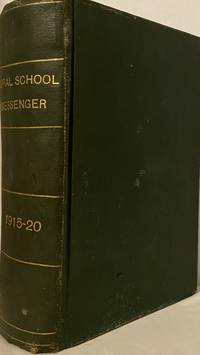
1915réf. 001162Kirksville Missouri: First District Normal School 1915. Green hardcover gilt lettering on spine. Bound copies of The Rural School Messenger magazine Kirksville MO. in the binding: January 1915 - March 1920 in green buckram binding. Gilt lettering on spine. Issues: For 1915: January 15; February 15; March-April; May; September; October; November-December. For 1916: January; February; March-April; September; October; November; December. For 1917: January-February; March-April; September; November. For 1918: January; March; September; November. For 1919: January; March; September; October 23 1919 and October 24 1919. For 1920: January; March. Condition of binding: Some wear scattered discoloration spots/rubbing light shelving wear; lightly age darken darker at spine. Endpapers: Writing on first pastedown endpaper; old signature of previous owner and embossed name/university on first free endpaper same embossment on rear free endpaper. Previous owner's embossed/blind stamping on p. 37 of February 1917 issue; lightly toned scattered signs of old moisture stains/minor foxing; few pencil notations in March 1920 issue; bottom corner missing on p. 136; else overall magazines are Very Good. Book covers developing/managing a rural school: gardening agriculture farm management best crops health ideas games for children theatrical play costumes scenery stage makeup medical school room layouts heating teaching equipment water supply mental deficiency infectious diseases building a sanitary toilet etc. Very insightful educational - a wealth of information great for country/rural schools home schoolers educators and parents of school children. Note: We are a well-established well-respected ethical book dealer in business since 1991. We describe the condition of our books thoroughly and honestly so you'll know exactly what you will be receiving when you order. We ship promptly. . Hard Cover. Very Good. First District Normal School Hardcover
2003réf. 1271Large thin softcover with 88 pages. AS NEW Allegany High School paperback
1991réf. mon0000193638LEXISNEXIS 1/1/1991 12:00:01 AM. paperback. New. 0.5000 in x 9.4000 in x 6.4000 in. LEXISNEXIS paperback
1998réf. 2-0750622415Elsevier Science & Technology 1998. Paperback. New. 3rd edition. 768 pages. 8.27x11.69x0.75 inches. Elsevier Science & Technology paperback
2019réf. 217771Beijing.: Central Party School Press. Reprint. 2019. Numerous colour photographic illustrations of interviewees groups of people locations certificates documents and so on relating to Xi Jinping's life in the period1982 - 85. 365pp text in simplified Chinese characters 23.3 x 16.5. Very good copy. The preface states that Zhengding was where Xi Jinping began his political career serving on the County Party Committee while working there for over 3 years 1982 - 85. The book consists of oral accounts of the people with whom he worked at that time which were originally published in "The Study Times". It is a sequel to the interview record "Xi Jinping's Seven Years as an Educated Youth". . Central Party School Press unknown
réf. 19658Letter from Rochester Kent ; 28 September 1872. Note from St. Margarets; 20 April 1877. Both items in fair condition aged and worn. ONE: ALS. 28 September 1872. 4pp. 12mo. Bifolium. He is 'taking somewhat of a liberty' but having heard 'that you are parting with one of your Clerks' says 'a word in favour of a person in whom for many reasons I take a great interest & of whom you & your Brothers may know something. I mean Mr. Prothero for many years an Inmate of my House & an Assistant Master in the School'. Prothero was 'for some years a Clerk in the County Court' but 'is obliged from paucity of business to leave it & is now out of employment'. He praises him as 'a most respectable & trustworthy man in whom you might place the most implicit confidence. He writes an admirable hand & his experience in the County Court would I should think fit him for the work of a Solicitors Orffice'. He has a wife and three children. TWO: ANS. 20 April 1877. 1p. 12mo. He thanks him for his 'friendly communication' and hopes to 'have the pleasure of meeting some members of the Corporation as proposed on Monday next'. The beginning of Raymond Postgate's review in the Spectator 31 August 1961 of Ralph Arnold's book sums up the story of 'The Whiston Matter': 'In the year 1842 the Reverend Robert Whiston was appointed by the Dean and Chapter to be headmaster of Rochester Cathedral grammar school which had been so badly run by the previous headmaster that only one pupil was left in it. He brought with him his own private pupils and his brother-in-law as assistant master; he was successful and popular and the school was ' quickly full again. The dean and chapter were pleased with him. They soon ceased to be. Whiston investigated the affairs of the cathedral and discovered that the statutes were being broken on a large scale. … The chapter had pocketed the proceeds of these malversations and he wrote to it requiring it to reform and using fairly peremptory terms. But they would not—they were by now very rich. … When Whiston published the facts about Rochester and other cathedrals in a pamphlet it was not very surprising that they dismissed him. … The story of his subsequent fight and victory against the cathedral reads like an excerpt from Trollope or Dickens; it was in fact used by both of them as raw material.' Letter from Rochester [ Kent ]; 28 September 1872. Note from St. Margarets; 20 April 1877. unknown
réf. 19657Rochester Kent ; 16 June 1854. 3pp. 4to. Bifolium. In fair condition aged and worn. Docketed: 'Application of the Revd. Robt. Whiston to make Dock & use Creek'. Written in a hurried hand. Begins: 'Gentlemen I have received a Notice from the Town Clerk informing me that I have acted illegally & infringed upon your Rights by endorsing & converting into a Dock without your License a portion of a Creek of the River Medway described in this Notice Permit me then to assure you that in doing so I acted without any knowledge that I was committing an illegal action & I now beg to express my regret for having done so in any way or to any extent.' He assures them that he is 'desirous of doing whatever may be right & proper in the matter' and asks them to grant him a license for which he will be happy to pay a 'reasonable amount'. He hopes concludes 'in the hope that you will not compel me to close an establishment which furnishes some employment in & contributes somewhat to the trade of the City'. The beginning of Raymond Postgate's review in the Spectator 31 August 1961 of Ralph Arnold's book sums up the story of 'The Whiston Matter': 'In the year 1842 the Reverend Robert Whiston was appointed by the Dean and Chapter to be headmaster of Rochester Cathedral grammar school which had been so badly run by the previous headmaster that only one pupil was left in it. He brought with him his own private pupils and his brother-in-law as assistant master; he was successful and popular and the school was ' quickly full again. The dean and chapter were pleased with him. They soon ceased to be. Whiston investigated the affairs of the cathedral and discovered that the statutes were being broken on a large scale. … The chapter had pocketed the proceeds of these malversations and he wrote to it requiring it to reform and using fairly peremptory terms. But they would not—they were by now very rich. … When Whiston published the facts about Rochester and other cathedrals in a pamphlet it was not very surprising that they dismissed him. … The story of his subsequent light and victory against the cathedral reads like an excerpt from Trollope or Dickens; it was in fact used by both of them as raw material.' Rochester [ Kent ]; 16 June 1854. unknown
réf. 226339 June 1823. Vol. I. No. 7. 'Communications to be addressed post paid to the Editors at C. Handy's 50 Brewer Street Golden Square.'. 8pp 12mo paginated 45-52. Unbound on two loose bifoliums one inserted inside the other. Drophead title. A short-lived periodical.The main piece in prose is titled 'A Dream' signed in type with an upside-down 'R.' and runs from the first page to the head of p.48; the rest of that page carries the first of three poems 'Stanzas on the Restoration of Charles II.' The other contributions are: 'On the Discontent of Mankind' by 'H.' pp.49-50; the second of the three poems 'Elegiac Verses on the Death of a Beloved Wife.' 'To be continued.' pp.50-51; 'On Absolute Dominion' by 'S.P.Q.R.' p.51-52; the last of the three poems 'Lines under a Statue of Cupid' by 'P.' p.52. At foot of p.52: 'Notice to Correspondents.' The only other reference to this periodical on OCLC JISC Library Hub Discover is to a run of the first eleven numbers beginning in 1823 in the British Library. 9 June 1823. Vol. I. No. 7. 'Communications to be addressed (post paid) to the Editors, at C. Handy's, 50, Brewer Street, Golden unknown
réf. 22576June 1864. Fulham Palace S.W. London. For information on Tait see her entry in the Oxford DNB. 1p 12mo. Aged worn and lightly stained. The fact that Tait was able to produce a lithographed circular for such a minor purpose indicates her resources. The only words in the document in Tait's genuine autograph are the interpolated 'now & in Jan'. The circular reads: 'My dear Sir I am very anxious to secure the election of Harriet Amelia Johnson to St Ann's School Brixton. Her father who was well known to us died this year leaving a widow and three children unprovided for. Can you kindly help me with your votes now & in Jan Believe me to be Yours very faithfully Catharine Tait'. June 1864. Fulham Palace S.W. [London]. unknown
réf. 22724Boston: Hubbard W. Swett & Co. 128 Washington Street. 1859. William White Printer 4 Spring Lane. The 'Rebellion' was precipitated by the whipping of Thomas J. Whall a Catholic boy at the Eliot School for refusing to recite the ten commandments in the Protestant King James translation. It resulted in the creation of nationwide Catholic parochial schools. 29pp 8vo. Saddle-stitched pamphlet with uncut edges and without wraps. On aged and worn paper. In double column and small print. A transcript of the closing arguments in the case without editorial interpolation. Scarce. No other copy traced of original edition. Boston: Hubbard W. Swett & Co., 128 Washington Street. 1859. [William White, Printer, 4 Spring Lane.] paperback
réf. 23710862like new. unknown
2004réf. 028-01-00170HARCOURT SCHOOL PUBLISHERS 2004-09-01. Paperback. Very Good. Pages Unused! Book Leaves in 1 Business Day or Less! Leaves Same Day if Received by 2 pm EST! Cover has shelf wear. Contents Unused. Very Good. HARCOURT SCHOOL PUBLISHERS paperback
1954réf. 2508150006Woodrow Wilson High School 1954. First Edition. Hardcover. Very Good. Bound in publisher's cloth. Hardcover. Good binding and cover. Barbara Burton's copy. Woodrow Wilson High School hardcover
réf. 18258On letterhead of Trinity Lodge Cambridge. 24 August 1904. 4pp. 12mo. Bifolium. In good condition with light signs of age. At head of first page: 'Dictated'. He refers him to 'the second Chapter of the book I published some years ago which deals with the subject on which we conversed the other night at dinner'. The amanuensis has written that the chapter deals with 'some of the reflections on matters ethereal' and Butler has corrected this to 'some reflections on matters Aesthetical'. Butler has also added the words 'more clearly though I fear' after the word 'puts' in the following: 'it puts at much greater length'. He ends by stating that he is sending him a copy of his 'Address'. On letterhead of Trinity Lodge, Cambridge. 24 August 1904. unknown
réf. 3563239541.Ghardcover. Good. Access codes and supplements are not guaranteed with used items. May be an ex-library book. hardcover
réf. 1024684849.Ghardcover. Good. Access codes and supplements are not guaranteed with used items. May be an ex-library book. hardcover
1943réf. 86335Holabird Ordnance Depot Baltimore MD: Ordnance Automotive School Holabird Ordnance Depot 1943. Presumed First Edition First printing. Single sheet printed on both sides. Good. Single sheet format is approximately 8.5 inches by 11 inches. Rare surviving copy of a WWII military training graduation program. The sheet has been folded in half. The front side is the event program. The graduation took place in Classroom # 1 on Saturday April 17 1943. There was an Invocation Introductory Remarks by Lt. Col. C. E. Kelly Ordnance Department Assistant Commandant. Then there was a Graduation Address by General H. J. Lawes Ordnance Department Commandant. This was followed by Presentation of Diploma and then a Benediction. The other side has a list of graduates which included 1 Captain 6 First Lieutenants and 17 Second Lieutenants. Except for one member of the Infantry the graduates were either members of the Corps of Engineers or the Coast Artillery Corps. Among the graduates were:Lloyd Griffith CAC; Ramon Fobes CAC; George Lenoir CAC; Robert Lyon CAC; Frederick Randolph CAC; James Rhodes CAC; Lawrence Robinson CAC; Joseph Ansel CE; Cornelius Butner CE; William Clever CE; Harold Crawley CE; Robert Dolan CE; Edward Doyle CE; James Fickes CE; Arvid Holderson CE; Gregory Kraus CE; Chester Lamb CE; Howard Morrison CE; Harold O'Connell CAC; Lloyd Rinehard CE; Edward Smith CE; Richard Snyder CAC Alfred Turney CE; and Samuel Walker Inf. Named for Quartermaster General Samuel B. Holabird 1826-1907 and established in 1917 as the Army's first motor transport training center and depot. Supplied World War I American Expeditionary Forces in France with Detroit-made vehicles. Fort Holabird was located in the southeast corner of Baltimore and northwest of the suburban developments of Dundalk Maryland in surrounding Baltimore County fronting on Holabird Avenue between Broening Highway and Dundalk Avenue. From 1941 until the end of World War II the military installation grew to include approximately 350 acres and 286 buildings. After the Second World War activities at Fort Holabird were curtailed and portions of the property were transferred from the Army. The city later developed the land in succeeding years into the Fort Holabird Industrial Park. During World War I Holabird supplied the American Expeditionary Forces in France with Detroit-made vehicles. Thousands of military personnel were trained there to drive and repair automobiles and trucks. In 1918 or after in became home to the Holabird Quartermaster Depot. By 1920 a center for the research and development of military vehicles was established at Holabird. Here the now-famous Jeep was tested and refined. In 1942 it was renamed as Holabird Ordnance Depot. Ordnance Automotive School Holabird Ordnance Depot unknown
1941réf. 86279Aberdeen Proving Ground MD: The Ordnance School 1941. Presumed First Edition First printing thus. Four-hole punched and held together with two two pronged clips. Good. Format is approximately 8 inches by 13 inches four-hole punched with two two pronged clips holding the text together. 3iii-vii 250 pages. Three pages of errata sheets. 18 appendices. 50 Figures. Printed single-sided only. Cover worn torn and soiled with some page wear and soiling noted. Pencil marks and notations on cover and some pages. The major portion of this text appears to be an early version of Field Manual No. 9-10 The Ordnance Company -Medium Maintenance; The Ordnance Battalion--Maintenance. It was apparently expected to be issued in July 1941 the the date of issue is blank. FM 9-10 Ordnance Field Manual Ordnance Field Maintenance was published on April 20 1942. There are substantial differences between this text and what was officially published as FM 9-10. This publication was intended solely for use as an Ordnance School text for instruction purposes only. It was not intended for general distribution to agencies or personnel outside the Ordnance training Center at Aberdeen Proving ground Md. It is reasonable to conclude that this instructional text was also a draft text for what would eventually become FM 9-10 and that the experience gained in its use at The Ordnance School contributed to the development of material changes. As such then this early version not labeled as a draft provides a significant and perhaps unique insight into the development of Ordnance doctrine training and practice at the Company and Battalion level at the time when the United States entered the Second World War. One page on Machine Gun Repairs to the M9197A1 laid in. The purpose of this manual was to present a coordinated and complete picture of the problem of ordnance field maintenance together with a logical solution of that problem. While this manual will be found to be helpful as a reference for operation of the maintenance organizations in garrison it was intended primarily as a guide for use in field operations. There are included in the various parts of this manual a discussion of a typical ordnance field shop and a method of conducting operations; a discussion of details pertaining to a typical maintenance company; and discussions of particular problems in ordnance field maintenance as they are encountered and solved. Except where obviously necessary in the interests of uniformity throughout all ordnance service it is not intended that this manual shall impose unnecessary restrictions on the imagination and initiative of ordnance personnel responsible for the operation of the units covered by this manual. On the contrary it is intended that the thoughts and imagination of such personnel will be stimulated to evolve more satisfactory solutions to the problems of ordnance field service. The organization of ordnance maintenance in the field army is based on the principle of progressive increases in available maintenance facilities from front to rear. The equipment and personnel assigned to each echelon are designed to carry the normal load of that echelon plus a certain peak load of the subordinate echelons. In Part I. The Ordnance Company - Medium Maintenance there are Chapters on General; Organization and Equipment; Operations; Duties of Individuals; and Administrative Details. Part II. The Ordnance Battalion Maintenance has Chapters on General and Operations. A list of appendices follow and are in turn followed by the list of Figures. There are specific discussions of ordnance weapons and vehicles and materiel. There is significant discussion of the inspection of ordnance materiel especially ammunition. The Ordnance School unknown
1931réf. 82680Los Angeles: Westlake School for Girls c1931. Presumed First Edition First printing. Single sheet printed on one side with thin protective sheet with small tears and envelop. Good. Format is approximately 9.25 inches by 7 inches. This sheet has been folded in half resulting in four panels. Only the front panel has text. This has been provisionally dated as 1931 as that is the first year after the school moved to North Faring Road where June 10th fell on a Wednesday. Text reads: Miss de Laguna and Miss Vance request the honor of your presence at the Commencement Exercises of the Westlake School for Girls on Wednesday morning June tenth at eleven o'clock seven hundred North Faring Road. This invitation was addressed to Miss Louisa Sterry believed to be the daughter of Norman S. Sterry famed California lawyer. Frederica De Laguna Frederica b. around 1874 was an American educator. Born in Oakland California c. 1874; Stanford AB 1896 Columbia AM 1904. With Jessica Smith Vance founded Westlake School for Girls in Los Angeles 1904 and Westlake Junior College 1924 later known as Holmby College. Founded by Jessica Smith Vance and Frederica de Laguna as a small college preparatory school in 1904 it was initially located opposite of Westlake Park. In 1917 the school moved to Westmoreland Avenue in the Wilshire district and then to the location at 700 N. Faring Road.; Originally constructed in 1928 in the Spanish Colonial Revival style the dormitory and complete campus were designed by Arthur Kelly and his associate Joe Estep. The design included exterior stucco walls tiled roofs and arches as decorative motifs towers corbel tables and wrought-iron balconies. The demolition of much of the campus followed the 1971 Sylmar earthquake. The Westlake School for Girls was established in 1904 by Jessica Smith Vance and Frederica de Laguna in what is now downtown Los Angeles California as an exclusively female institution offering both elementary and secondary education. It was so-named because it was near Westlake Park now known as MacArthur Park. At the time the school was a for-profit alternative to the already-established Marlborough School which had been established as a non-profit before the turn of the century. It moved to its present-day campus located on North Faring Road in Holmby Hills California in 1927. The school was purchased by Sydney Temple whose daughter Helen Temple Dickinson was headmistress until 1966 when Westlake became a non-profit institution. Shirley Temple the child star attended the school as did many who became notables in acting athletics and other endeavors Astronaut Sally Ride was an alumnae. The Temple family owned the school until 1977 with Dickinson serving in an ex officio capacity. In 1968 Westlake became exclusively a secondary school. The Harvard School for Boys was established in 1900 by Grenville C. Emery as a military academy on the site of a barley field located at the corner of Western Avenue and Sixteenth Street now Venice Boulevard in Los Angeles California. Emery was originally from Boston and around 1900 he wrote to Harvard University to ask permission to use the Harvard name for his new secondary school and received permission from the university's then-President Charles W. Eliot. As both schools continued to grow in size towards the late 1980s and as gender exclusivity became less of a factor both in the schools' reputations and desirability the trustees of both Harvard and Westlake effectuated a merger in 1989. The two institutions had long been de facto sister schools and interacted socially. Complete integration and coeducation began in 1991. Westlake School for Girls unknown
1917réf. 81627Marion County West Virginia: Fairmont High School sponsored by James Otis Watson 1917. Presumed First Edition First printing. Hardcover. Good. 362 4 pages. Cover has some wear and soiling. This was prepared under the supervision and direction of Dora Lee Newman Head of the Department of History in the High School. Includes Illustrations Class Roll Foreword The Source of Our Inspiration Legend of the Monongahela. Also includes chapters on The Land Beyond the Mountains; The Native Races; Trails and Transportation; Establishing a New Frontier; Means of Defense; The Struggle for the Mastery; Homes and Homelife; Before the Rule of Fashion; Manners and Customs; Remedies and Superstitions; Songs and Legends; Locating Mills; The Beginning of Other Industries; Organization and Government; The Early Churches; Schools and First Newspapers and the Coming of the Railroad. The writing of the history of pioneer Marion County has been of great interest and profit to the Class and has awakened a most wholesome interest throughout the county. It has kindled a friendly family feeling tracing back our ancestors to neighbors who lived side by side through perils and privations. It has impressed upon our minds the rugged sterling valor and virtues that secured for us the comforts and refinements of which they never even dreamed. James Otis Watson was the real pioneer in West Virginia coal development. After the first railroad was constructed through Fairmont in 1852 he immediately opened up the first coal mine called the American Coal Company. In 1852 Mr. Watson built a suspension bridge over the waters of the Monongahela River connecting Fairmont and Palatine. Marion County proper was created by an act of the Virginia Assembly on January 14 1842 from parts of Monongalia and Harrison Counties and was named after General Francis Marion of American Revolutionary War fame known to history as "The Swamp Fox". The year 1852 was an eventful time in Marion County's history starting with the great flood on Monday April 5. Heavy rains the day before caused the Monongahela and West Fork Rivers to rise at rate of 5 feet per hour until Tuesday afternoon when the water reached 43 feet above its normal level. The greatest damage was sustained on the West Fork where over 40 houses and buildings were swept away and floated past Fairmont. The flood also damaged the railroad which was in the final stages of being completed. By June 23 the Baltimore and Ohio Railroad was completed connecting Fairmont to the west and to large cities in the east like Baltimore. The railroad required the building of a bridge to cross the Monongahela River about 1 mile west of Fairmont. This was achieved by building a massive iron bridge spanning 650 feet and lifted 35 feet above the water. The third major event of the year 1852 was the completion of the Fairmont and Palatine suspension bridge connecting Fairmont to what was then the town of Palatine. The bridge was built under the direction of James L. Randolph assistant engineer of the Baltimore and Ohio Railroad; at a cost of about thirty thousand dollars. Marion was one of fifty Virginia counties that were admitted to the Union as the state of West Virginia on June 20 1863 at the height of the Civil War. In the months that followed West Virginia's counties were divided into civil townships with the intention of encouraging local government. This proved impractical in the heavily rural state and in 1872 the townships were converted into magisterial districts. Marion County was divided into seven districts: Fairmont Grant Lincoln Mannington Paw Paw Union and Winfield. Fairmont High School (sponsored by James Otis Watson) hardcover
1962réf. 79714Fort Eustis VA: U. S. Army Transportation School 1962. Presumed First Edition First printing. Wraps. Good. Five-hole punched and stapled on left side. Format is approximately 6.5 inches by 9.5 inches. iii 1 166 pages. Figures. Tables. References. Shipping Data. Cover has some wear and soiling. The text discusses the impact of tactical and logistical operations upon the world-wide distribution of special ammunition and other components of Army missile weapon systems. It describes the distribution sequence defines the control exercised over the distribution system and identifies the responsibilities of logistic agencies. the text also describes the transportation requirement transportation service responsibilities and the capabilities and limitations of the several modes of transportation. The text includes a discussion of the characteristics of special ammunition and transportability data applicable to all components of army missile weapon systems. The Special Text discusses: Distribution with CONUS Distribution within Oversea Commands The Transportation Environment and Transportation System Characteristics. Appendix I is References. Appendix II is the Safe Handling of explosives and other dangerous articles and protection of classified shipments. Appendix III is Characteristics and Properties of Propellants. Appendix IV is Army Missile Systems Component Shipping Data and this includes sections on Hawk Nike-Ajax Nike-Hercules Little John LaCrosse Sergeant Honest John Corporal Pershing Redstone SS-10 SS-11 Redeye Mauler Shillelagh Nike-Zeus Davy Crockett and a Quick reference complete round loading and shipping guide. On 31 July 1942 the Department of War recognized the need for a single manager of Army transportation and created a new branch the Transportation Corps. Since the Revolutionary War Army transportation had evolved through two branches the Quartermaster Corps and the Corps of Engineers. The demands of World War I made the Army first realize its need for a single manager for military transportation. So began an evolution over the next quarter century that culminated in the birth of the Transportation Corps during the opening months of World War II. The War Department directed the Quartermaster Corps to transfer the functions and responsibilities of truck and aviation units to the Transportation Corps by General Orders No. 77 on 24 July 1946. The same year the Transportation School consolidated all training except for drivers at Fort Eustis Virginia because of its intermodal rail and sea capability. In 1950 the Army turned over its deep-draft ships to the Military Sealift Command so the Army no longer had the largest navy in the United States military. That same year Brigadier General William B. Bunker convinced the Chief of Transportation Major General Frank S. Besson Jr. of the importance of helicopters in logistics. As a result in May the Army approved the organization of five helicopter companies with the first the 6th Transportation Company Helicopter activated in July 1952. In 1954 the Engineer Corps turned its landing craft over to the Transportation Corps making the Transportation Corps responsible for all modes of Army transportation. Coincidentally the Navy lifted the size limit on Army watercraft allowing the Army to build landing craft utility LCUs. This led the Transportation Corps to activate the 159th Boat Battalion. The Soviet threat against Europe provided the peacetime Army an enemy to plan against. In anticipation of the needs of the Army the Chief of Transportation directed and championed the development of military transportation. Contingency planners assumed the worst-case scenario in which the Soviet Union would use its bombers or worse yet its nuclear arsenal to destroy the fixed ports in France thus severing the vital lines of communication at their European end. This contingency required the Army to rely heavily on over-the-beach operations. The Transportation Corps is a Force Sustainment branch of the U.S. Army headquartered is now at Fort Lee Virginia and is responsible for the movement of personnel and matériel by truck rail air and sea. The Transportation Corps provides a full spectrum of transportation capabilities at the tactical operational and strategic levels of war. The Transportation School trains Soldiers to operate and maintain Army tactical trucks material handling equipment and watercraft. The school trains Transportation Operations Traffic Management Convoy Operations Cargo Transfer Cargo Documentation Movement Control Operation of Heavy Material Handling Equipment Sailing and Maintenance of Army Vessels and Unloading Aircraft Ships Railcars and Trucks. U. S. Army Transportation School paperback