Si Ma De SchoolBiblio.com
35 158 résultats
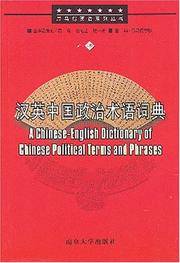
2000réf. 0800836Nanjing University Press 2000-01-01. paperback. Used - Good. Ship out in 2 business day And Fast shipping Free Tracking number will be provided after the shipment.Paperback. Number of Pages: 428 Pages. Language: Simplified Chinese-English. Includes 11.000 political terms in China among which current after Revolution of 1911 political terms take the majority. For example. san fan yun dong Movement Against the Three Evils. liang ge wen ming two types of civilization. fen pei tu di distribution of land. Every entry has pinyin and English translations. Satisfaction guaranteedor money back. Nanjing University Press paperback
2000réf. 0800834Nanjing University Press 2000-01-01. paperback. Used - Good. Ship out in 2 business day And Fast shipping Free Tracking number will be provided after the shipment.Paperback. Number of Pages: 524 Pages. Language: Simplified Chinese-English. The dictionary includes more than 20.000 entries. covering the following subjects and areas: Chinese philosophy. politics. military. sports. economics. law. ethnics. religion. education. medical science. aesthetics. pharmacology. literature and arts. drama. linguistics. architecture. sociology. customs. science and technology. industry and agriculture. business. traffic. crafts and arts. etc. Every entry has pinyin a. Satisfaction guaranteedor money back. Nanjing University Press paperback
190048p. + Plus frontis. Numerous text drawings. Age stained. Inked presentation to John Bitzel from Thomas Chapel Sunday School, Christmas 1904. 8vo. Original full cloth binding with color pictorial front cover of two small boys and a full basket of peaches. Spine and rear cover partially marred with red staining. Fine books from earlier Christmas seasons make great gifts today. CHRISTMAS/W67
réf. B9781425522803Paperback / softback. New. paperback
2001réf. Q-0153143983HARCOURT SCHOOL PUBLISHERS 2001-01-01. Paperback. New. New. In shrink wrap. Looks like an interesting title! HARCOURT SCHOOL PUBLISHERS paperback
1997réf. 297585PN. New. 1997. . Soft Cover. Date is original print. This is a reprint edition . PN paperback
1884réf. 29652Various places 1884-1958. Fine original condition. 73 letters from 43 correspondents including Lore Crewe Lord Curzon F. S. Kenyon Prince Louis of Battenberg Edward Lyttleton Lord Napier Lord Roseberry Sir Charles Trevelyan and others mostly pertaining to school events. unknown
1957réf. 1805090043Denver PA: Cocalico Union Pa. High School 1957. Hardcover. Very Good. 9 volume set. Vietnam era Includes the years: 1957 1958 1959 1960 1961 1962 1965 1966 1968. Denver Lancaster County Pennsylvania. Highschool Year Book. Bound in original cloth. The 1957 issue has astronomical space cover in honor of the Soviet Union launch of Sputnik 1. The 1962 issue has a chip missing from the spine. Two volumes 1965-1966 have been signed by members of the class to RoxAnn Showalter. All the other volumes are in excellent shape. Cocalico Union, Pa. High School hardcover
réf. 1332980023.Gpaperback. Good. Access codes and supplements are not guaranteed with used items. May be an ex-library book. paperback
réf. 12931TN: Fundcraft Publishing. 1st Edition. Soft Cover. BOOK NEAR FINE. 8vo - over 7¾"" - 9¾"" tall. Spiral Bound A very clean attractive copy. No previous owner markings. 242 pages. Indexed. Fundcraft Publishing paperback
1965réf. 2111902156201093Gakushu Kenkyusha 1965. Soft Cover. Fine. Number of pages: 191 pages Size: A5 size Gakushu Kenkyusha paperback
1975réf. 2111902160604583Kokusho Publishing Association 1975. Soft Cover. Fine. The book is in fine condition. Kokusho Publishing Association paperback
1975réf. 2111902161002303Kokusho Publishing Association 1975. Soft Cover. Fine. Number of pages: 207p Map size: 22cm Kokusho Publishing Association paperback
1839réf. 31245AB1839. London Longman & Co. 1839. Small Octavo 105 cm x 18 cm. XXVIII 269 3 pages. Hardcover / Original full eather with gilt ornament to spine. In protective Mylar. Very good condition with only minor signs of wear. Several manuscript entries by preowners of the William Splaine - Family in Bandon. hardcover
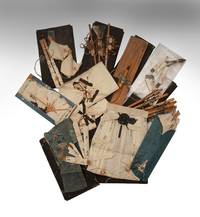
réf. 7079Various formats and sizes. Japan: ca. 1787-96. The Ogasawara School å°ç¬ åŽŸæµ founded in the 12th century laid the foundations of etiquette for the aristocratic and samurai classes throughout Japan for many centuries. The school specialized in teaching horsemanship archery mounted archery and samurai etiquette on and off the battlefield. Over the centuries the school transitioned itself to focus on a system of courtly manners along with skills in archery for ceremonial rituals. The school continues today supervised by the 31st generation leader Kiyotada Ogasawara. The Imperial House of Japan uses Ogasawara etiquette. This fascinating collection is made up of miniature models or samples of materials and objects required and used at formal Ogasawara events in the late 18th century as well as a number of manuscript documents. We begin with ten black paper four-sided folding envelopes each labeled and containing the items below. These envelopes are constructed of thick but flexible paper with string ties. The labels describe the contents of each envelope and have seals and signatures of either “Hisanobu” or “Nobumichi”: 1. a miniature paper model of a horo which is worn on the back of a samurai’s armor. Our horo is made of folded paper with a silk brocade adornment. Measurements are given in manuscript. With this is a model of the bag to carry the horo; 2. miniature fabric samples of pleated trousers a man’s formal kimono and vest along with samples of neatly wrapped objects elaborately tied which were to be carried. They include a sword a fan and a bolt of precious brocade; 3. three miniature tachi swords each for a specific occasion. Our sample tachi are made of wood and have thick thread attachments; 4. two kinds of miniature torches taimatsu along with their holders; 5. a most remarkable miniature wooden bow mounted on a wooden board. A quiver utsubo again made of wood and decorated in gold brocade is also mounted; 6. Six miniature examples of maku gushi poles to hold banners. They are joined by ropes here represented by fine decorative cord; 7. four samples of real hair cut off and tied during genpuku the Japanese coming-of-age ceremony; 8. a miniature target — an opened fan — mounted on a board for the hikime-no-gi the archery ritual; 9. two elaborate folded paper model sacks to protect the bow when it rains kasa yumi bukuro; and 10. seven strands of hay and 12 braided strips of paper kamioki which were used in ceremonies for two- and three-year-old aristocratic and samurai male children. These are accompanied by 69 examples of very complex ceremonial origami or origata. Origata as compared to recreational origami was developed amongst the higher class of samurai who stressed formal manners and a sense of decorum. It is a method of how to wrap gifts with very precious handmade papers used for gift-giving and ceremonies in order to maintain sound human relations. Each is folded in it own way and labeled with its intended contents for example an obi belt confectioneries a brush for calligraphy shark skin for sword handles incense wood a tooth-cleaning stick a fan Chinese silk thread hair ornaments gold dust sumi ink cake perfume belts for inner garments face powder tabi socks various sizes of fine writing paper feathers from hawks and cranes for arrows etc. Some examples of highly complex ornamental ties are also present. Finally there are about 20 contemporary letters all concerned with various aspects of Ogasawara etiquette including gastronomic matters. There is a stiff thick-paper folded cover for a gift signed “Ogasawara Taizen taifu Nagamasa.” There is also a packet of miscellaneous related papers. In fine condition and a remarkable survival. unknown
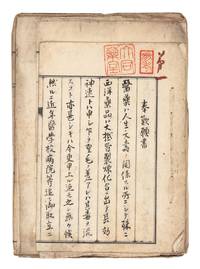
réf. 8335Ca. 52 leaves. 8vo leaves of various sizes but averaging 285 x 203 mm. written on paper with pre-printed columns stitched together. Osaka: 1872-75. The Osaka Medical School today part of Osaka University and one of the finest medical schools in Japan traces its origins and traditions to the Tekijuku an academy founded by Koan Ogata 1810-63 which based its teaching on Western learning mostly from the Dutch. The newly created Meiji government established the Osaka Medical School in 1869 with the help of Ogata’s son Koreyoshi and the Dutch doctor Antonius Franciscus Bauduin 1822-85. This was part of the massive effort in Japan to modernize. The “Fundamental Code of Education” promulgated in 1872 established a centralized national educational system which concentrated on Western science and technology. These manuscripts document the transformation of the medical school into a national institution. Details regarding rules for employees contracts for foreign employees including salaries housing matters of finance terms of severance standards regarding the making of pharmaceutical products lists of foreign employees correspondence with government officials etc. In fine condition. With the seal of the Shinto priest and physician Yasuaki or Kosho Nakano 1874-1947 and his private library Daido Yakushitsu. He was a major collector of kanpo the Japanese study of traditional Chinese medicine calligraphy maps illustrated scrolls waka poetry and paintings. unknown
réf. 67-01091Morris Press. Hardcover. New. . Morris Press hardcover
1989réf. 4754ml1989. Soft Cover. Good. Gd. condition . Recipes for Appetizers Breads and Rolls Cakes and Cookies Desserts Main Dishes . Soups and Salads Enchiladas Quesadillas Tostadas tamales Masa Meatballs Seafood.TK1 paperback
1860réf. 061517London: John Mason City Road 1860. Not Given . Hardcover. Near Fine. Large Octavo. Engraved Frontispiece. LONDON : 1860. Large print; words copy. 769 hymns and supplementary hymns 525-769 numbered. Double-column text. Engraved Frontispiece portrait of John Wesley. Hardback. Black full Morocco-leather. Blind triple-ruled spine with raised bands. Gilt lettered. Gilt and black embossed panelled boards. Gilt dentelles. All edges gilt. Original yellow end-papers. Bright tight and clean. Neat owner name Mr & Mrs Clulow to fly-leaf. No internal markings. Owner bookplate removed leaving feint shape. Nice and attractive copy. NEAR FINE. Four Indexes. FINE BINDING Will be well-packed for posting/shipping. Lg.8vo. London: John Mason City Road. FINE BINDING John Mason, City Road hardcover
réf. 8335Ca. 52 leaves. 8vo leaves of various sizes but averaging 285 x 203 mm. written on paper with pre-printed columns stitched together. Osaka: 1872-75. The Osaka Medical School today part of Osaka University and one of the finest medical schools in Japan traces its origins and traditions to the Tekijuku an academy founded by Koan Ogata 1810-63 which based its teaching on Western learning mostly from the Dutch. The newly created Meiji government established the Osaka Medical School in 1869 with the help of Ogata’s son Koreyoshi and the Dutch doctor Antonius Franciscus Bauduin 1822-85. This was part of the massive effort in Japan to modernize. The “Fundamental Code of Education” promulgated in 1872 established a centralized national educational system which concentrated on Western science and technology. These manuscripts document the transformation of the medical school into a national institution. Details regarding rules for employees contracts for foreign employees including salaries housing matters of finance terms of severance standards regarding the making of pharmaceutical products lists of foreign employees correspondence with government officials etc. In fine condition. With the seal of the Shinto priest and physician Yasuaki or Kosho Nakano 1874-1947 and his private library Daido Yakushitsu. He was a major collector of kanpo the Japanese study of traditional Chinese medicine calligraphy maps illustrated scrolls waka poetry and paintings. unknown books
réf. 7079Various formats and sizes. Japan: ca. 1787-96. The Ogasawara School å°ç¬ åŽŸæµ founded in the 12th century laid the foundations of etiquette for the aristocratic and samurai classes throughout Japan for many centuries. The school specialized in teaching horsemanship archery mounted archery and samurai etiquette on and off the battlefield. Over the centuries the school transitioned itself to focus on a system of courtly manners along with skills in archery for ceremonial rituals. The school continues today supervised by the 31st generation leader Kiyotada Ogasawara. The Imperial House of Japan uses Ogasawara etiquette. This fascinating collection is made up of miniature models or samples of materials and objects required and used at formal Ogasawara events in the late 18th century as well as a number of manuscript documents. We begin with ten black paper four-sided folding envelopes each labeled and containing the items below. These envelopes are constructed of thick but flexible paper with string ties. The labels describe the contents of each envelope and have seals and signatures of either “Hisanobu” or “Nobumichi”: 1. a miniature paper model of a horo which is worn on the back of a samurai’s armor. Our horo is made of folded paper with a silk brocade adornment. Measurements are given in manuscript. With this is a model of the bag to carry the horo; 2. miniature fabric samples of pleated trousers a man’s formal kimono and vest along with samples of neatly wrapped objects elaborately tied which were to be carried. They include a sword a fan and a bolt of precious brocade; 3. three miniature tachi swords each for a specific occasion. Our sample tachi are made of wood and have thick thread attachments; 4. two kinds of miniature torches taimatsu along with their holders; 5. a most remarkable miniature wooden bow mounted on a wooden board. A quiver utsubo again made of wood and decorated in gold brocade is also mounted; 6. Six miniature examples of maku gushi poles to hold banners. They are joined by ropes here represented by fine decorative cord; 7. four samples of real hair cut off and tied during genpuku the Japanese coming-of-age ceremony; 8. a miniature target — an opened fan — mounted on a board for the hikime-no-gi the archery ritual; 9. two elaborate folded paper model sacks to protect the bow when it rains kasa yumi bukuro; and 10. seven strands of hay and 12 braided strips of paper kamioki which were used in ceremonies for two- and three-year-old aristocratic and samurai male children. These are accompanied by 69 examples of very complex ceremonial origami or origata. Origata as compared to recreational origami was developed amongst the higher class of samurai who stressed formal manners and a sense of decorum. It is a method of how to wrap gifts with very precious handmade papers used for gift-giving and ceremonies in order to maintain sound human relations. Each is folded in it own way and labeled with its intended contents for example an obi belt confectioneries a brush for calligraphy shark skin for sword handles incense wood a tooth-cleaning stick a fan Chinese silk thread hair ornaments gold dust sumi ink cake perfume belts for inner garments face powder tabi socks various sizes of fine writing paper feathers from hawks and cranes for arrows etc. Some examples of highly complex ornamental ties are also present. Finally there are about 20 contemporary letters all concerned with various aspects of Ogasawara etiquette including gastronomic matters. There is a stiff thick-paper folded cover for a gift signed “Ogasawara Taizen taifu Nagamasa.” There is also a packet of miscellaneous related papers. In fine condition and a remarkable survival. unknown books
1987284 pages. Unmarked. Back cover missing, otherwise appear complete. Moderate wear. A sound copy of this pleasing compilation. Book
1972réf. 1155679Northmont High School 1972. Three volumes Fall 1971 Winter 1972 Spring 1972 within near fine slipcase. Soft cover. Fine. Quartos. Book. Northmont High School Paperback
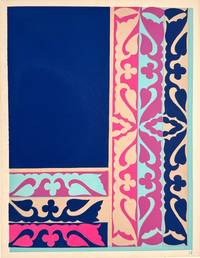
1920réf. 2598Paris 1920. Very good. Lithograph in colors on cream wove paper 13 3/4 x 10 3/4 inches 350 x 273 mm the full sheet. Plate 12 from an unidentified portfolio of decorative wallpaper motifs. In very good condition. unknown
1997réf. 299706PN. New. 1997. . Soft Cover. Date is original print. This is a reprint edition . PN paperback