509 résultats
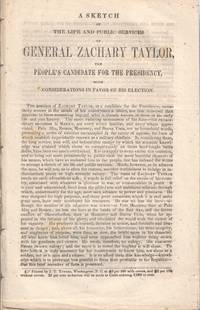
1848réf. 72681Washington DC: Printed by J. T. Towers 1848. Paperback. Very good. Paperback. 38pp. Disbound. Slightly foxed throughout else an about very good example. A pro Taylor election piece emphasizing his qualities for President. Printed by J. T. Towers paperback books
1962réf. 823381962. Wharton School. United States. Securities and Exchange Commission. A Study of Mutual Funds: Prepared for the Securities and Exchange Commission. Report of the Committee on Interstate and Foreign Commerce pursuant to section 136 of the Legislative reorganization act of 1946 Public law 601 79th Congress and House Resolution 108 87th Congress. Washington DC: U.S. Govt. Print. Off. 1962. xxxiii 595 pp. Softcover. Moderately worn and soiled with damp staining to covers. Internally clean. $15. unknown books
réf. 20786Pen and grey and brown ink grey wash on laid paper on an archival mount. Fine condition. Sheet size: 18 x 23 7/8 inches. Provenance: Dr. C.A. Pompe; G. Meijer; L. Houthakker with his collector's mark at lower right corner not in Lugt. A beautiful and very rare drawing of one of the most beautiful "Wunderkammern" of the day which later became the property of the Empress of Russia. This drawing shows the interior of the cabinet of curiosities of Catharina van Grovestins-von Schutz in the family house in The Hague. There is another earlier drawing of the same cabinet by the artist Daniel Marot the Younger 1695-1769 dated 1756 and currently in the collection of the Gemeentearchief in The Hague. This earlier drawing shows the interior just after it was completed but before the expanding collection necessitated certain improvements that are shown in the present drawing: additions include a shaped central cabinet bearing what may be a portrait bust of Catharina van Grovestins-von Schutz. Other improvements include the display shelves for taxidermy specimens that have been added between the built-in display cases and the architrave above; and the central bracketed display of coral and shells that was added above the fireplace. Catharina lady-in-waiting to Princess Anna of Orange employed the talents of the well-known naturalist and collector Arnout Vosmaer to help assemble the Cabinet. Vosmaer later commented in his memoirs that the cabinet was 'one of the most beautiful collections . covering every domain of nature" and noted that it was eventually sold to the Empress of Russia. The present drawing may perhaps have been intended as part of the successful attempt to sell the collection to the Empress The earliest cabinets were gathered together in the 16th century. They initially represented a genuine attempt to begin to understand the natural world but also came to be seen as an expression of the power and influence of the owner: the larger the 'wunderkammer' the more important the owner. They were the precursor to today's museums the most famous in England being the collection of Elias Ashmole 1617-1692. His private collection founded by the naturalist John Tradescant circa 1570-1638 was presented to Oxford University and opened to the public on 24 May 1683 as the Ashmolean Museum. One of the best known American examples was the Peale Museum founded in Philadelphia in 1784 for Charles Wilson Peale a painter and a scientist. His son Rembrandt Peale more famous today as a portrait painter subsequently established a 'branch' of the Peale Museum in Baltimore Maryland and this is now the oldest museum building in the Western hemisphere. The museum differed from the earlier more private collections in that it was always the Peales' intention to open the museum to the public. In its heyday the show included 90 specimens of mammals more than 700 bird specimens mounted in 'naturalistic' mini-dioramas a whole room of marine specimens about 4000 insects numerous minerals as well as their famous mammoth skeleton the first such display as well as scores of Peale's portraits. Cf. H. Engel Alphabetical list of Dutch Zoological Cabinets and Menageries Amsterdam: 1986; P. Fuhring Design into Art: drawings for architecture and ornament the Lodewijk Houthakker Collection London 1989 vol. II p. 761 #1102. unknown books
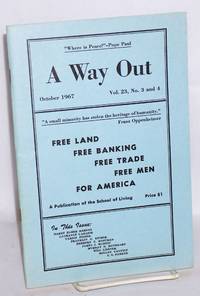
1967réf. 140029Brookville OH: The School of Living 1967. Magazine. 61p. stapled wraps 6x9 inches wraps unevenly toned front wrap lightly silverfished bottom corner dog-eared else good condition Magazine with contributions by Harry Elmer Barnes Laurance Labadie James J. Martin Vardis Fisher Holley Cantine Murray N. Rothbard and others. The School of Living unknown books
1988réf. 600284Atlantic Highlands New Jersey: Atlantic Highlands Elementary School 1988. Unbound. Fine. Stated "First Edition." Small quarto. Eight corner-stapled leaves printed rectos only. A fine copy of this sweet elementary school newspaper that prints goings-on at the school student poems and a one-page activity sheet titled "GET PUZZLED Atlantic Highlands Elementary School) unknown books
1959réf. 132252Paris: Ecole Estienne 1959. Softcover. Good inscribed by Krol. spine cracked dent to rear. White wraps with color illustration. 4 color and several bw plates. Text in French. Ecole Estienne paperback books
1963réf. 198523Brooklyn New York: The Pratt Adlib Press / Pratt Institute 1963. Paperback. Good jacket is scuffed & edge-worn; there is a stamp from the Newark Museum at the front; interior is clean. . White & brown illustrated gate-fold jacket w/ swiss bound book of 14 color & bw plates. All 14 plates are present. Plates remain sharp and bright. A lovely beautifully designed edition. The Pratt Adlib Press / Pratt Institute paperback books
1963réf. 189148New York: The Pratt Adlib Press / Pratt Institute 1963. Softcover. Good jacket highly scuffed & edge-worn. front paper cover of bound-in book has ~5inch tear to front & separating from textblock; majority of bound-in book has separated from textblock glue having aged & cracked. white & brown illustrated gate-fold jacket w/ swiss bound book of 14 color & bw plates. All 14 plates are present. Plates remain sharp and bright. A lovely beautifully designed edition. The Pratt Adlib Press / Pratt Institute paperback books
1961réf. 198526Brooklyn New York: Illustration Department of the Art School Pratt Institute 1961. Number 173 of 250. Paperback. Good Wraps are edgeworn/scuffed/smudged; stamps from newark museum on wraps; textblock edges are toned/scuffed/smudged; interior is lightly toned but clean; binding is solid. Orange black and white illustrated wraps with orange lettering; unpaginated; richly illustrated. Incredible collection of student woodcuts etchings and engravings. Illustration Department of the Art School, Pratt Institute paperback books
1961réf. 198525Brooklyn New York: Illustration Department of the Art School Pratt Institute 1961. Number 181 of 300. Paperback. Good Wraps are edgeworn/scuffed/smudged; stamps from newark museum on wraps; textblock edges are toned/scuffed/smudged; interior is lightly toned but clean; binding is solid. Orange black and white illustrated wraps with grey lettering; unpaginated; richly illustrated. Incredible collection of student woodcuts etchings and engravings. Illustration Department of the Art School, Pratt Institute paperback books
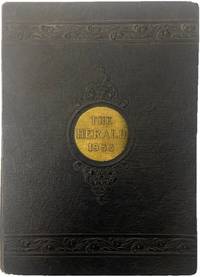
1950réf. 45335Washington DC: H.G. Roebuck Company 1950. Very Good. Washington DC: H.G. Roebuck Company 1950. First Edition. Quarto 29cm; 156pp. Photographic boards with white text along spine; photographic endsheets. Black-and-white photographs throughout. Boards lightly bumped and scuffed especially at corners. Binding sound. Textblock and endsheets toned; interior pages remain clean. Former owner’s name appears at first fixed endsheet; classmate and faculty signatures throughout. Very Good. Yearbook for the private Catholic high school in Washington DC the oldest boys’ school in the District. Find inside cheeky captions well-oiled hair and patterned ties indicative of the style of the time as well as advertisements for numerous local businesses. Among these businesses is A. Litteri a local Italian grocery store that remains open today. Though Washington DC was designated as a city in 1790 Congress did not hold session in the Capitol building until 1800. Thus 1950 marked the city’s sesquicentennial year as the seat of American government. This Gonzaga yearbook celebrates the growth of Catholic education in the District during that period featuring brief write-ups on Georgetown University Catholic University St. John’s College High School Trinity College and Archbishop Carroll High School which opened its doors the following year. “From a struggling little school in a struggling little city our Gonzaga has matured to its present position as the largest Catholic high school in the Nation’s Capitol” writes Father Gargan President. Laid-in is the former owner’s acceptance letter to Georgetown University. H.G. Roebuck Company unknown books
1928réf. 182801928. Randall Studio. University of Michigan Medical School student and faculty portrait 1928 documents racial and gender inclusion within a major American medical school during a period when African American and women physicians remained sharply underrepresented in medical education. The portrait supports research into professional training race gender and institutional access in interwar medicine especially because the group includes one African American man and four women among 82 students. The University of Michigan had admitted women beginning in 1870 and Sophia B. Jones became its first African American woman to earn a medical degree in 1885 giving this later class portrait added relevance within the school's longer history of medical education and inclusion. Silver gelatin photograph by Randall Studio. 1928. 22 x 18 inches. Mounted to photographer's board. The large-format image shows 82 students and faculty arranged in individual portrait format including four female students and one African American student. The scale and formal presentation identify the photograph as an institutional record of a medical cohort rather than a casual class image. The photograph captures a visibly limited but historically meaningful presence of women and an African American student in elite medical training before mid-century civil rights reforms. Small 1.5-inch tear to one corner barely affecting one of the 82 images; very small chips to side and top edges not affecting text or images; very good. Strong visual evidence of race gender and professional formation at the University of Michigan Medical School in 1928. unknown books
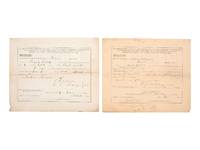
1888réf. 215331888. Rowan County Board of Education teacher pay vouchers 1888 and 1892 documenting African American education within the segregated public school system of post-Reconstruction North Carolina. The vouchers record segregated public education and its funding mechanisms through payments to Black teachers approved at the county level. These documents show how African American educators were paid through formally structured systems requiring countersignature by the county superintendent and approval by district committee members. Two manuscript teacher salary vouchers each approximately 8.5 x 7 inches and written on both sides. The first dated March 26 1888 authorizes payment of $30.00 to Maggie Locke for teaching in "School District No. 4 Rowan County for Colored Race" covering the period from January 3 to March 2 1888 in Atwell Township. The printed form specifies that payment is contingent upon countersignature by the county superintendent and approval by at least two district committee members establishing formal oversight procedures. The verso bears Locke's signed receipt dated March 27 1888 acknowledging payment from county treasurer J. M. McCubbins. The second voucher dated January 16 1892 records payment of $25.00 to Isaac Kerns for teaching in "School District No. 2 Salisbury & No. 2 Prov. Rowan County for Colored Race" with similar requirements for administrative approval prior to disbursement. The verso includes Kerns's signed acknowledgment of payment. Both documents explicitly designate the schools as serving the "Colored Race" indicating the formalized racial segregation embedded within the educational system. These vouchers document the operation of segregated schooling in the decades following the Civil War when African American education expanded under conditions of systemic underfunding and institutional control. The requirement for multiple authorizations before payment records the bureaucratic regulation of Black teachers' labor while the recorded wages provide quantitative evidence for comparative study of compensation disparities. Produced during a period when access to education for African Americans remained contested these documents contribute to research on Reconstruction-era legacies Jim Crow governance and the role of Black educators in sustaining community institutions. Light wear minor creasing and typical manuscript handling marks; overall very good condition. Documentary record of the administrative structure and lived realities of segregated education in the late nineteenth-century South. unknown books
1933réf. 175261933. Archive of Walter Johnson's 1933 Atlantic City High School yearbook and related reunion materials documents African American student life within a formally integrated but socially segregated New Jersey public school during the Great Depression. Johnson a graduating senior in 1933 appears in a yearbook extensively inscribed by classmates whose messages span both commencement year and later reunions preserving contemporaneous peer networks across four decades. Created in a city where redlining confined most Black residents to Atlantic City's Northside neighborhood the volume and accompanying ephemera situate one student's educational experience within broader histories of African American urban life public schooling in the Jim Crow North Depression-era youth culture and Black alumni civic organization. Archive dates primarily from 1933 with later additions from 1978 and subsequent reunion years; ten items total. Central volume is Atlantic City High School yearbook published by Westbrook Publishing Company Philadelphia 1933 183 pages hardcover 10.5 x 7.75 inches extensively inscribed throughout by classmates in 1933 and again at the 45th reunion in 1978. The school's divisions are organized by Technical Classical and Commercial tracks with individual portrait sections and personal profile prompts listing favorite activities characteristic phrases and anticipated futures including one sardonic entry predicting a destination "In the ranks of the unemployed." Accompanying materials include a June 16 1933 telegram in original envelope from the Negro Alumni Associates of Atlantic City High School congratulating Johnson on his graduation; two reunion pamphlets from the 45th and 50th reunions; several envelopes including one bearing a lengthy handwritten note from reunion organizer Ben Ginsburg; and two printed advertisements for Atlantic Coast Amusement Enterprises promoting comedians and song-and-dance acts associated with Atlantic City's boardwalk entertainment industry. Produced in the depths of the Great Depression the yearbook captures a graduating class confronting economic uncertainty while articulating ambition humor and collective identity. Its Art Deco stylistic elements and commercial advertising reflect Atlantic City's resort economy during its interwar peak while the presence of a formal Negro Alumni organization in 1933 demonstrates structured African American institutional engagement within a multiracial public school setting. Later reunion annotations underscore continuity of alumni networks across five decades. Light general wear consistent with age; inscriptions legible and internally clean; associated ephemera well preserved with minor handling wear. Overall very good condition. Cohesive documentation of African American secondary education alumni organization and urban community formation in Depression-era New Jersey extending into the late twentieth century. unknown books
réf. B238385-2Praha 2007. 126 2pp. Prof. illus. in color. 4to. Wraps. Praha, 2007. paperback books
1800réf. 26715Canton 1800. Large 4to. 15 x 12 1/2 inches. 141 watercolours on thin paper nearly all captioned in ink in Chinese in the lower right corner each tipped to a sheet of wove paper. Mid-nineteenth century citron half morocco over marbled paper covered boards spine with raised bands in six compartments lettered in gilt in the second compartment the others with a repeat decoration in gilt marbled edges Provenance: Annie Pearson Viscountess Cowdray née Cass 1860-1932 Dunecht House Aberdeenshire. An extraordinary album of early Chinese export watercolours of the highest quality. Beginning in the late 18th century centred on the treaty port of Canton there existed a thriving trade in ethnographical watercolours executed by local Chinese artists and sold to the western merchants and travellers. The best known result of this trade is William Mason's Costume of China first published in London in 1800 which is illustrated with 60 hand-coloured aquatints adapted from a series of original watercolours by Pu-Qua of Canton. It was common for the local artists including Pu-Qua to work from a set series of models. The present album includes a number of compositions that are from the same set of models as those used by Pu-Qua but they include more detail and more of the trade-associated paraphernalia than are shown in the images as published in Mason's work. This suggests that they were not copied from Mason but were after another more detailed source or were unique compositions by the artist based on a similar series of models. Importantly these watercolours are of a uniformly higher quality than usually encountered and represent not only a wide array of occupations but also members of the highest echelon of Chinese society. The detailing on the costumes worn by these members of the royal court is breathtaking with copious use of gilt. Later collections of Chinese export watercolours were routinely executed on less expensive pith paper whereas the present watercolours are on high quality tissue and are larger in size than those typically encountered. The album represents an earlier more prestigious style of export watercolour paintings specifically meant for wealthy Europeans. These are Chinese watercolours of the highest quality designed and executed to the highest standards. The album was once owned by Annie Pearson Viscountess Cowdray Steward of Colchester and wife of Lord Weetman Dickinson Pearson 1st Viscount Cowdray. Cf. Crossman The China Trade Princeton: 1972; cf. Clunas Chinese Export Watercolours London: 1984. unknown books
réf. 2512Rochester Kent: The School 1940. . 8vo tan cloth-covered boards spine orange cloth; printed paper spine label somewhat soiled COPAC and OCLC showing only one holding with this imprint--Cambridge University Library. Interesting piece produced by the students of the school. The whole was produced "in the clawses of the Typography Department of the Medway School.during the session 1939-40. Layout and arrangement in type by P. J. Reynolds .Set by students of the "Monotype Composition classes. Head of the Dpartment Charles L. Pickering under whose direction this book was made and finished in July 1940" Rochester, Kent: [The School], 1940. hardcover books
réf. 157490hardcover. The Quinquennial Catalogue. 403pp. 8vo cloth. Cambridge: Harvard Law School 1963. vg unknown books
réf. 86003001Edo c.1700-50 n.p. Brown & silver covered boards very clean 7 double-page b.w. erotic woodblock illustrations mounted on mica flecked paper 18 x 25 cm. accordion folded illustration size: 31 x 12 cm. FIRST & ONLY UNRECORDED COPY! . . . . A VERY RARE UNRECORDED EARLY BOOK . . . A BIZARRE & UNIQUE EROTIC BOOK . . . UNSIGNED BUT CLEARLY THE WORK OF A MASTER ARTIST . BY SUKENOBU OR HIS :SCHOOL: . A unique and hitherto unfound odd and most unusual erotic book of the early-mid-18th century. One of the most bizarre erotic books ever done in Japan. . The graphically explicit work portrays men and women with genitals on their foreheads engaged in heterosexual and homosexual intercourse. There is no other book with such unusual and strange illustrations. . . THE TITLE: THE LEGEND OF AMANJAKU or AMAN NO JAKU: Chinese Title: TIAN XIE GUI YUN . THE MEANING OF AMANJAKU: Japanese Buddhist literature is abundant with variations on the theme of "Aman-No-Jaku" aka. "Amanjaku" "Manojaku" commonly understood to be a "Heavenly Evil Spirit." . This spirit or demon-like creature in Japanese folklore is usually depicted as being a male during the day and female at night. The demon is usually depicted as a kind of small Oni devil and is thought to be able to provoke a person's darkest desires and instigate him into perpetrating wicked deeds. . Amanjaku is also depicted in Chinese and Japanese mythology the AMANOJAKU is a changeling a water spirit that infiltrates the human world to play cruel tricks on people by reading their minds and twisting their requests or desires to be used against them. . The "AMANOJAKU" is also known the "Lord of the River" and in Japan serves Bishamonten one of the four Deva kings of Buddhism as a minor demon. See Wikipedia below. . In Japanese the term "Amanojaku" also refers to a person who is deliberately contradictory someone who argues for the sake of arguing or can be used in common Japanese conversation to refer to someone who is a "Perverted Demon." . THE ILLUSTRATIONS: THE BUDDHIST THEME:. This work is unusual in that the genitals of common people are located on their foreheads. A symbolist meaning can be in Buddhist concept that sex and sexual hedonism is openly on the minds of 'lay' people. The Buddha and his disciples on the other hand do not have sex organs on their foreheads meaning their organs are covered and in a different usual location. This can symbolize 'self control' over such biological energies. Devout Buddhist disregard sex as a pleasurable pastime and devote themselves to monastic focus. By contrast "lay" people are distracted with hedonistic pleasure a path away from rather than towards the Dharma or teachings of Buddhism. . In a sense this work illustrates the overwhelming force of evil or the "Amanojaku" and how it distracts people from the "Righteous Path" towards the Dharma and the ultimate goal of attaining Nirvana. It can be posited that this work is designed to give understanding to "lay" people by way of visual example of what forces direct their energies away from the Buddhist teachings in an effort to redirect them towards the "Righteous Path" and life style. . EXCEPTIONALLY RARE UNIQUE WORK: . The work is exceptionally RARE unusual and erotic there are no other example showing genitals on the foreheads of any other Japanese book cited anywhere in the bibliographic literature or record. . This work is certainly RARE in subject content and quantity. Though it was woodblock printed and unsigned which was usual for Japanese erotic works which were banned by the Shogun we have not found anything similar or recorded anywhere in the bibliography. Being woodblock printed one assumes there are other copies in existence. The average printing from woodblocks were somewhere between 100-200 copies. However in this instance no others exist. We have the strong feeling the book could have been the production of a famous Japanese illustrator and perhaps financed by a Buddhist temple again there are no known facts about this rarity. . THE EROTIC ILLUSTRATIONS: . Number 1: This work begins showing the Buddha flanked by two of his disciple monks. The title is written in four Japanese Kanji in Kambun & Chinese characters. The Buddha and his two disciples listen to two elderly Buddhist believers: one is a male he has and erect penis on his forehead. The other is a woman she has a vagina on her forehead. Neither the Buddha nor his two disciples monks show genitals on their foreheads. The couple have come to consult with the Buddha about their grievances. . Number 2: Shows a man and a woman in a Tatami matted room both wear lovely 18th century decorated Kimono. They embrace each other and are engaged in making love from their foreheads which show an erect penis and testicles inserted into the woman's forehead where her vagina is located. Adjacent to the young couple is an older woman who has become aroused by the adjacent couple's making love. The old woman uses a dildo tied to a post which she hugs while inserting the dildo into the vagina on her forehead. . Number 3: Shows a couple laying on a blanket their Kimono pulled down and opened and used as a top cover. They engage in love-making and kiss. The man has an erect penis on his forehead the woman a vagina on hers. There is some used Chirishi toilet paper just above her head on the floor used to wipe the love fluids. There is a folded package of yet unused Chirishi in readiness. Chishiri shown in Japanese Shunga erotic prints prints & paintings is an 'erotic symbol' indicative of sexual excitement with lots of love fluids flowing. Ergo the need for paper to clean up the results of erotic love-making. . Number 4 shows an adult man with an erect penis on his forehead penetrating the anus of a younger man who's smaller but erect penis is seen on his forehead as he faces his lover. The younger man has no pubic hair yet indicating his youth. . Adjacent to these two men is a woman in the next room. The door is open she is a secret voyeur of the two men. Her vagina is also on her forehead. A Shogi board and two bowls for stones is located in the front left of the illustration. Gay activities in Japanese society were accepted as a norm and were not especially unusual. However to find graphic examples in Japanese erotic books are exceptionally rare and seldom found. . Number 5: Depicts a fully clothed man on his knees he bends over a sleeping woman. He has a very large erect penis and begins to penetrate a woman with her vagina on her forehead. She is fully clothed and sleeping on a wooden "pillow" which supports her elaborate hair coiffeur. . Number 6: Depicts a lively scene of two men and a woman. One man with a very large and erect penis pulls the woman's arm toward him while she fends him off with a straight arm to his head. A second excited man also with a large and erect penis on his forehead masturbates and ejaculates in ecstasy. The woman has a vagina on her forehead. The scene is likely an intended rape of a young girl. She looks away in an effort not to allow him to pull her close enough to insert his penis into her exposed vagina. . Number 7: Illustrating a lonely old man in bed. He has an erect penis on his forehead and holds a kind of pot with a large opening. He faces down and inserts his penis into the pot for gratification. . THE TEXT: The text in Shunga erotic Japanese books & prints is often an erotic dialogue describing the erotic action. Often these words are onomatopoetic mimicking the sounds of people in orgasm or making comments about making love or the pleasure and good feelings. The size and hardness of the penis or the flavor and the juices of the vagina and its supple feelings of euphoria when engaged in love-making. All wear 18thcentury period Kimono. . MODE AND FASHION OF THE MID-18TH CENTURY: The room furnishing and Kimono of the participants in this work all wear 18th century period Kimono with period decorations. The style of Kimono and room screens reflect this period. . BINDING AND MOUNTING: Binding: The book has probably been rebound sometime after the 1750's with a more recent thin brown decorated paper with a silver chrysanthemum and a Mon family crest with gold and black on both front and rear covers. Each cover has a distinctly different kind of illustration but of the same theme. The corners and edges are a bit worn some loss to the paper as usual for a work from this period. . Mounting: At an earlier time each page was expertly mounted on a stiff Washi hand-made Japanese paper into an accordion folded book. Each illustration is bordered with a rare and stunning crushed oyster-shell powder mixed with rice-glue and overlaid on the border paper. The stunning effect is a rare shimmering pearl-like color and hue with a remarkable effect. This rare and largely unknown effect has been used for print backgrounds by some of the later masters. . This was no ordinary mounting and appropriate for an exceptionally and most unusual RARE book ! . Contents: By and large the contents are clean solid with a two old worm holes for the first 6 of 7 pages. These are small and towards the edge and does not detract from the overall quality of the illustration. On page 7 there are a few center margin old minor worm holes. All of these have been restored when the prints were laid down on the thick Washi paper creating book format. The work is otherwise solid and firm. There are a few 'rubs' on the old Washi paper which was made from very soft Kozo fibers common to any item of this period on this on handmade papers of the period. . CONDITION OF THE WOODBLOCK PRINTS: . These are very early black and white woodcut prints. Each print has an excellent and vivid impression key blocks are black and superbly printed with strong images. The paper is old and has the patina of paper from that age the usual minor mild surface rubbing or thumbing in the lower corners which is common. . We tend to be overly critical of any flaws found on our books and believe it is better to overly describe rather than avoid such discussion any imperfections. Suffice to say by and large this is an excellent item in very nice condition something that any collector or museum would be proud to own. Please review photos posted to our website. . R A R I T Y OF SUBJECT: The placement of the genitals on the forehead gives one a lot of room to theorize on the meaning of such artistic expression. In our 50 years of experience in dealing Japanese woodblock printed books and painted original art this is the first and only example with such imaginative and symbolist expression. With the beginning of the work showing the Buddha and his two disciples lacking any genitals on their foreheads one can simply assume that in a Buddhist way they have given up carnal desire as represented by common people who's foreheads display genitals perhaps meaning that sex is on their minds or they simply view others as sexual objects eager to make love and engage in carnal thoughts and activities. Obviously seeing an erect penis on some man whiles others see what he thinks and feels is an insight to his innermost thoughts and desires. In all cases in this book the men all show an erect penis. The women are a bit more difficult to fathom. Their vaginas are simply visible on their foreheads and no fluids are visible or other evidence of their carnal desire or sexually excited stated. All of the men have public hair adjacent to their sex organs while all women are lacking any pubic hair completely. This is an erotic symbolism giving full view to women's genitals. . "BANNED" or "PROHIBITED" BOOKS: Shun Pon Haru Bon: In the case of this item it is very likely that it was printed in a much smaller discreet quantity than the 200 copies possible off the blocks. Due to the "banned" nature of such books there is no date publisher nor place cited. One is simply left to determine the date and artist by stylistic analysis. It is well-known that during the Tokugawa period 1603-1868 erotic prints and books were "BANNED" or "PROHIBITED" by decree of the Shogun. One of the influencing factors was that during this period some Shoguns were changing their views and being influenced by Christians who entered Japan during this period. The Shogun did not want foreigners and Jesuit missionaries to think that Japan was a crass and base nation. Naturally foreigners soon learned that prostitution was rampant and so this strange logic from the Shogun never had much affect on the Christians and surely not on the Japanese. . The Shogun enforced severe punishments for persons involved in drawing printing carving blocks and publishing erotic books and prints. With out the "Kiwame" or censor's approval seal all such items were "Banned" outright by the Shogun decree. . While these "Prohibited" books and prints were widely circulated in an "underground" society there are ample examples of famous artists taking on commissions to produce erotic books and prints fun or profit. The record and bibliography is loaded with these examples. "Banning" such erotic works simply meant that the number printed were limited to smaller numbers and distribution was done under the table discretely circulating such books privately among collectors. During these times it was not necessary for artists to sign their such artistic creations by-and-large the population had a very good idea who the artist was by being familiar with their style and other works it was simply a "public secret" who the artist was. Often the artist poked fun at the Shogun with political jokes and assumed names to confound any chance of being discovered by the authorities. . Over the centuries this knowledge decreased and is now the domain of the art historian or scholar to identify and determine the actual artist. Stylistic analysis remains the standard method for unsigned works. . THE ARTIST/SCHOOLS: While there are no signatures or seals indicating the artist's name or even his alternate Go studio name we believe this work is part of the "Primitives and First Century of Ukiyo-e School 1660-1765" period. See Lane below. The women's coiffeur is very similar to those found in this period as well as the drawing style technique and genre. It is this cataloger's opinion that this work was likely the creation of one of the Moronobu School masters. Perhaps done by Sukenobu Yoshikiyo Morishige Sugimura Moronobu Kiyonobu Masanobu or others from this period. We believe this work was likely done from around 1710-1750. It was also likely that it was done by one of the artists listed below. . LIKELY ARTIST ATTRIBUTION: . MORONOBU SUKENOBU SCHOOL: Nishikawa Sukenobu 1671 -August 20 1750 often called simply "Sukenobu" was a Japanese printmaker from Kyoto. He was unusual for a Ukiyo-e in being based in the imperial capital of Kyoto. He did prints of actors but gained note for his works concerning women. His Hyakunin Joro Shinasadame: Appreciating 100 Women in two volumes published in 1723 depicted women of all classes from the empress to prostitutes and received favorable results His Hyakunin Joro Shinasadame: Appreciating 100 women in two volumes published in 1723 depicted women of all classes from the empress to prostitutes and received favorable results Leading members of this school were: Nishikawa Sukenobu the founder; Nishikawa Suketada; Kawashima Nobukiyo; Nishikawa Terunobu; and Takagi Sadatake. . NISHIKAWA MORONOBU SCHOOL: Nishikawa Moronobu 1618-July 25 1694 was a Japanese painter and printmaker known for his advancement of the Ukiyo-e woodcut style starting in the 1670s. Leading members of the MORONOBU school were: Nishikawa Moronobu the founder; Hishikawa Morofusa; Hishikawa Moroyoshi; Hishikawa Moronaga; Hishikawa Moroshige; Hishikawa Morohira; and Tamazaki Ryujo. . BIBLIOGRAPHY: . This title is NOT listed in any of the below resources: SHIBUI Kiyoshi. UKIYO-E NAISHI. BIBLIOGRAPHY OF JAPANESE EROTIC ILLUSTRATED WOODBLOCK PRINTED BOOKS. H. KERLEN. CATALOGUE OF PRE-MEIJI JAPANESE BOOKS & MAPS IN PUBLIC COLLECTIONS IN THE NETHERLANDS. Richard Lane: IMAGES FROM THE FLOATING WORLD THE JAPANESE PRINT; pages 28 40-60 show examples of the Ukiyo-e primitives 1660-1765 especially the Moronobu school pp.60-88 et al. . NOT LISTED IN: . KSM SHIBUI Kiyoshi: UKIYO-E NAISI. BIBLIOGRAPHY OF JAPANESE EROTIC ILLUSTRATED WOODBLOCK PRINTED BOOKS. Modern Reading: UKIYO-E NAISHI KERLEN H.: CATALOGUE OF PRE-MEIJI JAPANESE BOOKS & MAPS IN PUBLIC COLLECTIONS IN THE NETHERLANDS. Not in any other usual bibliographies on Japanese E-hon woodblock printed books. . See: WIKIPEDIA:. unknown books
1933réf. 74633Boston:: Boston Cooking School Magazine Co. Very Good. 1933. Paperback. Black and white illustrations throughout. Original subscription slip laid in. Short edge tear to the covers at the base of the spine else very good in illustrated stapled wraps. . Boston Cooking School Magazine Co., paperback books
réf. 798222020. Sixteen 16 linear feet shelf space. Sixteen 16 linear feet shelf space. American Criminal Law Review. Georgetown Law School. Volumes 1 to 57 1963-2020 in 75 bound volumes with 54 no.4 in 1 softbound book. Together 76 books. Title varies: Volumes 1-9 American Criminal Law Quarterly. American Bar Association; Volumes 10-57 American Criminal Law Review. Georgetown Law School. Ex-library with property stamps shelf location labels at foot of spines and small bar code labels on lower front covers else very good. Sixteen 16 linear feet shelf space. $1500. The American Criminal Law Review ACLR is one of the nation's top-ranking criminal law journals. Its issues sit on the desk of thousands of judges academics and practitioners across the country. ACLR's mission is to serve the criminal law community by providing a forum for the best scholarship in the field. unknown books
1969réf. 92151969. Softcover. VG slight soiling to covers. Blue wraps. 48 pp. 34 bw plates. Includes a 2-page foreword by Paul Mocsanyi a catalogue of 147 drawings by 100 artists and the large bw plates. paperback books
réf. 798232020. American Journal of Criminal Law. University of Texas School of Law. Volumes 1 to 46 1972-2019 in 38 bound books Volumes 47 numbers 12 and 48 no 1 2020 in 3 paper bound volumes. Together 41 books. Ex-library with shelf location labels at foot of spines and property stamps on page edges else very good. $1750. The American Journal of Criminal Law has contributed to over four decades of articles published to promote and encourage improvement in the administration of criminal justice. It has established a respected reputation as one of the nation's longest running and most prolific legal serial publications serving as vanguard to top student-edited legal journals devoted to criminal law. unknown books
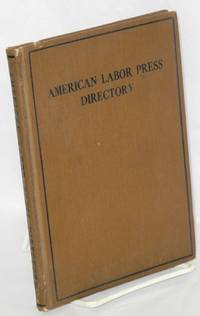
1925réf. 271469New York: Rand School of Social Sciences 1925. Hardcover. 82p. cover stained pencil marginalia else good condition. The director of the Department was Solon De Leon and the associate Nathan Fine. Includes some foreign language and leftist publications. Rand School of Social Sciences hardcover books
1925réf. 100425New York: Rand School of Social Sciences 1925. Hardcover. 82p. very good condition. The director of the Department was Solon De Leon and the associate Nathan Fine. Includes some foreign language publications and left publications. Rand School of Social Sciences hardcover books